The Demon King Editing Notes

Starting in April, I’m going to begin putting together a formal query letter for The Demon King. I’d like to participate in the #PitMad event on Twitter at the beginning of June, and I’d also like to finish up this portion of the project so that I can go ahead and get started on the next novella in the series.

If you’re interested, this is my fifty-word Twitter pitch:

The Demon King is a high fantasy adventure comedy about a garbage wizard named Balthazar who seeks to claim a magical relic sleeping within the castle of a powerful and devious princess. Until then, he would prefer to be left alone so he can read trashy romance novels in peace.

I’m going to put the first novella through another round of intense editing in May, but I just wrapped up the initial set of major edits. I’ve been fixing typos and other minor second-draft awkwardness, but I’ve also been thinking about tone and structure, as well as how I relate to the genre of fantasy in general.

Although this will change as the story progresses, the beginning of The Demon King is largely an episodic comedy that plays with tropes from epic fantasy novels and video games. Instead of exaggerating or subverting these tropes, I’m interested in looking at them from the perspective of rational adult characters who fit their assigned archetypes poorly at best.

Each chapter is prefaced by a short introductory section modeled on the sort of “lore” or “flavor text” that a player can unlock in a video game by defeating a certain number of enemies, collecting a certain number of items, and so on. This isn’t made explicitly clear in the first novella, but these intro sections are written by Balthazar, the eponymous Demon King, who is addicted to romance novels and secretly aspires to be a writer himself.

I’ve been putting a lot of work into crafting an appropriately epic language for these sections. What I’m aiming for is a needlessly fancy style that borders on purple prose without being actually poorly written or obnoxious. In addition, I’d like for readers who come back to these passages after they know more about the world of the story to be able to see where Balthazar is being ironic, where he’s being sincere, and where he’s flat-out lying.

I had initially rendered these sections in italics, but I think we can all collectively agree that italics are difficult to read. I therefore reformatted the text to remove all the italics on the chapter intro sections. I might put them back in to demonstrate that these are excerpts from “found sources” and not part of the main body of narration, but I think the character-specific perspectives of the chapters are clear enough that third-person omniscient narration stands out strongly on its own.

I also decided is that everyone is going to be represented as speaking English. If the viewpoint character – usually Balthazar – can understand what someone is saying, it won’t be accented with italics. Perhaps other characters might comment on the fact that he understands speech they don’t, but I don’t want to play games with fantasy languages. Along the same lines, I deleted all mentions of fantasy language names. Nobody needs that.

One of my most hated of all sci-fi and fantasy tropes is when a story gluts itself on constructed terminology, especially in lieu of meaningful worldbuilding. I therefore tried to keep fantasy words at an absolute minimum. The crow people (called starags, after the Gaelic word for “crow”) have their own name because it would be silly to call them “crow people,” and the concept of a “gaesh” (a type of semi-telepathic soul bond that facilitates magic sharing) is something that I want to feel strange and alien to the reader, but I think that’s it.

I leaned into this by using common words for elements that are native to the story. For example, Balthazar is not a “demon” in the usual sense of the word, the “gargoyles” who appear about halfway through the story are actually bat people, the “artifact” Balthazar is seeking is something highly unusual and specific, and the creatures that Balthazar calls “dogs” and “horses” are not dogs and horses, not by a long shot.

As the story continues, I think it’s going to be fun to play with the disconnect between what various characters take for granted as common knowledge, but I want this to remain comfortably in the realm of comedy and not venture into the territory of “who knows what secrets at what point in the story.” If anyone asks, you didn’t hear this from me, but plot is overrated. The plot of The Demon King is going to become more interesting and intricate as more layers of the story are revealed, but I want the reader to care about the characters before the plot ever becomes a concern.

That being said, there are major conflicts between the characters that have no easy resolutions, so I took care in my edits to make sure that each of the main characters states their goals clearly. Figuring out why these characters insist on pursuing these goals is the story’s primary source of forward momentum, so I’m doing my best to set up these mysteries while also providing ample clues and a healthy dose of foreshadowing.   

Hopefully the process of writing a query letter will help me clarify the themes and narrative structure so that I can continue to hone the story when I return to it in May for another set of edits.

For the time being, I’m hosting the first novella in The Demon King on AO3, and you can find it (here).

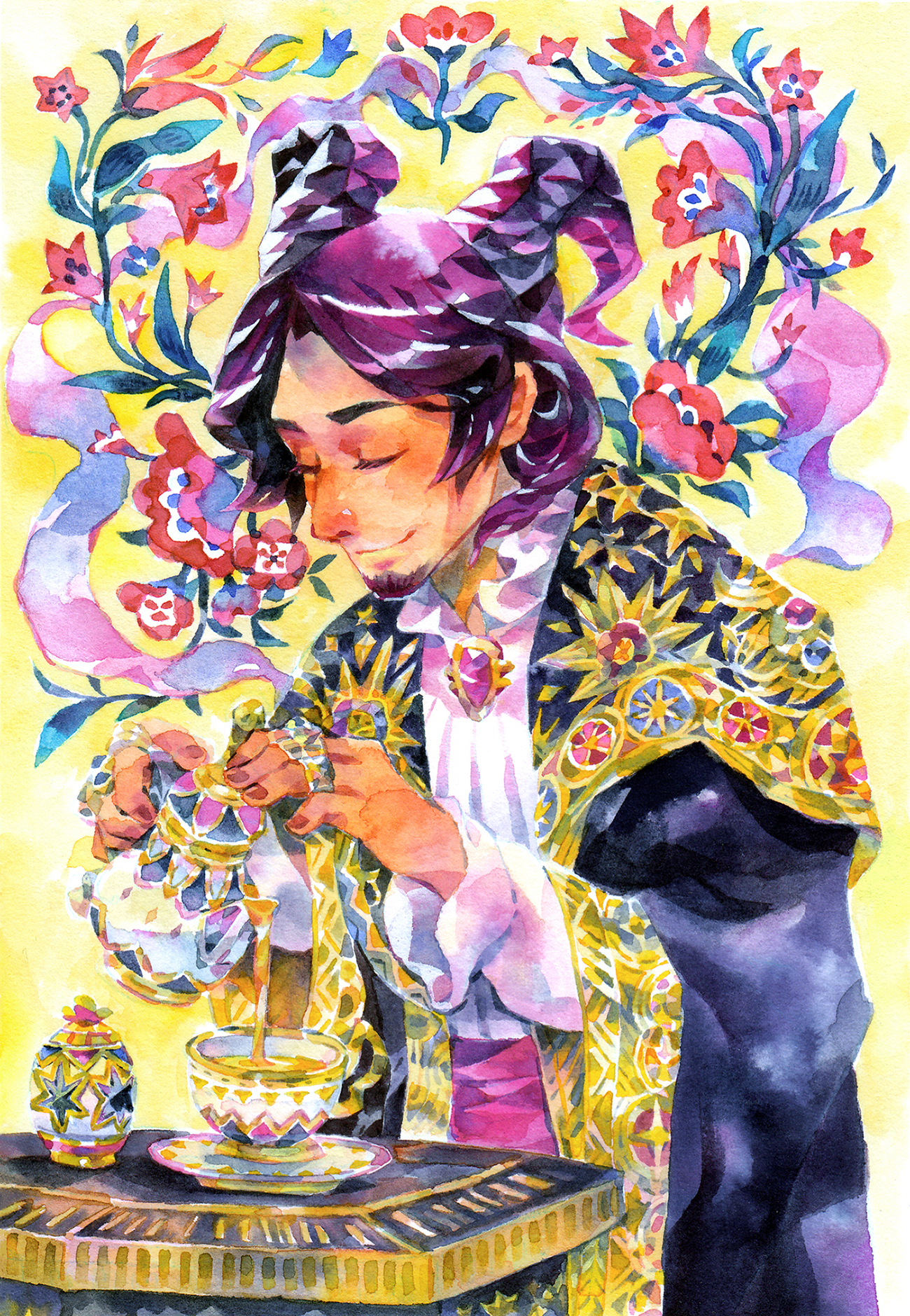
This post’s illustration of Balthazar is by the lovely @Lemonscribs on Instagram, who was kind enough to compare the character’s aesthetic to Katie O’Neill’s fantasy slice-of-life comic The Tea Dragon Society. What an apt observation, and what an incredible compliment!

Memorabilia Zine

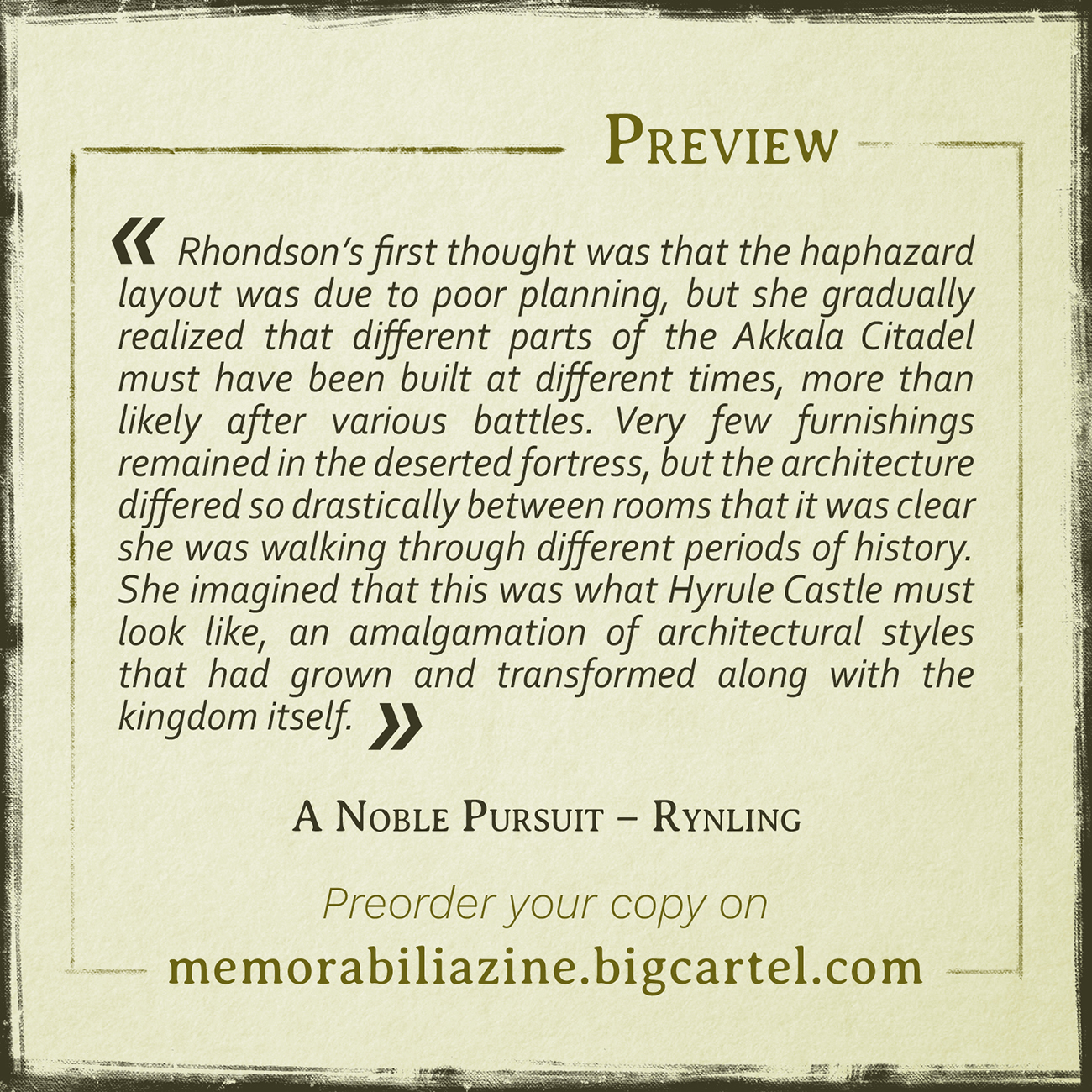
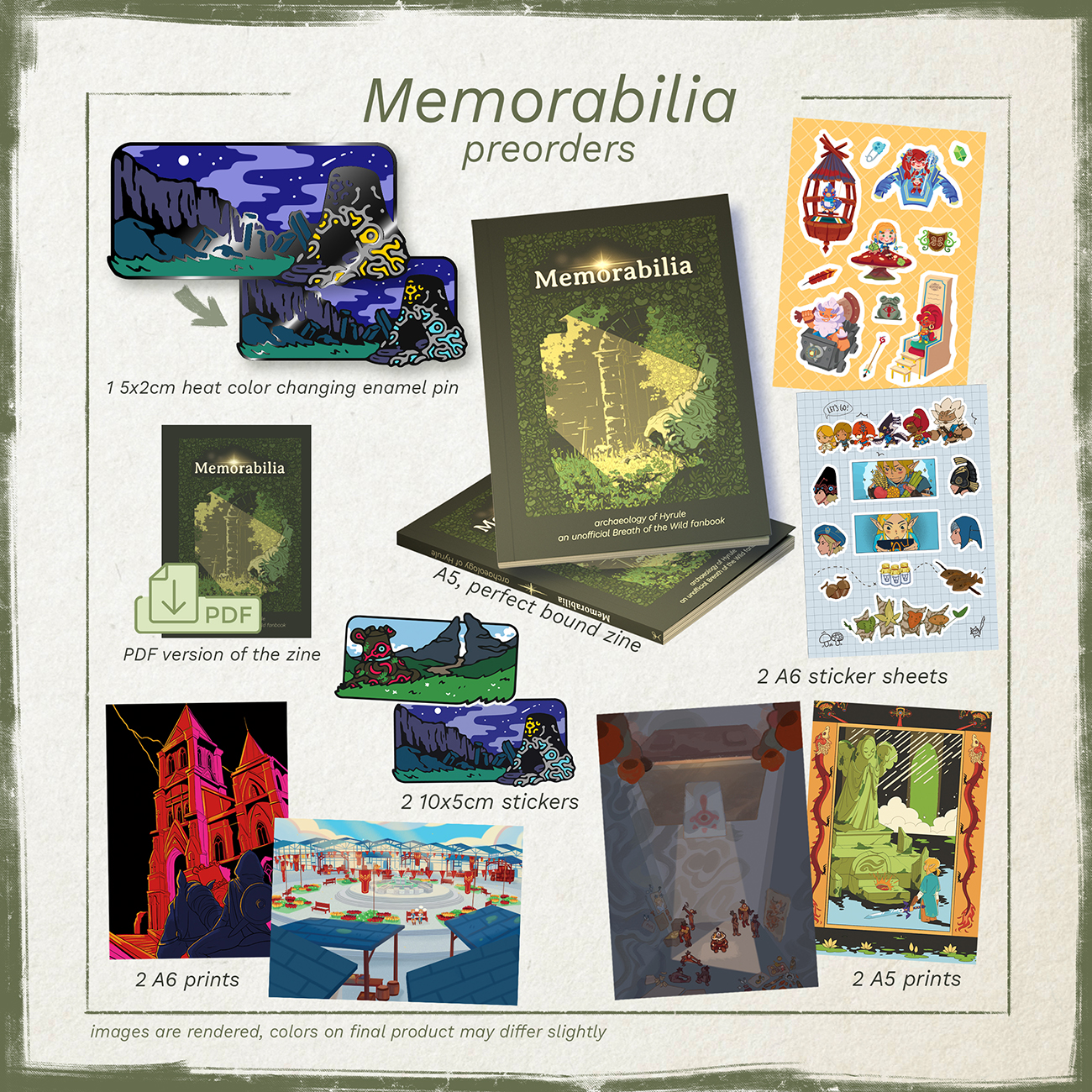
This is a preview of the short story I contributed to Memorabilia, a Legend of Zelda fanzine devoted to the archaeology and architecture of Breath of the Wild.

“A Noble Pursuit” is about Rhondson, the Gerudo tailor who moves to Tarrey Town, embarking on a husband hunt to the Akkala Citadel Ruins after Hudson goes missing. It’s a story about exploration and discovery, as well as different views of the past and hopes for the future that awaits Hyrule beyond “happily ever after.”

Pre-orders are open (here) until Sunday, March 14. This zine contains more than a hundred pages of brilliant writing and awe-inspiring art. It’s certain to be a treasure to anyone who enjoyed exploring the ruins and history of Breath of the Wild – and to anyone fascinated by the lore and environmental design in Creating a Champion.

You can check out more previews of the zine on its Twitter account, @MemorabiliaZine, and on its Tumblr account, @memorabiliazine.

Balthazar as Antagonist

The Demon King has ten chapters, and I’m a little more than halfway done with the first round of edits. I should be able to meet my projection of finishing by March 15, a month after I completed the first draft. The draft is only about 30k words, but progress is slow. The psychic damage I’m taking from finding typos and inconsistencies and unintended repetitions cannot be exaggerated.

This is only the first of five story arcs, so one of my main goals during this round of editing is to ensure that the central conflict is presented clearly and makes sense according to the somewhat limited information available to the reader. This is a short summary:

A powerful wizard named Balthazar wants to find a magical artifact hidden somewhere in the mountains between the kingdom of Whitespire and the ocean, which is highly poisonous. This artifact probably has something to do with the pure water coming down from the mountains and ensuring the prosperity of the kingdom. Balthazar doesn’t mention this artifact to his confidant Ceres, the reigning princess of Whitespire, who is presumably either unaware of its existence or unwilling to discuss it. If Balthazar does manage to find this artifact, the way he plans to use it will result in the downfall of Whitespire.

Balthazar is open with Ceres about his intentions to destroy Whitespire, but he makes no move to attack the kingdom, choosing instead to seek other magical artifacts elsewhere. It’s unclear why Balthazar is taking such a circuitous route toward his goal, but I hope the reader is able to get the sense that he’s not really the sort of person who would harm anyone if he could avoid it. He specifically doesn’t want to harm Ceres, mainly because he likes her.

There’s no significant antagonist in the story aside from Balthazar himself, as he’s going to have to do terrible things and hurt the people he cares about if he insists on achieving his goal. Unfortunately, he’s deadly serious about what he aims to do, so much so that it’s at the core of his sense of identity.

It’s embarrassing to admit this, but I’m inspired by the narrative structure of Homestuck, in which everything seems very silly and trope-driven until the reader gains a better understanding of what’s going on with the world of the story. I think it’s probably a fool’s errand to ask any given writer what themes they’re trying to express, but Balthazar has a line to the effect of “you always have a choice” that’s probably the closest thing to a statement of purpose I have regarding issues of individual freedom and dignity in the face of overwhelmingly horrible circumstances.

Also there are dick jokes, which symbolizes the fact that I like dick jokes.

In any case, once I finish this round of edits, I’m going to let the story sit for another month before writing a formal query. I’ll then do another round of edits before participating in several pitch events starting in late May. I’ll more than likely take the story offline at that point, but you can still read the draft as I edit it on AO3 (here).

Whisper of the Heart


My husband is a fan of European football, and he spends a lot of time scrolling through football Twitter under a pseudonymous throwaway account. Most of the accounts he follows are British. He got annoyed with not being able to watch the region-locked videos people linked to, so a week or two ago he set up a VPN. (If you’re curious, he uses ExpressVPN, which is $8 a month and seems to be working nicely for him.) His computer now registers as being in the UK, and he employs this for the nefarious purpose of watching a few minutes of football videos a day and being amused by the British ads that Twitter shows him (mostly for snacks).

Even though he doesn’t use it much these days, my husband never stopped paying for his Netflix account, and it recently occurred to him that, with a UK address, he could watch British Netflix.

So the other day I was standing in the kitchen waiting for tea to brew, and my husband was sitting on the couch looking at Netflix UK. I asked him if he’s found anything to watch, and he started complaining that Netflix keeps trying to show him animated movies. He told he that they look Japanese.

I was like, “Okay, yes, go on.”

And he was like, “Have you ever heard of Studio Ghibli?”

That’s when I realized that my husband had never heard of Studio Ghibli.

. . . . .

My husband enjoys movies, but he’s in his forties and comes from a country where there hasn’t been a culture of anime fandom until relatively recently. He likes the Makoto Shinkai movies we’ve watched, which he calls “documentaries about Japan,” so I thought that Whisper of the Heart would be the best Studio Ghibli movie to show him. He loved it.

I loved it too. It’s been about ten years since I last saw Whisper of the Heart, and I was not expecting it to hit as hard as it did.

Whisper of the Heart is about a middle-school girl named Shizuku who loves reading. Shizuku checks out books from the local library, and she’s noticed that there’s another kid’s name on almost all of the library borrower cards inside the covers of the books she reads. She ends up meeting this boy, who is her age but wants to study the craft of violin making in Italy instead of matriculating to high school. Inspired by his determination to follow his dream, Shizuku decides to follow her own dream of writing a fantasy novel.

Shizuku gets really absorbed in her writing. She tells a friend that she has no appetite because she’s too preoccupied with her novel, and then she eats shortbread cookies so she can stay awake while she’s writing in the evening. She stops hanging out with her friends after school so that she can fantasize about her novel while walking home. She only puts in the bare minimum of work necessary to get by at school, and her grades drop. She gets explosively irritated when people interrupt her while she’s writing. When she’s done with the story, she gets super neurotic about feedback. She cries a lot.

I was just sitting there, like, “Oh my god. Oh my god. Oh my god.”

How dare Hayao Miyazaki come into my house and call me out like this.

. . . . .

The range of what my husband does and doesn’t know about internet culture is a mystery to me, so I was surprised when he asked me if the anime girl from the Lofi Hip Hop Radio channel on YouTube is modeled on the protagonist of Whisper of the Heart.

The answer is yes, of course she is. This reference is so obvious to me that I never thought about it as something other people might not get.

Because I teach upper-level seminar classes that don’t have any formal prerequisites, I spend a lot of time thinking about what my students do and don’t already know. I treat grad students like the educated adults they are, but it can sometimes be difficult to tell with undergrads. At George Mason, most of the students were either immigrants or the children of immigrants, but they had all gone through American public high school, so I could assume that they were vaguely aware of certain cultural touchstones. At UPenn, on the other hand, the students who went to public high school in America might actually be a tiny minority. Each new microgeneration of kids is going to create its own common knowledge base regardless of where they come from, so you have to be sensitive to that, but it’s just the nature of working with a large and heterogeneous group of people that there will be all sorts of things you don’t think about.

I went to college early, and then went to grad school right after college and got my PhD fairly quickly, so I was roughly in the same generation as my students for most of the time I was teaching. I’ve gotten older, though, as people tend to do. Now it surprises me when my undergrads are genuinely curious about Harry Potter because they’ve never read the books or seen the movies. Things I just absorbed by osmosis because I grew up with them are now units of knowledge that need to be explained, and that’s wild.

I can’t help but wonder if that’s what getting older is about – being able to pick up on more cultural references because I’ve had more years in common with the people who create media. And then I wonder when the cross-over point is going to be, like, when will I stop getting references because I’m so old that younger people no longer have any culture in common with me?

In any case, Whisper of the Heart is set in the 1990s but feels timeless. It’s still just as beautiful to me now as it was when I first watched it in college. The fact that the vast majority of anime fans under the age of thirty have probably never even heard of movie feels a little weird, but it’s also kind of nice. It’s wonderful that amazing stories were created in the past, but the genius and creativity of past work doesn’t need to be a burden, as there will always be cultural room to create stories in the future that build on the past but still feel fresh and new to each generation.

The Demon King, Chapter Ten

It is a beautiful day, and you are a horrible demon king.

What would you like to do?

– Make a pot of tea.
– Water your plants.
– Read a trashy romance novel.
– Have a nice chat with your nemesis.
– Take a long nap.

This illustration is by the magical Starstray (on Instagram, Twitter, and Tumblr). The prompt I gave her was “a very powerful and very fancy wizard who is very bad at being a demon king.”

I commissioned this painting to celebrate having finished the first book of The Demon King, which I’m going to call The Temple of Everlasting Autumn. It took me four months to write this 30k-word novella, and I’m going to take another month to edit it. I’d also like to put together some book cover style graphics to showcase each of the ten chapters. After that, it will probably be time to start thinking about where the project can go in the future. In the meantime, you can read the first draft (as I gradually edit it) and check out all the comics and illustrations on AO3 (here).

The Demon King, Chapter 9

I just posted Chapter Nine of The Demon King on AO3 (here).

This is the second-to-last chapter of the novella, and it’s meant to function as a narrative climax. At the beginning of the first chapter, Balthazar casually murders someone; and, at the end of this chapter, he destroys an entire ecosystem. He has his reasons for doing what he’s doing, but I want to make it clear to the reader that he’s not fucking around. I also want to make it clear that this story is not YA fiction, so the language I used in this chapter is a bit… tumescent, let’s say.

Even though its narrative arc is complete in itself, this novella is intended to be the first part of a longer story, and I hope this sort of explosive conclusion is equally satisfying and intriguing. I think it can be understood as a natural outgrowth of the concepts that have already been introduced, but my goal is for an astute reader to come out of this chapter with a deeper curiosity about the history and metaphysics of this world.

This illustration of Balthazar is by the brilliant Jennifer So (@hellojennso on Twitter, @jennosaur on Instagram, and @jennlso on Tumblr), who designed the character. This is actually the first character design created for The Demon King (back in November 2018), and I’m excited to finally share it. Jenn nailed the character on the very first draft, and this is how I’ve pictured him since then.

Haunted Houses

Earlier this week I published my newest zine of horror-themed microfiction. Haunted Houses contains fifteen very short stories about haunted spaces and the terrible people who inhabit them. The cover art is by @QuinkyDinky, and the zine contains interior art by @irizuarts. I’ve got a listing up on Etsy (here), and I’m also promoting the zine on Twitter (here) and Instagram (here).

This zine is quite short, with each story and illustration occupying only one page. This is partially a trick of formatting, but it’s also a result of careful editing. You wouldn’t want to spend too much time in these places, after all.

I have to admit that, even though I’m categorizing this zine and the two other collections of microfiction that preceded it as “horror,” I’m on the fence about what genre my stories actually belong to.

In my mind, the genre of horror isn’t about a specific set of tropes or narrative structures. Rather, horror is characterized by the psychological and visceral sensation of unease it inspires.

I personally prefer to think of most horror, including the stories I write, as “dark fantasy,” or perhaps simply “magical realism.” I’m not easily creeped out by fiction, mainly because the real world is so lowkey awful so much of the time. As I write this, the National Guard is setting up base at a West Philadelphia Target in advance of the presidential election next week, ostensibly as a “defense” against people engaging in civic protest. There are actual tanks in the parking lot of the place I go to stock up on toilet paper, and that’s really scary. But monsters? Not so much.

I’ve always tended to identify with monsters, and not simply because so many villain characters are overtly coded as queer. Monsters are about disrupting the status quo, and I can get behind that. Postwar American horror cinema, including the slasher films of the 1970s and 1980s, is all about interlopers quietly invading small-town America and infecting people. The story behind many of these movies basically boils down to this: Can you even imagine scary things like communism and feminism and civil rights secretly gaining a foothold in our town? (Stephen King goes into fantastic detail about this in his 1981 book Danse Macabre, if you’re curious, and I think the book still reads well and holds up in many ways.)

To me, monsters aren’t scary because I am the monster, which is an uncomfortable set of life experiences to try to talk about in fiction or otherwise. There’s nothing you can specifically put your finger on regarding why people treat you the way they do, but you know there’s something a little off.

Fuck Sigmund Freud and his weird misogyny and homophobia, but I think I’m on the same page with him regarding “the uncanny” as one of the primary components of horror. Freud got a lot of things wrong in his career, but something he gets absolutely right is that it’s difficult to discuss the uncanny in concrete terms.

The uncanny doesn’t just apply to appearance, of course – social interactions and environments can be uncanny as well. If what I’m writing is horror at all, it probably falls into the subcategory of social horror, which focuses on people behaving in a way that’s almost human, but not quite. Many horror stories are cathartic, in that the status quo is threatened but ultimately restored at the end. Even if things have changed, we can feel relief in the knowledge that at least they’re getting back to normal. With social horror, however, our anxiety is never resolved, because we now understand that the status quo itself is horrifying.

It’s difficult for me to talk about the details of my identity and life in a mimetic way. When I’ve tried, it’s been my experience that people either won’t believe me, will think I’m being manipulative in an attempt to elicit undeserved sympathy, or will be put off by the political elements underlying my descriptions of the ways in which I’ve had to move through the world.

The point of the stories in Haunted Houses is not to try to explain why certain aspects of my life have been unsettling, but rather to create a sense of the uncanny in order to communicate the sense of feeling unsettled for reasons you can’t quite explain. Sometimes my stories about haunted houses are about the hidden trauma of being queer in a society that goes out of its way to create monsters; but, in the end, I just really like telling stories about strange people occupying uncomfortable places. I enjoy exploring these themes both as a reader and as a writer, and I’ve found that summoning the courage to open the door and peer into the darkness on the other side is, if not total escapism, still good spooky fun.

And right now, at this specific moment in time, I think we can all relate to the uncanny experience of feeling trapped in a haunted space, because this is our daily life – we live here now.

Malice

(The above illustration is by the amazing @mehkuno on Tumblr.)

In my writing logs, I keep mentioning the fanfic novel based on the Breath of the Wild sequel trailer that I’m writing, so I thought I’d try to describe the project. Here goes!

Story
When the long-dormant Guardians begin attacking Hyrule, Zelda, Link, and Ganondorf go underground to try to find the source of energy powering them.

Background Setting
This is an urban fantasy set in a modern-day version of Hyrule based on New York City. In this setting, the cave that Link and Zelda are exploring in the BotW sequel trailer translates to the sewer tunnels underneath the old site of Hyrule Castle, which has been converted into government offices. Everything that happened in BotW took place about three hundred years prior to the present day, but all mentions of magic, the Triforce, and the true nature of the Calamity have been erased from history. Ancient technology is exhibited in museums, but people treat it like art and have no understanding that it’s actually machinery. When the Guardians and other artifacts of ancient technology start going berserk, no one knows what’s happening.

Zelda (visual reference)
Although she comes from a powerful political family, Zelda is interested in the history and functionality of ancient technology. She’s 26 years old and about one or two years out of a Master’s program in Chemistry. She wants to get away from her family’s influence, so she currently works as a lab technician. Her intention is to succeed through her own efforts while pursuing her research. She was reserved and uptight when she was younger, but her relationships with Link and Ganondorf have helped her to become braver and more self-confident.

Link (visual reference)
He works as a courier for a delivery company, and there’s nothing he loves more than driving around Hyrule on his motorcycle. He’s into urban exploration and has a hugely popular account on Skyloft (Hyrule’s equivalent to Instagram). Like Link in BotW after he’s lost his memories of being constantly under pressure, this Link is easygoing, clever with his words, and a lot of fun to be around. He’s a year older than Zelda, and he gradually becomes friendly with her while making deliveries to her lab. As Zelda discovers odd inconsistencies regarding Hyrule’s history and technology, Link corroborates her suspicions by offering evidence of the strange things he’s seen with his own eyes in some of the city’s more out-of-the-way places.

Ganondorf (visual reference)
He works at a prestigious investment firm that specializes in technology. He’s only around thirty years old, but he’s inhumanly good at what he does and has managed to become extremely wealthy. Unlike Zelda and Link, Ganondorf was never in doubt that magic exists, mainly because he himself is a powerful wizard who is able to control both hardware and software. He knows what ancient technology is and what it can do, and he’d like to figure out a way to make it profitable. When his path crosses with Zelda’s, he becomes interested in her research, and he inadvertently becomes friendly with Link in the process. He’s an intense and unpleasant person, but being with Link and Zelda mellows him out and helps give him a sense of humor and perspective.

. . . . . . . . . . . . . . .

I’m afraid that I may have misrepresented this story as a lighthearted adventure. It’s a psychosexual melodrama with some fairly dark themes.

Link is smart, hard-working, attractive, and charming, but he doesn’t come from privilege, so he’s been jumping from one pointless temp job to another. He does good and interesting work on social media, but he can’t monetize it, which makes him bitter. He doesn’t feel as though he’s allowed to express negative emotions, though, so he comes off as fairly shallow. Later in the story he is going to snap and go feral.

Zelda was horribly abused as a child by her family, who tried to use psychiatric medication to control her. She represents a conflict between science as an incredible driving force of civilization and science as a means of social control, but she’s also my vehicle for working through my own experiences with how I’ve been dehumanized by the mental healthcare industry.

What’s going on with Ganondorf is something of a spoiler, but it’s distinctly unpleasant. On top of some Akira-style body horror, he’s an immigrant in a country where there’s a distinct possibility that the police could arrest (or even murder) him for no good reason. Even though he has an excellent grasp on human psychology, he sees empathy as a luxury he can’t afford, and the way this mentality influences his behavior toward Zelda can be creepy and uncomfortable.

I don’t openly talk about mental illness, but Zelda and Ganondorf are both coping with intense trauma. Neither of them is mentally “healthy,” and I don’t clearly signpost their toxic behavior as such. There’s no violence or angst or abuse for the sake of being edgy, but there’s not a lot of healing. Their character development goes from “bad” to “bad in a different way,” with “empowerment” being an unhealthy but necessary response to horrible circumstances.

When I started writing, I told myself that I would allow this story to become as dark as it needed to be, and it has gone to some places.

Haunted Haiku

Haunted Haiku collects of 147 horror-themed haiku. Some are eerie, some are elegiac, some are homages to cult horror films, and some are just weird.

This zine is fifty pages long and standard half-letter size. This was my first time printing a zine with perfect binding (in which the pages are glued instead of stapled together), and I underestimated how large the interior margins need to be. I’m almost sold out of this zine (although there are still a few copies left on Etsy), but I’m going to change the font size if I ever end up doing a reprint.

The cover art is by the Australian writer, illustrator, and comic artist Sarah Winifred Searle (@swinsea on Twitter). It was an incredible honor to be able to work with her! It was actually Sarah who came up with the title of this zine. I was going to call it “Horror Haiku” (like my other two haiku zines), but Sarah suggested that “Haunted Haiku” might sound nicer. She was right, of course, which is one of the many reasons why it’s always wonderful to collaborate with artists on projects like this.

In any case, this is the first zine I took to be sold at Atomic Books in Baltimore, which is one of my favorite independent bookstores in the world. One of the reasons I love Atomic Books is that their shelves of zines are the first thing you see when you walk in the door, which makes you feel as if you’re stepping into a unique and special space. Anyone can buy books on Amazon, which is why I appreciate when independent bookstores use their physical location as a way to bring an actual community of writers and readers together. Getting an email from Atomic Books saying that they would be interested in receiving a few copies of this zine is definitely one of the coolest things to happen to me this year.

Ghost Stories

Although I’ve written fanfiction on and off for decades, I got really serious about fandom around November 2014. I’ve written hundreds of thousands of words of fic since then; and, for the most part, it was a positive and rewarding experience. Although I’m still wrapping up a few ongoing fandom-related projects, I’ve started to think about publishing original fiction.

I published a chapbook called Ghost Stories in November 2018, and it collects thirteen short stories that occupy the space between horror, magical realism, and autobiography. It’s 28 pages long, standard half-letter size, and professionally printed with a velvet-touch cover and glossy interior pages by a service called Mixam. The tagline for the chapbook, which appears on the back cover, is this: These are the stories I tell myself to help make sense of a truth that’s too strange to be believed. Sometimes ghosts are kinder than the living.

The cover artist is Kirsten Brown (@unknownbinaries on Tumblr), who creates absolutely incredible horror-themed art.

I sold my last few copies of this zine at the DC Zinefest in July, but you can read the first story in the collection (here).