The Legend We Create

The courageous hero loves the wise princess, but they are bound by their fate and must put their feelings aside for the sake of a world floating above the ruins of an ancient kingdom.

…or so the legend goes, but some storytellers have a slightly different interpretation.

The Legend We Create is a tale of mutual pining and second-chance romance on the Great Sea, as well as a meditation on how each new generation heals the wounds of history by telling their own narratives about the past. You can read this short story on AO3 (here).

This story was published in Fated: A Zelink Zine. You check out the work of the other contributors on the zine’s Twitter account (here).

On the Internet, No One Knows You’re (Not) Kris

I recently participated in the annual Yuletide fic exchange for small fandoms. More than a thousand people contribute their work to this exchange, in which each participant is anonymously matched with someone who requests a story for one of the fandoms they’ve offered to write for. The person with whom I was matched asked for fic about Deltarune, and they requested “existential horror about free will and the ethics of a player guiding characters with self-awareness.” I’m always up for existential horror, and the recipient’s description of how they view the player-character Kris really vibed with me: “A Weird Kid who’s kinda lonely but not quite knowing how to make friends/not liking many of their options in town before the game starts.”

This prompt inspired me to write a story called “On the Internet No One Knows You’re (Not) Kris,” which is an exploration of Kris’s character within a narrative meta-analysis of the game. You can find it on AO3 (here).

The person who requested the story confessed that they’ve spent countless hours diving down the rabbit hole of Deltarune theories, so I took a plunge into the internet theory maze as well. The game subtly implies that Kris isn’t in full control of their body or personality, and that what’s manipulating them is their SOUL, the red heart that represents them during battle sequences. Many Deltarune theories try to answer the question of who (or what) is controlling Kris’s SOUL. There’s also the issue of what connection Deltarune might have to Undertale, as the two games share the same metaphysics and many of the same characters.

This ended up being my favorite Deltarune theory:
https://theamazingsallyhogan.tumblr.com/post/663249972697907200/great-big-massive-spoilers-under-the-cut-part-1

What this theory posits is that Kris has made a devil’s bargain with their SOUL, exchanging their free will for the power to rescue a childhood friend who mysteriously vanished a few years before the game begins. Although this theory doesn’t explain everything that’s going on in Deltarune – which, after all, has only released its first two chapters – the essay shines light on the characters’ backstory, which is only very briefly alluded to in the game itself.

This theory led me to create an illustration (here) based on the scene from Howl’s Moving Castle in which Howl makes a pact with the fallen star Calcifer, and I drew the comic above about how the ostensible villain of the second chapter of Deltarune might have a radically different view of the concept of free will. I also created an animated illustration (here) of the secondary villain Spamton, but I ultimately decided not to include it with the story. Spamton is bizarrely beloved in a certain corner of Deltarune fandom, but I think it’s probably safe to say that he’s an acquired taste. Still, I had a lot of fun writing Spamton’s dialog in my story. Despite spending far too long on the Deltarune wiki, I regret nothing.

An Unfound Door

The sacrificial princess Agnes spares the life of a demon from the blade of the hero who rescued her from certain demise, but was this the wisest decision? Upon returning to her decaying kingdom, she finds the beast waiting for her, now in the form of a man. He is determined to restore the ruins of his homeland to their former glory, but his ambition presages calamity. As Agnes follows her enemy through the shadows, she must shine light onto the mysteries of the past if she wishes to restore hope for the future.

This is my working description for An Unfound Door, the dark fantasy mystery novel that I’m currently writing. I borrowed the title from this passage in Thomas Wolfe’s Look Homeward, Angel, a coming-of-age story primarily set in an old and decrepit town: “Remembering speechlessly we seek the great forgotten language, the dark lane into heaven. A stone, a key, an unfound door. O lost and by the wind grieved ghost, come back again.”

The character illustrations are by Marianne Lalou, who is on Tumblr, on Twitter, and on Instagram. Lalou was able to take my amateur designs (that I posted here) and polish them into something magical. They’re one of my favorite fantasy illustrators and character designers, and it was an amazing experience to work with them!

Agnes and Zidan from An Unfound Door

An Unfound Door is a Gothic mystery set in a decaying castle. Agnes, the princess of Faloren, hopes to save her crumbling kingdom by recovering a long-lost relic, but she must find it before it’s discovered by Zidan, a foreign prince with mysterious motives. As their paths repeatedly cross in the twisting corridors and hidden passages, Agnes and Zidan realize that they must descend into the shadows of the past together if they hope to bring light to the future.

While I’ve been planning this story, I’ve also been working on character designs. This is what I’ve come up with…

Agnes is in her early twenties. Her palette is fairly monochromatic, making her look somewhat ghostly. She’s not used to interacting with people, and she’s aloof and serious to a fault. Her floral motif is the moonflower. I was aiming for something like a “dark academia” aesthetic.

Zidan is also in his early twenties. His palette is warm with accents in brighter colors. He’s charming and polite, but he’s too proud to conceal the sharp edges under his smooth exterior. His floral motif is the Chinese lantern flower. I was inspired by the work of the artist Emily Cheeseman in creating his design.

Carpe Noctem

Carpe Noctem: Vampires Through the Ages is an anthology of original art, comics, and historical fiction about vampires around the world. The backer campaign lasts until Saturday, December 11, and you can read about the project and order a copy of the book on Kickstarter (here). Carpe Noctem was fully funded in three days, and four stretch goals have been unlocked since then. You can check out contributor bios, merch illustrations, and previews of art and writing on the project’s Twitter account (here).

I’m contributing a short story about a Heian-period vampire titled “The Kumo Diary,” which follows a Meiji-era scholar’s assistant who discovers an old manuscript that she initially mistakes as a lost chapter from The Tale of Genji. Along with The Tale of Genji, I’ve drawn inspiration from Ryunosuke Akutagawa’s short story “Rashomon” and Fumiko Enchi’s eerie postwar novel Masks. In the excerpt above, you can see my homage to a fictional essay in Masks called “An Account of the Shrine in the Fields.” It was a lot of fun to write about Heian-period demonic women, and I also enjoyed doing research in order to put together the Meiji-period frame story. I’m very proud of the ending, and I hope readers will get a pleasant chill from the gradual transformation of the two narrators’ distinctive voices.

Carpe Noctem is scheduled to be published in August 2022. You can back the Kickstarter campaign to pre-order a copy of the anthology along with a collection of the dark and stylish merch created as a promotion. There’s a special NSFW zine and a bonus story told through a collection of physical documents that are exclusive to the Kickstarer campaign, so please check it out if you’re interested!

Flowerblight Ganon

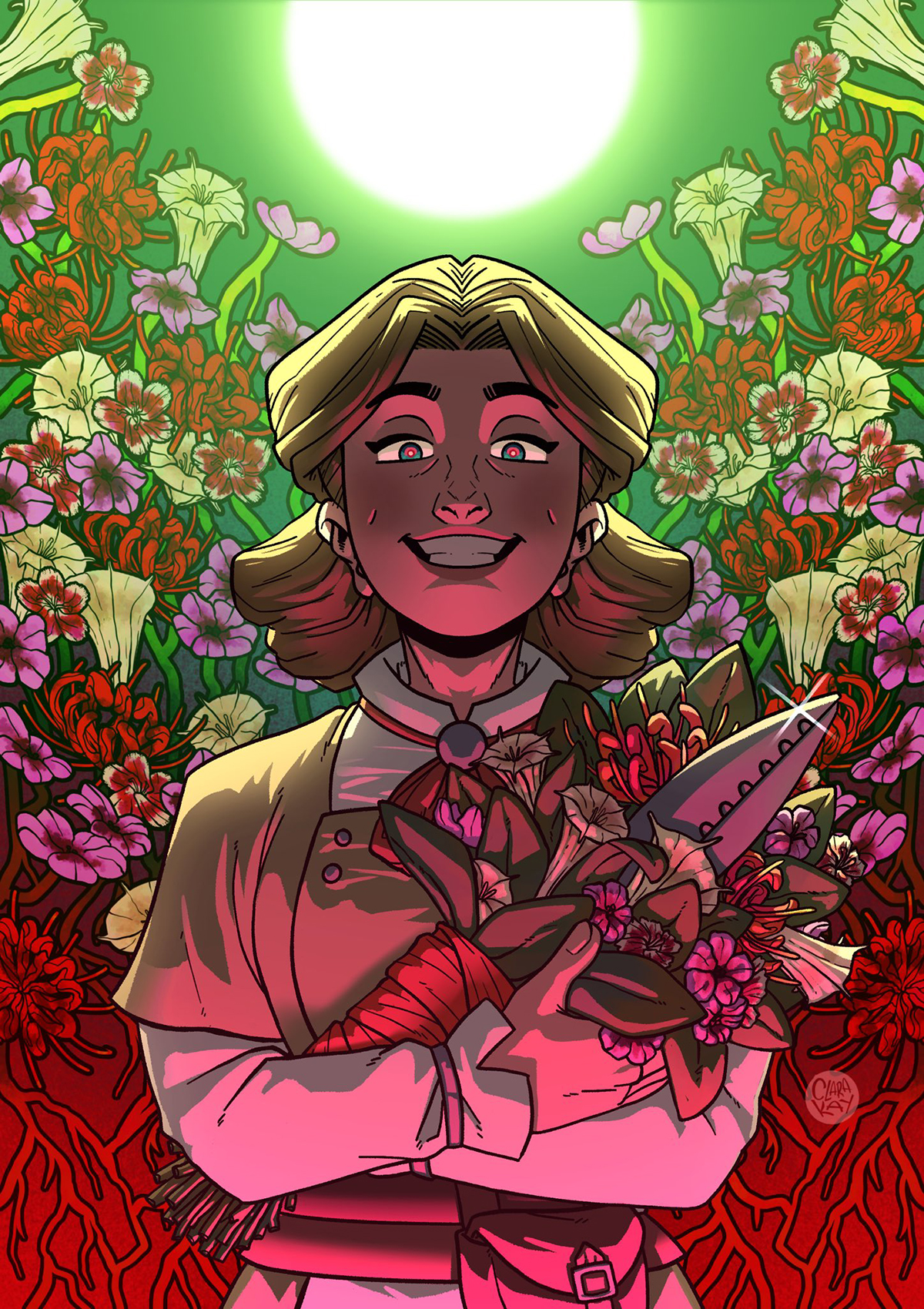
I posted a short story on AO3 (here) about a minor character in Breath of the Wild named Magda, who is affectionately known by the fandom as “Flowerblight Ganon.”

In Breath of the Wild, Malice is a tangible substance that infests objects and locations controlled by Ganon, including the four Divine Beasts, Hyrule Castle, and the Akkala Citadel Ruins. It also infects the dragon spirit Lanayru who guards the Spring of Wisdom.

While writing this story, I wondered if it were possible for Malice to infect regular people. If so, the woman who zealously guards the garden of flowers surrounding Hila Rao Shrine is as good of a candidate as anyone.

The story illustration is by Clara Kay, whose gorgeously monstrous horror art can be found on Twitter (here) and on Instagram (here). I really enjoyed working with Clara, and I also want to give a shout-out to her store (here), which has all sorts of cool Legend of Zelda merch!

I’d like to share a bit of the artist’s description of this piece, because it’s fascinating:

There’s a lot of symbolism packed into the flowers here. The petunias (pink) represent anger and resentment, the devil’s trumpet (the tall white one) represents power and caution, the spider lily (big spiny red one) represents death and reincarnation, and the carnation (white with red ring) is considered the ‘flower of the gods’ and represents admiration, passion, and love.

Carnations represent “passion and love” because they’re thought to be white flowers dyed red with blood, which is entirely appropriate for this story. “Flowerblight Ganon” is my first foray into botanical horror, and I don’t think it’s necessary to be familiar with Breath of the Wild to understand what’s going on. Magda is a regular woman enjoying gardening, quiet living, and occasional tea with friends in a dying postapocalyptic world, and if she lives her best life by indulging in murder every once in a while, then at least her flowers are well fertilized.
The Ghost Shop

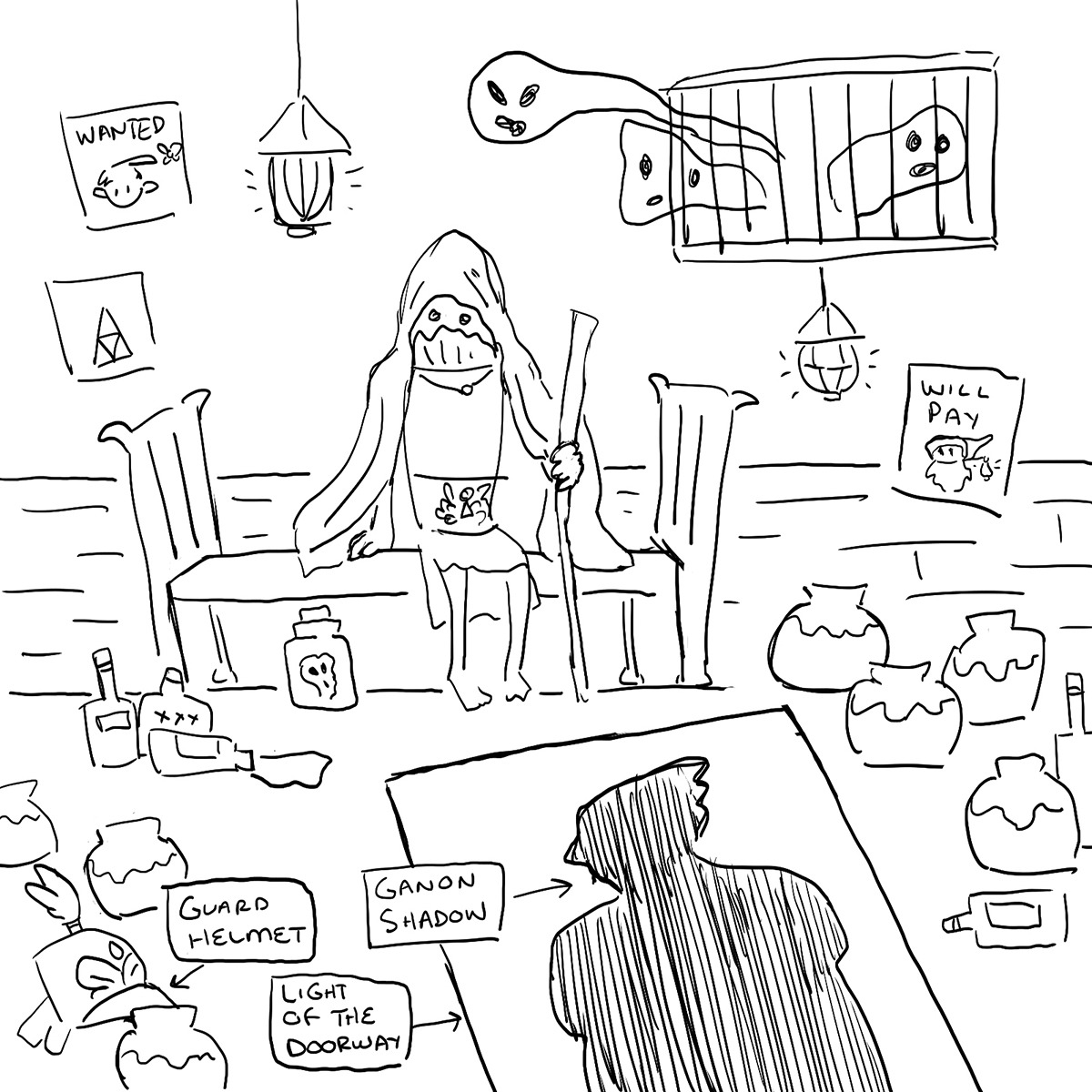
I just posted a short story about the Poe Collector in Ocarina of Time on AO3. It’s a spooky fandom treat for Halloween, and you can read it (here).

This story is about what it might have been like to live in Hyrule after the castle fell to Ganondorf, and I really enjoyed exploring the postapocalyptic environment. The story is also about standing up to power and the abuse of authority, even when it won’t benefit you in any way. Grand acts of heroism are all well and good, but it’s also nice to be too weird to care about what people think of you.

The illustration is by Frankiesbugs, whose creepy-cute art you can find on Instagram (here) and on Tumblr (here). They actually created two color variations, the one with the Halloween-inspired palette that I posted above, and a more Film Noir style version that I posted along with the fic on AO3 – and that they posted on Tumblr (here). It was difficult to choose between such gorgeous and stylish pieces! If you’d like to get a better understanding of just how brilliant Frankiesbugs is, you can check out the concept sketch I sent them (here). This artist’s illustrations have been one of my primary inspirations in writing Legend of Zelda horror stories, and it’s always a pleasure to work with them. You can read some of the horror-themed comics we’ve created together (here) and (here).

Mount Hiei

My story “Mount Hiei,” a dark fantasy about two young monks navigating the eerie twilight years of the Heian period, was just published in Hyakumonogatari Kaidankai, a special issue of the journal White Enso. The issue is currently ongoing and free to read online (here), and “Mount Hiei” is on (this page).

In this story, a ten-year-old boy becomes an apprentice monk on Mount Hiei, which houses a temple that has been tasked with protecting the nation. The boy grows accustomed to monastic life but never becomes comfortable with the statues of the monstrous Guardian King venerated by the other monks. When he discovers a secret door leading into the mountain, he comes to understand why the deity is depicted in such a frightening manner – as well as what “protecting the nation” actually entails.

Mount Hiei is a real place, as is Enryaku Temple, which serves as the setting of this historical horror story. To the best of my knowledge, the practical details of monastic life are accurate for the time period. I was inspired by the fiction of the Japanese author Ken Asamatsu, who applies a Lovecraftian sensibility to Japanese mythology and folklore, and I wrote this story from a place of admiration and respect for the medieval war epic The Tales of the Heike, on which it’s very loosely based.

By the way, the editors of White Enso are still looking for personal essays and original fiction for the 100 Ghost Stories Kaidankai project. Although they’re selective, they accept shorter and more casual pieces, and the submission process is very chill and relaxed. The editors are a pleasure to work with, and they’ll also create a podcast recording of your writing! If you’re interested, you can send your submission (here).

Sparkle

“They’re for my niece,” he explained to the clerk who rang up the pair of earrings. He was too young to have a niece, and he wouldn’t have given her cheap dollar store earrings anyway, but oh how they sparkled when he clipped them to his ears later that night.

. . . . .

I wrote this 50-word story for the “Dollar Store” issue of a magazine called Blink Ink, which describes itself as “home to the finest in contemporary 50 word fiction.” Blink Ink is only available in print, and you can get a subscription on their website (here) if you’re interested.

A Noble Pursuit

None of the lessons from the Gerudo Classroom have prepared Rhondson for married life with Hudson, who has grown restless and disappeared from Tarrey Town a year after its founding. She travels to the Akkala Citadel Ruins to hunt for her husband while reflecting on the bridges that will need to be rebuilt in order for Hyrule to embrace a peaceful future.

“A Noble Pursuit” is a short story that explores the theme of cultural differences, including different attitudes regarding the preservation of historic sites, via the Akkala Citadel Ruins.

As the Gerudo tailor Rhondson crosses the Sokkala Bridges, she’s impressed by how sturdy and practical they are; and, at the end of the story, she considers how building more bridges – both literal and cultural – might help make the Akkala Citadel habitable once more.

At the end of the story, Rhondson finds that her missing husband Hudson has made friends with the monstrous Hinox who’s always snoozing away on the citadel’s parade grounds. She realizes that both the Hinox and her husband need a renewed sense of purpose, and she encourages Hudson to direct his energy into rebuilding the ruins of the Akkala Citadel into a place better suited to cultural exchange.  

This story about archaeology, castles, ruins, giant monster friends, and what it means “to live happily ever after” was written for Memorabilia, a Breath of the Wild fanzine​ that you can check out on Twitter (here) and on Tumblr (here). The accompanying illustrations are by the stylish scholar Pocketwei, whose art of handsome characters and beautiful landscapes can be found on Twitter (here) and on Instagram (here).

You can read “A Noble Pursuit” on AO3 (here).