The Girl in the Screen at the End of the World

It’s been more than twenty years since rumors about a cursed videotape began to spread. The stories were true, and Japan is in ruins. Can the people who survived the collapse of civilization escape Sadako’s curse? Or do they seek her out instead?

“The Girl in the Screen at the End of the World” is a series of four short vignettes about the last living humans making their peace with the end of the world as Sadako bids a gentle goodbye to modern civilization. All of the human characters in the story die, but all the animals go on to live their best lives.

The story is complete at 1,800 words, and it’s on AO3 here:
https://archiveofourown.org/works/47735320

I had the immense privilege of working with an artist who goes by Vani on an illustration for this story. I was inspired by his short Animal Crossing comic about grief (here), and I love the way he draws handsomely rendered characters in lush environments brought to life by bold colors. You can find more of his evocative art on Twitter (here), on Instagram (here), and on Tumblr (here).

Hyrule’s Finest Teas

Link is a second-year college student who works as a barista at a small café on a cobblestone street next to his university. Every day he waters the plants, samples new teas, and listens patiently to the concerns of the people who visit. He especially enjoys the company of one of the regulars, a posh upperclassman named Zelda who comes to the café every day to write. It would be the perfect job if not for his boss, whose excellent taste does little to blunt the edge of his exacting standards.

It took me years of being in fandom to reach this point, but I finally embraced the cliché of writing a Coffeeshop AU. I had an intense Fall 2022 semester, and I wrote “Hyrule’s Finest Teas and Imports” to let off steam during the winter break. This started as a wholesome story about delicious café food, but it gradually transformed into something a bit darker. While I was thinking about why someone like Ganondorf would manage a café, I did a lot of research into the shady real estate practices common around college campuses in the United States. I ultimately decided that it would be fun for Ganondorf to commit tax fraud. As a treat.

The story is complete at four chapters and 9,200 words. It’s on AO3 here:
https://archiveofourown.org/works/43918116/chapters/110424639

I was extremely fortunate to work with the magical Mirarasol on an illustration for this story. Mirarasol creates lovely artwork of cute characters inhabiting stylish interiors, and they’ve done fan art for a number of games in addition to their original illustrations. If you’re interested, you can check out their work on Twitter (here) and on Instagram (here).  

Varré’s Bouquet

Deep under the Royal Capital of Leyndell, the cursed Omen son of Queen Marika bides his time within a prison of shadows. When the ambitious young surgeon Varré is summoned to attend to Mohg’s crown of horns, the two men forge a close bond, yet Varré can do nothing as the shining prince Miquella tempts Mohg with tales of a frightful power hidden within the dark hollows of the earth. As the Lands Between fall to ruin, Varré realizes the wisdom of Miquella’s dream, and he once again offers himself to Mohg, along with his love – and his blood.

While sweating through a set of analytical essays and academic book reviews earlier this year, I amused myself by writing a short story about the two worst characters in Elden Ring, White Mask Varré and Luminary Mohg. They’re both terrible people, but I’m intrigued by the unwritten backstory of their relationship. Because Varré is so unapologetically supportive of Mohg’s evil schemes, the pair has become the subject of a number of silly tongue-in-cheek memes (this one on Tumblr is probably of my favorite), but I followed my heart and wrote unironic gay monster romance. Game Rant may have called Mohg the “worst LGBT+ representation,” but I think he and Varré are adorable.

My story is complete at 3,800 words, and you can read it on AO3 here:
https://archiveofourown.org/works/46268107/chapters/116484187

I consider myself extremely lucky to have been able to work with Paristandard to create an illustration for the story. Along with Elden Ring, they also draw fan art for Lord of the Rings and The Silmarillion, and their original comics and character designs are fantastic. You can find their work on Twitter (here) and on Instagram (here).

The Academy of Raya Lucaria

This is how I imagine Sellen and Rennala celebrating the end of the semester at the Academy of Raya Lucaria.

The postapocalyptic world of Elden Ring isn’t a great place to live, and good people usually end up dead. The Academy of Raya Lucaria seems as though it was dangerous even before the world ended, as very few of the wizards who studied there had even the slightest hint of ethics regarding the otherworldly powers they were attempting to harness. As much as I would love to study magic myself, I’m fairly certain that I would die – or even worse, become undead – within the first semester of wizard school.

Also, multiple people have commented to me that Elden Ring contains the most accurate portrayal of academia they’ve seen in a video game. As a professor, I think it’s best that I keep my comments to myself, but damn if that isn’t the truth.

Dear Friend

If you want to fight your way into the spotlight, it always helps to have a dear friend with sharp teeth.

This is a fan illustration of an original short story written by a fandom friend, Runicmagitek on AO3. Their story is called “Dear Friend,” and it’s about a sinister shadow who follows an aspiring chanteuse from a dark corner of the forest into the bright lights of the city.

Runic is an incredible prose stylist, and it was a lot of fun to draw their characters! For more monster girls and murder friends, please check out their writing here:

🥂 AO3: https://archiveofourown.org/users/runicmagitek/
🔪 Twitter: https://twitter.com/runic_magitek
✨ Tumblr: https://runicmagitek.tumblr.com/

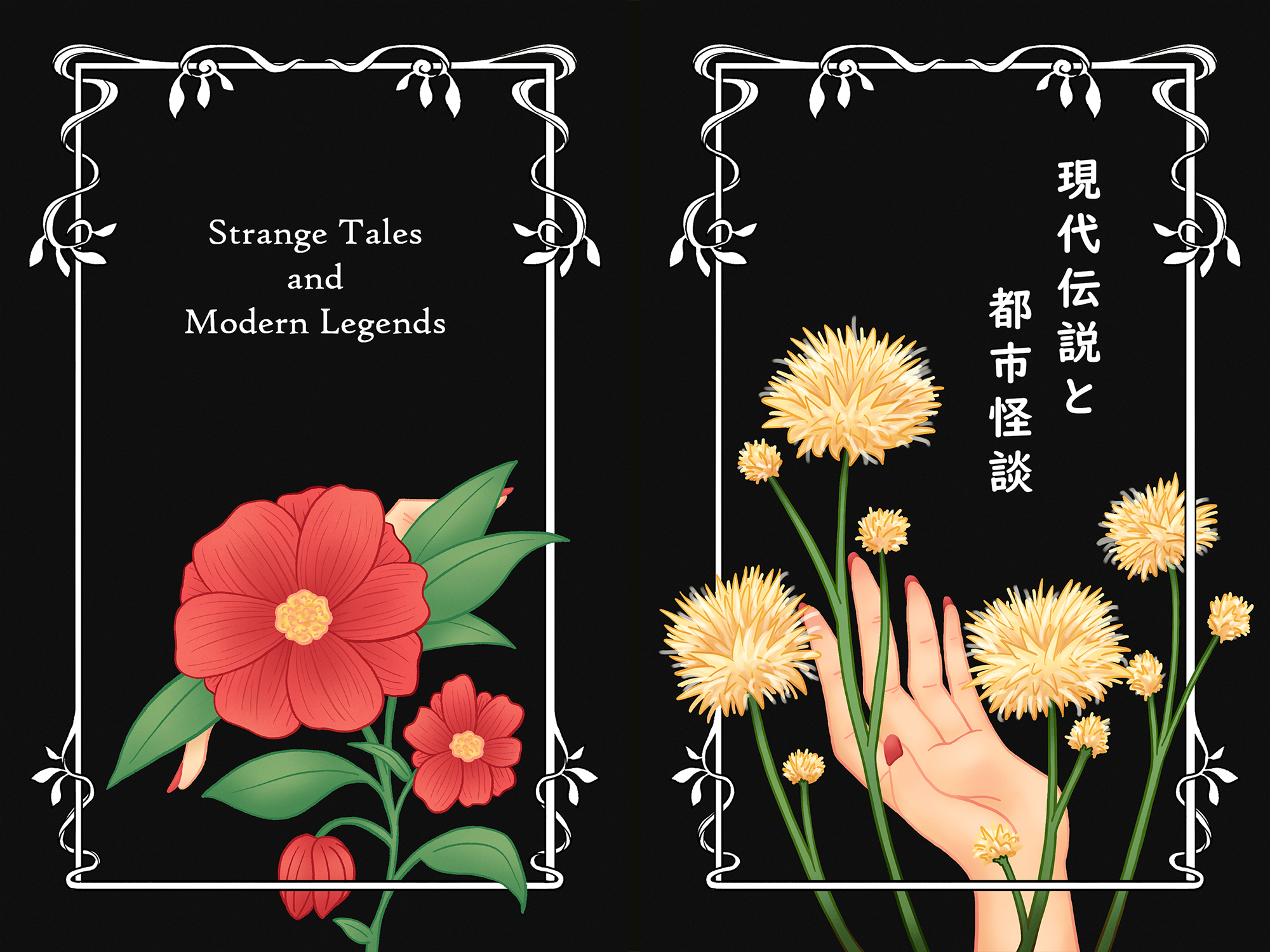
Strange Tales and Modern Legends

This semester I taught a seminar called “Japanese Ghost Stories.” (You can find links to the syllabus and course materials here.) A major element of this class was our study of how folkloric traditions have influenced literature. My specialty is contemporary fiction, so we spent a good amount of time talking about what urban legends are and how they work.

I believe that urban legends have the following three characteristics:

First, these stories are specific to a time and place, and they’re generally tied to a specific person as well. This person is someone known to the storyteller, and they’re either a reliable source of information or a direct witness to the event or phenomenon in question.

Second, the story is understood to be “real” and therefore nonfiction. In fact, it often isn’t much of a story at all. Unlike creepypasta, which is shortform fiction, the characters in an urban legend don’t have interiority, and they’re often not attributed with motivation. Rather, the story is stated as a simple fact. At the core of these stories is a statement like “you’ll die if you eat [a certain type of candy] mixed with soda” or “a child was once murdered in [a certain department store] bathroom.” The purpose of additional details is to add authenticity.

Third, urban legends almost always have a cautionary element, and the unfortunate events of the story are related to social and cultural anxieties. These fears tend to be politically sensitive and thus can’t be discussed openly, so urban legends function as a sort of pressure release valve. In the United States, for example, a lot of urban legends reflect racial tensions, while there are a lot of urban legends about bullying and social ostracization in Japan.  

This isn’t really a defining characteristic, but I find it interesting that an urban legend need not necessarily be untrue. Rather, the act of making something into a “story” adds an element of speculation. This means that, even though the story is stated as fact, both the teller and listener understand that the veracity of this fact is debatable. In other words, the story could be true, but both parties acknowledge that there’s no way to prove it.

Having provided the students with these criteria and a number of examples to use as potential templates, I asked them to write their own urban legends. I was absolutely blown away by the work they submitted. I promised that I wouldn’t spread their stories outside of class, but I decided to make a class zine so that they could share their work with each other. The image at the top of this post is the cover I created for the zine, which ended up being a 76-page book.

I like to think that Alvin Schwartz and Stephen Gammell would be proud.

Quiet Haunting

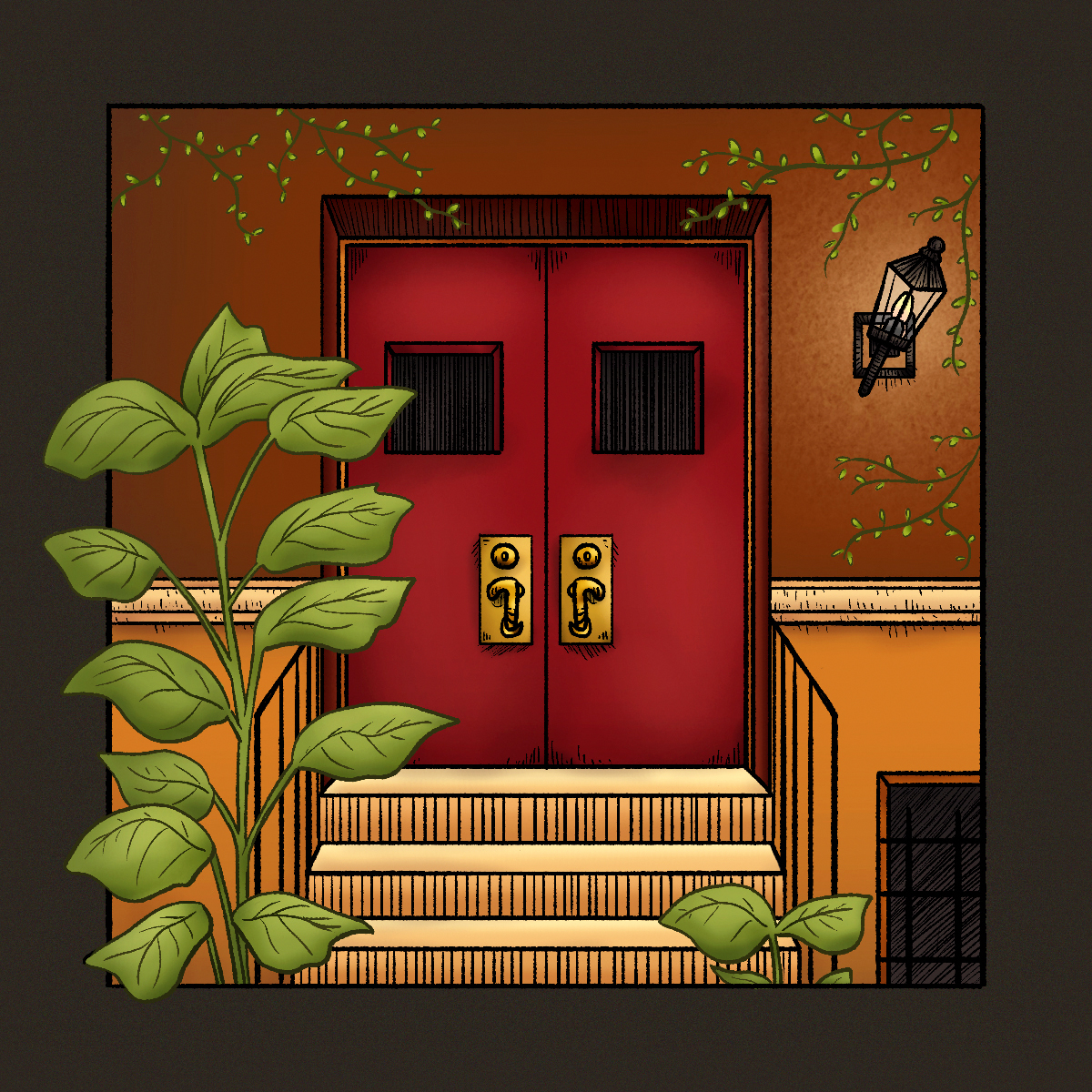
I moved to South Philadelphia toward the end of the pandemic. My landlord raised the rent, and it was cheaper just to buy a house. Granted, it’s not a big house, nor is it particularly nice. The floors are uneven, and the ceiling sags. The kitchen is like the set of an old movie, and the basement is infested with centipedes. But it’s affordable, and it’s quiet, especially since no one lives next door.

I’ve recently started to hear things moving on the other side of the townhouse wall. The noises aren’t loud, nor are they frequent. It’s mostly soft shuffling and light tapping, usually right before dawn and just after dusk. To make matters even more curious, someone has been watering the plants in the house’s back yard. Two leafy fig trees have grown from small sprouts to extraordinary heights over the summer.

Earlier this evening, I noticed that the house’s back door was open. It was just a crack, as if someone had forgotten to close it. The opossums that live in the alleyway will come inside and eat your trash if you let them, so I figured I’d be doing someone a favor if I closed the door. I climbed over the crumbling cinderblock wall and maneuvered through the foliage. When I put my hand on the knob, the door surprised me by swinging open.  

There was nothing inside, just uneven floors and sagging ceilings like my own, but I could hear a beeping sound emerging from the basement. I peeked down the stairs, where I saw an older man in a colorless cardigan sweater sitting on a metal folding chair. He was flipping through an issue of National Geographic that he’d taken from a cardboard box filled with old magazines.

I froze in alarm, but he looked up and met my eyes before I could back away. “I’m sorry to bother you,” I apologized. “I live next door, and I heard the beeping. I was worried something was going to explode.”

“It’s fine.” He shrugged. “It’s just an oven timer. I figured I’d give it a few more minutes, but I might as well turn it off.”

I felt awkward, like I couldn’t just leave, so I asked him why he was sitting in the basement with an oven timer.

“They pay me to look after the place,” he answered. “You know, rattle a few chains, make some thumping noises in the night. Feed the spiders, maybe put a bloody handprint on the window. That sort of thing. It keeps the property values down.”

I realized that I could see the back of the chair through the man’s sweater. This didn’t bother me as much as you’d think it would. I’d seen stranger things in the neighborhood, and the man seemed nice enough.

“I haven’t really heard anything from next door,” I admitted. “Do you want me to be more scared?”

“Don’t sweat it. They’re not paying me much, and I haven’t gotten a raise in years. My heart’s just not in it these days.” With a sigh, he closed the magazine and tossed it back into the box before disappearing in a thin wisp of smoke.

I left the basement, closing and locking the door behind me before returning to my own house. I guess the post-pandemic economy has been tough for everyone. All things considered, I don’t mind living next door to a haunted house. Like I said, it’s affordable, and it’s quiet.

. . . . . . . . . . . . . . . . . . . .

This illustrated short story was originally published in the Philly Zine Fest 2022 Anthology. This year’s Philly Zine Fest was held at Temple University on Saturday, November 5. Despite a giant political rally happening right across the street that afternoon, it was a very chill and relaxed event with lots of good vibes and creative energy. It’s been my dream to table at the Philly Zine Fest for years, and it was just as amazing as I hoped it would be. Here’s to many more celebrations of independent artists and writers in years to come! If you’re interested, you can find the Philly Zine Fest website (here), and it’s definitely worth checking out their parent organization, The Soapbox Community Print Shop & Zine Library.

The Museum of Hyrule

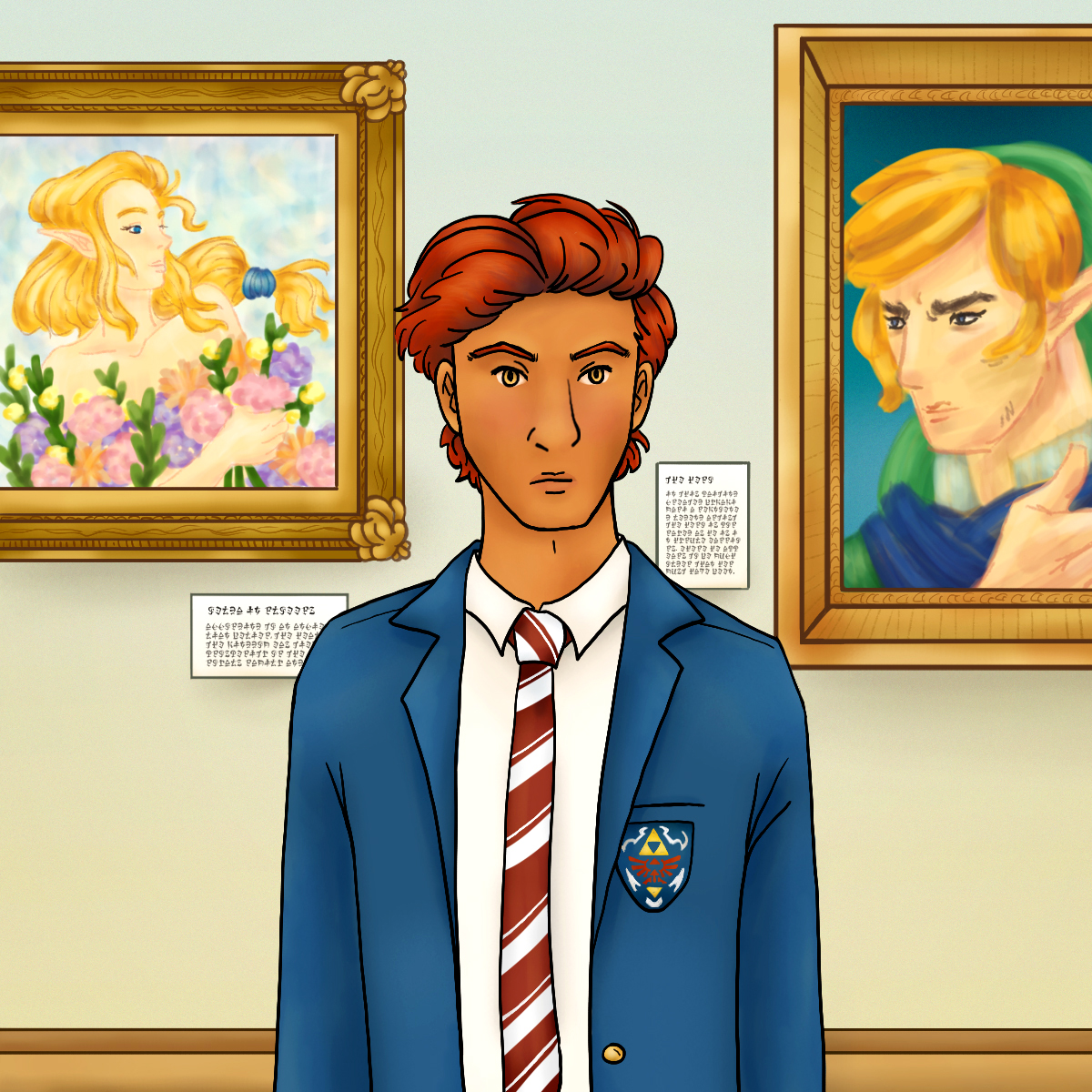
I was recently thinking about what a modern version of Hyrule would look like, and I was imagining how fun it would be for Link to encounter the Master Sword during a class trip to a museum. When I started sketching, however, what I ended up drawing is a reincarnation of Ganon seeing his crown from Ocarina of Time. The moment I wanted to capture is the calm immediately before a terrible storm.

Also, as someone who loves art and history, I tend to dislike museums, but that’s another story entirely.

The Best Witch of Her Generation

I’m excited to share another short story I wrote for Goddess Reborn, fanzine celebrating the female (and nonbinary!) characters of the Legend of Zelda series. You can download a free digital copy of the zine on Itchio (here), and you can read my full story on AO3 (here).

A Link Between Worlds is one of my favorite games in the Zelda series, mainly because I find the characters so charming. I’m especially fascinated by the figure of “someone who wants to be a hero but isn’t the fated Chosen One,” a character trope the series plays with but never fully explores. Groose from Skyward Sword is a good example, as is Ganondorf from The Wind Waker. There are several such characters in A Link Between Worlds, and Irene is my favorite.

Irene is the granddaughter of the Potion Witch, and she serves as the game’s fast-travel mechanic by flying Link around on her broom. She seems to be modeled half on Hermione Granger – she calls proudly herself “the best witch of her generation,” a play on Hermione’s famous epithet – and half on Kiki from Kiki’s Delivery Service. Like Hermione, Irene sees herself as a hero; but, like Kiki, her character arc involves her journey to understand and acknowledge her own specific set of talents.

What I wanted to capture was a moment of Irene’s life in which she’s happy and confident of herself as the protagonist of her own adventure. Irene understands that what she’s doing is just as important as Link’s quest, and she’s absolutely correct. Although the player may see Hyrule through Link’s eyes, the female characters who surround and support him are absolutely vital to Hyrule’s history.

While writing this short story, I wanted to get as close to the tone of “early-reader fiction” as I could. I’m not used to this style of writing, so it was a fun challenge. I was aided immensely by the story’s illustrator, Leh Latte. Leh helped me with the diction and rhythm, as well as with structure and balance. She also showed me what it means to work with page formatting in mind. Although the story itself is short and simple, it’s the product of a few good conversations during a collaboration between me, Leh, and Aven Wildsmith, the zine editor.

Leh and Aven are both fantastically talented and creative people who work in a variety of media. You can find links to all of Leh’s social media accounts on her Carrd (here). Aven’s website is (here), and you can find links to all their socials on Linktree (here). And again, Goddess Reborn is free to download on Itchio (here). There’s a lot of love on every page, and this zine is really something special.

The Potentate of Jarburg

About halfway through Elden Ring, I realized that the player’s character is the villain of the story.

At some point before the story begins, a manifest symbol of divine order called the “Elden Ring” was shattered by nefarious means, and the rulers of the land fought over its shards. Whether because of the battles or because of the nature of the shattering itself, everything is now in ruins.

As an outcast “Tarnished” warrior who has returned to the magical Lands Between, your job is to retrieve the shards of the Elden Ring from the fallen rulers and thereby restore the Golden Order of the once-great civilization. At least, that’s what you’re led to believe.

If you pay attention, you’ll notice that the society enabled by the Golden Order wasn’t so great. The ruling class built its civilization by subjugating other cultures in fantastically horrific ways. This isn’t subtext, exactly, but neither is it surtext – it’s simply the story told by the environment of the game.

You may think that perhaps, if you repair the Elden Ring and become the new Elden Lord, you’ll do better. You’ll burn the ruined vestiges of the old order and create a more just and fair society. The game defies this hope at every turn, however. For every kindness you attempt, you cause only more suffering.     

In more prosaic terms, almost every sidequest in Elden Ring ends badly.

The kind and modest Sorcerer Thops, who has developed a brilliant form of defensive magic, asks you to spare a key to the Academy of Raya Lucaria if you happen to find one. Should you do so, he is unprepared to face the dangers of the battleground the school has become, and he is slaughtered at his desk.

The gentle and noble Irina has fled from the besieged Castle Morne, and she asks you to deliver a letter to her father, beseeching him to join her instead of perishing in a hopeless battle. When you find Irina’s father, you learn that the castle was overtaken by the slaves he abused. Irina is slaughtered in your absence. This drives her father mad, and you are forced to kill him.

Meanwhile, Preceptor Seluvis, a member of the only group of good guys you encounter in Elden Ring, asks you to deliver a healing potion to one of your former companions. What this potion does is to turn her into a mindless “puppet.” This is an act of revenge against the woman’s adoptive father, with whom Seluvis has a feud that he never bothers to explain. It’s strongly implied that Seluvis uses his puppets as sex dolls, but this unsavory magic is necessary is help another female character. In order to save her from endless torture, you must agree to collude with Seluvis.

The only pure and wholesome place in Elden Ring is Jarburg, an isolated village filled with flowers and animate Living Jars. Living Jars are magical war machines that were abandoned because they happen to be extraordinarily bad at fighting. Should you visit Jarburg, you will be greeted by Jar Bairn, a young Living Jar who asks if you will become the Potentate of Jarburg. Jar Bairn will happily chat with you, and he has more lines than almost anyone else in the game. Aside from enjoying a few rounds of idle conversation, there’s nothing to do in Jarburg. There are no battles or treasures or quests, just Living Jars lazing about in the grass and tending to the flowers.

So the player will leave Jarburg – if they ever bother to find the village at all – and probably never return.

Instead, you’ll continue through the game, murdering and pillaging and destroying everything you encounter. Elden Ring doesn’t give you much of a choice. If you don’t kill something, it’s only because it succeeded in killing you first. You have to survive by any means necessary, even if that means leaving a trail of blood in your wake. In order to become the new Elden Lord, you must be utterly ruthless.

Along the way, you’ll bear witness to the atrocities committed by the former rulers of the Lands Between. You’ll gradually understand why this violence was necessary, and you’ll begin to realize that your own choices are limited. There is no happy end to this story, not for you or for anyone else.

So why finish the game, then? The former rulers are no longer in any position to subjugate anyone, and the formerly enslaved peoples are now free. Castles will crumble, and ancient cities will be forgotten, but the dead will finally be allowed to rest. Why not simply lay down your sword and allow the Lands Between to heal?

I am very bad at Elden Ring, which is an extremely difficult and punishing game. To make matters worse, no one in the game offers you real or meaningful guidance. On top of that, all of the guides available online are fragmentary, disconnected, and clearly written in haste. The artist Frankiesbugs is a veteran of the Soulsborne games, and she’s been patiently helping me find my way forward as we slowly navigate the Lands Between. Mostly we’ve been making silly jokes about the game’s shitty wizards and their appalling sense of fashion, but we wanted to try to create something a bit more serious that reflects the deeper themes of Elden Ring.

This collaborative comic is a tribute to a masterpiece of the medium that forces you to ask difficult questions with no easy answers. I have to admit that I may not ever finish Elden Ring, but maybe that’s okay. It wouldn’t be so bad to be the Potentate of Jarburg.

. . . . . . . . . . . . . . . . . . . . .

You can follow Frankiesbugs on Twitter (here), on Tumblr (here), and on Instagram (here). If you like this comic, you can leave Frankiesbugs a tip on Ko-fi (here) and browse her creepy-cute Plague Doctor merch on Redbubble (here). If you’re interested in stylish gothic horror with a heart, please check out Frankiesbugs’s ongoing comic Necrobirth, which you can read on Tapas (here), on Webtoon (here), or on Tumblr (here).