Project Kat is a short narrative horror game that’s free to play on Itch.io (here) and on Steam (here). A playthrough culminating in the game’s “true ending” will take about half an hour, but adventurous players might spend another fifteen minutes experimenting with paths leading to a premature death.
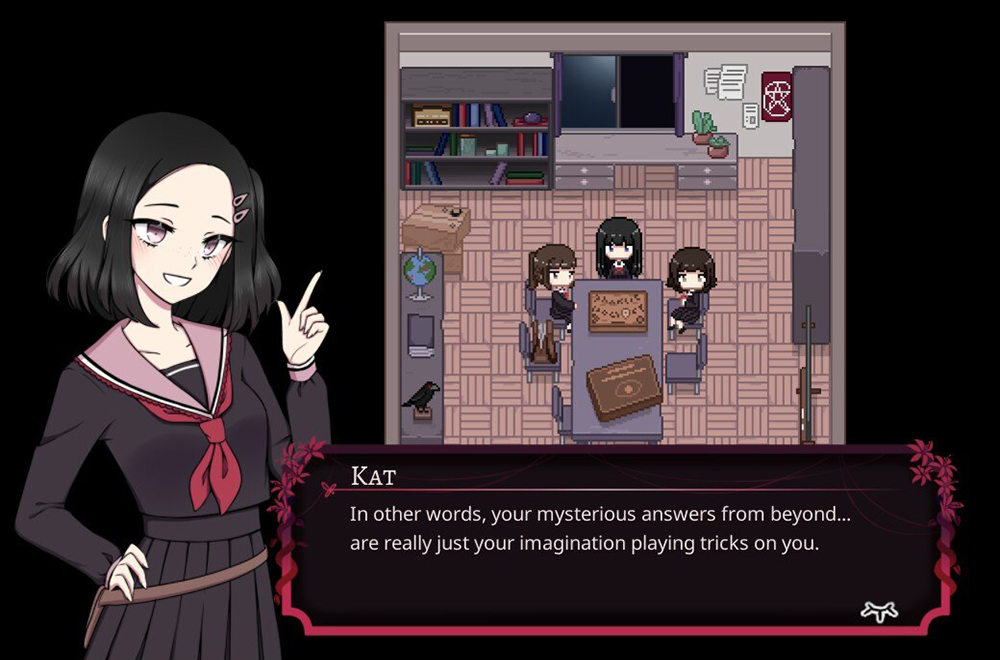
You play as a high school student named Kat who stays late at school one night to undertake an occult ritual of unknown origin and with unknown consequences. Kat has attempted a number of similar rituals, all to no avail. She claims not to believe in the supernatural and seems to be performing these rituals as a hobby. Unfortunately for Kat, this ritual is different.
As Kat, you have the run of three empty classrooms, a meeting room currently being used by the school’s Occult Club, and the Drama Club’s storage closet. Your job is to collect the materials needed for the ritual, such as chalk and candles, and then to perform the various steps of the ritual itself.
Coincidentally, the three members of the Occult Club are also spending the night at school. Kat taunts them as they experiment with a Ouija Board, saying that they’re deluding themselves. Despite getting the night off on the wrong foot, Kat can continue to talk with the three girls, and she can even recruit them to participate in the ritual with her.
This might be a mistake, however, as the instructions for the ritual state clearly that it must be performed alone.
Should Kat manage to complete the ritual successfully, the game ventures into a surreal space reminiscent of Yume Nikki. This is when the story stops pulling its punches, and the player begins to understand why Kat has started performing occult rituals – and also that her odds of surviving this one are very low. I was impressed by the visual creativity of the final section of the game, and also by the darkness of the ending it leads to.
I’m a fan of the Japanese tradition of occult “solo games” like One-Person Hide and Seek and Satoru-kun. While many of these rituals are meant to summon a spirit, the purpose of others is to create a gateway to a different dimension. If the dimension-linking ritual is performed correctly, what happens then? No one ever says, and Project Kat offers as good of an explanation as any regarding why this might be.
Since it’s a relatively short game, Project Kat leaves a number of questions unanswered. Still, I really enjoyed the story, which has good pacing and a nice tonal creep from camp into horror. Project Kat is a neat little game to play in one sitting, and the creators have released a longer story set in the same world, Paper Lily, which is free to play on Itch.io (here) and on Steam (here).
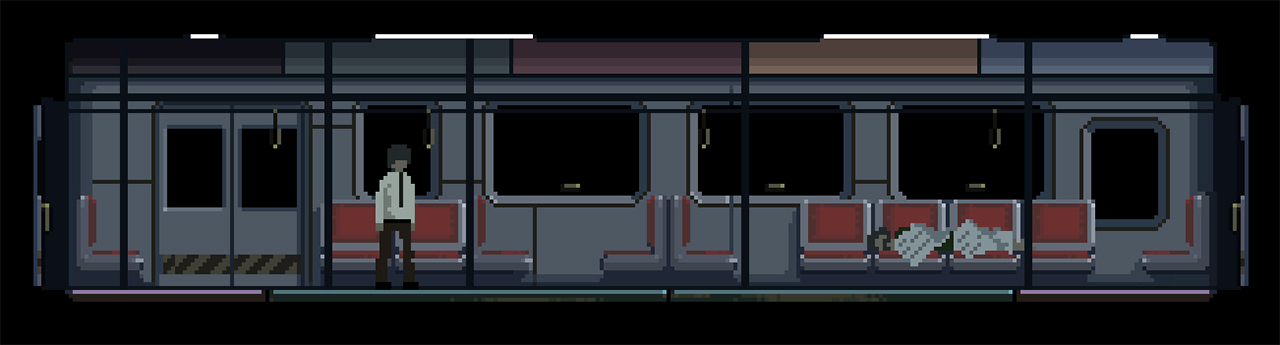
Last Train Home is a short and spooky creepypasta story game. It’s free to play in your browser, and it takes about five minutes to complete. You play as a salaryman who finds himself on a near-deserted commuter train in the dead of night.
The first half of the game is set in three train cars and the two walkways between them, each of which is occupied. With the doors at either end locked, you move between the three cars and talk with their occupants, befriending them by completing small tasks.
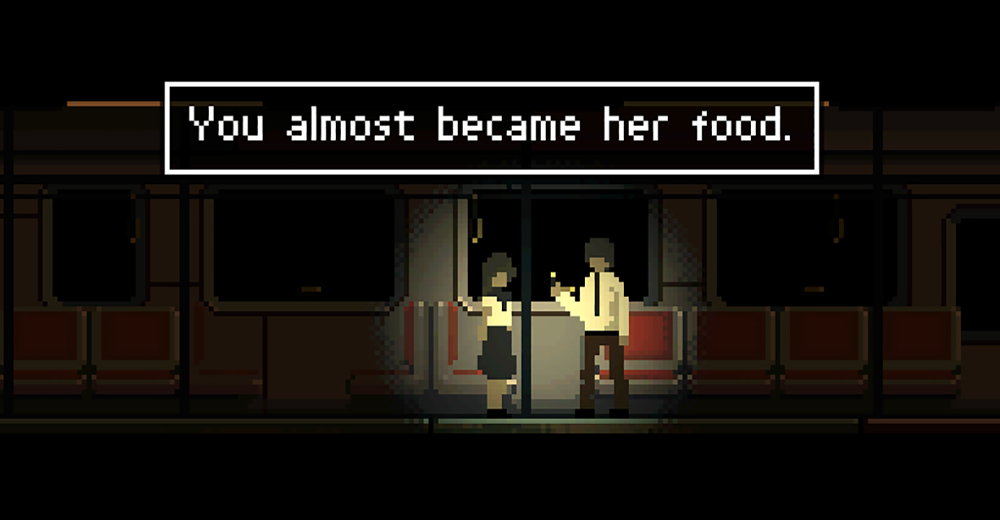
This is all well and good until the lights go off, at which point you’re left to fend for yourself in the darkness with nothing more than a cigarette lighter and the eerie flashes from outside the windows to illuminate your path forward. Where is this train going, and how do you get off?
Just as the United States is home to countless urban legends surrounding cars, from vanishing hitchhikers to cursed highway rest areas, there are all sorts of urban legends about commuter trains in Japan and South Korea. “The last train” is a common motif in cautionary tales warning midnight passengers against accidentally boarding the wrong train or even, heaven forbid, falling asleep and missing your stop as the train continues hurtling into the night.
In contrast to the pristine coziness of trains in East Asia, there’s a New York style grunginess to the cars in Last Train Home that renders the environment unsettling and uncanny. The lighting and sound design are nicely creepy as well. There’s not a lot of text, but each line manages to be subtly unpleasant. There are no jumpscares, just a pervasive atmosphere of creeping dread. The catharsis at the end of the story is lovely, but you’ll definitely have second thoughts about running to catch the last train after playing this game.
Paranormasight: The Seven Mysteries of Honjo is a supernatural thriller set in the Honjo neighborhood of Sumida Ward in central Tokyo during the 1980s. This visual novel’s story is told via the intersecting perspectives of three main protagonists through a series of short episodes laid out along a story grid. Although you have some choice regarding the order in which you play the episodes, the story is linear, with minor branching paths leading to premature endings. Paranormasight has strong elements of horror, as well as a few jumpscares, but it’s sensitive about its use of mature themes and graphic visual imagery. Depending on how quickly you read, it should take about ten to twelve hours to unlock all of the endings.
Let me cut to the chase: I really enjoyed Paranormasight and would happily recommend it even to people who aren’t horror fans. The game only has a moderate level of interactivity, so I’m not sure it would appeal to people who dislike visual novels. That being said, Paranormasight is at the height of its genre, and it’s as well-written, well-illustrated, and intriguingly presented as a visual novel can get.
A quick description of the story is going to sound like anime nonsense, but please take my word for it that this is a story written for an adult audience and bear with me for a moment.
During the early modern Edo period, an onmyōji wizard found the secret to a ritual that would bring someone back from the dead. In order to recreate the soul of the deceased, one would need to store sufficient “soul dregs” of murder victims inside a ritual object. The wizard managed to perform the ritual, a process that resulted in nine deaths. The history of these deaths has survived to the present in the form of urban legends about the “seven mysteries of Honjo.”
Late one night, ritual objects in the form of wooden netsuke charms mysteriously appear in the hands of nine people in the Honjo neighborhood. In addition to the physical charms, these “curse bearers” have inherited the resentful memories of the victims of the original ritual, as well as the power to kill others with a curse, which they’re able to trigger when certain conditions are met. If one of the curse bearers manages to kill enough people, they’ll be able to perform the ritual of resurrection – but only if another curse bearer doesn’t kill them first.
Paranormasight opens with a stand-alone prologue in which one of the curse bearers meets a gruesome end. When the prologue is concluded, the story is taken up by three more curse bearers: a grieving mother whose young son died in a kidnapping incident, a high school girl whose best friend committed suicide, and a senior police detective assigned to investigate the mysterious death of a youth truancy officer. All three of these protagonists are sympathetic, as is the companion character accompanying each of them. As the story unfolds, they gradually begin to work together in an attempt to figure out what’s happening so that they can survive the curse while preventing more murders.
I feel like I’ve spent years quietly waiting for Square Enix to start publishing visual novels, and I’m happy it’s finally happening. Visual novels are somewhat infamous for being relatively inexpensive to make, and it’s so cool to see one of these games with big-budget production values. Although the art and music are wonderful, the high quality of Paranormasight mainly comes through in the strength of its writing, its manga-style mise-en-scène, and its excellent translation.
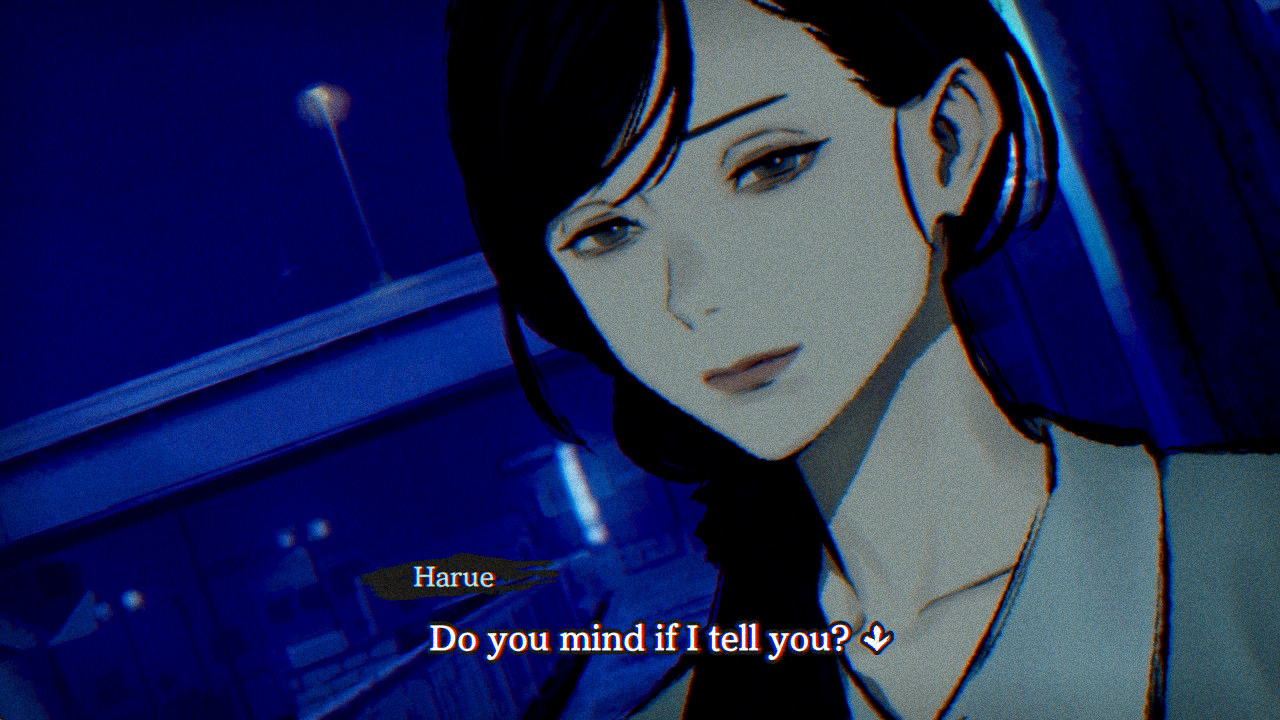
When I talk about the mise-en-scène, I’m referring to the cinematic framing of each scene. While many visual novels will show you a visually flat illustration of a character superimposed on top of a static background, Paranormasight puts a great deal of effort into making conversations feel more dynamic, with the camera following standard “line of sight” rules to show the player the conversation from different angles and perspectives. As a result, Paranormasight feels like reading a manga instead of reading an illustrated novel. This framing isn’t overly dramatic and doesn’t draw attention to itself, but it must have required an incredible amount of planning and effort to pull off with such skill and variety.
The same goes for the writing. The writing doesn’t go out of its way to appear “brilliant,” but the way the various threads of the characters gradually become woven into the larger story is incredible. Although you’ll often have to finish one character’s current storyline before continuing another’s, I was impressed by how the game maintains its forward momentum while still giving the player a fair amount of freedom to move between characters and conversation topics. I also appreciate how none of the characters ever devolves into a stereotype, and how both major and minor characters have a balanced mixture of admirable and problematic personality traits.
On a lark, I downloaded Paranormasight onto my older Nintendo Switch and played the prologue in Japanese. I can therefore say with confidence that the English translation is excellent. The translation team preserves the flavor of the original writing through canny localization choices, especially regarding the game’s more arcane vocabulary. I’ve been annoyed with the translation of Tears of the Kingdom, which is filled with nonsense like “Ultrahand” and “secret stones,” so I admire how the English version of Paranormasight manages to make its more unusual terms seem perfectly natural.
Despite its goofy name and slightly silly supernatural premise, Paranormasight was created for an audience of intelligent adults. The game is very much mass-market entertainment published by a giant corporation, so perhaps it’s not as bold or edgy as it could be, but I actually think this market concession to “broad appeal” is a blessing. Sometimes it’s nice to read a horror thriller that has the confidence not to rely on sexual assault, fantastically grotesque violence, or poorly-disguised bigotry against minorities. As a fun bonus, there are no creepy “male gaze” character designs, just a wide range of character types who are drawn in an appealing anime-influenced style but still look like real people.
Paranormasight was developed in cooperation with the Sumida City Tourism Association, and the game does a fantastic job of giving the player a sense of its setting. This works especially well in tandem with the story’s theme of how many Japanese urban legends are closely connected to a specific place and the history of the people who live there. Although most of the gameplay involves choosing how to advance the conversation, there are also moments when the player is invited to explore an area via a visual panorama while investigating points that catch their attention. It’s fun to explore this weird little neighborhood in Sumida that’s been around since the Edo period, and you never feel as though you’re on the receiving end of a history lecture.
One of the coolest aspects of Paranormasight is its framing device, in which a narrator wearing an Edo-period kimono and a half-face Noh mask directly addresses the player. This narrator invites the player to watch the story through a Shōwa-era color television, one of the bulky cathode-ray screens embedded in its own piece of furniture.
The menu has a great time with this retro aesthetic, distorting the background with tv “noise” and curving the screen at the edges. From the menu, you can access an annotated index with entries for the characters, places, and historical incidents that appear in the story. Each entry is accompanied by an illustration and two or three paragraphs of text. I generally don’t bother with the annotated indices in visual novels, but the one in Paranormasight is especially well-written and edited to provide a satisfying amount of intriguing information without overwhelming the player with walls of text. I also love that the entries for the urban legends are illustrated with period-accurate woodblock prints.
For someone with my particular set of interests, Paranormasight is a 10/10 game. Even if you’re not into urban history or urban legends, I still think the strength of the game’s writing and the cleverness of its design are strong selling points. You can download Paranormasight as a phone app, but it’s perfect for Nintendo Switch’s handheld mode and well worth the $20.
By the way, if you’re intrigued by the concept of “virtual tourism through a visual novel,” I’d also like to recommend the supernatural mystery thriller Root Letter. Its story is set in the small city of Matsue in rural Shimane prefecture, which is also famous for its Edo-period urban legends. Root Letter is very good, but it’s nowhere near as polished as Paranormasight. Square Enix really hit it out of the park with this one.
This semester I taught a seminar called “Japanese Ghost Stories.” (You can find links to the syllabus and course materials here.) A major element of this class was our study of how folkloric traditions have influenced literature. My specialty is contemporary fiction, so we spent a good amount of time talking about what urban legends are and how they work.
I believe that urban legends have the following three characteristics:
First, these stories are specific to a time and place, and they’re generally tied to a specific person as well. This person is someone known to the storyteller, and they’re either a reliable source of information or a direct witness to the event or phenomenon in question.
Second, the story is understood to be “real” and therefore nonfiction. In fact, it often isn’t much of a story at all. Unlike creepypasta, which is shortform fiction, the characters in an urban legend don’t have interiority, and they’re often not attributed with motivation. Rather, the story is stated as a simple fact. At the core of these stories is a statement like “you’ll die if you eat [a certain type of candy] mixed with soda” or “a child was once murdered in [a certain department store] bathroom.” The purpose of additional details is to add authenticity.
Third, urban legends almost always have a cautionary element, and the unfortunate events of the story are related to social and cultural anxieties. These fears tend to be politically sensitive and thus can’t be discussed openly, so urban legends function as a sort of pressure release valve. In the United States, for example, a lot of urban legends reflect racial tensions, while there are a lot of urban legends about bullying and social ostracization in Japan.
This isn’t really a defining characteristic, but I find it interesting that an urban legend need not necessarily be untrue. Rather, the act of making something into a “story” adds an element of speculation. This means that, even though the story is stated as fact, both the teller and listener understand that the veracity of this fact is debatable. In other words, the story could be true, but both parties acknowledge that there’s no way to prove it.
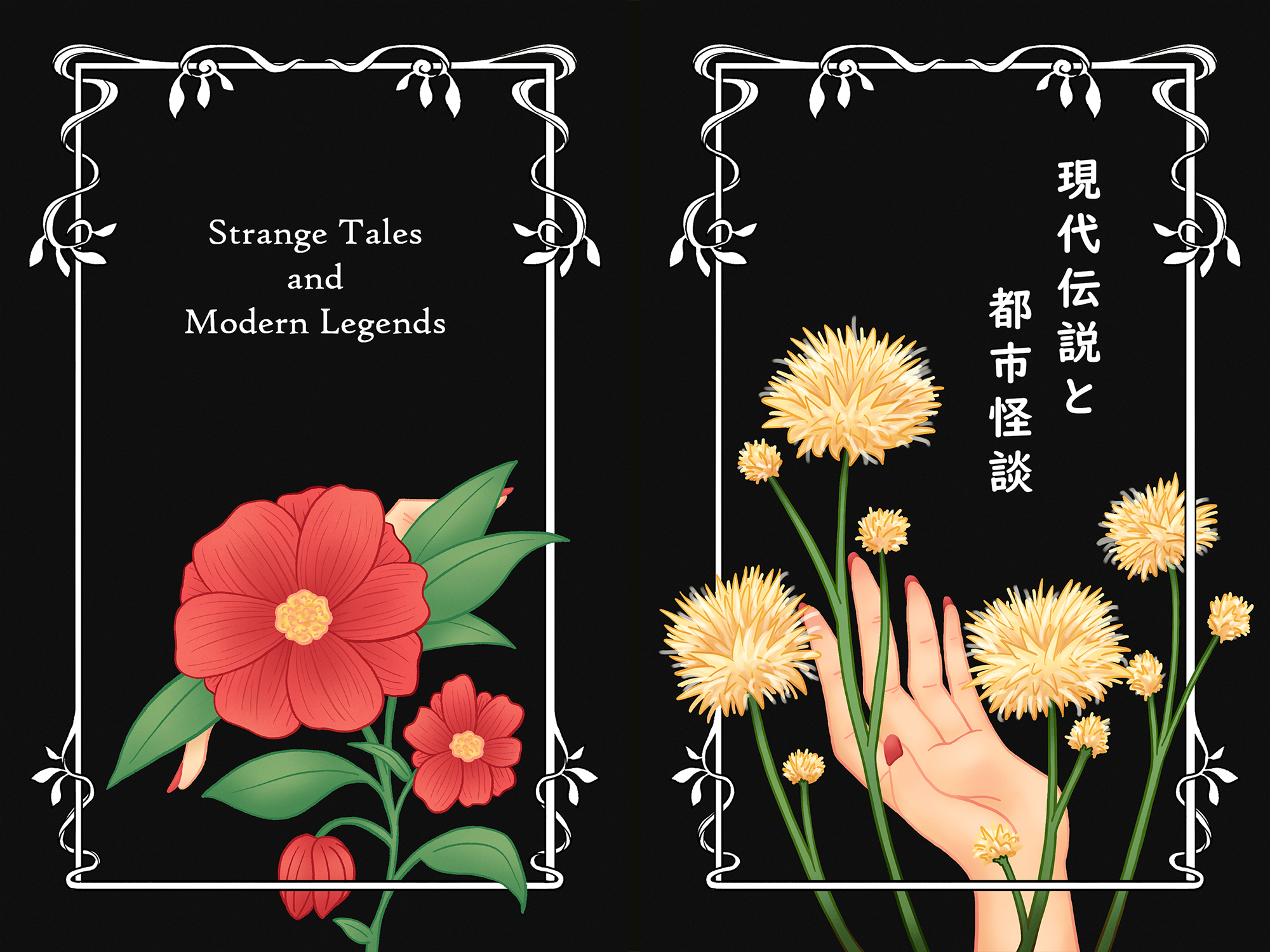
Having provided the students with these criteria and a number of examples to use as potential templates, I asked them to write their own urban legends. I was absolutely blown away by the work they submitted. I promised that I wouldn’t spread their stories outside of class, but I decided to make a class zine so that they could share their work with each other. The image at the top of this post is the cover I created for the zine, which ended up being a 76-page book.
I like to think that Alvin Schwartz and Stephen Gammell would be proud.
Spirit Hunter: NG is a 2018 visual horror novel about the urban legends that come out after dark in a sleepy Tokyo suburb. You play as Akira Kijima, a 17-year-old delinquent whose young cousin has been captured by a spirit named Kakuya. Kakuya challenges Akira to a game, promising that she will return his cousin if he manages to confront a series of monsters local to the neighborhood of Kissouji.
The overarching story of Kakuya’s game is somewhat silly, as are the protagonist and supporting characters. The stars of the game are the urban legends that form the core of each of the seven chapters. As far as I can tell, these urban legends are all original, and it’s a lot of fun to slowly gather the details of the stories. The monster artwork is very creative and very gruesome, while the scenes depicting the monsters’ victims are horrible, explicit, and intense. There are no jump scares, but I was genuinely shocked by some of the deaths.
The gameplay is simple. You investigate your environment by shining your flashlight on objects embedded in the background artwork, and you collect various odds and ends that you use to solve simple puzzles. You’ll occasionally find yourself in life-or-death encounters with monsters who want to kill you, as well as overzealous police who will end your adventure early by arresting you. During these encounters, you’re presented with a timed series of dialog choices, and you’ll receive an instant “game over” if you select incorrectly.
Unfortunately, you can only save at certain points, meaning that you may have to replay an entire extended encounter sequence if you mess up. It’s possible to speed through previously read text, but I became so frustrated by an early-game confrontation that I started using a walkthrough to help make the gameplay a bit smoother. Although most of the puzzles and dialog choices are self-explanatory, others can feel entirely random. Still, if you don’t mind consulting a walkthrough before you play through the monster encounter sequences, the story flows smoothly, and the exploration elements are enjoyable and fairly intuitive.
NG has “good,” “bad,” and “normal” endings based on whether you treat the monsters with violence or compassion. Other than that, there don’t seem to be any branching paths, and your choices don’t have anything more than minor cosmetic effects on the story. You can raise the level of affection that the named NPCs feel toward you, but this doesn’t seem to affect anything other than a few throwaway lines of dialog.
The game also includes a few sidequests that involve solving simple riddles to find D-Cards, trading cards that contain information on bonus urban legends with marginal connections to the main plot. These sidequests give the player an opportunity to explore the environment with a greater attention to detail, and the cards showcase some of the most interesting writing in the game. None of this card collecting is mandatory, but it’s nice to have an excuse to walk around the Tokyo suburbs late at night when all the sources of light are artificial and vaguely eerie by default. The atmospheric sound design is excellent as well, and it’s a pleasure to listen to your character’s footsteps echoing on concrete against a backdrop of city traffic, buzzing streetlights, and convenience store chimes.
If you use a walkthrough to progress smoothly through the confrontations with monsters, NG takes about fifteen hours to complete, and it’s easy to get sucked into the story. All of the urban legends are fascinating, and the game has a fairly progressive worldview on corporate violence, corrupt law enforcement, and the ways in which wealth and power facilitate the “othering” of people who are different. NG isn’t misogynistic or gross about its female characters, and there’s no sexual violence or lolicon.
All but one of the urban legend monsters are female, and NG is a treasure trove of themes and imagery to anyone interested in the intersections between gender and horror. The mystery at the core of the overarching story is tied both to real Shintō traditions and to real urban legends about (hopefully fictional) Shintō traditions, so there are a few extra layers of the narrative that players familiar with Japanese religion and folklore will be able to appreciate and enjoy.
I definitely wouldn’t recommend NG to anyone who can’t handle graphic R-rated horror, but it’s visually striking and thematically satisfying. I respect and admire the game’s creepy demonic women, and I gradually came to sympathize with a few of the monstrous male characters as well. NG is so rich in narrative detail that it would be a fun game to write an in-depth academic research paper about… and who knows, I might even write this paper myself!
(1) It needs to be after dark. (2) You should be standing at a bus stop. (3) You need to be horribly, desperately lonely. (4) You can’t have a specific destination in mind. (5) You’ll see a bus with no route number on the display. (6) It will slow down but not stop, so you need to chase it. (7) You probably won’t catch it, but if you do… (8) The driver will let you on without asking you to pay. (9) You’ve made it this far. You might as well sit down.
I’ve recently found myself asking people I meet in West Philadelphia if they know any urban legends. Most of what I’ve heard are rumors about real people who have become local characters or stories about bodies being buried under public places. (Because Philadelphia is a relatively old city, the stories about buried bodies are mostly true!) A few people also told me about a ghostly SEPTA bus, which is famous enough to be mentioned a few times online.
According to the stories I’ve heard from university students and friendly strangers I’ve spoken with at local bars, the ghost SEPTA bus picks up people late at night, but only if they have nowhere to go and no one to miss them once they disappear onto the bus.
There are actually a number of non-supernatural SEPTA buses that drive back along their routes through West Philly when they aren’t in service, and I occasionally see them pick up city maintenance workers and hospital staff late at night. What’s different about the ghost bus is what happens once you get on.
Apparently, there are three possibilities. The first is that the bus vanishes, and you’re never heard from again. The second is that you’re now trapped on the SEPTA bus along with the other desperate and unlucky souls who boarded before you. The third is that the bus travels back in time, albeit within a span limited to the history of the bus, and that you can signal the driver to stop when you’ve reached your desired destination in the past.
The third possibility seems the most likely, as no one who has vanished or become trapped on the bus would be able to tell other people how this process works. Then again, it may be that a person who boards the mysterious SEPTA bus seems to vanish or sit in stasis from the perspective of someone who’s still in our timeline. There’s only one way to find out for sure…
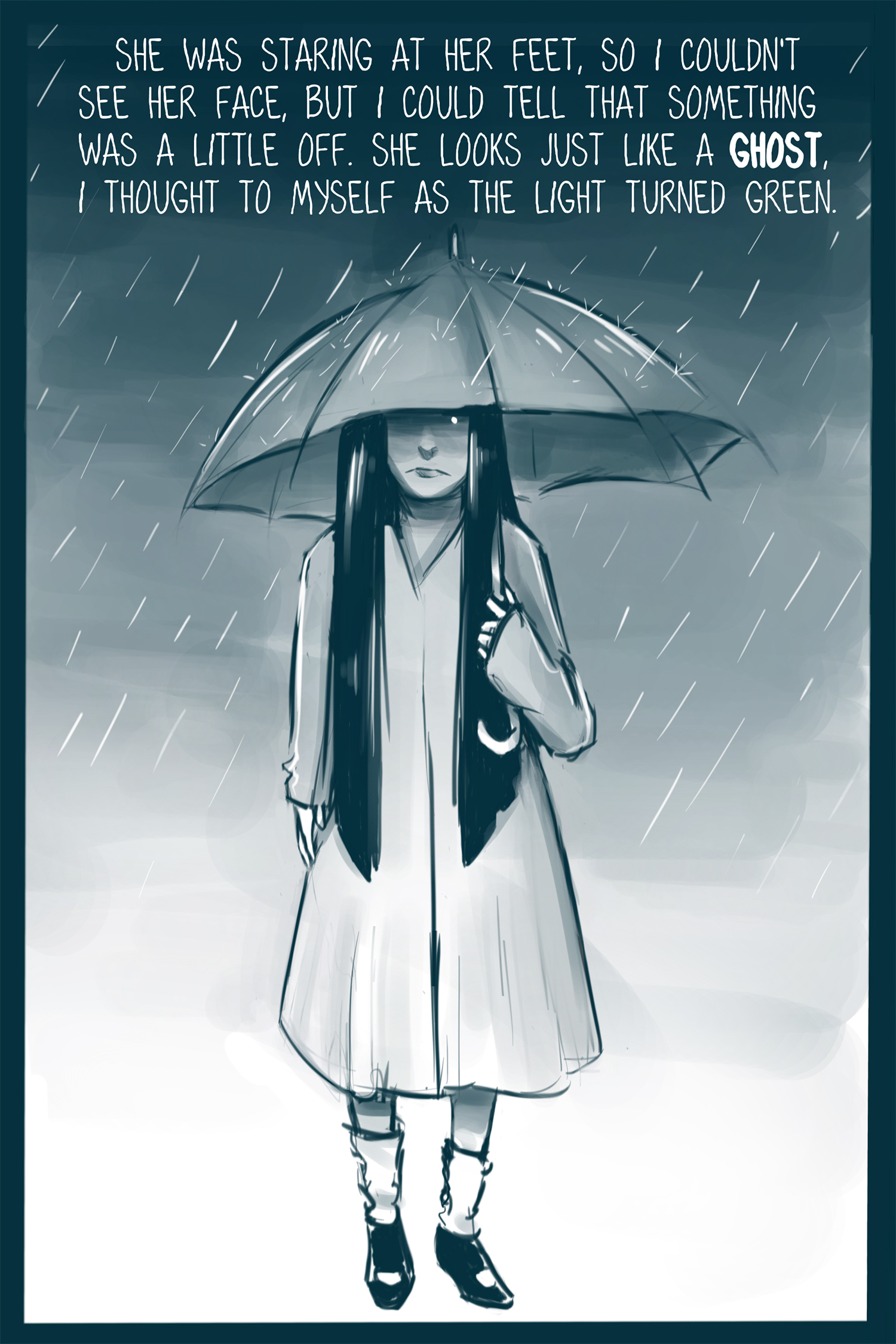
This comic was drawn by Frankiesbugs (@frankiesbugs on Tumblr) and written by me, Kathryn Hemmann (@kathrynthehuman on Twitter).
This actually happened to me in Philadelphia in 2012. It was super creepy, and I still think about it sometimes. Maybe this is just me, but I’m not entirely sure that Philadelphia exists in consensus reality.






 Digital Fantasy Diary