Ganondorf’s Robes in The Wind Waker

I’m excited to share my contribution to Hyrule Fashion Anthology, a fanzine celebrating the complex evolution of fashion history through the characters and setting of the Legend of Zelda series. Here’s a short description…

“A Wind-Grieved Ghost” discusses the influence of medieval Noh theater on the striking costume worn by Ganondorf in The Wind Waker. I provide a brief introduction of Noh drama and summarize how its character archetypes are enhanced by their clothing. I then explain the symbolism of Ganondorf’s gorgeously patterned robes and argue that the sartorial allusions to Noh theater serve to characterize Ganondorf as a frightening yet tragic ghost displaced from the beautiful vanished kingdom of Hyrule.

If you’re interested, you can read the full essay on AO3 here:
https://archiveofourown.org/works/60062635

I consider myself extremely fortunate to have this essay illustrated by the dangerously stylish Astarsor, who shares bold and colorful character portraits on Instagram (here).

Leftover sales for Hyrule Fashion Anthology are open until November 15. This is a beautifully published zine filled with gorgeous artwork and fascinating articles inspired by the golden age of glossy fashion magazines, and it’s a stunning physical object. You can pick up a digital or paper copy along with a dazzling selection of merch via the zine’s storefront (here).

Evil Gardening with Ganondorf

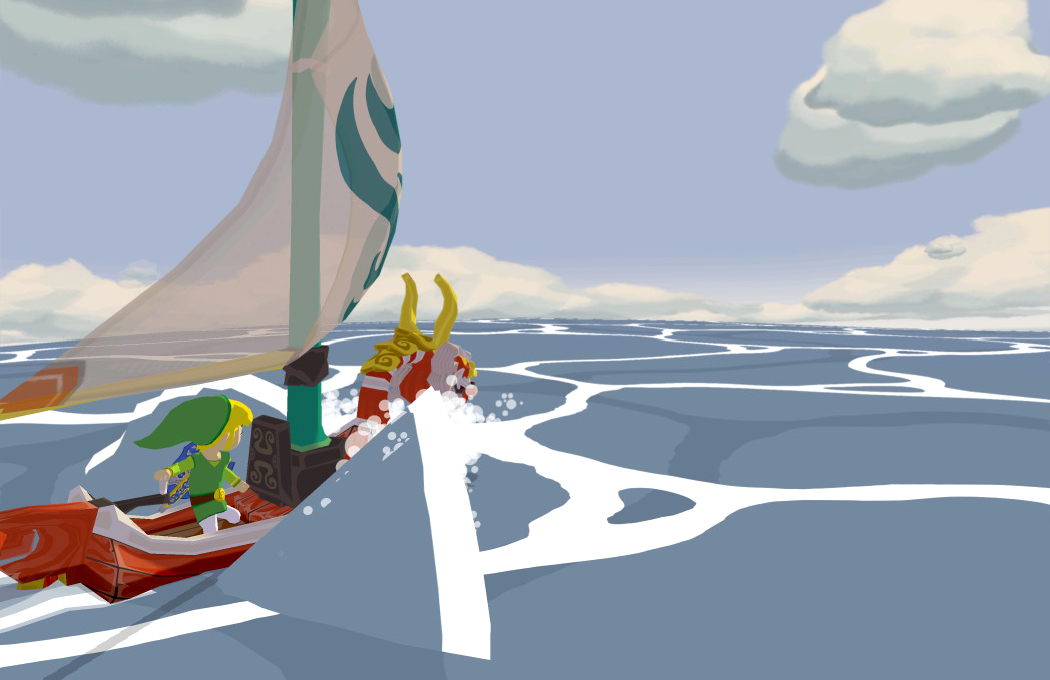
I always seem to find myself in a Wind Waker mood during summer. One of the many things I love about The Wind Waker is how beautiful and green and breezy it is. It’s a joy to spend time in the world of the game, which is filled with all sorts of strange and interesting creatures.

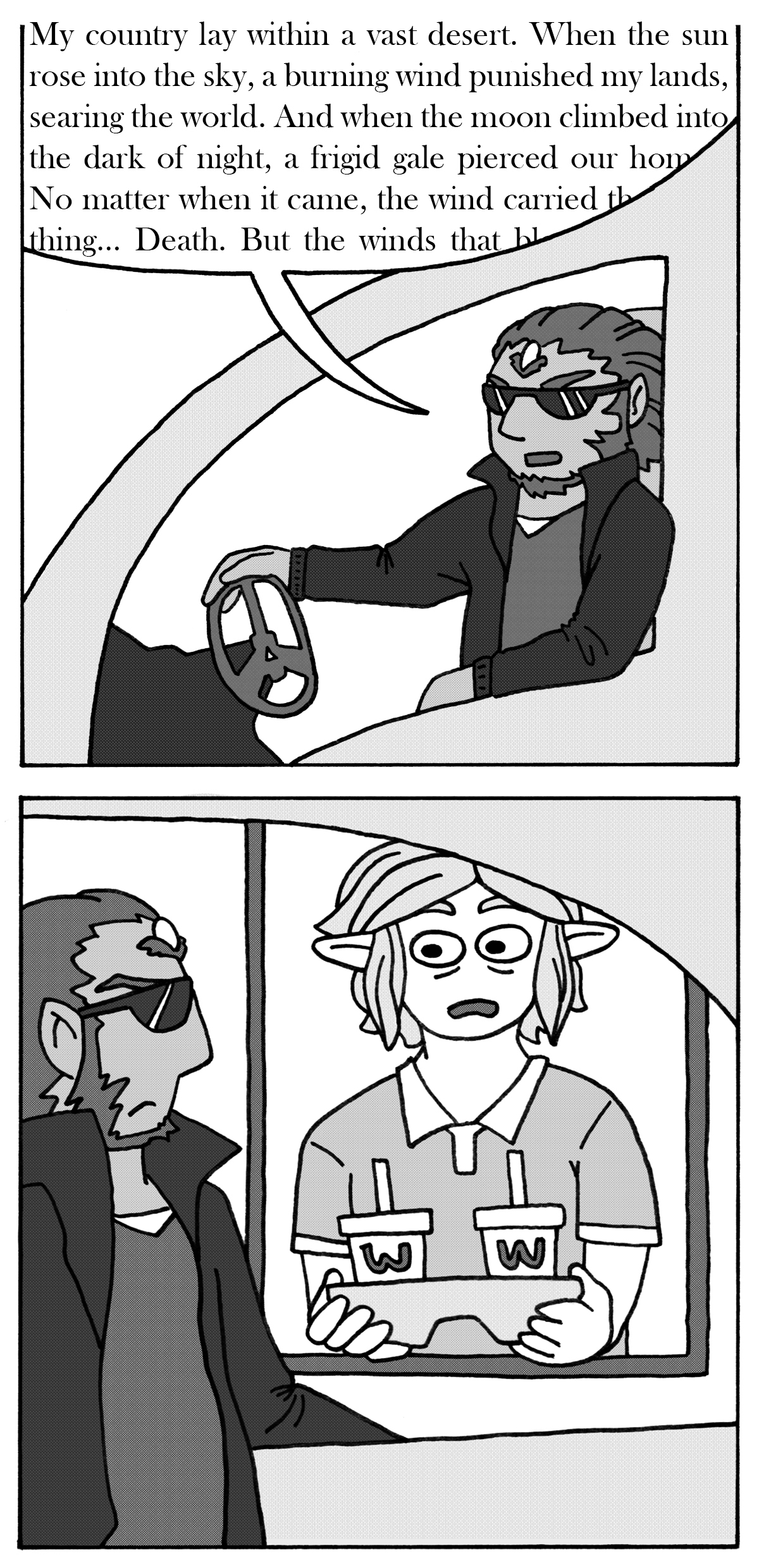
To me, then, it’s always been amusing that the Deku Tree in the Forest Haven blames this state of affairs on Ganondorf. I believe the implication is supposed to be that Ganondorf is so innately evil that his very presence on the Great Sea causes monsters to appear, but that’s extremely silly. Ganondorf may be up to no good, but he’s just a crabby old man.

If Ganondorf is responsible for the appearance of plant monsters, I prefer to think that this is because one of his many old man hobbies is gardening. Evil gardening!!

This comic was drawn by the darkly brilliant Frankiesbugs, whose cute and creepy illustrations and comics can be found on Tumblr (here), on Instagram (here), on Cara (here), and on Redbubble (here). Frankiesbugs is also responsible for the comic art and environment design featured in an upcoming beat-em-up game called V’s Rage. Like Wind Waker, V’s Rage boasts plenty of cute creatures, beautiful sun-soaked landscapes, and ridiculous middle-aged men. You can check out the game and play a substantial free demo on Steam (here).

RiME

Rime (stylized as RiME) is an atmospheric 3D exploration adventure game released in May 2017. Its aesthetics are heavily influenced by The Legend of Zelda: The Wind Waker, while its nonviolent gameplay is a tribute to Journey. You’d think this game would be made specifically for me, but I didn’t like it. The music and graphics are beautiful, but the gameplay is abysmal, while the larger story is almost laughably trite. What I’d like to do is try to explain why Rime didn’t work for me.

Like Journey, Rime doesn’t tell the player how things work but instead helps you figure out the mechanics for yourself through environmental design. At the beginning of the game, a young boy washes up on a deserted island, and within the first few minutes he’s given the task of activating four statues. Each of these statues is marked by a bright blue beam that serves as an obvious goalpost indicator. One statue is just off the main path from the beach to the interior of the island, one requires the boy to feed fruit to a boar so that it will move out of his way, and one requires the boy to dive and swim through an underwater passage in order to reach a small offshore structure.

Rime gently guides the player through the actions needed to achieve the first of these three goals. When the boy stands next to the first statue, the triangle button appears onscreen, showing the player how to activate it with the “voice” command. When the boy stands close to the fruit bushes next to the second statue, the square button appears onscreen, showing the player how to pick the fruit with the “interact” command. When the boy swims to the small structure in the bay, the cross button appears onscreen, showing the player how to dive using a variation on the “jump” command. No problems here.

The difficulty with the fourth statue is that it’s far away from the point of specialist action needed to reach it. Moreover, this target point is not flagged in any way. What the player is supposed to do is use the circle button (which otherwise makes the boy perform a somersault) to drop down from a cliff so that the boy hangs from it by his fingertips. He then shimmies along its edge until he can jump to another cliff before following a path to the other side of the island.

There are plenty of cliffs on the island, but most players will have learned that they mark boundaries, as jumping off of them will result in death. Climbable ledges are marked by white erosion patterns, but the player can’t see these patterns from above. Since the cliff the boy needs to navigate is so far away from the actual statue, it would stand to reason that the circle button would appear onscreen when the player approaches this particular cliff – but it doesn’t.

I therefore spent a good 45 minutes running around and trying to jump over or climb up or somersault through piles of rocks close to the fourth statue, all to no avail. I finally had to give up and resort to a video walkthrough. This sort of failure in accessible design wouldn’t be a flaw in a game that’s meant to be difficult, perhaps. Unfortunately, it’s definitely a problem in Rime, which consistently feels twitchy and stressful instead of expansive and atmospheric.

Where Rime succeeds are its striking and brightly colored landscapes, but the game forces the player to spend an inordinate amount of time in unlit interiors fooling around with finicky moving block puzzles hindered by awkward camera angles. On top of that, Rime‘s platforming elements are atrocious. The boy’s jumps won’t successfully land unless he’s positioned in exactly the right place and at exactly the right angle. Again, the camera angle often doesn’t help. The character moves so slowly that returning to the jump point is often a tedious process, especially later in the game when chains of jumps must be completed.

The narrative payoff for the platforming and block puzzles is that the player gradually learns the boy’s story. I suspected that, like other indie games in which a child must complete trials in an otherwise empty world, the boy might already be dead. If that was the case, I wasn’t sure that the emotional payoff of the game would be worth the frustration.

It turns out that the boy is in fact dead, having fallen overboard during a storm while on a boat with his father. It’s not clear whether you play as the kid’s soul making the transition from life to death or whether you play as the father imagining the kid’s fantasy adventures as he navigates his grief, but the last bit of the game involves the father walking around the kid’s room and picking up the kid’s toys, each of which played a symbolic role in the game (a stuffed fox is the fox spirit that leads you through the early stages, and so on). I am predisposed to cry at video games, but this revelation came so totally out of left field that I had no reaction at all.

I think I would have preferred a more straightforward story of a kid being shipwrecked on an island and discovering the remains of an ancient civilization. The game is structured so that the boy is able to visit the island in what seems to be different time periods. In one era, it’s lush and green. In another, it’s filled with ghosts and sand-choked ruins. In yet another, there are robots. Many of the game’s puzzles involve circles, orbits, the sun and moon, light and darkness, and other elements that suggest the cyclical nature of time. It would therefore make sense, both in terms of game design and gameplay, to have the game’s theme be the ultimate ephemerality of human achievement within the endless flow of time.

I can imagine a number of interesting endings in line with this theme. It would be cool if the boy gradually realized that he’s the heir to this ancient civilization but then left everything behind on the island so that he can go home, for instance. Or perhaps the boy might inadvertently (or deliberately) destroy everything on the island, but this wouldn’t be a tragedy to him. Or maybe the boy was sent to the island as some sort of trial or pilgrimage in order to become an adult.

At first glance, Rime seems to have a lot of potential, but I was disappointed that it isn’t more thematically cohesive. As it stands, the game feels like a waste of what could have been a gorgeous work of environmental storytelling. I’m not sure that even the most resonant of themes or the most brilliant storytelling could make up for Rime’s endless series of needlessly frustrating puzzles and godawful platforming, though. In the end, all the art and atmosphere in the world can’t compensate for a poorly-designed game that feels bad to play.

Still, I don’t have it in my heart to say that there’s nothing good or interesting about Rime. It’s not a long game, maybe only about seven or eight hours, and parts of it are genuinely beautiful and clever, especially toward the beginning. Since there’s no payoff at the end, my recommendation would be to get Rime when it’s on sale and enjoy it until it stops being fun.
A Worthy Successor

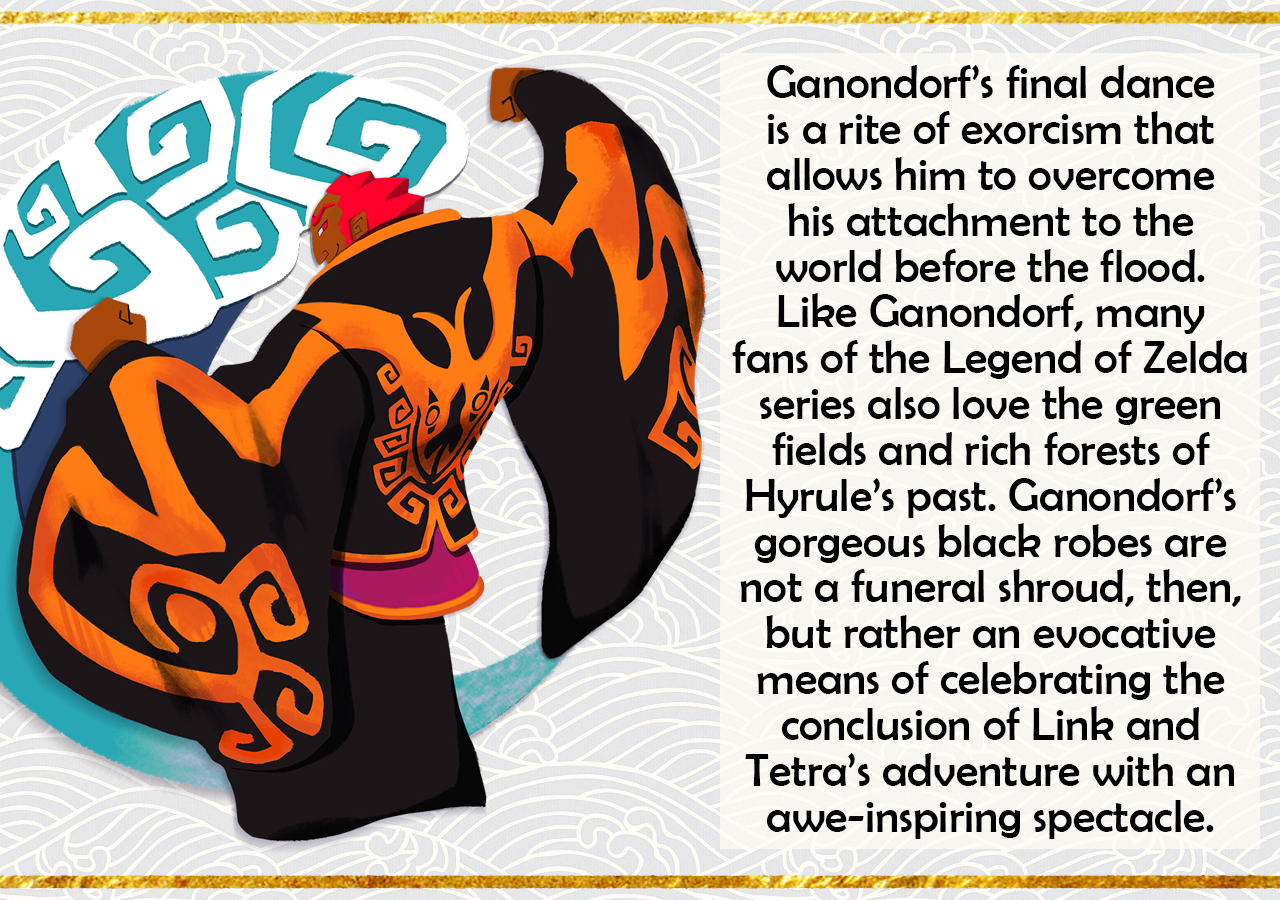
In an eerie castle submerged under cursed waters, Ganondorf tells Tetra about the world that once was. Ganondorf’s story is at its end, but his words inspire Tetra to dream of the world to come.

I recently started playing The Wind Waker in order to do research for a short essay about Koroks. The Wind Waker is a fresh and lovely game, at least at the beginning, and I always forget the emotional impact of the end. The pathos of Ganondorf’s longing for the Hyrule of the past always gets me right in the heart.

I think it’s interesting that, after The Wind Waker, Tetra goes on to establish New Hyrule, the setting of Spirit Tracks. She thereby achieves Ganondorf’s goal of restoring an ancient kingdom blessed by gentle winds. This begs the question – how would Tetra know about Hyrule? Given how much time Tetra spent with Ganondorf under the Great Sea, I think it’s safe to assume that they must have talked to one another.

This story is my attempt to envision what these conversations might have been. I wrote this story a few years ago, but I’m returning to it now because it still resonates with me. The older I get, the more I sympathize with Ganondorf, and the more willing I become to let decaying empires fall to ruin in favor of embracing the winds of change.

You can read the story here:
https://archiveofourown.org/works/35251798

The comic adaptation is by the magical Lightsintheskye, who is:
(on Twitter) + (on Tumblr) + (on Etsy)

Hyrule Fashion Anthology Preorders

Hyrule Fashion Anthology is open for preorders (here)!

Hyrule Fashion Anthology is a fanzine celebrating the complex evolution of fashion history through the characters and setting of the Legend of Zelda series. I contributed an essay titled “A Wind-Grieved Ghost” about the influence of medieval Japanese Noh theater on Ganondorf’s costume and character in The Wind Waker. I put a lot of love and research into this piece, and I may have even made myself cry.

The zine is filled with gorgeous fashion illustrations that illuminate the historical and cultural influences of the character designs in the series, as well as brilliant renditions of fan-favorite characters in a diversity of times and places. In addition to the artwork, the zine also includes articles about weaving, metalworking, and the beauty of style in all its forms.

Preorders are open until September 19!
If you’re interested, you can check out the zine through these links…

Carrd: https://hyrulefashionanthology.carrd.co
Twitter: https://twitter.com/HyruleFashion
Bigcartel: https://hyrulefashionanthology.bigcartel.com

How The Wind Waker Navigated Fan Expectations

I’m excited to have published an essay titled “How Legend of Zelda: The Wind Waker Navigated Fan Expectations” on one of my favorite video game sites, Sidequest.

I’ve been studying fan interpretations of the Legend of Zelda games for about five years, but I’ve mainly focused on fancomics. In this essay, I finally ventured into the stormy territory of IGN forums in an attempt to understand why people disliked The Wind Waker when it came out twenty years ago. Here’s an excerpt from my essay:

For better or worse, gamers have grown up, and video games have developed as an artistic medium alongside us. In the case of The Wind Waker, the Legend of Zelda fandom has matured enough to appreciate the depth of the game’s story and design, as well as the unique character of its graphic style. Meanwhile, the challenge Tears of the Kingdom will face is that many of the younger players who embraced Breath of the Wild are now seven years older, and they expect the game’s sequel to reflect the seven years of cultural progression they experienced alongside gaming fandom on social media.

If you’re interested, the full piece is available to read online here:
https://sidequest.zone/2023/05/02/how-the-wind-waker-navigated-fan-expectations/

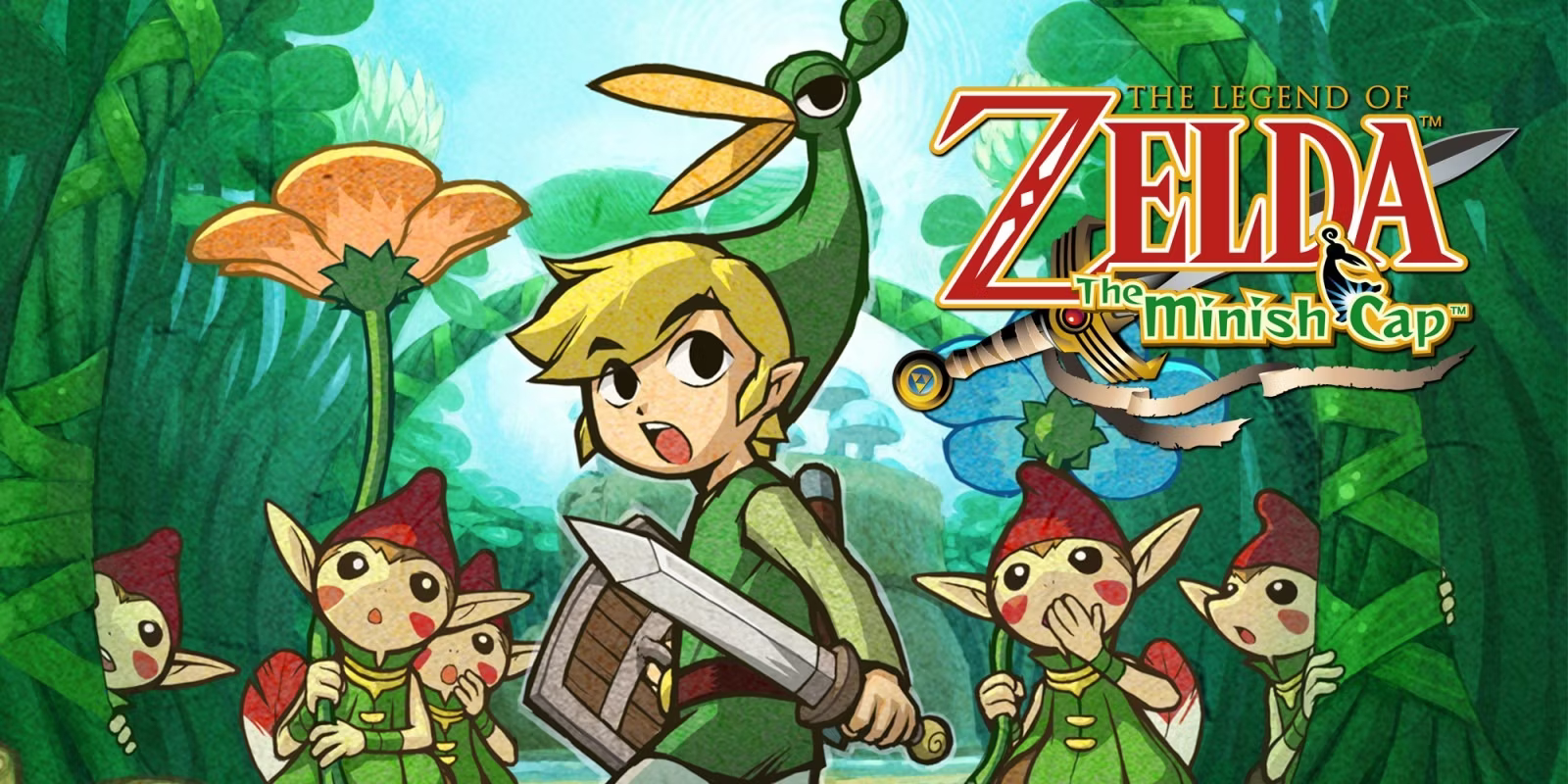
The Minish Cap

Nintendo recently released The Minish Cap on the Game Boy Advance virtual console included with its Nintendo Switch Online + Expansion Pack subscription service. This service costs $50 a year, and you have to pay the annual fee all at once. As a reminder: It is always morally correct to pirate Nintendo games.

The Minish Cap came out around the same time as The Wind Waker, and it translates a lot of The Wind Waker’s characters and enemy designs into a 16-bit pixel aesthetic modeled on A Link to the Past. As a Zelda game, the structure of The Minish Cap is very conventional: There are five themed dungeons in five themed zones. You must beat these dungeons in order, as the item you find in each dungeon allows you to access more of the world. All of the dungeons are well-designed, and it’s fun to navigate each of the five zones.

To me, there are three things that make The Minish Cap special. The first is a core game mechanic that’s brilliant and magical; the second is a minor game mechanic I hate; and the third is the game’s lighthearted tone.

The main conceit of The Minish Cap is that Link is able to shrink down to the size of the Minish, tiny little mouse-elves who live in adorable mushroom houses, hollowed-out books, and so on. The Minish spaces in the game are a Studio Ghibli fantasy on par with The Secret World of Arrietty, and there are a number of fun navigation puzzles that require Link to alternate between human size and Minish size. This is especially enjoyable during an item quest that requires you to return three books to the library, which necessitates navigating the central hub of Hyrule Castle Town at Minish size.

Unfortunately, the Minish are obsessed with fusing kinstones. A kinstone is a broken medallion, and several dozen NPCs are willing to connect their half of a kinstone with a matching half in your possession. A successful fusion will result in a small change somewhere in the world – a merchant will come to Castle Town, a treasure chest will appear in a cave, or a special golden monster will appear in the field. These fusions are mostly random, as are the kinstones you find. All of the game’s sidequests (if you can even call them that) are connected to kinstone fusions, and the randomness of the fusions can make these sidequests infuriating. Thankfully, none of the sidequests is necessary, as The Minish Cap is easy enough to play with just the bare minimum of resources.

I imagine that most players will probably think of successful kinstone fusions as fun bonuses, but a Zelda game without sidequests can feel a little empty. In addition, because many of these fusions are made with random NPCs at seemingly random points in the game, none of the sidequests is connected to a narrative.

This lack of substance and specificity is tied to the lighthearted tone of The Minish Cap, which doesn’t have much of a story. The King of Hyrule has been possessed by an evil Minish wizard named Vaati, who turns Princess Zelda to stone during the first ten minutes of the game. Because only children are pure-hearted enough to see the Minish, only Link can save Zelda. Meanwhile, none of the adults care about any of this.

Aside from Zelda and your trusty talking hat Ezlo (who has also been transformed by Vaati), nothing bad happens to anyone in the game. In fact, everyone is quite happy.

In The Wind Waker, the disconnect between the carefree world of the Great Sea and the importance of Link’s quest is a major thematic element of the story. The only person living on the Great Sea who cares about Hyrule is Ganondorf, and the only reason he cares is because he’s been woefully displaced in time. The fact that no one except the King of Red Lions understands Link’s quest emphasizes The Wind Waker’s tone of loneliness, and this is why it’s so emotionally impactful when Link finds someone who appreciates the stakes of what he’s trying to accomplish and volunteers to help.

Meanwhile, in The Minish Cap, Hyrule is densely populated by Hylians and Minish who seem to be doing just fine, even without a government. Aside from poor Zelda, everyone is living their best life, and no one needs your help. I can’t overemphasize that there is not a single element of darkness in this game, which has no narrative tension and very little forward momentum.

A fandom friend who recently played The Minish Cap for the first time said that this is the game they’d recommend to first-time Legend of Zelda players, and I can understand where they’re coming from. The Minish Cap is about as conventional as you can get. Overall, it’s really fun, and neither its combat nor its puzzles are difficult.

Unfortunately, the kinstone fusion sidequests can be hideously annoying, and the game’s “safe for children” cutesy tone makes the world and its story seem unimportant and forgettable. The Minish Cap feels like it was created for casual players, and your mileage may vary on how much you appreciate this.

In the end, The Minish Cap is still a great 8/10 game that’s very much worth playing, but it’s on an entirely different level than A Link Between Worlds, which perfected the top-down 2D Zelda formula while also featuring excellent writing and interesting design work. Given its limitations, I think The Minish Cap will probably appeal most strongly to 16-bit retro game fans, as well as its actual target demographic of ten-year-old kids.

The Legend We Create

The courageous hero loves the wise princess, but they are bound by their fate and must put their feelings aside for the sake of a world floating above the ruins of an ancient kingdom.

…or so the legend goes, but some storytellers have a slightly different interpretation.

The Legend We Create is a tale of mutual pining and second-chance romance on the Great Sea, as well as a meditation on how each new generation heals the wounds of history by telling their own narratives about the past. You can read this short story on AO3 (here).

This story was published in Fated: A Zelink Zine. You check out the work of the other contributors on the zine’s Twitter account (here).

My Favorite Things in Ocarina of Time

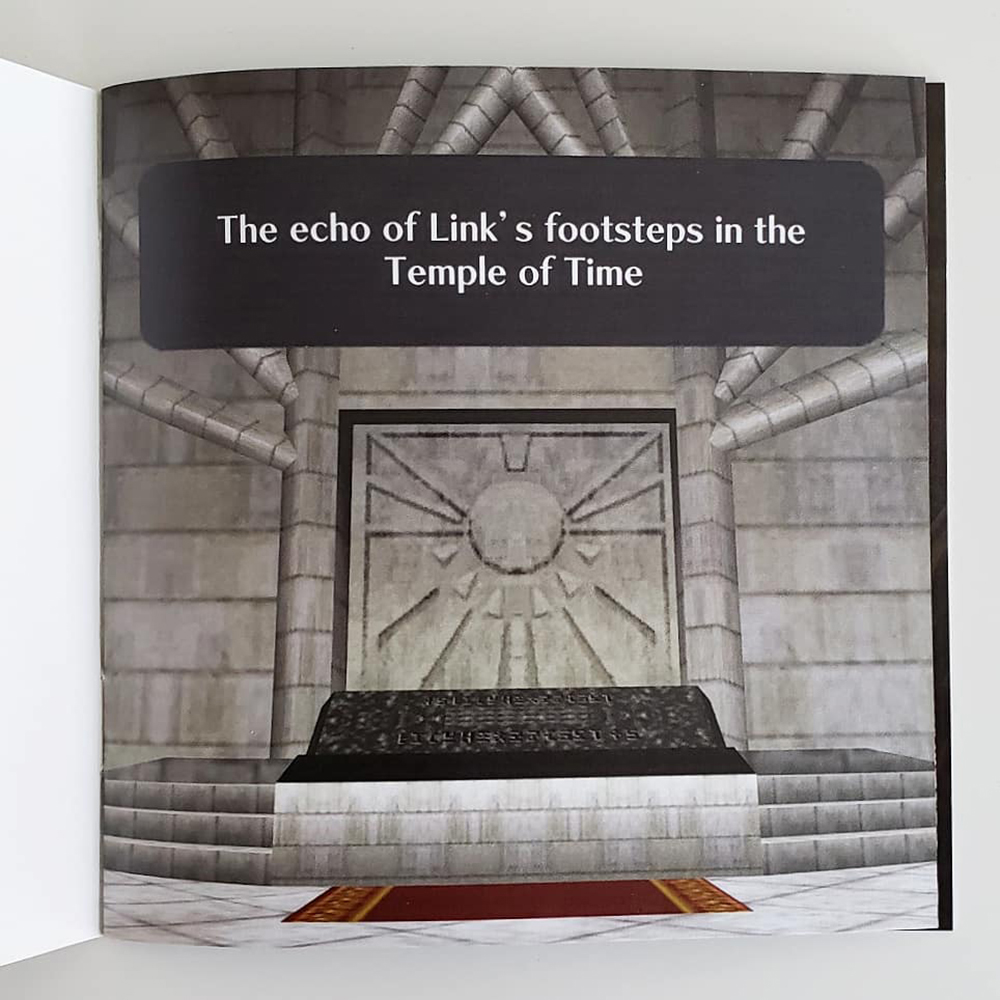
This is a small zine I made to express my appreciation for some of the more interesting things in Ocarina of Time using graphics and screenshots from the game itself. It’s eight pages long and 4.75″ x 4.75″ (roughly the size of a Nintendo 3DS box).

It took me about four hours spread out over two days to make this zine. On the first day, I spent two hours collecting screenshots and other graphic elements like text boxes and fonts. On the next day, I spent another two hours creating the front and back covers, laying out the pages, and writing the text. My previous zines took weeks to put together, so I wanted to challenge myself to make something short in a limited amount of time.

I also made this zine to have something small to sell for $1.00 at the DC Zinefest this summer. I sold almost all of my copies at the event, and I put the remaining copies in my shop on Etsy. I think it’s probably fair to say that there are a lot of people who love the Legend of Zelda games, and it’s been fun to use this zine as an excuse to meet and talk with other Zelda fans in person and online.

What the experience of making this zine taught me is that it wouldn’t be that difficult to make something like a fake game manual that looks fairly official. What this means is that, at my current Photoshop skill level, I could make something that looks almost exactly like the official game manual for Ocarina of Time but provides “instructions” for an entirely different version of the game. For example, I could make a manual for a game in which Princess Zelda is the protagonist or a game in which it’s the player’s goal to capture and tame various monsters. I could also (very easily) reframe Ocarina of Time as a dating sim. The possibilities are endless, really.

In the future, I think it would be fun to do a similar zine about my favorite things in The Wind Waker. It might be also cool to create a fake Wind Waker game manual written from the perspective of Ganondorf, who wants the hero to stop mucking around and bring him the Triforce already. I’m planning to start work on an actual book about The Wind Waker soon, and making these two zines might be a good way to keep the project exciting and interesting.