Only Power Remains

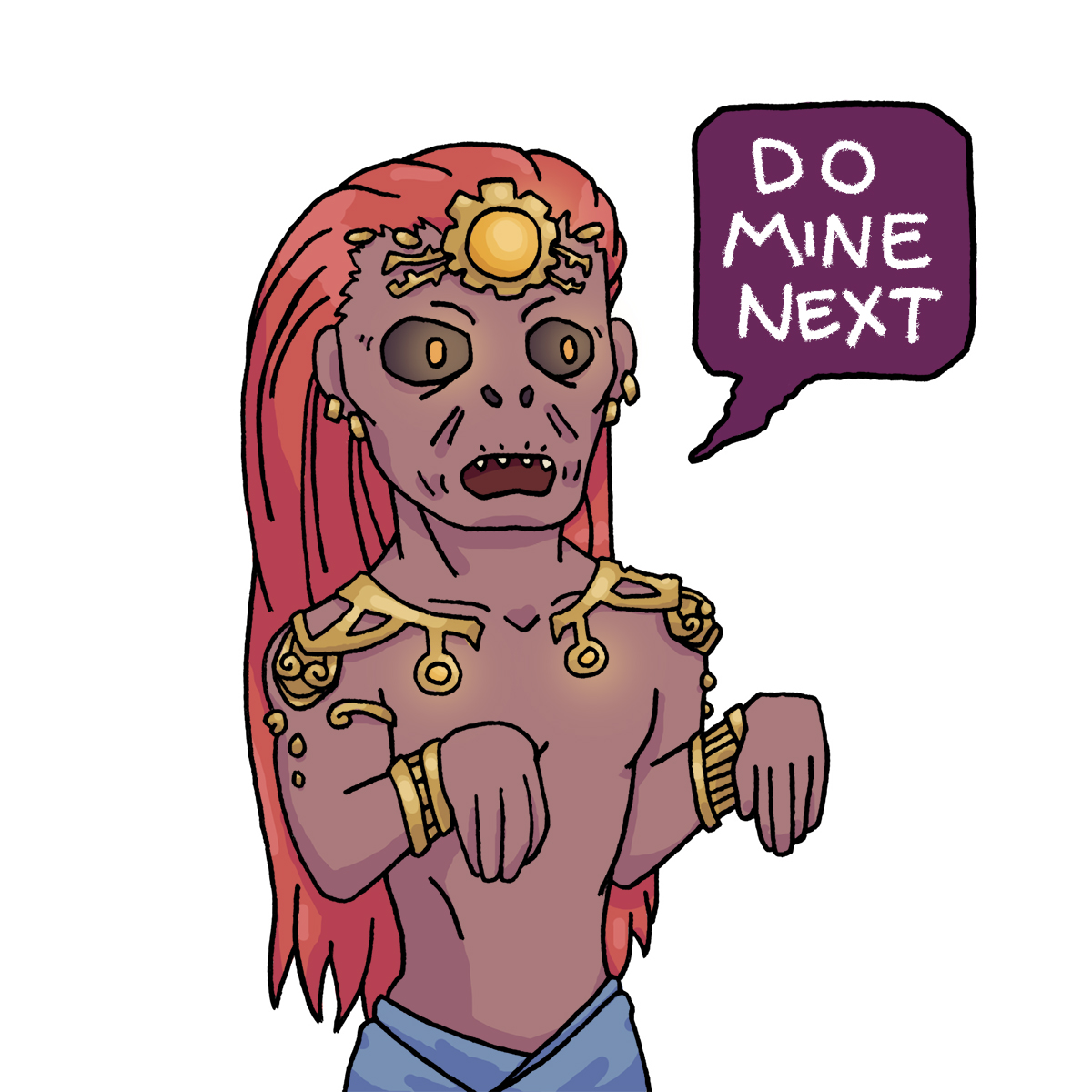
Only Power Remains is an Ocarina of Time fancomic that explores the backstory of Ganondorf, the iconic villain of the Legend of Zelda games. According to the series lore, Ganondorf was the only male child born to the Gerudo, and otherwise all-female society living in the desert at the border of the kingdom of Hyrule. Through a series of connected scenes, Only Power Remains investigates how Ganondorf grew from a strong-willed boy to a power-hungry warlord.

This comic is a fascinating and insightful exploration of Ganondorf’s backstory that rings true to the Legend of Zelda canon while still being accessible to casual fans of the series. It also stands on its own as a cohesive story, and I would happily recommend it to curious readers who may not be familiar with the details of the Zelda games. Louisa Roy’s writing is sharp and original, and her vibrant and expressive art does a lot of heavy lifting in terms of introducing and developing established characters.

In her extensive “Author Notes” at the end of the zine, Roy explains that she especially enjoyed drawing Ganondorf’s childhood interactions with a merchant in Hyrule Castle Town. The merchant is disrespectful during their first meeting, as he sees Ganondorf as nothing more than a bratty kid. Ganondorf therefore learns the Hylian language spoken by the merchant in order to come back a year later and verbally cut him down before taking what he wants from his stock of musical instruments. Without becoming too political, Roy conveys the tensions of cultural differences, and there’s a certain charm in watching Ganondorf slice through the Gordian knot of xenophobic stereotypes.

The supporting cast receives a similar level of nuance and sympathy, especially Nabooru, a Gerudo leader who eventually rebels against Ganondorf. With Nabooru, as with Ganondorf, the reader is given a sense that the tragic story of the Gerudo could have gone a different way had circumstances been even slightly different. The comic ventures into many unexplored corners of Hyrule during its journey, but the artist’s design work is brilliant and remains faithful both to the world of the games and to their real-life cultural influences.

Only Power Remains is far from the first Legend of Zelda fancomic created by Louisa Roy, who has published a number of zines featuring side stories that allow the minor characters in the games to shine in their own heroic (or antiheroic) light. The publication quality of these comic zines is consistently excellent, from the layout to the lettering to the cover design. You can follow the artist as @om_nom_berries on Twitter and @om-nom-berries on Tumblr, and you can find her comics on her website (here) and browse through her zines on Etsy (here). If you’re interested in Only Power Remains, you can check out the listing is (here).

Ballad of the Wind Fish

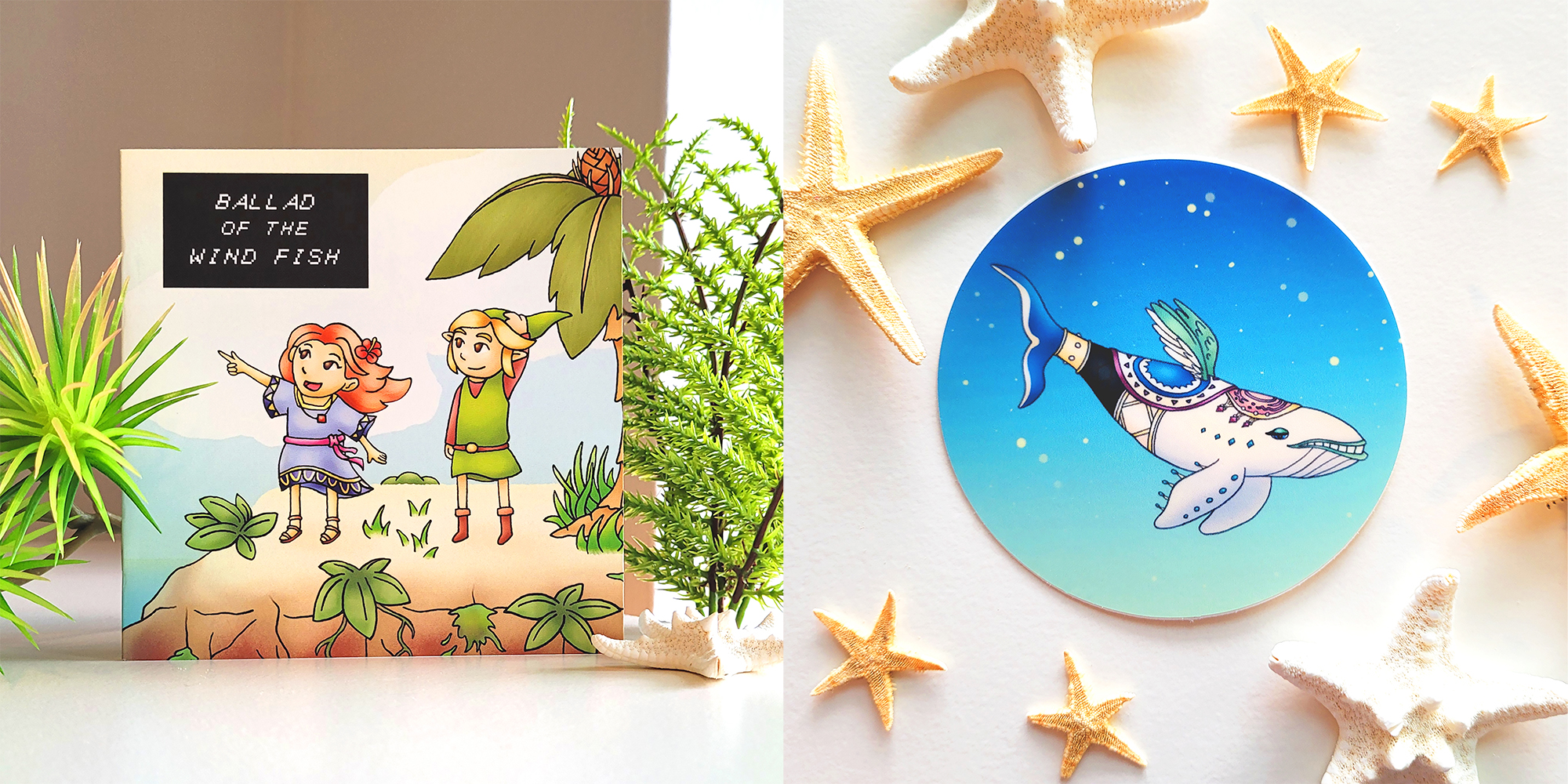
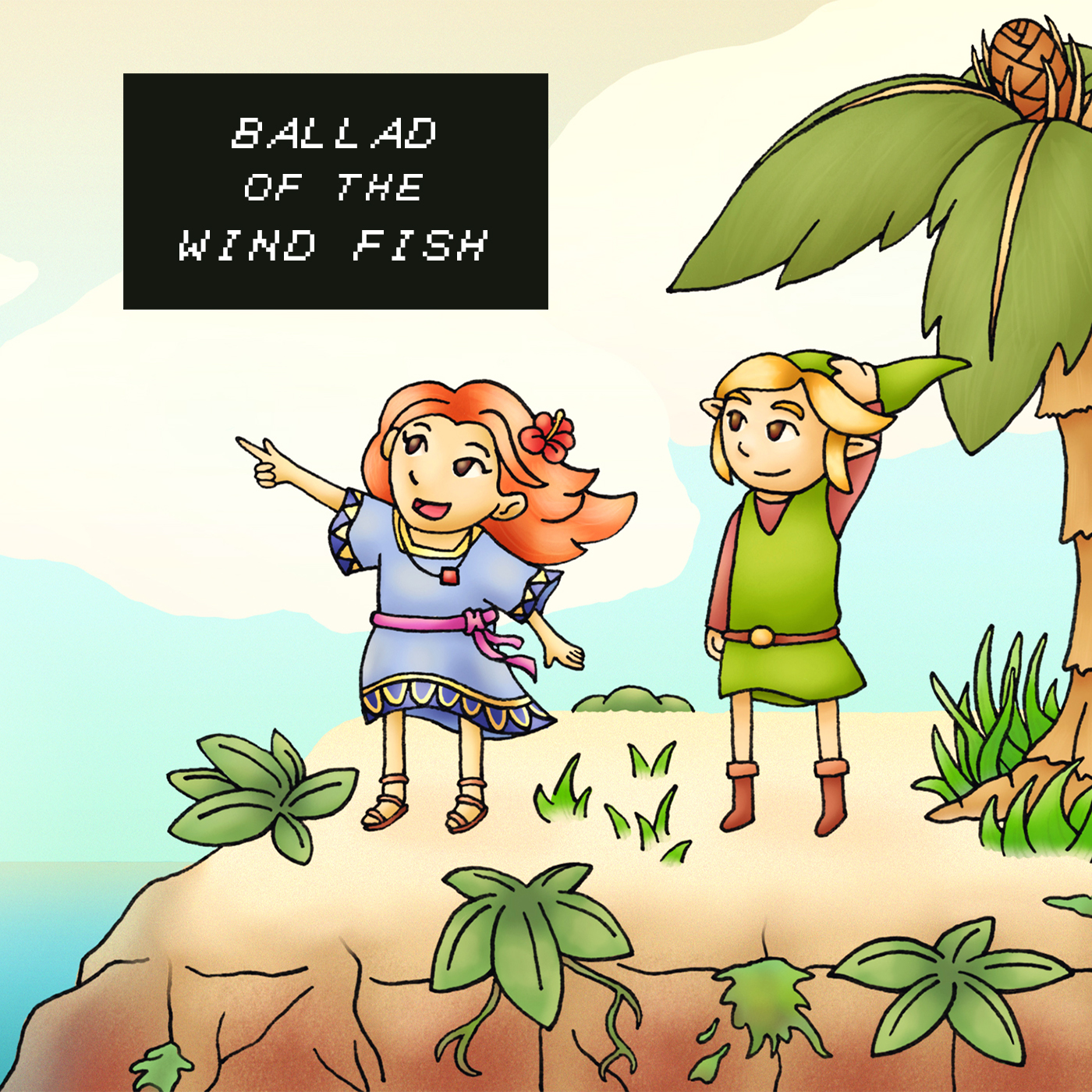
Ballad of the Wind Fish is a bittersweet narrative minicomic that uses the 1993 Game Boy game The Legend of Zelda: Link’s Awakening as a stage to explore the connections between childhood fantasies, nostalgia, and escapism.

The comic is twelve pages long, with one panel per page. I created it for the #Linktober drawing challenge on Instagram during October 2019, but it’s still very near and dear to my heart. Although the comic is ostensibly about Link’s Awakening, it’s really more of a meta exploration of a certain glitch in the original release of the game, as well as a meditation on being a child of the 1990s. I formatted it into a zine and created two pieces of polished art to use for the cover. It’s my hope that this short comic fills the reader with warm memories and sunny summertime vibes.

You can download a free digital copy from Gumroad:
https://gum.co/windfishzine

If you like, you can buy a physical copy on Etsy:
https://www.etsy.com/listing/1035486197/ballad-of-the-wind-fish-zelda-minicomic

The zine is 4.75” square, or roughly the size of a Nintendo DS game case. It’s professionally printed in vibrant full color, and it comes with a 3” circular vinyl sticker depicting the eponymous Wind Fish.

If you’d rather not bother with any of that, you can read the comic as I originally posted it on Tumblr (here).

The Legend of Haiku

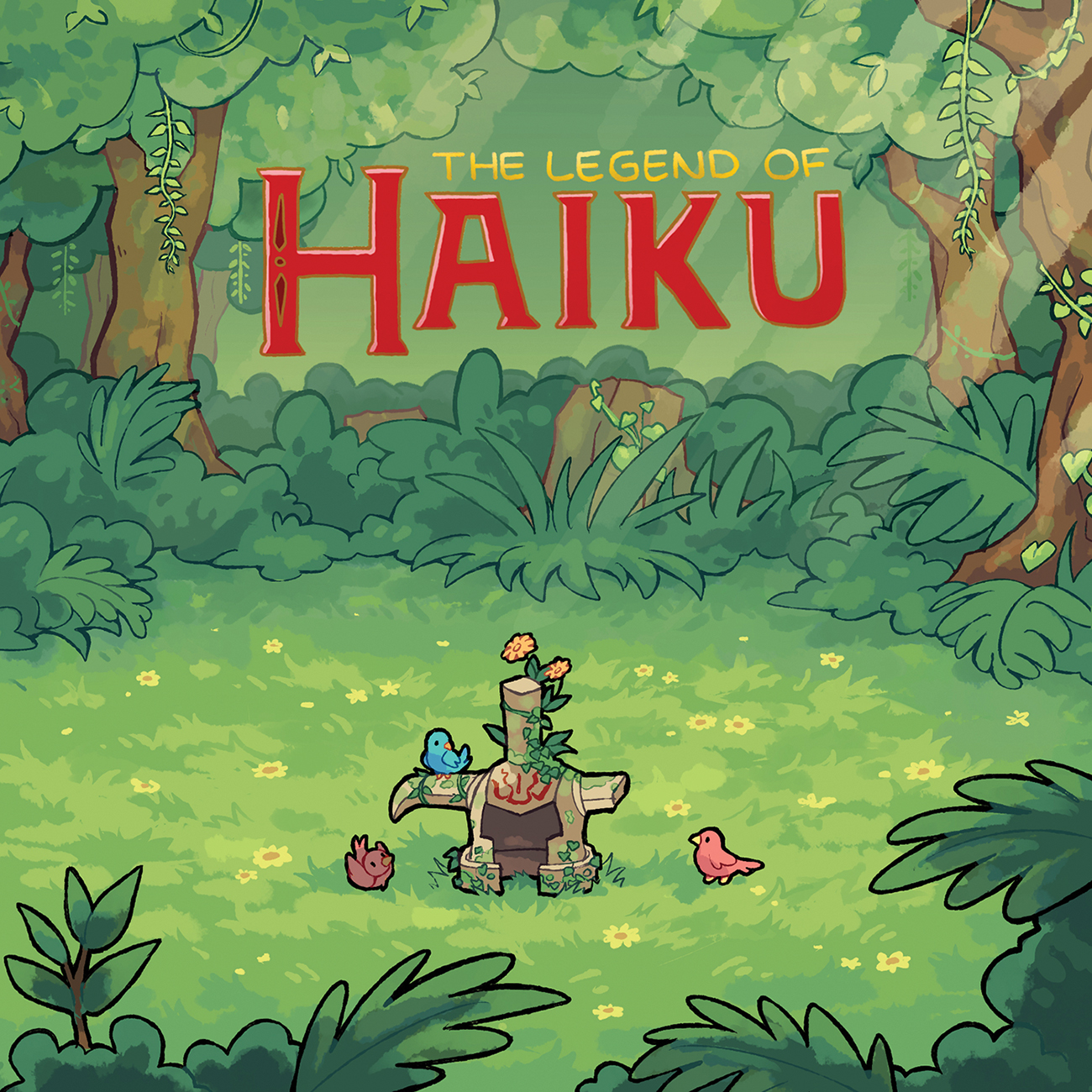
The Legend of Haiku celebrates the natural environments and quiet moments of the games in the Legend of Zelda series. This 46-page zine collects the work of 28 poets and artists from around the world who have pooled their talents to create a gentle adventure into a beautiful green world filled with mystery and discovery.

🌿 You can download a free digital copy on Gumroad (here).
🌿 There are a handful of physical copies available on Etsy (here).
🌿 You can download the digital zine directly from Google Drive (here).

This project was a journey. I had initially planned to release the zine in November shortly after the end of the submission period, but I received such an incredible diversity of submissions from such a large number of people that I found myself at a loss regarding the best way to move forward. In addition, the pandemic resulted in severe delays with the United States Postal Service, and I actually had to close my store on Etsy because nothing was getting where it was supposed to go. I therefore had to put the project on hiatus for three months, and I was only able to resume work in March.  

If I learned anything from this process, it’s that most people are lovely and patient and kind. I was expecting to encounter more frustration, but everyone was very chill and nice.

I also learned that it’s good to take a big project like this in baby steps until I reach a sense of critical mass and can work for longer periods as I get a better sense of what needs to be done and how best to do it. I wasn’t prepared for the incredible response I got concerning this project, but I’m very grateful for the support of the contributors as I muddled my way through.

Thankfully, the zine turned out to be gorgeous, so it was all worth it in the end.  

I want to give a special shout-out to the cover artist, who goes by @flyingcucco on Twitter and @acro_bike on Instagram. Trina was an absolute pleasure to work with, and she put an extraordinary level of thought and attention into creating a design that captures the themes of the project. The full, unedited wrap-around cover illustration was awarded the honor of being a Daily Deviation on the portfolio hosting site DeviantArt, and I highly encourage you to check it out (here) if you’d like to read Trina’s concise but insightful artist statement.

Memorabilia Zine

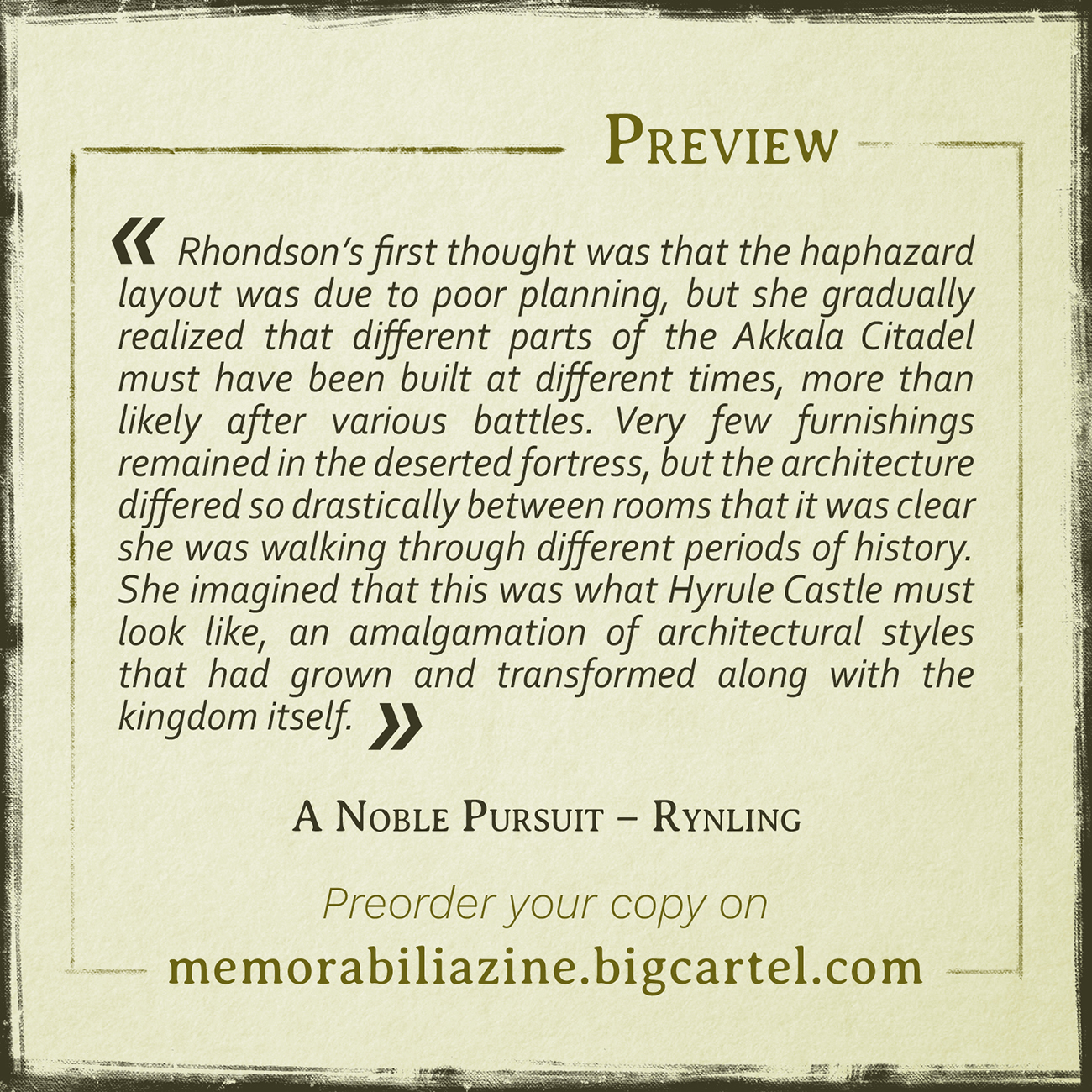
This is a preview of the short story I contributed to Memorabilia, a Legend of Zelda fanzine devoted to the archaeology and architecture of Breath of the Wild.

“A Noble Pursuit” is about Rhondson, the Gerudo tailor who moves to Tarrey Town, embarking on a husband hunt to the Akkala Citadel Ruins after Hudson goes missing. It’s a story about exploration and discovery, as well as different views of the past and hopes for the future that awaits Hyrule beyond “happily ever after.”

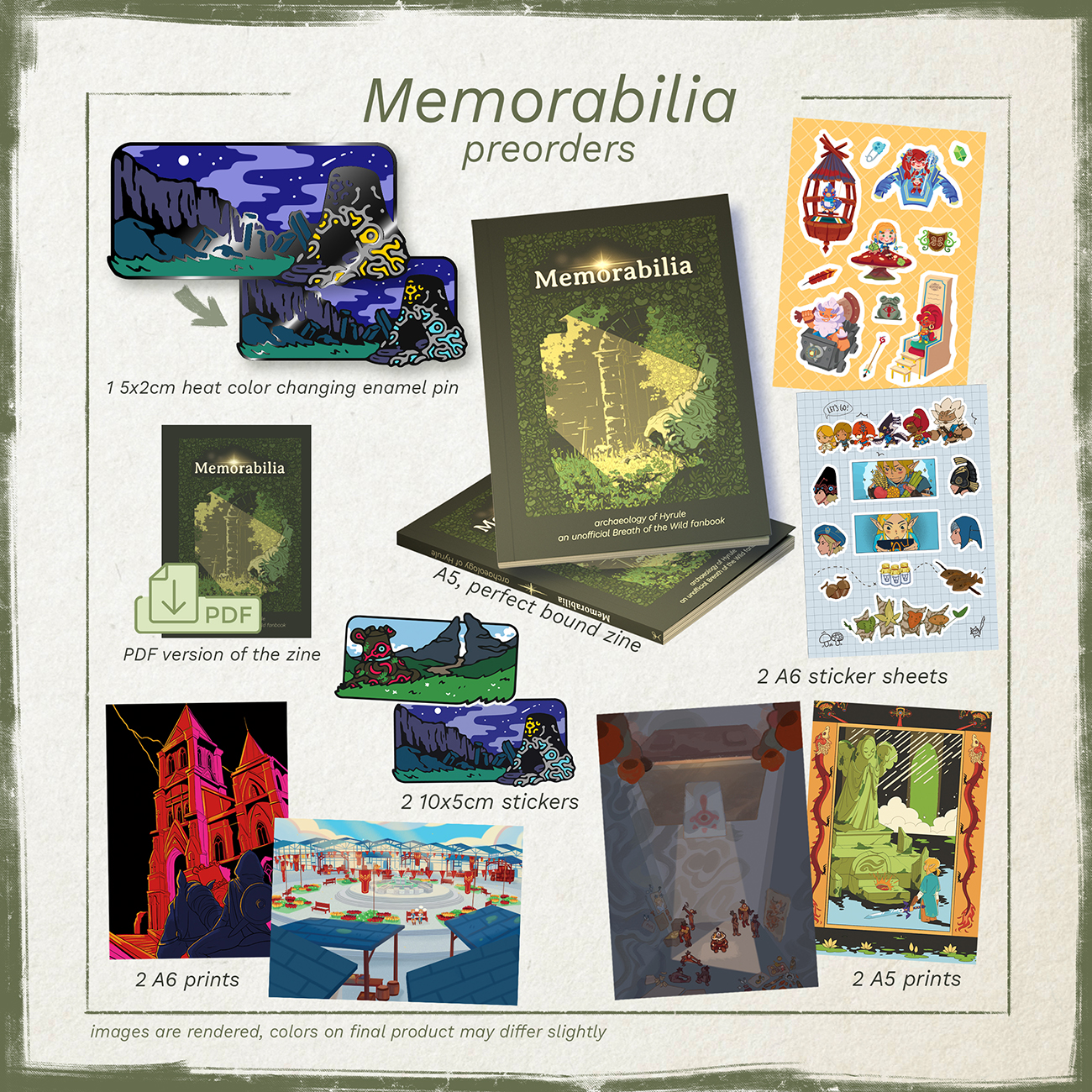
Pre-orders are open (here) until Sunday, March 14. This zine contains more than a hundred pages of brilliant writing and awe-inspiring art. It’s certain to be a treasure to anyone who enjoyed exploring the ruins and history of Breath of the Wild – and to anyone fascinated by the lore and environmental design in Creating a Champion.

You can check out more previews of the zine on its Twitter account, @MemorabiliaZine, and on its Tumblr account, @memorabiliazine.

A Short Hike

A Short Hike was released for Nintendo Switch about three weeks ago, and my only regret is that I waited so long to download it.

You play as an anthropomorphic bird named Claire who’s spending the weekend on holiday visiting her Aunt May in Hawk Peak Provincial Park, and your goal is to climb to the top of the mountain so that you can get reception on your phone. Since you’re a bird, you can jump down and glide whenever and wherever you feel the need. You can also fly for short periods of time, and you can collect Golden Feather upgrades to extend your flying time. There’s no combat, no danger, and no puzzles to solve. Although you’re free to go anywhere you like, the main climbing trail is clearly marked. If you get lost, you can just jump down and glide to an earlier point on the trail. It’s all very relaxing, and the soundtrack is adaptive, meaning that the music changes depending on the altitude and weather.

Because the game is so overtly referential, I don’t think it’s lazy to call it a cross between Animal Crossing and Night in the Woods. Some of the (completely optional) mechanics, such as fishing and digging up X marks on the ground, are pure Animal Crossing, as are the character designs. The dialogue never gets grim or dark, but it’s a little weirder and less performatively wholesome than Animal Crossing. The writing is unobtrusive but clever, and Claire has a lot in common with Mae from Night in the Woods.

Meanwhile, the exploration elements are very Legend of Zelda, and the game looks a lot like Phantom Hourglass and Spirit Tracks, from the cell shading to the head-to-body proportions to the 3D modeling of the landscape. There’s an option to increase the frame rate and make the graphics less pixelated, but the Nintendo DS style visual atmosphere is lovely even if you don’t harbor any particular nostalgia for that era of gaming.

If you go straight up and down the mountain, the game takes maybe half an hour to play, but you can easily spend another half hour going off on side trails and having conversations with the various people you meet during your climb. I imagine that you could spend even more time with the game if you wanted to find every Golden Feather and record every species of fish in your journal, but the game’s menu screen isn’t set up in a way that makes you feel compelled to do so.

I’ve read a few reviews that criticized A Short Hike for being too, well, short, but I don’t think that’s a problem. I am no stranger to the task of collecting all 900 forest sprite poos or evolving all 900+ species of battle monsters or getting all of my fantasy fighters to Level 99, but I also love being surprised and delighted by short, self-contained, and immensely satisfying small-studio games.

I’m not sure how I feel about Nintendo asking $20 for this game, which is a bit expensive for its category, but honestly that seems like a reasonable price to pay for the experience of a solid hour of uninterrupted joy.

Malice

(The above illustration is by the amazing @mehkuno on Tumblr.)

In my writing logs, I keep mentioning the fanfic novel based on the Breath of the Wild sequel trailer that I’m writing, so I thought I’d try to describe the project. Here goes!

Story
When the long-dormant Guardians begin attacking Hyrule, Zelda, Link, and Ganondorf go underground to try to find the source of energy powering them.

Background Setting
This is an urban fantasy set in a modern-day version of Hyrule based on New York City. In this setting, the cave that Link and Zelda are exploring in the BotW sequel trailer translates to the sewer tunnels underneath the old site of Hyrule Castle, which has been converted into government offices. Everything that happened in BotW took place about three hundred years prior to the present day, but all mentions of magic, the Triforce, and the true nature of the Calamity have been erased from history. Ancient technology is exhibited in museums, but people treat it like art and have no understanding that it’s actually machinery. When the Guardians and other artifacts of ancient technology start going berserk, no one knows what’s happening.

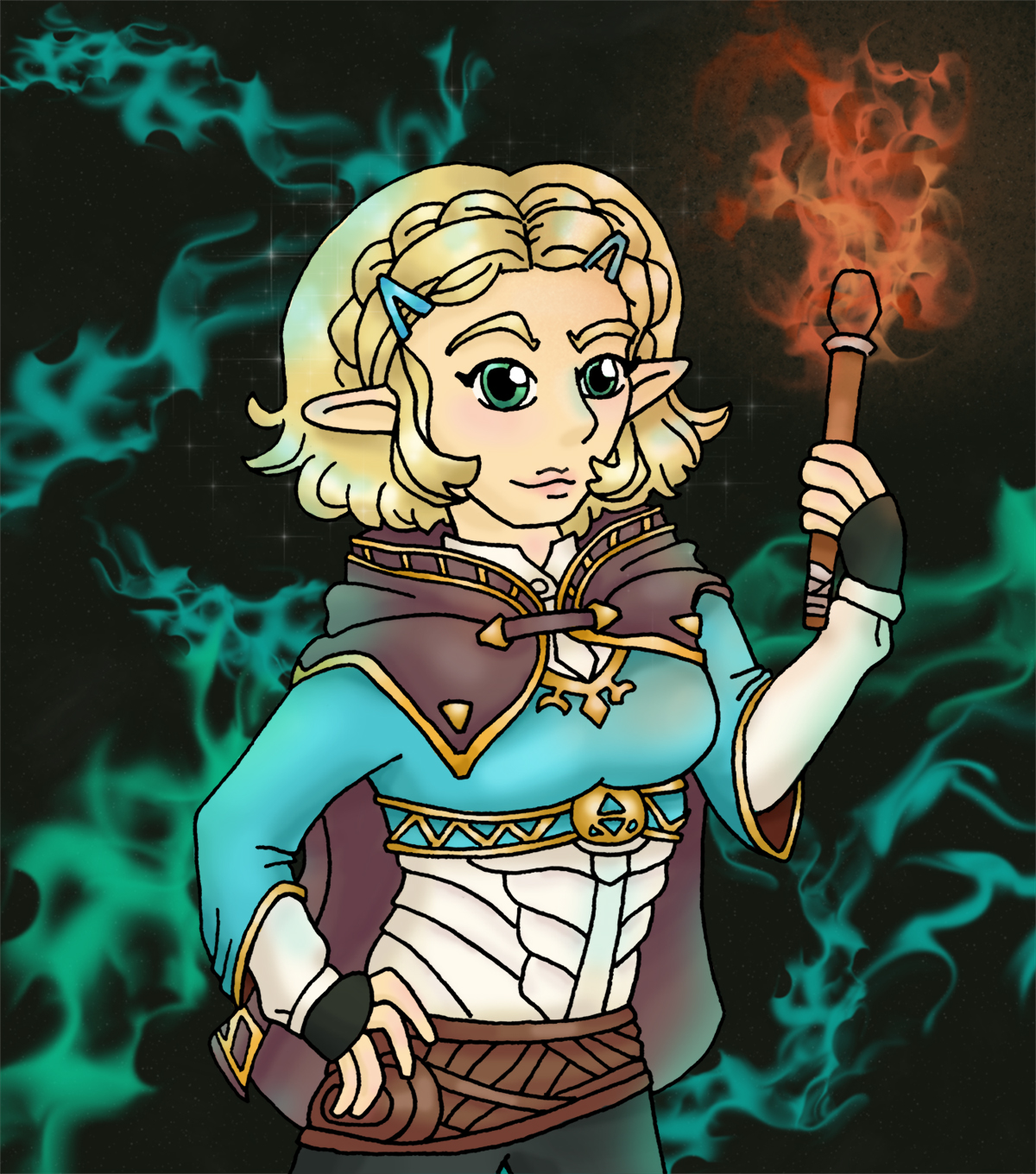
Zelda (visual reference)
Although she comes from a powerful political family, Zelda is interested in the history and functionality of ancient technology. She’s 26 years old and about one or two years out of a Master’s program in Chemistry. She wants to get away from her family’s influence, so she currently works as a lab technician. Her intention is to succeed through her own efforts while pursuing her research. She was reserved and uptight when she was younger, but her relationships with Link and Ganondorf have helped her to become braver and more self-confident.

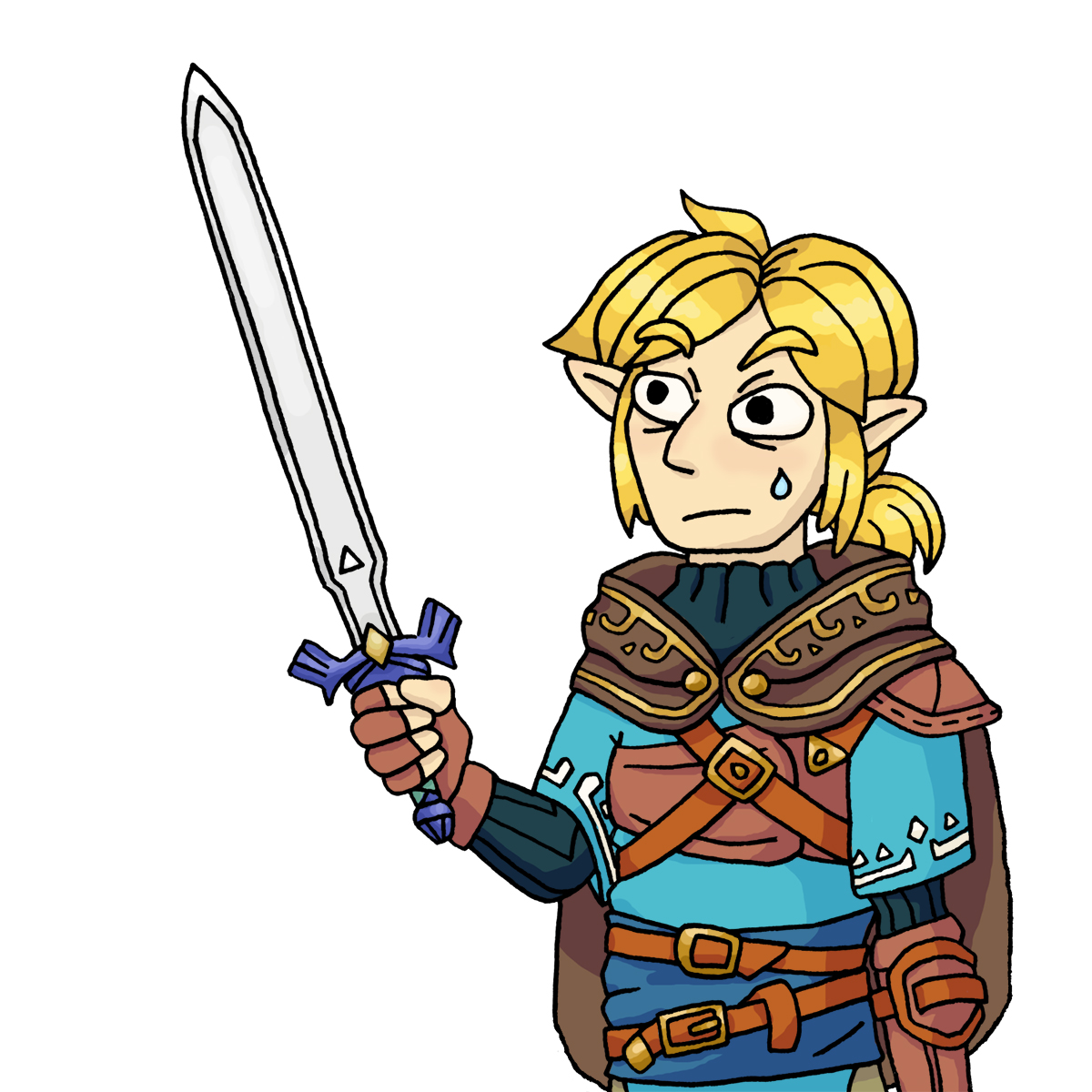
Link (visual reference)
He works as a courier for a delivery company, and there’s nothing he loves more than driving around Hyrule on his motorcycle. He’s into urban exploration and has a hugely popular account on Skyloft (Hyrule’s equivalent to Instagram). Like Link in BotW after he’s lost his memories of being constantly under pressure, this Link is easygoing, clever with his words, and a lot of fun to be around. He’s a year older than Zelda, and he gradually becomes friendly with her while making deliveries to her lab. As Zelda discovers odd inconsistencies regarding Hyrule’s history and technology, Link corroborates her suspicions by offering evidence of the strange things he’s seen with his own eyes in some of the city’s more out-of-the-way places.

Ganondorf (visual reference)
He works at a prestigious investment firm that specializes in technology. He’s only around thirty years old, but he’s inhumanly good at what he does and has managed to become extremely wealthy. Unlike Zelda and Link, Ganondorf was never in doubt that magic exists, mainly because he himself is a powerful wizard who is able to control both hardware and software. He knows what ancient technology is and what it can do, and he’d like to figure out a way to make it profitable. When his path crosses with Zelda’s, he becomes interested in her research, and he inadvertently becomes friendly with Link in the process. He’s an intense and unpleasant person, but being with Link and Zelda mellows him out and helps give him a sense of humor and perspective.

. . . . . . . . . . . . . . .

I’m afraid that I may have misrepresented this story as a lighthearted adventure. It’s a psychosexual melodrama with some fairly dark themes.

Link is smart, hard-working, attractive, and charming, but he doesn’t come from privilege, so he’s been jumping from one pointless temp job to another. He does good and interesting work on social media, but he can’t monetize it, which makes him bitter. He doesn’t feel as though he’s allowed to express negative emotions, though, so he comes off as fairly shallow. Later in the story he is going to snap and go feral.

Zelda was horribly abused as a child by her family, who tried to use psychiatric medication to control her. She represents a conflict between science as an incredible driving force of civilization and science as a means of social control, but she’s also my vehicle for working through my own experiences with how I’ve been dehumanized by the mental healthcare industry.

What’s going on with Ganondorf is something of a spoiler, but it’s distinctly unpleasant. On top of some Akira-style body horror, he’s an immigrant in a country where there’s a distinct possibility that the police could arrest (or even murder) him for no good reason. Even though he has an excellent grasp on human psychology, he sees empathy as a luxury he can’t afford, and the way this mentality influences his behavior toward Zelda can be creepy and uncomfortable.

I don’t openly talk about mental illness, but Zelda and Ganondorf are both coping with intense trauma. Neither of them is mentally “healthy,” and I don’t clearly signpost their toxic behavior as such. There’s no violence or angst or abuse for the sake of being edgy, but there’s not a lot of healing. Their character development goes from “bad” to “bad in a different way,” with “empowerment” being an unhealthy but necessary response to horrible circumstances.

When I started writing, I told myself that I would allow this story to become as dark as it needed to be, and it has gone to some places.