Best Horror Comics on How to Love Comics

I had the immense honor of being able to contribute to a list of “The 45 Best Horror Comics You Should Read” on the website How To Love Comics. Here’s how I pitched the eight titles I recommended…

Betwixt: A Manga Horror Anthology, edited by Fawn Lau and Mayuko Hirao
A diverse collection of big-name creators showcasing manga-style stories that focus on urban legends and folk horror.

Bloodborne: The Healing Thirst, by Ales Kot and Piotr Kowalski
A stand-alone story that captures the oppressive gothic atmosphere of Bloodborne while being accessible to readers with no knowledge of the game.

The Crossroads at Midnight, by Abby Howard
A single-artist collection of queer short stories with distinctive monochromatic art and intensely disturbing imagery. 

The Hills of Estrella Roja, by Ashley Robin Franklin
A lushly illustrated graphic novel about a college student on the hunt for cryptids in the beautiful but eerie Texas desert.

Loving, Ohio, by Matthew Erman and Sam Beck
A suburban gothic horror story about a small town quietly controlled by an all-too-realistic cult. 

Not Drunk Enough, by Tess Stone
A colorful and stylish horror comedy about being trapped in a mad science corporation after dark.

PTSD Radio, by Masaaki Nakayama
A quiet but intensely creepy collection of Japanese urban legends loosely connected by an overarching narrative.

The Shadow over Innsmouth, by Gou Tanabe
A painstakingly faithful Lovecraft adaptation with meticulously drafted art and a well-researched translation. 

You can check out the fully annotated list (here). There are a lot of famous heavy hitters on this list, and it was a pleasure to be able to include a few lesser-known manga and indie graphic novels.
NextDoor

NextDoor
https://broelbrak.itch.io/nextdoor

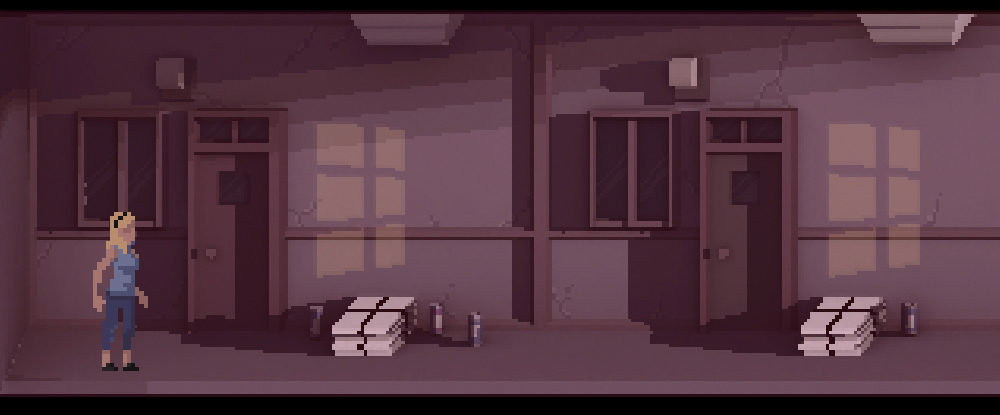
NextDoor is a spooky 2D interactive story game based on one of Junji Itō’s short horror manga. It’s free to download or play in your browser, and it takes about ten to fifteen minutes to read.

You play as a college student living in a rundown apartment building. The student is unable to concentrate because of the loud music blaring in the apartment above hers, so she finally snaps and goes to complain. The upstairs tenant is an asshole who refuses to turn down his stereo because his next-door neighbor has never said a word to him about the noise. If you can convince his neighbor to complain, the manchild gripes, perhaps he might listen to what you have to say.

The problem is that the next-door neighbors are decidedly unfriendly. Another tenant in the building says that there’s actually a group of women in that apartment, but they’re very quiet, and no one has ever spoken with them. Perhaps it’s not the best idea to attract their attention…

Despite its limited scope, the environment design of NextDoor is nicely done and more than sufficiently creepy. Ironically, the music is quite good, and the sound design is better. The character animations are a pleasure to watch, especially when the player gets to see more of the mysterious next-door neighbor.

“The Lady Next Door” is from Junji Itō’s collection Mimi’s Tales of Terror, and it’s a fun play on a category of Japanese urban legends that take the form of “here’s some weird shit I saw in a Shōwa-era (built before the 1990s) apartment building.” Itō transforms the tropes of these non sequitur “weird shit I saw” stories into a cautionary tale, and it’s delightfully cathartic to witness the unnecessarily harsh punishment of the transgressor. Because seriously, fuck that guy.

NextDoor’s adaptation of this manga is interesting in that it configures the college student as the transgressor. By association, you the player are the transgressor as well, and it’s fun to push the college student forward into increasingly bad decisions. She doesn’t die, but she most definitely sees some weird shit.

There’s one (very mild) jumpscare in the game, and it’s a cameo from my favorite Junji Itō manga, Junji Ito’s Cat Diary: Yon & Mu. Yon & Mu is exactly what you would expect from a cute autobio pet manga drawn by Junji Itō, and it’s marvelous. It’s always a pleasure to have an unexpected encounter with one of these adorable hellbeasts.

Japanese Ghost Stories

This fall, I’m teaching a new class called “Japanese Ghost Stories.” Here’s the course description…

This course offers a survey of the numinous and supernatural through Japanese fiction, drama, comics, animation, and video games from the Heian period to the present day. Students will assemble a foundational knowledge of Japanese religion and folklore while studying popular narrative traditions representative of their historical eras.

By peering into the liminal spaces connecting the living with the dead, students will develop critical thinking and media literacy through careful investigation into the matters that people of different times and places have perceived as monstrous, alien, and unspeakable. Issues of gender, sexuality, and ethnic minority status will receive special attention as we navigate theories relating to the cultural role and social relevance of ghosts. By the end of the semester, students will possess a broad perspective on Japanese narrative traditions and popular culture, as well as an understanding of how fantastic stories of the dead reflect the tangible experiences of the living.  

You can download a copy of the syllabus (here).
I’ve collected PDF files of the course readings on Dropbox (here).
If you’re interested, a copy of the course assignments handout is (here).
You can check out the work of artist who drew the banner image (here).

I’d like to acknowledge that this course was inspired by Professor Naomi Fukumori’s class “The Monstrous in Japanese Literature and Culture,” and I encourage anyone who is interested to check out the course syllabus (here).