The Girl in the Screen at the End of the World

It’s been more than twenty years since rumors about a cursed videotape began to spread. The stories were true, and Japan is in ruins. Can the people who survived the collapse of civilization escape Sadako’s curse? Or do they seek her out instead?

“The Girl in the Screen at the End of the World” is a series of four short vignettes about the last living humans making their peace with the end of the world as Sadako bids a gentle goodbye to modern civilization. All of the human characters in the story die, but all the animals go on to live their best lives.

The story is complete at 1,800 words, and it’s on AO3 here:
https://archiveofourown.org/works/47735320

I had the immense privilege of working with an artist who goes by Vani on an illustration for this story. I was inspired by his short Animal Crossing comic about grief (here), and I love the way he draws handsomely rendered characters in lush environments brought to life by bold colors. You can find more of his evocative art on Twitter (here), on Instagram (here), and on Tumblr (here).

Haunted Houses

I recently published a new edition of my horror fiction zine Haunted Houses!

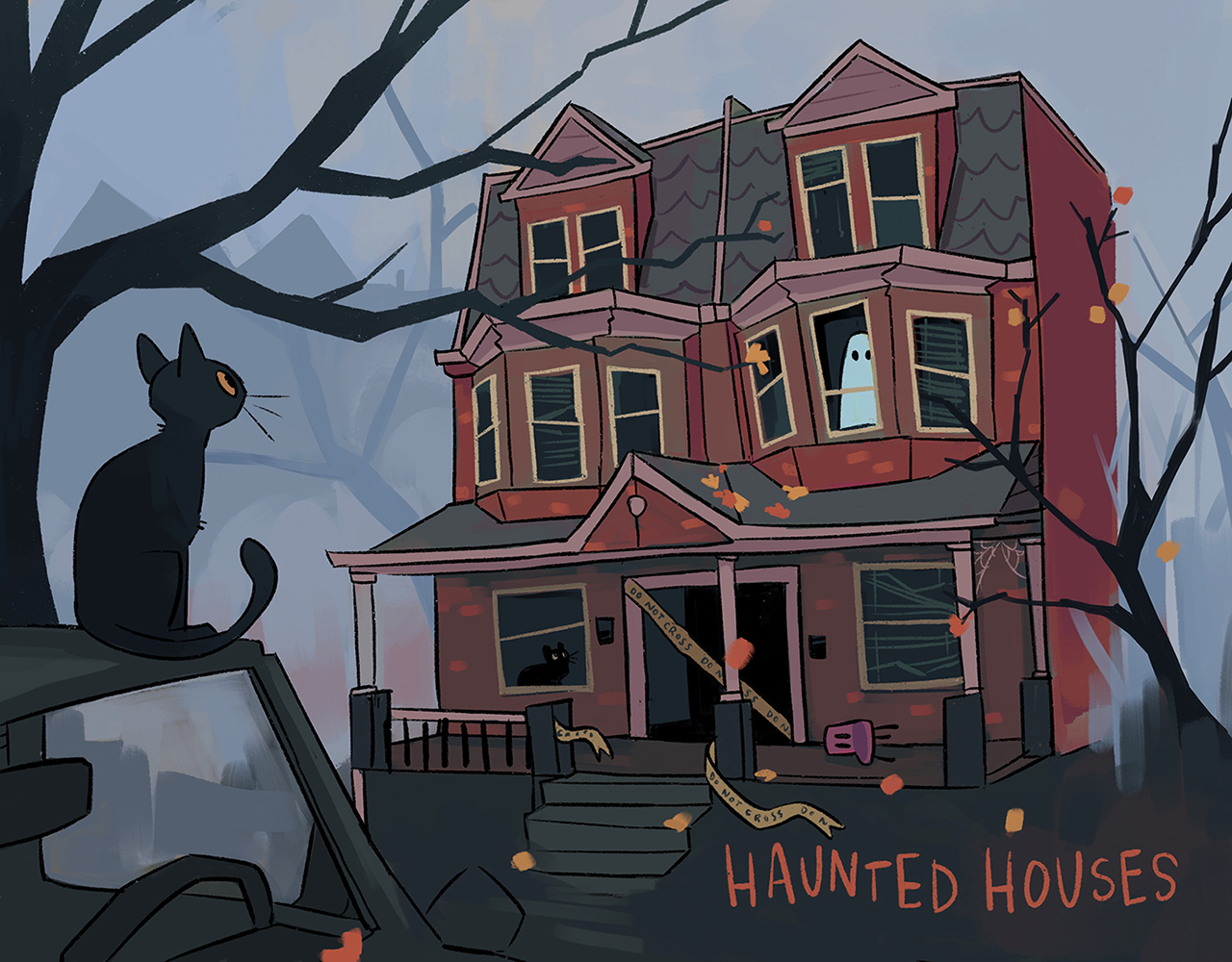
Haunted Houses collects seventeen pieces of surreal flash fiction about haunted spaces and the terrible people who inhabit them. This edition of the zine includes several new stories and illustrations, as well as a gorgeous cover illustration by Megan Crow, who was able to channel the everyday spookiness of West Philadelphia. Although the stories in this zine fit firmly into the mode of magical realism, I wanted to use the medium of fiction to explore a truly terrifying set of real-life themes relating to housing, from gentrification to rent spikes to urban depopulation.

If you’re interested, physical copies of the zine are available on Etsy:
https://www.etsy.com/listing/890744799/haunted-houses-fiction-zine

I’ve also started to host free digital editions of my older zines on Itchio:
https://digitalterrarium.itch.io/

Horror Fiction Zines at Common Meter Press

I’m honored to have three of my zines in stock at Common Meter, a new zine distro and poetry micropress!

These three zines – Ghost Stories, Haunted Houses, and Haunted Haiku – are only available through Common Meter. They’ve done a fantastic job with the listings, which you can find on their website (here). It’s incredible to see my creative work presented in such a cool and stylish way, and I’m beyond impressed by how Common Meter supports the writers and poets they work with. I understand that the press is currently creating a series of original, hand-printed chapbooks, so please check them out if you’re interested in reading (and perhaps publishing) cutting-edge writing.

I also want to recommend Common Meter’s Instagram (here), where they’ve started to post gorgeous photos featuring zines ranging from bright and colorful minicomics to letterpress poetry chapbooks. They’re just getting off the ground, and I can’t wait to see where the wind takes them.

The Eyes of Hyrule Zine Preview

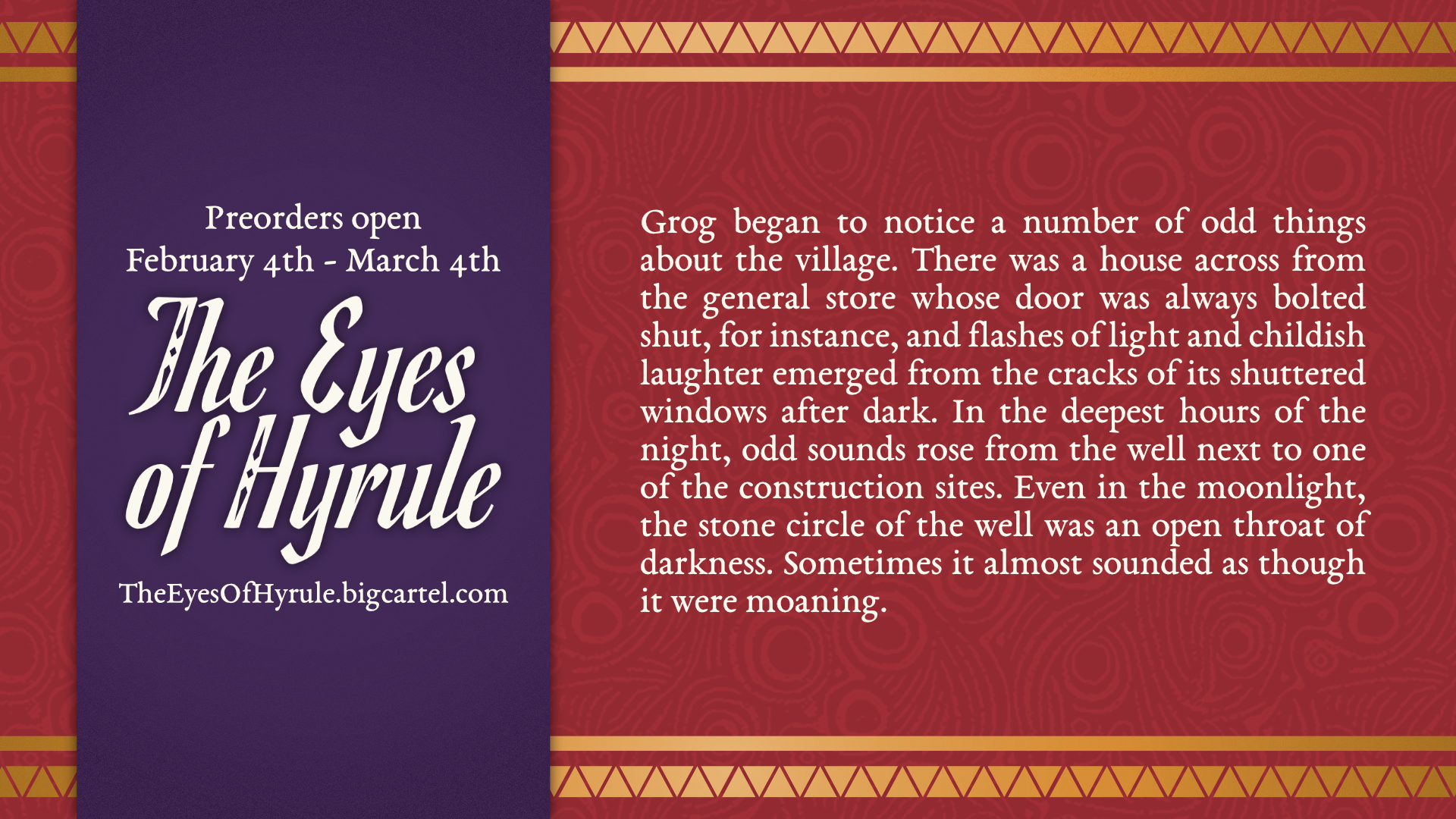
I’m excited to announce that preorders are open for The Eyes of Hyrule, a Legend of Zelda fanzine devoted to the Sheikah. The zine’s Carrd is (here), and you can check out more previews on its Twitter account (here).

There’s a lot of talent involved in this project, and the mods have been totally on the ball at keeping everything organized for the zine, which is expected to ship out this summer. It’s always a pleasure to be part of a project where everything clicks and comes together so well. Also, I might be biased, but I think the stories (and comics!) in this zine are especially interesting and unique.  

My own piece, “The Only Come Out at Night,” is a soft horror story about Kakariko Village in Ocarina of Time. It’s narrated from the perspective of Grog, the punk kid who hangs out near the entrance of the village at night. During the trading sequence necessary to acquire Biggoron’s Sword, the player can pick up hints that Grog’s story is much darker and more complicated than his initial appearance would suggest. I therefore wanted to use this character to explore the darker side of the Sheikah through the medium of a Stephen King style “peculiar little town” story. I had a lot of fun writing this piece, and I can’t wait to share it.

If you’re interested, you can preorder a copy of The Eyes of Hyrule via Bigcartel (here).

Spooktober Fifteen Day Challenge

I’m thrilled that my work has been published in The Oracle‘s first issue, an anthology of horror-themed flash fiction and art. My piece, “Spooktober Fifteen Day Challenge,” is a creepy little story told in the form of a cursed social media game.

I recently read an article in Rolling Stone (this one right here) about the Momo Challenge, and this Halloween-themed story is inspired by the idea that a monster might prey on children through a series of social media challenge prompts. Although the format is nontraditional, my goal is for the reader to gradually get a sense of the loneliness and anxiety of the “you” to whom the prompts are addressed. 

The “Fright Flash” issue of the zine is very short, but it’s lovely to look at and quite spooky. If you’re interested, The Oracle is (here) on Twitter, and you can download a free digital copy of the “Fright Flash” issue via Google Drive (here).

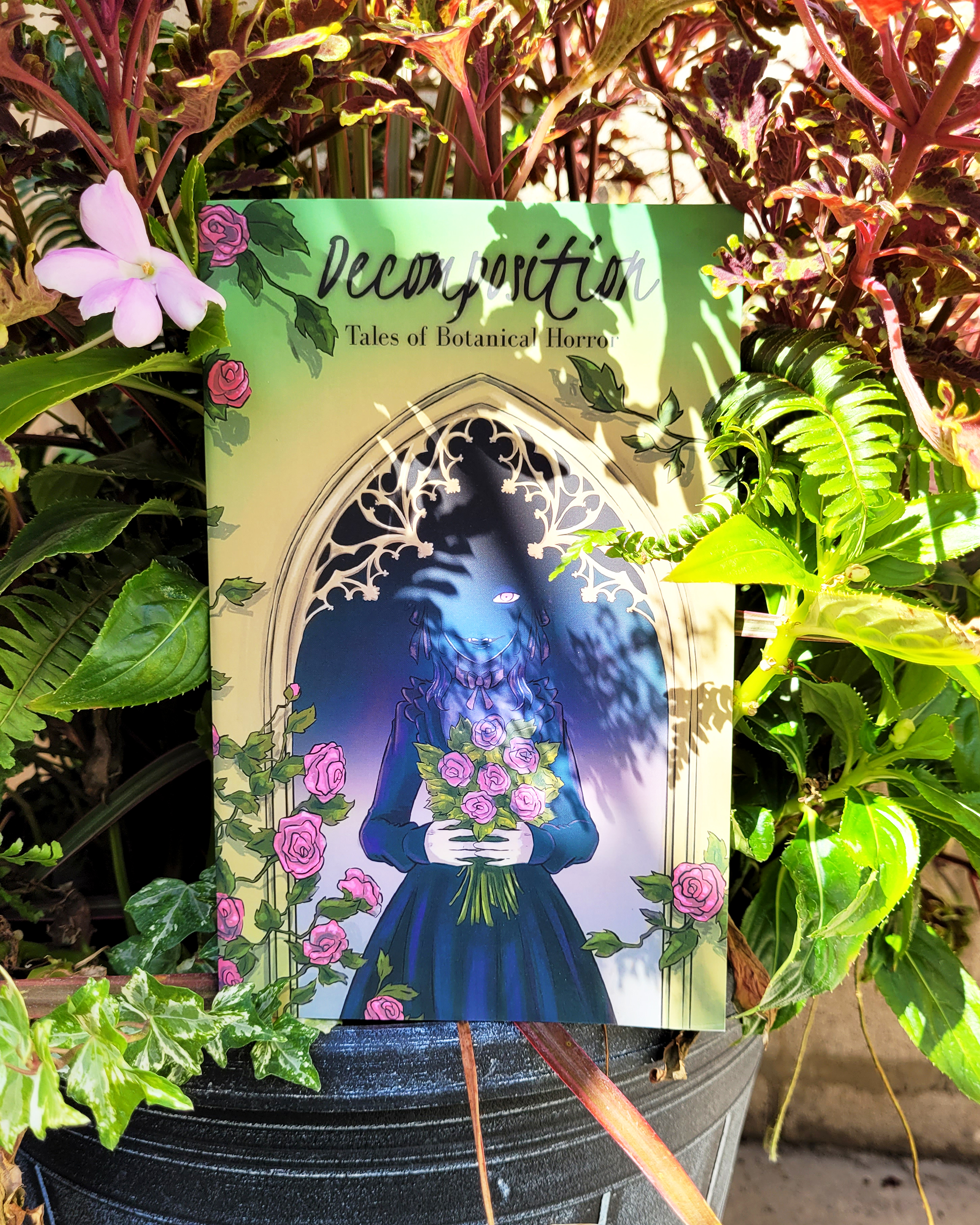
Decomposition: Tales of Botanical Horror

My newest short fiction zine, Decomposition, collects six short stories of botanical horror and dark fantasy. It features a number of guest artists and spot illustrations, as well as a gorgeous cover created by the botanical art wizard Frankiesbugs. I’ve listed the zine on Etsy (here) if you’re interested.

The past few years have been tough for me. It’s become somewhat taboo in American culture to admit that the pandemic wasn’t the best thing to ever happen to you, so the less said about this the better.

I have to admit that I’m a gremlin who doesn’t really care about germs, but for a while I found it very difficult to relate to other people. I didn’t want to see other human beings at all if I could help it. This is why, after I moved to Philadelphia, I started spending a lot of time wandering around abandoned spaces.

Philadelphia is a fun and interesting city with a steadily growing population and multiple vibrant local cultures, and I find it annoying when people take pictures of a normal street or an early-morning empty parking lot and tag their photos as “urban decay” on social media. That’s just rude. Still, I think it’s easier to get funding to build new construction than it is to repair existing structures, so there’s a surprising density of ruins and wild spaces in and around Philadelphia.

What surprised me while walking around the emptier areas of Philadelphia is just how quickly most architecture returns to nature. Maybe stone castles and granite walls and asphalt roads can last for centuries without maintenance, but a normal house or Burger King or whatever is going to last for one or two decades at most. It’s only going to take about five years before the roof goes; and then, once the water damage gets started, that building is finished. The shell of the walls becomes its own little ecosystem, with plants pushing up through the brick and concrete. In Philadelphia, fig trees and sumac shrubs grow wild just about everywhere, providing food and shelter for insects, birds, and larger animals like opossums and raccoons.

On one hand, it’s lovely to see these pockets of green in postindustrial urban areas. On the other hand, it’s a bit creepy how aggressive plants are in taking over space formerly occupied by people. If you think about it, plants have been on this earth for hundreds of millions of years, and they will remain here long after the last human draws its final breath. Their green dreams are beyond our comprehension as their roots silently feed on the soil of our bodies. Plants are forever growing and forever hungry, and they’ll take everything back from us eventually.

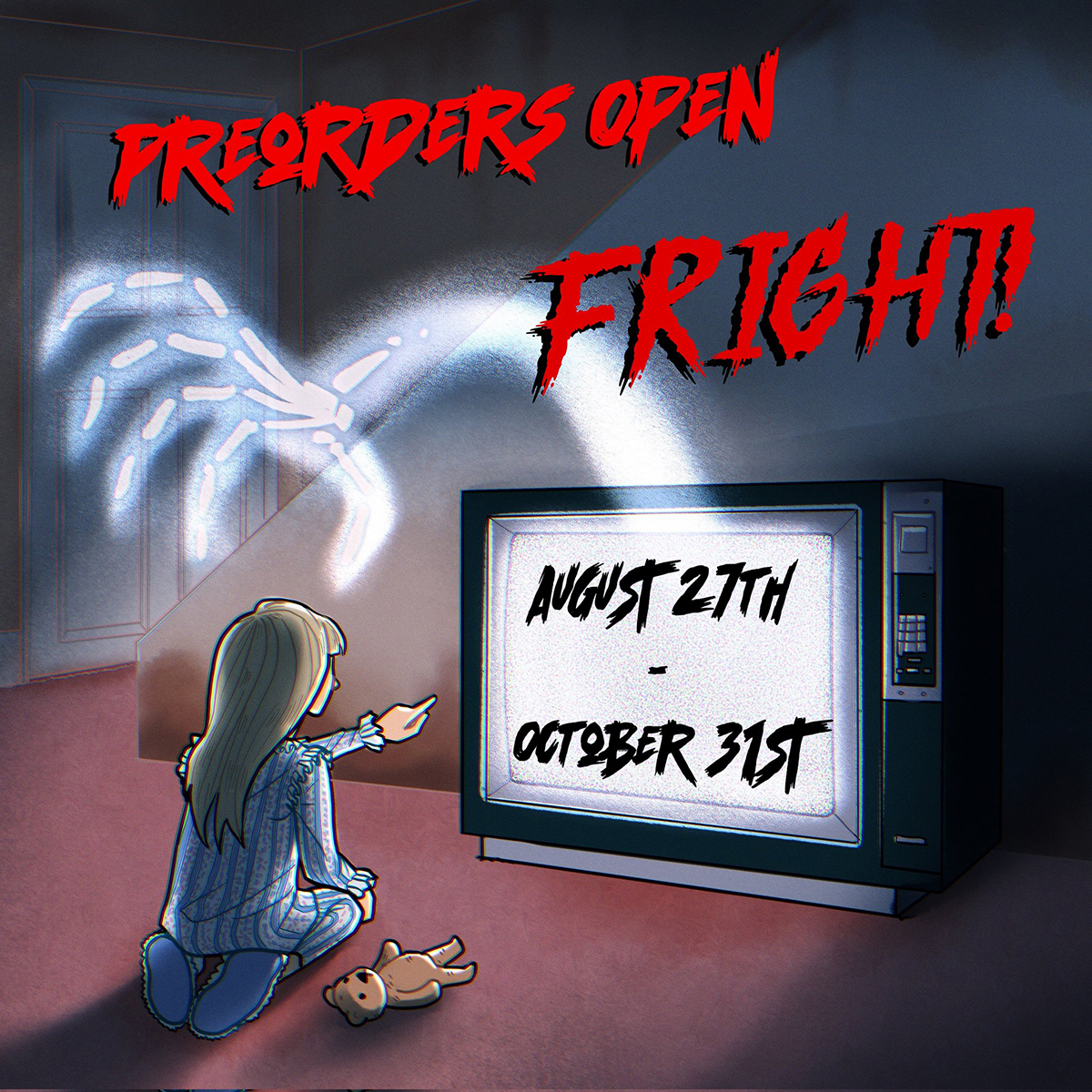
Fright! Horror Zine Preorders Open

Fright, a classic movie horror zine, has opened preorders!

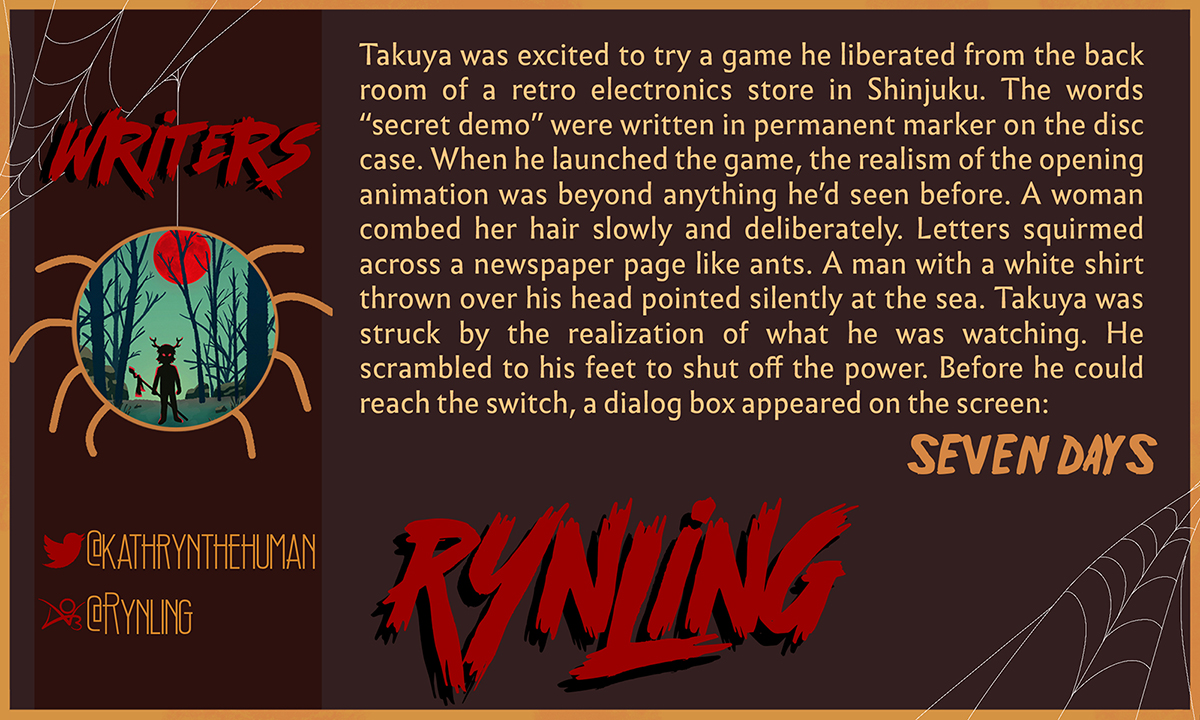
I contributed a story called “The Girl in the Screen at the End of the World,” which is about Sadako from Ringu picking off the last humans to survive the collapse of society. The story gradually comes together through vignettes narrated from the perspectives of different characters, all of whom encounter Sadako’s curse in unexpected ways. Some of these characters actually seek her out, as it’s always good to have a friend to help you deal with the end of the world. If you’re interested, you can check out the zine through these links…

💀 Carrd: https://frightzine.carrd.co/
💀 Twitter: https://twitter.com/frightzine
💀 Bigcartel: https://frightzine.bigcartel.com/

Japanese Ghost Stories

This fall, I’m teaching a new class called “Japanese Ghost Stories.” Here’s the course description…

This course offers a survey of the numinous and supernatural through Japanese fiction, drama, comics, animation, and video games from the Heian period to the present day. Students will assemble a foundational knowledge of Japanese religion and folklore while studying popular narrative traditions representative of their historical eras.

By peering into the liminal spaces connecting the living with the dead, students will develop critical thinking and media literacy through careful investigation into the matters that people of different times and places have perceived as monstrous, alien, and unspeakable. Issues of gender, sexuality, and ethnic minority status will receive special attention as we navigate theories relating to the cultural role and social relevance of ghosts. By the end of the semester, students will possess a broad perspective on Japanese narrative traditions and popular culture, as well as an understanding of how fantastic stories of the dead reflect the tangible experiences of the living.  

You can download a copy of the syllabus (here).
I’ve collected PDF files of the course readings on Dropbox (here).
If you’re interested, a copy of the course assignments handout is (here).
You can check out the work of artist who drew the banner image (here).

I’d like to acknowledge that this course was inspired by Professor Naomi Fukumori’s class “The Monstrous in Japanese Literature and Culture,” and I encourage anyone who is interested to check out the course syllabus (here).

Gothic Horror Story Elements

In order for a story to be considered “Gothic,” I think it needs to include…

– A house. This “house” can be a castle or a space station or an abandoned medical research facility or what have you, but it needs to be a place where people live and eat and sleep.

– It has to be a big house. In addition to being big on the outside, it should be larger than it appears. The house should have something along the lines of a secret sub-basement, hidden rooms, tunnels in the walls, a House of Leaves style portal to another dimension, or something along those lines. The house needs to be large enough to be considered a labyrinth.

– The house has to be old and in a state of decay or disrepair. In addition, the house needs to be isolated and surrounded by wilderness. Over the course of the story, the natural environment should intrude on the interior of the house. This should still be the case even if the environment is not technically “natural,” as in the case of Suburban Gothic.

– The house needs to be associated with and occupied by a family.

– The family needs to have a dark secret, preferably one hidden within the house.

– At least one member of the family should still live in the house. “Family” can be loosely defined, but the concept of “family” as such is key.

– If there’s no family living in the house, then the story is a “haunted house” story, not a “Gothic” story. This is also the case if the people living in the house aren’t alive or aren’t human (or whatever passes for “a normative person” in the world of the story). This is important, as “Gothic” is just as much of a narrative structure as it is a collection of tropes. For example…

– The point-of-view character should be a member of the family in some way. Often this character will come into the house through marriage or inheritance. Sometimes they won’t initially know they’re related to the family. In the case of servants and governesses and so on, the point-of-view character will either be secretly related to the family, or they’ll be a parent or spouse in all but name. If the point-of-view character isn’t related to the family, they will gradually fall under the delusion that they are.

– The point-of-view character will obviously be privileged, as they live in a large house and are associated with a wealthy family, but they also need to be disadvantaged in some way. The way in which they’re disadvantaged should have some thematic relevance to the dark secret hidden by the house.

– The point-of-view character must be forbidden from certain behavior by an arcane rule or system of rules. The forbidden behavior will generally involve the navigation of space in or around the house: Don’t go into the forest, don’t go into the cellar, don’t leave your room at night, etc.

– The disadvantage of the point-of-view character will compel them to accept the family rules even though they can intuitively feel that something is horribly wrong. This traps them within the house.

– The goal of the point-of-view character is to escape the maze of the house. The only way to navigate this labyrinth is by breaking the rules, engaging in forbidden behavior, and bringing the dark secret to light.

– The primary antagonist should be a living person in the family, related to the family, or emotionally invested in the family in some way. Although supernatural elements are not out of the question, it’s often the case that the phenomena presumed to be supernatural have a rational (albeit psychologically deranged) explanation. That being said, there’s often a Todorovian elision between “natural” and “supernatural,” with the distinction being left to the reader.

– When the point-of-view character reveals the family’s secret, this destroys the house. This destruction is usually literal. The family almost always dies as well. If the point-of-view character is too closely tied to the family, they may die too. Regardless, the reader will understand that the collapse of the house and the demise of the family is a good thing that needed to happen.

– The house and family should represent an older social system responsible for the disadvantage of a group of people represented by the point-of-view character. This system usually concerns oppression on the basis of class or gender, but it can sometimes be about race, nationality, or colonial heritage.

– The Gothic genre is not conservative, because it’s essentially about how outdated systems of privilege that still continue to oppress people are deeply fucked up and unhealthy and need to be destroyed. “Haunted house” stories are often conservative, but I would argue that Gothic stories advocate for radical systemic change and the self-realization of freedom from social expectations.

– At the same time, Gothic stories are not didactic. The lure of the forbidden goes both ways, after all, and the reader should be able to understand why the point-of-view character allows themselves to become trapped in the house. The old castle is majestic. The beast-husband is attractive. The spoils of ill-gotten wealth are luxurious and comfortable. The ruins are delightfully mysterious. The poison apple looks delicious. The story is queer and problematic, and that’s precisely why it’s appealing.

There are numerous cross-genres and sub-genres of Gothic that have their own specific conventions, like Gothic Romance and Boarding School Gothic. I didn’t address the visual language of the Gothic, or how tropes and conventions vary between times and cultures. Still, I think this is the core of the genre.

Cross the Moon

Cross the Moon is a visual horror novel about a near-future dystopia in which a fraction of the moon has shattered, an event concomitant to the appearance of vampires. No one knows why people suddenly began displaying symptoms of vampirism, but those affected have become a disadvantaged underclass of society.

The game’s story follows two mixed-race vampire siblings and a Japanese detective through the streets of L’Amour, a French city that hosts the headquarters of a corporation called bloodFLOW, a leading producer of artificial blood and scientific research relating to vampires. Although Cross the Moon begins as a murder mystery, it gradually expands into the territory of cosmic horror.  

The beginning is standard vampire fare. The player is introduced to a high school student named Lux who is hanging out at a bar and fishing for someone who will consent to share their blood. Lux is essentially a good kid and thinks this is a bad idea, but he’s acting on behalf of his crush Apollon, who seems to be in thrall to his girlfriend, a manic pixie femme fatale named Corentine. Unfortunately for the trio, the man they seduce is found dead the next morning, and Apollon is charged with murder. In an attempt to clear his friend’s name, Lux ends up becoming involved with the vampire underworld, where he learns that Corentine is not an ordinary high school student – nor is Apollon.

This YA narrative is complicated by the interwoven story of Lux’s adult sister Aurore, who has managed to land an interview for a prestigious job at bloodFLOW. Her intake interview is weird, the job she’s asked to do is bizarre, and her coworkers are more than a little strange. She isn’t a big fan of the company itself, which she knows is exploiting the vampire population. Still, Aurore has grown up watching her working-class parents struggle, and she’s willing to do whatever it takes to give herself and her family a better life. Unfortunately, this leads her to sign a non-disclosure agreement regarding corporate secrets that turn out to be far beyond anything she imagined.

Meanwhile, Yoko has just transferred into L’Amour’s police force as part of an exchange program meant to facilitate cross-cultural communication regarding vampire-related policies and best practices. Due to the timing of her arrival, she’s immediately dropped into the investigation of the gruesome murder supposedly committed by Apollon. She strongly suspects Apollon is innocent, which convinces her to dig deeper into why a random teenage boy is being framed. This in turn leads her to the main mystery of Cross the Moon – what’s going on with bloodFLOW? What does the company have hidden under its corporate offices, and why does Yoko feel so compelled to pry into its secrets?

Cross the Moon is more of a graphic novel than a game. The only interactive element is the option to save your progress, and the story is completely linear. Although Cross the Moon is formatted as a visual novel, with long horizontal text boxes overlaid onto the bottom of a single full-screen image, it’s not a “game” in any meaningful sense. There are no branching paths, and there’s only one ending. There’s no animation or voice acting, and the character art assets are fairly limited. Cross the Moon is also quite long, promising at least seven or eight hours of reading.

The story starts off slow. I’m afraid this may put off many players used to flashy video game opening sequences, but it’s a pitch-perfect opening to a horror novel. This is how almost every Stephen King novel works, after all – the world needs to be built before it’s destroyed, and the reader needs to learn to care about the characters before they start to find themselves in serious trouble. Through the mundane details of the everyday lives of the characters, the player gradually builds an understanding of how the society of L’Amour operates, which makes the final horrific reveals all the more dramatic.

The author is sensitive to inequalities concerning race, class, and gender, but it’s worth mentioning that the game’s take on vampirism is its own thing and not analogous to any real-world identity. The minority status of vampires is informed by real-world politics, but Cross the Moon takes the concept in a creative and unexpected direction. I have to admit that I’m not a particular fan of vampires, but I found myself growing progressively more curious about how vampirism operates in the world of the game, as well as how it originated.

(By the way, if you’ve been reading between the lines of this review and have come to the conclusion that the ethically dubious corporation created vampires, that’s not what’s happening. This story has layers of progressively deepening strangeness, and it absolutely doesn’t go where you expect it to.)

The worldbuilding of Cross the Moon is enhanced by its visual style. The soft grayscale character art pops against the super-saturated backgrounds, which are composed of photographs overlaid with high-contrast color filters. I know this sounds like Baby’s First Photoshop, but it’s remarkably well done and extremely stylish. As I mentioned earlier, the character art assets are limited, so the player is occasionally asked to suspend disbelief while, for example, a character lies in a hospital bed in a full suit. For the most part, the graphics contribute a great deal of atmosphere to the story, as does the ambient music. The game contains some uncomfortably gory and deliciously creepy moments, and there’s a jump scare toward the end that really got me.

If reading a lengthy mature-audience horror story in the form of a visual novel sounds like a chore, then Cross the Moon probably isn’t for you. Speaking personally, I always find myself getting annoyed by extraneous gameplay elements in visual novels, so what Cross the Moon is doing is perfect for me. I read it on my Nintendo Switch between sessions with more action-oriented games, and I very much enjoyed myself. I’m intrigued by the potential of this hybrid medium of storytelling, and I’d love to see more “visual novels” that are in fact genuine novels intended for adult readers.