Almost People

Almost People
https://evan-megel.itch.io/almost-people

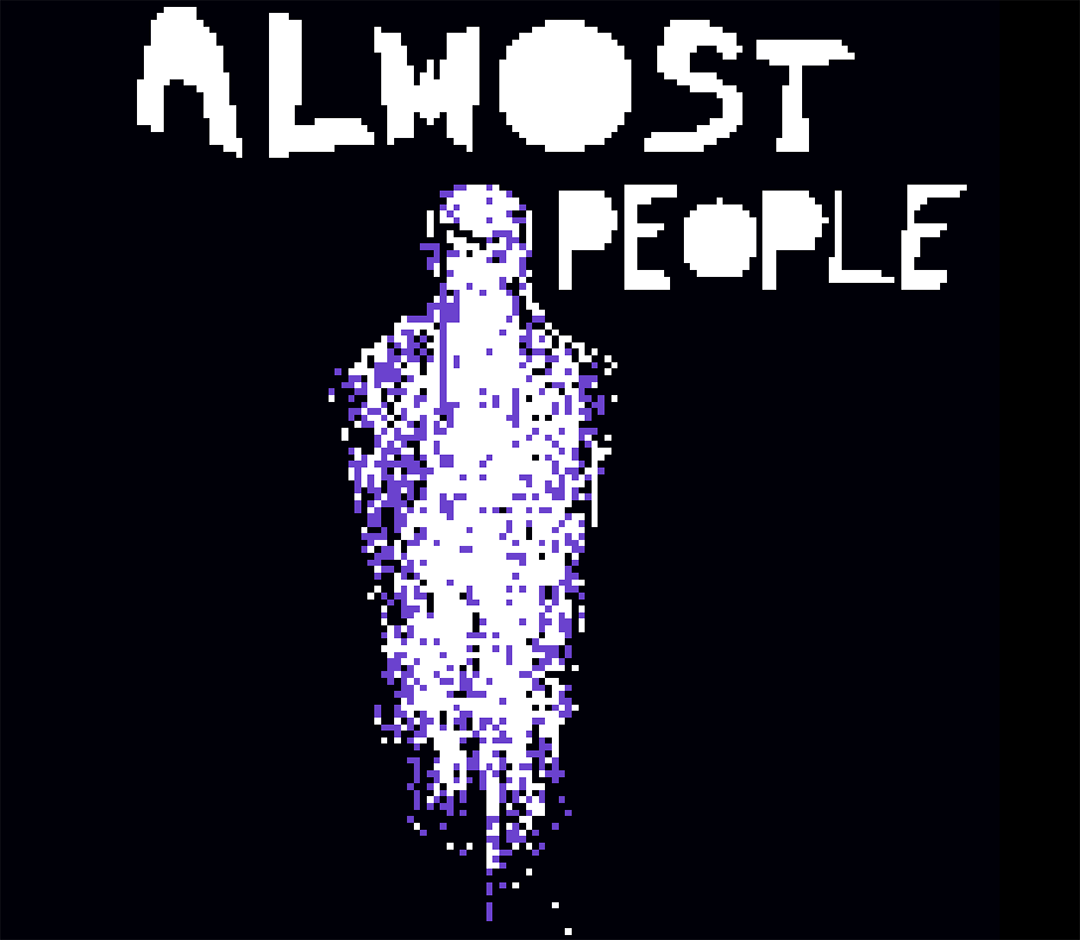
Almost People is a narrative dark fantasy Game Boy game that’s free to play and takes about 8-10 minutes to finish.

You play as an alchemist who has created several types of artificial beings. After setting them free and leaving them to their own devices for an unspecified amount of time, you must decide what to do with them. Should they be allowed to continue as they are, or do you end their lives?

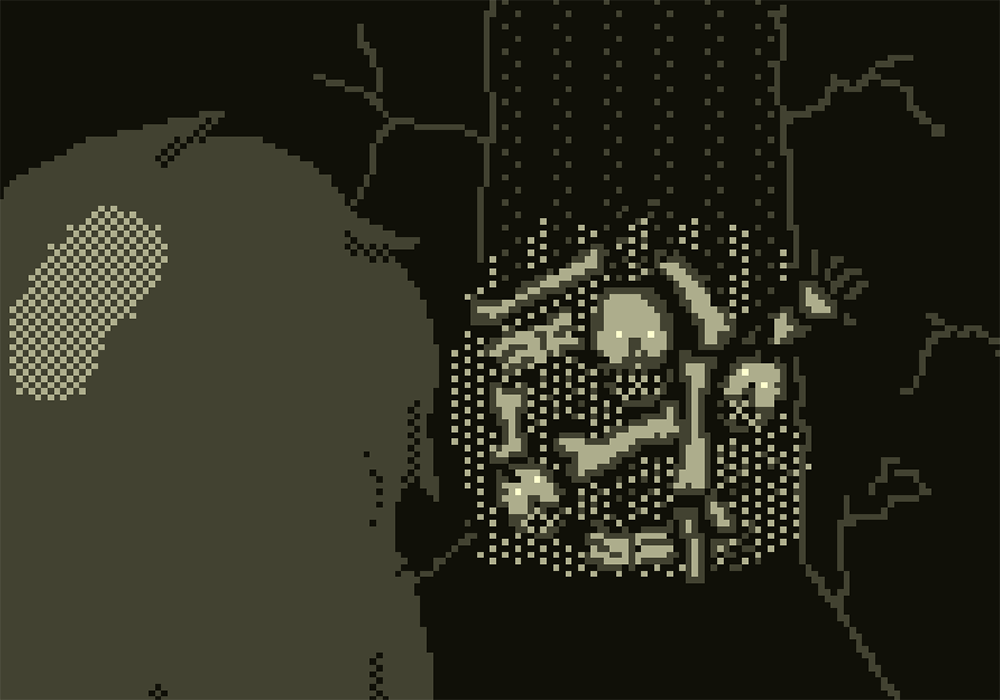
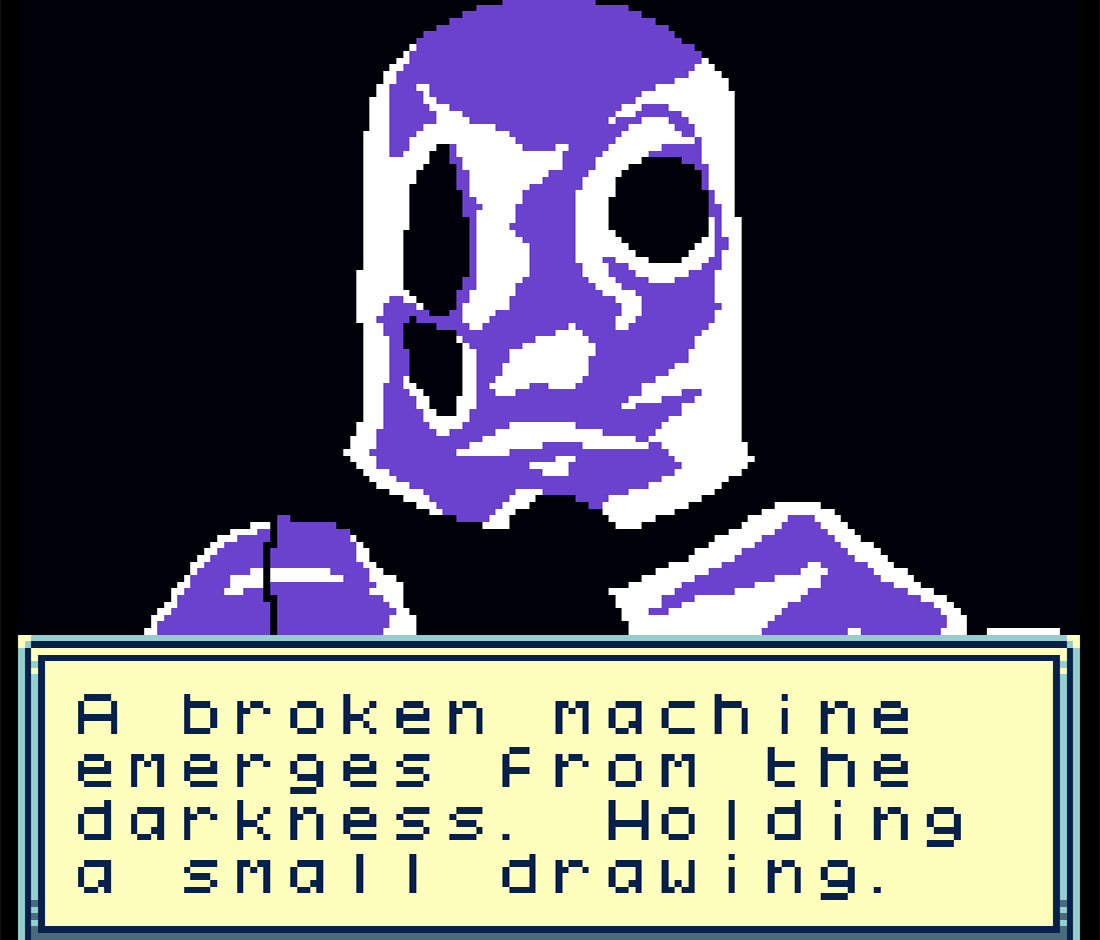
Before each conversation, the alchemist walks across a 2D screen that shows the creature (or creatures) in the lair it’s constructed for itself. Despite the limitations of the Game Boy graphics, the art is bold, striking, and very creepy.
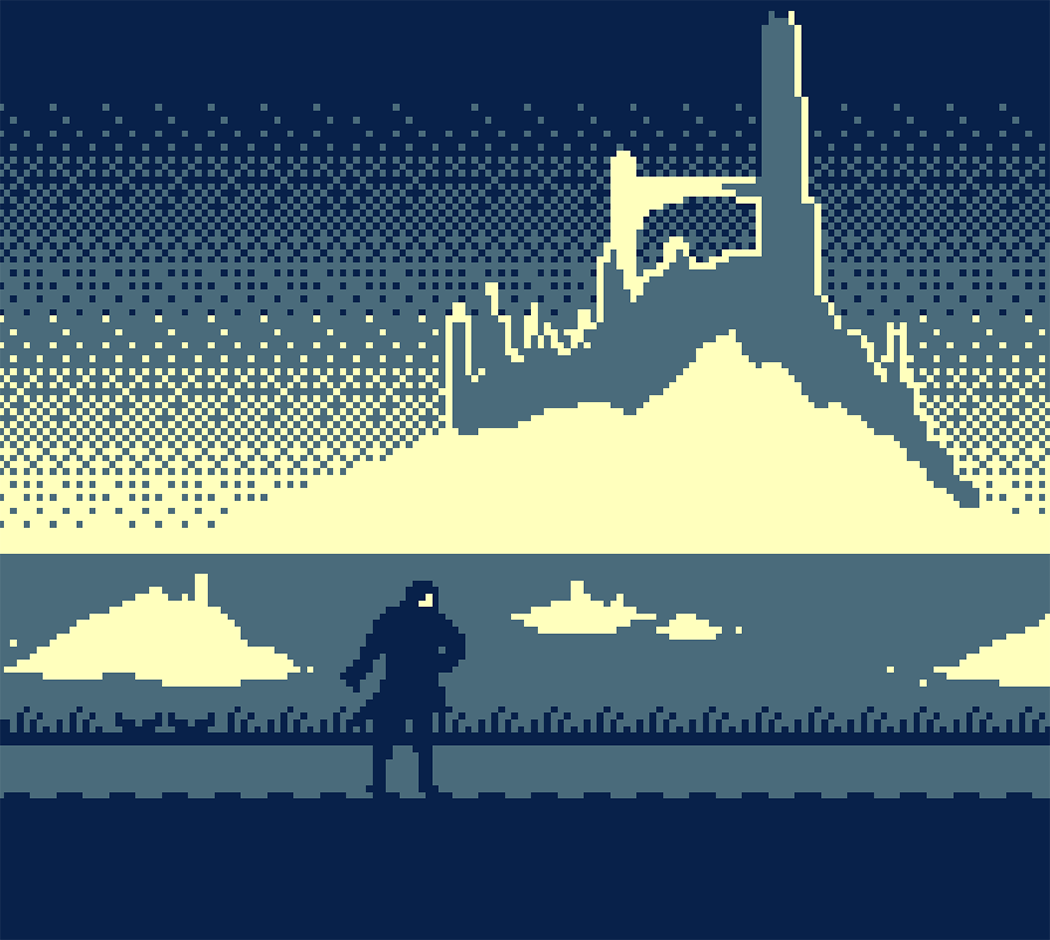
The conversations with the creatures are subtly disturbing as well. I don’t get the feeling that the artist who made this game is coming from a well-defined philosophical perspective, but the choices the player is asked to make are interesting. If you want to get the good ending, the alchemist is going to have to take responsibility for what they’ve created. Specifically, you’re going to have to kill at least one of the creatures.

Though the game works well as a Frankenstein story, I also understood it as an allegory for creativity. As upsetting as it is to consider killing an actual living creature, I tend to think that it’s healthy to end projects that have outlived their original purpose. This allegory isn’t immediately apparent, and I’m not entirely sure that it was intended. I suppose that the themes of “creation” and “death” are broad enough to accommodate any number of readings.

Almost People is a weird and unsettling little game, and I appreciate the experience of playing as a character with dubious morality. I’m getting a little tired of the “surprise! the heroes are bad actually” trope, so it’s cool to take on the role of a wizard who openly engages in dark deeds. A teenager with a magical sword should really put an end to this asshole, but I guess that’s another game entirely.
Forest of Fallen Knights

Forest of Fallen Knights
https://felrasyr.itch.io/forest-of-fallen-knights

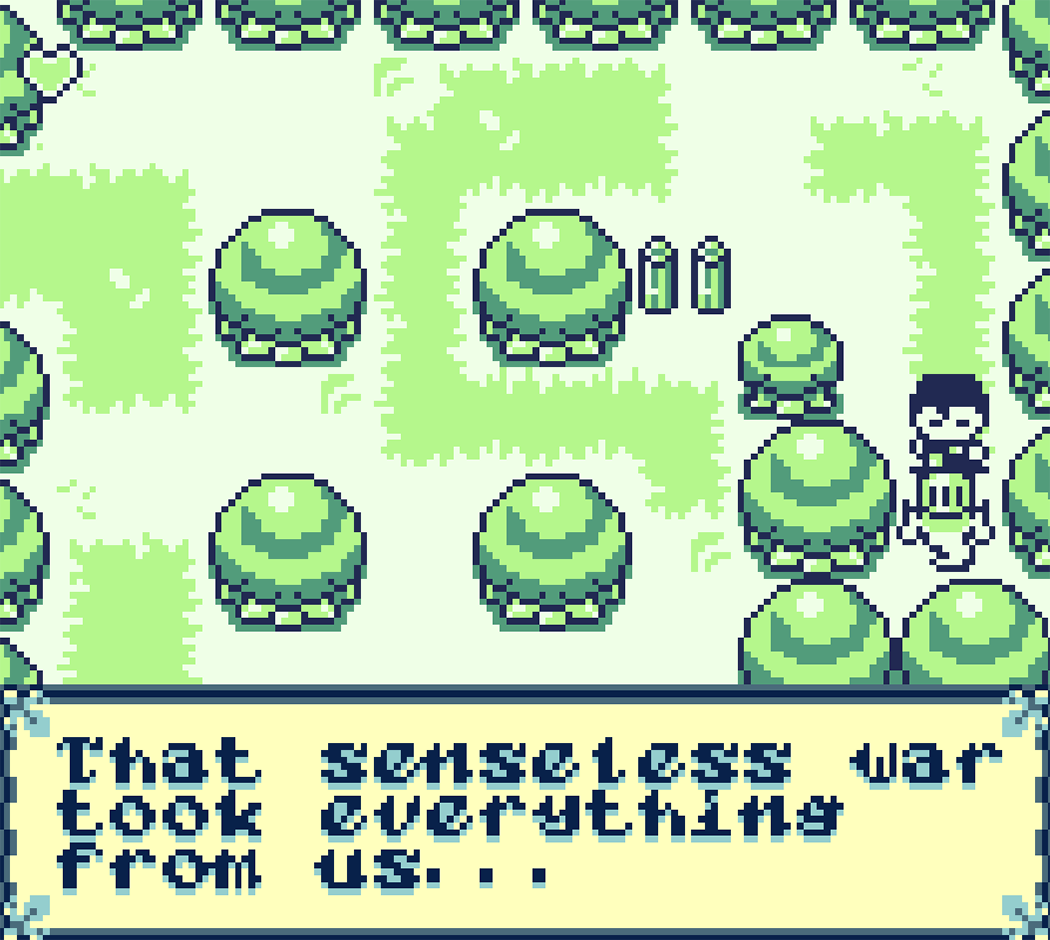
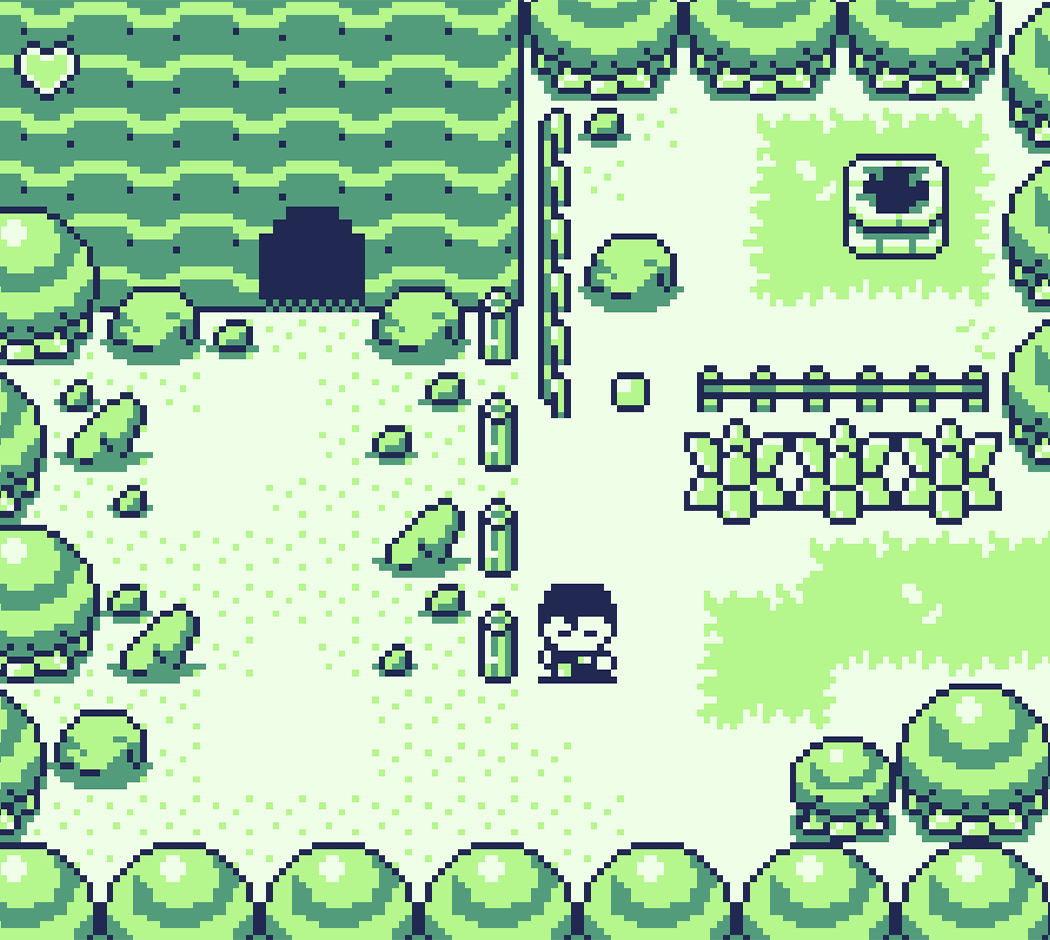
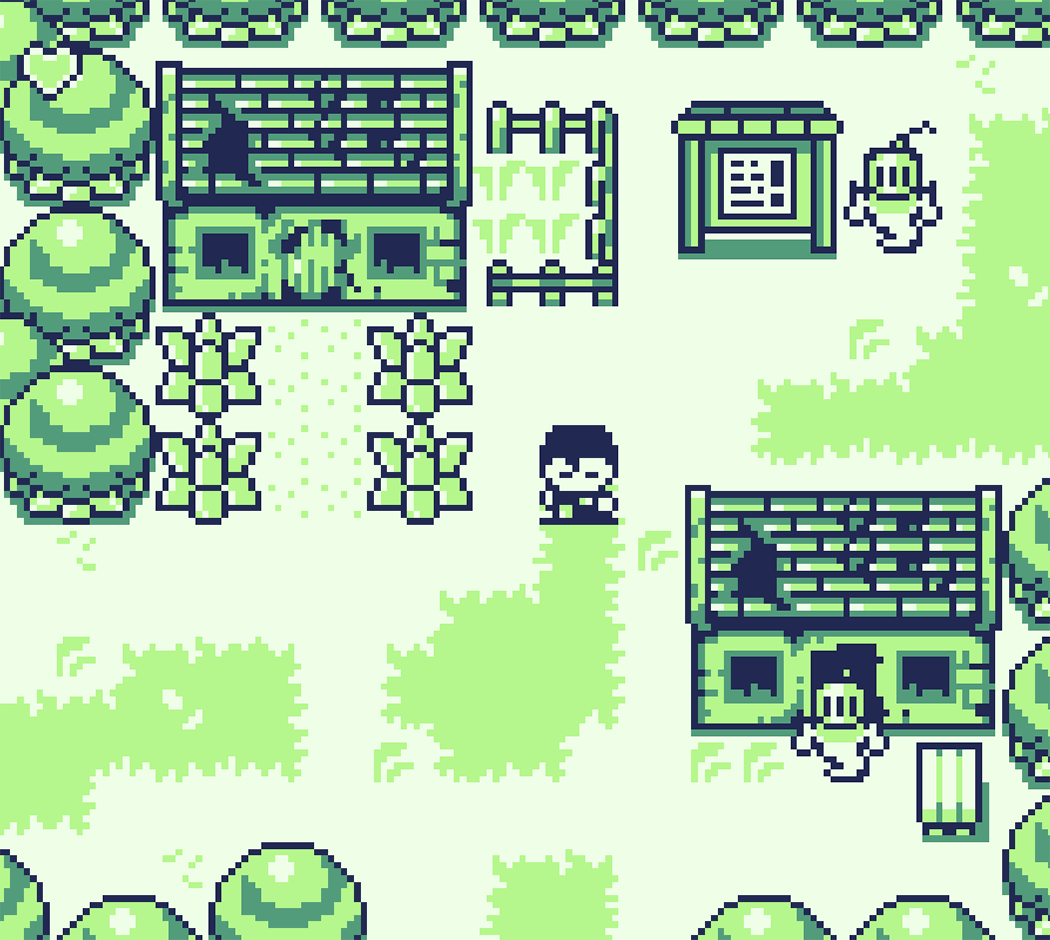
Forest of Fallen Knights is a free-to-play Game Boy narrative adventure game that takes about 30-40 minutes to finish. Though the game is visually modeled after Link’s Awakening, its setting and story are a homage to Dark Souls.

You play as a nameless adventurer who’s found himself alone and unarmed at the bottom of a cave. After the ghost of a knight offers him a sword, the adventurer emerges into a dense forest dotted with ruined houses that were once inhabited by the knights who fled from a devastating war. Though no longer alive, neither can the knights die. Your job, as the still-living adventurer, is to help them make peace with their regrets.

Admittedly, it’s unclear what purpose your good deeds will serve in the long run, given that the knights are eternally unable to pass on. Perhaps the adventurer should take care that their curse doesn’t pass to him as well…

Forest of Fallen Knights consists of about twenty overworld screens, as well as an additional dozen screens inside caves and houses. The gameplay involves walking around, talking to everyone, and taking on simple fetch quests. There’s some (very) basic combat, as well as a small dungeon that requires a moderate level of pattern memorization and dexterity. Save crystals are generously scattered throughout the forest, so you won’t lose much progress if you happen to die. For the most part, the swordplay serves to add texture to what is largely an exploration-based adventure.

The game’s writing is simple but effective. Now that everything they once fought for is gone, the undead knights are attempting to maintain their hold on what was most important to them in life. Any one of their fetch quests might come off as sentimental on its own; but, in aggregate, the player gets a strong sense of how pathetic and regrettable the situation truly is.

There are a few secrets to find in the game, though they aren’t too terribly well-hidden. If the player is moderately observant, perhaps the adventurer might reveal his reason for venturing into the forest, and perhaps he might even find a means to release the fallen knights from their curse. If not, the default ending is more than sufficiently satisfying.

As a fan of both Link’s Awakening and Dark Souls, I feel like Forest of Fallen Knights was made for me specifically, and the time I spent with this game coalesced into a pocket of unadulterated joy. It’s therefore difficult for me to be objective, but I still think it’s fair to say that Forest of Fallen Knights is well-crafted, thoughtfully considered, and at the top of the pile of homebrew Game Boy adventure games.

Many kudos to the developer, NeroGames (who is on Bluesky here). I’m always here for indie artists who use the retro gaming medium to share strange and haunting stories.

Dorotea

Dorotea
https://pasquiindustry.itch.io/Dorotea

Dorotea is a spooky ten-minute narrative adventure game made in Game Boy Studio and set in the medieval castle town of Conversano in southeast Italy.

You play as Dorotea, a researcher who has been hired by a local museum to catalog the books, manuscripts, and art objects in a neglected storage room housing a collection dating from the 1600s. Upon opening and passing through a strange door at the back of the room, Dorotea finds herself transported to the medieval era, when the museum was still a convent.

Thankfully, Dorotea is intercepted by a nun before she can land herself in trouble, but she’s not entirely out of danger. The lord of the castle on the hill isn’t a good person, and there also seem to be monsters of a more literal sort in the vicinity.

Dorotea features a suspenseful (but no-penalty) chase sequence, but its horror is largely atmospheric. The game’s uncanny pixel-art insert illustrations contribute to the feeling of something being terribly amiss, as do the ghosts and monsters, but the game also explores the anxiety generated by the prospect of being trapped in the past. As much as we might like to romanticize the medieval period, the culture shock experienced by most people – especially women – would likely be atrocious.

Putting its supernatural elements aside, Dorotea dwells in what might be called “archive horror,” or the morbid claustrophobia of a closed room filled with the relics of people long dead. There’s the dankness of the space itself, as well as the fear of the door swinging closed behind you, trapping you inside with nothing but dust. Then there’s the very real possibility that, in all the detritus of the past, you might find something deeply disturbing that you wish you hadn’t seen – or that someone very much wanted to hide. With its retro graphics and creepy pixel illustrations, Dorotea is a fantastic vehicle for conveying a sense of unease.

Dorotea is a short game, but it nevertheless manages to pull off a gut punch of a twist ending while indulging in a few interesting experiments with the ludic medium. The game was created for Italocurso Game Jam 2025, which is themed on folk horror specific to regional cultures in Italy. The 33 entries include a number of games offered in English, and all of them look amazing.

Deep Forest

Deep Forest by Small is Beautiful
https://small.itch.io/deep-forest

Deep Forest is a free GB Studio adventure game that takes about 45 minutes to play. There’s no combat, and the game is driven by puzzle-solving and exploration. You play as a forest witch tasked with helping three trees that have become mysteriously cursed. To purify a tree, you must first find it by exploring the forest. You then enter its nightmare, which functions as a dungeon. Once the tree’s curse is lifted, its thorny roots vanish, thereby allowing you to explore more of the forest.

This is the basic gameplay cycle of the Legend of Zelda series, and the simple puzzles of Deep Forest remind me of certain segments of Oracle of Seasons and Oracle of Ages wherein you:

(1) Use an animal to procure a seed.
(2) Find a patch of soil to plant the seed,
(3) which sprouts into a vine
(4) that allows you to climb a cliff.

If this similarity is intentional, it’s a lovely homage to the debut work of Hidemaro Fujibayashi, who went on to become the director of Breath of the Wild. In addition, I had a nice “Legend of Zelda” moment when I found a secret in Deep Forest. I was delighted when I realized that you can water the single square of roots in front of an otherwise unremarkable cave in order to discover a hidden spring. This moment of discovery lit a spark of excitement that reminded me of exploring Hyrule for the first time.

In terms of its visual style, Deep Forest is reminiscent of the Game Boy games that were released in the West under the “Final Fantasy” logo, which include the first Secret of Mana game and the first three games in the SaGa series. This style feels extremely nostalgic, and it’s cool to see it used to depict a thriving forest.

Deep Forest is fairly linear, and the gameplay mechanics are beautifully intuitive. I would have loved this game as a kid, and I’m extremely fond of it as an adult. It’s exactly the perfect length, and I enjoyed the exploration elements and wholesome story. As a unexpected bonus, the interactive postgame credits sequence is beautiful and genuinely feels like a reward for playing.

Opossum Country

Opossum Country by Ben Jelter
https://benjelter.itch.io/opossum-country

Opossum Country is a free ten-minute lo-fi horror game about a rural pizza delivery driver who finds himself stranded in an isolated trailer park where something isn’t quite right. If you’re worried that the game is poking fun at the sort of low-income and mentally unbalanced of people who might live in a trailer park, there’s definitely an element of that, but the story goes in a direction that I wasn’t expecting. In the end, the moral of Opossum Country is that you shouldn’t jump to conclusions about a community you don’t understand. I mean, if the game can be said to have a moral. Which it arguably doesn’t. Regardless, the ending is fantastic.

Ben Jelter also made another free ten-minute Game Boy game called The Last Employee, which definitely has a moral: fuck capitalism. This being the case, I’m guessing that Opossum Country was created from a place of deep sympathy for people on the margins of society. This narrative viewpoint is refreshing in its unapologetic portrayal of difference, but Jelter’s sympathy for these characters doesn’t stop the game from being creepy as fuck. The overworld pixel graphics are creative and unsettling, as are the more detailed character portraits.

Opossum Country was made with a program called GB Studio. Not only is it free, but there are also a ton of pay-what-you-want graphics asset packs floating around Itchio, as well as collections of free-to-use chiptunes music that’s compatible with the Game Boy engine. I also found a few pixel art resources for Clip Studio Paint in the form of brushes, templates, and filters. I’m not sure that “just anyone” can make a game as unique and interesting as Opossum Country, but it’s nice to know that there’s nothing stopping you from trying.

A Dark Winter Wander

A Dark Winter Wander by Red Skald
https://redskald.itch.io/a-dark-winter-wander

A Dark Winter Wander is a free horror-themed narrative adventure game created with GB Studio, a game creator that replicates the look and feel of retro handheld games. The game’s story is about a girl chasing her sister through a (mostly linear) maze of underground tunnels filled with monsters. Although it’s deliberately unclear what’s going on, I think the protagonist’s sister might have an eating disorder, while she herself is depressed. This isn’t important to the gameplay, but those elements are there from the beginning of the game if you’re sensitive and need to watch out for them.

In any case, you see your sister run off into the woods and decide to go after her. While chasing her, you fall into a hole filled with monsters. You talk to the monsters instead of fighting them, and the game is entirely driven by exploration and dialog. This invites a comparison to Undertale, but all of the monsters in A Dark Winter Wander absolutely wish you harm. The creature designs are great, and the lo-fi sound and graphics contribute to the unsettling atmosphere.

If you don’t follow your sister into the woods, you can actually finish the game in about ten minutes and watch a depressing indie game ending. I did this inadvertently, and it was a downer. I then reset the game, did what it wanted me to do, and played for about an hour. Exploring the monster tunnels is a lot of fun, and you can easily spend more than an hour poking around if you’re interested in seeing everything this game has to offer. The creator has offered free downloads, and I’d recommend downloading a Game Boy emulator so that you can play the game offline and create save states.

The unskippable cut scenes at the beginning of the game feel unnecessarily long, and the writing is a bit clunky at times. I also find the lack of specificity regarding what’s going on with the narrator’s family frustrating. You probably already know if a text-heavy Game Boy horror game that’s a metaphor for depression is for you, so I won’t try to sell it. Still, A Dark Winter Wander is one of the most interesting and engaging GB Studio projects that I’ve found on Itchio, and it’s inspired me to check out more work in this weird little subgenre.