After crossing the bone-covered courtyard of the west wing, Fhiad and Agnes enter the main library of the former magic academy. It’s in an advanced state of decay, but Agnes finds an isolated reading room that’s still in decent condition. While searching the shelves, Fhiad remembers how he was seduced and betrayed by Agatha, the princess of his era.
Fhiad lashes out at Agnes, who weathers his emotional storm and tells him that she’s found a book with illustrations of the three keystones needed to open the door in the courtyard. Two of the stones are in Faloren, but the third is in Fhiad’s home in Erdbhein. Agnes proposes that they travel there, revealing that she has experience fighting the magically preserved corpses called husks that have infested Erdbhein.
.
This is the last chapter of the “Fun and Games” section of Act 3 of An Unfound Door. In this chapter, Fhiad and Agnes visit the third library of the castle. What’s cool about this library is that it’s been partially exposed to the elements, so it’s filled with trees and mushrooms and bats and centipedes. All of the books are rotting. This is my story, so I get to put in all of my favorite things.
Thankfully, one of the smaller reading rooms has been preserved, and this is where Agnes does some detective work while Fhiad has a minor breakdown. Since this chapter is written from Fhiad’s perspective, the reader gets to follow his mental state as he becomes progressively more upset and unnerved. Agnes is generally fairly observant, but she’s having so much fun going on the magical adventure she’s wanted all her life that she doesn’t pick up on Fhiad’s distress until it’s too late.
Fhiad loses himself for a moment and threatens physical violence in a burst of anger that’s partially fueled by his confused attraction. Agnes responds to this as she always confronts adversity, by coldly insisting on getting back to business. Neither of them looks good in this scene.
Still, the characters need room to grow, and there also needs to be an inciting incident that moves the story forward. Agnes has begun to care for Fhiad, and she’s gotten the message that both of them need to get out of the castle.
After leaving Faloren, are Agnes and Fhiad going to a second ruined castle filled with terrible things? Yes they are! I won’t lie, I love writing stories filled with drama in decaying ruins.
The illustration that graces this week’s chapter preview was created by the marvelous Hansoeii, a connoisseur of darkly compelling characters who posts sharp and handsome artwork on Instagram (here), on Tumblr (here), and on Twitter (here).
Fhiad and Agnes enter the abandoned west wing of Faloren Castle via a covered bridge that crumbles into the lake below as they cross. As they explore the empty corridors, Fhiad admits that he wasn’t particularly well-suited to being a diplomat. All he wanted was to leave for the university in Cretia, as his talent at magic was the only thing that set him apart from his sisters. After entering the ruins of the academy housed in the west wing, Fhiad and Agnes experiment with the magical tools left behind in a lecture hall, gleefully not caring about the wreckage they create.
.
Chapter 12 is at the core of the “fun and games” section of the novel, which mainly involves Agnes and Fhiad exploring an impossibly giant castle. The currently occupied east wing is sad and empty but still livable, while the abandoned west wing is a crumbling ruin barely held together by magic. I did my best not to write too many scenes of characters walking down hallways, but I enjoyed describing the decrepitude of the environment.
This is the chapter in which Fhiad and Agnes begin to flirt with one another. As the culmination of their flirtation in the chapter’s final scene, they experiment with magical tools left behind by dead mages, and they behave a bit like Link smashing pots in a dungeon just because he can. Personally speaking, this is 100% what I’d do if magic were real. I wouldn’t want to hurt anyone, of course. I just think it would be neat to make junk cars explode.
I spent my teenage years in a rural area in the Deep South near where Stranger Things was filmed. I worked a number of garbage part-time jobs with other local kids; and, when we got off our shifts in the evening, we would drive around the country roads and look for abandoned houses where we could sit and smoke weed to chill out for a bit before going home.
A lot of these abandoned houses were filled with literal piles of junk, and there was a certain pleasure in lining up ancient Coke bottles along rotten wooden porch railings and throwing rocks to smash them. The glass made a lovely sound when it shattered, and the broken shards were beautiful in the moonlight.
Fhiad and Agnes aren’t teenagers, and neither of them is the sort of person who would work in a gas station convenience store. Still, I think this is an aspect of human nature that transcends time and place and social class. If the world is already filled with ruins, why not smash some glass? It’s a minor and ultimately meaningless act of rebellion against a system that failed long before you were born, but that doesn’t make it any less satisfying.
The illustration accompanying this chapter preview was created by the magical SashaArts, who draws radiant fantasy portraits that you can find on Instagram (here), on Twitter (here), and on Bluesky (here).
The errant knight Caelif rides to Faloren Castle from the south. Through Caelif’s eyes, the reader sees the castle city, which was once grand but has fallen into decline. Caelif enters the castle and is greeted by Agnes’s cousin Galien, with whom he shares a professional and romantic partnership.
After they indulge in an intimate moment, Caelif reflects on his first acquaintance with Galien in Cretia. He tells Galien that he believes Fhiad to be the demon that Agnes was sacrificed to resurrect, and Galien reveals that he suspected as much. Galien assures Caelif that Fhiad is no danger to Agnes, and he confesses that he’s far more concerned with who may have abducted her in the first place.
.
At the beginning of An Unfound Door, Agnes leads a demon through the woods. To stave off exhaustion, she’s started talking to the demon, complaining that she’s not cut out to be a princess. Agnes argues that her cousin Galien, who is a duke in his own right, would be perfect in her position. He’s a born politician, and he would make a good king.
Agnes has previously shared several conversations with Galien, but this is the first chapter in which he takes the spotlight. He does so through the viewpoint perspective of his partner Caelif, the knight who rescued Agnes immediately before the novel opens.
Caelif serves as Galien’s messenger and fixer, as he’s willing and able to travel freely. A bit later in the story, Agnes explains to Fhiad that Caelif works for her as well, as she’s been asking him to sell the heirlooms of the royal family outside the kingdom, a last-resort fundraising strategy facilitated by Galien.
In another story, Galien would be the villain, but he and Agnes get along well and care for each other a great deal. Agnes had intended to renounce her royal status so Galien would be next in line for the throne, but her plans were complicated by her father’s ill health and her own abduction.
All of the chapters so far have been focused on Agnes and Fhiad, and this is where the story introduces a broader perspective. What I’d like to achieve with Caelif’s chapters (of which this is the first) is to give the reader a sense of the story being set on the edge of a much larger world.
Also, some of the oddness at the beginning of the novel is hopefully starting to make more practical sense. What I’d like to do with the narrative progression of this story is to take the broad archetypes of the initial scenario – a princess walking through the woods with a demon boar, who turns out to be a cursed prince – and gradually add more layers until the reader finally understands exactly how and why these characters arrived in that situation. In other words, the story is something like a mystery that the reader solves along with the characters.
If you’re curious, Caelif’s name comes from Caelifera, the scientific name for the suborder of insects that includes grasshoppers. Meanwhile, the concept art I used for this chapter’s graphic is from Bloodborne. I love how the city of Yharnam feels magnificently grand yet oppressively empty, and I aim to convey the same atmosphere of ruined grandeur in An Unfound Door.
After returning from the library in the east tower, Agnes and Fhiad immediately head to the door in the graveyard via a set of underground access tunnels for the castle staff. They enter the tunnel system through the ground floor library. Along the way, Agnes remarks on how all of the underground areas of the castle have been abandoned for decades. In the courtyard, Fhiad tries to open the door with magic but fails.
The next day, Agnes talks with her father, who is recovering from a lingering illness. He suggests that she should visit the castle’s west wing, which once hosted a world-renowned magic academy but has fallen to ruin after the war with Erdbhein. As she prepares to present herself at court that evening, Agnes reflects on the magic of the lost Soreiya’s Tear and thinks that her own wish would be to see Faloren before its decline.
.
Following two successive library explorations, this chapter is significantly more mundane. Agnes and Fhiad manage to locate the “unfound door” of the novel’s title, but Fhiad can’t open it. Agnes then talks to her father, the king, but he doesn’t know anything either.
The king points Agnes in a potential direction, but his advice is little more than his own wishful thinking. Much later on in the story, it will be revealed that Agnes’s father and mother spent a fair bit of time exploring the castle themselves. Although it may seem like Agnes’s father is an antagonist, he had dreams and ambitions once, and he loves his daughter in his own way.
An Unfound Door isn’t YA fiction – everyone in this story is an adult – but one of the staple elements of the genre of YA fiction that has always bothered me is how anyone over the age of twenty is automatically cast as a villain. I understand why it can be useful to set up “adults” as antagonists from a narrative perspective, but the idea that any given adult would have any actual power in real life is laughable.
Speaking personally, I feel like there are more limitations placed on me with every year I get older, and that’s the theme I want to express through Agnes’s father. Precisely because he’s a king, there are many things he can’t do. Still, when Agnes obliquely mentions that she’s taking up the quest he secretly began when he was younger, he can’t help but get excited. Agnes’s father isn’t a bad person; he’s just the hero of an entirely different story.
Also, although I love novels like those in the Redwall and Harry Potter series, I want to use the setbacks and mundanity of this chapter to challenge the fantasy genre convention that Agnes will be embarking on a fun adventure in a magical castle. I am not made of stone, and I’ve definitely enjoyed writing the adventure segments! Still, the point of this story is for Agnes to realize that her quest to save her kingdom isn’t what she should be doing with her life. Not everyone is meant to be a hero, and that’s okay.
The illustration in this chapter’s graphic was created by the magical Allison McKenzie, a Final Fantasy fan artist who draws colorful and expressive female characters who are always full of life. As you can probably guess from Agnes’s visual design, her character is partially based on Garnet from Final Fantasy IX, so I’m thrilled that Allison drew this illustration for me. You can check out her art on Twitter (here), on Instagram (here), and on Tumblr (here).
Agnes and Fhiad visit the magic library in the abandoned tower of the east wing of the castle, where Fhiad demonstrates the concept of magical “cost” to Agnes. Fhiad then locates a book about the castle’s architecture left in the library by Agatha, the princess of his era. He explains that Agatha was searching for a secret entrance to the castle’s deeper subterranean levels, where she believed Soreiya’s Tear was hidden. Fhiad shows Agnes an illustration of a door, and she immediately recognizes it as the entrance to a vault in the graveyard adjoining the north courtyard garden.
Fhiad is frustrated that Agnes was able to solve the problem so quickly, while Agnes is jealous of Fhiad’s relationship with Agatha. She snaps at him; and, in retaliation, he creates an entirely new staircase to the main hallway in a grand display of magic. Agnes is impressed, and Fhiad is pleased by her praise. They agree to visit the door in the graveyard immediately in order to see it for themselves.
.
There’s a tidy bit of plot setup in the chapter. This is where the reader learns about the weirdness going on between Fhiad and the princess of his era, and this is also where I introduce the eponymous “unfound door” of the novel’s title.
This is the second chapter narrated from Fhiad’s perspective. When he sets part of the tower library on fire in order to adjust the castle architecture, he doesn’t remark on the fact that he’s doing anything unusual, but this is where it should become clear to the reader how exceptionally skilled he is. Agnes had a similar scene in Chapter Five, when it’s strongly implied that she’s keeping the bureaucracy of the royal household running almost single-handedly.
An Unfound Door isn’t a power fantasy, however. This is a story about the fall of empires and the gentle beauty of decay, and it ultimately doesn’t matter how talented the characters are. Both Agnes and Fhiad want to restore their kingdoms, but this isn’t possible, not even with their incredible skills. This isn’t a story about being strong and overcoming obstacles. That sort of narrative makes me tired.
I originally wrote this chapter in October 2023 before taking a long hiatus from the project. I returned to the novel this past April, and I’m pleased to say that the first draft is finished. Now that I’ve returned to the earlier chapters, it feels strange to see Fhiad and Agnes at this stage of their relationship. Even though I wrote this story myself, I have to admit that I’m looking forward to watching them gradually warm up to one another.
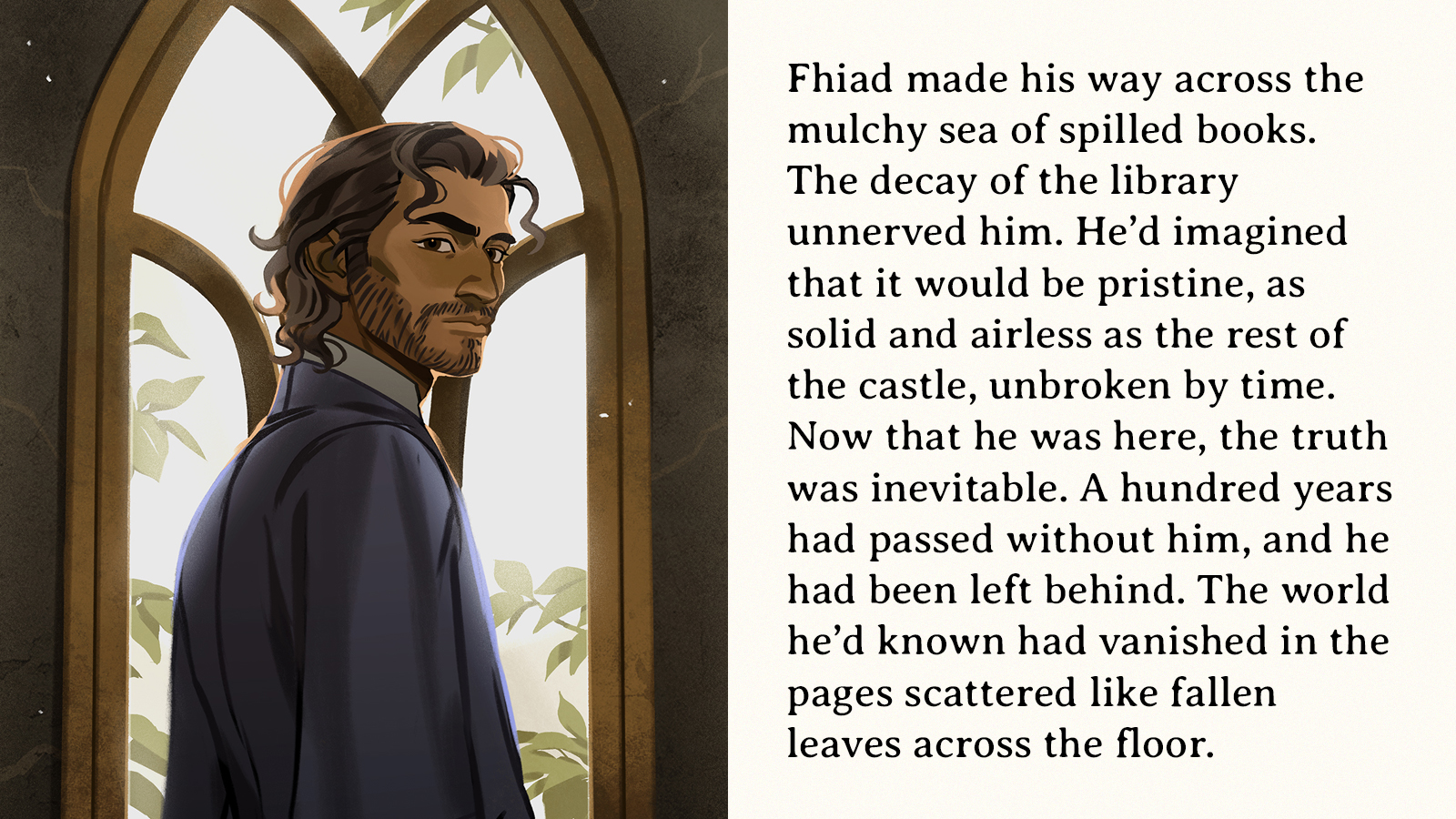
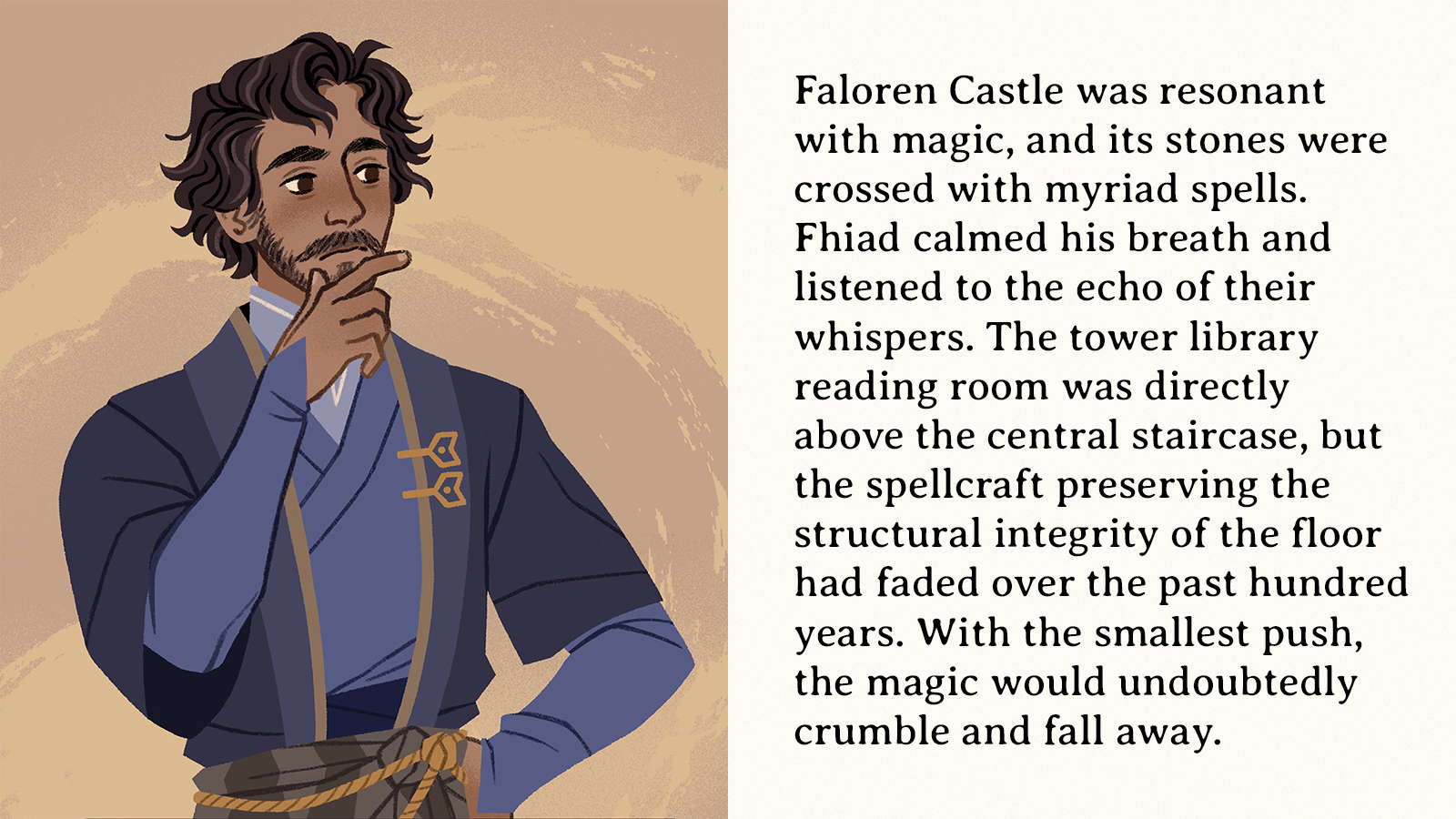
The illustration of Fhiad in this chapter’s preview graphic was created by the marvelous Emily Cheeseman, whose website is (here). You can follow her work on Instagram (here), and I recommend checking out her postcard club on Patreon (here). The general atmospheric vibe of An Unfound Door was partially inspired by Em’s graphic novella adaptation of Gawain and the Green Knight (here), so it was an incredible honor to have her draw one of my story’s main characters!
I’m proud to see my story “Ms. Weaver’s Halloween Candy” in the newest issue of Suburban Witchcraft.
“Ms. Weaver’s Halloween Candy” is a magical realist suburban gothic fantasy about love, creativity, and the (human) sacrifices necessary to survive as an outsider in academia. The piece begins as a Stephen King style story about a kid on a bike investigating a local legend in a small college town, but it gradually unravels into a veiled reworking of the Ariadne myth as the protagonist learns that the ambitions of her mother extend far beyond the confines of her family.
Suburban Witchcraft Magazine is a gorgeous digital repository of weird writing with a literary bent, and each issue is free to read online. You can check out the issue with my story here:
Usurper Ghoul is a nonviolent Game Boy adventure game that channels the “ruined kingdom” vibe of Dark Souls. I tend to think that Dark Souls is marred by needless difficulty; and, in the same way, the gameplay elements of Usurper Ghoul are needlessly frustrating. The nonlinear exploration-based gameplay of Usurper Ghoul is on brand for a Soulslike Game Boy game, but it’s not for everyone. Like Dark Souls, Usurper Ghoul becomes more interesting the more you engage with it, but the beginning is rough.
You play as a horned, skull-headed demon who wakes in a garden in the hills overlooking a small village, which in turn overlooks a valley of tombs. In true Dark Souls fashion, no one tells you where to go or what you need to do, and it’s possible to spend a lot of time walking around without getting anywhere. There are a few people scattered across the wilderness, but they’re not particularly helpful.
With no particular goal other than to explore the world, your job is to collect three items from three categories. Flowers allow you to interact with people, sticks allow you to interact with the environment, and rocks allow you to access more knowledge about the world. One stick allows you to unlock doors, for example, while another stick allows you to read written text. The catch is that you can only hold one of each type of item at a time.
The necessity of discarding one item in order to use another fits the broader theme of the game, which is that something must be sacrificed in order for something else to be gained. Unfortunately, switching between items involves a great deal of needless backtracking. The world of Usurper Ghoul isn’t that big, and the game isn’t overly complicated, but it’s big and complicated enough for the backtracking to be annoying. There are no puzzles involved; it’s just donkey work.
One might say that Dark Souls involves needless complications and barriers to progress, but one of the primary attractions of Dark Souls is that it’s gorgeous to look at. You might be continually frustrated over the course of your journey through Lordran, but you tolerate the setbacks because the environment is so beautiful and atmospheric. The world design of Usurper Ghoul is unique and interesting, to be sure, but it’s still rendered with primitive Game Boy graphics. There’s no background music, and the sound design is limited to jarring beeps at odd moments. In other words, it’s not necessarily a pleasure to trek back and forth across the map to switch out one tool for another.
The overall story of Usurper Ghoul is intriguing, but the writing is hit or miss. Most NPCs say decontextualized NPC banalities, and the lore encountered in books and on monuments often feels like a parody of Dark Souls. Although this is never explained, your goal is to enter a tower; and, to do so, you have to collect enough lore to figure out the right order to light torches in front of the tombs in the valley. You need different sticks to unlock gates, to read the writing on the tombs, and to light their torches, so this is a tedious process even if you (like me) lose patience with the game’s obtuse writing and resort to a walkthrough to figure out the order.
Having discussed what’s frustrating about Usurper Ghoul, I now want to explain why I enjoyed it anyway. The next paragraph contains mild gameplay spoilers, but it’s also the coolest part of the game.
For your own nefarious purposes, you can offer three varieties of flowers to NPCs. Comely flowers make people like you, malodorous flowers make people dislike you, and horrid flowers will kill anyone who touches them (except you). In one of the game’s endings, you can climb the tower in the valley and simply leave the kingdom behind without hurting anyone. If you want to experience everything Usurper King has to offer, however, your goal becomes to kill as many NPCs as possible while managing the limitations imposed by each death. Each NPC you kill with a horrid flower leaves a book in the tower whose text emphasizes the theme of sacrifice. For me, this was when the story became worth the trouble of navigating the world.
I found the endgame of Usurper Ghoul to be extremely compelling. And really, despite the initial annoyances, the ideas informing Usurper Ghoul are brilliant. I feel that the success of the execution is limited by the Game Boy technology, and I’d like to give the developer a nice chunk of cash to hire collaborators and develop these ideas into a less bare-bones format, perhaps along the lines of Tunic. Usurper Ghoul is a fascinating proof of concept; and, with a bit of polish, I could easily imagine it becoming a cult classic.
For me, the payoff of Usurper Ghoul was worth the frustration of the gameplay and the occasional Dark Fantasy Generator™ writing, but your mileage may vary. There’s a lot to explore and experiment with in the world of the game, and it’s definitely possible to spend several hours there. I lost patience toward the middle and used (this walkthrough on Reddit) to smooth over some of the rougher bits, and I ended up spending a bit more than two hours with the game. If nothing else, I’m really looking forward to checking out the developer’s comic projects in the near future.
This past weekend, I played an early access version of the dark fantasy 2D action-adventure game Ender Magnolia: Bloom in the Mist, which includes about three and a half hours of content. So far, I really like what I see.
Ender Magnolia is a sequel to Ender Lilies, a Soulslike Metroidvania published by the Japanese developer Binary Haze Interactive in January 2021. In Ender Lilies, you play as a young girl named Lily who wakes up alone in a ruined kingdom built on the edge of a much older kingdom. The blight that plagued the kingdom of the Ancients spread to Lily’s kingdom untold decades ago. As the last of a line of priestesses, Lily’s job is to purify those affected by the blight by laying them to rest. Since Lily is defenseless on her own, she’s aided by the spirits of the blighted whom she’s purified. Each boss and miniboss the player defeats contributes to Lily’s moveset, which is completely customizable.
Although this isn’t 100% confirmed in the early access version, there’s strong evidence to suggest that Ender Magnolia is a prequel that takes place during the last days of the kingdom of the Ancients. This kingdom has clearly fallen on hard times, but it still boasts a sophisticated fusion of magic and technology that led to the creation of artificial lifeforms called homunculi. Homunculi are able to resist the influence of a magical blight rising from underground, but only to a limited extent.
You play as a young girl named Lilac who is an Attuner, a title that designates someone who possesses the magic necessary to repair homunculi and purge the influence of the blight. Where Lily purified decaying zombies in Ender Lilies, Lilac attunes renegade humanoid robots. While Lily’s purification allowed the blighted to rest by allowing them to die, Lilac’s attunement helps homunculi regain their sanity.
Since they’re still alive after attunement, the defeated robots don’t automatically join Lilac as companions. If I had to guess, I’d say that the relatively limited number of Lilac’s companions in Ender Magnolia is probably Binary Haze’s response to a common criticism of Ender Lilies, namely, that there were too many companion spirits and not enough upgrade resources to experiment or use them all effectively. Thankfully, this excess of choice doesn’t seem to be an issue in Ender Magnolia, in which Lilac’s attacks are still fully customizable but much more focused on a core moveset.
None of the minibosses join Lilac, but they’re still fun to fight, as are the challenging area bosses. Whereas there were major spikes in difficulty in Ender Lilies, Ender Magnolia seems to be more balanced and linear in terms of challenge. According to the developer notes on Steam, the full version of the game will allow the player to customize the difficulty, but the standard setting worked just fine for me. I still died a lot (affectionate) and was grateful for every character stat upgrade.
In Ender Lilies, Lily was the only living person in the entire kingdom, so she didn’t have any need for money. This is not the case in Ender Magnolia, which has a central village hosting a small shop where Lilac can buy bracelets that boost her defense and other upgrades. Money isn’t directly received from defeating enemies, but must be found in the environment or offered as a reward.
The game’s economy is supported by numerous NPCs who can be found in the central hub, as well as scattered across the map. Some of these NPCs are human, and some are homunculi, and some seem to be visitors from the “upper stratum” of the city, like Lilac herself. The player can still find scraps of text with background lore hidden in the environment, but there are also living people directly sharing their experiences. Some of this text is relevant to Lilac, but I appreciate that most of it isn’t. As in Ender Lilies, Ender Magnolia contains a lot of smaller stories that have very little to do with the player. This world is in decline, but the player gets a sense that there’s still something for Lilac to save. She’s a very sweet girl, as is her main companion Nola, a stern but elegant sword lesbian. I’m looking forward to all the tears I’m going to cry as their tragedy unfolds.
Like Ender Lilies, Ender Magnolia is intensely atmospheric. The primary aesthetic of Ender Lilies was ruin and decay, while Ender Magnolia seems to be more rustpunk (or whatever you’d call what’s going on in the city of Midgar in Final Fantasy VII). There’s a beautiful city above, but you begin the game in the slums, which are filthy and decrepit. When the rusty browns of this aesthetic are interrupted, such as in an abandoned castle overgrown with brilliantly scarlet maple trees, it’s a sight to behold. The sound design and music are also marvelous. To me, the way the game designers use the beauty of the environment to inspire the player to overcome challenges is the hallmark of Soulslike games, and Ender Magnolia nails this perfectly.
I keep comparing Ender Magnolia to Ender Lilies, but it’s not necessary to be familiar with Ender Lilies to enjoy and appreciate what’s going on in Ender Magnolia. In fact, I’d say that Ender Magnolia is much more accessible to newcomers, at least based on what I’ve seen so far.
Meanwhile if you, like me, have done multiple playthroughs of Ender Lilies, Ender Magnolia still feels fresh. It’s significantly different from its predecessor in ways that are fun and interesting and not just new for the sake of change.
I’m really excited about Ender Magnolia. If nothing else, not only can you pet the big fluffy robot zombie dog, but he also serves as your method of fast travel. What a good boy!!
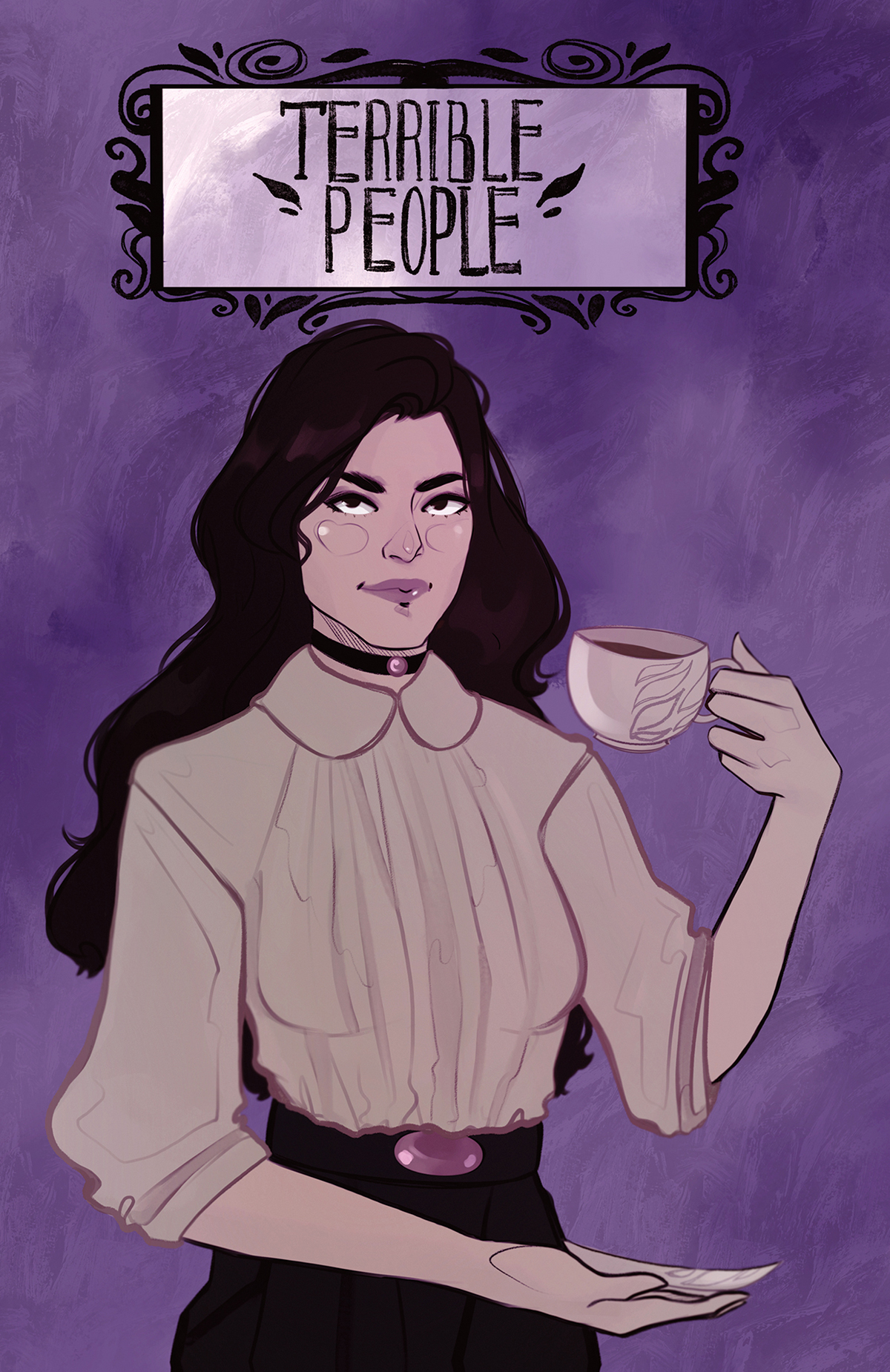
Terrible People collects six short and eerie tales of dark fantasy, unfortunate encounters, and horrible life choices. The writing is accessible to teenagers and adults alike, and there’s a diversity of death, poison, and murder for everyone to enjoy.
Terrible People is my fifth zine of original short fiction, and it’s the first that feels like a real short story collection. Each of the stories in this zine was accepted for publication elsewhere; but unfortunately, every single one of these publications was cursed. To give an example, one online magazine closed their website and deleted their social media accounts less than a month after they accepted one of these stories. To give another example, a small press that published an anthology with another of the stories burned down, meaning that almost all copies of the book were destroyed.
Perhaps I’m tempting fate by printing these stories on my own. Who can say?
At 52 pages, the zine is relatively lengthy, which means I was able to give it a spine. This necessitated extra formatting work, and I feel like I’m slowly starting to understand the art of book design. What I’m thinking of doing in the near future is making a short chapbook from a single story and experimenting with the formatting until it looks more like an actual book. Terrible People is probably the last zine I’m going to make that has the style of formatting I’m using now, which I actually quite like.
I’ve been thinking that perhaps it might be nice to set up a micropress one day. For the time being, however, I’m content simply to continue writing these strange little stories while hoping that the curse haunting my attempts to publish them eventually dissipates.
Ender Lilies: Quietus of the Knights is a fantasy-themed 2D adventure-platformer with moderate elements of horror and a moderately high level of difficulty. Unlike many modern Metroidvania games, there is nothing retro about the graphics. The backgrounds are gorgeous works of HD digital art filled with stunning details, and the characters and enemies are all beautifully animated. Both the combat and exploration are a lot of fun, and it’s a joy to move through this ruined world.
You play as a young unnamed priestess (referred to by the user interface as Lily) who wakes in the catacombs beneath a cathedral filled with monsters. You’re greeted by an adult knight (initially called “the Umbral Knight” but later revealed to be named Ferin) who accompanies Lily outside, where the landscape is dark and dripping with the water of a poisonous rain. Everything touched by the rain becomes “blighted,” or monstrous and undead. Lily has the ability to purify monsters by removing the blight from their bodies, thereby allowing them to die. Although the game has no quest-givers to explain what’s going on, it’s easy enough to make the assumption that Lily’s job is to find the source of the blight and purify it.
Lily is a small child who is physically fragile, and she cannot defend herself on her own. Your attacks are therefore performed by the Umbral Knight, who is gradually joined by other spirits. The Umbral Knight performs a basic sword attack, but Lily meets spirits who can perform heavy attacks, ranged attacks, area-of-effect attacks, and so on. You can equip two sets of three spirits at a time and map them onto whatever buttons you wish in order to create different combos and skill sets appropriate to different bosses and exploration challenges. This is much less complicated that it sounds, and the Umbral Knight is strong and versatile enough to carry you through the game.
You can upgrade these spirits using different types of limited resources that you find through exploration. Aside from Lily, everyone in the world of the game is either dead or undead, and there is no “economy” to speak of – only the relics and resources that Lily can scavenge from corpses. Spirits are acquired by defeating boss monsters, many of which are optional and must also be found by exploration. I really love this system of fighting a powered-up version of a regular monster in order to acquire its abilities, especially since the player should already be familiar with these abilities from having faced a number of such creatures in combat.
The optional minibosses are tricky but fun, but the mandatory zone bosses are legitimately challenging. This challenge is mitigated by the game’s leveling system, in which defeating enemies gives Lily experience points that allow her to gain levels. Health and attack upgrades must be acquired elsewhere, but each new level grants Lily ever-so-slightly better defense and a tiny boost to the power of the Umbral Knight. There is always a save point right before a zone boss fight, as well as an enemy-dense screen on the other side of the save point that provides a good opportunity to level up if needed. The only real way to defeat these bosses is to learn their attack patterns while optimizing your own set of attacks, but the zone leading to each boss does a good job of teaching you the skills you need to survive.
You can also find various relics in the world that grant enhanced abilities, such as giving you more healing charges, increasing the amount healed with each charge, increasing your defense, strengthening certain types of attacks, and so on. In addition, you’ll find items that allow you to equip more relics, as well as items that permanently increase your health bar. Some of these items are hidden behind illusory walls, but these “secrets” are never unmarked, and the game teaches you how to read the environment fairly early on. If you pay attention and don’t mind an occasional bit of backtracking – which you’ll need to do anyway to find a path forward through the interconnected zones – you should be able to strengthen Lily just enough to keep going without having to grind for levels.
Ender Lilies is clearly inspired by Dark Souls and Hollow Knight. It’s not easy, but I would say it’s more “challenging” than “punishing.” The combat is a lot of fun, but the true emphasis is on exploration and paying close attention to the environment. Each screen of the game has its own unique design and artwork, meaning that you’ll be inspired to explore just to see what’s around the next corner. In addition, each relic and spirit and upgrade material you find is valuable, as is every zone boss spirit, all of which grant you an additional exploration ability. I found the gameplay loop of Ender Lilies to be extremely satisfying.
Given that everyone in the world of the game is dead, careful exploration also allows you to find bits and pieces of the story in the form of Fallout-style journals and missives that have been left lying around. Like the gameplay, the story is inspired by Dark Souls and Hollow Knight, and the overarching plot is similar – a morally ambiguous king has made a difficult choice involving arcane forces that were poorly understood by hubristic scientist-wizards. Ender Lilies adds a few interesting twists to this formula, especially towards the end, and the abject tragedy of what happened in this kingdom feels earned, narratively speaking.
What I love about the story is that every textual object you find has a distinct narrative voice. It goes without saying that the presentation of information is not linear, and it’s always a fun surprise to find something written by a blighted monster you encountered much earlier in the game. Some of these characters are much more important than others, but the gradual accumulation of their stories leads the player to the dawning realization that, despite the horror of the situation, the kingdom was filled with flawed but deeply human people who were doing the best they could.
It’s easy to dismiss Ender Lilies as “2D anime Dark Souls for casuals” at a glance, but I ended up being genuinely moved by the story and characters. The horror themes are expressed with creativity and style, and Ender Lilies is nothing if not atmospheric. In terms of gameplay, I think Ender Lilies may be a perfect Metroidvania, and the game features various ease-of-life concessions that help make it more accessible without diminishing the thrill or challenge of the gameplay.
And finally, I appreciate how the spirits Lily has purified hang out with you at save points. There’s nothing I love more than the image of a cute girl sitting amongst weathered ruins surrounded by grotesque monsters as rain falls in the background. That’s the good stuff right there.





 Digital Fantasy Diary