Ender Lilies: Quietus of the Knights

Ender Lilies: Quietus of the Knights is a fantasy-themed 2D adventure-platformer with moderate elements of horror and a moderately high level of difficulty. Unlike many modern Metroidvania games, there is nothing retro about the graphics. The backgrounds are gorgeous works of HD digital art filled with stunning details, and the characters and enemies are all beautifully animated. Both the combat and exploration are a lot of fun, and it’s a joy to move through this ruined world.

You play as a young unnamed priestess (referred to by the user interface as Lily) who wakes in the catacombs beneath a cathedral filled with monsters. You’re greeted by an adult knight (initially called “the Umbral Knight” but later revealed to be named Ferin) who accompanies Lily outside, where the landscape is dark and dripping with the water of a poisonous rain. Everything touched by the rain becomes “blighted,” or monstrous and undead. Lily has the ability to purify monsters by removing the blight from their bodies, thereby allowing them to die. Although the game has no quest-givers to explain what’s going on, it’s easy enough to make the assumption that Lily’s job is to find the source of the blight and purify it.   

Lily is a small child who is physically fragile, and she cannot defend herself on her own. Your attacks are therefore performed by the Umbral Knight, who is gradually joined by other spirits. The Umbral Knight performs a basic sword attack, but Lily meets spirits who can perform heavy attacks, ranged attacks, area-of-effect attacks, and so on. You can equip two sets of three spirits at a time and map them onto whatever buttons you wish in order to create different combos and skill sets appropriate to different bosses and exploration challenges. This is much less complicated that it sounds, and the Umbral Knight is strong and versatile enough to carry you through the game.

You can upgrade these spirits using different types of limited resources that you find through exploration. Aside from Lily, everyone in the world of the game is either dead or undead, and there is no “economy” to speak of – only the relics and resources that Lily can scavenge from corpses. Spirits are acquired by defeating boss monsters, many of which are optional and must also be found by exploration. I really love this system of fighting a powered-up version of a regular monster in order to acquire its abilities, especially since the player should already be familiar with these abilities from having faced a number of such creatures in combat.

The optional minibosses are tricky but fun, but the mandatory zone bosses are legitimately challenging. This challenge is mitigated by the game’s leveling system, in which defeating enemies gives Lily experience points that allow her to gain levels. Health and attack upgrades must be acquired elsewhere, but each new level grants Lily ever-so-slightly better defense and a tiny boost to the power of the Umbral Knight. There is always a save point right before a zone boss fight, as well as an enemy-dense screen on the other side of the save point that provides a good opportunity to level up if needed. The only real way to defeat these bosses is to learn their attack patterns while optimizing your own set of attacks, but the zone leading to each boss does a good job of teaching you the skills you need to survive.

You can also find various relics in the world that grant enhanced abilities, such as giving you more healing charges, increasing the amount healed with each charge, increasing your defense, strengthening certain types of attacks, and so on. In addition, you’ll find items that allow you to equip more relics, as well as items that permanently increase your health bar. Some of these items are hidden behind illusory walls, but these “secrets” are never unmarked, and the game teaches you how to read the environment fairly early on. If you pay attention and don’t mind an occasional bit of backtracking – which you’ll need to do anyway to find a path forward through the interconnected zones – you should be able to strengthen Lily just enough to keep going without having to grind for levels.

Ender Lilies is clearly inspired by Dark Souls and Hollow Knight. It’s not easy, but I would say it’s more “challenging” than “punishing.” The combat is a lot of fun, but the true emphasis is on exploration and paying close attention to the environment. Each screen of the game has its own unique design and artwork, meaning that you’ll be inspired to explore just to see what’s around the next corner. In addition, each relic and spirit and upgrade material you find is valuable, as is every zone boss spirit, all of which grant you an additional exploration ability. I found the gameplay loop of Ender Lilies to be extremely satisfying.

Given that everyone in the world of the game is dead, careful exploration also allows you to find bits and pieces of the story in the form of Fallout-style journals and missives that have been left lying around. Like the gameplay, the story is inspired by Dark Souls and Hollow Knight, and the overarching plot is similar – a morally ambiguous king has made a difficult choice involving arcane forces that were poorly understood by hubristic scientist-wizards. Ender Lilies adds a few interesting twists to this formula, especially towards the end, and the abject tragedy of what happened in this kingdom feels earned, narratively speaking.

What I love about the story is that every textual object you find has a distinct narrative voice. It goes without saying that the presentation of information is not linear, and it’s always a fun surprise to find something written by a blighted monster you encountered much earlier in the game. Some of these characters are much more important than others, but the gradual accumulation of their stories leads the player to the dawning realization that, despite the horror of the situation, the kingdom was filled with flawed but deeply human people who were doing the best they could.

It’s easy to dismiss Ender Lilies as “2D anime Dark Souls for casuals” at a glance, but I ended up being genuinely moved by the story and characters. The horror themes are expressed with creativity and style, and Ender Lilies is nothing if not atmospheric. In terms of gameplay, I think Ender Lilies may be a perfect Metroidvania, and the game features various ease-of-life concessions that help make it more accessible without diminishing the thrill or challenge of the gameplay.

And finally, I appreciate how the spirits Lily has purified hang out with you at save points. There’s nothing I love more than the image of a cute girl sitting amongst weathered ruins surrounded by grotesque monsters as rain falls in the background. That’s the good stuff right there.  

An Unfound Door, Chapter Eight

Agnes and Fhiad meet in the library on the morning after the summer court opens. Agnes wakes before dawn out of habit, while Fhiad has been up all night reading. Fhiad left to get tea, and he returns just as Agnes is studying the books he left on a desk.

They sit down together, and Fhiad apologizes for making wild proclamations. When Agnes asks if Fhiad would truly destroy Faloren if he found Soreiya’s Tear, he explains that doing so would be impossible, as the cost for performing magic on such a large scale would have an unimaginably high cost. Fhiad gives a demonstration of magical cost, and Agnes is so amazed that she asks a clueless question about his past, thus chilling the warmth of an intimate moment. 

. . . . . . . . . . . . . . . . . . . . .

This chapter marks the beginning of what Jessica Brody (of Save the Cat fame) calls the “fun and games” section of the story, which should constitute the bulk of Act Two. While the opening and closing of a novel should ideally follow a set formula that helps guide the reader, the middle of the story offers much more freedom to the writer.

I like to use this freedom to indulge in all of the narrative tropes I enjoy, and this chapter includes one of my favorite scenes. Namely, I love when an intimate conversation in a library helps the protagonist and her foil understand that they should be friends. At the beginning of this chapter, Agnes is characteristically blunt and ready to fight, but she and Fhiad manage to establish a common ground by virtue of the fact that they’re both giant nerds.

Fhiad begins to show his true colors in this scene. He’s more socially polished than Agnes, but he’s a shy academic at heart. In fact, most of Fhiad’s trouble has resulted from him being a pushover. Although he gets in a few good jabs at Agnes, Fhiad also submits to her demands multiple times during this conversation.

I was recently reading an academic book chapter about gothic fiction, and the author was saying that the erotic charge of the narrative is primarily generated by the question of whether a wild and mysterious man will sexually assault the heroine who fears him. This sexual fear turns to romance when the heroine realizes that the man’s menacing aura is a result of his violent passion for her.

I unapologetically appreciate that sort of character dynamic, but it doesn’t fit what’s going on with Agnes and Fhiad. Agnes isn’t fearless, but her extreme pragmatism drives her to behave as if she were. Meanwhile, Fhiad is competent and talented in his own way, but he has no business being “wild” or “menacing.” In a reversal of the classic gothic gender dynamic, Fhiad needs Agnes to push him forward, while what Agnes needs from Fhiad is his patience and kindness.     

More than anything, however, this chapter is about doing magic in a cool library. The next chapter is also going to be about magic and libraries. And the chapter after that? More magic, and more libraries. I love libraries and magic, what can I say. This is my story, and I get to write whatever I want.

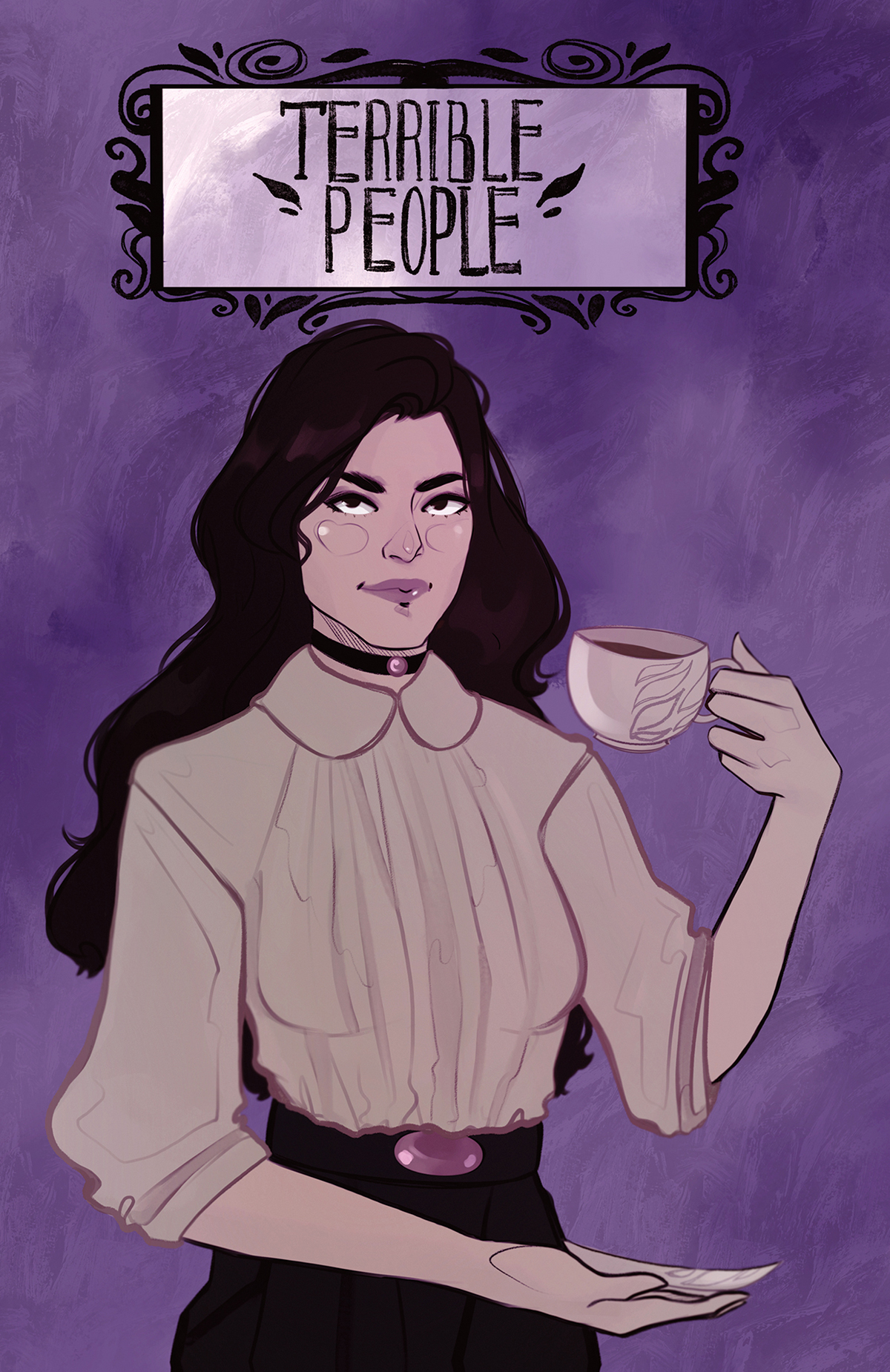
The lovely gothic portrait of Agnes that accompanies this chapter’s preview was created by the magical Emily.E.Draws, whose vibrantly colorful fantasy characters can be found on Instagram (here) and on Tumblr (here).

An Unfound Door, Chapter Seven

Fhiad leaves the court and walks through the halls of the castle as he reflects on the circumstances that brought him to Faloren. Guerig, the king’s secretary and acting regent, has granted Fhiad permission to live in the castle while supposedly doing research on the building’s architecture. Fhiad curses himself for being drawn back to the kingdom, but he has few resources and fewer choices.

As he wanders, Fhiad reflects on how he was originally sent to Faloren as a replacement for a retired diplomat during what he intended to be a temporary break from his studies. He reflects on how the kingdom has declined during the past hundred years, and he wonders why Agnes seems to be a ghost of the person he met in the northern forest. 

. . . . . . . . . . . . . . . . . . . . .

An Unfound Door is written in limited third-person perspective, and this is the first chapter that focuses on Fhiad. As the representative of the novel’s “B Story,” Fhiad represents the upside-down world of Act Two, which begins when the “A Story” character’s status quo is disrupted. Fhiad is the catalyst for this disruption, but his arc is also a mirror of Agnes’s character development. Fhiad and Agnes ultimately want the same thing – the power to choose the direction of their lives – but their initial motivations and goals are drastically different.

Fhiad may have told Agnes that he intends to destroy her kingdom, but what he truly wants is to understand what happened to him. He’s suffering from severe trauma that he hasn’t been able to process, and he alternates between distraction and intense anger. He attempts to distract himself from his grief by tasking himself with a quest. Meanwhile, his frustration has no outlet save for Agnes, who became his target simply because she’s the only living person he knows. Fhiad is doing his best to survive, but he’s a hot mess.

More than anything, this chapter establishes how and why Fhiad has come to Faloren Castle. It also provides a second perspective on the setting.

What the reader is able to see through Fhiad’s eyes are two things that Agnes takes for granted. First, Agnes is subtly shunned by the members of her court; and second, Faloren Castle is impossibly large and labyrinthine. These two observations help justify the “fun and games” portion of Act Two, which will involve Agnes and Fhiad hunting for a hidden relic. In other words, Fhiad’s observations hint that Agnes is free to search the castle precisely because she doesn’t have many social obligations, and that her search is going to be interesting because it isn’t going to be easy.

Something else Fhiad has noticed is that there’s something suspicious about Agnes’s cousin Galien. This is fair, as Galien is hiding a number of unpleasant secrets. Still, Galien is no more a villain than Fhiad. I like to think of An Unfound Door as a “gothic fantasy mystery,” which means that everyone has secrets. This is why, at this point in the story, the main task of the characters is to learn how to communicate with each other. If they’re going to figure out who the actual villains are, they’ll need to be able to trust each other.

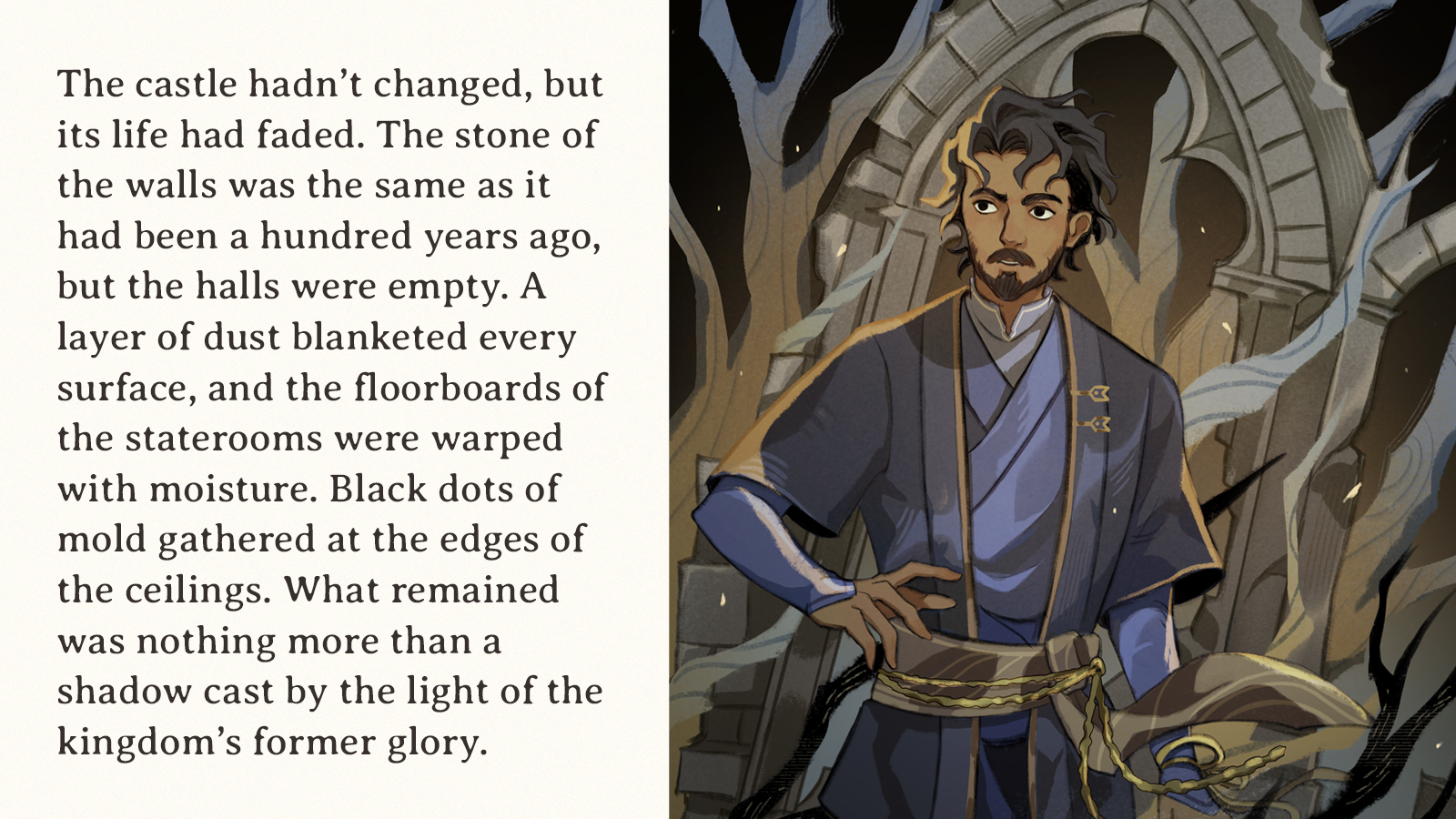
The portrait of Fhiad in the chapter preview was created by the heroic Silverpeel, a fantasy artist with a gothic flair. You can see more of Peel’s illustrations of knights and forests and gods and legends on Instagram (here), on Bluesky (here), and on Tumblr (here).

An Unfound Door, Chapter Five

Agnes rises early the next morning in order to attend to the correspondence that has accumulated in her absence. As she dresses, she reflects on how her mother’s charm and social grace slowed her kingdom’s decline. Unfortunately, her father has done nothing to alleviate the grim atmosphere pervading the castle since the queen’s death.

Agnes proceeds to her study, a dilapidated yet still handsome room where she secludes herself to work. She is interrupted by her cousin Galien, who encourages her to open the summer court. Agnes agrees, believing that a large and lively celebration will be an appropriate symbolic marker of her vow to rejuvenate the kingdom.   

. . . . . . . . . . . . . . . . . . . . .

This chapter is about Agnes’s comfortable existence in the status-quo world. It is indeed a very comfortable and cozy chapter, and I enjoyed writing it.

Aside from establishing the scene of the next chapter, which will be the opening of the summer court, not much happens here. As I wrote in my notes for the previous chapter, it’s important for the reader to understand why Agnes is willing to remain content with the status quo.

It seems as though Agnes is doing useful work and making actionable plans for the future, but none of this actually means anything. An astute reader should be asking the questions that Agnes is aggressively ignoring: How did she find herself out in the woods on the border of her kingdom? Where did the demon come from? Who kidnapped her? Was it someone in the castle? Are they still there?

Agnes needs to start asking herself these questions soon, because Fhiad is going to come back and cause trouble. For the time being, though, it’s nice to have a small interlude of peace.  

I recently read a Tumblr post (here) regarding how the Gothic genre is all about taking four pages to describe a staircase, and there’s a bit of that in this chapter. I want the reader to see how shabby and decrepit Agnes’s castle is, and I want there to be an opportunity to enjoy the comfortable aspects of this state of decay.

All of the chapters in An Unfound Door have titles, by the way. I’m not sure if I’ll end up using them, but I especially like the title for this chapter, “A Slow and Silent Decay.”

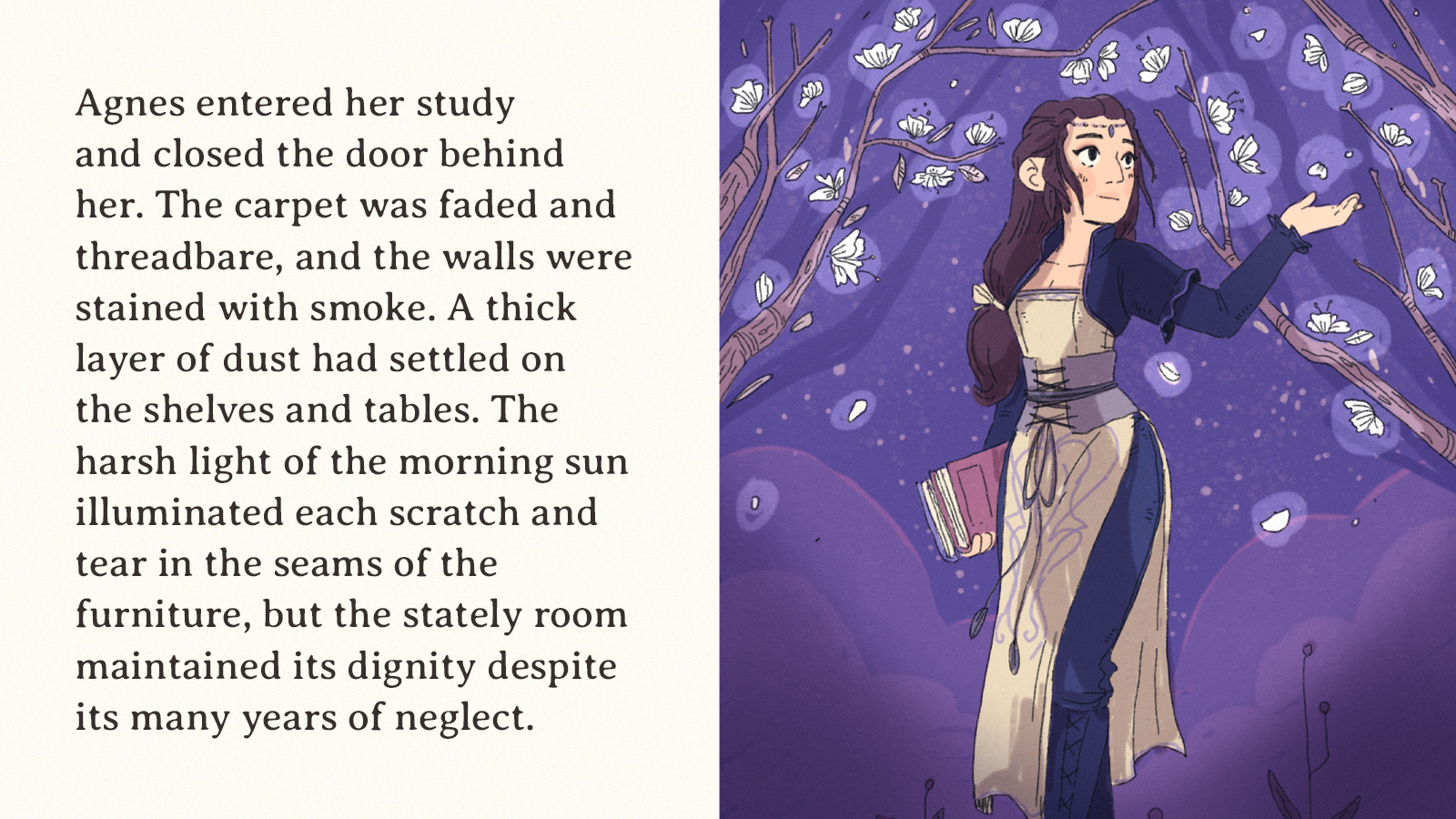
The illustration of Agnes that accompanies the chapter preview was created by the fantasy artist and gentle wizard Madeline Hale, whose colorful and whimsical character designs can be found on Instagram (here) and on on Bluesky (here).

An Unfound Door

The sacrificial princess Agnes spares the life of a demon from the blade of the hero who rescued her from certain demise, but was this the wisest decision? Upon returning to her decaying kingdom, she finds the beast waiting for her, now in the form of a man. He is determined to restore the ruins of his homeland to their former glory, but his ambition presages calamity. As Agnes follows her enemy through the shadows, she must shine light onto the mysteries of the past if she wishes to restore hope for the future.

This is my working description for An Unfound Door, the dark fantasy mystery novel that I’m currently writing. I borrowed the title from this passage in Thomas Wolfe’s Look Homeward, Angel, a coming-of-age story primarily set in an old and decrepit town: “Remembering speechlessly we seek the great forgotten language, the dark lane into heaven. A stone, a key, an unfound door. O lost and by the wind grieved ghost, come back again.”

The character illustrations are by Marianne Lalou, who is on Tumblr, on Twitter, and on Instagram. Lalou was able to take my amateur designs (that I posted here) and polish them into something magical. They’re one of my favorite fantasy illustrators and character designers, and it was an amazing experience to work with them!

Mount Hiei

My story “Mount Hiei,” a dark fantasy about two young monks navigating the eerie twilight years of the Heian period, was just published in Hyakumonogatari Kaidankai, a special issue of the journal White Enso. The issue is currently ongoing and free to read online (here), and “Mount Hiei” is on (this page).

In this story, a ten-year-old boy becomes an apprentice monk on Mount Hiei, which houses a temple that has been tasked with protecting the nation. The boy grows accustomed to monastic life but never becomes comfortable with the statues of the monstrous Guardian King venerated by the other monks. When he discovers a secret door leading into the mountain, he comes to understand why the deity is depicted in such a frightening manner – as well as what “protecting the nation” actually entails.

Mount Hiei is a real place, as is Enryaku Temple, which serves as the setting of this historical horror story. To the best of my knowledge, the practical details of monastic life are accurate for the time period. I was inspired by the fiction of the Japanese author Ken Asamatsu, who applies a Lovecraftian sensibility to Japanese mythology and folklore, and I wrote this story from a place of admiration and respect for the medieval war epic The Tales of the Heike, on which it’s very loosely based.

By the way, the editors of White Enso are still looking for personal essays and original fiction for the 100 Ghost Stories Kaidankai project. Although they’re selective, they accept shorter and more casual pieces, and the submission process is very chill and relaxed. The editors are a pleasure to work with, and they’ll also create a podcast recording of your writing! If you’re interested, you can send your submission (here).

Haunted Houses

Earlier this week I published my newest zine of horror-themed microfiction. Haunted Houses contains fifteen very short stories about haunted spaces and the terrible people who inhabit them. The cover art is by @QuinkyDinky, and the zine contains interior art by @irizuarts. I’ve got a listing up on Etsy (here), and I’m also promoting the zine on Twitter (here) and Instagram (here).

This zine is quite short, with each story and illustration occupying only one page. This is partially a trick of formatting, but it’s also a result of careful editing. You wouldn’t want to spend too much time in these places, after all.

I have to admit that, even though I’m categorizing this zine and the two other collections of microfiction that preceded it as “horror,” I’m on the fence about what genre my stories actually belong to.

In my mind, the genre of horror isn’t about a specific set of tropes or narrative structures. Rather, horror is characterized by the psychological and visceral sensation of unease it inspires.

I personally prefer to think of most horror, including the stories I write, as “dark fantasy,” or perhaps simply “magical realism.” I’m not easily creeped out by fiction, mainly because the real world is so lowkey awful so much of the time. As I write this, the National Guard is setting up base at a West Philadelphia Target in advance of the presidential election next week, ostensibly as a “defense” against people engaging in civic protest. There are actual tanks in the parking lot of the place I go to stock up on toilet paper, and that’s really scary. But monsters? Not so much.

I’ve always tended to identify with monsters, and not simply because so many villain characters are overtly coded as queer. Monsters are about disrupting the status quo, and I can get behind that. Postwar American horror cinema, including the slasher films of the 1970s and 1980s, is all about interlopers quietly invading small-town America and infecting people. The story behind many of these movies basically boils down to this: Can you even imagine scary things like communism and feminism and civil rights secretly gaining a foothold in our town? (Stephen King goes into fantastic detail about this in his 1981 book Danse Macabre, if you’re curious, and I think the book still reads well and holds up in many ways.)

To me, monsters aren’t scary because I am the monster, which is an uncomfortable set of life experiences to try to talk about in fiction or otherwise. There’s nothing you can specifically put your finger on regarding why people treat you the way they do, but you know there’s something a little off.

Fuck Sigmund Freud and his weird misogyny and homophobia, but I think I’m on the same page with him regarding “the uncanny” as one of the primary components of horror. Freud got a lot of things wrong in his career, but something he gets absolutely right is that it’s difficult to discuss the uncanny in concrete terms.

The uncanny doesn’t just apply to appearance, of course – social interactions and environments can be uncanny as well. If what I’m writing is horror at all, it probably falls into the subcategory of social horror, which focuses on people behaving in a way that’s almost human, but not quite. Many horror stories are cathartic, in that the status quo is threatened but ultimately restored at the end. Even if things have changed, we can feel relief in the knowledge that at least they’re getting back to normal. With social horror, however, our anxiety is never resolved, because we now understand that the status quo itself is horrifying.

It’s difficult for me to talk about the details of my identity and life in a mimetic way. When I’ve tried, it’s been my experience that people either won’t believe me, will think I’m being manipulative in an attempt to elicit undeserved sympathy, or will be put off by the political elements underlying my descriptions of the ways in which I’ve had to move through the world.

The point of the stories in Haunted Houses is not to try to explain why certain aspects of my life have been unsettling, but rather to create a sense of the uncanny in order to communicate the sense of feeling unsettled for reasons you can’t quite explain. Sometimes my stories about haunted houses are about the hidden trauma of being queer in a society that goes out of its way to create monsters; but, in the end, I just really like telling stories about strange people occupying uncomfortable places. I enjoy exploring these themes both as a reader and as a writer, and I’ve found that summoning the courage to open the door and peer into the darkness on the other side is, if not total escapism, still good spooky fun.

And right now, at this specific moment in time, I think we can all relate to the uncanny experience of feeling trapped in a haunted space, because this is our daily life – we live here now.