Green Dreams: Tales of Botanical Fantasy

I’m excited to announce that I published a new zine! Green Dreams: Tales of Botanical Fantasy collects six illustrated stories about our relationships with plants and nature.

“Each turn of the seasons brings an end to lives both large and small, but new seeds sprout joyously from the ruins” is the zine’s tagline, and disaster is a major theme of the collection. One of the opening stories is about the gradual effects of climate change; and, in the closing story, environmental catastrophes have become so severe that humans have disappeared completely. The zine also features stories about a medical tragedy narrowly averted, the aftermath of a devastating war, and a porous biological quarantine.

I considered subtitling the zine “Tales of Botanical Dark Fantasy,” but the truth is that none of the stories are actually that “dark.” In fact, I’d say the main theme of the collection is a persistent hope for the future. At this particular moment in history, the state of the world seems very bleak, so it’s good to remember that the environment that surrounds us is much larger – but also much more personal – than whatever horrors are currently unfolding.

Precisely because are so many fires burning in the world, I think it’s important to spend time in thriving green spaces that suggest futures of shifting and changing growth. I believe that a mindful contemplation of our natural environment can also be useful in the uncomfortable but necessary process of decentering normative humanity while challenging the artificial divisions we impose on ourselves and each other.

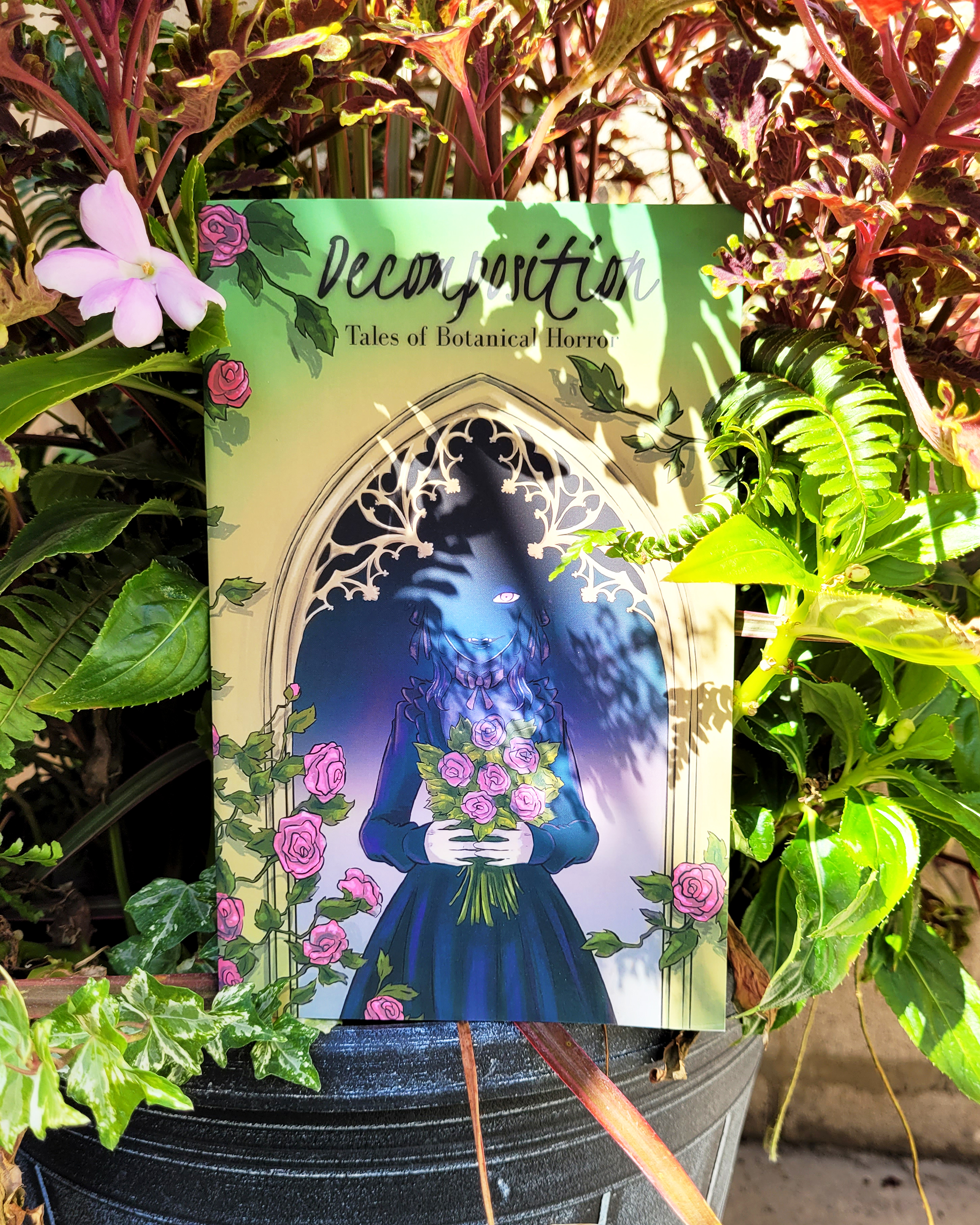
The incredible cover art by Frankiesbugs captures the mood of these stories perfectly.

Frankie creates bold and imaginative botanical fantasy art, and I asked them to illustrate the pagan archetypes of the flower maiden and the horned god, who together represent the endless natural cycle of death and rebirth. In this zine, I wanted to play with symbols that convey the beauty and mystery of the natural world, and Frankie embraced this theme, tinging the painting with potent Christian motifs and a powerful sense of fertility.

It’s an extremely impressive piece of art, and you to check out more of the artist’s work on Instagram (here), on Bluesky (here), and on Redbubble (here).

In this collection, I did my best to share a sense of fertile “green dreams” for the future. Mostly, though, I just really wanted to write some fun ecofiction about plants and mushrooms.

If you’re interested, you can read a free digital version of the zine on Itch.io or order a print copy from Etsy.

🌿 https://digitalterrarium.itch.io/green-dreams
🌿 https://www.etsy.com/listing/4351990958/green-dreams-fantasy-fiction-zine
Symbiosis

Symbiosis
https://spicaze.itch.io/symbiosis

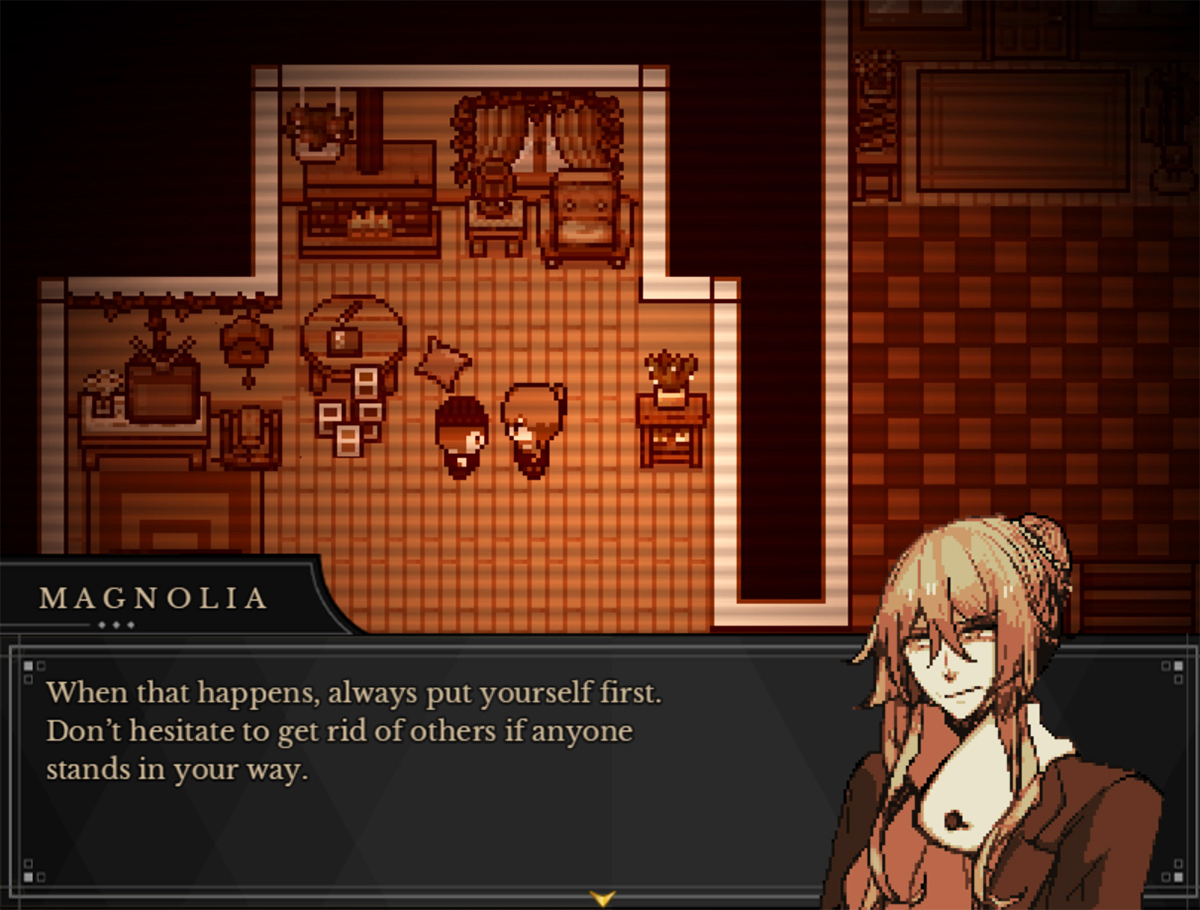
Symbiosis is a free-to-play RPG Maker horror game about a murderous mad scientist living in a house in the woods with an adorable child. The story has two endings, and it takes about 25 minutes to play through the game once.

You play as Magnolia, a geneticist who left her university post after a mysterious fire broke out in her lab when her research came under public scrutiny. She now lives in isolation with Mint, a curious and precociously intelligent young boy whom she’s raising as her son. According to local rumors, Magnolia is a witch. It doesn’t help that hikers have a tendency to disappear in the forest surrounding her property.

The game begins as Magnolia carves up the corpse of someone she caught sneaking into her house. She’s interrupted by Mint, who can’t sleep and wants a bedtime story. Unfortunately, there are three more intruders in the house, and Mint won’t stay in his room. Your job as the player is to turn the remaining intruders into corpses – for science! – while ensuring that Mint remains out of harm’s way. 

Magnolia’s house isn’t too terribly large, but it’s big enough to have all sorts of nooks and crannies to poke around, as well as various journals and research notes to find. The player can use these clues to figure out who Magnolia is and where Mint came from, although you’ll have to make your own decision regarding Magnolia’s feelings toward Mint and what the fate of the pair will be. The game’s creator has posted a guide for the two endings (here), and this short devlog also contains their thoughts on the story and characters.

What sets Symbiosis apart from the crowd of RPG Maker horror games is the creator’s gleeful willingness to allow Magnolia to be messy and problematic. She initially seems to be a complete sociopath, and her bad behavior is a joy to watch. As you witness her interactions with Mint unfold, however, her character becomes more complicated. Why Magnolia feels affection for Mint is open to interpretation, but I think it’s fair to say that her attachment is genuine.

The way I interpret this relationship is that it’s an analogy for the process of artistic creation (or scientific discovery, as the case may be). In order to create something meaningful, an artist has to be unpleasant, selfish, and more than a little antisocial. Gradually the art comes to take on a life of its own, and it’s up to the artist to decide whether to let it go or to keep it firmly in the orbit of their own dysfunctional personality.

Lest you think I’m spoiling the story, fear not – there’s all sorts of nasty business in Magnolia’s past for the player to discover. This woman is a legitimately horrible person, and her crimes are fantastic fun.

Symbiosis tells a short but grisly story through simple narrative adventure gameplay intercut with stylishly illustrated cutscenes, and I enjoyed it enough to go back and see both endings. I definitely recommend this game to fans of gothic horror, demonic women, and questionable scientific ethics.

Bloodbark

Bloodbark
https://sirtartarus.itch.io/bloodbark

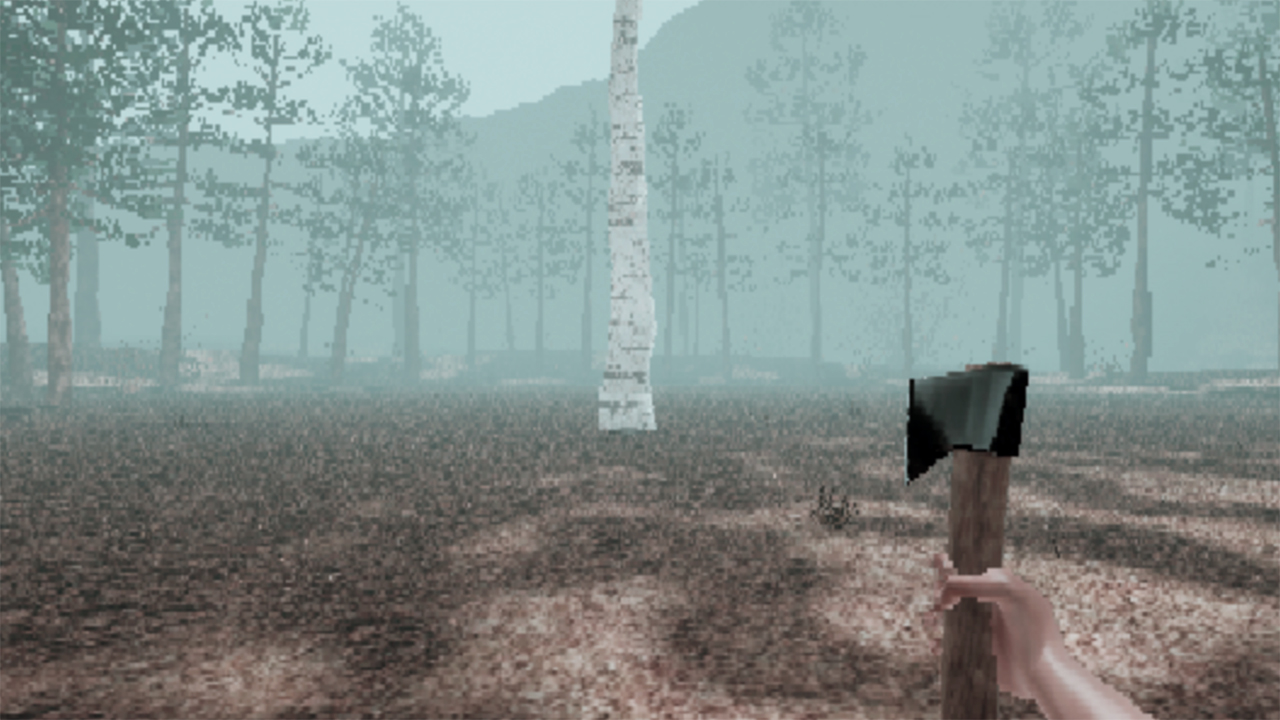
Bloodbark is a forest horror game based on the art of Eduardo Valdés-Hevia that’s free to download and takes about half an hour to play. You play as a lumberjack camping out in a small cabin next to a state park where a new type of tree has been discovered. Although these trees look like normal birches on the outside, their wood is bright red and fetches a high price. The lumberjack’s job is simple – he needs to find the special trees on his employer’s fenced-in property, cut them down, and return the timber to his cabin.

Still, given how much blood is involved… Are you really sure that it’s trees you’re chopping?

The gameplay of Bloodbark is limited to wandering around (with tank controls) and striking various objects with your axe. As you walk, your character’s thoughts automatically appear on the screen as text overlay. The lumberjack is somewhat unwell at the beginning of the game, and he becomes progressively more unhinged as the days pass. Fun times!

The standard route of progression through Bloodbark is fairly well signposted and easy to follow. If you like, however, you can wander to your heart’s content, and the game features a number of achievements and collectibles. Though it won’t have any effect in most circumstances, you can also hack at anything you like. My favorite surprise in the game is a large cocoon suspended from a pole on a dock at the lake. If you manage to find it and get it open, you’re in for an odd little treat.

Although the twist to the story is nothing you wouldn’t expect, the writing leaves a number of interesting questions open to the player’s interpretation. I am not unsympathetic to the lumberjack, who has reasonable doubts about the job he’s been paid to do, and I’m just as annoyed as he is by the car alarms and other annoyances from the neighboring state park. I also think it’s telling that the lumberjack won’t cut down any tree he’s not paid for, no matter how hard the player tries.

My only issue with Bloodbark is that it conveys “darkness” by turning the visual contrast down to zero. Unless you play the game in a sealed room with no external light, the screen appears to be almost solid black. Depending on the quality of your monitor, the parts of the game that take place at night can range from needlessly annoying to impossible to see. It’s a shame, but I’m afraid that this flaw in the game’s visual design may make it inaccessible to many players.

Thankfully, when you can see the game’s graphics, they’re quite lovely. I’m a fan of this sort of lo-fi crispiness to begin with, and I think it creates an interesting contrast with the visual style of many of the secrets you can encounter. To give an example, interacting with three roadside crosses will trigger the brief appearance of a Biblically accurate angel, and the fluidity of this manifestation is a sight to behold against the pixelated mountains and treetops.

If you’re unable to play Bloodbark yourself due to accessibility issues, I’d recommend (this video), which has no voiceover and allows you to watch a streamlined yet still thorough run of the game. Whether you’re watching the game or playing it yourself, Bloodbark is an oddly relaxing game about losing your sanity in the woods, and I’d recommend it to anyone who enjoys the themes and imagery of horror but is happy to dispense with the tension and jumpscares.

Seeded Ground

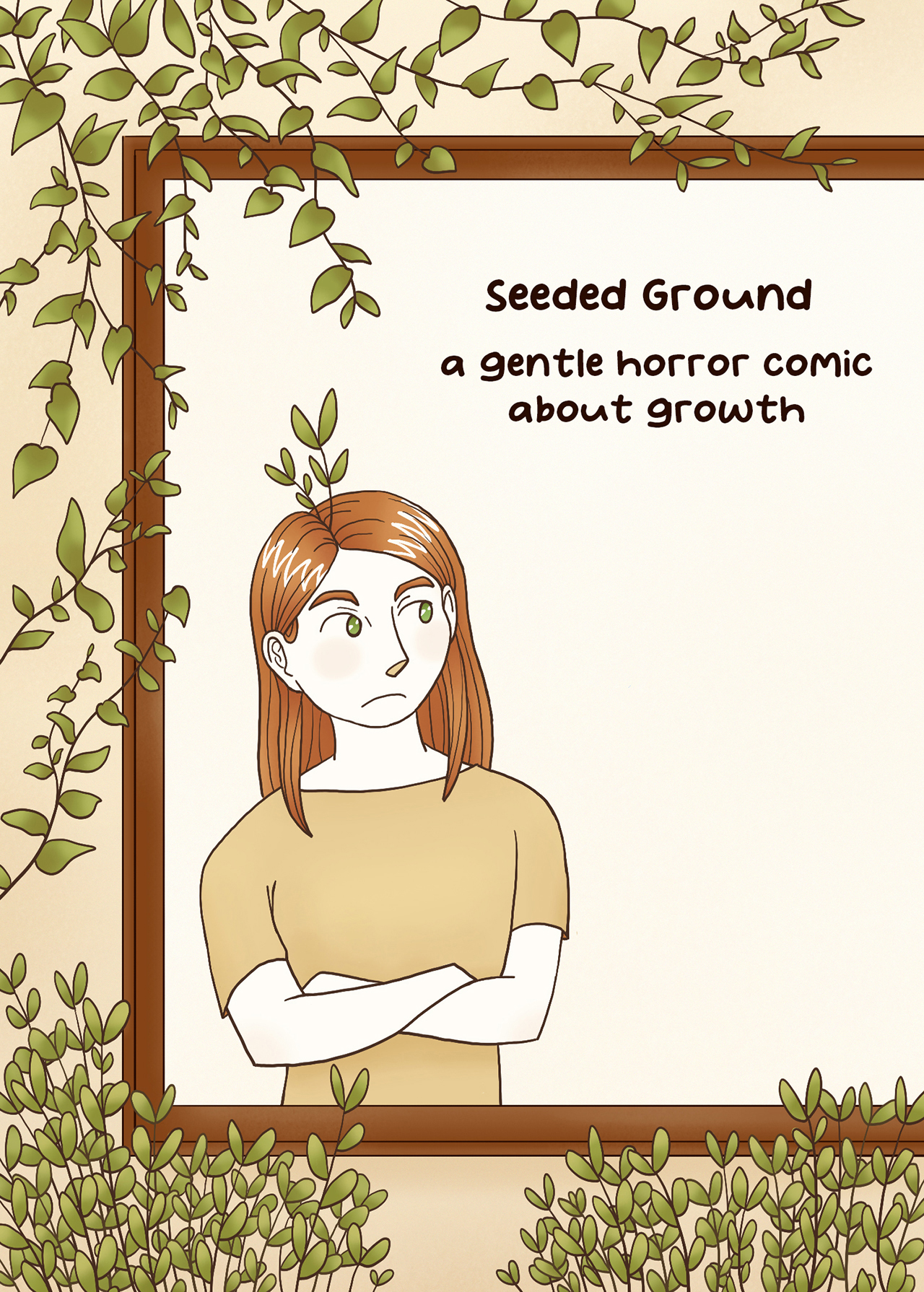
Seeded Ground is a twelve-page botanical horror comic about growth. It reads a bit like a supervillain origin story, but I created it as a statement of resistance against the oppressive ideologies of neoliberalism that have lured so many people in my generation into the trap of self-optimization.

You can download a free digital copy of the comic from Itch.io here:
https://digitalterrarium.itch.io/seeded-ground

I was inspired to draw this comic by a tweet written by a respected senior scholar. They argued that assigning at least five pages of writing every week is necessary to maintain “a certain standard of quality” in the undergraduate students who register for their classes.

This tweet inspired me to reflect on an unfortunate aspect of education in the United States. Namely, it’s an unstated but almost universally accepted goal of the formal education system to monopolize students’ time in order to train them to become the sort of adult workers who are willing to devote their lives to their career. An employee at a “good” job is expected to wake up early, commute, spend the entire day at work, and then go home and finish the tasks they didn’t have time to complete at the office. Meanwhile, freelance and part-time workers are expected to be available at any hour of the day, every day of the week, and at short notice. This is messed up, and I hate it.

My own experience as a professional working adult has essentially been the equivalent of that professor’s tweet. Namely, I’ve felt compelled to engage in meaningless work that no one will ever see in order to maintain the pretense of “a certain standard of quality.” Around the time of the pandemic, I got fed up. Was I really supposed to feel guilty about not replying to emails within 24 hours while I was sick with Covid? Fuck that.

These days I’m much more aggressive about enforcing boundaries concerning how much work I’m willing to do, and I can’t even begin to express how much the quality of my life has improved. I have no regrets.

As an epilogue to Seeded Ground, I illustrated a quote from the radical social theorist Herbert Marcuse’s 1964 book One-Dimensional Man: Studies in the Ideology of Advanced Industrial Society:

“If the individual were no longer compelled to prove himself on the market, as a free economic subject, the disappearance of this compulsion would be one of the greatest achievements of civilization.”

And he’s not wrong! I know it’s a twee Millennial stereotype to hate capitalism, but I really do believe that the point of life is not to optimize your performance as an employee. People need room to grow.

And if that growth is impeded? All sorts of bad things can happen. 🌿

Ground Down

Ground Down
https://inverts.itch.io/ground-down

Ground Down is a short botanical horror story presented in the form of a Twine game. The player is occasionally offered choices concerning how to proceed, but there’s only one ending. Depending on your choices and your reading speed, I’d say Ground Down takes about ten to twenty minutes to finish.

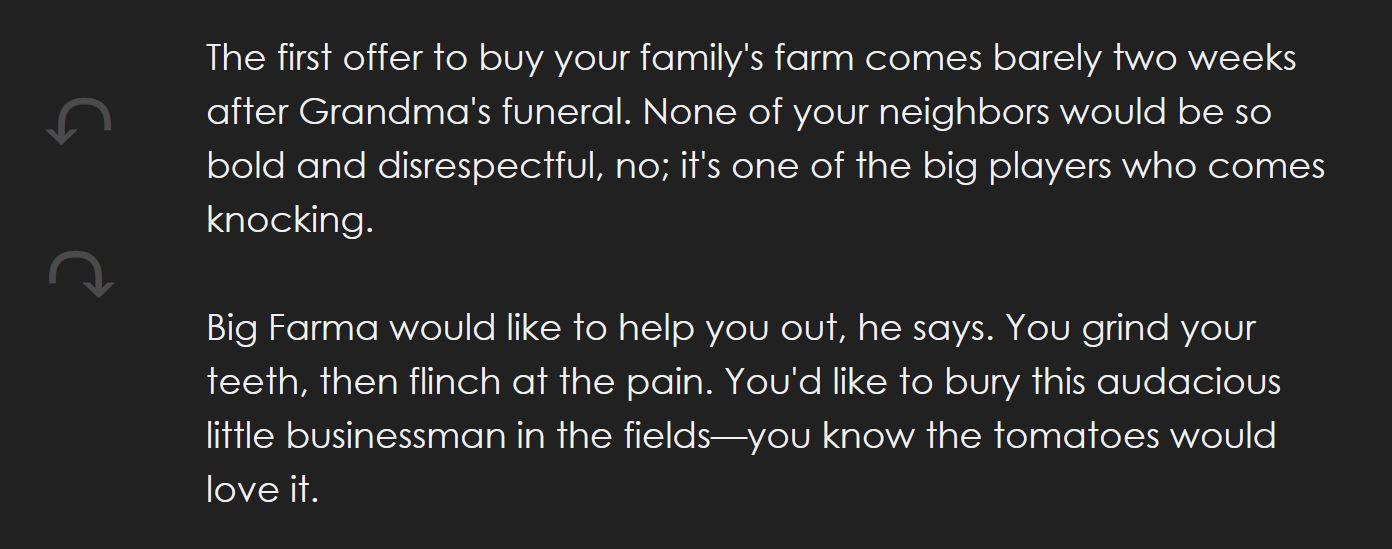
You play as a young farmer whose grandmother has just passed away, leaving you the farm you’ve grown up on. You also have your grief, a house full of mementos, and debts to pay. On top of that, you’ve started to grind your teeth, but you have neither the time nor the money to visit a dentist.

I should say that, if you’re unusually squeamish about teeth, you might want to give this game a pass.

Personally speaking, I’m a little squeamish about teeth and dental pain in general, but I very much enjoyed this game. I felt some mild discomfort at the beginning, but the way the theme of “teeth as a symbol of agency” comes back at the end of the story is nothing short of brilliant.

The writing of Ground Down is fantastic in general. Each sentence is perfectly constructed, and each word is chosen with care. There’s a Raymond Carver feel of resonant simplicity to the prose, which is a pleasure to read and to reflect on. The gradual build of the narrative tension is subtle but palpable, and the ending is gorgeously cathartic.

The creator describes Ground Down as a “kinetic novel,” and there’s an interesting rhythm to the text, which sometimes speeds up and slows down. The choices you can and can’t make are interesting as well. Although your choices don’t affect the ending, they’ll color your understanding of what happens.

It’s also worth noting that the Century Gothic font is easy to read, and the contrast between the dark gray background and the light gray text is easy on the eyes, especially if you’re playing the game on your phone. The ambient background music, Kevin MacLeod’s “Decline,” is perfect.

Really, everything about Ground Down is perfect. I played the game twice, and I’m looking forward to playing it again soon. The story’s theme of protecting the roots of your identity from the erosion of late-stage capitalism resonated with me, and the imagery is delicious. And, as a fun bonus, you can name and pet your hen!

At the Edge of the Garden

When I was ten years old, all my friends had trampolines. I wanted a trampoline too, but my mother was opposed to the idea. One of my cousins decided to jump onto a trampoline from the roof of his house, breaking his arm and becoming a neighborhood hero in the process. My mother used my cousin’s behavior as a justification for keeping our yard trampoline-free, but I understood that she didn’t want her garden to be invaded.

My family lived on the outskirts of a pine forest bordering a small town. The property would later be sold, cleared, and incorporated into a subdivision, but our house was fairly isolated when we lived there. Since I had no one to play with and nothing better to do, I spent the summer roaming the forest with my dog while pretending to be a dinosaur. After a boy was shot in a hunting accident only a mile away from our house, my mother came to the reluctant conclusion that keeping me and the dog in the yard on a trampoline would probably be safer than letting us run wild in the woods.

The trampoline dominated my mother’s garden, as she had known it would, but this was more than likely a relief for her. She had neglected to do any weeding that summer, and the plants had gone feral. The trampoline blocked the view of the overgrown tangle of the rose bushes and ornamental shrubs that she used to keep meticulously maintained. My dog would sometimes disappear into the thistles and milkweed that grew as tall as my waist at the edge of the yard and emerge with his coat covered in burs, and my mother would pretend not to notice.

My parents’ marriage had turned sour. They fought after dinner, so I tried to be in the house as little as possible. I would go outside to jump on the trampoline every evening. It was soothing, almost hypnotic. I would position myself in the middle of the black canvas tarp and bounce in place as I watched the sun set over the pine trees standing just beyond the garden. I would hop off the trampoline and head back inside once the sky had gone completely dark, but twilight tends to linger in that part of the world, especially during summer. Sometimes I would be on the trampoline for more than an hour, letting my mind draft into various fantasies of prehistoric life while my dog barked at the rabbits that sniffed around the patch of soil where my mother used to grow carrots.

One evening, just as the sun had begun to sink below the tops of the pines, I saw a figure slink out of the dim forest underbrush. There wasn’t enough light to see clearly, but I was convinced it was a person. My dog was somewhere else, so I was alone with the shadow.

I was struck by a sense of terror, but I couldn’t stop jumping on the trampoline. My body moved mechanically as the blob of darkness made its way across the yard. Eventually it halted, raised the stalks of its arms, and slowly waved at me. I kept jumping, and it kept waving. It seemed as though it were trying to get my attention, but I refused to acknowledge its presence. If I looked at it directly, the stalemate would be broken, and I would be eaten. I was only a dinosaur in my mind, after all, and I knew that I was no match for whatever had come out of the trees.

As the sun disappeared, the shadow sank back into the forest. I hopped off the trampoline and ran inside as quickly as my shaking legs could carry me. 

The next day, when the sun was fully back in the sky, I ventured out to the line of trees beyond the garden, but I didn’t find anything out of the ordinary. The thick mat of pine needles covering the ground lay undisturbed.

Later that afternoon, my dog got hit by a speeding truck on the state highway that ran past the end of our driveway, but I don’t think there was any connection to what I’d seen the previous evening. How could there have been? Nothing made sense to me at the time – not the death of my dog, not the end of my parents’ marriage, and not the creeping realization that my mother and I would have to leave our home at the end of the summer. All things considered, a strange shadow lurking in the woods at the edge of the garden was the least of what was wrong with that house.

. . . . . . . . . . . . . . .

This story was originally published in Issue 7 of 3 Moon Magazine in April 2021. The issue’s theme was “Growing Malcontent,” and this story was my first foray into botanical horror. 3 Moon Magazine ceased publication and closed its website at the end of 2022, and I am reproducing this story with the kind permission of the editors.

Strange Tales and Modern Legends

This semester I taught a seminar called “Japanese Ghost Stories.” (You can find links to the syllabus and course materials here.) A major element of this class was our study of how folkloric traditions have influenced literature. My specialty is contemporary fiction, so we spent a good amount of time talking about what urban legends are and how they work.

I believe that urban legends have the following three characteristics:

First, these stories are specific to a time and place, and they’re generally tied to a specific person as well. This person is someone known to the storyteller, and they’re either a reliable source of information or a direct witness to the event or phenomenon in question.

Second, the story is understood to be “real” and therefore nonfiction. In fact, it often isn’t much of a story at all. Unlike creepypasta, which is shortform fiction, the characters in an urban legend don’t have interiority, and they’re often not attributed with motivation. Rather, the story is stated as a simple fact. At the core of these stories is a statement like “you’ll die if you eat [a certain type of candy] mixed with soda” or “a child was once murdered in [a certain department store] bathroom.” The purpose of additional details is to add authenticity.

Third, urban legends almost always have a cautionary element, and the unfortunate events of the story are related to social and cultural anxieties. These fears tend to be politically sensitive and thus can’t be discussed openly, so urban legends function as a sort of pressure release valve. In the United States, for example, a lot of urban legends reflect racial tensions, while there are a lot of urban legends about bullying and social ostracization in Japan.  

This isn’t really a defining characteristic, but I find it interesting that an urban legend need not necessarily be untrue. Rather, the act of making something into a “story” adds an element of speculation. This means that, even though the story is stated as fact, both the teller and listener understand that the veracity of this fact is debatable. In other words, the story could be true, but both parties acknowledge that there’s no way to prove it.

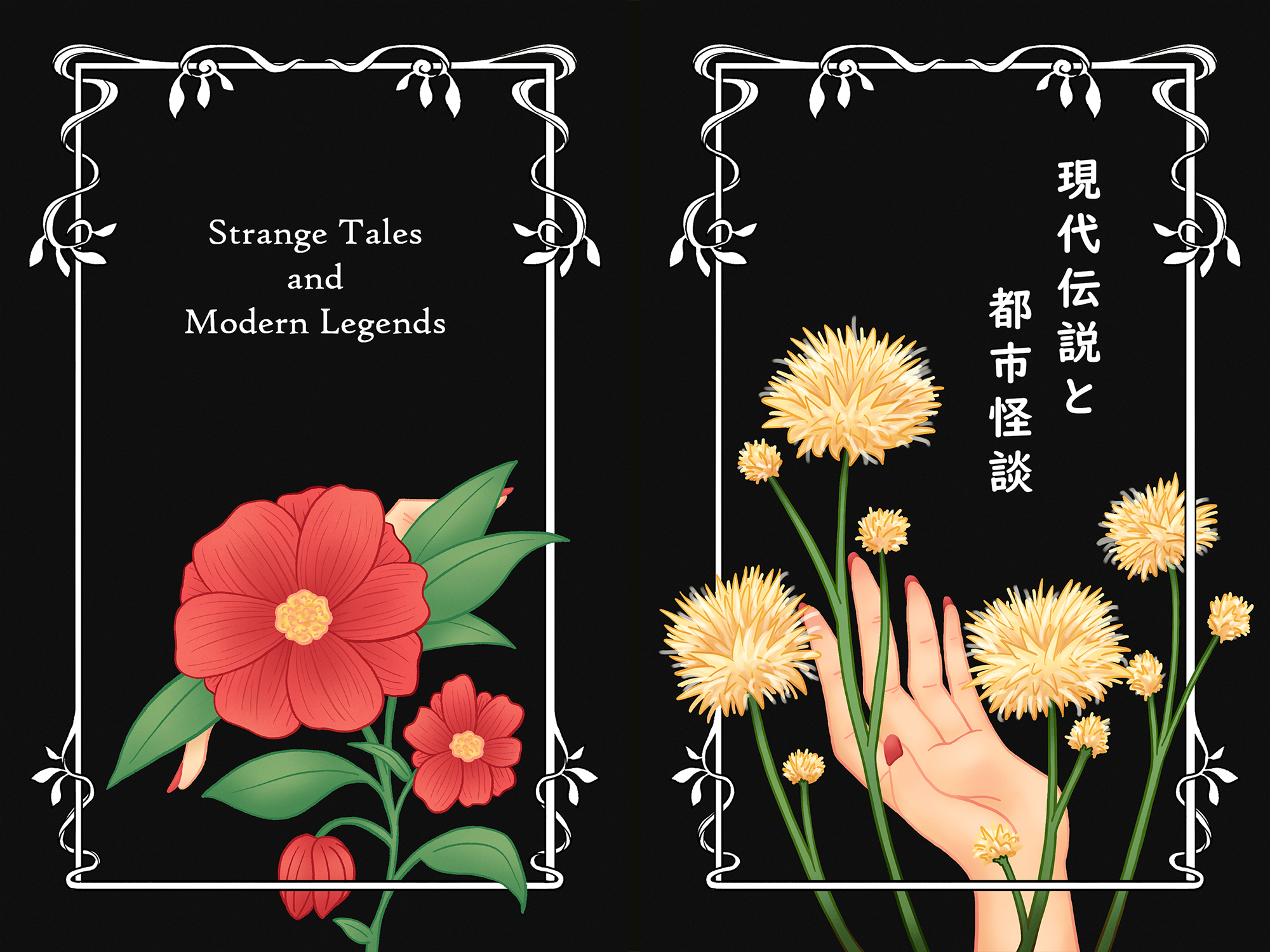
Having provided the students with these criteria and a number of examples to use as potential templates, I asked them to write their own urban legends. I was absolutely blown away by the work they submitted. I promised that I wouldn’t spread their stories outside of class, but I decided to make a class zine so that they could share their work with each other. The image at the top of this post is the cover I created for the zine, which ended up being a 76-page book.

I like to think that Alvin Schwartz and Stephen Gammell would be proud.

Fruiting Bodies Review on WWAC

I recently had the honor of writing a review of Ashley Robin Franklin’s graphic novella Fruiting Bodies for the website Women Write About Comics. Here’s an excerpt:

Franklin joins Silvia Moreno-Garcia and Jeff Vandermeer in the pantheon of contemporary writers and artists who have celebrated the uncanny invisible world that stretches deep below our feet and proliferates in the warmth of our bodies. Classical botanical horror has its roots in concerns over cultural hybridization, but Fruiting Bodies resists the genre’s Victorian anxieties in favor of a probing exploration of the primal fears surrounding the collapse of bodily autonomy. In the end, Franklin suggests, human social distinctions of gender and sexuality are meaningless to a natural world that devours everyone equally.

You can read the full review (here), and you can find the book’s page on Silver Sprocket’s website (here). You can follow Ashley Robin Franklin on Instagram (here), and I also recommend checking out her other short comics on her Etsy store (here). As always, I want to acknowledge the good work of my patient and brilliant editor, whom you can follow on Twitter (here).

Decomposition: Tales of Botanical Horror

My newest short fiction zine, Decomposition, collects six short stories of botanical horror and dark fantasy. It features a number of guest artists and spot illustrations, as well as a gorgeous cover created by the botanical art wizard Frankiesbugs. I’ve listed the zine on Etsy (here) if you’re interested.

The past few years have been tough for me. It’s become somewhat taboo in American culture to admit that the pandemic wasn’t the best thing to ever happen to you, so the less said about this the better.

I have to admit that I’m a gremlin who doesn’t really care about germs, but for a while I found it very difficult to relate to other people. I didn’t want to see other human beings at all if I could help it. This is why, after I moved to Philadelphia, I started spending a lot of time wandering around abandoned spaces.

Philadelphia is a fun and interesting city with a steadily growing population and multiple vibrant local cultures, and I find it annoying when people take pictures of a normal street or an early-morning empty parking lot and tag their photos as “urban decay” on social media. That’s just rude. Still, I think it’s easier to get funding to build new construction than it is to repair existing structures, so there’s a surprising density of ruins and wild spaces in and around Philadelphia.

What surprised me while walking around the emptier areas of Philadelphia is just how quickly most architecture returns to nature. Maybe stone castles and granite walls and asphalt roads can last for centuries without maintenance, but a normal house or Burger King or whatever is going to last for one or two decades at most. It’s only going to take about five years before the roof goes; and then, once the water damage gets started, that building is finished. The shell of the walls becomes its own little ecosystem, with plants pushing up through the brick and concrete. In Philadelphia, fig trees and sumac shrubs grow wild just about everywhere, providing food and shelter for insects, birds, and larger animals like opossums and raccoons.

On one hand, it’s lovely to see these pockets of green in postindustrial urban areas. On the other hand, it’s a bit creepy how aggressive plants are in taking over space formerly occupied by people. If you think about it, plants have been on this earth for hundreds of millions of years, and they will remain here long after the last human draws its final breath. Their green dreams are beyond our comprehension as their roots silently feed on the soil of our bodies. Plants are forever growing and forever hungry, and they’ll take everything back from us eventually.

Flowerblight Ganon

I posted a short story on AO3 (here) about a minor character in Breath of the Wild named Magda, who is affectionately known by the fandom as “Flowerblight Ganon.”

In Breath of the Wild, Malice is a tangible substance that infests objects and locations controlled by Ganon, including the four Divine Beasts, Hyrule Castle, and the Akkala Citadel Ruins. It also infects the dragon spirit Lanayru who guards the Spring of Wisdom.

While writing this story, I wondered if it were possible for Malice to infect regular people. If so, the woman who zealously guards the garden of flowers surrounding Hila Rao Shrine is as good of a candidate as anyone.

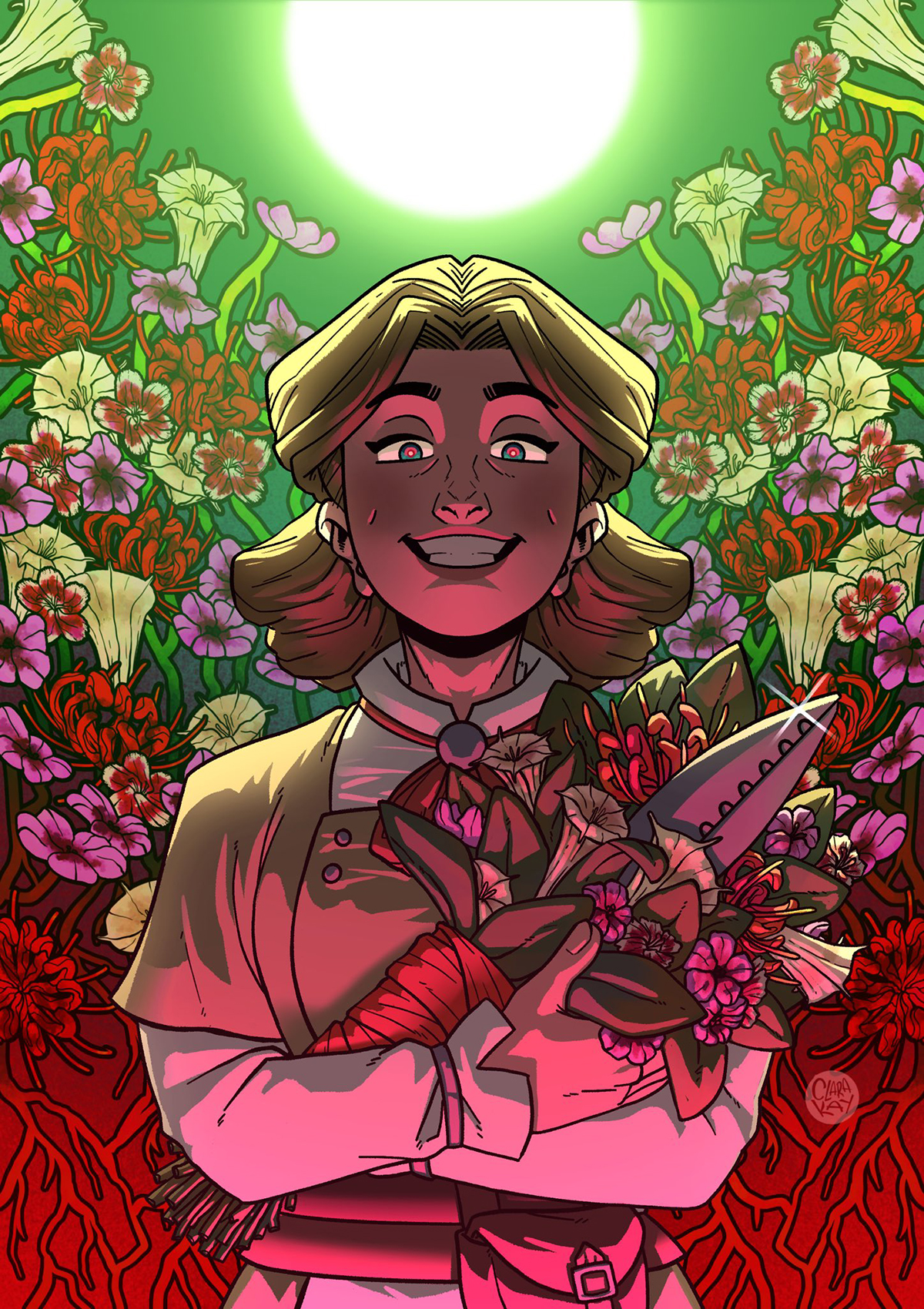
The story illustration is by Clara Kay, whose gorgeously monstrous horror art can be found on Twitter (here) and on Instagram (here). I really enjoyed working with Clara, and I also want to give a shout-out to her store (here), which has all sorts of cool Legend of Zelda merch!

I’d like to share a bit of the artist’s description of this piece, because it’s fascinating:

There’s a lot of symbolism packed into the flowers here. The petunias (pink) represent anger and resentment, the devil’s trumpet (the tall white one) represents power and caution, the spider lily (big spiny red one) represents death and reincarnation, and the carnation (white with red ring) is considered the ‘flower of the gods’ and represents admiration, passion, and love.

Carnations represent “passion and love” because they’re thought to be white flowers dyed red with blood, which is entirely appropriate for this story. “Flowerblight Ganon” is my first foray into botanical horror, and I don’t think it’s necessary to be familiar with Breath of the Wild to understand what’s going on. Magda is a regular woman enjoying gardening, quiet living, and occasional tea with friends in a dying postapocalyptic world, and if she lives her best life by indulging in murder every once in a while, then at least her flowers are well fertilized.