Memorabilia Zine

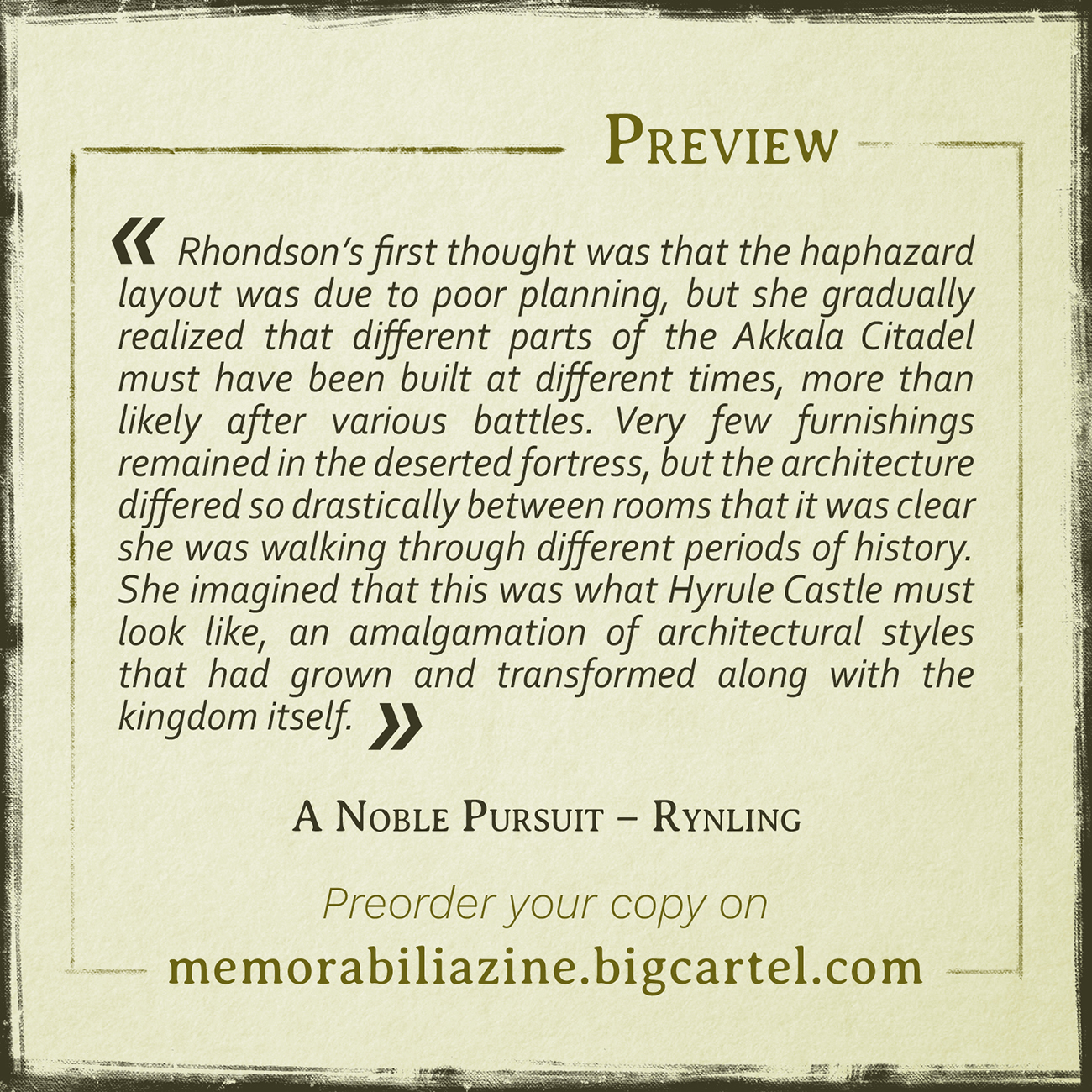
This is a preview of the short story I contributed to Memorabilia, a Legend of Zelda fanzine devoted to the archaeology and architecture of Breath of the Wild.

“A Noble Pursuit” is about Rhondson, the Gerudo tailor who moves to Tarrey Town, embarking on a husband hunt to the Akkala Citadel Ruins after Hudson goes missing. It’s a story about exploration and discovery, as well as different views of the past and hopes for the future that awaits Hyrule beyond “happily ever after.”

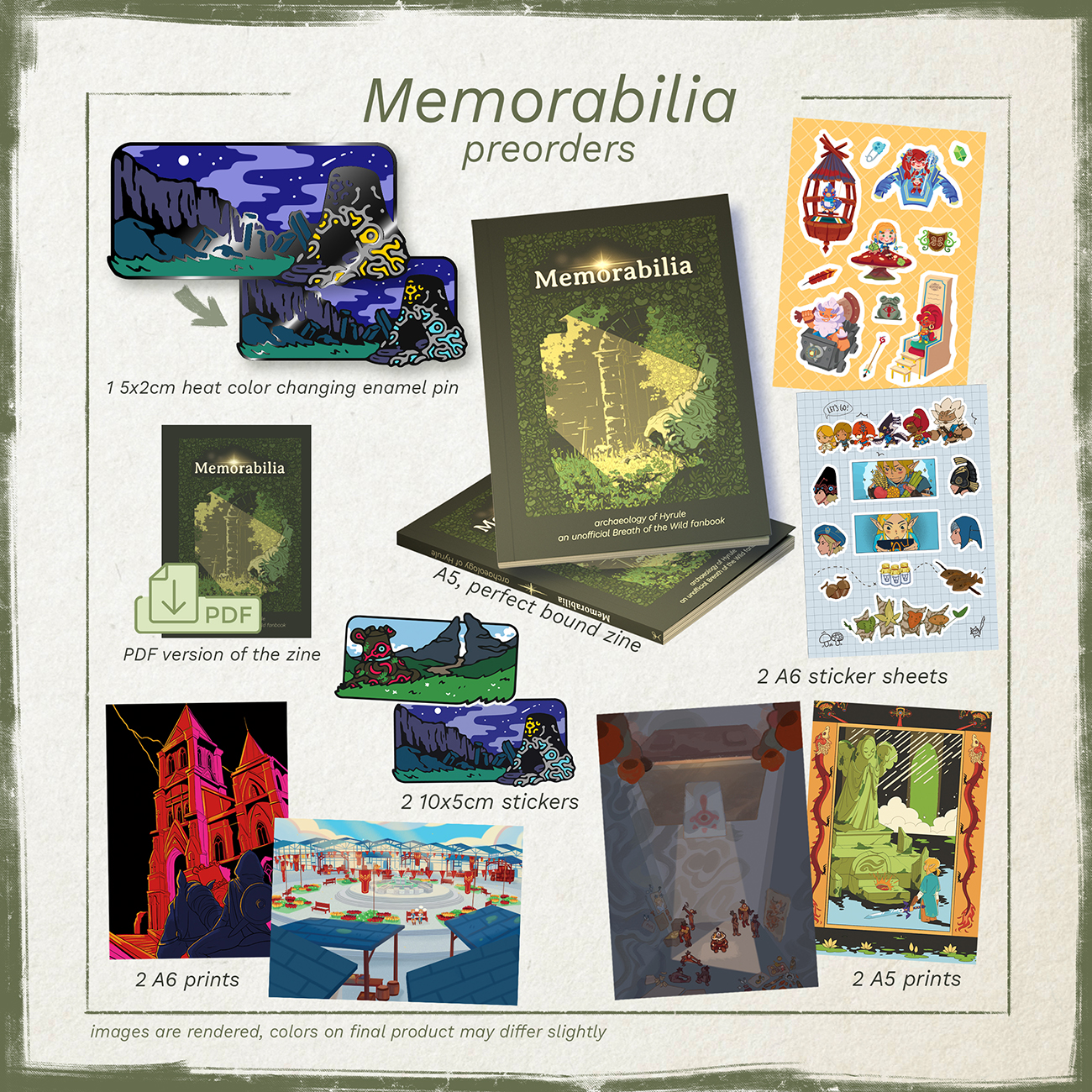
Pre-orders are open (here) until Sunday, March 14. This zine contains more than a hundred pages of brilliant writing and awe-inspiring art. It’s certain to be a treasure to anyone who enjoyed exploring the ruins and history of Breath of the Wild – and to anyone fascinated by the lore and environmental design in Creating a Champion.

You can check out more previews of the zine on its Twitter account, @MemorabiliaZine, and on its Tumblr account, @memorabiliazine.

Balthazar as Antagonist

The Demon King has ten chapters, and I’m a little more than halfway done with the first round of edits. I should be able to meet my projection of finishing by March 15, a month after I completed the first draft. The draft is only about 30k words, but progress is slow. The psychic damage I’m taking from finding typos and inconsistencies and unintended repetitions cannot be exaggerated.

This is only the first of five story arcs, so one of my main goals during this round of editing is to ensure that the central conflict is presented clearly and makes sense according to the somewhat limited information available to the reader. This is a short summary:

A powerful wizard named Balthazar wants to find a magical artifact hidden somewhere in the mountains between the kingdom of Whitespire and the ocean, which is highly poisonous. This artifact probably has something to do with the pure water coming down from the mountains and ensuring the prosperity of the kingdom. Balthazar doesn’t mention this artifact to his confidant Ceres, the reigning princess of Whitespire, who is presumably either unaware of its existence or unwilling to discuss it. If Balthazar does manage to find this artifact, the way he plans to use it will result in the downfall of Whitespire.

Balthazar is open with Ceres about his intentions to destroy Whitespire, but he makes no move to attack the kingdom, choosing instead to seek other magical artifacts elsewhere. It’s unclear why Balthazar is taking such a circuitous route toward his goal, but I hope the reader is able to get the sense that he’s not really the sort of person who would harm anyone if he could avoid it. He specifically doesn’t want to harm Ceres, mainly because he likes her.

There’s no significant antagonist in the story aside from Balthazar himself, as he’s going to have to do terrible things and hurt the people he cares about if he insists on achieving his goal. Unfortunately, he’s deadly serious about what he aims to do, so much so that it’s at the core of his sense of identity.

It’s embarrassing to admit this, but I’m inspired by the narrative structure of Homestuck, in which everything seems very silly and trope-driven until the reader gains a better understanding of what’s going on with the world of the story. I think it’s probably a fool’s errand to ask any given writer what themes they’re trying to express, but Balthazar has a line to the effect of “you always have a choice” that’s probably the closest thing to a statement of purpose I have regarding issues of individual freedom and dignity in the face of overwhelmingly horrible circumstances.

Also there are dick jokes, which symbolizes the fact that I like dick jokes.

In any case, once I finish this round of edits, I’m going to let the story sit for another month before writing a formal query. I’ll then do another round of edits before participating in several pitch events starting in late May. I’ll more than likely take the story offline at that point, but you can still read the draft as I edit it on AO3 (here).

Whisper of the Heart


My husband is a fan of European football, and he spends a lot of time scrolling through football Twitter under a pseudonymous throwaway account. Most of the accounts he follows are British. He got annoyed with not being able to watch the region-locked videos people linked to, so a week or two ago he set up a VPN. (If you’re curious, he uses ExpressVPN, which is $8 a month and seems to be working nicely for him.) His computer now registers as being in the UK, and he employs this for the nefarious purpose of watching a few minutes of football videos a day and being amused by the British ads that Twitter shows him (mostly for snacks).

Even though he doesn’t use it much these days, my husband never stopped paying for his Netflix account, and it recently occurred to him that, with a UK address, he could watch British Netflix.

So the other day I was standing in the kitchen waiting for tea to brew, and my husband was sitting on the couch looking at Netflix UK. I asked him if he’s found anything to watch, and he started complaining that Netflix keeps trying to show him animated movies. He told he that they look Japanese.

I was like, “Okay, yes, go on.”

And he was like, “Have you ever heard of Studio Ghibli?”

That’s when I realized that my husband had never heard of Studio Ghibli.

. . . . .

My husband enjoys movies, but he’s in his forties and comes from a country where there hasn’t been a culture of anime fandom until relatively recently. He likes the Makoto Shinkai movies we’ve watched, which he calls “documentaries about Japan,” so I thought that Whisper of the Heart would be the best Studio Ghibli movie to show him. He loved it.

I loved it too. It’s been about ten years since I last saw Whisper of the Heart, and I was not expecting it to hit as hard as it did.

Whisper of the Heart is about a middle-school girl named Shizuku who loves reading. Shizuku checks out books from the local library, and she’s noticed that there’s another kid’s name on almost all of the library borrower cards inside the covers of the books she reads. She ends up meeting this boy, who is her age but wants to study the craft of violin making in Italy instead of matriculating to high school. Inspired by his determination to follow his dream, Shizuku decides to follow her own dream of writing a fantasy novel.

Shizuku gets really absorbed in her writing. She tells a friend that she has no appetite because she’s too preoccupied with her novel, and then she eats shortbread cookies so she can stay awake while she’s writing in the evening. She stops hanging out with her friends after school so that she can fantasize about her novel while walking home. She only puts in the bare minimum of work necessary to get by at school, and her grades drop. She gets explosively irritated when people interrupt her while she’s writing. When she’s done with the story, she gets super neurotic about feedback. She cries a lot.

I was just sitting there, like, “Oh my god. Oh my god. Oh my god.”

How dare Hayao Miyazaki come into my house and call me out like this.

. . . . .

The range of what my husband does and doesn’t know about internet culture is a mystery to me, so I was surprised when he asked me if the anime girl from the Lofi Hip Hop Radio channel on YouTube is modeled on the protagonist of Whisper of the Heart.

The answer is yes, of course she is. This reference is so obvious to me that I never thought about it as something other people might not get.

Because I teach upper-level seminar classes that don’t have any formal prerequisites, I spend a lot of time thinking about what my students do and don’t already know. I treat grad students like the educated adults they are, but it can sometimes be difficult to tell with undergrads. At George Mason, most of the students were either immigrants or the children of immigrants, but they had all gone through American public high school, so I could assume that they were vaguely aware of certain cultural touchstones. At UPenn, on the other hand, the students who went to public high school in America might actually be a tiny minority. Each new microgeneration of kids is going to create its own common knowledge base regardless of where they come from, so you have to be sensitive to that, but it’s just the nature of working with a large and heterogeneous group of people that there will be all sorts of things you don’t think about.

I went to college early, and then went to grad school right after college and got my PhD fairly quickly, so I was roughly in the same generation as my students for most of the time I was teaching. I’ve gotten older, though, as people tend to do. Now it surprises me when my undergrads are genuinely curious about Harry Potter because they’ve never read the books or seen the movies. Things I just absorbed by osmosis because I grew up with them are now units of knowledge that need to be explained, and that’s wild.

I can’t help but wonder if that’s what getting older is about – being able to pick up on more cultural references because I’ve had more years in common with the people who create media. And then I wonder when the cross-over point is going to be, like, when will I stop getting references because I’m so old that younger people no longer have any culture in common with me?

In any case, Whisper of the Heart is set in the 1990s but feels timeless. It’s still just as beautiful to me now as it was when I first watched it in college. The fact that the vast majority of anime fans under the age of thirty have probably never even heard of movie feels a little weird, but it’s also kind of nice. It’s wonderful that amazing stories were created in the past, but the genius and creativity of past work doesn’t need to be a burden, as there will always be cultural room to create stories in the future that build on the past but still feel fresh and new to each generation.

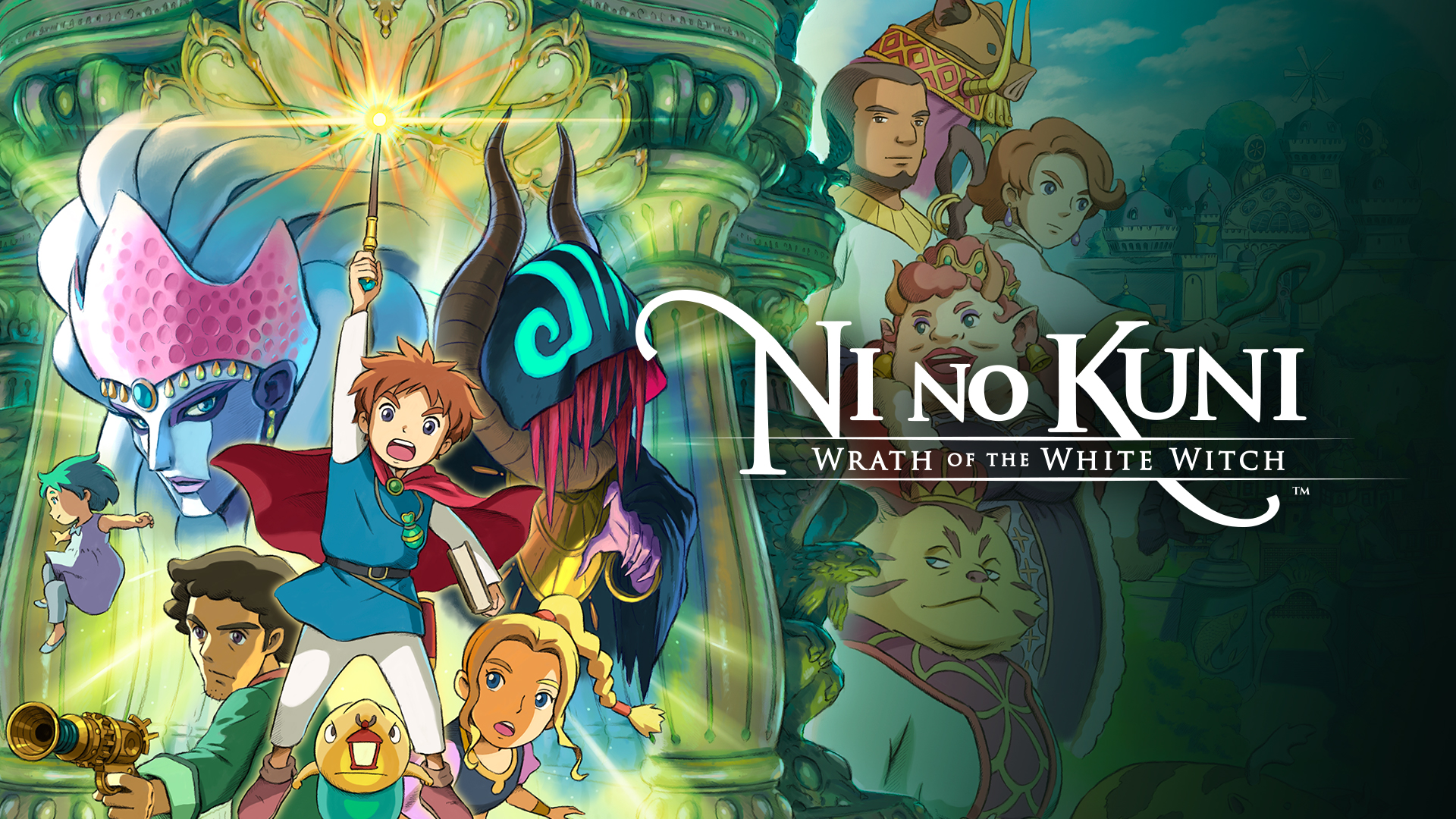
Ni No Kuni: Wrath of the White Witch

I’ve been saving Ni No Kuni: Wrath of the White Witch for a rainy day since it came out on the Nintendo Switch in September 2019, and my “rainy day” turned out to be my first winter back in Philadelphia, which has hit me with far more snow than I expected. Wrath of the White Witch is magical and delightful, and it’s the perfect game for cozy days indoors.

Wrath of the White Witch is a seventy-hour JRPG that’s intended for kids around the same age as the game’s protagonist, who is around ten years old. It was developed in collaboration with Studio Ghibli by Level-5, which makes the Professor Layton and Yo-kai Watch games.

As indicated by the game’s title, it takes place in two closely connected worlds, a high fantasy world of wizards and castles and talking animals and a world loosely based on our own. You play as Oliver, a boy who travels between a suburb of 1950s Detroit and the fantasy world with the intent of finding a way to save his mother, who has recently passed away from an illness. The idea is that Oliver’s mother’s “soulmate” in the fantasy world has gone missing; and, if he can find and rescue her, then this might have an effect on his mother’s fate in his own world.

The game’s combat system is much more complicated to describe than it is to actually play. You have three characters who can move freely across the battlefield while executing commands. You control one, and the others are controlled by AI. The AI is unfortunately not that smart, but almost none of the battles are actually that hard. The classic JRPG strategy of “just be five levels over where you probably need to be” works perfectly every time, and there’s also an Easy Mode that you can switch on and off whenever you like.

Each of your three characters can equip three familiars, which you can catch in the wild and train like pokémon. You’ll use your familiars to fight, but there isn’t any pressing need to balance your team or do research into the strengths or weaknesses of individual creatures. There’s also no pressure to catch new familiars, or even any way to check your progress if “catching them all” is your goal. The familiars are cute and fun to play with, and there’s no drawback to just using the ones you like. You can also feed them adorable status-boosting snacks if you want to.

The combat system is fairly deep, but it took me about five hours of gameplay to start moving beyond a basic sort of “attack by hitting the enemy with your stick” mentality. Wrath of the White Witch originally came out on the PlayStation 3 console in 2011; and, true to that era, it tries to explain everything to you with copious amounts of text. Oliver is accompanied by a companion named Drippy, who’s a little like Fi in Skyward Sword in that he will repeatedly interrupt gameplay to explain mechanics you could easily have figured out for yourself. Thankfully, he eventually backs off, which makes it much easier to experiment and thereby figure out the ins and outs of battle strategies.

There are a few other aspects of Wrath of the White Witch that show the game’s age. To give an example, it reminds me somewhat of Final Fantasy XII in that it forces the player to sit through more than two hours of exposition and pointless tutorial missions before the game actually begins in earnest. I won’t lie – this is horribly tedious, and you just kind of have to sit there and be patient.

Bits and pieces of the game’s story are a little tone-deaf as well, especially given its secondary setting in the United States at the beginning of the Civil Rights Movement.

There is one African-American character in Wrath of the White Witch. His name is Rusty, and he beats his wife. Like, right in front of you. His back is turned to the camera when he does it, but what’s happening is obvious. This is one of the only real instances of the game portraying a negative emotion stronger than mild anger or gentle sadness, and it’s… I mean, this is a poor word choice, but it’s striking.

One of Oliver’s traveling companions in the fantasy world is Esther, a girl from a vaguely Orientalist desert city modeled on Silk Road culture. Her counterpart in Oliver’s world is his best friend’s neighbor, a girl named Myrtle. Oliver has seen Myrtle out of her window, but he’s never spoken to her because she’s ostensibly too sick to leave the house.

It turns out that the Myrtle was sick but has gotten better, and that she doesn’t leave her room because she’s scared of her father. Rusty, a car mechanic, has had to work overtime to pay for her hospital bills, and he’s been taking his frustration out on his wife, which terrifies Myrtle. Since Oliver is a wizard, he can use magic to heal Rusty’s heart, help Myrtle overcome her anxiety, and thus inspire Esther to embrace the courage she needs to go on her own journey.

This is very much a ten-year-old’s wish-fulfillment fantasy, and it makes sense in its own way, but…

Both Myrtle and Esther have straight blond hair, bright blue eyes, and peach-tinted pale skin. It’s weird to call anyone speaking Japanese “white,” but almost everyone in the game is a generic light-skinned anime person. This means that the abusive husband’s racial identity really stands out.

He gets better, of course. After Rusty’s heart is healed, he apologizes to his wife and hugs his daughter, and everything is okay. He helps you out with a sidequest later on in the game in a way that demonstrates his high competence as a mechanic. But still, for there to be only one Black person in Detroit… And for the one Black character in the game to be violent like that… And for both his wife and daughter to be coded as white… I just feel like there’s a lot of racial history at play here that isn’t given sufficient depth for its inclusion in the game to be worthwhile.

I guess what I’m trying to say is that there’s more to American culture than hot dogs and hamburgers and saying hello to your neighbors from across their white-picket fences as you stroll down Main Street. If you’re setting a game in the United States, you should have more than one Black character, and you need to be aware of the historical violence and deep cultural wounds created by stereotypes about Black male violence against white women.

I suppose you could counter this with, “But Wrath of the White Witch is a Japanese game for children that flattens and parodies all of the people and cultures it incorporates into its fantasy world,” and that’s fair. At the same time, I’m happy that Japanese game developers have since figured out that it’s okay to have more than one Black or dark-skinned character in any given game, and that it won’t break anyone’s sense of immersion to have NPCs walking around with a variety of skintones.

(Just as an aside, I want to emphasize that I’m not cherry-picking an example here. There are a few other examples of problematic portrayals of racial and ethnic difference in Wrath of the White Witch, as well as many other examples that could be drawn from JRPGs in general. This is a serious and complicated topic, but addressing it isn’t really the point of this blog post. If you’re interested in pursuing this further, the essay collection The State of Play is a great place to get started.)

So there are elements of Wrath of the White Witch that betray the game’s age, both in terms of gameplay and in terms of its reflection of the then-current state of transnational conversations concerning representation. Still, most of the game is an absolute treasure.

The cel-shaded graphics are amazing and have not aged a day. The animation is spectacular. In particular, the way that the mantle of Oliver’s cape moves is a technological marvel. You really do feel as though you’re walking around in a Studio Ghibli movie, and it’s incredible. The world map is gorgeous, and the towns are intricately detailed and full of life. You can tell that Level-5 and Studio Ghibli put a lot of love and attention into designing the world, and it’s an enormous amount of fun to explore and take on sidequests.

The translation is brilliant, and the voice acting is lovely. The level of detail put into the sound design is pure Studio Ghibli. The score by Joe Hisaishi is everything you’d hope it would be.

I’m not saying that every game needs to have an active fandom, but I wonder why this game is relatively uncelebrated in my circles of social media. There were precious few JRPGs on the PlayStation 3, which was odd after the immense popularity of JRPGs on the PlayStation 2, so you’d think a high-quality game like Wrath of the White Witch would have stood out. Then again, I myself never managed to get into it back when it first came out despite having started it a few times. My guess is that Wrath of the White Witch’s innocent charm and nostalgic JRPG elements help it work well as a pokémon-style portable game on the small screen of the Nintendo Switch.

I know that a sequel, Revenant Kingdom, was released for PlayStation 4 in 2018, but I was too obsessed with Breath of the Wild at the time to pay much attention to it. Revenant Kingdom is partially set in contemporary New York, and I get the sense that it’s intended for an adult audience. I think it might be worth checking out once I finish up the last few postgame sidequests of Wrath of the White Witch just to see how the world of the story (and the worldview of its creators) has changed in the past ten years.

Dungeon Etiquette

We live in a society.

Trying to apply real world logic to video games is a fool’s errand, but I don’t think it’s too much of a stretch to suggest that most of what “heroes” do is awfully close to war crimes.

…I write, having just spent two hours leveling up my JRPG adventuring party through wanton murder and environmental destruction.

The Demon King, Chapter Ten

It is a beautiful day, and you are a horrible demon king.

What would you like to do?

– Make a pot of tea.
– Water your plants.
– Read a trashy romance novel.
– Have a nice chat with your nemesis.
– Take a long nap.

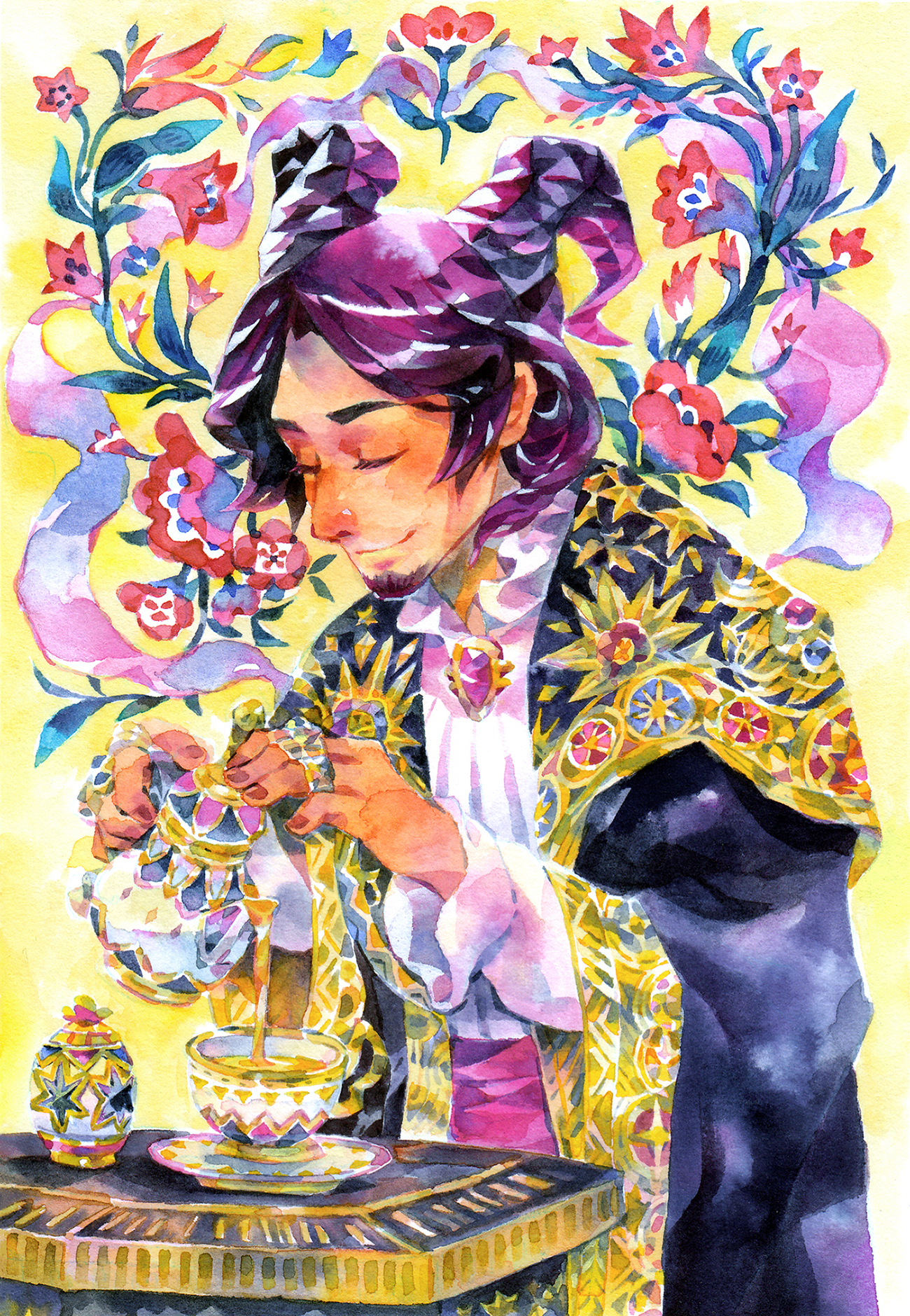
This illustration is by the magical Starstray (on Instagram, Twitter, and Tumblr). The prompt I gave her was “a very powerful and very fancy wizard who is very bad at being a demon king.”

I commissioned this painting to celebrate having finished the first book of The Demon King, which I’m going to call The Temple of Everlasting Autumn. It took me four months to write this 30k-word novella, and I’m going to take another month to edit it. I’d also like to put together some book cover style graphics to showcase each of the ten chapters. After that, it will probably be time to start thinking about where the project can go in the future. In the meantime, you can read the first draft (as I gradually edit it) and check out all the comics and illustrations on AO3 (here).

Year of the Ox

Happy Lunar New Year! And best wishes for a strong a gentle new year.

I submitted this illustration to the Goodbye 2020/Hello 2021 collaborative zine put together by the organizers of the DC Zinefest. I loved their 2020 collabzines about Halloween and COVID-19, so I jumped at the chance to participate in this one. I wanted to draw something much angrier and more political, but I ended up settling on the theme of “support and recovery.” I’m probably more furious at this particular moment than I have ever been in my life, but I also feel like I have a duty to be kind and not post upsetting things on social media while everyone is stuck inside, trapped in Zoom meetings and “essential” jobs, and dealing with poverty, eviction, and life-threatening illness. I’ve got a lot of material saved up, though, so once we get this vaccine I am going to go wild.

You can follow DC Zinefest (on Twitter) and (on Instagram), and you can download free full-color and printable copies of all the collabzines they’ve organized from their website (here).

Hades

I’ve spent a lot of time playing Hades during the past two months, and I think it’s fair to say that I enjoy it. I’d like to write about brilliant its storytelling is, but first I have to explain the gameplay.

Hades is an isometric Rougelike action game, which means that the player watches from a bird’s eye view as the character runs around and kills things in randomly generated levels. Like most Rougelike games, the level of difficulty is fairly high, but the game’s optional “God Mode” allows the player-character to become incrementally more resistant to damage with each successive death. Because of the way God Mode eventually allows you to calibrate the game to your exact level of comfort, I would recommend (and have recommended) Hades to anyone who enjoys video games, even if they hate Rougelikes. Hades is a long game with a lot to discover; but, somewhat like Breath of the Wild, you have to commit to around three to four hours of learning how the game works before you get to the good stuff.

You play as Zagreus, the son of Hades, and your goal is to leave the underworld to find your mother, Persephone. You start the game in the House of Hades, where you can talk with various NPCs, buy upgrades, and choose the weapon and status-boosting “keepsake” you’ll use on your next run through the game. A complete run will take you through four levels, each of which are about ten stages long, and a final culminating boss fight. If you die, the River Styx carries you back to the House of Hades to try again from the beginning. You collect various resources during each run that you retain when you die, and you can use them to make your character stronger between runs.

It took me 24 attempts to make it to the end of a run and beat the final boss for the first time. After you finish your first complete run, it takes another 10 successful runs to be able to watch the end credits. The game is only really half-finished after you watch the end credits, however. In order to complete the story, you’re encouraged to work toward an epilogue. It took me a total of 87 runs through the game to trigger the epilogue.

When you first start playing Hades, a full run might take 40 to 50 minutes. Once you become more comfortable with the game’s weapons and start to learn enemy attack patterns, it takes about 20 to 25 minutes to do a full run. If you balance out the longer run times with all the times you die within the first 10 minutes, I’m going to say that an average run takes about half an hour.

What this means is that it will probably take most players about 20 hours to get to the end credits and perhaps around 45 hours to complete the game. In my case, at least, these were 45 hours well spent.

If playing the same four levels over and over and over sounds repetitive, it absolutely is. Hades is a game about trying and failing and gradually getting better. There’s a lot of failure, and a lot of trying new things to figure out what works. If you’ve ever played an action game, whether it’s Super Mario Bros or Super Meat Boy, you’re familiar with how this gameplay cycle operates. What sets Hades apart is just how fun and flashy its combat mechanics are. Hades has the same addictive gameplay everyone loved in Supergiant Games’s debut title Bastion, except now you’re given the opportunity to explore the full range of each level and weapon and ability instead of quickly moving on to the next thing.

Thankfully, the randomly generated Rougelike elements of Hades are programmed to be fair, and the player is never punished by simple bad luck. After playing through the game about two dozen times, you start to get a sense for how its stage creation algorithm works, and the level design and enemy placement no longer feels random at all. Nothing unexpected comes out of left field; and, once you get to a point where you stop dying, you probably won’t die anymore. I know that sounds tautological, but what I mean is that the difficulty curve is well-designed, even for someone such as myself who is embarrassingly bad at action games.

If the sheer enjoyability of the gameplay helps Hades shine, the cleverness of its storytelling raises the game to the level of brilliance.

Hades tells its story through a series of conversations that are spread out across multiple playthroughs. You won’t learn a character’s story by speaking with them once, or even a dozen (or two dozen) times. Because the character interactions are (somewhat) randomly triggered, you have to be patient.

You can earn the trust and affection of most of the game’s primary and secondary characters by giving them rare bottles of nectar and even more rare bottles of ambrosia, and most characters have a “heart meter” that shows the progress of your relationship. Even if you want to focus on developing a relationship with a certain character, however, you can’t guarantee that you’ll encounter them in any given playthrough. You also can’t guarantee that they’ll be willing to accept gifts from you – each character’s heart meter is “locked” at a certain point, and it can only be unlocked by meeting certain conditions, which usually involve having conversations with other characters. There’s been a lot of message board speculation about what the heart meter unlocking conditions are for each character, because they’re not straightforward. I want to emphasize that it’s not difficult to max out each character’s heart meter, necessarily; rather, it requires having the patience to allow each relationship to develop organically and understanding that each character has connections with other people, not just with the player-protagonist.

Hades thereby forces the player to take time between conversations, to develop an understanding of a wider network of social relationships, and to keep returning to each character with additional knowledge and perspective. This type of fragmented storytelling allows for a degree of complication and nuance that a more straightforward story might struggle with. It also encourages the player to develop empathy for characters and situations that are “problematic” – or, as they might be more accurately described, “interesting.”

If you’ve been considering whether you want to play Hades, I hope you’ll be convinced to give it a shot. The rest of this post is filled with spoilers, so you may want to stop reading here.

To summarize what follows: As amazing as the gameplay of Hades is, its storytelling is even better. It’s fun game about fighting with good writing about family, and I can’t recommend it enough.

Okay, spoilers below. . .

As Zagreus, the son of Hades, you begin the game with one objective – to escape the underworld. Your father doesn’t want you to leave, because he’s apparently an asshole, so he sends various monsters and shades of the dead to stop you. You, however, are a badass, and you do what you want. The gods of Olympus have somehow learned of your desire to join them on their mountain, and they send you various power-up “boons” to help you fight your way out of the underworld.

The story becomes more complicated as you play. You learn that, due to an esoteric decree of the Fates, Zagreus was born dead and can’t survive outside of the underworld. His mother Persephone was so traumatized by this that she left Hades, not understanding that Zagreus was still “alive” in his own way. Unfortunately for Persephone, she has nowhere to go, as she had secretly asked Zeus to set up an arranged marriage with Hades because she hated Olympus. Hades is worried that, if Zagreus meets Persephone, the Olympian gods will learn where she’s hiding and force her to return against her will. Your goal therefore becomes to help Persephone and Hades communicate with one another, and then to help Persephone communicate with her extended family.

After the end credits, Persephone returns to the underworld and is reunited with Hades, who has always loved her. During the epilogue, all of the Olympians are invited to a party in the underworld, and Persephone tells them (a version of) the truth. Most of the gods already knew what was going on, but they still appreciate the gesture. There are no hard feelings, and everyone behaves like an adult and has a wonderful time.

Despite the unabashedly happy ending, the point of the story is that everything is more complicated than it seems at first. Characters who seem strong and unyielding have weaknesses, characters who seem like antagonists have their own valid motivations, and characters who seem as if they only live to serve the interests of the player actually have interesting lives and stories of their own.

It’s one thing to read a few sentences stating that these complications exist, but it’s something else entirely to experience these complications for yourself through scattered conversations across 45 hours of gameplay. While running around and killing things, the player has time to process each conversation and reflect on it before the story progresses. Nothing is resolved quickly, so the player has to sit with each new complication while slowly developing a more well-rounded sense of perspective on each character. Some contradictions end up never being resolved – and, by the time you get to the end of the game, you realize that that’s okay.

In particular, the character Hades becomes much more interesting as you get uncover more of the story. Although he’s not supportive of Zagreus in a way that perhaps he should be, Hades is a constant presence in the midst of a shifting cast of characters who come and go as they please. He’s there for his son at the beginning of every run; and, as the final boss, he’s there at the end as well. He checks up on Zagreus at various waypoints and helps him out in small ways. Most players will eventually realize that Hades isn’t too terribly committed to playing the role of an antagonist, which begs the question of why he’s so opposed to Zagreus leaving the underworld in the first place.

This realization is not immediate, however. In the game’s only flashback scene, Hades is having a bad day and takes it out on Zagreus by being needlessly hypercritical. As an adult, I know exactly where Hades is coming from, but I also remember being a teenager and not understanding what was going on when teachers and managers were like this. Hades is tired and overworked and lonely and doing his best, but he doesn’t have the emotional energy to communicate effectively and transposes his frustration at his own behavior onto his son. I’m not trying to suggest that Hades’s behavior in this scene is healthy, of course, and you can understand why he and his son have such a tense relationship. Still, the way the game allows you to gradually develop a broader sense of perspective helps you understand that Hades isn’t just a “villain” or “abusive” or “a bad father.”

This sort of nuance in characterization is present in other types of relationships. Although Hades allows you to romance various characters, it’s not so much a dating sim as it is a “learning to communicate properly before you enter into an intimate relationship” sim.

One of the romanceable characters is Dusa, a disembodied Gorgon head with self-confidence issues. Zagreus can follow the standard gameplay path to romance her, but this romance ends up becoming a romantic friendship. Zagreus’ foster mother Nyx cautions Dusa against talking to him, but her reservations have less to do with class (ie, Dusa is a servant and Zagreus is a prince) than they have to do with Nyx’s concern that Dusa is only exacerbating her issues with self-confidence by engaging with someone whose position makes her nervous about her own role in the household. In other words, Nyx is attempting to encourage Dusa to grow as a person so that she can make a choice about the relationship that stems from her own feelings, not a sense of obligation. Dusa seems to start out as a joke character – she’s a cute anime maid, but also a disembodied monster head! – but her narrative arc is surprisingly touching.

The player watches all of these stories unfold while Zagreus is doing his own thing, fighting and collecting treasure and leveling up weapons and gathering resources to add cosmetic changes to the game’s central hub, most of which do nothing except look pretty and earn irate comments from the comically grumpy Hades. The brilliance of the game’s storytelling is that, while you’re living your life, you come to the realization that other people are living theirs, and they’ve got just as much going on as you do.

Hades is a super fun and stylish game about killing things, but it’s also an empathy game in a way that only a super fun and stylish game about killing things can be. The action-oriented gameplay is a buffer that allows the story to unfold at its own pace, which is slowly and erratically. You can’t make a walking simulator 45 hours long, but the Rougelike gameplay of Hades not only gives you those 45 hours but ensures that you enjoy every single one of them.
Political Art

I’m about as “indie” as someone can be, but I’ve had trouble finding a place in various indie creative communities during the past year. This is partially because I can’t meet or talk with anyone face to face, but I think it might also be because the sort of work I do isn’t considered to be political. I’m not punk enough, basically.

I don’t see my work as apolitical, though. For example, the full title of this illustration is:

“In higher education, you can’t ask for help because people will think you’re damaged, and you won’t receive help because no one wants to waste resources on the sort of person who has to ask for help. I tried to change the system from the inside by becoming a professor and being kind and supportive to my students and colleagues, and I was remarkably successful. In the end, however, I’m still the sort of person who needs to ask for help every once in a while, so I was denied tenure. The ideology of neoliberal capitalism has all but destroyed the values of higher education, and the pandemic has only exacerbated the damage. Because the problem is systemic, there’s very little any one individual can do, so here, have some plants. They represent diversity, but only in a superficial and visually pleasing way.”

This botanical study was inspired by the point-and-click game When the Past Was Around, which tells a story about burning out and rediscovering joy. Through its gameplay and visual design, the game encourages the player to nurture a more forgiving worldview and advocates for adjusting your goals to reflect your passions instead of your limitations. It’s a short game, but it really spoke to me.

A lot of people are very angry right now, and I understand that. I’m angry too, but I express it in my own way. To me, the opposite of neoliberalism isn’t “productive” anger, but rather “laziness” and an embrace of the sort of gentleness and beauty that exists for its own sake. I like video games precisely because they’re a “waste” of time. I like fan art because it’s “worthless” in creative economies, and I like plants because they exist in their own “imperfect” and “limited” ways without requiring “work” or “effort.”

In any case, aggressively ignoring the bourgeois dichotomy between high art and pop art feels very punk to me.

The Demon King, Chapter 9

I just posted Chapter Nine of The Demon King on AO3 (here).

This is the second-to-last chapter of the novella, and it’s meant to function as a narrative climax. At the beginning of the first chapter, Balthazar casually murders someone; and, at the end of this chapter, he destroys an entire ecosystem. He has his reasons for doing what he’s doing, but I want to make it clear to the reader that he’s not fucking around. I also want to make it clear that this story is not YA fiction, so the language I used in this chapter is a bit… tumescent, let’s say.

Even though its narrative arc is complete in itself, this novella is intended to be the first part of a longer story, and I hope this sort of explosive conclusion is equally satisfying and intriguing. I think it can be understood as a natural outgrowth of the concepts that have already been introduced, but my goal is for an astute reader to come out of this chapter with a deeper curiosity about the history and metaphysics of this world.

This illustration of Balthazar is by the brilliant Jennifer So (@hellojennso on Twitter, @jennosaur on Instagram, and @jennlso on Tumblr), who designed the character. This is actually the first character design created for The Demon King (back in November 2018), and I’m excited to finally share it. Jenn nailed the character on the very first draft, and this is how I’ve pictured him since then.