Hades

I’ve spent a lot of time playing Hades during the past two months, and I think it’s fair to say that I enjoy it. I’d like to write about brilliant its storytelling is, but first I have to explain the gameplay.

Hades is an isometric Rougelike action game, which means that the player watches from a bird’s eye view as the character runs around and kills things in randomly generated levels. Like most Rougelike games, the level of difficulty is fairly high, but the game’s optional “God Mode” allows the player-character to become incrementally more resistant to damage with each successive death. Because of the way God Mode eventually allows you to calibrate the game to your exact level of comfort, I would recommend (and have recommended) Hades to anyone who enjoys video games, even if they hate Rougelikes. Hades is a long game with a lot to discover; but, somewhat like Breath of the Wild, you have to commit to around three to four hours of learning how the game works before you get to the good stuff.

You play as Zagreus, the son of Hades, and your goal is to leave the underworld to find your mother, Persephone. You start the game in the House of Hades, where you can talk with various NPCs, buy upgrades, and choose the weapon and status-boosting “keepsake” you’ll use on your next run through the game. A complete run will take you through four levels, each of which are about ten stages long, and a final culminating boss fight. If you die, the River Styx carries you back to the House of Hades to try again from the beginning. You collect various resources during each run that you retain when you die, and you can use them to make your character stronger between runs.

It took me 24 attempts to make it to the end of a run and beat the final boss for the first time. After you finish your first complete run, it takes another 10 successful runs to be able to watch the end credits. The game is only really half-finished after you watch the end credits, however. In order to complete the story, you’re encouraged to work toward an epilogue. It took me a total of 87 runs through the game to trigger the epilogue.

When you first start playing Hades, a full run might take 40 to 50 minutes. Once you become more comfortable with the game’s weapons and start to learn enemy attack patterns, it takes about 20 to 25 minutes to do a full run. If you balance out the longer run times with all the times you die within the first 10 minutes, I’m going to say that an average run takes about half an hour.

What this means is that it will probably take most players about 20 hours to get to the end credits and perhaps around 45 hours to complete the game. In my case, at least, these were 45 hours well spent.

If playing the same four levels over and over and over sounds repetitive, it absolutely is. Hades is a game about trying and failing and gradually getting better. There’s a lot of failure, and a lot of trying new things to figure out what works. If you’ve ever played an action game, whether it’s Super Mario Bros or Super Meat Boy, you’re familiar with how this gameplay cycle operates. What sets Hades apart is just how fun and flashy its combat mechanics are. Hades has the same addictive gameplay everyone loved in Supergiant Games’s debut title Bastion, except now you’re given the opportunity to explore the full range of each level and weapon and ability instead of quickly moving on to the next thing.

Thankfully, the randomly generated Rougelike elements of Hades are programmed to be fair, and the player is never punished by simple bad luck. After playing through the game about two dozen times, you start to get a sense for how its stage creation algorithm works, and the level design and enemy placement no longer feels random at all. Nothing unexpected comes out of left field; and, once you get to a point where you stop dying, you probably won’t die anymore. I know that sounds tautological, but what I mean is that the difficulty curve is well-designed, even for someone such as myself who is embarrassingly bad at action games.

If the sheer enjoyability of the gameplay helps Hades shine, the cleverness of its storytelling raises the game to the level of brilliance.

Hades tells its story through a series of conversations that are spread out across multiple playthroughs. You won’t learn a character’s story by speaking with them once, or even a dozen (or two dozen) times. Because the character interactions are (somewhat) randomly triggered, you have to be patient.

You can earn the trust and affection of most of the game’s primary and secondary characters by giving them rare bottles of nectar and even more rare bottles of ambrosia, and most characters have a “heart meter” that shows the progress of your relationship. Even if you want to focus on developing a relationship with a certain character, however, you can’t guarantee that you’ll encounter them in any given playthrough. You also can’t guarantee that they’ll be willing to accept gifts from you – each character’s heart meter is “locked” at a certain point, and it can only be unlocked by meeting certain conditions, which usually involve having conversations with other characters. There’s been a lot of message board speculation about what the heart meter unlocking conditions are for each character, because they’re not straightforward. I want to emphasize that it’s not difficult to max out each character’s heart meter, necessarily; rather, it requires having the patience to allow each relationship to develop organically and understanding that each character has connections with other people, not just with the player-protagonist.

Hades thereby forces the player to take time between conversations, to develop an understanding of a wider network of social relationships, and to keep returning to each character with additional knowledge and perspective. This type of fragmented storytelling allows for a degree of complication and nuance that a more straightforward story might struggle with. It also encourages the player to develop empathy for characters and situations that are “problematic” – or, as they might be more accurately described, “interesting.”

If you’ve been considering whether you want to play Hades, I hope you’ll be convinced to give it a shot. The rest of this post is filled with spoilers, so you may want to stop reading here.

To summarize what follows: As amazing as the gameplay of Hades is, its storytelling is even better. It’s fun game about fighting with good writing about family, and I can’t recommend it enough.

Okay, spoilers below. . .

As Zagreus, the son of Hades, you begin the game with one objective – to escape the underworld. Your father doesn’t want you to leave, because he’s apparently an asshole, so he sends various monsters and shades of the dead to stop you. You, however, are a badass, and you do what you want. The gods of Olympus have somehow learned of your desire to join them on their mountain, and they send you various power-up “boons” to help you fight your way out of the underworld.

The story becomes more complicated as you play. You learn that, due to an esoteric decree of the Fates, Zagreus was born dead and can’t survive outside of the underworld. His mother Persephone was so traumatized by this that she left Hades, not understanding that Zagreus was still “alive” in his own way. Unfortunately for Persephone, she has nowhere to go, as she had secretly asked Zeus to set up an arranged marriage with Hades because she hated Olympus. Hades is worried that, if Zagreus meets Persephone, the Olympian gods will learn where she’s hiding and force her to return against her will. Your goal therefore becomes to help Persephone and Hades communicate with one another, and then to help Persephone communicate with her extended family.

After the end credits, Persephone returns to the underworld and is reunited with Hades, who has always loved her. During the epilogue, all of the Olympians are invited to a party in the underworld, and Persephone tells them (a version of) the truth. Most of the gods already knew what was going on, but they still appreciate the gesture. There are no hard feelings, and everyone behaves like an adult and has a wonderful time.

Despite the unabashedly happy ending, the point of the story is that everything is more complicated than it seems at first. Characters who seem strong and unyielding have weaknesses, characters who seem like antagonists have their own valid motivations, and characters who seem as if they only live to serve the interests of the player actually have interesting lives and stories of their own.

It’s one thing to read a few sentences stating that these complications exist, but it’s something else entirely to experience these complications for yourself through scattered conversations across 45 hours of gameplay. While running around and killing things, the player has time to process each conversation and reflect on it before the story progresses. Nothing is resolved quickly, so the player has to sit with each new complication while slowly developing a more well-rounded sense of perspective on each character. Some contradictions end up never being resolved – and, by the time you get to the end of the game, you realize that that’s okay.

In particular, the character Hades becomes much more interesting as you get uncover more of the story. Although he’s not supportive of Zagreus in a way that perhaps he should be, Hades is a constant presence in the midst of a shifting cast of characters who come and go as they please. He’s there for his son at the beginning of every run; and, as the final boss, he’s there at the end as well. He checks up on Zagreus at various waypoints and helps him out in small ways. Most players will eventually realize that Hades isn’t too terribly committed to playing the role of an antagonist, which begs the question of why he’s so opposed to Zagreus leaving the underworld in the first place.

This realization is not immediate, however. In the game’s only flashback scene, Hades is having a bad day and takes it out on Zagreus by being needlessly hypercritical. As an adult, I know exactly where Hades is coming from, but I also remember being a teenager and not understanding what was going on when teachers and managers were like this. Hades is tired and overworked and lonely and doing his best, but he doesn’t have the emotional energy to communicate effectively and transposes his frustration at his own behavior onto his son. I’m not trying to suggest that Hades’s behavior in this scene is healthy, of course, and you can understand why he and his son have such a tense relationship. Still, the way the game allows you to gradually develop a broader sense of perspective helps you understand that Hades isn’t just a “villain” or “abusive” or “a bad father.”

This sort of nuance in characterization is present in other types of relationships. Although Hades allows you to romance various characters, it’s not so much a dating sim as it is a “learning to communicate properly before you enter into an intimate relationship” sim.

One of the romanceable characters is Dusa, a disembodied Gorgon head with self-confidence issues. Zagreus can follow the standard gameplay path to romance her, but this romance ends up becoming a romantic friendship. Zagreus’ foster mother Nyx cautions Dusa against talking to him, but her reservations have less to do with class (ie, Dusa is a servant and Zagreus is a prince) than they have to do with Nyx’s concern that Dusa is only exacerbating her issues with self-confidence by engaging with someone whose position makes her nervous about her own role in the household. In other words, Nyx is attempting to encourage Dusa to grow as a person so that she can make a choice about the relationship that stems from her own feelings, not a sense of obligation. Dusa seems to start out as a joke character – she’s a cute anime maid, but also a disembodied monster head! – but her narrative arc is surprisingly touching.

The player watches all of these stories unfold while Zagreus is doing his own thing, fighting and collecting treasure and leveling up weapons and gathering resources to add cosmetic changes to the game’s central hub, most of which do nothing except look pretty and earn irate comments from the comically grumpy Hades. The brilliance of the game’s storytelling is that, while you’re living your life, you come to the realization that other people are living theirs, and they’ve got just as much going on as you do.

Hades is a super fun and stylish game about killing things, but it’s also an empathy game in a way that only a super fun and stylish game about killing things can be. The action-oriented gameplay is a buffer that allows the story to unfold at its own pace, which is slowly and erratically. You can’t make a walking simulator 45 hours long, but the Rougelike gameplay of Hades not only gives you those 45 hours but ensures that you enjoy every single one of them.

Political Art

I’m about as “indie” as someone can be, but I’ve had trouble finding a place in various indie creative communities during the past year. This is partially because I can’t meet or talk with anyone face to face, but I think it might also be because the sort of work I do isn’t considered to be political. I’m not punk enough, basically.

I don’t see my work as apolitical, though. For example, the full title of this illustration is:

“In higher education, you can’t ask for help because people will think you’re damaged, and you won’t receive help because no one wants to waste resources on the sort of person who has to ask for help. I tried to change the system from the inside by becoming a professor and being kind and supportive to my students and colleagues, and I was remarkably successful. In the end, however, I’m still the sort of person who needs to ask for help every once in a while, so I was denied tenure. The ideology of neoliberal capitalism has all but destroyed the values of higher education, and the pandemic has only exacerbated the damage. Because the problem is systemic, there’s very little any one individual can do, so here, have some plants. They represent diversity, but only in a superficial and visually pleasing way.”

This botanical study was inspired by the point-and-click game When the Past Was Around, which tells a story about burning out and rediscovering joy. Through its gameplay and visual design, the game encourages the player to nurture a more forgiving worldview and advocates for adjusting your goals to reflect your passions instead of your limitations. It’s a short game, but it really spoke to me.

A lot of people are very angry right now, and I understand that. I’m angry too, but I express it in my own way. To me, the opposite of neoliberalism isn’t “productive” anger, but rather “laziness” and an embrace of the sort of gentleness and beauty that exists for its own sake. I like video games precisely because they’re a “waste” of time. I like fan art because it’s “worthless” in creative economies, and I like plants because they exist in their own “imperfect” and “limited” ways without requiring “work” or “effort.”

In any case, aggressively ignoring the bourgeois dichotomy between high art and pop art feels very punk to me.

The Demon King, Chapter 9

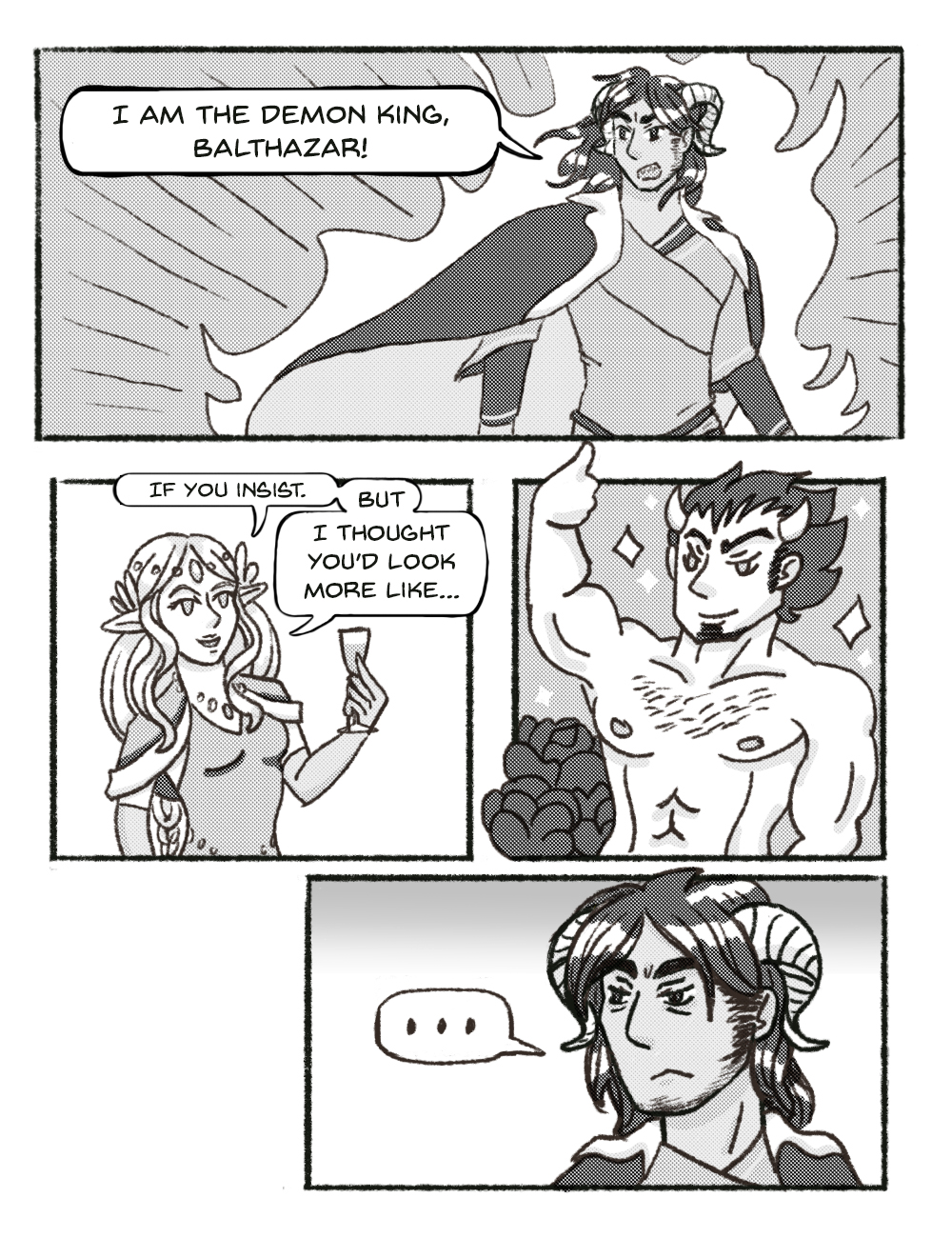
I just posted Chapter Nine of The Demon King on AO3 (here).

This is the second-to-last chapter of the novella, and it’s meant to function as a narrative climax. At the beginning of the first chapter, Balthazar casually murders someone; and, at the end of this chapter, he destroys an entire ecosystem. He has his reasons for doing what he’s doing, but I want to make it clear to the reader that he’s not fucking around. I also want to make it clear that this story is not YA fiction, so the language I used in this chapter is a bit… tumescent, let’s say.

Even though its narrative arc is complete in itself, this novella is intended to be the first part of a longer story, and I hope this sort of explosive conclusion is equally satisfying and intriguing. I think it can be understood as a natural outgrowth of the concepts that have already been introduced, but my goal is for an astute reader to come out of this chapter with a deeper curiosity about the history and metaphysics of this world.

This illustration of Balthazar is by the brilliant Jennifer So (@hellojennso on Twitter, @jennosaur on Instagram, and @jennlso on Tumblr), who designed the character. This is actually the first character design created for The Demon King (back in November 2018), and I’m excited to finally share it. Jenn nailed the character on the very first draft, and this is how I’ve pictured him since then.

Book Cover Studies

I’ve been thinking about graphic design a lot recently, especially as a tool to help writers promote their work. Contemporary mainstream social media is extremely image-oriented, which puts writers at a disadvantage. I therefore think it’s worthwhile to figure out how to create graphic images that focus on text but are still visually striking and easily shared.

Since book covers serve the same purpose, I decided to launch this project by thinking about how certain compositions are used to convey specific moods, and I’ve been drawing quick studies along the way. Silja Götz’s online class Book Cover Illustration has been an incredible resource!

It probably won’t surprise anyone to learn that I love horror novel covers. “Modern gothic” is one of my favorite genres, and I could sketch these types of covers all day (and night).

My Husbando

A true story from These Trying Times™

The song my husband is singing is (this one) from Azumanga Daioh.

“I would have just moved to another apartment,” someone commented when I posted this on Instagram. And I totally agree, but at the same time, moving during the COVID-19 pandemic wasn’t easy, and I don’t want to do it again. My illustrated piece of flash fiction “Apartment Hunting” (here) is actually about how strange and unpleasant this experience was. It’s been difficult to try to navigate my professional life without a stable internet connection, but at least I have a large library of anime to help me make it through.

The Demon King, Chapter 8

This illustration of Ceres is by Sali (@salisillustrations on Instagram and @saliechelon255 on Tumblr), who creates beautiful digital paintings based on books and anime, including Studio Ghibli movies and the Harry Potter novels, alongside her original work. Her characters are fashionable and expressive, and they always fit perfectly into their richly detailed environments. Sali has a talent for drawing fancy wizards, and it was a pleasure to be able to work with her on this illustration for The Demon King.

The eighth chapter of The Demon King is the culmination of Ceres’s first character arc. It echoes her introduction, in which she glibly treats murder as the only viable option to a tricky political problem, but now the reader is able to see the deliberation that leads to her decisions.

I’m interested in female political leadership, especially at high levels, when an executive’s position is just as symbolic as it is practical. It’s my impression that, whether it’s Hillary Clinton or Kamala Harris or Tsai Ing-wen or Angela Merkel, there’s an expectation that a woman needs to be perfectly competent and capable while still being both “rational” and having all the charm and charisma of a male politician. This is impossible in real life, of course, but it’s fun to exaggerate these pressures and expectations in fiction to see where they lead.

In any case, the prompt I gave the artist was “a beautiful fairytale princess quietly plotting murder.”

Although it’s still rough around the edges, I’m posting the first draft of The Demon King on AO3, and you can find it (here).

Apartment Hunting

I moved to Philadelphia earlier this year. The circumstances weren’t ideal, and I only had a few days to find an apartment. I went on several tours of large buildings and fancy condos, all of which were way out of my budget. Besides, I wouldn’t want to live in a place like that anyway.

I decided to pursue a different strategy. Instead of looking for listings online, I drove through several neighborhoods and took photos of places with For Rent signs outside. I sat in my car, made a list of phone numbers, and agreed to meet with anyone who picked up when I called.

This was how I found myself standing on the sagging porch of an old townhouse in West Philadelphia with ornamental spires above the windows and a historic registry plaque beside the front entryway. A woman with a colorless suit and a severe haircut met me at the door and handed me a blank application form. Just in case, she said.

The interior was much larger than I expected. I’d never been inside a townhouse before, and I wasn’t prepared for how far back the hallway would stretch. The doors were strangely small, and the ceiling seemed far too high. This must be the building’s historic character, I told myself. Local color. The realtor wasn’t interested in conversation, so I stopped to take a picture of the crown molding, which was ornamented with carvings of infinitely spiraling vines.

When I looked up from my phone, I realized that I was alone. The hallway in front of me was dark, so I turned around and began walking back the way I came.

There were more turns and staircases than I remembered. As I walked, the floor grew spongy underneath my feet. My shoes made unpleasant squelching noises with every step. I started to notice that there were small mushrooms crouching in the corners of the walls and creeping up the support beams between doors.

I swallowed my embarrassment and called out to the realtor, but no one answered. I tried dialing the number printed on the For Rent sign, but no one picked up. I was lost, I realized. I’d somehow lost my way outside. At least I still had the application form.

It’s not so bad, all things considered. I was alarmed at first, but I’ve gotten used to it, and it’s not as if there’s anything I can do. I guess I live here now.

. . . . . . . . . . .

This was my submission to the 2020 Philly Zine Fest Anthology. You can download a free PDF copy of the anthology (here). The Philly Zine Fest is held every November, and you can stay updated on Twitter (here).

Emotional Support Photo

Embarrassingly enough, this actually happened to me in 2018.

The one thing I didn’t miss in 2020 was having to go to academic conferences. I’m not crazy about infinite Zoom meetings, but flying across the country to spend two nights in an expensive conference hotel so that I could work sixteen hours in one day wasn’t fun either. I used to love flying when I was younger, but I eventually got to a point where it started to stress me out. If nothing else, it’s nice to be able to take a break from conference travel.

I still use (this photo) to help myself cope with Zoom meetings, though.

Root Letter

Root Letter is a mystery-themed visual novel that should take most people about six or seven hours to play. I’ve read a number of positive reviews of the game, so I went ahead and downloaded a copy onto my Nintendo Switch when it went on sale at the end of the year.

You play as Takayuki, a thirty-something white collar worker who’s left his job at a design firm and has a bit of free time before he’s scheduled to start a new job. When he goes home to visit his parents, he finds a set of letters from Aya Fumino, his pen pal from his senior year of high school. He’d exchanged nine letters with her, but he discovers a tenth at the bottom of the stack that he doesn’t remember reading. In this letter, Aya tells Takayuki that she can no longer continue their correspondence. She apologizes, saying that she has killed someone.

Takayuki decides to try to find her in Matsue, a city on the Sea of Japan about halfway between Osaka and Hiroshima. When he arrives at the address on the letters, however, he finds an empty lot. A passing neighbor tells him that the house burned down fifteen years ago, so he checks the records at the city library. He learns that, while a girl named Aya Fumino used to live in that house, she died twenty-five years ago, long before she could have written to him.

Why did the house burn down? Who was pretending to be Aya Fumino? And who did she kill?

With a week of free time and an intriguing mystery on his hands, Takayuki sets about tracking down the seven friends his pen pal mentioned in her letters. None of them want to talk to him, however, and everyone claims not to know anyone named Aya Fumino, even when presented with her photo. Your goal, as Takayuki, is to find and interrogate these seven adults in an attempt to figure out who “Aya Fumino” was and what happened during her senior year of high school.

There are five possible endings to Root Letter, but its gameplay is almost completely linear. You use a drop-down menu to move between various locations in Matsue as you follow various hints and clues, and the “Think” command on your menu will (almost) always tell you where the game wants you to go next. The interrogation scenes feature a few Ace Attorney style elements that involve presenting the right piece of evidence at the right moment, but this is also extremely linear. There’s no reward for exploration or creativity; but, thankfully, there’s no punishment for failure. Root Letter is much more of an interactive novel than a game, and it’s not interested in derailing your progress through the story.

The ending you see is determined by your choice of how Takayuki responded to the letter from Aya Fumino that’s presented at the beginning of each of the game’s chapters. You’re given two sets of choices per letter, and your options tend to fall into discrete categories at don’t make much sense unless you already know which ending you’re trying to unlock. Like the shitty casual gamer I am, I chose a “normal” (to me) range of mixed responses and got the worst ending, in which the whole mess about Aya Fumino was a government conspiracy to cover up an alien invasion.

My advice would be to avoid my rookie mistake by consulting a guide to the endings before you begin. Don’t worry about spoiling yourself, because Root Letter’s story is so convoluted that none of the endings will make sense if you haven’t played the game.

It’s my understanding that the “default” ending, meaning the ending you’ll see if you always choose the first response option, is a bittersweet story about missed connections, growing up, and letting the past go as you move on with your life. Another ending, the “Cursed Letter” ending, is about the power of teenage imagination to create both urban legends and personal identity; while another, the “Princess of Himegamori Forest” ending, is a horror-themed exploration of local Shintō folklore.

One of the main benefits of playing the Last Answer edition of the game (as opposed to the original 2016 release) is that it contains an optional “drama mode.” The drama version of the game uses photos of real actors and locations; and, based on what I’ve seen, the photography is quite polished and surprisingly faithful. Having played the game through once with anime illustrations, I’m looking forward to playing it again in drama mode at some point in the future.

While Root Letter pushes the player forward with the strong forward momentum of its mystery story, it also invites you to take time to appreciate the sights of Matsue. As Takayuki, you’ll get to stay at a traditional hot springs inn, stroll through the forested grounds of Matsushiro Castle, visit art museums, and eat at trendy cafés. Root Letter leans especially hard into its celebration of the local cuisine, and I’m excited about the prospect of being able to enjoy photographic depictions of Matsue’s food culture.

Unfortunately, some elements of the game haven’t aged well, probably because they were never attractive to begin with. To give an example, one character admits to a violent attempted rape, and the other characters just sort of shake their heads and move on. If this assault only comes up briefly and is never mentioned again, why include it in the story at all? Likewise, “Aya Fumino’s” fake suicide is teased fairly early in the game but isn’t given any dramatic weight. Rather, it’s played purely for shock value, with the implicit understanding that this sort of thing is just what moody high school girls do.

Some of the most uncomfortable parts of the game involve a character nicknamed “Fatty.” This character’s entire arc is about how he’s overweight, and about how overweight people are weak and gross and unlovable. In order to psychologically break this character during his investigation, Takayuki taunts him with chocolate-covered potato chips, which he can’t resist because, at the deepest core of his being, he is and will always be a big fat fatty. The whole thing is super gross, especially in combination with the casual gay panic thrown into this chapter. I feel that this is one of the many instances in which a more judicious localization could have made some slight changes, not to erase this type of bigotry and meanness, but to mitigate it somewhat.

The player’s enjoyment of Root Letter is largely based on its story, so it’s a shame that the translation is so lackluster. It’s perfectly serviceable, and it’s far from unreadable, but it has numerous quality control issues that would be tedious to list. My main complaint is that the translation received very little localization, which is frustrating in terms of both story and gameplay.

Regarding gameplay, the lack of a localization has rendered it somewhat difficult to talk to or interrogate people, as there are numerous instances in which none of the dialog choices make the slightest bit of sense. The game isn’t that complicated, so you can brute-force your way through the poorly translated bits by trial and error, but it goes without saying that you shouldn’t have to.

It’s tricky to discuss the situations in which localization would have been preferable to a direct translation without resorting to an infodump, but I can give one example that’s fairly self-explanatory. One of the friends Aya Fumino mentions in her letters is nicknamed “Bitch.” In Japanese, the loanword bicchi doesn’t necessarily mean “mean girl,” as it does in English. Rather, it’s the 2015 version of gyaru or kogal, and it refers to a teenage girl who dyes her hair and uses tanning lotion and dresses in trendy clothes and pays a lot of attention to the entertainment industry. The English equivalent of this term changes from decade to decade; but, given that Takayuki probably went to high school around 1998-2001 or thereabouts, “valley girl” or “Barbie girl” might work. The character nicknamed “Bitch” is actually quite friendly, so listening to the other characters talk about how much they used to admire their friend “Bitch” is bizarre.

Root Letter has some definite rough patches, but I want to emphasize that I enjoyed this game. I spent a week playing it, reading for about an hour every day, and I had a lot of fun with its ridiculous characters, charmingly convoluted plot, and unapologetic embrace of virtual tourism. I’m happy that I finally got a chance to play Root Letter, but I’m also happy that I was able to get the game on sale, because I’m not sure it’s worth more than $20.