Anodyne

After starting and abandoning Anodyne a few times on various platforms, I downloaded it onto my Nintendo Switch. Being able to play this retro-styled adventure game on a handheld console turned out to be just what I needed in order to appreciate the experience, and I got completely sucked into its world. Because of its horror elements, I’m not sure Anodyne is for everyone, but I had a great time working my way through the game while eagerly anticipating what sort of strange and grotesque imagery I would encounter next.

The game has Pokémon Ruby/Sapphire style Game Boy Advance era graphics. The pixel art is by turns allusive and unique, and it’s occasionally genuinely gorgeous or horrifying.

The screen-by-screen dungeon and overworld layouts remind me a lot of the two Legend of Zelda Oracle games, and the gameplay is like what those games could have been if they had focused on their core strengths instead of distracting the player with extraneous marginalia. If you’re willing to explore a bit, you can learn to jump fairly in the game, and it’s a neat ability to incorporate into the Zelda-style gameplay.

Anodyne also gives off strong Yume Nikki vibes. You start off on a fairly generic quest, but it quickly becomes clear that you’re exploring a manifestation of the subconscious mind of the protagonist, who is not doing okay. There are clear references to addition, depression, and suicidal ideation, and each of the dungeons is themed after a specific fear. The first dungeon is about the fear of not being able to see, the second dungeon is about the fear of being born from the bloody entrails of your mother’s body, the third dungeon is about the fear of being generic and unnecessary, and so on.

Anodyne also reminds me of the original The Legend of Zelda in that there’s zero guidance – the game has no interest in telling you where to go or what to do. This is why I abandoned it the first few times I tried to play it, as I arrived at its open field area and became overwhelmed. Once I decided to stick with it and finally figured out the small environmental clues meant to lead the player forward, it was a lot of fun to be able to go anywhere and do anything while unearthing a few secrets along the way.

Anodyne’s structure is balanced between the overworld areas and the dungeons, and each of the dungeons is a perfect puzzle box. Despite the gameplay mechanics being deliberately limited and basic, some of the puzzles are very clever. The controls are a little loose, but it’s not really a combat-heavy game. There’s no real penalty for dying, and I died a good three dozen times out of sheer laziness but didn’t feel frustrated even once.

It took me about six hours to finish Anodyne, and I enjoyed every minute. It seems there’s a lot of postgame content that involves revisiting various locations, talking to important characters again, and using a new ability to access a bonus dungeon. This game is subtly but undeniably disturbing, and I’m looking forward to seeing just how weird it can get after the first “quest” has been completed. Or maybe the player-character finally works through his trauma and gets better? That would be good too. I guess.

To summarize: Anodyne is a 16-bit nightmare adventure for a mature audience, sort of like a re-imagining of Majora’s Mask in which characters are allowed to say fuck. Putting the edginess aside, it’s super fun to play, and the dungeons are ghoulishly creative.
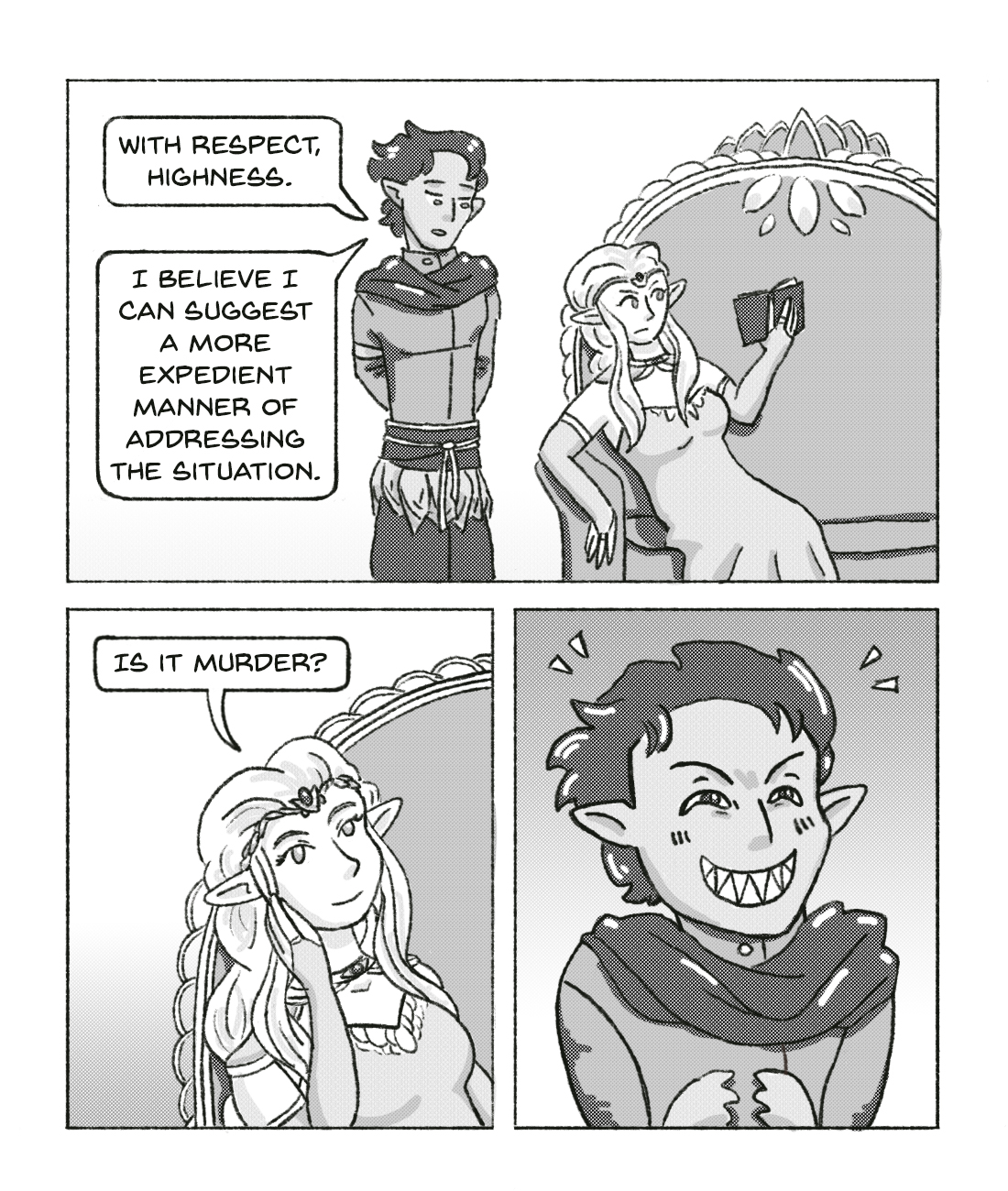
Murder Is Very Expedient!

This comic is based on a marvelous illustration of Ceres and Weive created by @l-a-l-o-u on Tumblr. You can see the piece in all its colorful glory (here). 

I’m going to use this illustration as the cover for the second story arc of The Demon King, which I plan to start posting on AO3 beginning on August 1. Being able to work on collaborative illustrations and my own silly comics fills me with inspiration, and I’m excited to share the next segment of the story!

Turnip Boy Commits Tax Evasion

Turnip Boy Commits Tax Evasion is a 16-bit Zelda-style adventure game with cute graphics and meme-heavy writing that takes about two and a half hours to play from start to finish with 100% completion.

Along with a bright and colorful overworld, Turnip Boy Commits Tax Evasion features three formal inside dungeons and two less formal outside dungeons, as well as the usual variety of “go fetch me this thing” sidequests. The game is meant to be accessible to a diversity of players but still presents a range of entertaining challenges. The gameplay isn’t engineered for precision mechanics, which makes the boss fights somewhat more difficult than they perhaps need to be, but you can turn on “god mode” at any time from the menu. Around the middle of the game, Turnip Boy discovers a device that generates portals, and this tool enables are some fun puzzles involving getting bombs and blocks to where they need to be on the map in order to move forward.

Your main goal, as Turnip Boy, is to destroy every single piece of horrible paper you get your (non-existent) hands on. Tax documents? Rip them up. Leases? Rip them up. Receipts? Rip them up. A love letter that the girl you like wants you to deliver to someone who isn’t you, even though she knows you like her? Rip it up right in front of her face. Someone’s uwu anime drawing? Rip that mess up.

It’s very cathartic.

The exploration and puzzles are fun, but what I really enjoyed about Turnip Boy is the dialog, as well as the way your adorable yet feral protagonist’s silence is used for comedic effect. This game uses one of my favorite Earthbound-inspired tropes ever, which is to populate dungeons with people who talk to you, making them feel like towns that happen to be temporarily overrun with monsters. There are also diaries and other documents (that you can rip up!) scattered about in the dungeons that provide lowkey Fallout-style worldbuilding.

So I suppose you could say that Turnip Boy Commits Tax Evasion is a comedy story game that’s set up as a 16-bit Zelda adventure quest. Thankfully, the 16-bit graphics and Zelda-style gameplay elements work really well. The music is super-catchy too.

Is Turnip Boy Commits Tax Evasion worth $15? To me, it definitely was. A team of fifteen people developed this game, and I’m happy to give each of them a dollar. If you’re in the “I want shorter games with worse graphics made by people who are paid more to work less and I’m not kidding” camp, Turnip Boy Commits Tax Evasion is the game for you, especially if you’re in the mood to take an afternoon off and enjoy yourself by exploring a colorful fantasy garden while gleefully smashing capitalism.

A Noble Pursuit

None of the lessons from the Gerudo Classroom have prepared Rhondson for married life with Hudson, who has grown restless and disappeared from Tarrey Town a year after its founding. She travels to the Akkala Citadel Ruins to hunt for her husband while reflecting on the bridges that will need to be rebuilt in order for Hyrule to embrace a peaceful future.

“A Noble Pursuit” is a short story that explores the theme of cultural differences, including different attitudes regarding the preservation of historic sites, via the Akkala Citadel Ruins.

As the Gerudo tailor Rhondson crosses the Sokkala Bridges, she’s impressed by how sturdy and practical they are; and, at the end of the story, she considers how building more bridges – both literal and cultural – might help make the Akkala Citadel habitable once more.

At the end of the story, Rhondson finds that her missing husband Hudson has made friends with the monstrous Hinox who’s always snoozing away on the citadel’s parade grounds. She realizes that both the Hinox and her husband need a renewed sense of purpose, and she encourages Hudson to direct his energy into rebuilding the ruins of the Akkala Citadel into a place better suited to cultural exchange.  

This story about archaeology, castles, ruins, giant monster friends, and what it means “to live happily ever after” was written for Memorabilia, a Breath of the Wild fanzine​ that you can check out on Twitter (here) and on Tumblr (here). The accompanying illustrations are by the stylish scholar Pocketwei, whose art of handsome characters and beautiful landscapes can be found on Twitter (here) and on Instagram (here).

You can read “A Noble Pursuit” on AO3 (here).

Hot Dad Ganondorf

I saw a screencap of (this tweet) circulating on Tumblr after watching the recent teaser trailer for the Breath of the Wild sequel, and this is where my mind immediately went. People in the Legend of Zelda fandom say that they want “hot dad Ganon,” but be careful what you wish for!

I’d like to extend my sincere gratitude to Frankiesbugs for putting up with my awful dad humor and drawing this silly comic. You can find more of the artist’s cute and creepy comics and illustrations on Instagram, on Tumblr, and on DeviantArt.

Only Power Remains

Only Power Remains is an Ocarina of Time fancomic that explores the backstory of Ganondorf, the iconic villain of the Legend of Zelda games. According to the series lore, Ganondorf was the only male child born to the Gerudo, and otherwise all-female society living in the desert at the border of the kingdom of Hyrule. Through a series of connected scenes, Only Power Remains investigates how Ganondorf grew from a strong-willed boy to a power-hungry warlord.

This comic is a fascinating and insightful exploration of Ganondorf’s backstory that rings true to the Legend of Zelda canon while still being accessible to casual fans of the series. It also stands on its own as a cohesive story, and I would happily recommend it to curious readers who may not be familiar with the details of the Zelda games. Louisa Roy’s writing is sharp and original, and her vibrant and expressive art does a lot of heavy lifting in terms of introducing and developing established characters.

In her extensive “Author Notes” at the end of the zine, Roy explains that she especially enjoyed drawing Ganondorf’s childhood interactions with a merchant in Hyrule Castle Town. The merchant is disrespectful during their first meeting, as he sees Ganondorf as nothing more than a bratty kid. Ganondorf therefore learns the Hylian language spoken by the merchant in order to come back a year later and verbally cut him down before taking what he wants from his stock of musical instruments. Without becoming too political, Roy conveys the tensions of cultural differences, and there’s a certain charm in watching Ganondorf slice through the Gordian knot of xenophobic stereotypes.

The supporting cast receives a similar level of nuance and sympathy, especially Nabooru, a Gerudo leader who eventually rebels against Ganondorf. With Nabooru, as with Ganondorf, the reader is given a sense that the tragic story of the Gerudo could have gone a different way had circumstances been even slightly different. The comic ventures into many unexplored corners of Hyrule during its journey, but the artist’s design work is brilliant and remains faithful both to the world of the games and to their real-life cultural influences.

Only Power Remains is far from the first Legend of Zelda fancomic created by Louisa Roy, who has published a number of zines featuring side stories that allow the minor characters in the games to shine in their own heroic (or antiheroic) light. The publication quality of these comic zines is consistently excellent, from the layout to the lettering to the cover design. You can follow the artist as @om_nom_berries on Twitter and @om-nom-berries on Tumblr, and you can find her comics on her website (here) and browse through her zines on Etsy (here). If you’re interested in Only Power Remains, you can check out the listing is (here).

Link Loves Revolution

After Nintendo premiered the new Breath of the Wild sequel trailer during E3, all sorts of artists rushed to draw illustrations of the mysterious hero in the sky, but all I can think about when I see these handsome young men is how Link canonically eats bugs. In this house we love our feral son, and I couldn’t resist drawing the Ponyo meme.

Ballad of the Wind Fish

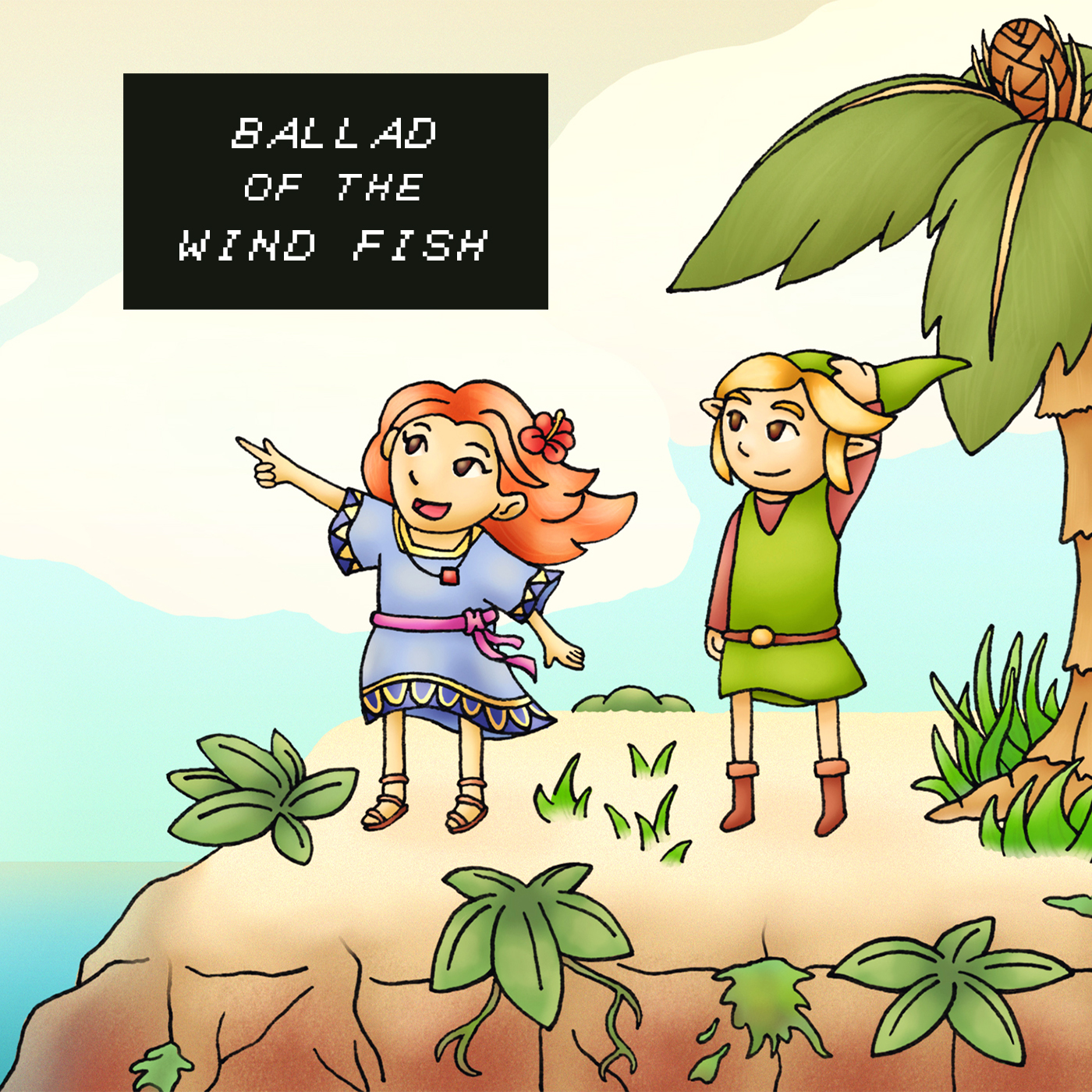
Ballad of the Wind Fish is a bittersweet narrative minicomic that uses the 1993 Game Boy game The Legend of Zelda: Link’s Awakening as a stage to explore the connections between childhood fantasies, nostalgia, and escapism.

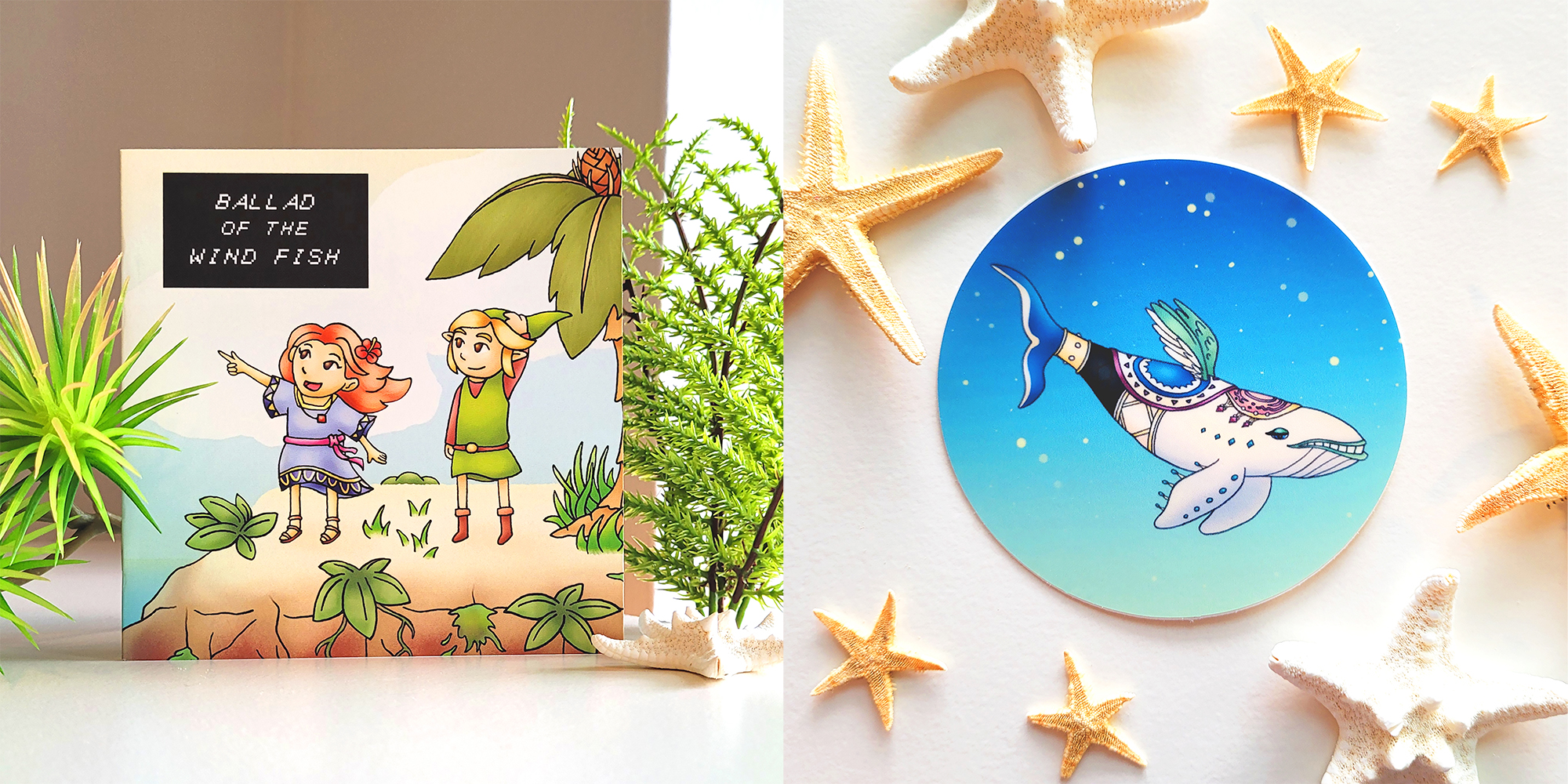
The comic is twelve pages long, with one panel per page. I created it for the #Linktober drawing challenge on Instagram during October 2019, but it’s still very near and dear to my heart. Although the comic is ostensibly about Link’s Awakening, it’s really more of a meta exploration of a certain glitch in the original release of the game, as well as a meditation on being a child of the 1990s. I formatted it into a zine and created two pieces of polished art to use for the cover. It’s my hope that this short comic fills the reader with warm memories and sunny summertime vibes.

You can download a free digital copy from Gumroad:
https://gum.co/windfishzine

If you like, you can buy a physical copy on Etsy:
https://www.etsy.com/listing/1035486197/ballad-of-the-wind-fish-zelda-minicomic

The zine is 4.75” square, or roughly the size of a Nintendo DS game case. It’s professionally printed in vibrant full color, and it comes with a 3” circular vinyl sticker depicting the eponymous Wind Fish.

If you’d rather not bother with any of that, you can read the comic as I originally posted it on Tumblr (here).

Vision

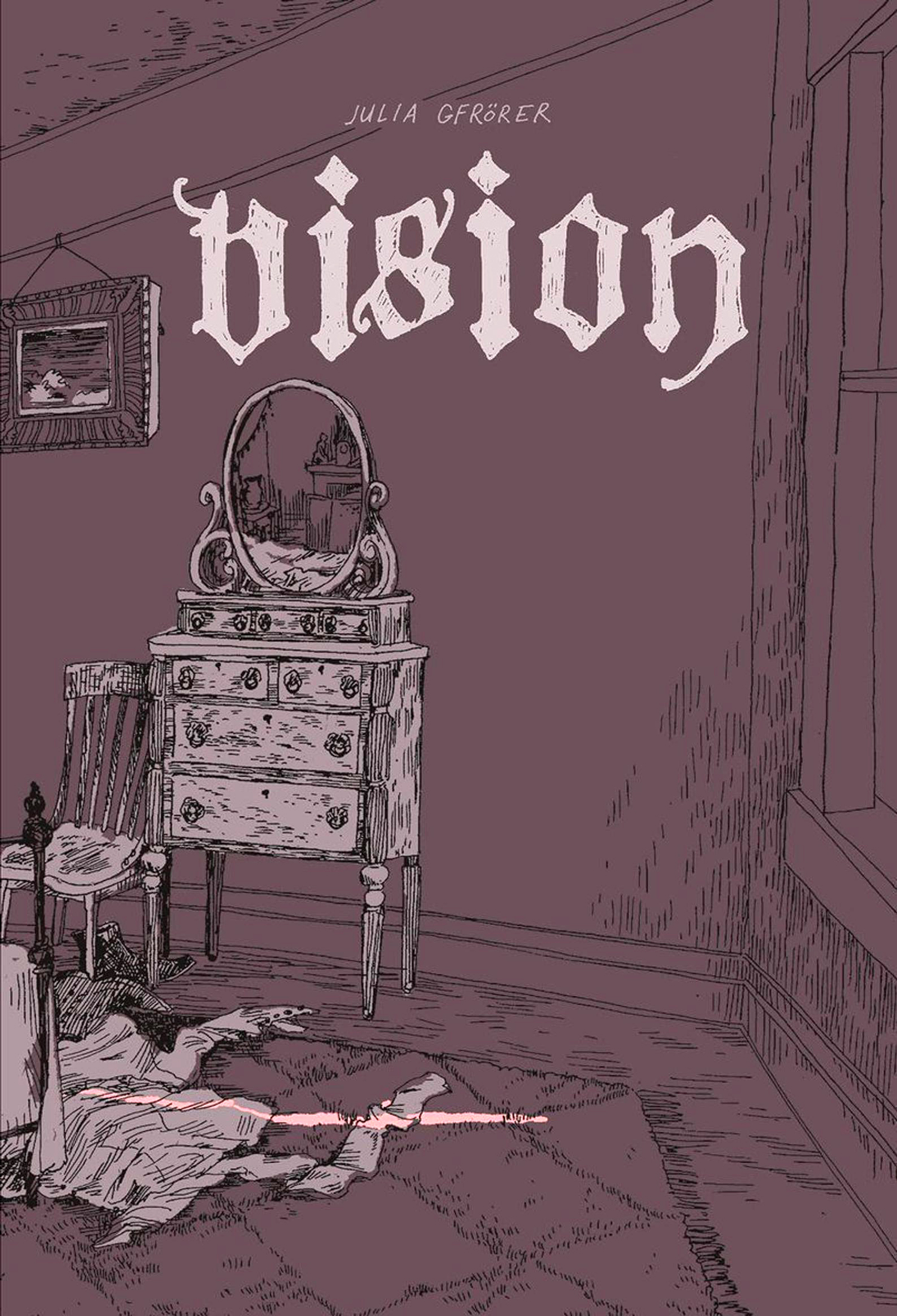
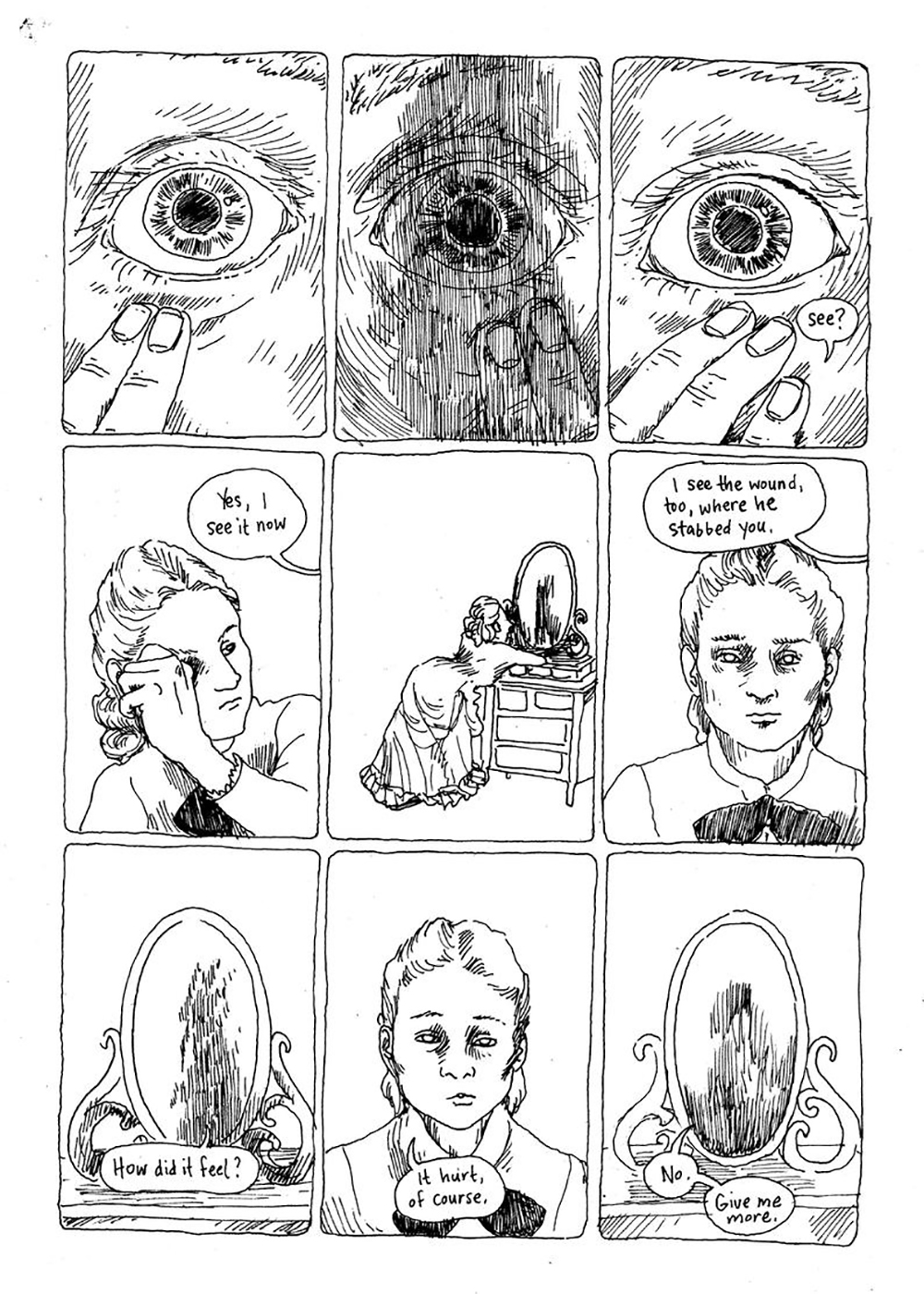
In nineteenth-century London, Eleanor lives in her deceased parents’ house with her brother Robert and his wife Cora, who is bedridden with a vague illness. Eleanor was previously engaged, but her fiancé died after enlisting in military service. Having become an unmarried woman of a certain age, Eleanor spends her days caring for her sister-in-law. At night, however, she engages in sexual fantasies in front of her mirror, which she imagines as speaking to her in the voice of an unseen lover.

This situation might continue indefinitely were it not for the romantic attentions of a certain Doctor Bishop, who treats Eleanor’s cataracts and prescribes Laudanum to calm Cora’s nerves. Bishop is affectionate and well-meaning, but Eleanor is a quiet storm of resentment and repressed sexuality whose veneer of quiet virtue and good sense is one the verge of cracking.

Vision is a brilliantly written and gorgeously drawn graphic novella that explores the subtleties of how trapped and lonely people isolate themselves while simultaneously seeking connection, but it’s also a sharp and disturbing story about sex and death. The death is understated and phantasmal, while Eleanor’s sexuality and desire is on open display. Each of the erotic scenes is mirrored by a grotesque reflection, such as when the imagery of Eleanor’s self-pleasure with a candle is reflected in an extended scene depicting her eye surgery. Julia Gfrörer’s linework is delicate yet expressive, granting her characters warmth and personality while occasionally portraying them as eerily inhuman.

Eleanor’s story becomes stranger as various small mysteries and imbalances accumulate into an ever more fragmented portrait of a haunted household. The climax is shocking but perhaps not unexpected, and far more questions are raised than could ever be answered. The absence of clear explanations and justifications is part of the appeal of the narrative conclusion, however, while gradual shifts in the ink style contribute to an encroaching sense of dread – and curiosity.

Vision was published by Fantagraphics Books in September 2020. You can read more about the book on the press’s website (here), and you can order a copy from the Julia Gfrörer’s store on Etsy via its listing (here). Gfrörer’s two previous graphic novel publications with Fantagraphics, as well as her zines, are also listed on Etsy, and each is as creepy and fascinating as the next.