World End Syndrome

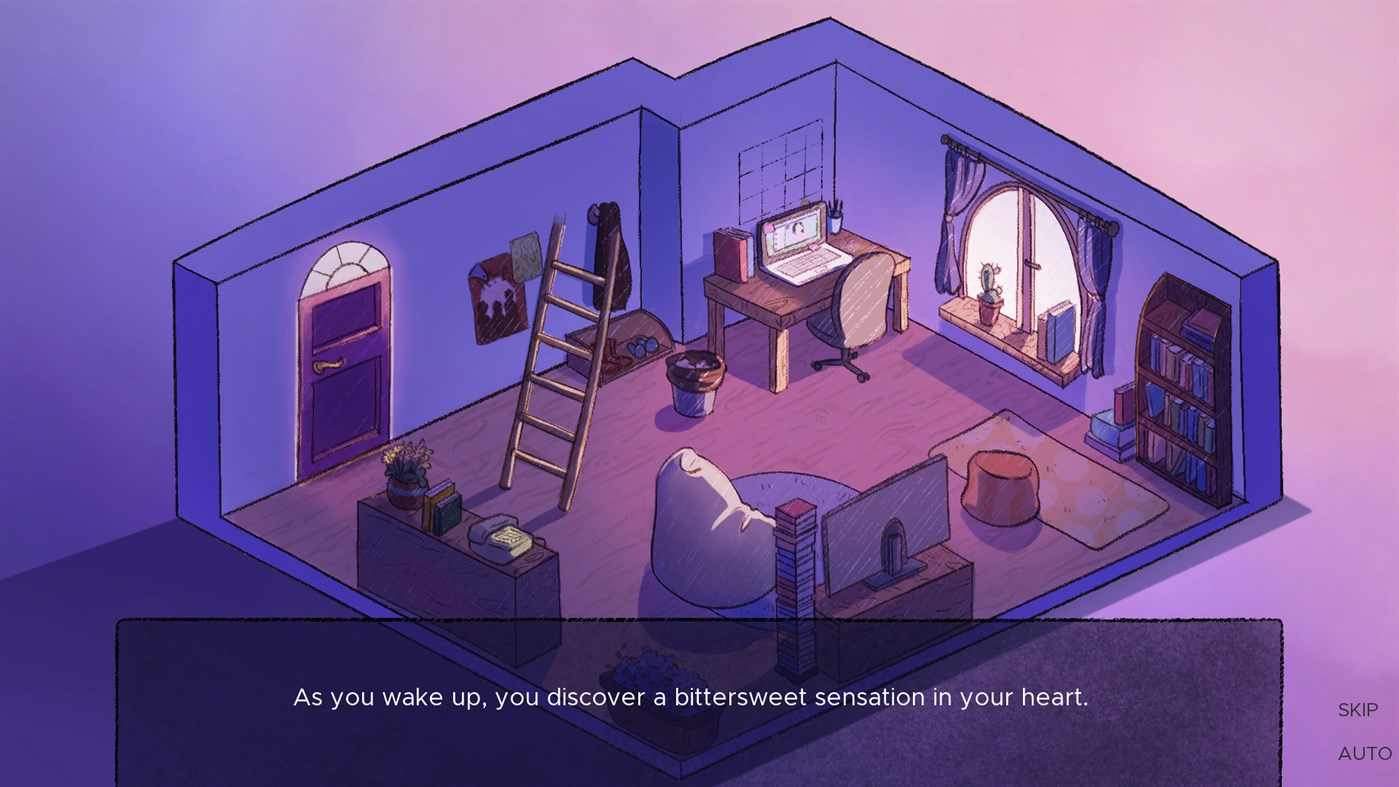
World End Syndrome is a visual novel about a small seaside town with dark secrets. It’s structured like a dating sim, and you have to romance each of the five datable characters if you want to unlock the “true ending” that answers all the questions about the overarching mystery. Thankfully, the dating sim elements are relatively undemanding. There aren’t a lot of dialog options, and the gameplay mainly involves choosing which location to visit on each day during the month of August.

I know this will be a deal-breaker for some people, so I should say at the beginning that there’s some mandatory incest in this game. But it’s sort of okay because of plot reasons? As far as dating sim incest goes, the relationships in World End Syndrome didn’t particularly creep me out. It’s honestly not that big of a deal, especially not in a game that would be PG-rated were it not for the occasional murder, but your mileage may vary.

As the nameless protagonist, you move to the small seaside town of Mihate to live with your cousin following the death of your sister in a car accident. You and your cousin are in the same class in high school, and your homeroom teacher is a folklore scholar who just published a bestselling YA romance novel. The novel is called World End Syndrome, and it’s based on the Mihate legend of the Yomibito, a dead person who returns to life but doesn’t know they’re dead.

There are strong “Bruce Willis at the end of Sixth Sense” vibes surrounding the protagonist at the beginning, but he turns out to be very much alive – at least until he gets murdered at the end of the prologue. This is the game’s official “worst ending,” and you have to start over from the beginning and make a different choice at a crucial point to progress. In order to avoid being murdered, you have to form an emotional bond one of the girls in your class. Successfully doing so for the first time leads you to an ending that, while satisfying in and of itself, does nothing to explain what the deal is with Mihate and its spooky legends.

It would be tedious to explain the details, but World End Syndrome has an interesting system of unlocking various scenes and dialog choices based on the number of previously completed interactions. Your cumulative progress carries over between saves, even when you’re hopping from one save file to another on the same romance route. What this means is that each playthrough is going to be different, even during repeated scenes. Your first full playthrough will tell a fairly straightforward story about a high school romance that’s sweet despite having hints of darkness, but on subsequent playthroughs you’ll begin to realize that there’s something very weird going on in Mihate. World End Syndrome isn’t really a horror game, as it’s not gruesome and doesn’t go out of its way to be upsetting, but it turns out to be an intriguing supernatural mystery.

The character art of the girls is very cute, the character art of the boys is very over-the-top silly, and the environmental art is absolutely gorgeous. Although there’s nothing special about the writing on a line-by-line basis, the translation is solid and pleasant to read.

What helps World End Syndrome stand out is the voice acting and sound design. I don’t have the vocabulary to describe what makes the audio elements of the game so appealing, save to say that the quality of the recording is excellent. There’s a lovely in-game radio broadcast that allowed me to finally understand the appeal of ASMR, and I think the sound quality is something you can appreciate even without knowledge of Japanese. The game gives you a lot of control over the sound channels, and you can turn down or even mute the voice acting if you prefer.

I was on the fence about World End Syndrome, as I was dubious about a game that wants you to play the same story six or seven times, but I’m glad I gave it a chance. If you’re only interested in one playthrough, that’s perfectly fine. It takes about ten to twelve hours to get from the beginning to the first character-specific “good ending,” which is a respectable length for a visual novel. Even if you don’t have the patience to solve the mysteries of Mihate, it’s a lot of fun to explore the town, attend club activities, and go on dates while there are dead people (and possibly a cult) wandering around and killing people in the background.

The Shadows of Hyrule

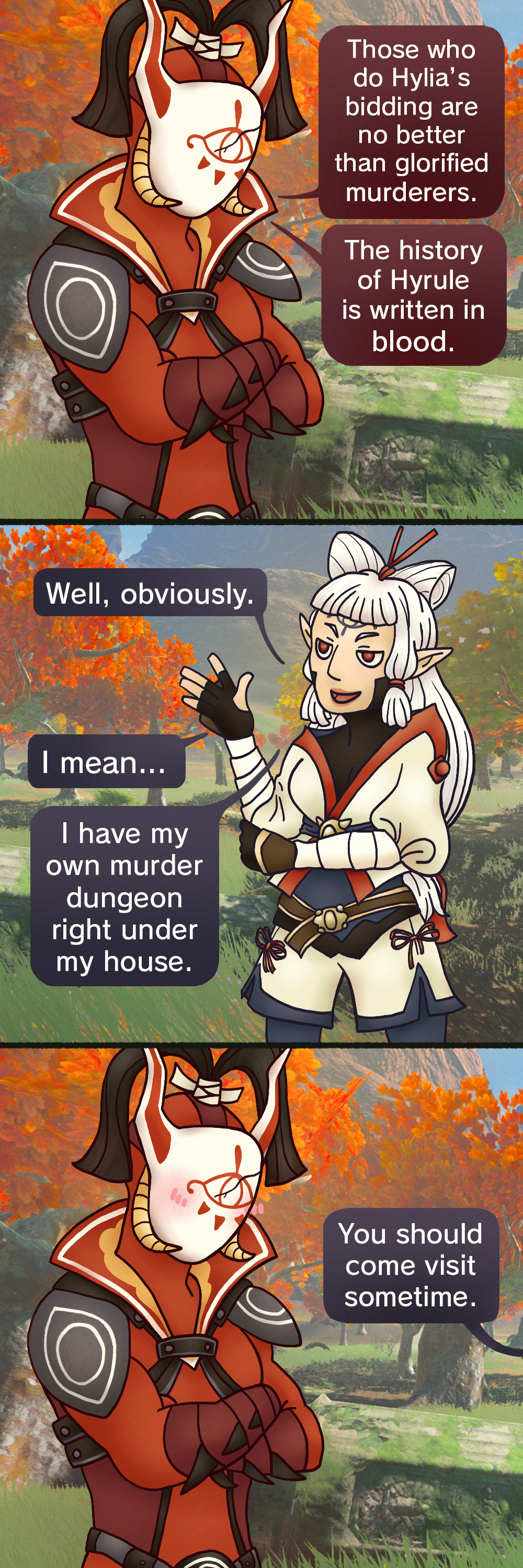
Honey, everyone has a murder dungeon in Kakariko Village.

The joke is that, while the “evil” Yiga Clan is characterized as violent and bloodthirsty in Breath of the Wild, the “good” Sheikah Clan is canonically just as disturbing. They’re all magical ninja assassins. What do you expect?

These two characters are Sooga and Impa from the Breath of the Wild AU melee fighting game Age of Calamity, and this is fan art of the four-part Sooga/Impa fancomic Shadow Folk by Frankiesbugs on Tumblr. You can read Shadow Folk on Tumblr starting (here), or you can donate 1€ to download a PDF version (here). I have to admit that I never considered any sort of relationship between Impa and Sooga until I read this comic, but the art is stylish and beautiful and the story is a lot of fun.

On the Internet, No One Knows You’re (Not) Kris

I recently participated in the annual Yuletide fic exchange for small fandoms. More than a thousand people contribute their work to this exchange, in which each participant is anonymously matched with someone who requests a story for one of the fandoms they’ve offered to write for. The person with whom I was matched asked for fic about Deltarune, and they requested “existential horror about free will and the ethics of a player guiding characters with self-awareness.” I’m always up for existential horror, and the recipient’s description of how they view the player-character Kris really vibed with me: “A Weird Kid who’s kinda lonely but not quite knowing how to make friends/not liking many of their options in town before the game starts.”

This prompt inspired me to write a story called “On the Internet No One Knows You’re (Not) Kris,” which is an exploration of Kris’s character within a narrative meta-analysis of the game. You can find it on AO3 (here).

The person who requested the story confessed that they’ve spent countless hours diving down the rabbit hole of Deltarune theories, so I took a plunge into the internet theory maze as well. The game subtly implies that Kris isn’t in full control of their body or personality, and that what’s manipulating them is their SOUL, the red heart that represents them during battle sequences. Many Deltarune theories try to answer the question of who (or what) is controlling Kris’s SOUL. There’s also the issue of what connection Deltarune might have to Undertale, as the two games share the same metaphysics and many of the same characters.

This ended up being my favorite Deltarune theory:
https://theamazingsallyhogan.tumblr.com/post/663249972697907200/great-big-massive-spoilers-under-the-cut-part-1

What this theory posits is that Kris has made a devil’s bargain with their SOUL, exchanging their free will for the power to rescue a childhood friend who mysteriously vanished a few years before the game begins. Although this theory doesn’t explain everything that’s going on in Deltarune – which, after all, has only released its first two chapters – the essay shines light on the characters’ backstory, which is only very briefly alluded to in the game itself.

This theory led me to create an illustration (here) based on the scene from Howl’s Moving Castle in which Howl makes a pact with the fallen star Calcifer, and I drew the comic above about how the ostensible villain of the second chapter of Deltarune might have a radically different view of the concept of free will. I also created an animated illustration (here) of the secondary villain Spamton, but I ultimately decided not to include it with the story. Spamton is bizarrely beloved in a certain corner of Deltarune fandom, but I think it’s probably safe to say that he’s an acquired taste. Still, I had a lot of fun writing Spamton’s dialog in my story. Despite spending far too long on the Deltarune wiki, I regret nothing.

Growing Up with The Legend of Zelda

The Legend of Zelda series has been criticized for its formulaic writing, but one of the strengths of its archetypal characters is that they allow room for multiple interpretations. I was born in the same year as the Zelda series, and my perspective on these characters and their stories has shifted as I’ve grown older.

When I was a kid, I loved Link. I had no innate skill as a gamer, but I enjoyed the thrill of running wild in Hyrule. I may not have fully understood the game mechanics, but this meant I was always discovering new things. Despite my many deaths, I reveled in the certainty that I was a force of good fighting for justice, and it was comforting to know that all I had to do in order to succeed was to follow the marks on my map.  

In my late teens, I began to identify more with Princess Zelda. As my view of the world became wider, I realized that it wasn’t always the best course of action to charge forward with an unsheathed sword. I also came to understand that it was impossible for me to be a lone hero. There were times when I would be at the mercy of forces beyond my control, and sometimes I would need to rely on the strength of other people to achieve my goals.  

Now that I’m an adult, I can’t help but sympathize with Ganondorf. The world is infinitely complicated and filled with impossible decisions. Even though you may have the best of intentions, it’s inevitable that some people will see you as a villain when you challenge the status quo. If you want the power to change the world, you have to forge your own path, and no one will give you a map marked with signposted quests to complete. Still, as long as you’re making your own rules, you might as well be stylish and have gorgeous hair.

The Legend of Zelda series has become a type of modern mythology. The games continue to be relevant not just because of the strength of their gameplay, but also because of the resonance of their archetypes in the lives of the people who grow up with their stories. Instead of growing out of the Zelda series, I’ve found that I’ve grown to appreciate it more now that I can relate to the characters through multiple levels of lived experience.

. . . . . . . . . . . . . . . . . . .

This essay and its accompanying illustration were originally published in Coin-Operated Press’s Nerd! Zine anthology. You can check out the zine on the press’s website (here).

An Unfound Door

The sacrificial princess Agnes spares the life of a demon from the blade of the hero who rescued her from certain demise, but was this the wisest decision? Upon returning to her decaying kingdom, she finds the beast waiting for her, now in the form of a man. He is determined to restore the ruins of his homeland to their former glory, but his ambition presages calamity. As Agnes follows her enemy through the shadows, she must shine light onto the mysteries of the past if she wishes to restore hope for the future.

This is my working description for An Unfound Door, the dark fantasy mystery novel that I’m currently writing. I borrowed the title from this passage in Thomas Wolfe’s Look Homeward, Angel, a coming-of-age story primarily set in an old and decrepit town: “Remembering speechlessly we seek the great forgotten language, the dark lane into heaven. A stone, a key, an unfound door. O lost and by the wind grieved ghost, come back again.”

The character illustrations are by Marianne Lalou, who is on Tumblr, on Twitter, and on Instagram. Lalou was able to take my amateur designs (that I posted here) and polish them into something magical. They’re one of my favorite fantasy illustrators and character designers, and it was an amazing experience to work with them!

Agnes and Zidan from An Unfound Door

An Unfound Door is a Gothic mystery set in a decaying castle. Agnes, the princess of Faloren, hopes to save her crumbling kingdom by recovering a long-lost relic, but she must find it before it’s discovered by Zidan, a foreign prince with mysterious motives. As their paths repeatedly cross in the twisting corridors and hidden passages, Agnes and Zidan realize that they must descend into the shadows of the past together if they hope to bring light to the future.

While I’ve been planning this story, I’ve also been working on character designs. This is what I’ve come up with…

Agnes is in her early twenties. Her palette is fairly monochromatic, making her look somewhat ghostly. She’s not used to interacting with people, and she’s aloof and serious to a fault. Her floral motif is the moonflower. I was aiming for something like a “dark academia” aesthetic.

Zidan is also in his early twenties. His palette is warm with accents in brighter colors. He’s charming and polite, but he’s too proud to conceal the sharp edges under his smooth exterior. His floral motif is the Chinese lantern flower. I was inspired by the work of the artist Emily Cheeseman in creating his design.

Carpe Noctem

Carpe Noctem: Vampires Through the Ages is an anthology of original art, comics, and historical fiction about vampires around the world. The backer campaign lasts until Saturday, December 11, and you can read about the project and order a copy of the book on Kickstarter (here). Carpe Noctem was fully funded in three days, and four stretch goals have been unlocked since then. You can check out contributor bios, merch illustrations, and previews of art and writing on the project’s Twitter account (here).

I’m contributing a short story about a Heian-period vampire titled “The Kumo Diary,” which follows a Meiji-era scholar’s assistant who discovers an old manuscript that she initially mistakes as a lost chapter from The Tale of Genji. Along with The Tale of Genji, I’ve drawn inspiration from Ryunosuke Akutagawa’s short story “Rashomon” and Fumiko Enchi’s eerie postwar novel Masks. In the excerpt above, you can see my homage to a fictional essay in Masks called “An Account of the Shrine in the Fields.” It was a lot of fun to write about Heian-period demonic women, and I also enjoyed doing research in order to put together the Meiji-period frame story. I’m very proud of the ending, and I hope readers will get a pleasant chill from the gradual transformation of the two narrators’ distinctive voices.

Carpe Noctem is scheduled to be published in August 2022. You can back the Kickstarter campaign to pre-order a copy of the anthology along with a collection of the dark and stylish merch created as a promotion. There’s a special NSFW zine and a bonus story told through a collection of physical documents that are exclusive to the Kickstarer campaign, so please check it out if you’re interested!

Free Real Estate

Just another day in the life of a powerful but clueless wizard and the princess who (barely) tolerates him.

This scene takes place at the end of the second arc of my original fantasy novel, The Demon King. In this segment of the story, Balthazar attempts to learn how to control the weather and ends up harnessing ancient forces at the limits of human comprehension. He uses his newfound power for silly nonsense that does not benefit him or anyone else, but you have to admit that floating islands are cool. And, as Ceres says, it’s free real estate.

This comic was written by me and illustrated by Mjoyart on Twitter (and elsewhere). I wrote the script and sketched a set of rough thumbnails, and Meghan was able to turn my stupid joke into something truly magical. Meghan posts Pokémon and Legend of Zelda comics and fan art on Twitter, and I highly recommend checking out her online portfolio (here) to see her original storyboards and animation projects. Her art is fantastic and never ceases to amaze me, and I’m very lucky to have been able to work with her!

Tsuboniwa

Shigeru Miyamoto has famously said that he envisions video games as small gardens. He uses the Japanese word tsuboniwa, which refers to the tiny courtyard gardens of traditional Kyoto machiya townhouses that are narrow but long enough to have a private garden in the middle. This is how video games have always felt to me. When I enter one of these virtual worlds, I can explore the green space at my leisure while taking a quiet moment to rest and reflect.

. . . . . . . . . .

I created this piece to include in the Philly Zine Fest 2021 Anthology. You can check out this year’s event on their Instagram account (here) and their website (here).