Tales of the Black Forest

Tales of the Black Forest
https://store.steampowered.com/app/1093910/Tales_of_the_Black_Forest/

Tales of the Black Forest is a 16-bit RPG Maker narrative adventure game whose tone is split evenly between wholesome cuteness and graphic horror. Although Tales of the Black Forest features a dozen simple puzzles, a few short chase sequences, and limited elements of exploration, it might be more accurate to call it a visual novel instead of a classic adventure game. Tales of the Black Forest takes about three and a half hours to play, and more than half of this time is spent reading character dialog as you progress through a linear story.

The game’s story follows a high school student named Kihara Kashin who wakes up on a bench outside an abandoned train station. Kihara has somehow been transported to a depopulated town called Kuromori (whose name means “black forest”), where she used to live as a child before her mother died in a car accident. Inside the derelict station, Kihara meets a mysterious shape-shifting woman named Kiritani Yuki, who tells her that she has been trapped in the ruins of Kuromori by a curse. The only way to escape Kuromori is to use Nensha, a magical power that allows Kihara to travel back in time by touching retro electronic devices. By going back to the 1990s with Kiritani as her guide, Kihara can learn the origin of the curse and hopefully break it. 

The overall story arc of Tales of the Black Forest admittedly doesn’t make much sense. Thankfully, the game is split into three distinct chapters, each of which showcases the stand-alone character story of a cute yōkai girl while allowing the player to explore her environment. Each of the three chapters also explores the intersection between an urban legend and a social issue of the 1990s.

The first chapter is about a deserted village, Shiranaki (a play on the urban legend of Inunaki Village), and rural depopulation. The second chapter is about a magical ghost train and a fictional version of the Aum Shinrikyō “new religious movement” that carried out the Tokyo Subway Sarin Gas Attacks in March 1995. The third chapter is about a haunted movie theater that serves as a case study for how many small businesses that thrived during the postwar Shōwa era were forced to close during the prolonged economic recession of the 1990s.

Along with urban legends and social issues, Tales of the Black Forest is strongly inspired by the movies of Studio Ghibli, and its magical world is filled with quirky yōkai and gentle kami. The character illustrations of cute girls that accompany the dialog text are somewhat generic, but the game’s developers clearly put a great deal of love and attention into the 16-bit character sprites and their environments. There’s not a single part of this game that doesn’t make a gorgeous screenshot.
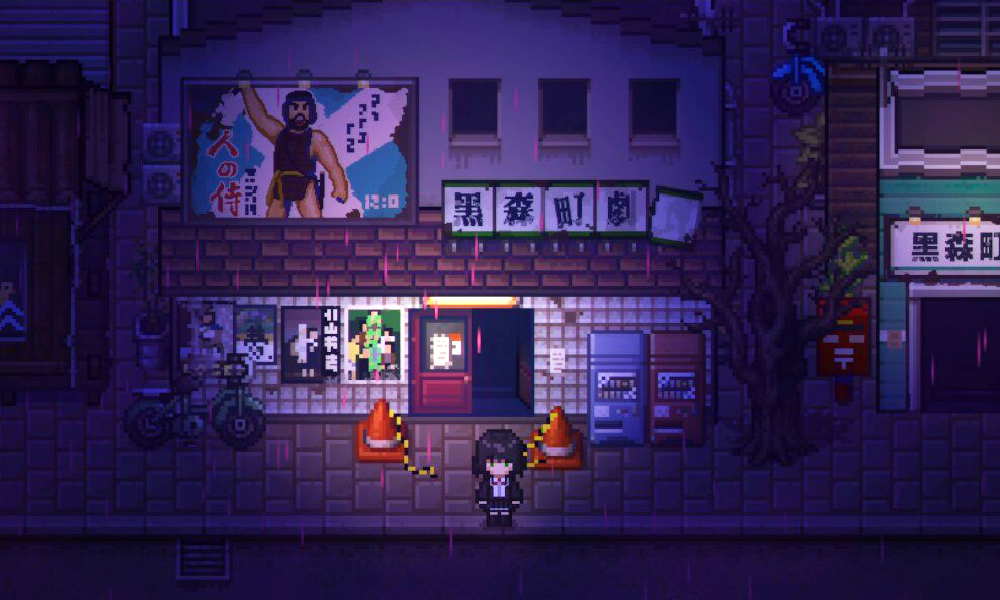
Alongside its whimsy and beauty, however, Tales of the Black Forest contains serious and sometimes graphically violent scenarios with disturbing themes and imagery. The overall tone of the game’s story emphasizes character drama more than horror, but the gruesome and upsetting elements are still there. You’ll be talking to adorable cats in the beautiful green yard of a forest café, and fifteen minutes later you’ll be watching a young woman beaten to death by a deranged cultist.

This mix of wholesome and horror worked for me, but both tonal aspects of the story are equally prominent. Accordingly, I wouldn’t recommend Black Forest to anyone who can’t sit through the creepier moments of The Ring, nor would I recommend it to anyone who can’t tolerate the more sentimental moments of My Neighbor Totoro.

Tales of the Black Forest was made by a Chinese studio in an obvious homage to Japanese popular culture, and its story occasionally feels like an attempt to filter a lecture from an “Introduction to Contemporary Japanese Society” university course through the medium of fiction. I personally found the references to Japanese social problems of the 1990s to be interesting and well-intentioned, but I could understand that some players might find these elements of the story a bit cringe in the way that early 2000s “onigiri means rice ball desu” North American anime fandom was a bit cringe.

Tales of the Black Forest was originally written in Chinese, and the English translation feels as though it was created by someone without much experience in localization. It’s serviceable, but it can be awkward at times. I tend to think the concept of “standard English” is nonsense, and I found the translation to be charming, especially because it reminded me of how pirated anime used to have English subtitles created by people whose first language was Chinese. In keeping with the retro theme of the game, I very much appreciated this unintentional element of nostalgia.

Tales of the Black Forest isn’t perfect, but it’s a solid 7/10 game that’s elevated to an 8/10 by virtue of the love and care that the two-person development team put into every aspect of its creation. This game caters to Japanese pop culture nerds who are fans of both cute anime characters and creepy urban legends, and I’m surprised it hasn’t attracted more attention since it was released on Steam in 2019. Tales of the Black Forest is a small but shining hidden treasure.

Neko Can Dream Review on Sidequest

I’m excited to have published a review of the indie narrative adventure game Neko Can Dream on Sidequest. Neko Can Dream was created by the Japanese yuri manga artist Nekobungi Sumire, who captures a complex and beautiful world inside the simple Game Boy graphics.

Here’s an excerpt from my review:

Neko Can Dream will take most players about two and a half hours to finish. Even though the narrative tone is gentle, the pace is quite brisk, and the excellent game design ensures that the player never becomes lost or confused. Certain elements of the individual character stories will resonate strongly with players interested in themes relating to queer identity; however, at its core, Neko Can Dream is about how the dream worlds of video games can help people at all stages of life recover from trauma and reach out for connection.

If you’re interested, you can read the full review on Sidequest here:
https://sidequest.zone/2024/05/27/neko-can-dream-bittersweet-nostalgic-treat/

Usurper Ghoul

Usurper Ghoul
https://evandahm.itch.io/usurper-ghoul

Usurper Ghoul is a nonviolent Game Boy adventure game that channels the “ruined kingdom” vibe of Dark Souls. I tend to think that Dark Souls is marred by needless difficulty; and, in the same way, the gameplay elements of Usurper Ghoul are needlessly frustrating. The nonlinear exploration-based gameplay of Usurper Ghoul is on brand for a Soulslike Game Boy game, but it’s not for everyone. Like Dark Souls, Usurper Ghoul becomes more interesting the more you engage with it, but the beginning is rough.

You play as a horned, skull-headed demon who wakes in a garden in the hills overlooking a small village, which in turn overlooks a valley of tombs. In true Dark Souls fashion, no one tells you where to go or what you need to do, and it’s possible to spend a lot of time walking around without getting anywhere. There are a few people scattered across the wilderness, but they’re not particularly helpful.

With no particular goal other than to explore the world, your job is to collect three items from three categories. Flowers allow you to interact with people, sticks allow you to interact with the environment, and rocks allow you to access more knowledge about the world. One stick allows you to unlock doors, for example, while another stick allows you to read written text. The catch is that you can only hold one of each type of item at a time.

The necessity of discarding one item in order to use another fits the broader theme of the game, which is that something must be sacrificed in order for something else to be gained. Unfortunately, switching between items involves a great deal of needless backtracking. The world of Usurper Ghoul isn’t that big, and the game isn’t overly complicated, but it’s big and complicated enough for the backtracking to be annoying. There are no puzzles involved; it’s just donkey work.

One might say that Dark Souls involves needless complications and barriers to progress, but one of the primary attractions of Dark Souls is that it’s gorgeous to look at. You might be continually frustrated over the course of your journey through Lordran, but you tolerate the setbacks because the environment is so beautiful and atmospheric. The world design of Usurper Ghoul is unique and interesting, to be sure, but it’s still rendered with primitive Game Boy graphics. There’s no background music, and the sound design is limited to jarring beeps at odd moments. In other words, it’s not necessarily a pleasure to trek back and forth across the map to switch out one tool for another.

The overall story of Usurper Ghoul is intriguing, but the writing is hit or miss. Most NPCs say decontextualized NPC banalities, and the lore encountered in books and on monuments often feels like a parody of Dark Souls. Although this is never explained, your goal is to enter a tower; and, to do so, you have to collect enough lore to figure out the right order to light torches in front of the tombs in the valley. You need different sticks to unlock gates, to read the writing on the tombs, and to light their torches, so this is a tedious process even if you (like me) lose patience with the game’s obtuse writing and resort to a walkthrough to figure out the order.

Having discussed what’s frustrating about Usurper Ghoul, I now want to explain why I enjoyed it anyway. The next paragraph contains mild gameplay spoilers, but it’s also the coolest part of the game.

For your own nefarious purposes, you can offer three varieties of flowers to NPCs. Comely flowers make people like you, malodorous flowers make people dislike you, and horrid flowers will kill anyone who touches them (except you). In one of the game’s endings, you can climb the tower in the valley and simply leave the kingdom behind without hurting anyone. If you want to experience everything Usurper King has to offer, however, your goal becomes to kill as many NPCs as possible while managing the limitations imposed by each death. Each NPC you kill with a horrid flower leaves a book in the tower whose text emphasizes the theme of sacrifice. For me, this was when the story became worth the trouble of navigating the world.

I found the endgame of Usurper Ghoul to be extremely compelling. And really, despite the initial annoyances, the ideas informing Usurper Ghoul are brilliant. I feel that the success of the execution is limited by the Game Boy technology, and I’d like to give the developer a nice chunk of cash to hire collaborators and develop these ideas into a less bare-bones format, perhaps along the lines of Tunic. Usurper Ghoul is a fascinating proof of concept; and, with a bit of polish, I could easily imagine it becoming a cult classic.

For me, the payoff of Usurper Ghoul was worth the frustration of the gameplay and the occasional Dark Fantasy Generator™ writing, but your mileage may vary. There’s a lot to explore and experiment with in the world of the game, and it’s definitely possible to spend several hours there. I lost patience toward the middle and used (this walkthrough on Reddit) to smooth over some of the rougher bits, and I ended up spending a bit more than two hours with the game. If nothing else, I’m really looking forward to checking out the developer’s comic projects in the near future.

NextDoor

NextDoor
https://broelbrak.itch.io/nextdoor

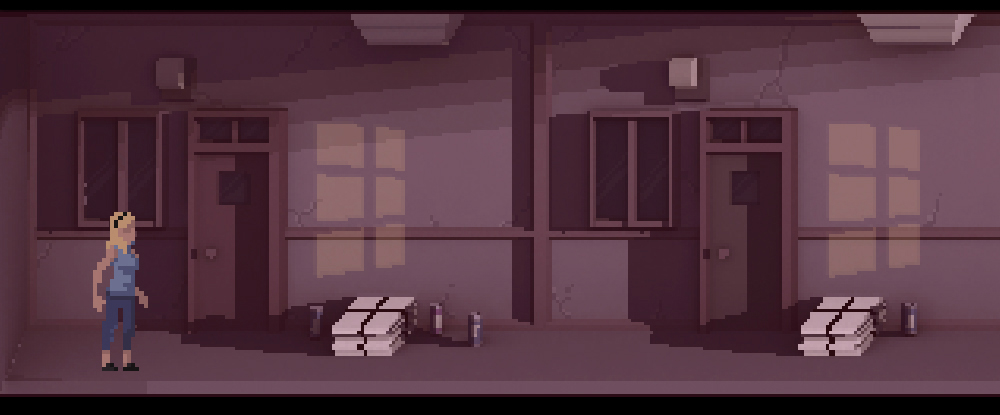
NextDoor is a spooky 2D interactive story game based on one of Junji Itō’s short horror manga. It’s free to download or play in your browser, and it takes about ten to fifteen minutes to read.

You play as a college student living in a rundown apartment building. The student is unable to concentrate because of the loud music blaring in the apartment above hers, so she finally snaps and goes to complain. The upstairs tenant is an asshole who refuses to turn down his stereo because his next-door neighbor has never said a word to him about the noise. If you can convince his neighbor to complain, the manchild gripes, perhaps he might listen to what you have to say.

The problem is that the next-door neighbors are decidedly unfriendly. Another tenant in the building says that there’s actually a group of women in that apartment, but they’re very quiet, and no one has ever spoken with them. Perhaps it’s not the best idea to attract their attention…

Despite its limited scope, the environment design of NextDoor is nicely done and more than sufficiently creepy. Ironically, the music is quite good, and the sound design is better. The character animations are a pleasure to watch, especially when the player gets to see more of the mysterious next-door neighbor.

“The Lady Next Door” is from Junji Itō’s collection Mimi’s Tales of Terror, and it’s a fun play on a category of Japanese urban legends that take the form of “here’s some weird shit I saw in a Shōwa-era (built before the 1990s) apartment building.” Itō transforms the tropes of these non sequitur “weird shit I saw” stories into a cautionary tale, and it’s delightfully cathartic to witness the unnecessarily harsh punishment of the transgressor. Because seriously, fuck that guy.

NextDoor’s adaptation of this manga is interesting in that it configures the college student as the transgressor. By association, you the player are the transgressor as well, and it’s fun to push the college student forward into increasingly bad decisions. She doesn’t die, but she most definitely sees some weird shit.

There’s one (very mild) jumpscare in the game, and it’s a cameo from my favorite Junji Itō manga, Junji Ito’s Cat Diary: Yon & Mu. Yon & Mu is exactly what you would expect from a cute autobio pet manga drawn by Junji Itō, and it’s marvelous. It’s always a pleasure to have an unexpected encounter with one of these adorable hellbeasts.

Last Train Home

Last Train Home
https://hby.itch.io/last-train-home

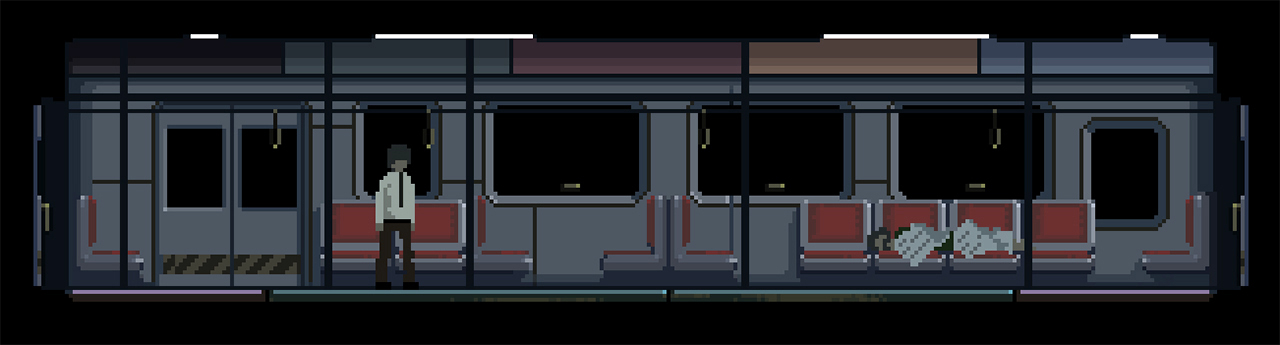
Last Train Home is a short and spooky creepypasta story game. It’s free to play in your browser, and it takes about five minutes to complete. You play as a salaryman who finds himself on a near-deserted commuter train in the dead of night.

The first half of the game is set in three train cars and the two walkways between them, each of which is occupied. With the doors at either end locked, you move between the three cars and talk with their occupants, befriending them by completing small tasks.

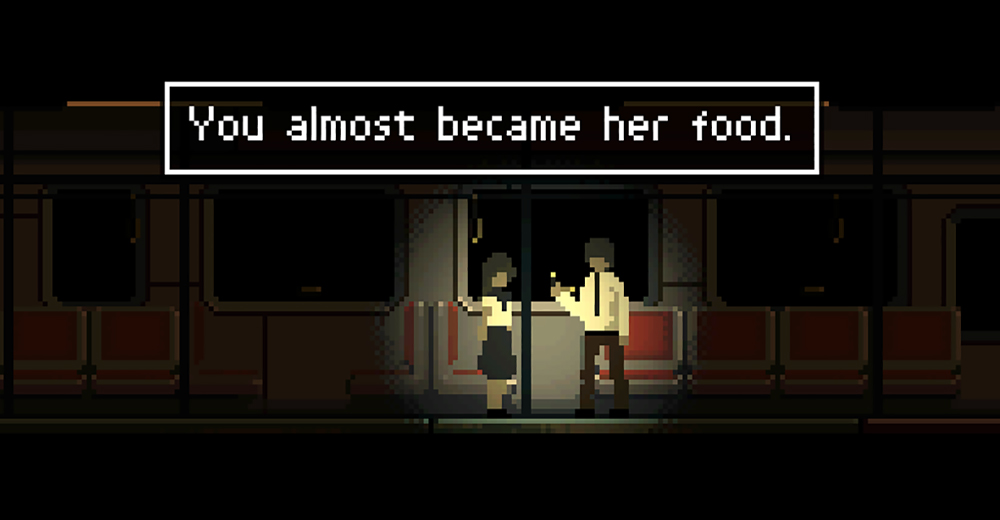
This is all well and good until the lights go off, at which point you’re left to fend for yourself in the darkness with nothing more than a cigarette lighter and the eerie flashes from outside the windows to illuminate your path forward. Where is this train going, and how do you get off?

Just as the United States is home to countless urban legends surrounding cars, from vanishing hitchhikers to cursed highway rest areas, there are all sorts of urban legends about commuter trains in Japan and South Korea. “The last train” is a common motif in cautionary tales warning midnight passengers against accidentally boarding the wrong train or even, heaven forbid, falling asleep and missing your stop as the train continues hurtling into the night.

In contrast to the pristine coziness of trains in East Asia, there’s a New York style grunginess to the cars in Last Train Home that renders the environment unsettling and uncanny. The lighting and sound design are nicely creepy as well. There’s not a lot of text, but each line manages to be subtly unpleasant. There are no jumpscares, just a pervasive atmosphere of creeping dread. The catharsis at the end of the story is lovely, but you’ll definitely have second thoughts about running to catch the last train after playing this game. 

A Zelda Game Starring Princess Zelda

When the first trailer for Tears of the Kingdom was posted in June 2019, fans were excited about Princess Zelda’s new cropped haircut. Perhaps this meant she would be a playable character, people speculated, as it meant that no weapons or armor would have to clip through her hair. In November 2020, Zelda was indeed one of the main playable characters in Age of Calamity. Although it’s great fun to use Zelda’s magical light blasts to part seas of swarming enemies, it was also somewhat disappointing that the gameplay of Age of Calamity positioned Zelda as just another fighter, while Zelda was largely absent from the gameplay of Tears of the Kingdom.

No one can deny that Zelda is an important character in the games that bear her name, but it’s a shame to see her sidelined. My frustration with Tears of the Kingdom made me wonder what the gameplay of a title that focused on Princess Zelda might look like…

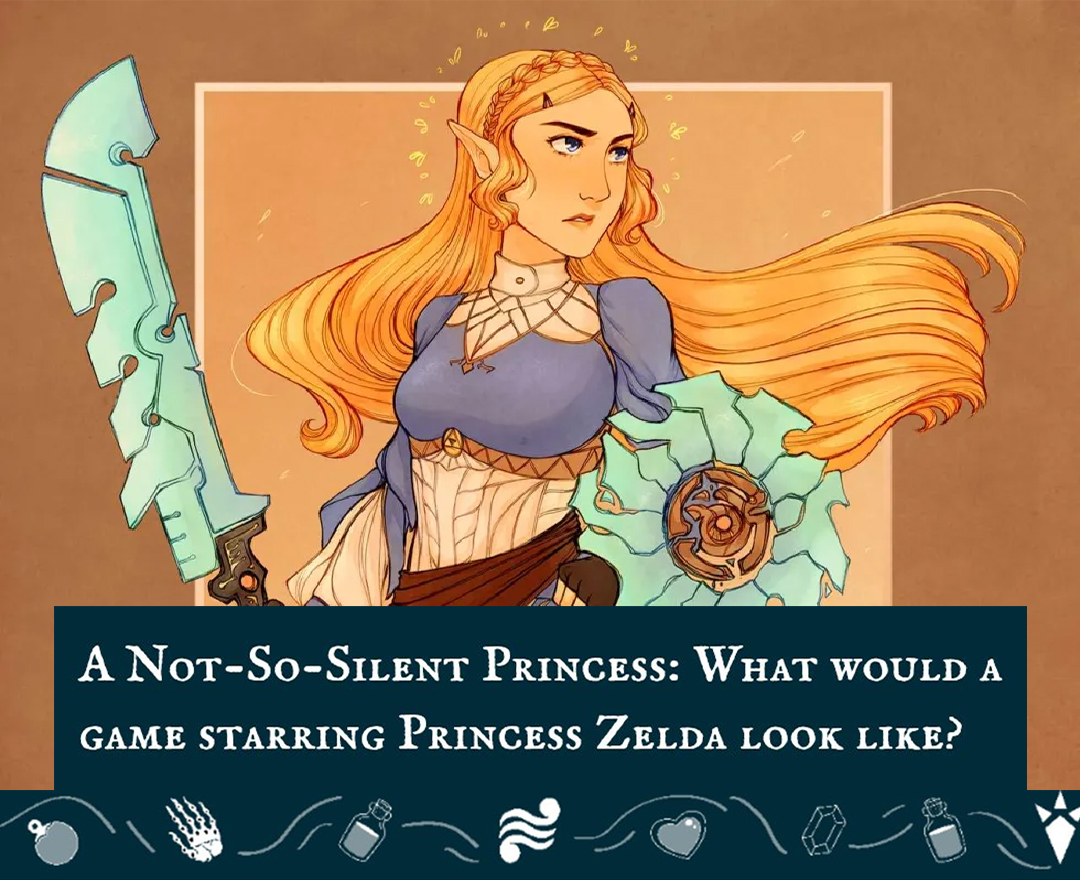
I recently had the opportunity to write a short essay for the Zelda Creators community blog based on this month’s creative prompt, “How would you design a Legend of Zelda game?” I’ve been thinking about what Princess Zelda might look like as a video game protagonist for years, and it was a lot of fun to share my ideas. I included some illustrations that I’ve commissioned over the years that envision Princess Zelda as a playable character, and the art used for the preview graphic is by the wise and powerful Benvey0 on Tumblr.

If you’d like to read the full essay, you can find it here:
https://www.zeldacreators.com/blog/a-not-so-silent-princess

A Man Outside

A Man Outside
https://litrouke.itch.io/a-man-outside

A Man Outside is a short vocabulary quiz game. This twist is that, while you play, a creepy shadow man watches you from outside your bedroom window. You’re tasked with doing three sets of ten vocab cards as spooky ambient sounds play in the background, and you can look out of the window at any time to see if the man has gotten closer. Between quiz sets, you can text a friend to update them on the situation.

I hope it doesn’t spoil this game to say that there are no jumpscares. The vocabulary gets progressively creepier, though, and there are fun distortions in the quiz interface. The vocab game itself is quite good, even without the added attraction of the creepy man. Necrophagy is my new favorite word.

Based on what I’ve seen in YouTube playthroughs, your vocab score doesn’t matter, and the choices you make in the text conversations simply add a bit of extra flavor. In order to get the true ending of the game, you have to play it from start to finish three times. There are three different vocab difficulty levels, so I suppose that adds a bit of replay value. Each run only takes about seven or eight minutes, but I don’t think the second or third ending is anything special. The alternate endings are nice bonuses for vocab flash card enthusiasts who want to try every difficulty level, but the first ending is perfect.

As an aside, as someone with ADHD, I often have to pretend that someone is watching me in order to get past executive dysfunction. I used to “have someone watch me” by going to coffee shops, but that only worked in Tokyo and Washington DC, which are beautiful and walkable and filled with cafés. Philadelphia has many charms, but it’s not that sort of city. Now, if I’m having trouble sending emails or whatever, I have to conjure an amorphous imaginary person who’s sitting in the room with me just out of eyesight like some sort of sleep paralysis demon.

So, for me, playing A Man Outside was kind of comforting. Cozy, even. Honestly, this might actually be a decent way to study vocab.

One Hell of a Maid

One Hell of a Maid
https://bun-tired.itch.io/one-hell-of-a-maid

One Hell of a Maid is a free, ten-minute RPG Maker horror game about a young man who has been dispatched on his first assignment for an at-home maid service. Unfortunately, the apartment he’s been contracted to clean belongs to a group of cultists. Using a handy set of cleaning tools, you follow the handsome maid as he cleanses the apartment of blood on the floor, eldritch horrors in the bathtub, and coffee stains on the couch.

The apartment has three rooms, and each of them has a (very) mild jumpscare. I love the monster design, and I also love the poor maid’s no-nonsense attitude regarding the horrors he encounters. This was the only job he could get, apparently, so he might as well do it. It’s unclear why he has to wear a frilly maid’s outfit, but it’s probably best not to think about that too hard. 

The ending of the game is very sweet. When the cultists finally come home, they are adorable. The gameplay in One Hell of a Maid is minimal, but the art and writing do a lot of heavy lifting. Just like the maid himself, bless his heart.

One Hell of a Maid is not for everyone, but…

Actually who am I kidding. The appeal of this game is universal. What a fun and tasty snack.

An Elegy of Earth and Sky

An Elegy of Earth and Sky
https://archiveofourown.org/works/55003288

Long ago, in a time now lost to the ages, Hyrule was a formless void roiling with primal darkness. Seeing potential in this untapped energy, three goddesses descended from the source of light to shape Hyrule according to their will. They bestowed three sacred virtues upon their daughter before leaving her in the land they created, where the god of the earth waited to grant her a gift of his own.

I’ve been intrigued by the mythology of the Legend of Zelda games since I first read the fantastically illustrated story of Hyrule’s creation in the game manual for A Link to the Past, and I’ve enjoyed how games like Ocarina of Time and Skyward Sword have expanded on the divine cosmology of the series. I was frustrated by the lack of any foundational mythology in Tears of the Kingdom, so I decided to write my own version of Hyrule’s origin story. The first half is based on Hesiod’s Theogony, while the second half borrows from one of the stories about Izanami and Izanagi in the Kojiki. Hopefully this short story reflects the poetry of its inspirations!

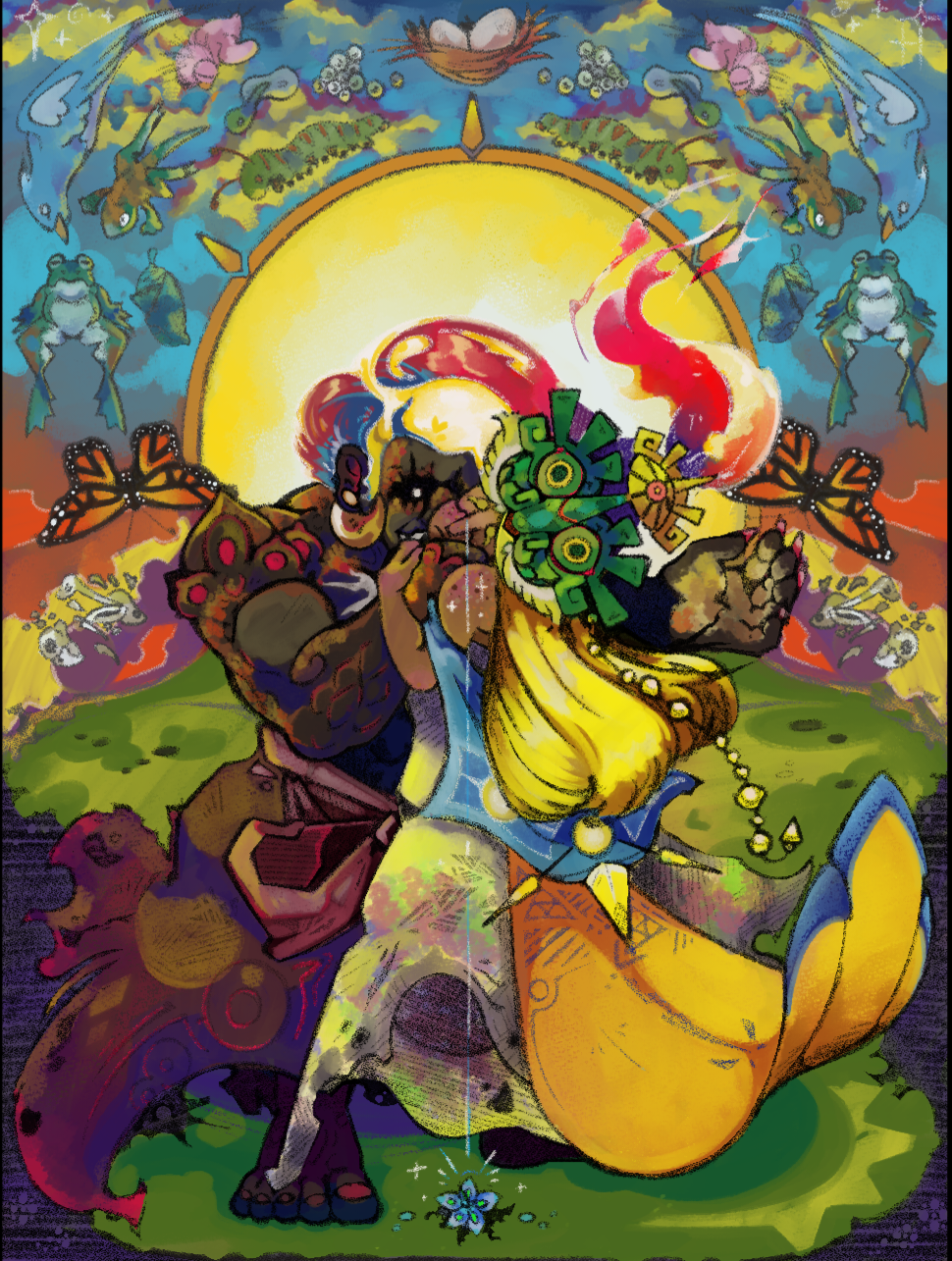
The illustration that accompanies this story was created by Hylias_Disgrace, a purveyor of the strange and divine whose gorgeous character art and intriguing comics can be found on Instagram (here). It was the artist’s decision to use the famous Gustav Klimt painting The Kiss as a way to bring out the parallels between Hyrule’s deities and the myth of Hades and Persephone, and I love how this dynamic illustration celebrates the cycles of the natural world.

Ender Magnolia Early Access Review

This past weekend, I played an early access version of the dark fantasy 2D action-adventure game Ender Magnolia: Bloom in the Mist, which includes about three and a half hours of content. So far, I really like what I see.

Ender Magnolia is a sequel to Ender Lilies, a Soulslike Metroidvania published by the Japanese developer Binary Haze Interactive in January 2021. In Ender Lilies, you play as a young girl named Lily who wakes up alone in a ruined kingdom built on the edge of a much older kingdom. The blight that plagued the kingdom of the Ancients spread to Lily’s kingdom untold decades ago. As the last of a line of priestesses, Lily’s job is to purify those affected by the blight by laying them to rest. Since Lily is defenseless on her own, she’s aided by the spirits of the blighted whom she’s purified. Each boss and miniboss the player defeats contributes to Lily’s moveset, which is completely customizable.  

Although this isn’t 100% confirmed in the early access version, there’s strong evidence to suggest that Ender Magnolia is a prequel that takes place during the last days of the kingdom of the Ancients. This kingdom has clearly fallen on hard times, but it still boasts a sophisticated fusion of magic and technology that led to the creation of artificial lifeforms called homunculi. Homunculi are able to resist the influence of a magical blight rising from underground, but only to a limited extent.

You play as a young girl named Lilac who is an Attuner, a title that designates someone who possesses the magic necessary to repair homunculi and purge the influence of the blight. Where Lily purified decaying zombies in Ender Lilies, Lilac attunes renegade humanoid robots. While Lily’s purification allowed the blighted to rest by allowing them to die, Lilac’s attunement helps homunculi regain their sanity.

Since they’re still alive after attunement, the defeated robots don’t automatically join Lilac as companions. If I had to guess, I’d say that the relatively limited number of Lilac’s companions in Ender Magnolia is probably Binary Haze’s response to a common criticism of Ender Lilies, namely, that there were too many companion spirits and not enough upgrade resources to experiment or use them all effectively. Thankfully, this excess of choice doesn’t seem to be an issue in Ender Magnolia, in which Lilac’s attacks are still fully customizable but much more focused on a core moveset.

None of the minibosses join Lilac, but they’re still fun to fight, as are the challenging area bosses. Whereas there were major spikes in difficulty in Ender Lilies, Ender Magnolia seems to be more balanced and linear in terms of challenge. According to the developer notes on Steam, the full version of the game will allow the player to customize the difficulty, but the standard setting worked just fine for me. I still died a lot (affectionate) and was grateful for every character stat upgrade.

In Ender Lilies, Lily was the only living person in the entire kingdom, so she didn’t have any need for money. This is not the case in Ender Magnolia, which has a central village hosting a small shop where Lilac can buy bracelets that boost her defense and other upgrades. Money isn’t directly received from defeating enemies, but must be found in the environment or offered as a reward.

The game’s economy is supported by numerous NPCs who can be found in the central hub, as well as scattered across the map.  Some of these NPCs are human, and some are homunculi, and some seem to be visitors from the “upper stratum” of the city, like Lilac herself. The player can still find scraps of text with background lore hidden in the environment, but there are also living people directly sharing their experiences. Some of this text is relevant to Lilac, but I appreciate that most of it isn’t. As in Ender Lilies, Ender Magnolia contains a lot of smaller stories that have very little to do with the player. This world is in decline, but the player gets a sense that there’s still something for Lilac to save. She’s a very sweet girl, as is her main companion Nola, a stern but elegant sword lesbian. I’m looking forward to all the tears I’m going to cry as their tragedy unfolds.   

Like Ender Lilies, Ender Magnolia is intensely atmospheric. The primary aesthetic of Ender Lilies was ruin and decay, while Ender Magnolia seems to be more rustpunk (or whatever you’d call what’s going on in the city of Midgar in Final Fantasy VII). There’s a beautiful city above, but you begin the game in the slums, which are filthy and decrepit. When the rusty browns of this aesthetic are interrupted, such as in an abandoned castle overgrown with brilliantly scarlet maple trees, it’s a sight to behold. The sound design and music are also marvelous. To me, the way the game designers use the beauty of the environment to inspire the player to overcome challenges is the hallmark of Soulslike games, and Ender Magnolia nails this perfectly.

I keep comparing Ender Magnolia to Ender Lilies, but it’s not necessary to be familiar with Ender Lilies to enjoy and appreciate what’s going on in Ender Magnolia. In fact, I’d say that Ender Magnolia is much more accessible to newcomers, at least based on what I’ve seen so far.

Meanwhile if you, like me, have done multiple playthroughs of Ender Lilies, Ender Magnolia still feels fresh. It’s significantly different from its predecessor in ways that are fun and interesting and not just new for the sake of change.

I’m really excited about Ender Magnolia. If nothing else, not only can you pet the big fluffy robot zombie dog, but he also serves as your method of fast travel. What a good boy!!