An Elegy of Earth and Sky

An Elegy of Earth and Sky
https://archiveofourown.org/works/55003288

Long ago, in a time now lost to the ages, Hyrule was a formless void roiling with primal darkness. Seeing potential in this untapped energy, three goddesses descended from the source of light to shape Hyrule according to their will. They bestowed three sacred virtues upon their daughter before leaving her in the land they created, where the god of the earth waited to grant her a gift of his own.

I’ve been intrigued by the mythology of the Legend of Zelda games since I first read the fantastically illustrated story of Hyrule’s creation in the game manual for A Link to the Past, and I’ve enjoyed how games like Ocarina of Time and Skyward Sword have expanded on the divine cosmology of the series. I was frustrated by the lack of any foundational mythology in Tears of the Kingdom, so I decided to write my own version of Hyrule’s origin story. The first half is based on Hesiod’s Theogony, while the second half borrows from one of the stories about Izanami and Izanagi in the Kojiki. Hopefully this short story reflects the poetry of its inspirations!

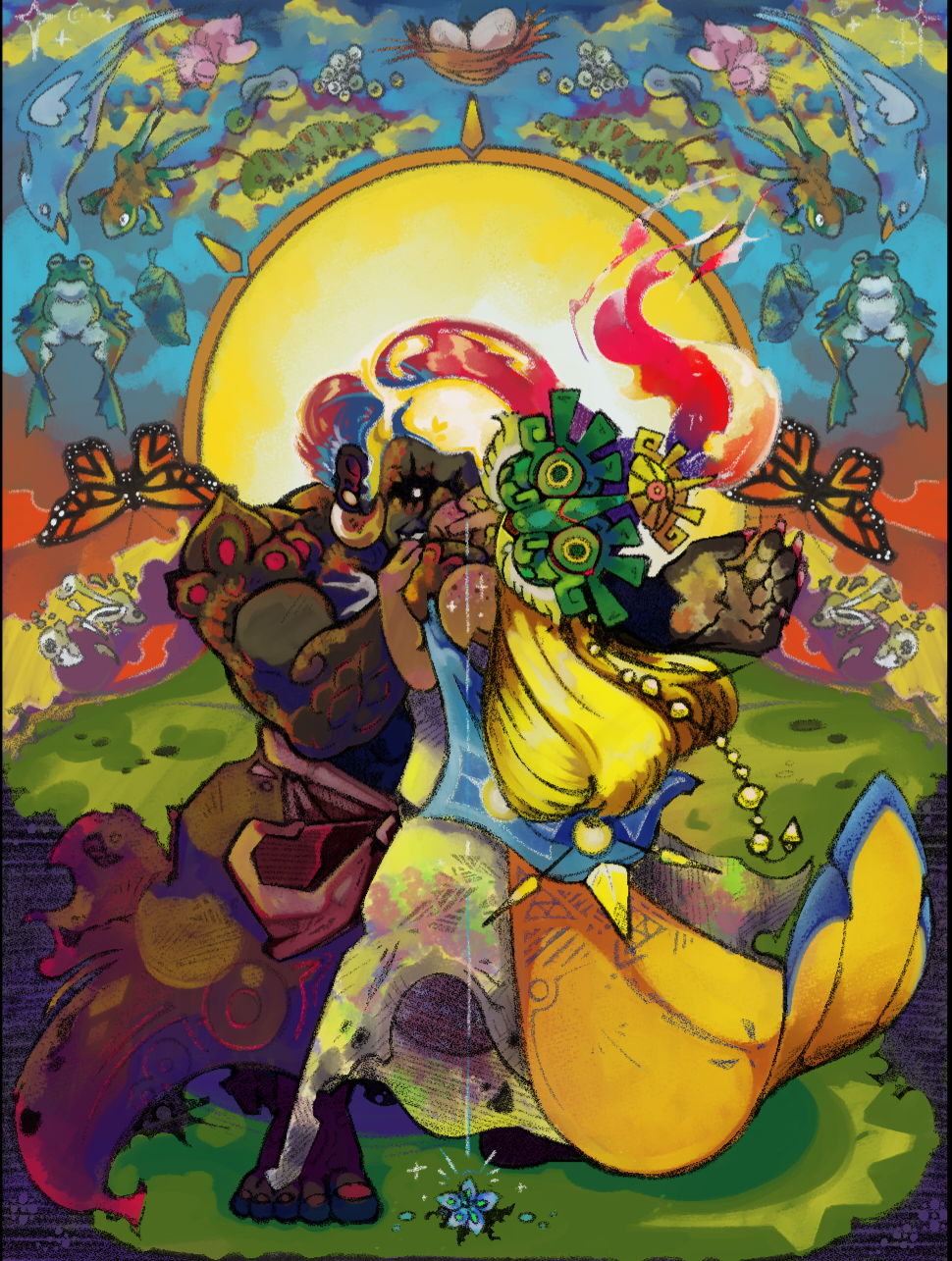
The illustration that accompanies this story was created by Hylias_Disgrace, a purveyor of the strange and divine whose gorgeous character art and intriguing comics can be found on Instagram (here). It was the artist’s decision to use the famous Gustav Klimt painting The Kiss as a way to bring out the parallels between Hyrule’s deities and the myth of Hades and Persephone, and I love how this dynamic illustration celebrates the cycles of the natural world.

Why You Will Always Write Better Than ChatGPT

Let me begin with an admission: I’ve experimented with machine-generated art. No matter the AI model, I find computer-generated images to be aesthetically unappealing, but there’s something charming about their jankiness. Sometimes it’s necessary to post a low-resolution jpeg of the Power Rangers sharing a pizza with Godzilla to the group chat, and it’s best that no actual human artist is harmed in the creation of this image.

Still, I was uninterested in ChatGPT, which seemed less like an amusing toy and more like an annoying tool used by content creators to manufacture endless pages of trash for search engine optimization. My casual dismissal of ChatGPT was challenged when I started to notice a distinctive writing style crop up in undergraduate student papers in early 2023. Later that summer, I began to see the same style appearing on AO3 – and even in professionally published writing. When I finally bit the bullet and signed up for ChatGPT myself, there was the exact same writing style, ready and waiting to produce anything I wanted. I hated it immediately.

At the end of this post, I’ll provide a small selection of essays written by experts about the myriad problems surrounding computer-generated art and writing. Before that, I’d like to offer my own analysis of the “style” of text produced by ChatGPT in order to support an argument for why our human writing will always be better.

(1) Stylistic uniformity

ChatGPT produces sentences of uniform length and structure, which it uses to build paragraphs of similarly uniform length and structure. Sentences always follow a “Clause 1 + Conjunction + Clause 2” pattern and contain a roughly equal number of words. Without exception, paragraphs either have three or five sentences, and the words in the final sentence of the paragraph will mirror the words of the first sentence. This visual uniformity produces a smoothness that makes writing produced by ChatGPT easy to skim. While it’s easy to run your eyes over frictionless paragraphs, however, the lack of texture makes it difficult to find a foothold.

(2) By-the-book formulaic structure

Whether writing fiction or nonfiction, ChatGPT will use the same organizational structure to present information. It relies on a set pattern of transition words and expressions to map this structure, and it always concludes with a moral or take-away point. In all fairness, this is how students are taught to write in English and Rhetoric classes. The clarity of this style must be taught and enforced because its precision doesn’t follow natural human thought patterns, which tend to meander as a writer draws from personal experience and cultural context. A dry organizational precision may be suitable for textbooks and instruction manuals, but this type of writing is infamously boring to read.

(3) Inability to surprise the reader

ChatGPT cannot lie. Granted, it’s prone to hallucinate. It invents citations, misuses specialist terminology, and doesn’t understand basic math. Still, it can’t deliberately create doubt or uncertainty for artistic effect. Moreover, as it can’t acknowledge its past mistakes or correct its assumptions, it can’t create multilayered arguments. The same lack of depth is characteristic of the fictional characters it generates. It’s precisely this lack of a flawed perspective that makes ChatGPT uninteresting and unable to provoke surprise or reflection in the reader.

(4) Lack of a distinct voice

When ChatGPT writes nonfiction, it has no sense of a target audience, so it can’t regulate its tone. Various commenters on social media have pointed out that ChatGPT reads remarkably like mansplaining, a type of address that comes off as condescending because it refuses to acknowledge the pre-existing knowledge of the reader. When it comes to fiction, ChatGPT can’t create distinct character voices, which results in generic characterizations. This inability to understand tone, culture, and context can be downright offensive when ChatGPT is used to mimic a voice grounded in a specific time, place, or identity.

(5) Failure to achieve insight

Even in the most utilitarian nonfiction writing, the process of putting words on the page with your own hands is important. This process generates a distinct mental space, and the physical act of typing enables the time necessary to analyze information properly. As you write, you make connections with your life and past experiences that create insight, and these connections create a sense of depth and meaning. Without a specificity of voice or the serendipity of insightful connections, ChatGPT has nothing to draw on save for a database of clichés.

Many professional writers spend their lives working to achieve a smooth and frictionless style, but every human has stylistic quirks, including favorite words and preferences regarding punctuation. ChatGPT has no texture or individuality at all. It’s this lack of a distinct voice (especially when combined with stylistic uniformity) that alerts me to the use of ChatGPT in student work. One might argue that a tonal flatness is the defining characteristic of ChatGPT’s “voice,” and I would agree. Even if you’re not trained in linguistic or literary analysis, ChatGPT’s generic style of writing is distressingly easy to identify simply because of how boring it is.

Instead of being a pleasure to read, the writing generated by large language models feels like the worst sort of homework. Whether you specialize in fiction or nonfiction, this is why you will always write better than ChatGPT.

If you’re interested in pursuing this topic in a broader cultural context, please allow me to recommend six recent essays written by fellow humans.

Confessions of a Viral AI Writer, by Vauhini Vara
https://www.wired.com/story/confessions-viral-ai-writer-chatgpt

AI Art & the Ethical Concerns of Artists, by Vicki Fox
https://beautifulbizarre.net/2023/03/11/ai-art-ethical-concerns-of-artists/

My A.I. Writing Robot, by Kyle Chayka
https://www.newyorker.com/culture/infinite-scroll/my-ai-writing-robot

AI-generated art raises tricky questions about ethics, copyright, and security, by Melissa Heikkilä
https://www.technologyreview.com/2022/09/20/1059792/the-algorithm-ai-generated-art-raises-tricky-questions-about-ethics-copyright-and-security

How Hollywood writers triumphed over AI, by Dani Anguiano and Lois Beckett
https://www.theguardian.com/culture/2023/oct/01/hollywood-writers-strike-artificial-intelligence

The strange world of high-speed semi-automated genre fiction, by Josh Dzieza
https://www.theverge.com/c/23194235/ai-fiction-writing-amazon-kindle-sudowrite-jasper

. . . . .

This essay was originally published on the blog of the Get Your Words Out writing community on Dreamwidth (here). You can learn more about the community on their website (here), and membership opens every December. The moderators share writing encouragement and advice on the community’s public Tumblr (here) and on Bluesky (here).
Zelda Horror Zine Preorders Open

I’m excited to share a preview of my story for Blood Moon Rising, a Legend of Zelda horror fanzine.

I wrote about the undead princess of Zelda II, as well as the decision that Impa is forced to make in dooming the princess of the original Legend of Zelda to the same fate. The two NES Zelda games are deeply dystopian, and I enjoyed going full Dark Souls while exploring the decay of their horrifically postapocalyptic settings.

Preorders of the zine are open until March 15, and all proceeds will go to Medical Aid for Palestinians. There’s some truly frightful work in this zine, so please check out their social media if you’re interested!

🩸 https://bloodmoonzine.carrd.co
🩸 https://bloodmoonzine.tumblr.com
🩸 https://twitter.com/BloodMoonZine
🩸 https://bloodmoonrising.bigcartel.com

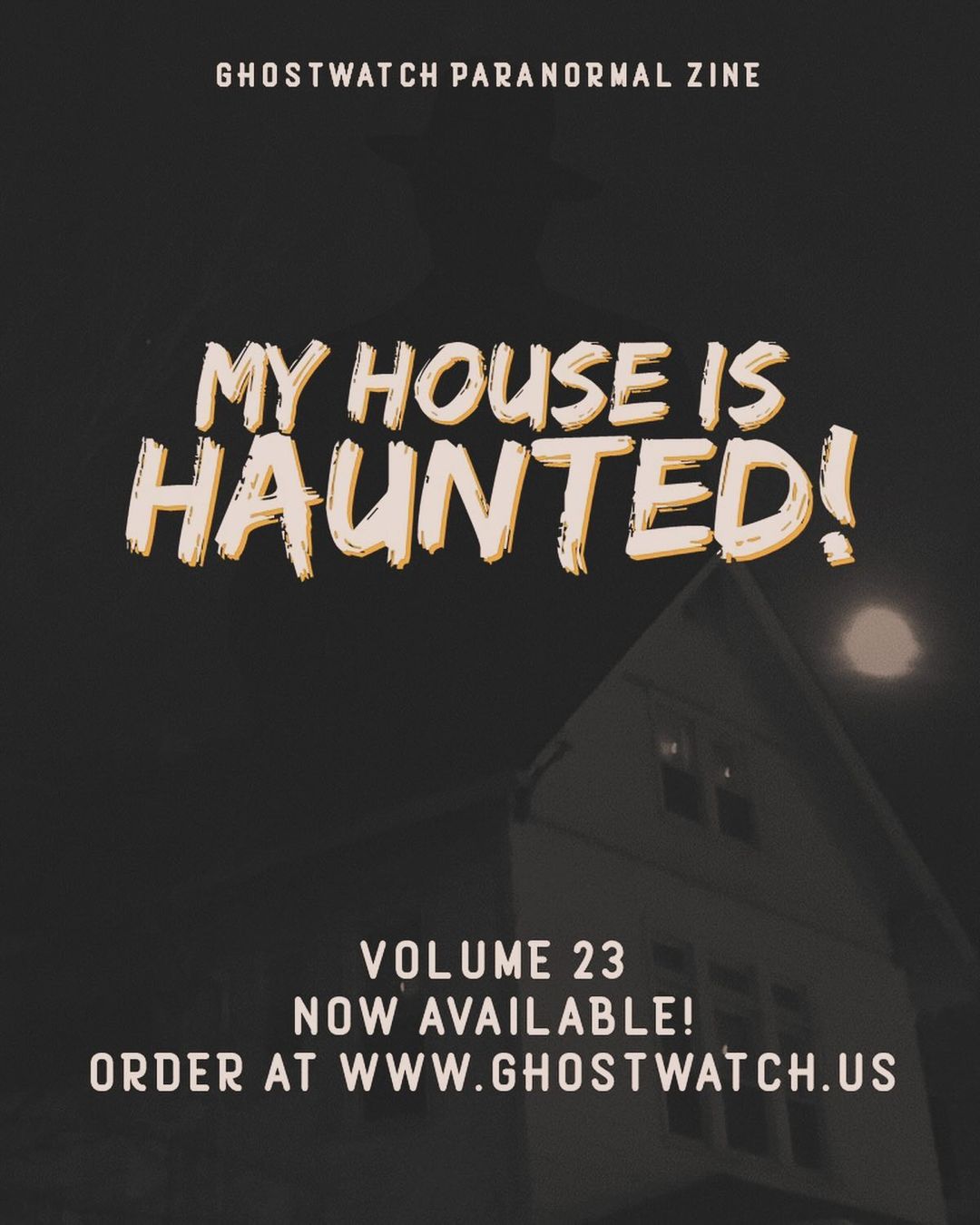
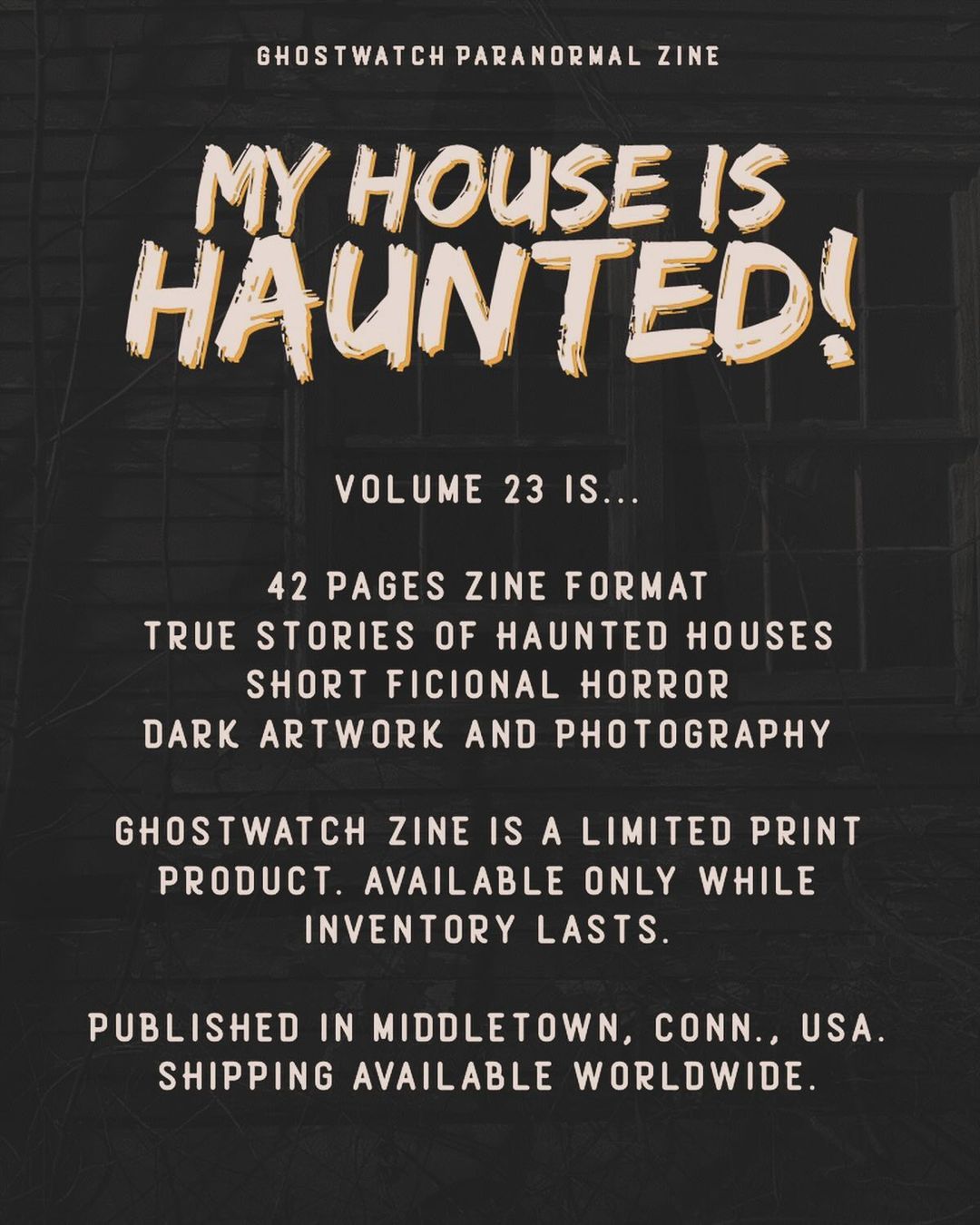
My House Is Haunted!

I’m excited to have a short story appearing in the latest issue of Ghostwatch.

My story, “The Sweet Blue House,” is based on a property I viewed while househunting in the suburbs of West Philadelphia. There’s nothing paranormal about what I saw, but some houses don’t need ghosts to be haunted.

Ghostwatch is a really neat publication. I have zero belief in the supernatural, and what I love about Ghostwatch is how it collects odd and interesting bits of folklore and documents local and regional cultures in the United States while maintaining a supremely chill attitude. The zine’s account on Instagram is a lot of fun too.

If you’re interested, you can order the “My House Is Haunted” issue here:
https://www.ghostwatch.us/product/vol-23-my-house-is-haunted

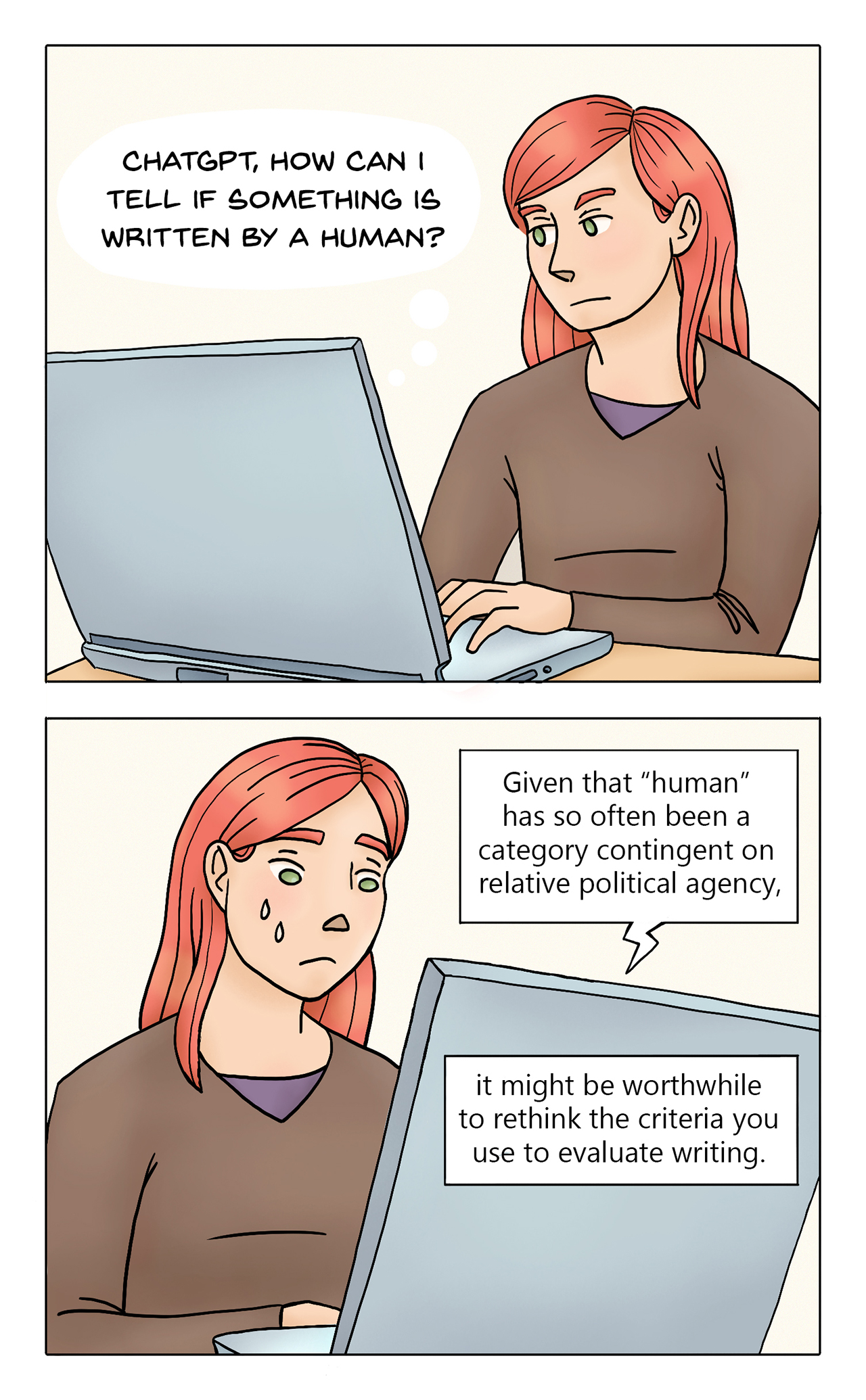
This Year’s Adventures in AI Ethics

Out of curiosity, I started experimenting with ChatGPT this semester. There’s not much to say about it, save that it generates stale and flavorless writing that’s easy to recognize once you know what it looks like.

Unfortunately, now that I can recognize text generated by ChatGPT, it’s hard not to see it. It’s also hard not to get my feelings hurt when my students submit work written by ChatGPT. Why would they do me dirty like that?

So I’m not saying that I like ChatGPT. I actually kind of hate it.

Still, the potential for this sort of writing engine is incredible. What if it could work not just as an actually functional grammar checker, but also as a translator between different ways of self-expression? Wouldn’t it be interesting if the model could be developed to “translate” an outline or quickly written sketch of an idea into a piece of writing that was more easily understandable by a broader audience? Wouldn’t it be nice if people who felt embarrassed or otherwise unable to express themselves had a means of putting their thoughts on paper?

I understand how unrealistic it is to think that ChatGPT won’t be abused by bad-faith actors, and I also understand that there’s no point of people in marginalized positions having a voice if the venues where they could be heard are shut down due to AI-generated content spamming. At the same time, I think it’s probably healthy to keep an open mind and be as inclusive as possible when defining who (and what) counts as “human.”

The Memory of Stone

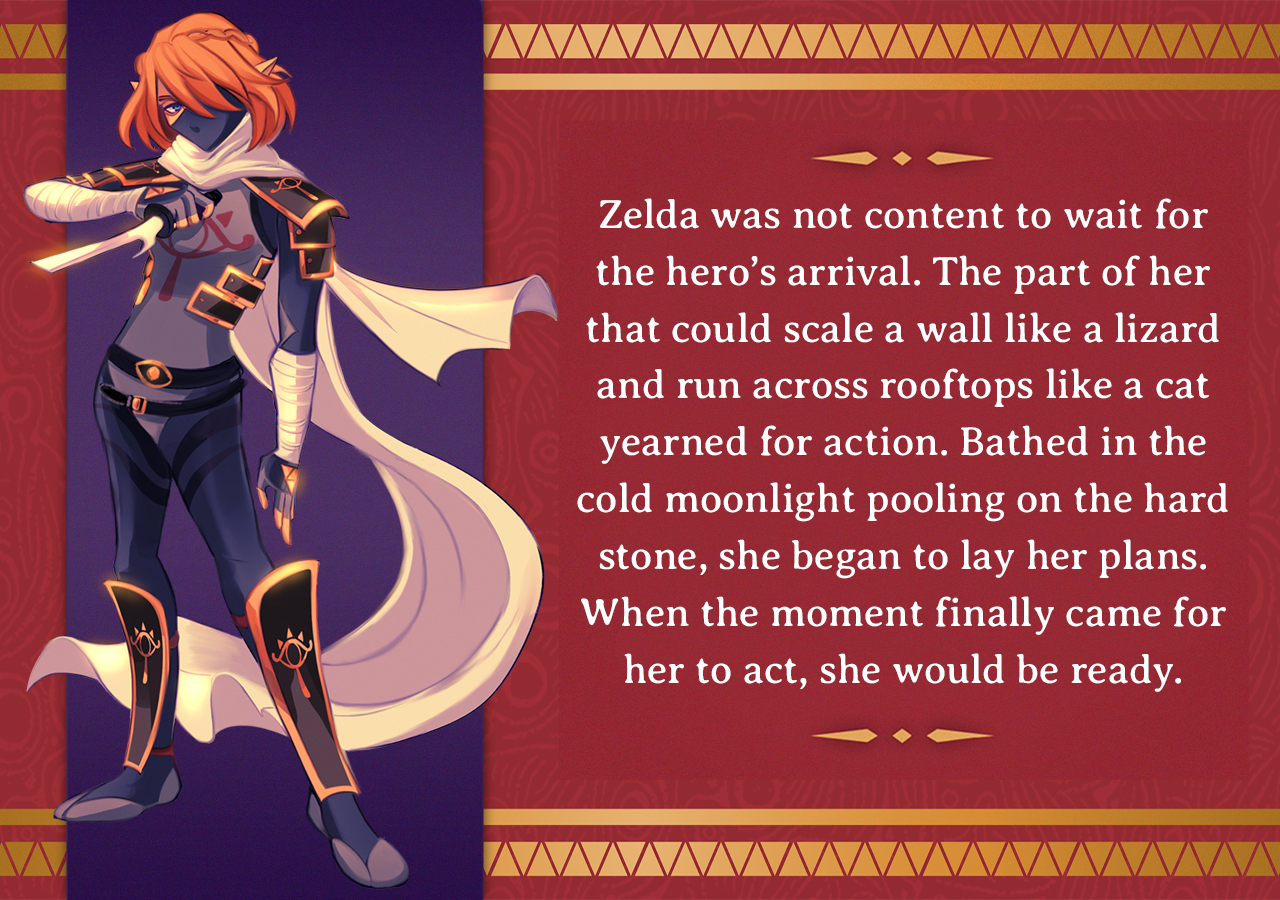
I wrote “The Memory of Stone” back in 2020, when the announcement of a sequel to Breath of the Wild encouraged many Legend of Zelda fans to speculate that the game would feature Princess Zelda as a playable character. I returned to this story after finishing my second playthrough of Tears of the Kingdom, which reduces Zelda to a voiceless source of crafting materials. It was a disappointment, to say the least.

One might argue that there are other games with female protagonists, so why insist on playing as Zelda? I would counter this argument with another question: why not play as Zelda? The concept of Zelda as a playable character makes perfect sense within the context of the games’ stories. Link’s journey almost always runs parallel to a journey that Zelda undertakes on her own, after all, and being able to explore Hyrule with a different set of skills (and from a different narrative perspective) would be a lot of fun.

“The Memory of Stone” follows Zelda through each of the temples in Ocarina of Time, and it’s a small attempt to imagine what the eponymous “legend of Zelda” might look like through the eyes of Zelda herself.

You can read the story on AO3 here:
https://archiveofourown.org/works/25230271

The illustration of Sheik included in the story preview graphic was drawn by the revolutionary Nolvini, a fan of shōjo anime who creates magical character illustrations filled with personality and flare. You can check out her work on Twitter (here), on Instagram (here), and on Tumblr (here), and she also has a shop on Etsy (here).

Love in the Time of Gloom Spawn

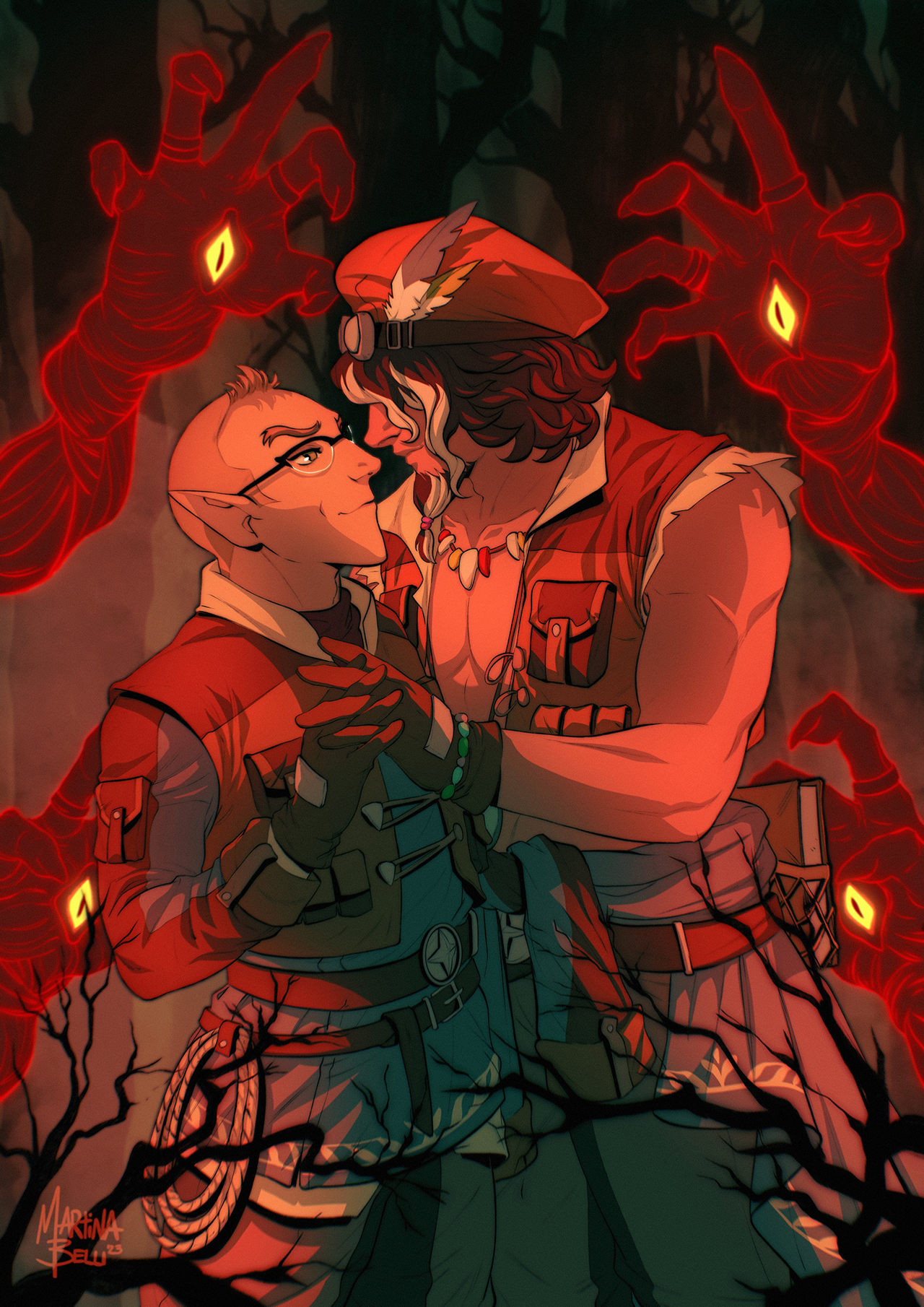
After years spent investigating the mysterious shrines of East Necula, Dr. Calip has joined the Zonai Survey Team’s efforts to study the Ring Ruins of Kakariko Village. The ancient structures are fascinating, but what has captured Calip’s attention is the chasm in the forest on the hill. While Calip has been gazing into the abyss, however, the leader of the Zonai Survey Team has been gazing at him.

As I grow more impatient with grand narratives of nation-building and heroic destiny, I’ve become more interested in how epic fantasy universes appear to normal people. Hyrule is especially fascinating as a case study, as the privileges enjoyed by Link clearly aren’t applicable to everyone else. This is especially true of the knowledge Link accumulates over his journey, during which the secrets of prior eras are revealed to him alone.

In the present postapocalyptic era of Breath of the Wild, it seems the only person trying to study and understand Hyrule is a scholar named Calip, who lives in an isolated cabin as he attempts to stage an archaeological investigation into the site of one of the ancient Sheikah shrines. As an academic, Calip is a pompous asshole. Regardless of “Dr.” Calip’s self-serving motives, I admire him as a character who investigates the world and tries to understand it instead of simply killing things and accumulating treasure.  

Perhaps because of the popularity of the fandom’s speculation and study of Hyrule, Tears of the Kingdom leans into the ethos of archaeological inquiry with the establishment of a large and diverse set of NPCs forming the Zonai Survey Team. This Sheikah-funded research organization is led by a brick house of a character named Tauro. Tauro has set himself up in Kakariko Village, which has been beset by ruins falling from sky islands and a giant pit opening in the forest on the eastern hill.

Given their interests, it’s only natural that Calip and Tauro would interact. When you read the diaries that Calip has left at his former cabin and at his desk in his office in Kakariko, you learn that Calip is undeniably attracted to Tauro, who apparently went out of his way to invite Calip to work with him. Late in the game, the two men abandon their duties to run off and do research together. I think is a sweet lowkey love story – and even Kotaku agrees, apparently!

The emphasis on archaeological excavation in Tears of the Kingdom is somewhat problematic. In essence, the kingdom of Hyrule had a state-building myth that justified its sovereignty over the surrounding regions, and the result of the archaeological study performed by state-sponsored Zonai Survey Team is the demonstration that these myths were true in the most literal sense. Yes, there are evil outsiders who will kill everyone if they get the chance; and yes, only the royal family and its servants can protect everyone; and yes, the royal family is literally descended from gods/dragons. It’s all kind of gross.

What I therefore appreciate about the implied love story between Calip and Tauro is that they turn their backs on the politics of ancient texts and leave Kakariko so that they can go out into the woods and look at ruins together. For them, curiosity about the world has nothing to do with national mythologies and everything to do with the connection they feel to the people who lived on the land before them – and the connection they have with each other.

Because I am apparently incapable of creating anything that doesn’t have monsters, however, the story I wrote about Calip and Tauro ended up being a horror story as much as it is a love story. It has a happy ending, but it also has a healthy dose of eldritch horrorterrors. Phantom Ganon also makes an appearance, because of course he does.

The story is complete at 4,000 words, and you can read it on AO3 here:
https://archiveofourown.org/works/51328888

The illustration is by the marvelously talented Martina Belli, whose magical artwork helped me bring these two characters and their story to life. Marty paints dynamic portraits of fantasy characters and dramatic science fiction scenes, and she excels at creating compositions that draw the viewer into the world of her art. It was a lot of fun to work with her, and I highly recommend following her creations on Twitter (here).

The Kumo Diary

A professor’s assistant at Tokyo Imperial University uncovers a curious manuscript whose author weaves an elegant tale of the twilight years of the Heian court. As she reads between the gossamer lines of the narrator’s account of a moonlit assignation, the quiet and unassuming scholar reflects on what happens in the shadows cast by civilization and enlightenment.

This story is a play on The Tale of Genji that I contributed to Carpe Noctem: Vampires Through the Ages, an anthology of historical fantasy fiction, illustrations, and comics about vampires in historically specific settings.

I wouldn’t say I’m a “fan” of The Tale of Genji in the same way that I’m a fan of the Legend of Zelda series, but I’ve read multiple translations of the book and enjoyed them all. When you engage with a story so deeply, it’s difficult not to come up with fun theories. I certainly wouldn’t be the first person in Japanese literary history to make this suggestion, but please consider: Why are the characters in The Tale of Genji always described as being so pale, and why are many of them only active between dusk and dawn?

“The Kumo Diary” is set in the Meiji period (1868-1912), Japan’s industrial era of “civilization and enlightenment.” As Japan attempted to establish itself as a nation that could compete with Western powers, its intelligentsia were motivated to create a unified “Japanese culture.” The Tale of Genji occupied an interesting place in this movement. On one hand, it could easily be regarded as the quintessential work of classical Japanese literature. On the other hand, its plot is largely concerned with the love affairs of a rotating cast of beautiful but neurotic women. Japanese scholars were therefore tasked with making The Tale of Genji a respectable classic to be held in esteem by a modern nation.

Scholars had been compiling and revising the chapters of The Tale of Genji for centuries, so it was necessary to create a “definitive” version of the text. While I was studying the history of The Tale of Genji, I couldn’t help but wonder about all the apocryphal chapters that never made it into the canonical text.

It took me ten years, but finally I wrote one of these apocryphal chapters myself. I embedded the so-called “Kumo Diary” into a frame story about a woman who finds the manuscript and decides not to share it with the stodgy male professor who employs her. It’s interesting to imagine there being a secret history of The Tale of Genji, and I really enjoyed writing the ending of my story. After all, who’s to say there aren’t demonic women pulling the strings from the shadows? If they do their work correctly, we’d never know they were there at all.

I’ve posted the story on AO3, and you can read it here:
https://archiveofourown.org/works/50802628

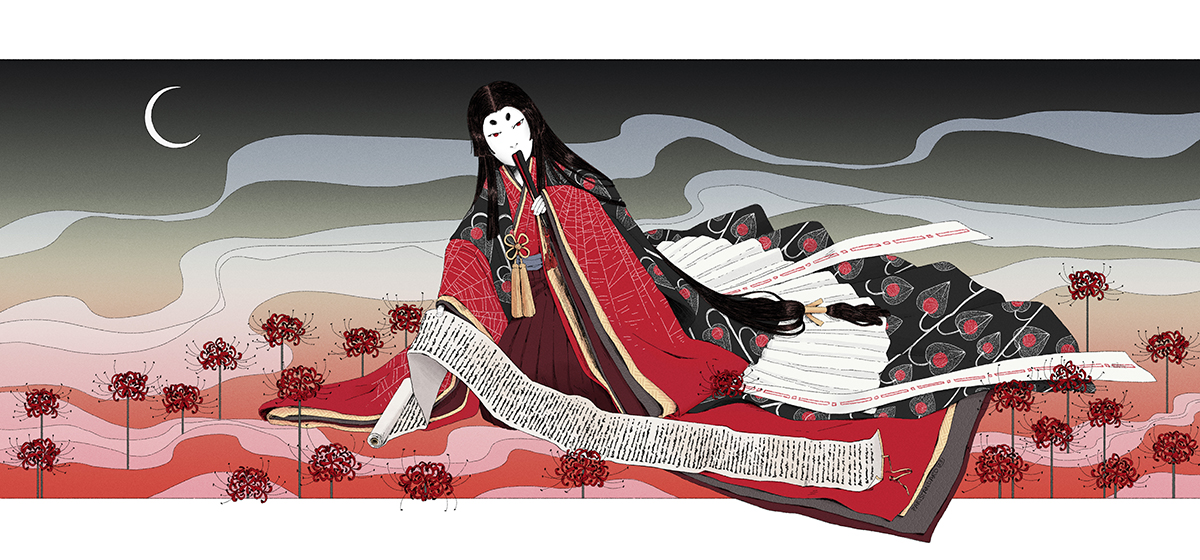
The illustration is by the darkly brilliant Paristandard, whose creepy and creative illustrations can be found (on Twitter), (on Tumblr), and (on Instagram). It was an amazing experience to work with them, and I can’t recommend them enough for character designs, book covers, short comics, and other illustration projects. For this project in particular, the historical specificity of their costume design was uncanny, and I am in awe.

A Worthy Successor

In an eerie castle submerged under cursed waters, Ganondorf tells Tetra about the world that once was. Ganondorf’s story is at its end, but his words inspire Tetra to dream of the world to come.

I recently started playing The Wind Waker in order to do research for a short essay about Koroks. The Wind Waker is a fresh and lovely game, at least at the beginning, and I always forget the emotional impact of the end. The pathos of Ganondorf’s longing for the Hyrule of the past always gets me right in the heart.

I think it’s interesting that, after The Wind Waker, Tetra goes on to establish New Hyrule, the setting of Spirit Tracks. She thereby achieves Ganondorf’s goal of restoring an ancient kingdom blessed by gentle winds. This begs the question – how would Tetra know about Hyrule? Given how much time Tetra spent with Ganondorf under the Great Sea, I think it’s safe to assume that they must have talked to one another.

This story is my attempt to envision what these conversations might have been. I wrote this story a few years ago, but I’m returning to it now because it still resonates with me. The older I get, the more I sympathize with Ganondorf, and the more willing I become to let decaying empires fall to ruin in favor of embracing the winds of change.

You can read the story here:
https://archiveofourown.org/works/35251798

The comic adaptation is by the magical Lightsintheskye, who is:
(on Twitter) + (on Tumblr) + (on Etsy)

Hyrule Fashion Anthology Preorders

Hyrule Fashion Anthology is open for preorders (here)!

Hyrule Fashion Anthology is a fanzine celebrating the complex evolution of fashion history through the characters and setting of the Legend of Zelda series. I contributed an essay titled “A Wind-Grieved Ghost” about the influence of medieval Japanese Noh theater on Ganondorf’s costume and character in The Wind Waker. I put a lot of love and research into this piece, and I may have even made myself cry.

The zine is filled with gorgeous fashion illustrations that illuminate the historical and cultural influences of the character designs in the series, as well as brilliant renditions of fan-favorite characters in a diversity of times and places. In addition to the artwork, the zine also includes articles about weaving, metalworking, and the beauty of style in all its forms.

Preorders are open until September 19!
If you’re interested, you can check out the zine through these links…

Carrd: https://hyrulefashionanthology.carrd.co
Twitter: https://twitter.com/HyruleFashion
Bigcartel: https://hyrulefashionanthology.bigcartel.com