Review of Textual Cacophony

I was honored to write a review for Pacific Affairs of Daniel Johnson’s 2023 monograph Textual Cacophony, a critical analysis of Japanese internet culture between roughly 2006 and 2014. Johnson is especially interested in the anonymous message board 2channel and the video sharing site Niconico, and my review highlights why the online subcultures associated with these sites are still relevant and worth studying. Here’s the opening paragraph:

It’s no secret that a great deal of twenty-first century media has been influenced by internet subcultures; unfortunately, much of this culture has been lost to time. Many emergent online cultures of the 2000s have proved tragically ephemeral, with the scarce documentation that exists often falling into the trappings of cultural nostalgia. Thankfully, Daniel Johnson’s Textual Cacophony: Online Video and Anonymity in Japan functions as a critical analysis that documents and preserves an important moment in Japanese media history that continues to resonate across national borders.

You can read the full review on the Pacific Affairs website here:
https://pacificaffairs.ubc.ca/book-reviews/textual-cacophony-online-video-and-anonymity-in-japan-by-daniel-johnson/

Review of Hunger’s Bite on The Beat

I’m thrilled to have published another graphic novel review on Comics Beat. I got to write about Hunger’s Bite, a work of historical fantasy set on a luxury passenger ship during the 1920s. I was pleasantly surprised by how hard the artist leans into an anti-capitalist message, and I appreciate how he 100% owns and supports this stance in his author bio. The kids are all right.

Here’s an excerpt of my review:

Hunger’s Bite is an engaging work of historical fantasy that indulges in fun steampunk tropes like plucky young heroes, cigar-smoking villains in sharp suits, and secret magical societies. At the same time, the artist handles the historical reality of the story’s 1920s setting with a critical eye and respect for its startling inequalities. Taylor Robin’s graphic novel will provide ample food for thought for more mature teens in the YA bracket, as well as readers of any age who enjoy period fantasy with a bite.

You can read the full piece on The Beat here:
https://www.comicsbeat.com/graphic-novel-review-hungers-bite-historical-fantasy-inequities-of-the-1920s/

Review of The Skin You’re In on The Beat

I’m excited to have published my first review on The Comics Beat, and I’m honored that I got to write about The Skin You’re In, a handsome hardcover collection of queer horror comics drawn by Ashley Robin Franklin and published by Silver Sprocket. Here’s an excerpt of my review:

Each of the seven stories in The Skin You’re In is eerily beautiful and unnerving. Even as Franklin’s queer and female characters exist in a world that doesn’t perceive their humanity as normative, these stories provide a visceral reminder that there’s nothing “normal” about being a human on a planet that hosts a vast array of organisms.

You can read the full piece on The Beat here:
https://www.comicsbeat.com/graphic-novel-review-the-skin-youre-in-pushes-the-uncanny-boundaries-of-humanity/

Beacon Pines

Beacon Pines is an isometric narrative adventure game that takes about four hours to finish. You play as a 12yo boy named Luka who decides to explore a mysterious abandoned factory over summer break and accidentally uncovers the dark secret of his quiet mountain town in the process.

In terms of its playspace, Beacon Pines is relatively small. Not counting a few plot-specific locations that you only visit once, there are about fifteen outdoor screens in the game, along with perhaps half as many indoor screens. Each of these screens is beautifully painted, with each point of interaction clearly indicated. 

What gives Beacon Pines a sense of scale is its structure. The game envisions its story as a tree and gives the player the option to make a key choice at each divided branch. While progressing through the separate branches of the story, the player will naturally pick up “charms,” or words that can be used to slightly adjust the narrative at critical points.

You can always return to an earlier choice with zero backtracking when you get a new charm, and the story’s pacing is excellent. The time spent on each branch is relatively short, which makes it easy to remember what’s going on when you switch to another branch. The way everything fits together as you progress is a masterpiece of narrative craftsmanship.

The tone and level of the writing is consistent with Luka’s age, and the first three Harry Potter novels are the easiest analogy. Each character in the expansive cast has a limited yet well-defined personality, and the story scenarios are improbable yet intriguing. There’s not much psychological depth, and the plot is pure fantasy, but I still had a great time with Beacon Pines. It was a pleasant shock the first time I saw the first dead-end branch of the story, which was delightfully morbid.

There’s one true ending of Beacon Pines, but players should expect to see about a dozen premature endings before they get there. In other words, it’s a linear story, but it’s told in a creatively nonlinear manner that takes every “what if” scenario into account. Again, the narrative craftsmanship is superb.

It’s easy to make a comparison with Night in the Woods, as you directly control a character who makes progress by walking around a beautiful small town and talking to every NPC. The themes of the story are similar as well, as the town of Beacon Pines suffers from corporate ownership of its fertilizer factory in the same way that Possum Springs suffers from corporate ownership of its mines. As in Night in the Woods, there are supernatural elements at play, although Beacon Pines is more concerned with mad science than cosmic horror. The major difference is that I wouldn’t give Night in the Woods to a child, while Beacon Pines is suitable for middlegrade (10-14yo) players.

I am not the target audience for “all-ages” fiction, but I enjoyed Beacon Pines regardless. Most of the adult characters in the game are problematic and relatable, and the story’s environmental themes are worth considering beyond a superficial level. The villains are a lot of fun, as are the more horror-themed elements of the plot.

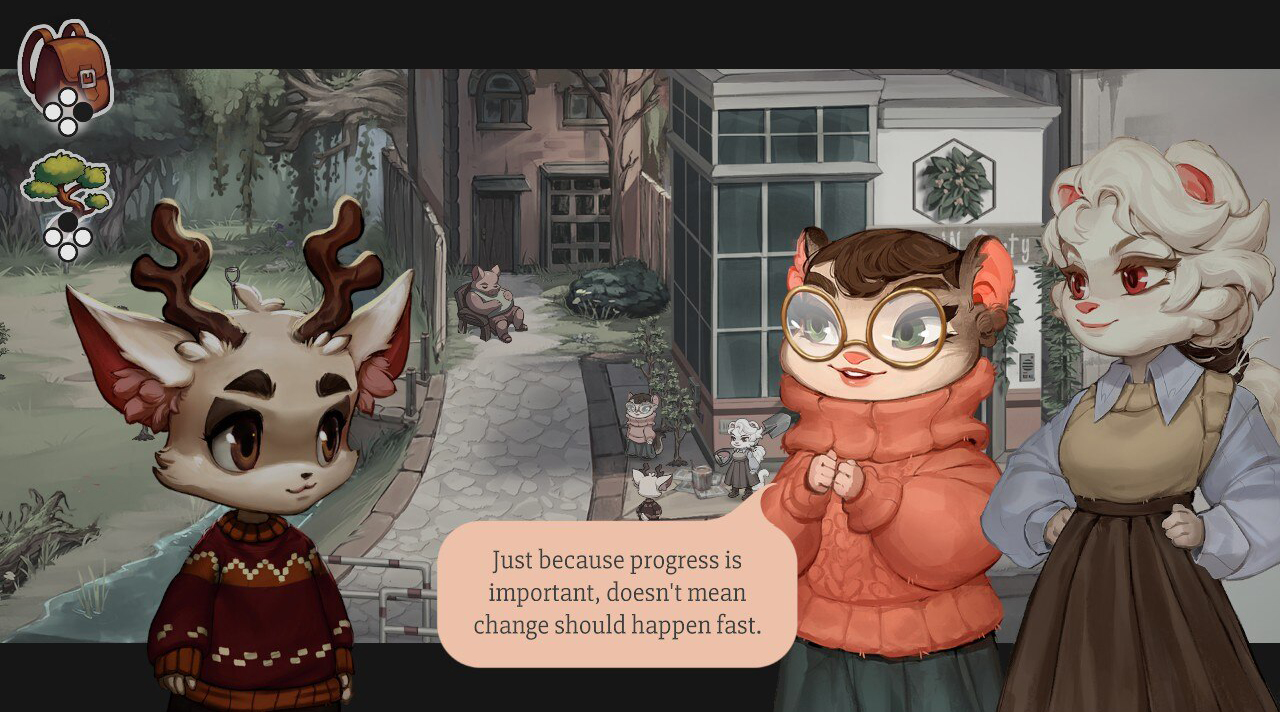
It’s also important to note that the character art is gorgeous. The animal characters were clearly drawn by a furry artist in a way that the characters in Night in the Woods were not, but I have nothing but love for this art style. Despite the relatively large cast of characters, the character designs are all unique and visually interesting. I’m not a furry myself, but I was still able to appreciate the high polish of the art. There is no cringe here, just beauty and creativity.

The environmental art is gorgeous as well. The pleasant façade of Beacon Pines is indeed pleasant, with lovely trees and handsome buildings adorning each screen. Although we don’t see much of the town’s dark secret, the visual design of the spaces it affects fit the theme perfectly. 

In terms of gameplay, I always felt directly engaged with the story. There’s nothing missable or collectable, and the game doesn’t get cute with achievements. There are two optional minigames, and they’re both unobtrusive and enjoyable.

Beacon Pines is short, inexpensive, and accessible. If you’re a fan of Night in the Woods, or if you’d like to play a visual novel with more interactivity, I’d definitely recommend giving Beacon Pines a shot. Since it comes off a bit like a generic cozy game on its Steam page, I had no idea Beacon Pines would be as interesting as it is, but it’s an amazing treasure of a game.

Apartment Complex

Apartment Complex
https://kinerus.itch.io/apartment-complex

Apartment Complex is a short and free-to-download narrative exploration game set in a mostly abandoned apartment building. The only human occupants of this building are its two landlords. You play as one of the owners, who is middle-aged, jobless, and depressed. In an effort to do something with his life, your character takes it upon himself to check in with the tenants, who are not even remotely human.

The game only takes about twenty minutes to play, and the gameplay consists of walking through the three-story building and talking to the tenants. Just to put this out on front street, Apartment Complex has a message, and that message is that landlords are bad. I don’t disagree, but the game isn’t shy about being didactic. Putting the armchair Marxism aside, the writing is a lot of fun.

Each of the eight tenants (inasmuch as they can be counted) is a Lovecraftian monstrosity that defies Euclidean logic but still needs a place to stay on this particular plane of reality. Perhaps because of his depression, your character isn’t the least bit bothered by the ontology of these beings. Regardless of whether he’s talking to the fungus-infested remains of the former co-landlord, a divorced dad with multiple alligator mouths, or a colossal all-seeing eye of the abyss, this guy takes each of these conversations in stride.

And honestly, this is such a mood. I get it. Sanity-altering cosmic abnormalities are a dime a dozen, but you know what’s really fucked up? The unequal distribution of wealth across class lines. Again, Apartment Complex has a message, but it’s not wrong.

Also, given that the creator is only twenty years old, I admire the accuracy of the game’s portrayal of the jaded middle-aged mindset. Like does it really matter that your neighbor is an eldritch abomination who exists in the shadows of reality? Does it even matter.

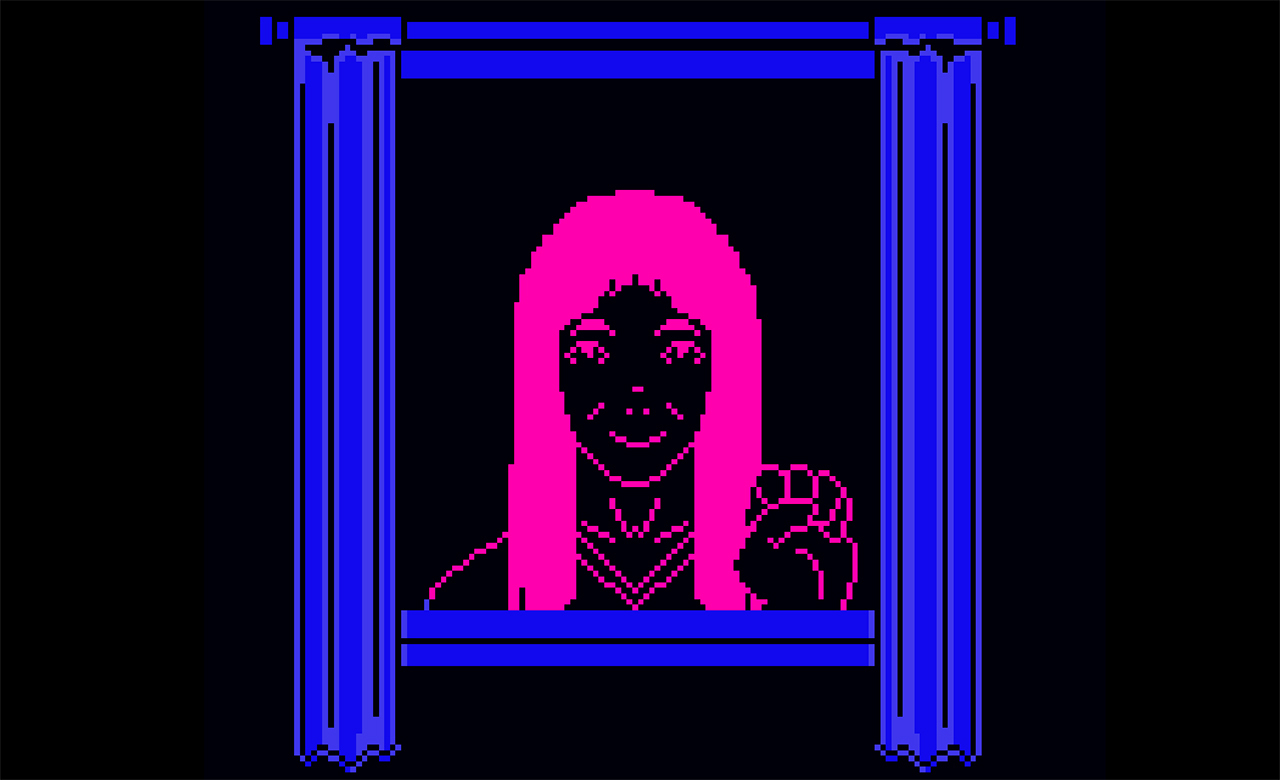
Where Apartment Complex shines is the boldness and creativity of its 16-bit pixel art. The floorplan and room layouts of the building are bog-standard, but the way each tenant occupies the space has to be seen to be believed. If you’ve ever wondered just how weird Earthbound-style graphics can get, this game is for you. The character portraits displayed during conversations are incredible.

From its eye-catching color palette to the dry tone of its absurdist humor, Apartment Complex makes me nostalgic for Welcome to Night Vale in the best possible way. This is a chill and fantastically creative game about monster friends and postmodern malaise, and honestly? It’s super relatable.

Vacant

Vacant
https://doublecrow.itch.io/vacant

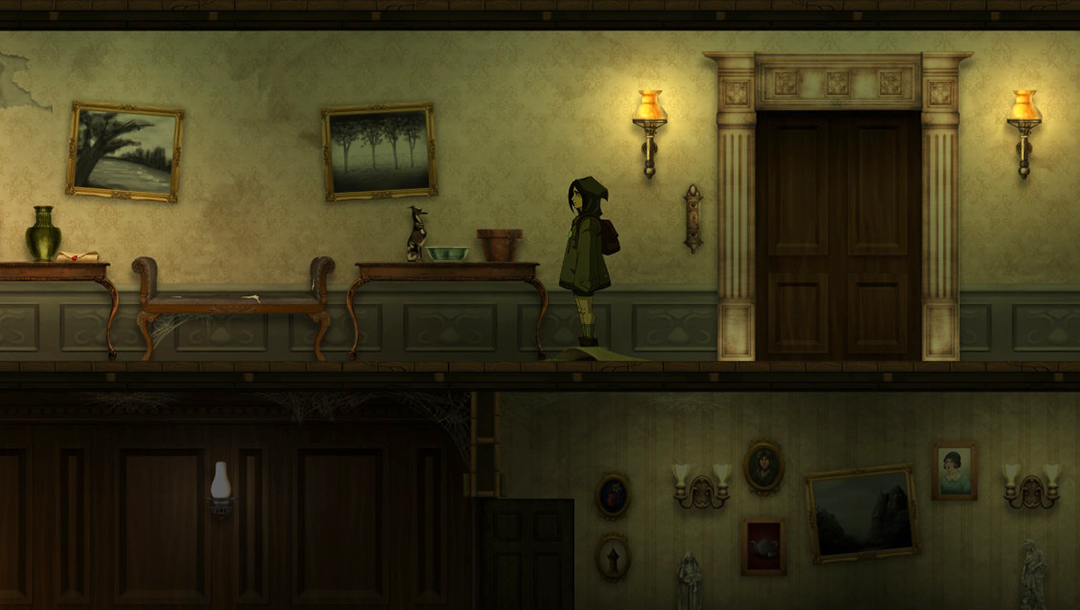
Vacant is a free-to-play 2D narrative adventure game that takes about 35 minutes to finish. You play as a camerawoman named Elena who accompanies her friend Priya to a hotel that was abandoned shortly after it was built. Priya runs a ghost hunting video channel, and she wants to make it big by solving the mystery of the unexplained disappearances of Masthill Lodge.

Following a short hike through the woods, Elena and Priya enter the abandoned hotel, which has two floors and a basement. There’s a kitchen and a few staff rooms on the first floor, and the guestrooms are on the second floor. The space is large enough to be fun to explore but small enough to be manageable. All points of interaction are clearly marked, and there are no puzzles. The occasional dialogue choices are fun but don’t seem to affect the story, which is fairly linear.

After you poke around a bit, Elena and Priya have a heart-to-heart talk about why Priya makes these videos despite her firm belief that ghosts don’t exist. Her work is about the craft and the connection with her audience, she says, giving a perfectly reasonable explanation for why so many people enjoy ghost hunting videos.

Regardless, there’s something not quite right about Masthill Lodge. How did 54 people disappear here, exactly? And why has no information about any of them turned up in the ten years since?

The tension comes to a head when a man suddenly appears outside the lodge. “Don’t make a sound,” Priya says, and this is when the strength of the medium comes into play. As the player, you have to move forward, and your choices are limited for the worst possible reasons. I don’t generally get creeped out by horror games, but let me be honest – this one got me.

The writing in Vacant is excellent, and the characters are human and believable. The pixel graphics and sound design contribute to the subtly creepy atmosphere. The pacing is perfect, with a good balance of character drama, humor, mystery, and horror. The ending is fantastic.

There’s no way to save your progress, so you’ll need to sit down and play the whole story in one go. I didn’t mind, as the game is so well crafted that it’s easy to become immersed in the fiction. If you’re a fan of the character writing of Night in the Woods or the magical realism of The Magnus Archives, I’d definitely recommend checking out Vacant.

Firebird

Firebird is a choice-based visual novel that takes about an hour and a half to play. The story is set in the northern borderlands of contemporary Russia, where a Hungarian migrant named Mariska makes her living as a freight trucker.

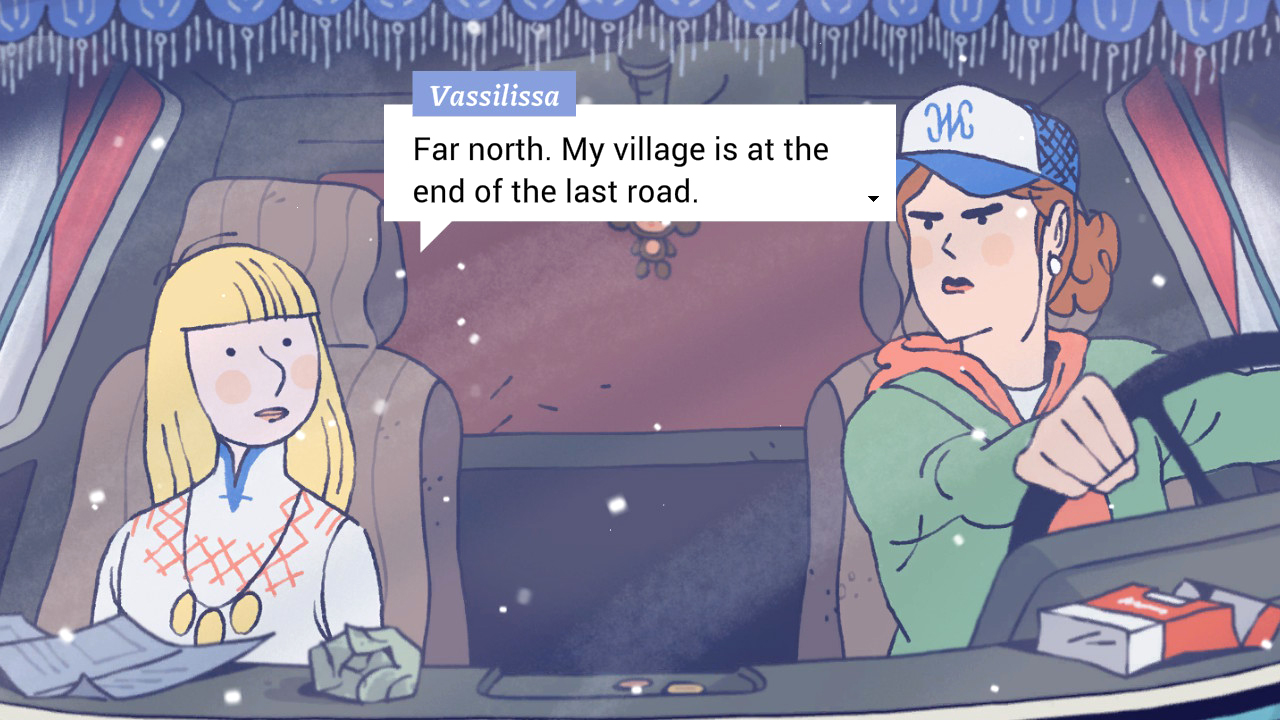
Since she’s in the country illegally, Mariska had to take out the loan for her truck, the Firebird, from a local mob boss. When she’s caught after trying to flee the boss’s territory without paying the interest on her loan, Mariska crosses paths with a strange girl in traditional clothing named Vassilissa, who promises great riches if Mariska will deliver food to her village in the far north.   

Your job as the player is to navigate between points on the map as Mariska and Vassilissa head steadily northward. There’s no backtracking, so you’ll have to choose between multiple routes while ensuring that the Firebird doesn’t run out of gas. The game is entirely text-based, and the elements of resource management are fairly chill.

More than anything, the gameplay is about roleplaying as you explore the dialogue options. It’s possible to die, but doing so will simply restart the game at a crucial choice. As the player, you’re mostly just along for the ride. And what an incredible ride it is.

At each point on the map along her route, Mariska is able to leave her truck and search for gasoline or money (which can occasionally be used to buy gas). The road is littered with the ruins of old villages and Soviet outposts, but a few of the waystations are still populated. The humans Mariska and Vassilissa meet are friendly, but the wolves and bears are another story entirely. To make matters worse, the mob boss has sent his henchman Ivan to pursue Mariska in his truck, the Gray Wolf.  

As you might have guessed from the character names, which are drawn from Slavic folklore, there are supernatural forces at play. Over the course of her journey, Mariska encounters various legendary characters, from the crafty witch Baba Yaga to the warrior princess Maria Morevna. The gradual shift from gritty realism into the realm of a fairy tale is a lot of fun, especially when the seemingly absurd advice offered by characters along the way begins to make perfect sense. Thankfully, Mariska is nothing if not pragmatic, and her no-nonsense attitude is exactly what she needs to get the job done.   

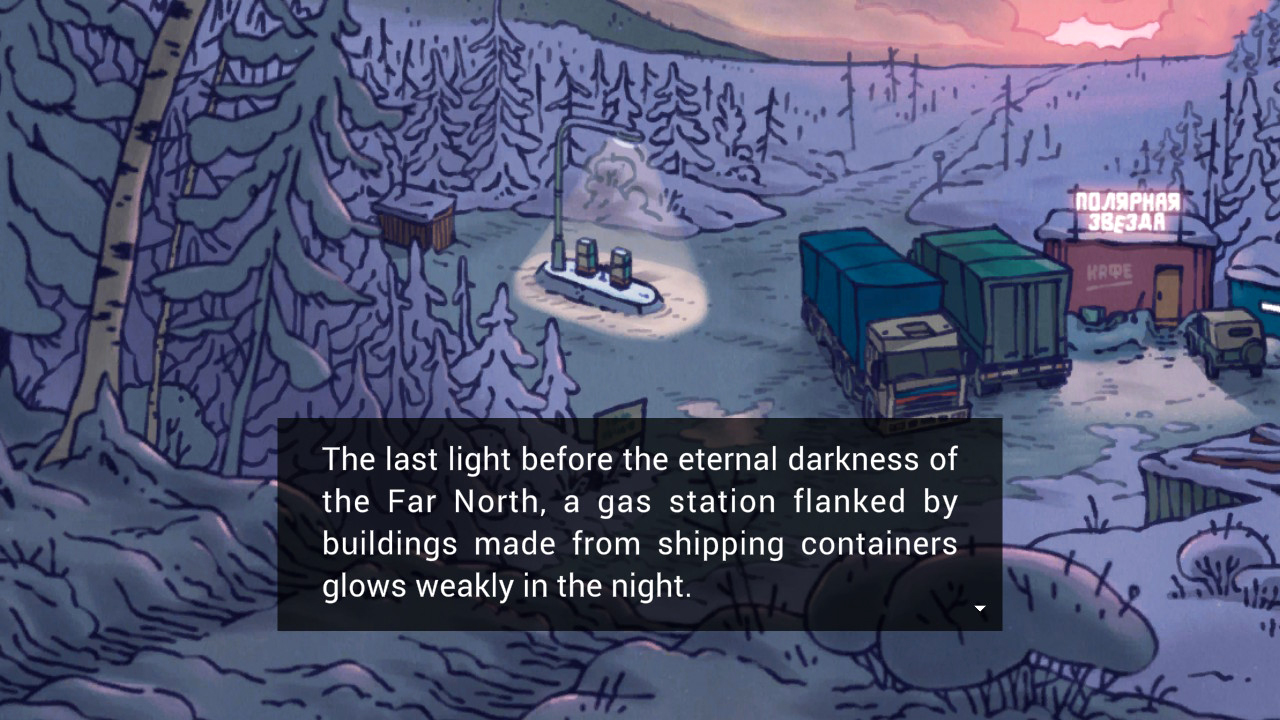
Firebird’s developers, Ludogram, are based in France, but they’ve devoted love and care to bringing the Russian setting to life. The luminous ligne claire artwork of Quentin Vijoux invites the player onto the northern tundra while conveying a strong sense of lingering twilight and freezing cold. Despite Firebird’s celebration of Slavic folklore, the game’s narrative makes no attempt to hide its criticism of the Russian state, especially the collusion between government and organized crime. There’s also a haunting scene with Soviet ghosts that I found genuinely chilling.

Although it’s possible to see an entirely different variation of the game’s story during a second playthrough by having Mariska drive through a different set of points on the map, the destination is always the same. No matter what path you choose, Firebird connects to universal themes as it acknowledges the cycles of nature – between winter and summer, and hardship and plenty, and faith and hard work. The bad times won’t last forever, Firebird suggests, and Mariska will keep on trucking.

Blackout

Blackout
https://freshgames.itch.io/blackout

Blackout is a Halloween-themed point-and-click adventure game that you can play in your browser or download for free.

You play as a teenage witch who falls from the roof of a house while trying to snatch a feather from a crow. She loses her memory during her tumble to a second-floor balcony, and she’s surprised to find that the house is filled with corpses. The electricity seems to have been cut, and it’s too dark to see anything clearly. Your job as the player is to guide the witch through the haunted house and get the lights on so she can figure out what happened.  

Once the lights are back on, you’re free to explore the house a second time to see what’s actually going on. This is a super fun twist, and it’s what really sells the game for me. The tone completely shifts, and the ending is fantastic. I hope it doesn’t spoil the story to say that it’s just as much comedy as it is horror.  

Even though your character is in the dark, the game’s 16-bit pixel art is bright and colorful. Each room of the house is a pleasure to explore. There are enough points of interest to provide flavor, but the graphics are designed to help the important puzzle pieces stand out. The puzzles are mostly self-explanatory – use the footstool to reach the key on the shelf, etc. – but some are silly and surprising. The writing in this game is just as charming as the art, and I really enjoyed the time I spent in this weird little house.

Blackout probably takes twenty minutes to play if you know what you’re doing. Since there’s not much guidance, I got stuck a few times, and it took me about 45 minutes to finish the game. I’m grateful to ( this ) short video walkthrough on YouTube for helping me figure out the endgame puzzle, which is very clever but only makes sense in retrospect once the lights are back on.

Don’t Let Her In

Don’t Let Her In
https://flowerstudio.itch.io/dont-let-her-in

Don’t Let Her In is a free ten-minute horror game that you can play on a Game Boy Color emulator (such as mGBA) or directly in your browser on Itch.io.

You play as a teenager who hasn’t set foot outside the house in several weeks. Their father left a note on the kitchen table with a simple warning: Don’t let her in. As the player, you move through the house while interacting with various objects. You have one job, but you won’t be able to keep yourself safe forever.

Alternatively, you can ignore your father’s warning and invite the creepy woman inside the house as soon as she knocks on the kitchen window. This also leads to a satisfying story, although I’d recommend playing the game straight the first time around. The slow lead to the twist ending is wonderful, and having already experienced this twist makes the second ending much more satisfying.

The game’s graphics are simple but effective, and you might be surprised by how much body horror a few pixels can generate. The subtle worldbuilding is quite intriguing as well. There’s no good ending to this story, and its tone is bleak – there’s no irony or campiness, just horror. Don’t Let Her In may be short, but it’s remarkably effective at creating an atmosphere of loneliness and dread.

I Am Setsuna

I Am Setsuna, which was published by Square Enix in 2016, is a twenty-hour JRPG set in a beautiful fantasy world blanketed by snow.

You play as a young man named Endir, a member of a secretive tribe of masked warriors. Endir has been hired by a mysterious third party to assassinate Setsuna, a young woman who has been chosen as the sacrifice whose death will hold back the tide of ice and monsters plaguing the world for another decade. When Endir finds and confronts Setsuna, she tells him that she is willing to die, but she requests that he accompany her on her journey to the sacrificial grounds so that her death will have meaning.

The structure of the game follows a standard JRPG progression. As he follows Setsuna on her pilgrimage, Endir travels between an alternating series of towns and dungeons. Each new town has slightly nicer weapons, and the money gained while fighting monsters allows these weapons to be purchased. The player can also purchase accessories that can be customized with various materials dropped by defeated monsters, thus granting characters new and improved battle abilities and magic spells.

I am Setsuna takes its inspiration in equal parts from Final Fantasy X and Chrono Trigger, meaning that its combat system is simple, easy to pick up, and fun to experiment with. Your characters gain levels quickly, so you’ll never have to worry about grinding. To help keep battles engaging, the combat employs an optional system of timed button presses that enable attack bonuses.

About ten hours in, the game becomes more challenging. Enemies take longer to defeat and often damage your characters before they die, while the dungeons become twisting labyrinths of indistinguishable corridors. It shames me to admit this, but I had to buy the Japanese strategy guide to find my way through an endgame dungeon filled with teleporter traps. In addition, I’d have to say that the game’s story begins to lose its threads well before the ending, which is remarkably unsatisfying.

As I’ve gotten older, I’ve found that I care far less about finishing any given video game. The moment a game stops being fun, I put it down and move on to something else. This is less about frustration and more about appreciation. Even if I never beat a game’s final boss, I can still be grateful for the parts of it that I enjoyed. Once I’ve seen everything I want to see, I can feel satisfied.

For me, I am Setsuna is a perfect example of a game that’s wonderful to play until it stops being fun. Although I’ve finished the story twice in the past, I was happy to enjoy about a dozen hours during my most recent playthrough. I suppose that I could keep going and power through the segments that necessitate a walkthrough, but I don’t particularly want to. And that’s okay.

Over the course of the first twelve hours of I am Setsuna, you’ll traverse snow-covered forests, venture into mountain villages beset by blizzards, and explore sparkling ice caves. Along the way, you’ll fight winter-themed creatures such as snow rabbits, arctic foxes, walruses, and bears. All of your characters are bundled up in warm and comfortable clothing, and it’s a pleasure to spend time in the villages chatting with NPCs by the fire while admiring the dried herbs and patterned quilts hanging from the walls.

I’m a fan of I am Setsuna, but I’d recommend it in the same way I’d recommend an actual retro game like Ocarina of Time. It’s absolutely worth playing I am Setsuna to experience its atmosphere and charm, but no one should feel bad about walking away when it becomes difficult and awkward.