Review of Hero Cave on Comics Beat

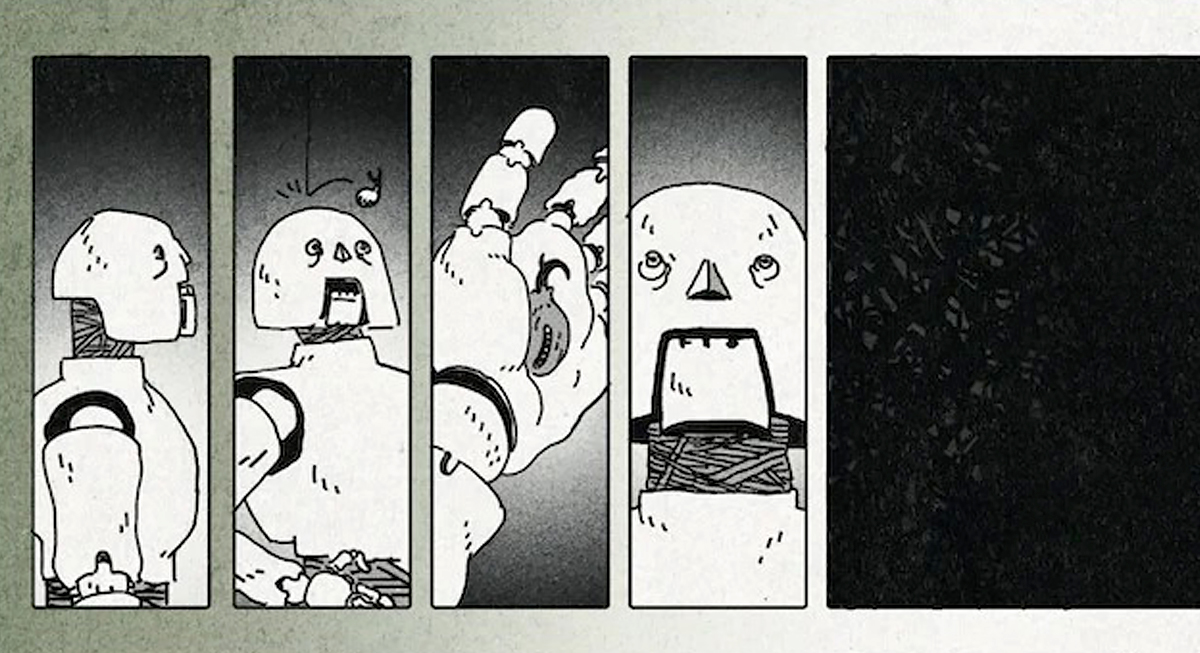
My review of Hero Cave, a dark fantasy comedy, was recently published on Comics Beat (here). This graphic novella is only about fifty pages long, but it’s surprisingly powerful and cathartic. Here’s an excerpt from my review…

It’s easy to look down on NPCs, the “non-player characters” who seem shallow and uninteresting when compared to the protagonists. It’s not so easy to realize that, in certain aspects of your life, you’re not much better than an NPC yourself. In Player vs. Monster: The Making and Breaking of Video Game Monstrosity, Jaroslav Ŝvelch explains how the construction of monsters in Dungeons & Dragons reflects the concerns of the white-collar managerial class. To the dungeon master, even a creature as miraculous as a walking skeleton is little more than a series of numbers to be entered into a spreadsheet. Given how frequently we’re all reduced to data points — by social media algorithms, by insurance companies, and certainly by employers — perhaps it’s worthwhile to extend a bit of sympathy to a low-level skeleton.

You can read the full review on Comics Beat here:
https://www.comicsbeat.com/graphic-novel-review-hero-cave/

As an aside, Hero Cave features a type of nonbinary representation that I love to see. Waifishly thin models with stylishly androgynous faces are all well and good, but it’s frustrating that only attractive and nonthreatening “childlike” body types are commonly understood as being nonbinary. I believe we should have a bit more range in our representation, while also not limiting ourselves to conventional notions of “humanity.”

Why, for example, does a cartoon skeleton need to fit into a binary notion of gender? Also, if a character is an undead eldritch monstrosity, it’s silly to think that their nonbinary gender identity is the most interesting thing about them. Hero Cave demonstrates a refreshing lack of concern for the gender of its skeleton protagonist, but that doesn’t preclude the possibility of queer sexuality serving as an escape from the restrictive confines of hellworld capitalism. I didn’t want to get into this aspect of the book in my review, but it’s brilliant, and it means a lot of me personally.

Review of Bramble on Comics Beat

My review of Hollow Press’s newest publication, Bramble, was posted on Comics Beat!

Hollow Press is an Italian micropress that publishes strategy guides for dark fantasy adventure games that don’t exist. Their most well-known book is Vermis (which I wrote about here), but I think Bramble is probably more accessible to a wider readership. It’s very weird and creative, and the art style is a lot of fun. Here’s an excerpt from my review…

Bramble is a worthy successor to Vermis, and the book proudly stands on its own as an accessible introduction to the emerging genre of original strategy guides. Its story is driven by the forward momentum of a traditional graphic novel and augmented by the intriguingly fragmented worldbuilding presented by digital RPGs. As a physical object, Bramble also suggests the nostalgic mystery of forgotten media, and the reader can easily imagine coming across this book hidden in the back of a closet or buried at the bottom of a box at a flea market. 

You can read the full review on Comics Beat here:
https://www.comicsbeat.com/graphic-novel-review-bramble/

Review of Model Five Murder on Comics Beat

I really enjoyed Tan Juan Gee’s Model Five Murder, which was just published by Silver Sprocket. This graphic novella is an intriguing sci-fi noir mystery with stylish art that investigates the issues of AI, technology, and labor. I’m very lucky to have been able to write a review for Comics Beat. Here’s an excerpt…

Model Five Murder is a thematically rich murder mystery that plays with the question of whether concepts like “victim” and “murderer” have any meaning in a situation involving artificial life and artificial intelligence. If memories and consciousness can be transferred between bodies, is it murder to shoot an android? If androids are proprietary technology owned by a corporation, who has the legal right to make decisions about their bodies?

You can read the full review here:
https://www.comicsbeat.com/graphic-novel-review-model-five-murder/

Escaped Chasm

Escaped Chasm
https://tuyoki.itch.io/escaped-chasm

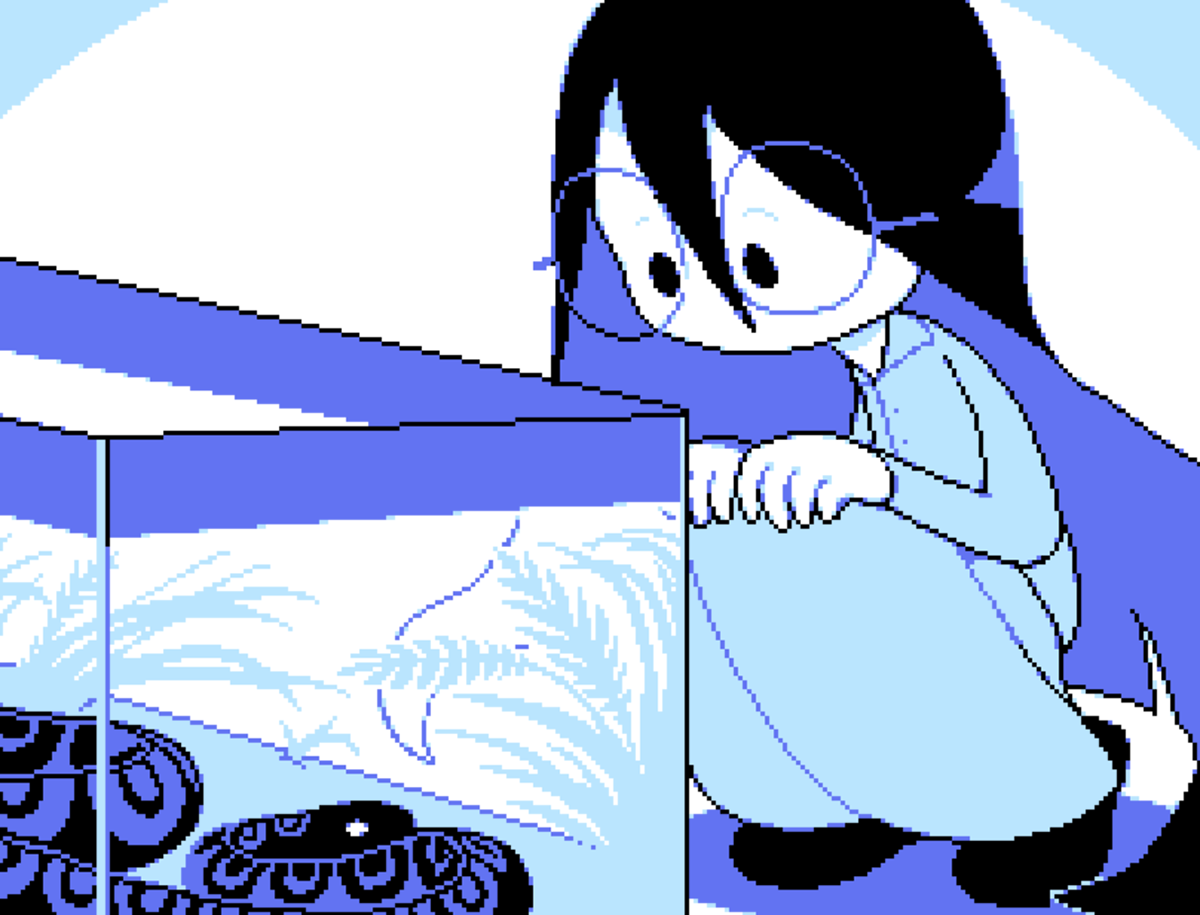
Escaped Chasm is a 25-minute dark fantasy adventure game created in RPG Maker with a mix of retro Game Boy graphics and anime-style cutscenes. Originally released in 2019, it’s the first stand-alone project of Temmie Chang, a longtime collaborator of Toby Fox who contributed character designs and graphics to Undertale and Deltarune.

You play as a young teenage “Lonely Girl” who doesn’t leave the house and lives vicariously through her dreams and art. Her parents appear to have gone missing, and she doesn’t know what to do. To make matters worse, she’s tired all the time, and a strange man has started appearing in her house.

Something is seriously wrong, and the Lonely Girl has four days to figure it out and escape. If leaving the house isn’t an option, where can she go? And how can she find the courage to leave?

Escaped Chasm is free to download, and the zip file contains an illustrated guide to the game’s four endings. I get the feeling that most players will probably see the good ending simply by playing the game naturally, but it’s nice to have grimdark alternatives. After unlocking the good ending, the player is able to enter and explore a bonus “developer’s room” that I love with all my heart. It’s fascinating to read Chang’s thoughts about making the game while checking out extra material that fills out a few gaps in the story.

Both Toby Fox and Temmie Chang were fans of and contributors to Homestuck, and it’s possible to see its influence on Escaped Chasm. It’s difficult to summarize Homestuck, but the webcomic begins as a story about four young teenagers who can’t leave their houses because they’re the last remaining survivors of a universe that’s unraveling around them. I get the sense that the Lonely Girl in Escaped Chasm is based on one of the four teenagers in Homestuck, Jade Harley, and it’s probably not a coincidence that she’s found herself in a remarkably similar situation.

Escaped Chasm is like a bridge between Homestuck and Deltarune in its theme of “using art and imagination to escape into another world,” but it’s also very much its own thing. I love Chang’s illustration style and narrative voice, and I admire how she pushes the boundaries of the medium to create a palpable sense of liminality and dread – and of catharsis and joy. Escaped Chasm is atmospheric horror with a (potentially) happy ending, and it’s idiosyncratic and self-indulgent in interesting ways that elevate it above the level of mere pastiche.

Escaped Chasm is a short test project made in preparation for Dweller’s Empty Path (on Itch.io here), a more extensive Game Boy style narrative adventure game. I really enjoyed Escaped Chasm, and I’m looking forward to jumping into Dweller’s Empty Path.

Symbiosis

Symbiosis
https://spicaze.itch.io/symbiosis

Symbiosis is a free-to-play RPG Maker horror game about a murderous mad scientist living in a house in the woods with an adorable child. The story has two endings, and it takes about 25 minutes to play through the game once.

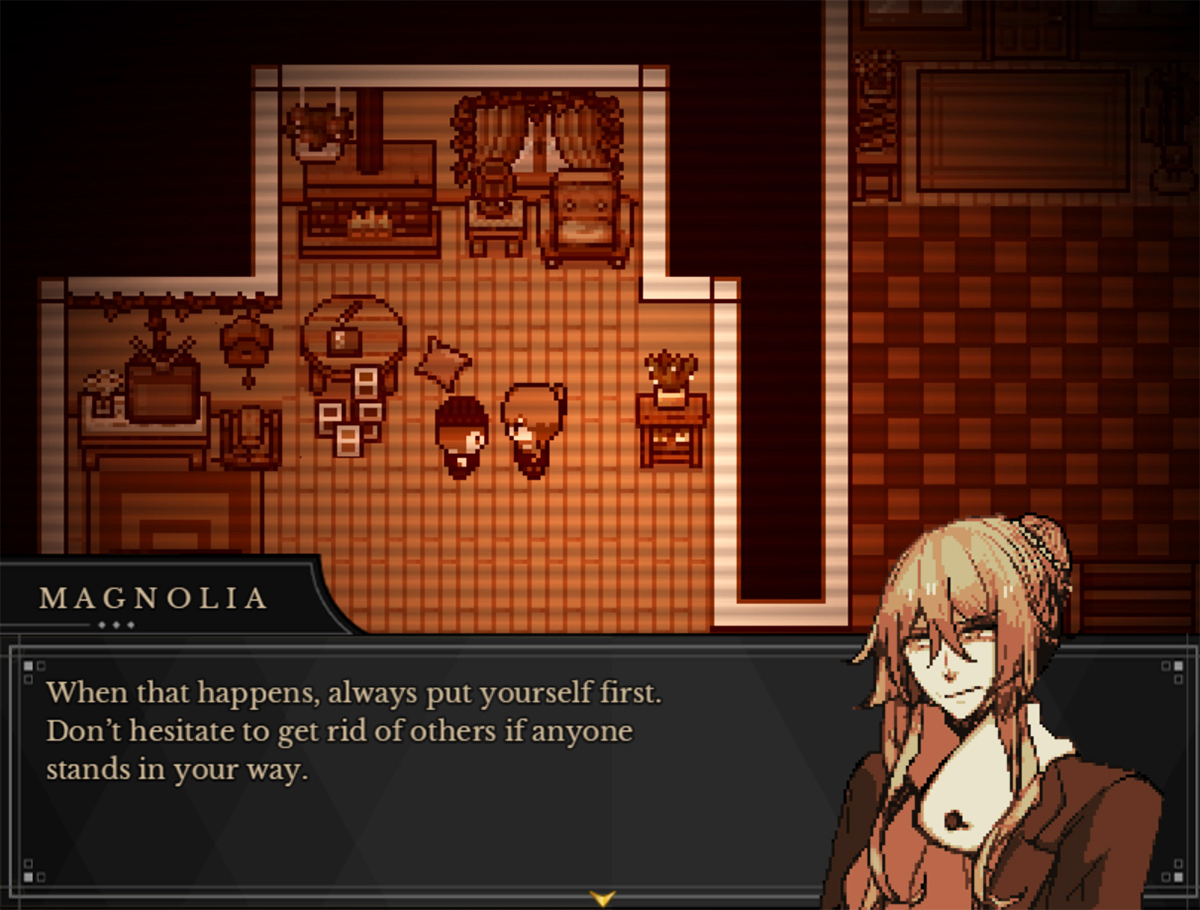
You play as Magnolia, a geneticist who left her university post after a mysterious fire broke out in her lab when her research came under public scrutiny. She now lives in isolation with Mint, a curious and precociously intelligent young boy whom she’s raising as her son. According to local rumors, Magnolia is a witch. It doesn’t help that hikers have a tendency to disappear in the forest surrounding her property.

The game begins as Magnolia carves up the corpse of someone she caught sneaking into her house. She’s interrupted by Mint, who can’t sleep and wants a bedtime story. Unfortunately, there are three more intruders in the house, and Mint won’t stay in his room. Your job as the player is to turn the remaining intruders into corpses – for science! – while ensuring that Mint remains out of harm’s way. 

Magnolia’s house isn’t too terribly large, but it’s big enough to have all sorts of nooks and crannies to poke around, as well as various journals and research notes to find. The player can use these clues to figure out who Magnolia is and where Mint came from, although you’ll have to make your own decision regarding Magnolia’s feelings toward Mint and what the fate of the pair will be. The game’s creator has posted a guide for the two endings (here), and this short devlog also contains their thoughts on the story and characters.

What sets Symbiosis apart from the crowd of RPG Maker horror games is the creator’s gleeful willingness to allow Magnolia to be messy and problematic. She initially seems to be a complete sociopath, and her bad behavior is a joy to watch. As you witness her interactions with Mint unfold, however, her character becomes more complicated. Why Magnolia feels affection for Mint is open to interpretation, but I think it’s fair to say that her attachment is genuine.

The way I interpret this relationship is that it’s an analogy for the process of artistic creation (or scientific discovery, as the case may be). In order to create something meaningful, an artist has to be unpleasant, selfish, and more than a little antisocial. Gradually the art comes to take on a life of its own, and it’s up to the artist to decide whether to let it go or to keep it firmly in the orbit of their own dysfunctional personality.

Lest you think I’m spoiling the story, fear not – there’s all sorts of nasty business in Magnolia’s past for the player to discover. This woman is a legitimately horrible person, and her crimes are fantastic fun.

Symbiosis tells a short but grisly story through simple narrative adventure gameplay intercut with stylishly illustrated cutscenes, and I enjoyed it enough to go back and see both endings. I definitely recommend this game to fans of gothic horror, demonic women, and questionable scientific ethics.

Review of The Harrowing Game on Comics Beat

I consider myself extremely fortunate to have been an early reader of Antoine Revoy’s newest graphic novel, The Harrowing Game. I love this book, which is strongly inspired by Junji Ito but still very much its own thing. I’m also lucky to have gotten an opportunity to write a review for Comics Beat. Here’s an excerpt…

The Harrowing Game will delight fans of Junji Ito and H.P. Lovecraft, to be sure, and connoisseurs of horror will appreciate Revoy’s intriguing interpretations of familiar tropes. Revoy twists gothic stories into broken reflections of cultural anxieties, and the storytelling is no less dramatic for the subtlety of its social commentary. If nothing else, it’s a pleasure to get lost in the details of Revoy’s spectacular illustrations. Whether you’ll be able to find your way out untouched and undisturbed is another story.

You can read the full review on Comics Beat here:
https://www.comicsbeat.com/graphic-novel-review-the-harrowing-game/

Flesh, Blood, & Concrete

Flesh, Blood, & Concrete
https://waxwing0.itch.io/fbc

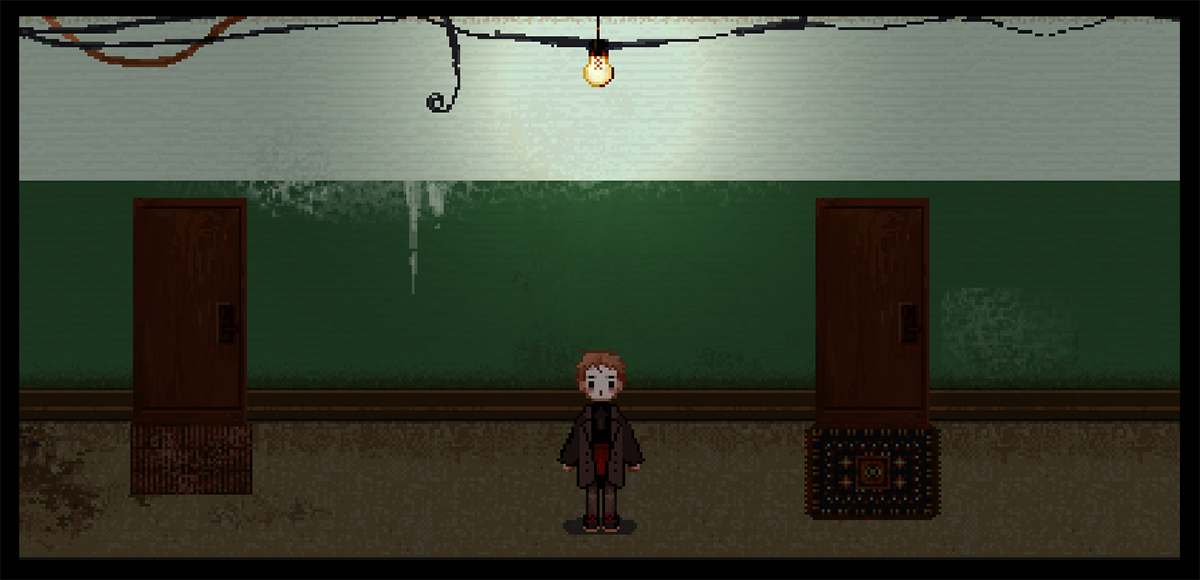
Flesh, Blood, & Concrete is a free-to-play RPG Maker adventure game that bills itself as “an apartment building exploration simulator.” During its 45-minute playtime, the game delves into themes of isolation, mental illness, and existential dread within the confines of a decaying apartment complex.

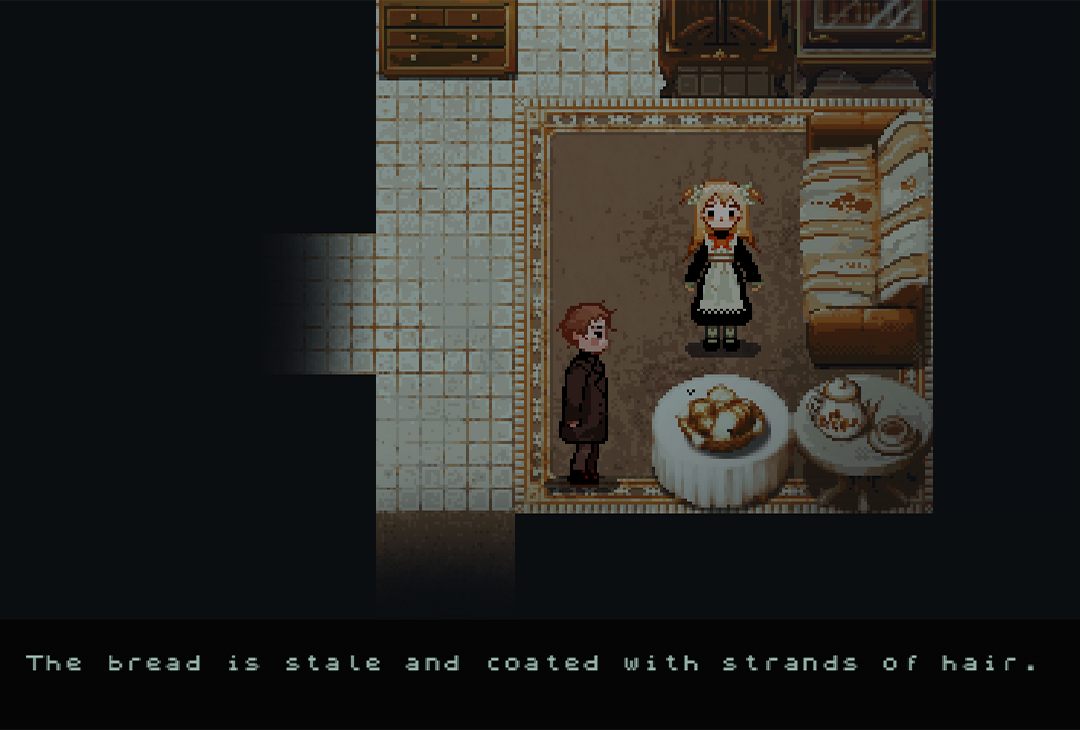
Players take on the role of Lera, a 28yo architect whose car breaks down in the snow. While seeking refuge from the cold, Lera meets a girl named Nika who, inexplicably, is dressed like an anime maid. Nika invites Lera to warm up inside her “house,” a giant abandoned apartment block at the edge of an unnamed town. As Lera, the player is given free rein to explore the building. The deeper inside you get, the stranger the architecture becomes, and it turns out that the “flesh and blood” of the title are not merely symbolic.

Flesh, Blood, & Concrete has no combat or puzzles. Instead, players explore the building and interact with the environment. In essence, your job is to collect items, which you can examine in the game’s small menu screen at your leisure. As you move from floor to floor and poke around all the vacant units, you gradually piece together Lera’s backstory through environmental storytelling and occasional conversations with Nika.

While the game’s pacing might feel a bit slow, the deliberate sense of space between incidents gives the player time to reflect on what exactly is going on with Lera. In my interpretation, Lera’s interactions with Nika hint at her desire to flee from the adult world, and I don’t think it’s a stretch to suggest that the dilapidated building is a manifestation of the intensity of Lera’s depression. At the end of the game, the player is confronted with a symbolic choice (the mechanics of which are explained in the creator’s spoiler-free guide), and what constitutes the “good” ending is open to interpretation.

In keeping with the bleakness of the game’s themes, its pixel art is rendered in muted tones. The corridors are desolate stretches of flickering lights and peeling wallpaper, and the individual apartment interiors start off as charming and cozy but gradually descend deeper into the uncanny. The game’s soundtrack complements its visuals, with a blend of ambient sounds and minimalist synth piano pieces working to create a melancholic mood. Any sense of nostalgic coziness won’t last, however – some of the game’s visuals are sublimely gory. 

As an aside, I recently played the indie narrative adventure game Indika, and I was thinking that I’d love to see more games set in Eastern Europe. Flesh, Blood, & Concrete is a universal story, but the specificity of the game’s Russian setting adds a unique and interesting flavor to its narrative and visuals. I also appreciate that this “apartment exploration simulator” takes the darker aspects of mental illness seriously but still delights in the playfulness of its morbid style of creative expression. It’s one of the more intriguing RPG Maker horror games I’ve encountered, and I’d recommend giving it a shot if you can handle the (literal) viscerality of its imagery.

Aviary Attorney

Aviary Attorney is a four-hour visual novel modeled on the Phoenix Wright series and set in Paris in 1848, right on the cusp of the revolution that ushered in the Second Republic.

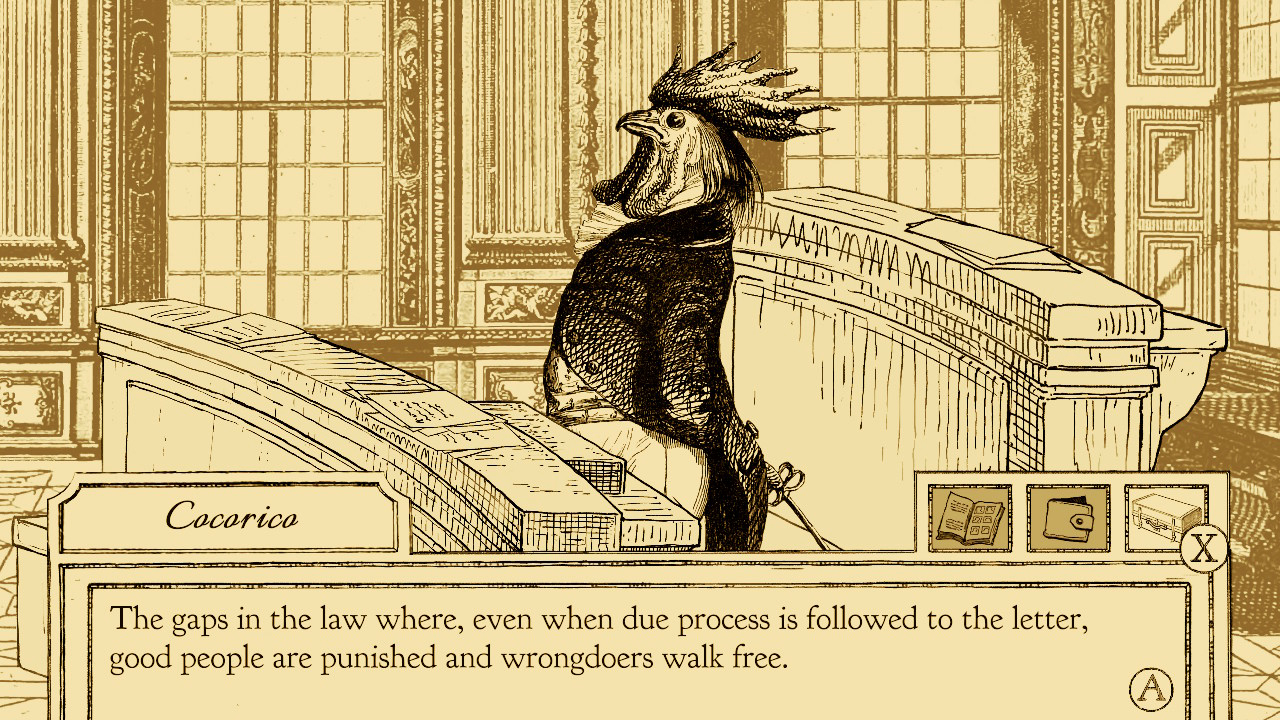
You take on the role of Jayjay Falcon, a private defense attorney. Jayjay is shadowed by his apprentice Sparrowson, who provides comic relief, and he often butts heads with his rival, the brilliant but arrogant prosecutor Cocorico. The game’s story plays out across four trials. In the days leading to the trial, Jayjay has the opportunity to collect evidence and testimonies by investigating various locations in Paris. During the trial, Jayjay is given the opportunity to present relevant evidence and cross-examine a key witness.

The characters are styled as animal-headed caricatures lifted directly from the line illustrations of J. J. Grandville, an illustrator active in the first half of the nineteenth century known for his detailed line art and his razor-sharp political commentary. As explained in the game’s credits, all of the artwork in Aviary Attorney was taken from Wikipedia and the Internet Archive, and Allison Meier’s article on Hyperallergic (here) presents Granville’s illustrations in their original context. Given how seamlessly all of the game’s assets are integrated, however, a player might be forgiven for assuming that they were custom made. This is a very good-looking game.

Although the story doesn’t strive for realism, the writing is excellent. Each trial has a dramatic twist at the end, and I thought these developments were great fun. If you enjoy ladies doing murder, I think you’ll have a good time too. Even more than the crime, however, what I love is the opportunity to explore Paris while speaking to people from all walks of life and gradually coming to understand why the February Revolution happened.

I also appreciate that, unlike the Phoenix Wright games, the focus of the trials in Aviary Attorney isn’t on catching the culprit or assigning guilt, but rather on ensuring that the accused receives due process under law. Revolution is all well and good, but I admire the characters’ commitment to upholding the practice of civil society. If you manage to achieve the game’s best ending (which I did by using this guide), you’ll learn that Jayjay Falcon is the grandson of Robespierre, the great eighteenth-century French legal theorist. This isn’t a political game, but it’s always a pleasure to see writing that devotes careful attention to historical details while putting itself in conversation with the philosophies of the time.

Aviary Attorney is an interesting exercise in how public domain works can be transformatively reconfigured into contemporary media, but it’s also a great game. Obviously I’d recommend Aviary Attorney to fans of Phoenix Wright and to connoisseurs of visual novels in general, but I really want to encourage anyone who enjoyed the themes and message of Pentiment to give this game a chance. It’s got excellent writing, a unique visual appeal, and a satisfying sense of historical specificity.

Review of Hourglass on Comics Beat

I had the immense honor of publishing a review of Barbara Mazzi’s graphic novella Hourglass on Comics Beat. Hourglass is gorgeous, and it explores the full speculative potential of steampunk. It has its gears and smashes them too, all the while being incredibly stylish. I’m ambivalent about steampunk, but I have nothing but love for this fantastic book. Here’s a short excerpt from my review…

Barbara Mazzi’s stylish artwork is the perfect vehicle for these characters and their world. Instead of moldering in the usual steampunk attachment to the Victorian era, Hourglass delights in the lavish luxury of the 1920s. Designs inspired by Art Deco contrast strong angles against delicate filigree. Meanwhile, the interior of the machine is a chaos of detail that reminds me of the detailed mechanical designs of Studio Ghibli films like Castle in the Sky. Mazzi’s warm shades of gray convey the warmth of the machine’s interior, while the mellow gold of the spot color emphasizes the magic of this world and the humanity of its inhabitants.

You can read the full review on Comics Beat here:
https://www.comicsbeat.com/graphic-novel-review-hourglass-gears-are-powered-by-adventure/

Whispering Willows

Whispering Willows (on Steam here) is a 2D adventure game set in a haunted mansion. There’s no combat, and the game takes about three hours to finish. It’s a small indie game made in 2014, and it’s not perfect. Still, I enjoyed the time I spent in Willows Mansion, and I’d recommend giving this game a shot if you’re into spooky gothic stories.

You play as Elena Elkhorn, a teenage girl whose father works as the groundskeeper at the derelict and abandoned Willows Mansion. Elena’s father doesn’t return one night, and she has a bad feeling about the mansion. Hoping to bring her father home, Elena sneaks onto the property and immediately falls headlong into an underground crypt. There she meets the ghost of her ancestor, who teaches her how to use the power of her magical pendant to leave her body to go spiritwalking. In a cursed mansion filled with phantoms, this is an extremely useful ability to have.  

Before I jump into the many things I love about this game, let me be upfront about its flaws:

– There’s not much actual gameplay.
– The hand-drawn cutscene art is unpolished.
– The writing is good but a bit uneven.
– The background music is limited.
– Your character walks very slowly.
– There’s no map to help you navigate.

Essentially, this is a small indie game that indeed looks and feels like a small indie game. I’m not complaining about the rough edges of Whispering Willows; I just want to make it clear that it’s a game made ten years ago on a tiny budget earned from a Kickstarter campaign. Still, I found its simplicity and amateurish aspects charming, and it has many strong points.

To begin with, the map is surprisingly large, and there’s a lot of space to navigate. You’ll explore the mansion’s crypt, its garden, and various outbuildings; but mainly you’re going to be walking around the house itself. The mansion is impossibly large and includes all the standard gothic flourishes: locked doors, grisly kitchens, moldy bathrooms, crooked paintings, peeling wallpaper, taxidermied hunting trophies, creepy dolls, and all the secret passageways you could ever want.

Of course there are all manner of notes lying around, and these notes collectively tell a suitably gothic story about the very wealthy but very evil man who built the mansion. This story never quite comes together in terms of plot or themes, and the character motivations are ridiculous. Still, all the individual bits and pieces are gothic catnip, from a lover kept in a secret room to a murdered best friend to a servant driven mad by what he’s seen.

This all takes place in California during the Wild West days, meaning that the land occupied by the mansion had to be taken from someone. It turns out that it was forcibly wrested from Elena’s own ancestors. Alongside his more intimate crimes, then, the mansion’s owner became the mayor of a frontier town by means of enacting war and genocide on First Nations people.

We tend to think of gothic mansions as being located in Europe, or perhaps New England. There are definitely nineteenth-century mansions in California, though (like the Carson Mansion), and they’re built on land soaked in blood.

Importantly, the First Nations people in Whispering Willows aren’t all ghosts. Elena and her father are very much alive, and they’re not tempted by the faded pseudo-grandeur of the former colonists. At the end of the game, it’s extremely satisfying to see Elena essentially say “fuck all this” as she walks away from the mansion with her father.  

This is an interesting perspective on classic gothic story tropes that I love to see. And honestly, Whispering Willows isn’t such a bad game. The puzzles are easy, but the lack of difficulty is a selling point for me. Also, the gameplay mechanic of Elena spiritwalking to interact with the numinous aspects of the environment is used in clever ways, and it’s a lot of fun.  

Aside from Elena’s slow walking speed, my only real complaint is that this game would benefit immensely from a map. Even though navigation isn’t particularly complicated, I got lost a few times and had to resort to a walkthrough (this one here) a few times, which wouldn’t have been necessary if the player could just pull up a subscreen.

Whispering Willows definitely feels like an indie game, but it’s got a delightfully grisly story and an excellent sense of atmosphere, and it’s worth checking out if you’re interested in Wild West Gothic from an indigenous perspective.

As a side note, this was apparently the game that launched Akupara Games, a publisher that specializes in quirky indie games with a strong sense of style and setting. Two of my favorite titles they’ve helped get off the ground are Rain World and Mutazione, and it’s cool to know that this was where they started.