An Unfound Door, Chapter 12

Fhiad and Agnes enter the abandoned west wing of Faloren Castle via a covered bridge that crumbles into the lake below as they cross. As they explore the empty corridors, Fhiad admits that he wasn’t particularly well-suited to being a diplomat. All he wanted was to leave for the university in Cretia, as his talent at magic was the only thing that set him apart from his sisters. After entering the ruins of the academy housed in the west wing, Fhiad and Agnes experiment with the magical tools left behind in a lecture hall, gleefully not caring about the wreckage they create.

.

Chapter 12 is at the core of the “fun and games” section of the novel, which mainly involves Agnes and Fhiad exploring an impossibly giant castle. The currently occupied east wing is sad and empty but still livable, while the abandoned west wing is a crumbling ruin barely held together by magic. I did my best not to write too many scenes of characters walking down hallways, but I enjoyed describing the decrepitude of the environment.

This is the chapter in which Fhiad and Agnes begin to flirt with one another. As the culmination of their flirtation in the chapter’s final scene, they experiment with magical tools left behind by dead mages, and they behave a bit like Link smashing pots in a dungeon just because he can. Personally speaking, this is 100% what I’d do if magic were real. I wouldn’t want to hurt anyone, of course. I just think it would be neat to make junk cars explode.

I spent my teenage years in a rural area in the Deep South near where Stranger Things was filmed. I worked a number of garbage part-time jobs with other local kids; and, when we got off our shifts in the evening, we would drive around the country roads and look for abandoned houses where we could sit and smoke weed to chill out for a bit before going home.

A lot of these abandoned houses were filled with literal piles of junk, and there was a certain pleasure in lining up ancient Coke bottles along rotten wooden porch railings and throwing rocks to smash them. The glass made a lovely sound when it shattered, and the broken shards were beautiful in the moonlight.

Fhiad and Agnes aren’t teenagers, and neither of them is the sort of person who would work in a gas station convenience store. Still, I think this is an aspect of human nature that transcends time and place and social class. If the world is already filled with ruins, why not smash some glass? It’s a minor and ultimately meaningless act of rebellion against a system that failed long before you were born, but that doesn’t make it any less satisfying.

The illustration accompanying this chapter preview was created by the magical SashaArts, who draws radiant fantasy portraits that you can find on Instagram (here), on Twitter (here), and on Bluesky (here).

Necromancer Zelda

Echoes of Wisdom is growing on me, and I especially love how Zelda fights by rapid-summoning monsters to overwhelm her enemies. I suppose Zelda is technically creating “echoes” instead of resurrecting her defeated foes, but she still reminds me of the Tears of the Kingdom trailer in which Ganondorf triggers the Blood Moon, summons a bunch of monsters, and tells them to “sweep over Hyrule.” Necromancy seems like a very fun gig if you can get it.

This comic was drawn by the horrifically talented Frankiesbugs, whose cute and creepy illustrations and comics can be found on Tumblr (here), on Instagram (here), on Cara (here), and on Redbubble (here).

An Unfound Door, Chapter 11

The errant knight Caelif rides to Faloren Castle from the south. Through Caelif’s eyes, the reader sees the castle city, which was once grand but has fallen into decline. Caelif enters the castle and is greeted by Agnes’s cousin Galien, with whom he shares a professional and romantic partnership.

After they indulge in an intimate moment, Caelif reflects on his first acquaintance with Galien in Cretia. He tells Galien that he believes Fhiad to be the demon that Agnes was sacrificed to resurrect, and Galien reveals that he suspected as much. Galien assures Caelif that Fhiad is no danger to Agnes, and he confesses that he’s far more concerned with who may have abducted her in the first place.

.

At the beginning of An Unfound Door, Agnes leads a demon through the woods. To stave off exhaustion, she’s started talking to the demon, complaining that she’s not cut out to be a princess. Agnes argues that her cousin Galien, who is a duke in his own right, would be perfect in her position. He’s a born politician, and he would make a good king.

Agnes has previously shared several conversations with Galien, but this is the first chapter in which he takes the spotlight. He does so through the viewpoint perspective of his partner Caelif, the knight who rescued Agnes immediately before the novel opens.

Caelif serves as Galien’s messenger and fixer, as he’s willing and able to travel freely. A bit later in the story, Agnes explains to Fhiad that Caelif works for her as well, as she’s been asking him to sell the heirlooms of the royal family outside the kingdom, a last-resort fundraising strategy facilitated by Galien.

In another story, Galien would be the villain, but he and Agnes get along well and care for each other a great deal. Agnes had intended to renounce her royal status so Galien would be next in line for the throne, but her plans were complicated by her father’s ill health and her own abduction.

All of the chapters so far have been focused on Agnes and Fhiad, and this is where the story introduces a broader perspective. What I’d like to achieve with Caelif’s chapters (of which this is the first) is to give the reader a sense of the story being set on the edge of a much larger world.

Also, some of the oddness at the beginning of the novel is hopefully starting to make more practical sense. What I’d like to do with the narrative progression of this story is to take the broad archetypes of the initial scenario – a princess walking through the woods with a demon boar, who turns out to be a cursed prince – and gradually add more layers until the reader finally understands exactly how and why these characters arrived in that situation. In other words, the story is something like a mystery that the reader solves along with the characters.

If you’re curious, Caelif’s name comes from Caelifera, the scientific name for the suborder of insects that includes grasshoppers. Meanwhile, the concept art I used for this chapter’s graphic is from Bloodborne. I love how the city of Yharnam feels magnificently grand yet oppressively empty, and I aim to convey the same atmosphere of ruined grandeur in An Unfound Door.

An Unfound Door, Chapter Eight

Agnes and Fhiad meet in the library on the morning after the summer court opens. Agnes wakes before dawn out of habit, while Fhiad has been up all night reading. Fhiad left to get tea, and he returns just as Agnes is studying the books he left on a desk.

They sit down together, and Fhiad apologizes for making wild proclamations. When Agnes asks if Fhiad would truly destroy Faloren if he found Soreiya’s Tear, he explains that doing so would be impossible, as the cost for performing magic on such a large scale would have an unimaginably high cost. Fhiad gives a demonstration of magical cost, and Agnes is so amazed that she asks a clueless question about his past, thus chilling the warmth of an intimate moment. 

. . . . . . . . . . . . . . . . . . . . .

This chapter marks the beginning of what Jessica Brody (of Save the Cat fame) calls the “fun and games” section of the story, which should constitute the bulk of Act Two. While the opening and closing of a novel should ideally follow a set formula that helps guide the reader, the middle of the story offers much more freedom to the writer.

I like to use this freedom to indulge in all of the narrative tropes I enjoy, and this chapter includes one of my favorite scenes. Namely, I love when an intimate conversation in a library helps the protagonist and her foil understand that they should be friends. At the beginning of this chapter, Agnes is characteristically blunt and ready to fight, but she and Fhiad manage to establish a common ground by virtue of the fact that they’re both giant nerds.

Fhiad begins to show his true colors in this scene. He’s more socially polished than Agnes, but he’s a shy academic at heart. In fact, most of Fhiad’s trouble has resulted from him being a pushover. Although he gets in a few good jabs at Agnes, Fhiad also submits to her demands multiple times during this conversation.

I was recently reading an academic book chapter about gothic fiction, and the author was saying that the erotic charge of the narrative is primarily generated by the question of whether a wild and mysterious man will sexually assault the heroine who fears him. This sexual fear turns to romance when the heroine realizes that the man’s menacing aura is a result of his violent passion for her.

I unapologetically appreciate that sort of character dynamic, but it doesn’t fit what’s going on with Agnes and Fhiad. Agnes isn’t fearless, but her extreme pragmatism drives her to behave as if she were. Meanwhile, Fhiad is competent and talented in his own way, but he has no business being “wild” or “menacing.” In a reversal of the classic gothic gender dynamic, Fhiad needs Agnes to push him forward, while what Agnes needs from Fhiad is his patience and kindness.     

More than anything, however, this chapter is about doing magic in a cool library. The next chapter is also going to be about magic and libraries. And the chapter after that? More magic, and more libraries. I love libraries and magic, what can I say. This is my story, and I get to write whatever I want.

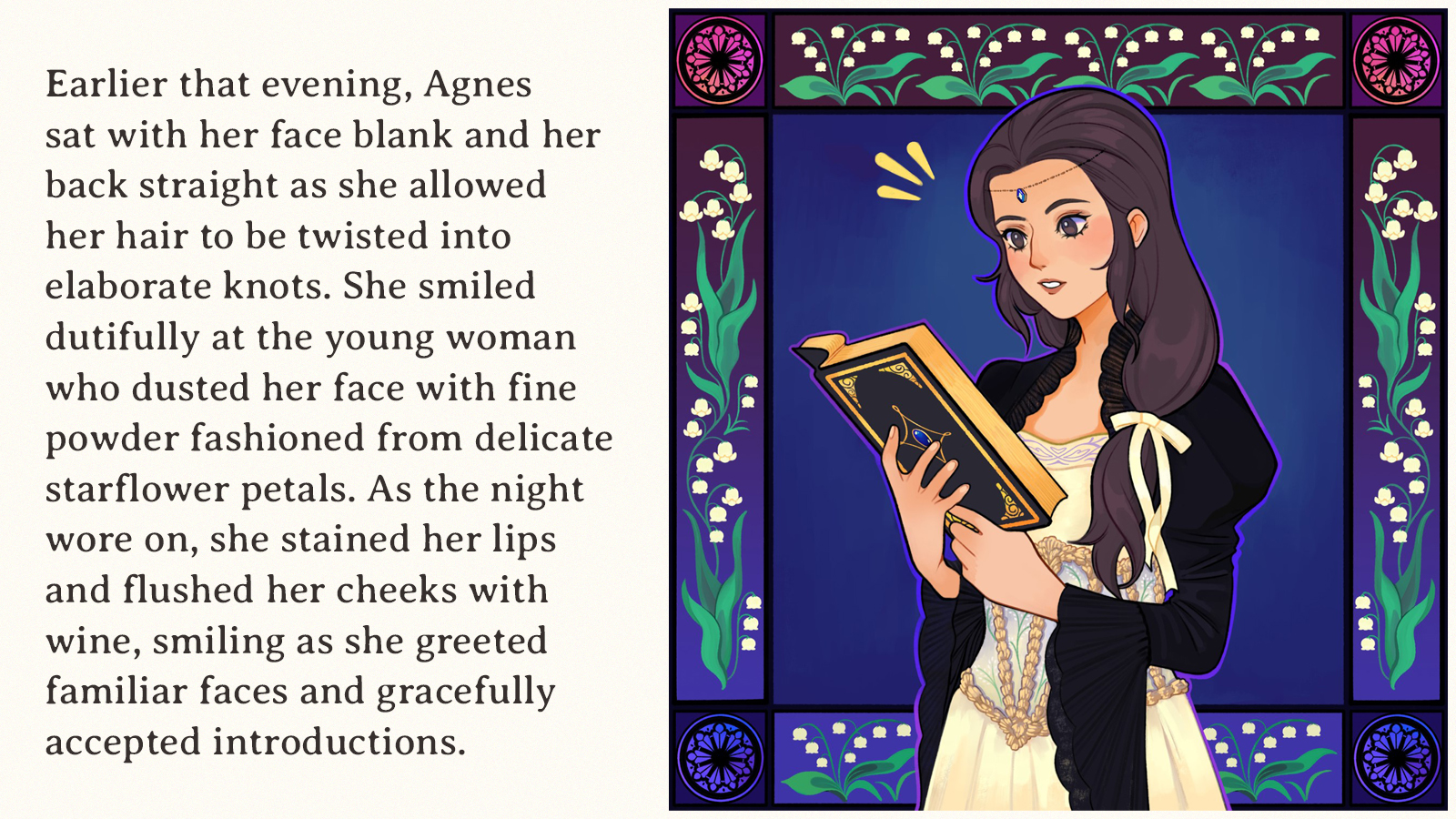
The lovely gothic portrait of Agnes that accompanies this chapter’s preview was created by the magical Emily.E.Draws, whose vibrantly colorful fantasy characters can be found on Instagram (here) and on Tumblr (here).

An Unfound Door, Chapter Seven

Fhiad leaves the court and walks through the halls of the castle as he reflects on the circumstances that brought him to Faloren. Guerig, the king’s secretary and acting regent, has granted Fhiad permission to live in the castle while supposedly doing research on the building’s architecture. Fhiad curses himself for being drawn back to the kingdom, but he has few resources and fewer choices.

As he wanders, Fhiad reflects on how he was originally sent to Faloren as a replacement for a retired diplomat during what he intended to be a temporary break from his studies. He reflects on how the kingdom has declined during the past hundred years, and he wonders why Agnes seems to be a ghost of the person he met in the northern forest. 

. . . . . . . . . . . . . . . . . . . . .

An Unfound Door is written in limited third-person perspective, and this is the first chapter that focuses on Fhiad. As the representative of the novel’s “B Story,” Fhiad represents the upside-down world of Act Two, which begins when the “A Story” character’s status quo is disrupted. Fhiad is the catalyst for this disruption, but his arc is also a mirror of Agnes’s character development. Fhiad and Agnes ultimately want the same thing – the power to choose the direction of their lives – but their initial motivations and goals are drastically different.

Fhiad may have told Agnes that he intends to destroy her kingdom, but what he truly wants is to understand what happened to him. He’s suffering from severe trauma that he hasn’t been able to process, and he alternates between distraction and intense anger. He attempts to distract himself from his grief by tasking himself with a quest. Meanwhile, his frustration has no outlet save for Agnes, who became his target simply because she’s the only living person he knows. Fhiad is doing his best to survive, but he’s a hot mess.

More than anything, this chapter establishes how and why Fhiad has come to Faloren Castle. It also provides a second perspective on the setting.

What the reader is able to see through Fhiad’s eyes are two things that Agnes takes for granted. First, Agnes is subtly shunned by the members of her court; and second, Faloren Castle is impossibly large and labyrinthine. These two observations help justify the “fun and games” portion of Act Two, which will involve Agnes and Fhiad hunting for a hidden relic. In other words, Fhiad’s observations hint that Agnes is free to search the castle precisely because she doesn’t have many social obligations, and that her search is going to be interesting because it isn’t going to be easy.

Something else Fhiad has noticed is that there’s something suspicious about Agnes’s cousin Galien. This is fair, as Galien is hiding a number of unpleasant secrets. Still, Galien is no more a villain than Fhiad. I like to think of An Unfound Door as a “gothic fantasy mystery,” which means that everyone has secrets. This is why, at this point in the story, the main task of the characters is to learn how to communicate with each other. If they’re going to figure out who the actual villains are, they’ll need to be able to trust each other.

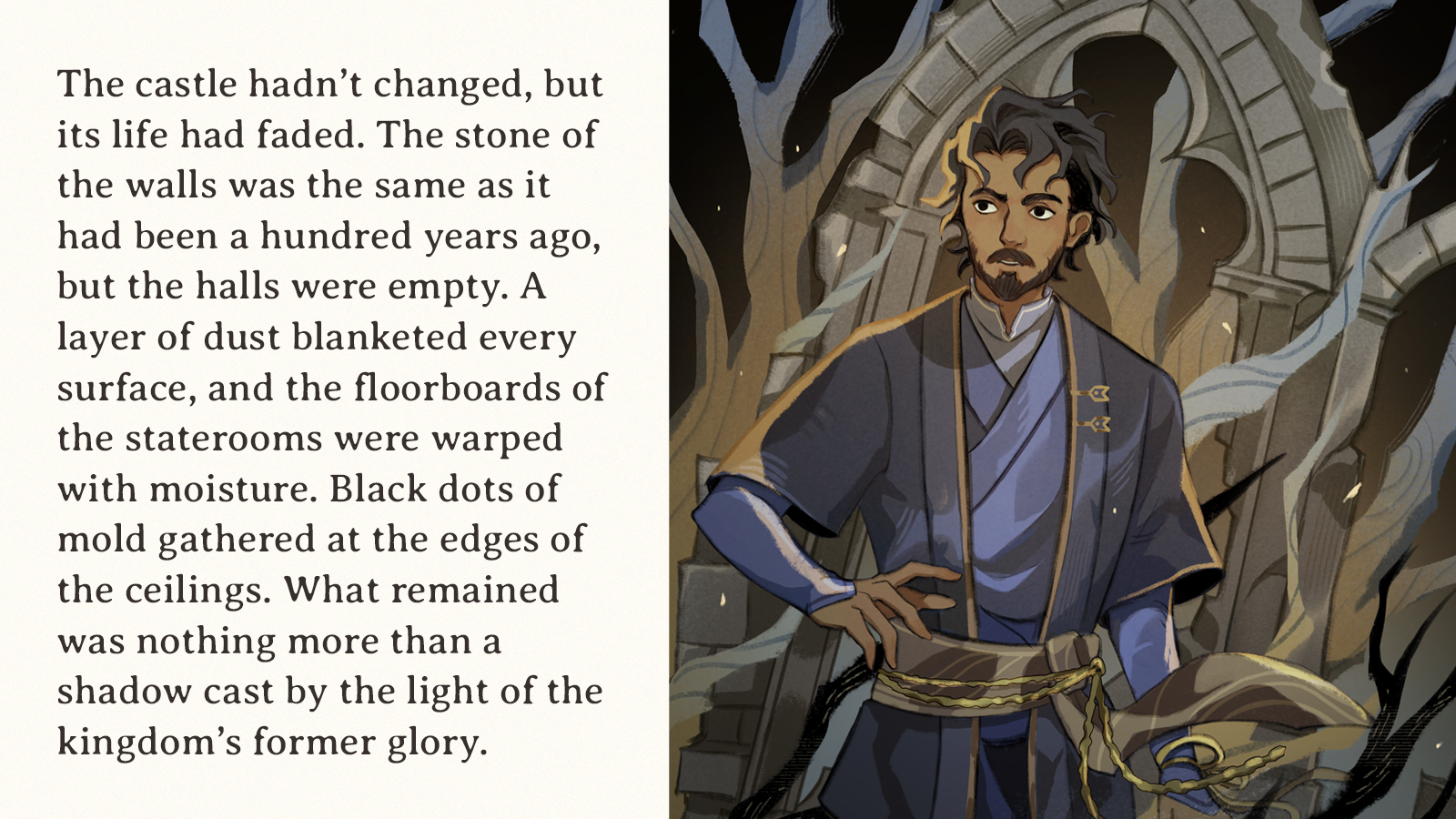
The portrait of Fhiad in the chapter preview was created by the heroic Silverpeel, a fantasy artist with a gothic flair. You can see more of Peel’s illustrations of knights and forests and gods and legends on Instagram (here), on Bluesky (here), and on Tumblr (here).

An Unfound Door, Chapter Six

The summer court opens with a celebration attended by the wealthy families and nobility of Faloren. After the ailing king retires for the evening, Agnes is introduced to Fhiad, who claims to be a university student from Cretia studying architecture. Later, when Agnes escapes to a shadowy corner for a moment of quiet, Fhiad approaches her and quickly becomes cruel and insulting. He tells Agnes that his homeland of Erdbhein has been destroyed, and he declares his intention to take revenge by visiting the same ruin on Faloren by finding Soreiya’s Tear, the legendary relic he was once accused of stealing.

. . . . . . . . . . . . . . . . . . . . .

This chapter is the transition between Act One and Act Two. Fhiad has returned, and he establishes himself as an antagonist. He states his goal to uncover a magical artifact with the intention of destroying Agnes’s kingdom. Fhiad’s anger is not the real problem, however, and it will Agnes’s goal to find a means of addressing the atrocity he survived.

It’s always bothered me when a villain is angry about something legitimately upsetting, but then the writer has this character kick a puppy to show that their anger is bad. What I mean by “kicking a puppy” is that the villain will do something excessively violent or disturbing that is either entirely out of character or framed in such a way as to make their actions seem irrational and done solely for the sake of being evil.

A villain typically represents a challenge to an established order, especially an order built on arbitrary divisions that inform a hierarchy. In the case of fantasy, there is often a class of “monsters” who are sentient yet still positioned as being okay to kill. When a villain wants to establish an alternate power structure in which “monsters” are not killed, it’s only natural to wonder if they might indeed be justified in doing so. The villain must therefore be shown kicking a proverbial puppy so that we do not begin to feel sympathy for them. Based on my observations of various fandom discourse wars, a surprising number of people take this puppy kicking very seriously as an indication that a villain is irredeemably evil.

It’s important to me that Fhiad is portrayed as a legitimate antagonist, at least at first. In this chapter, he proves himself to be two-faced, manipulative, and more than a little creepy. He invades Agnes’s personal space, physically threatens her, and mocks and insults her. He verbally attacks her at a vulnerable moment, and he says horrible things that are all the more hurtful because they’re true. Even worse, he’s cruel to Agnes precisely because he knows she can do nothing to stop him. In addition, it’s implied that he may no longer be entirely human.

Regardless, the root cause of Agnes’s problem – the decline of her kingdom – is not Fhiad, nor is it anything he’s said or done in the past or the present. Rather, this problem is a direct result of a horrible atrocity committed in the past by Agnes’s ancestor. I therefore had to make sure that what Fhiad does at the beginning of Act Two is upsetting but doesn’t fall to the level of puppy kicking. In other words, I attempted to create tension by means of the antagonist’s bad behavior while still being fair to the complexity of his character and his experience of justified anger.

Meanwhile, surrounding both of these characters is the opening of the summer court, a lavish gathering that offers a possibility of what Faloren could be if the kingdom weren’t in decline. Despite the good cheer of the party, Agnes is acutely uncomfortable in her role as a princess. Her keen displeasure in being made an object of display is a window into her essential character, as well as foreshadowing for the development of her story.

The illustration that accompanies the chapter preview was created by Arte072, a fantasy artist inspired by medieval fashion and illuminated manuscripts. You can find their work on Instagram (here) and on Tumblr (here).

An Unfound Door, Chapter Five

Agnes rises early the next morning in order to attend to the correspondence that has accumulated in her absence. As she dresses, she reflects on how her mother’s charm and social grace slowed her kingdom’s decline. Unfortunately, her father has done nothing to alleviate the grim atmosphere pervading the castle since the queen’s death.

Agnes proceeds to her study, a dilapidated yet still handsome room where she secludes herself to work. She is interrupted by her cousin Galien, who encourages her to open the summer court. Agnes agrees, believing that a large and lively celebration will be an appropriate symbolic marker of her vow to rejuvenate the kingdom.   

. . . . . . . . . . . . . . . . . . . . .

This chapter is about Agnes’s comfortable existence in the status-quo world. It is indeed a very comfortable and cozy chapter, and I enjoyed writing it.

Aside from establishing the scene of the next chapter, which will be the opening of the summer court, not much happens here. As I wrote in my notes for the previous chapter, it’s important for the reader to understand why Agnes is willing to remain content with the status quo.

It seems as though Agnes is doing useful work and making actionable plans for the future, but none of this actually means anything. An astute reader should be asking the questions that Agnes is aggressively ignoring: How did she find herself out in the woods on the border of her kingdom? Where did the demon come from? Who kidnapped her? Was it someone in the castle? Are they still there?

Agnes needs to start asking herself these questions soon, because Fhiad is going to come back and cause trouble. For the time being, though, it’s nice to have a small interlude of peace.  

I recently read a Tumblr post (here) regarding how the Gothic genre is all about taking four pages to describe a staircase, and there’s a bit of that in this chapter. I want the reader to see how shabby and decrepit Agnes’s castle is, and I want there to be an opportunity to enjoy the comfortable aspects of this state of decay.

All of the chapters in An Unfound Door have titles, by the way. I’m not sure if I’ll end up using them, but I especially like the title for this chapter, “A Slow and Silent Decay.”

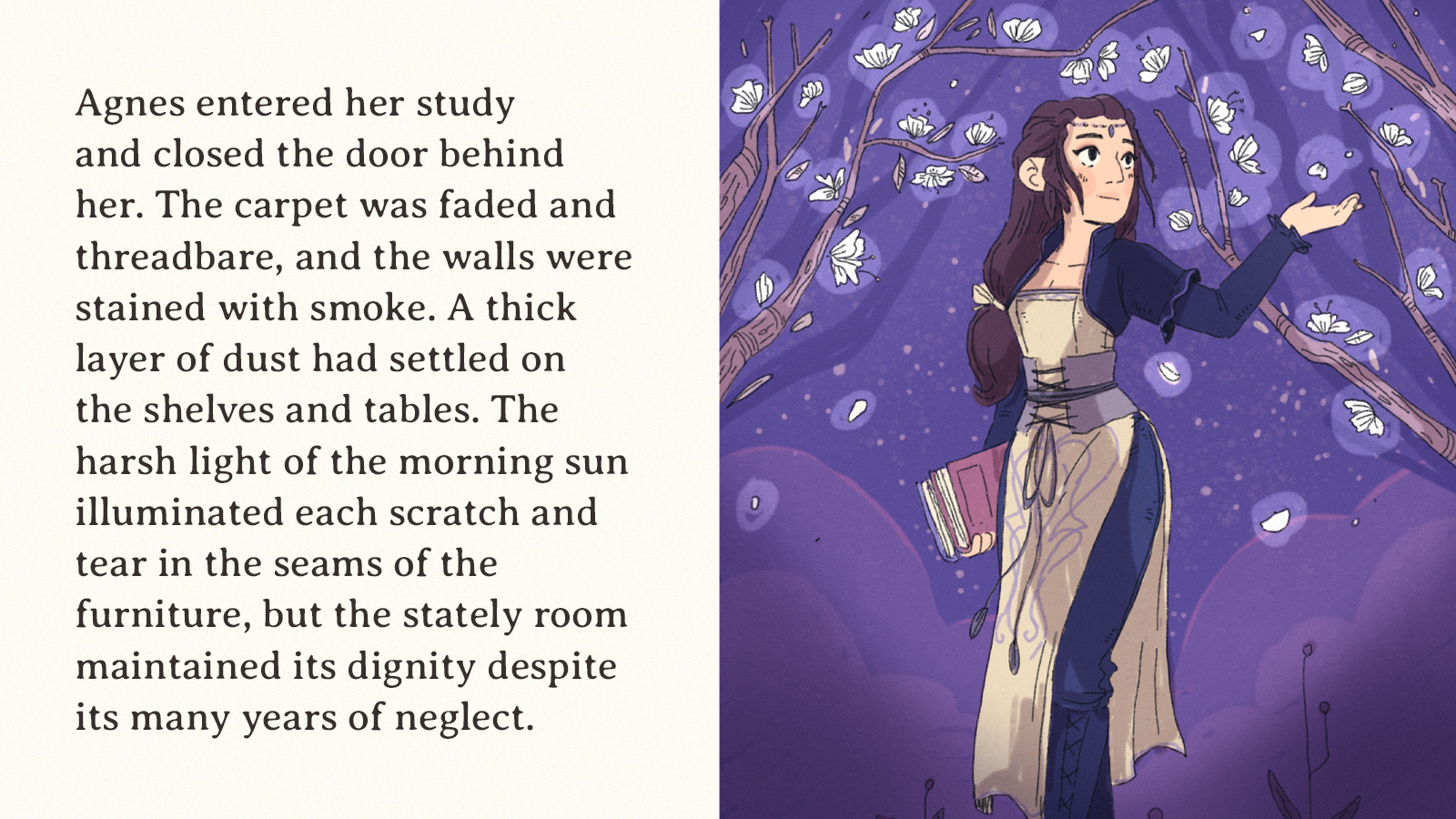
The illustration of Agnes that accompanies the chapter preview was created by the fantasy artist and gentle wizard Madeline Hale, whose colorful and whimsical character designs can be found on Instagram (here) and on on Bluesky (here).