Cross the Moon

Cross the Moon is a visual horror novel about a near-future dystopia in which a fraction of the moon has shattered, an event concomitant to the appearance of vampires. No one knows why people suddenly began displaying symptoms of vampirism, but those affected have become a disadvantaged underclass of society.

The game’s story follows two mixed-race vampire siblings and a Japanese detective through the streets of L’Amour, a French city that hosts the headquarters of a corporation called bloodFLOW, a leading producer of artificial blood and scientific research relating to vampires. Although Cross the Moon begins as a murder mystery, it gradually expands into the territory of cosmic horror.  

The beginning is standard vampire fare. The player is introduced to a high school student named Lux who is hanging out at a bar and fishing for someone who will consent to share their blood. Lux is essentially a good kid and thinks this is a bad idea, but he’s acting on behalf of his crush Apollon, who seems to be in thrall to his girlfriend, a manic pixie femme fatale named Corentine. Unfortunately for the trio, the man they seduce is found dead the next morning, and Apollon is charged with murder. In an attempt to clear his friend’s name, Lux ends up becoming involved with the vampire underworld, where he learns that Corentine is not an ordinary high school student – nor is Apollon.

This YA narrative is complicated by the interwoven story of Lux’s adult sister Aurore, who has managed to land an interview for a prestigious job at bloodFLOW. Her intake interview is weird, the job she’s asked to do is bizarre, and her coworkers are more than a little strange. She isn’t a big fan of the company itself, which she knows is exploiting the vampire population. Still, Aurore has grown up watching her working-class parents struggle, and she’s willing to do whatever it takes to give herself and her family a better life. Unfortunately, this leads her to sign a non-disclosure agreement regarding corporate secrets that turn out to be far beyond anything she imagined.

Meanwhile, Yoko has just transferred into L’Amour’s police force as part of an exchange program meant to facilitate cross-cultural communication regarding vampire-related policies and best practices. Due to the timing of her arrival, she’s immediately dropped into the investigation of the gruesome murder supposedly committed by Apollon. She strongly suspects Apollon is innocent, which convinces her to dig deeper into why a random teenage boy is being framed. This in turn leads her to the main mystery of Cross the Moon – what’s going on with bloodFLOW? What does the company have hidden under its corporate offices, and why does Yoko feel so compelled to pry into its secrets?

Cross the Moon is more of a graphic novel than a game. The only interactive element is the option to save your progress, and the story is completely linear. Although Cross the Moon is formatted as a visual novel, with long horizontal text boxes overlaid onto the bottom of a single full-screen image, it’s not a “game” in any meaningful sense. There are no branching paths, and there’s only one ending. There’s no animation or voice acting, and the character art assets are fairly limited. Cross the Moon is also quite long, promising at least seven or eight hours of reading.

The story starts off slow. I’m afraid this may put off many players used to flashy video game opening sequences, but it’s a pitch-perfect opening to a horror novel. This is how almost every Stephen King novel works, after all – the world needs to be built before it’s destroyed, and the reader needs to learn to care about the characters before they start to find themselves in serious trouble. Through the mundane details of the everyday lives of the characters, the player gradually builds an understanding of how the society of L’Amour operates, which makes the final horrific reveals all the more dramatic.

The author is sensitive to inequalities concerning race, class, and gender, but it’s worth mentioning that the game’s take on vampirism is its own thing and not analogous to any real-world identity. The minority status of vampires is informed by real-world politics, but Cross the Moon takes the concept in a creative and unexpected direction. I have to admit that I’m not a particular fan of vampires, but I found myself growing progressively more curious about how vampirism operates in the world of the game, as well as how it originated.

(By the way, if you’ve been reading between the lines of this review and have come to the conclusion that the ethically dubious corporation created vampires, that’s not what’s happening. This story has layers of progressively deepening strangeness, and it absolutely doesn’t go where you expect it to.)

The worldbuilding of Cross the Moon is enhanced by its visual style. The soft grayscale character art pops against the super-saturated backgrounds, which are composed of photographs overlaid with high-contrast color filters. I know this sounds like Baby’s First Photoshop, but it’s remarkably well done and extremely stylish. As I mentioned earlier, the character art assets are limited, so the player is occasionally asked to suspend disbelief while, for example, a character lies in a hospital bed in a full suit. For the most part, the graphics contribute a great deal of atmosphere to the story, as does the ambient music. The game contains some uncomfortably gory and deliciously creepy moments, and there’s a jump scare toward the end that really got me.

If reading a lengthy mature-audience horror story in the form of a visual novel sounds like a chore, then Cross the Moon probably isn’t for you. Speaking personally, I always find myself getting annoyed by extraneous gameplay elements in visual novels, so what Cross the Moon is doing is perfect for me. I read it on my Nintendo Switch between sessions with more action-oriented games, and I very much enjoyed myself. I’m intrigued by the potential of this hybrid medium of storytelling, and I’d love to see more “visual novels” that are in fact genuine novels intended for adult readers.
Reminiscence in the Night

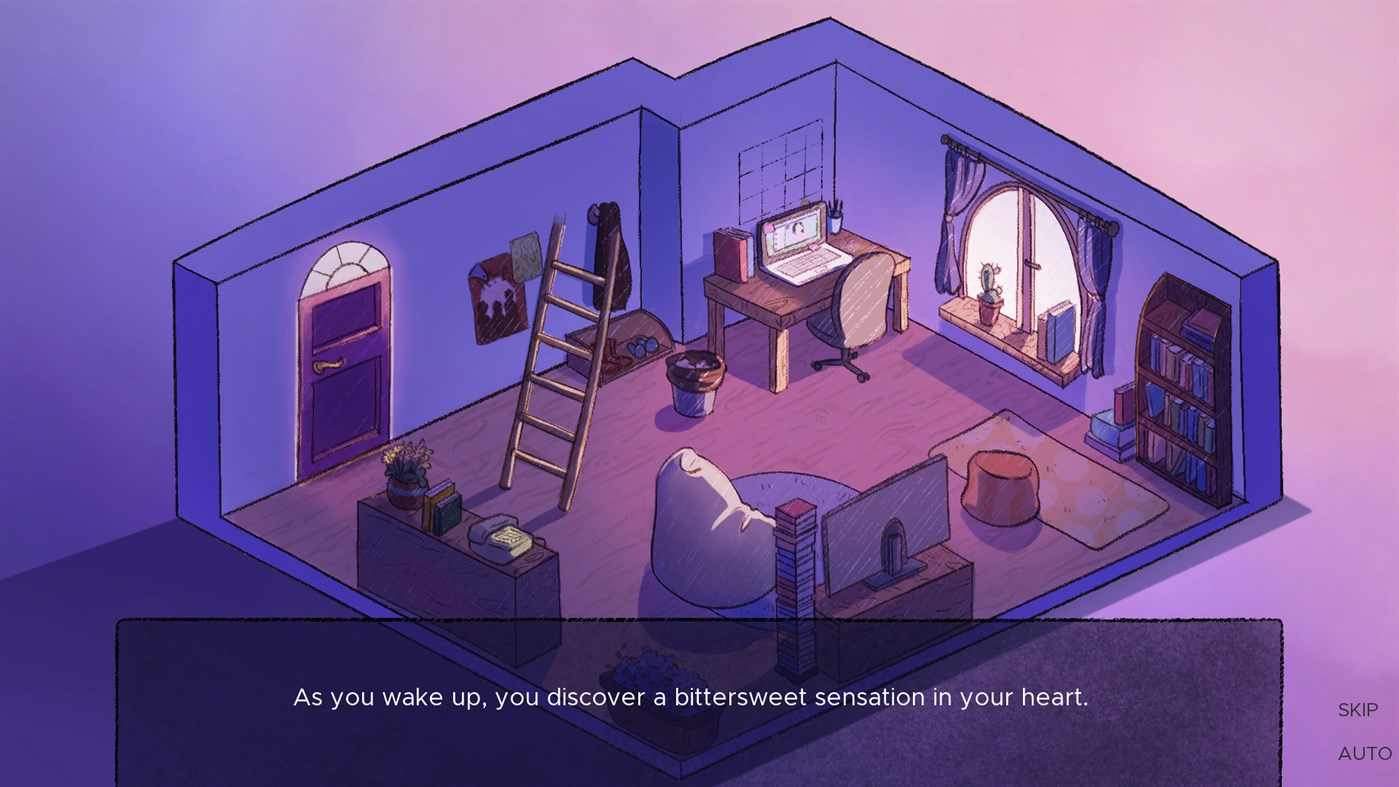
Reminiscence in the Night is a short point-and-click story game that takes place in the two-room apartment of someone with serious depression. It has multiple endings, and it takes about half an hour to play.

At the beginning of the game, your character wakes up in their apartment with no memories, and they can’t (or won’t) go outside. Their only clues to their identity are their mother, who calls on the phone, and their childhood friend Sofia, whom they can video chat with on their computer. Unfortunately, their mother is suffering from a memory disorder, and things are a bit awkward with Sofia.

The controls are simple and easy, but there isn’t much to interact with. The endings aren’t broadcast, and the dialog choices seem arbitrary. Unless you use a walkthrough, you’re probably not getting out of the apartment.

The game’s soft pastel graphics are cute, but its themes are very dark, and there are mild elements of horror. It’s difficult to understand exactly what happens if you get the bad ending, but either a ghost that lives in your mirror attacks and destroys you, or the ghost is metaphorical and you commit suicide.

The good endings are a bit more interesting, but you can only unlock them through an exact series of specific choices. If you happen to choose the “wrong” response to Sofia during your first conversation – which is, again, not broadcast at all – you’re almost certainly going to get the bad ending.

I’m not sure how well this arbitrariness works as a narrative device; but, if you’re willing to accept Reminiscence in the Night as a horror game with a dark ending, it’s an entertaining way to spend half an hour. It’s going for $3 on the Nintendo Switch store, and I’d say it’s worth it.

I’m intrigued by Team SolEtude, the studio that developed Reminiscence in the Night. They’ve got about half a dozen free games up on Itchio, and I’m definitely interested in playing more of their work.

Spirit Hunter: NG

Spirit Hunter: NG is a 2018 visual horror novel about the urban legends that come out after dark in a sleepy Tokyo suburb. You play as Akira Kijima, a 17-year-old delinquent whose young cousin has been captured by a spirit named Kakuya. Kakuya challenges Akira to a game, promising that she will return his cousin if he manages to confront a series of monsters local to the neighborhood of Kissouji.

The overarching story of Kakuya’s game is somewhat silly, as are the protagonist and supporting characters. The stars of the game are the urban legends that form the core of each of the seven chapters. As far as I can tell, these urban legends are all original, and it’s a lot of fun to slowly gather the details of the stories. The monster artwork is very creative and very gruesome, while the scenes depicting the monsters’ victims are horrible, explicit, and intense. There are no jump scares, but I was genuinely shocked by some of the deaths.

The gameplay is simple. You investigate your environment by shining your flashlight on objects embedded in the background artwork, and you collect various odds and ends that you use to solve simple puzzles. You’ll occasionally find yourself in life-or-death encounters with monsters who want to kill you, as well as overzealous police who will end your adventure early by arresting you. During these encounters, you’re presented with a timed series of dialog choices, and you’ll receive an instant “game over” if you select incorrectly.

Unfortunately, you can only save at certain points, meaning that you may have to replay an entire extended encounter sequence if you mess up. It’s possible to speed through previously read text, but I became so frustrated by an early-game confrontation that I started using a walkthrough to help make the gameplay a bit smoother. Although most of the puzzles and dialog choices are self-explanatory, others can feel entirely random. Still, if you don’t mind consulting a walkthrough before you play through the monster encounter sequences, the story flows smoothly, and the exploration elements are enjoyable and fairly intuitive.  

NG has “good,” “bad,” and “normal” endings based on whether you treat the monsters with violence or compassion. Other than that, there don’t seem to be any branching paths, and your choices don’t have anything more than minor cosmetic effects on the story. You can raise the level of affection that the named NPCs feel toward you, but this doesn’t seem to affect anything other than a few throwaway lines of dialog.

The game also includes a few sidequests that involve solving simple riddles to find D-Cards, trading cards that contain information on bonus urban legends with marginal connections to the main plot. These sidequests give the player an opportunity to explore the environment with a greater attention to detail, and the cards showcase some of the most interesting writing in the game. None of this card collecting is mandatory, but it’s nice to have an excuse to walk around the Tokyo suburbs late at night when all the sources of light are artificial and vaguely eerie by default. The atmospheric sound design is excellent as well, and it’s a pleasure to listen to your character’s footsteps echoing on concrete against a backdrop of city traffic, buzzing streetlights, and convenience store chimes.

If you use a walkthrough to progress smoothly through the confrontations with monsters, NG takes about fifteen hours to complete, and it’s easy to get sucked into the story. All of the urban legends are fascinating, and the game has a fairly progressive worldview on corporate violence, corrupt law enforcement, and the ways in which wealth and power facilitate the “othering” of people who are different. NG isn’t misogynistic or gross about its female characters, and there’s no sexual violence or lolicon.

All but one of the urban legend monsters are female, and NG is a treasure trove of themes and imagery to anyone interested in the intersections between gender and horror. The mystery at the core of the overarching story is tied both to real Shintō traditions and to real urban legends about (hopefully fictional) Shintō traditions, so there are a few extra layers of the narrative that players familiar with Japanese religion and folklore will be able to appreciate and enjoy.  

I definitely wouldn’t recommend NG to anyone who can’t handle graphic R-rated horror, but it’s visually striking and thematically satisfying. I respect and admire the game’s creepy demonic women, and I gradually came to sympathize with a few of the monstrous male characters as well. NG is so rich in narrative detail that it would be a fun game to write an in-depth academic research paper about… and who knows, I might even write this paper myself!

World End Syndrome

World End Syndrome is a visual novel about a small seaside town with dark secrets. It’s structured like a dating sim, and you have to romance each of the five datable characters if you want to unlock the “true ending” that answers all the questions about the overarching mystery. Thankfully, the dating sim elements are relatively undemanding. There aren’t a lot of dialog options, and the gameplay mainly involves choosing which location to visit on each day during the month of August.

I know this will be a deal-breaker for some people, so I should say at the beginning that there’s some mandatory incest in this game. But it’s sort of okay because of plot reasons? As far as dating sim incest goes, the relationships in World End Syndrome didn’t particularly creep me out. It’s honestly not that big of a deal, especially not in a game that would be PG-rated were it not for the occasional murder, but your mileage may vary.

As the nameless protagonist, you move to the small seaside town of Mihate to live with your cousin following the death of your sister in a car accident. You and your cousin are in the same class in high school, and your homeroom teacher is a folklore scholar who just published a bestselling YA romance novel. The novel is called World End Syndrome, and it’s based on the Mihate legend of the Yomibito, a dead person who returns to life but doesn’t know they’re dead.

There are strong “Bruce Willis at the end of Sixth Sense” vibes surrounding the protagonist at the beginning, but he turns out to be very much alive – at least until he gets murdered at the end of the prologue. This is the game’s official “worst ending,” and you have to start over from the beginning and make a different choice at a crucial point to progress. In order to avoid being murdered, you have to form an emotional bond one of the girls in your class. Successfully doing so for the first time leads you to an ending that, while satisfying in and of itself, does nothing to explain what the deal is with Mihate and its spooky legends.

It would be tedious to explain the details, but World End Syndrome has an interesting system of unlocking various scenes and dialog choices based on the number of previously completed interactions. Your cumulative progress carries over between saves, even when you’re hopping from one save file to another on the same romance route. What this means is that each playthrough is going to be different, even during repeated scenes. Your first full playthrough will tell a fairly straightforward story about a high school romance that’s sweet despite having hints of darkness, but on subsequent playthroughs you’ll begin to realize that there’s something very weird going on in Mihate. World End Syndrome isn’t really a horror game, as it’s not gruesome and doesn’t go out of its way to be upsetting, but it turns out to be an intriguing supernatural mystery.

The character art of the girls is very cute, the character art of the boys is very over-the-top silly, and the environmental art is absolutely gorgeous. Although there’s nothing special about the writing on a line-by-line basis, the translation is solid and pleasant to read.

What helps World End Syndrome stand out is the voice acting and sound design. I don’t have the vocabulary to describe what makes the audio elements of the game so appealing, save to say that the quality of the recording is excellent. There’s a lovely in-game radio broadcast that allowed me to finally understand the appeal of ASMR, and I think the sound quality is something you can appreciate even without knowledge of Japanese. The game gives you a lot of control over the sound channels, and you can turn down or even mute the voice acting if you prefer.

I was on the fence about World End Syndrome, as I was dubious about a game that wants you to play the same story six or seven times, but I’m glad I gave it a chance. If you’re only interested in one playthrough, that’s perfectly fine. It takes about ten to twelve hours to get from the beginning to the first character-specific “good ending,” which is a respectable length for a visual novel. Even if you don’t have the patience to solve the mysteries of Mihate, it’s a lot of fun to explore the town, attend club activities, and go on dates while there are dead people (and possibly a cult) wandering around and killing people in the background.

Carpe Noctem

Carpe Noctem: Vampires Through the Ages is an anthology of original art, comics, and historical fiction about vampires around the world. The backer campaign lasts until Saturday, December 11, and you can read about the project and order a copy of the book on Kickstarter (here). Carpe Noctem was fully funded in three days, and four stretch goals have been unlocked since then. You can check out contributor bios, merch illustrations, and previews of art and writing on the project’s Twitter account (here).

I’m contributing a short story about a Heian-period vampire titled “The Kumo Diary,” which follows a Meiji-era scholar’s assistant who discovers an old manuscript that she initially mistakes as a lost chapter from The Tale of Genji. Along with The Tale of Genji, I’ve drawn inspiration from Ryunosuke Akutagawa’s short story “Rashomon” and Fumiko Enchi’s eerie postwar novel Masks. In the excerpt above, you can see my homage to a fictional essay in Masks called “An Account of the Shrine in the Fields.” It was a lot of fun to write about Heian-period demonic women, and I also enjoyed doing research in order to put together the Meiji-period frame story. I’m very proud of the ending, and I hope readers will get a pleasant chill from the gradual transformation of the two narrators’ distinctive voices.

Carpe Noctem is scheduled to be published in August 2022. You can back the Kickstarter campaign to pre-order a copy of the anthology along with a collection of the dark and stylish merch created as a promotion. There’s a special NSFW zine and a bonus story told through a collection of physical documents that are exclusive to the Kickstarer campaign, so please check it out if you’re interested!

Flowerblight Ganon

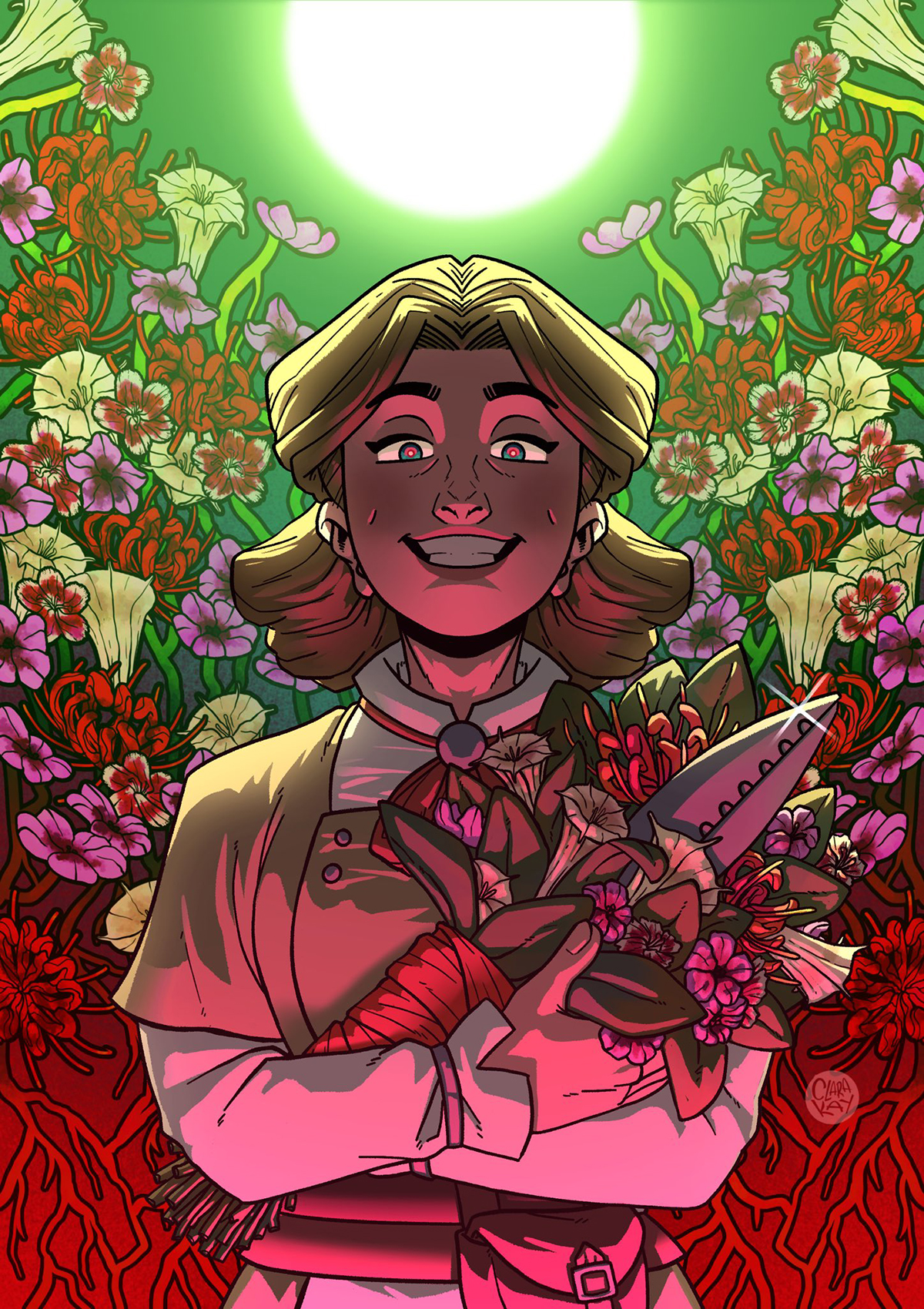
I posted a short story on AO3 (here) about a minor character in Breath of the Wild named Magda, who is affectionately known by the fandom as “Flowerblight Ganon.”

In Breath of the Wild, Malice is a tangible substance that infests objects and locations controlled by Ganon, including the four Divine Beasts, Hyrule Castle, and the Akkala Citadel Ruins. It also infects the dragon spirit Lanayru who guards the Spring of Wisdom.

While writing this story, I wondered if it were possible for Malice to infect regular people. If so, the woman who zealously guards the garden of flowers surrounding Hila Rao Shrine is as good of a candidate as anyone.

The story illustration is by Clara Kay, whose gorgeously monstrous horror art can be found on Twitter (here) and on Instagram (here). I really enjoyed working with Clara, and I also want to give a shout-out to her store (here), which has all sorts of cool Legend of Zelda merch!

I’d like to share a bit of the artist’s description of this piece, because it’s fascinating:

There’s a lot of symbolism packed into the flowers here. The petunias (pink) represent anger and resentment, the devil’s trumpet (the tall white one) represents power and caution, the spider lily (big spiny red one) represents death and reincarnation, and the carnation (white with red ring) is considered the ‘flower of the gods’ and represents admiration, passion, and love.

Carnations represent “passion and love” because they’re thought to be white flowers dyed red with blood, which is entirely appropriate for this story. “Flowerblight Ganon” is my first foray into botanical horror, and I don’t think it’s necessary to be familiar with Breath of the Wild to understand what’s going on. Magda is a regular woman enjoying gardening, quiet living, and occasional tea with friends in a dying postapocalyptic world, and if she lives her best life by indulging in murder every once in a while, then at least her flowers are well fertilized.

Felis Decapoda

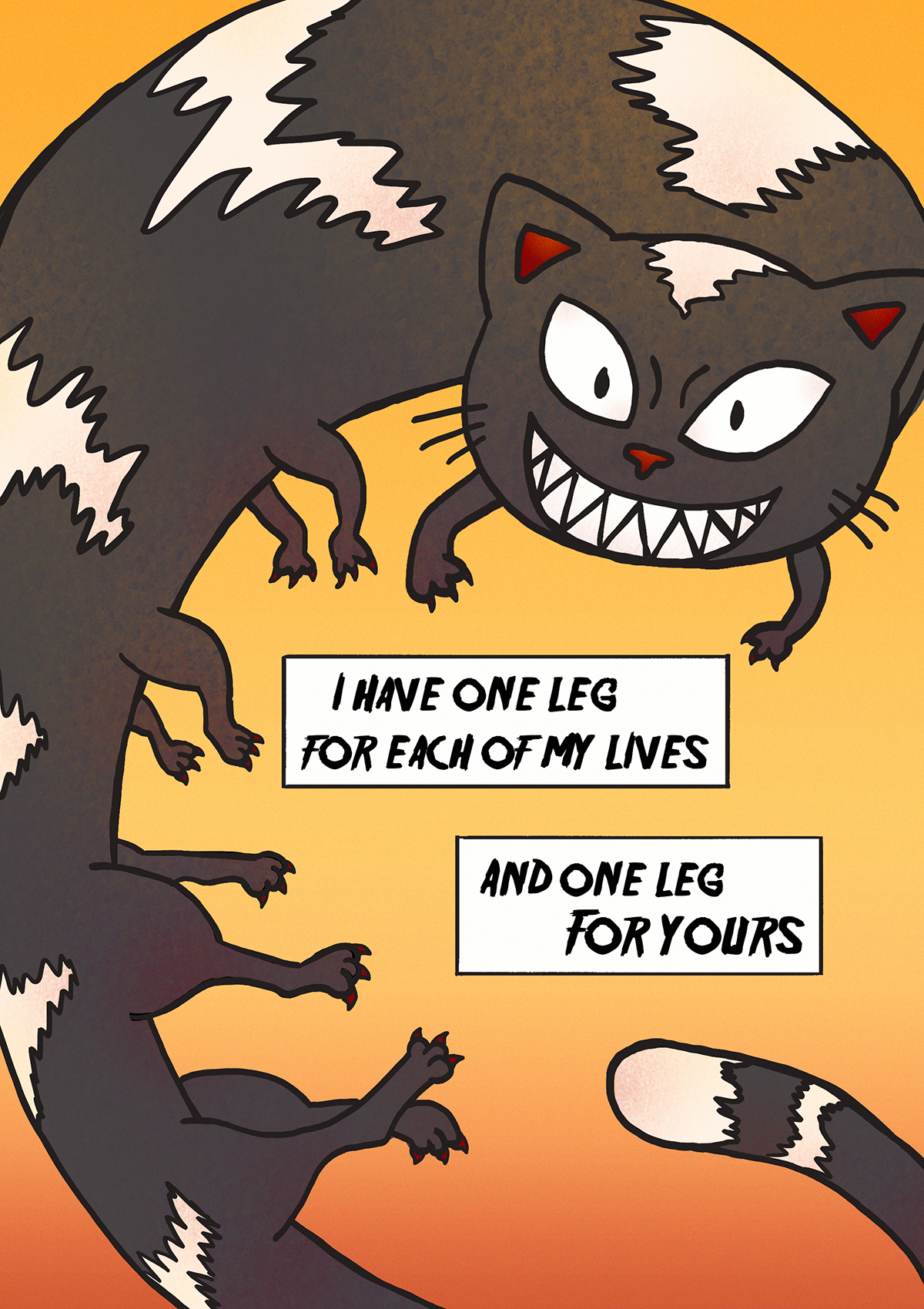
I spent part of my childhood in rural Georgia in an old farmhouse that my mother went into bankruptcy to refurbish and remodel. Along with antique furniture, my mother collected stray cats, and at several points we had more than two dozen roaming around the house and yard.

I know that living in an historic farmhouse filled with expensive furniture and cats sounds like a dream come true for many people, and presumably this was the case for my mother. For me, however, it was extremely uncomfortable. I could never sleep properly, and I used to have nightmares about the cats eating each other and merging into giant mega-cats with far too many legs.

I don’t have anything against cats, and I’d like to adopt one of my own one day, but for the time being I’m happy being a dog person.

The Ghost Shop

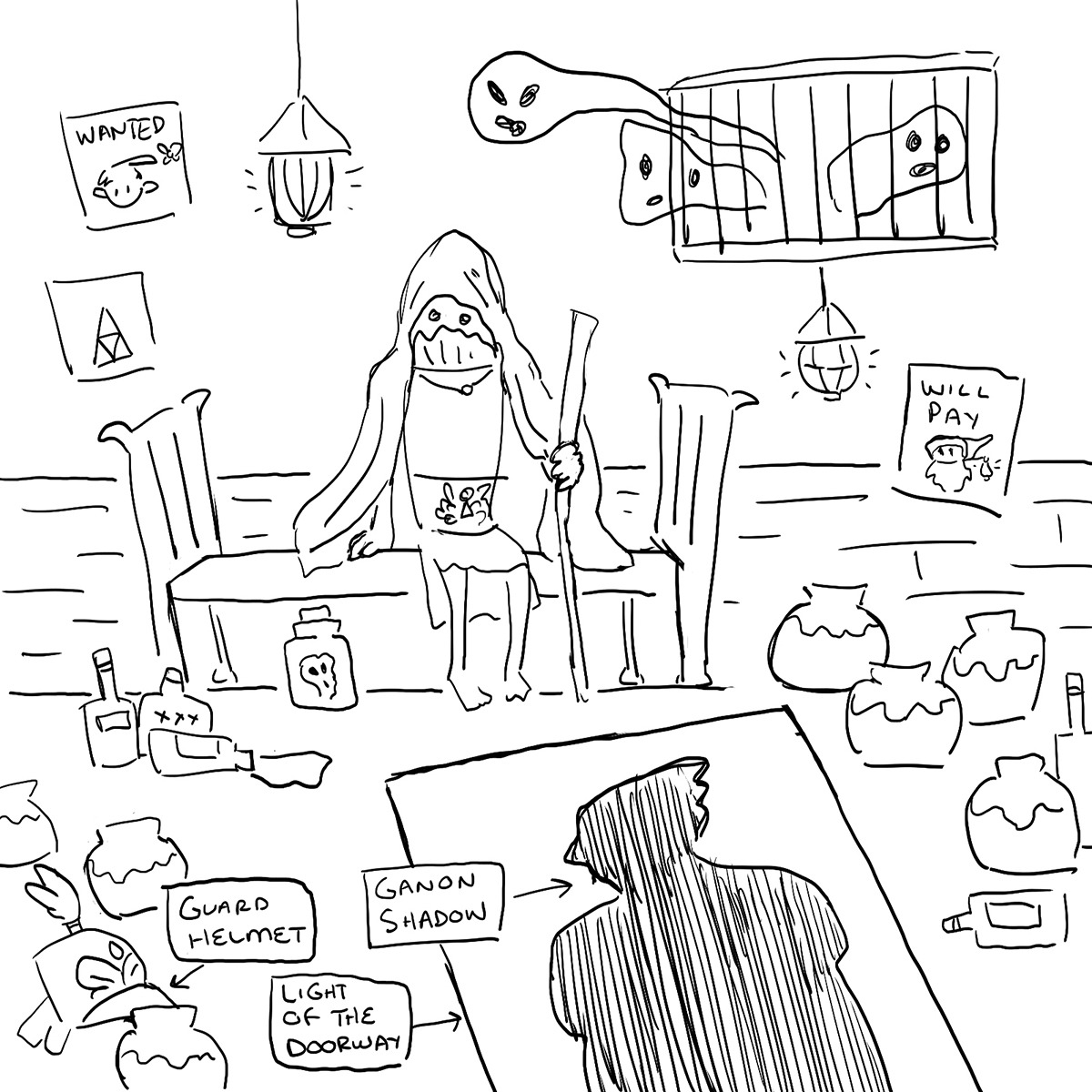
I just posted a short story about the Poe Collector in Ocarina of Time on AO3. It’s a spooky fandom treat for Halloween, and you can read it (here).

This story is about what it might have been like to live in Hyrule after the castle fell to Ganondorf, and I really enjoyed exploring the postapocalyptic environment. The story is also about standing up to power and the abuse of authority, even when it won’t benefit you in any way. Grand acts of heroism are all well and good, but it’s also nice to be too weird to care about what people think of you.

The illustration is by Frankiesbugs, whose creepy-cute art you can find on Instagram (here) and on Tumblr (here). They actually created two color variations, the one with the Halloween-inspired palette that I posted above, and a more Film Noir style version that I posted along with the fic on AO3 – and that they posted on Tumblr (here). It was difficult to choose between such gorgeous and stylish pieces! If you’d like to get a better understanding of just how brilliant Frankiesbugs is, you can check out the concept sketch I sent them (here). This artist’s illustrations have been one of my primary inspirations in writing Legend of Zelda horror stories, and it’s always a pleasure to work with them. You can read some of the horror-themed comics we’ve created together (here) and (here).

Mount Hiei

My story “Mount Hiei,” a dark fantasy about two young monks navigating the eerie twilight years of the Heian period, was just published in Hyakumonogatari Kaidankai, a special issue of the journal White Enso. The issue is currently ongoing and free to read online (here), and “Mount Hiei” is on (this page).

In this story, a ten-year-old boy becomes an apprentice monk on Mount Hiei, which houses a temple that has been tasked with protecting the nation. The boy grows accustomed to monastic life but never becomes comfortable with the statues of the monstrous Guardian King venerated by the other monks. When he discovers a secret door leading into the mountain, he comes to understand why the deity is depicted in such a frightening manner – as well as what “protecting the nation” actually entails.

Mount Hiei is a real place, as is Enryaku Temple, which serves as the setting of this historical horror story. To the best of my knowledge, the practical details of monastic life are accurate for the time period. I was inspired by the fiction of the Japanese author Ken Asamatsu, who applies a Lovecraftian sensibility to Japanese mythology and folklore, and I wrote this story from a place of admiration and respect for the medieval war epic The Tales of the Heike, on which it’s very loosely based.

By the way, the editors of White Enso are still looking for personal essays and original fiction for the 100 Ghost Stories Kaidankai project. Although they’re selective, they accept shorter and more casual pieces, and the submission process is very chill and relaxed. The editors are a pleasure to work with, and they’ll also create a podcast recording of your writing! If you’re interested, you can send your submission (here).

How to Board the West Philly Ghost Bus

(1)  It needs to be after dark.
(2)  You should be standing at a bus stop.
(3)  You need to be horribly, desperately lonely.
(4)  You can’t have a specific destination in mind.
(5)  You’ll see a bus with no route number on the display.
(6)  It will slow down but not stop, so you need to chase it.
(7)  You probably won’t catch it, but if you do…
(8)  The driver will let you on without asking you to pay.
(9)  You’ve made it this far. You might as well sit down.

I’ve recently found myself asking people I meet in West Philadelphia if they know any urban legends. Most of what I’ve heard are rumors about real people who have become local characters or stories about bodies being buried under public places. (Because Philadelphia is a relatively old city, the stories about buried bodies are mostly true!) A few people also told me about a ghostly SEPTA bus, which is famous enough to be mentioned a few times online.

According to the stories I’ve heard from university students and friendly strangers I’ve spoken with at local bars, the ghost SEPTA bus picks up people late at night, but only if they have nowhere to go and no one to miss them once they disappear onto the bus. 

There are actually a number of non-supernatural SEPTA buses that drive back along their routes through West Philly when they aren’t in service, and I occasionally see them pick up city maintenance workers and hospital staff late at night. What’s different about the ghost bus is what happens once you get on.

Apparently, there are three possibilities. The first is that the bus vanishes, and you’re never heard from again. The second is that you’re now trapped on the SEPTA bus along with the other desperate and unlucky souls who boarded before you. The third is that the bus travels back in time, albeit within a span limited to the history of the bus, and that you can signal the driver to stop when you’ve reached your desired destination in the past. 

The third possibility seems the most likely, as no one who has vanished or become trapped on the bus would be able to tell other people how this process works. Then again, it may be that a person who boards the mysterious SEPTA bus seems to vanish or sit in stasis from the perspective of someone who’s still in our timeline. There’s only one way to find out for sure…