Deadeus

Deadeus
https://izma.itch.io/deadeus

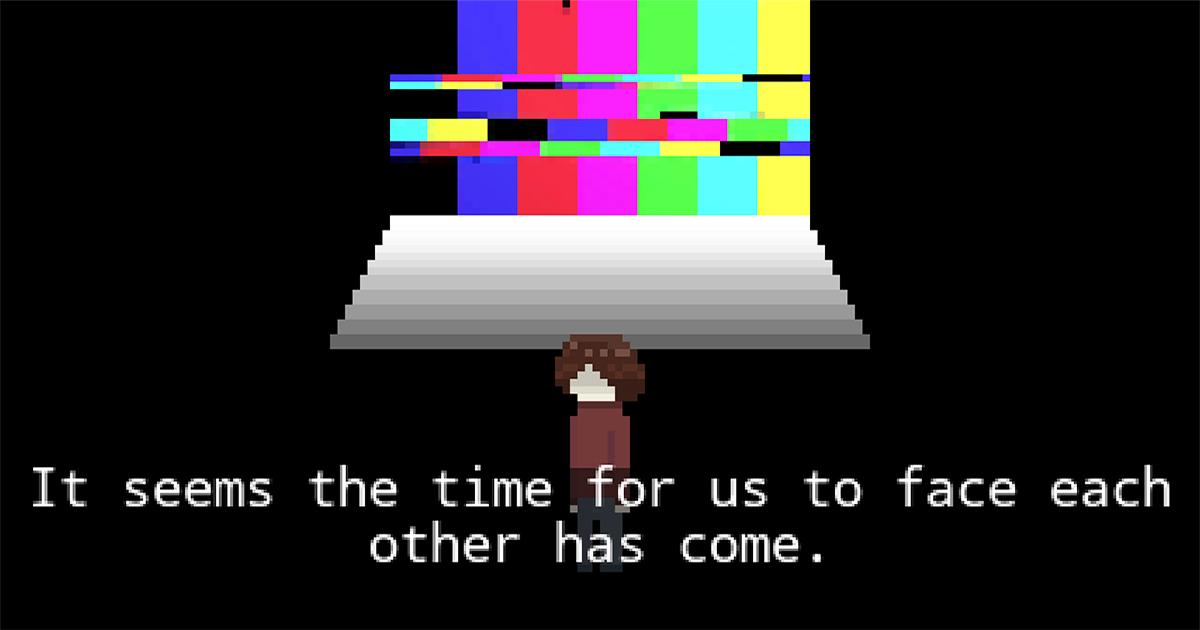
Deadeus is a retro Game Boy horror adventure game in which you have three days before the apocalypse. If you play the game straight, you quietly enjoy your remaining time in your small seaside town before climbing a scenic hilltop to watch the sky fall. If you discover the hidden passageway underneath the town church, however, you can join an evil cult and get the party started early.

You play as a young boy who lives with his mother. Attendance at the local school is voluntary, so you’re free to explore anywhere you like in your town, which is large but not unmanageably so. The town consists of about thirty screens (not including indoor areas), and you can pull up a map with Select if you need it. There are about forty people you can talk with, and their dialogue changes every day. There’s no time limit to these days, which end when you decide to go to bed. If you’re doing a pacifist run, it takes about twenty minutes to explore everything each day has to offer.

The premise of Deadeus is that all the town children are having bad dreams. In the first of these dreams, an eldritch horrorterror informs the children that it will manifest in three days. The town itself seems quaint and utopian; but, as you talk to people and read various documents in the library, you learn that the area has a dark history. There have been waves of unexplained disappearances, for instance, as well as a surprising number of attempted murders.  

If you want, you can steal a ceremonial knife from the town cult and attempt some murders yourself. The game subtly guides you in this direction, and this is where most of the potential gameplay lies.

Deadeus has eleven endings, and the more interesting of these endings involve killing people in specific ways. In order to get the most satisfying (by which I mean the most gruesome) ending, you need to play through the three days while collecting objects to use in a cult ritual.

Meanwhile, the most gameplay-intensive ending involves killing every single NPC in town without getting caught. Deadeus has no combat, so this is largely a matter of stealth and strategy. A few murders require you to be clever, and I enjoyed the challenge.

Still, you don’t have to hurt anyone, and the default ending of Deadeus stands on its own. I think this might actually be the ending I prefer, especially considering what you learn about yourself and your town.

If you make use of your Game Boy emulator’s Save State function, it takes about three hours to see everything there is to see in Deadeus. Some of the endings are much better than others, so I recommend consulting the list of endings (here) and following your heart. The spoiler-free town map (here) is also useful.

A lot of homebrew Game Boy horror games are rough around the edges, but Deadeus is extremely polished. The gameplay is great, the art is perfect, the writing is decent, and even the music choices are interesting. Despite the disturbing imagery, there are no jumpscares in the game, and it’s entirely up to the player how gory they want their experience to be. It’s also up to the player how much reading they want to do, and there’s a fair bit of text on offer if you’re into lore hunting.

And finally, I like how your character’s eyes seem to be bleeding throughout the entire game. Understated pixel horror is always appreciated.

The Mist

The Mist
https://yliader.itch.io/the-mist

The Mist is a Game Boy horror adventure game based on Cthulhu mythos and inspired by the 2019 movie The Lighthouse. Despite only consisting of about twenty side-scrolling screens, it’s an intricate game that takes around 40 to 45 minutes to finish.

You play as an old man sent to maintain an isolated lighthouse for two months. Your job is simple: keep the light at the top of the tower going, maintain the chapel, and don’t try to look for the body of the previous lighthouse keeper.

This potential gameplay loop is quickly interrupted when your character starts having strange dreams involving a sea monster calling him “son” and asking him to return to the ocean. Your character’s dreams become progressively stranger, and what you end up doing is completely neglecting the lighthouse as you poke around the tower to satisfy his curiosity.

About halfway through the game, you begin to navigate dream sequences as well as the waking world, and these dreams are a lot of fun. There are no jumpscares in the dreams, but there are a few (excellent) monster animations that you’re forced to watch become progressively more disturbing. In addition to the in-game cutscenes, there are about two dozen illustrations for longer conversations and reading passages. The pixel art in this game is wonderful, especially given the graphic limitations.

The Mist includes a few puzzle sequences, but these sequences mainly consist of figuring out what you need to do next. Given that your range of motion is limited, these “puzzles” can be solved by process of elimination. There’s one puzzle about thirty minutes into the game that might be a little frustrating, but the creator has embedded a full playthrough video in the game’s page on Itchio if you get stuck.

The creator of The Mist is French, which means two things. First, their English is a little off, but it’s off in a way that makes sense in French and is still completely comprehensible to English speakers. Second, their concept of Christianity is extremely Catholic, and it was amusing to me to imagine a grizzled New Englander consecrating an altar with wine and praying to various saints. It’s always interesting to see how other cultures interpret the Cthulhu mythos, and I unironically loved this.

The Mist loses its footing for a bit in the middle – especially around the puzzle I mentioned earlier – but it’s a neat piece of storytelling that creates an immersive environment at a slow but steady pace. Even if you’re not a Lovecraft fan, The Mist is an interesting and atmospheric game about slowly losing your mind on the fragile shell of land suspended above the massive horrors of the watery depths.

It’s Not Me, It’s My Basement

It’s Not Me, It’s My Basement
https://arcadekitten.itch.io/its-not-me-its-my-basement

It’s Not Me, It’s My Basement is an RPG Maker gothic horror game from 2021 along the lines of The Witch’s House and Mad Father. It takes about 35 minutes to finish, and it’s free to download from Itchio.

You play as a kid named Embry whose parents have been eaten by monsters. Embry has managed to padlock the basement door, but the monsters are constantly hungry. The player is therefore tasked with feeding the monsters so they don’t escape and eat Embry. The game consists of navigating between Embry’s kitchen and the town market while stopping at the basement door a few times along the way.

The story is divided into three days, during which food becomes progressively scarce and the monsters become increasingly hungry. Each night, after feeding the monsters, Embry has a dream. All three dreams end with an extremely mild jumpscare, but the game is more concerned with creating an oppressive atmosphere than it is with trying to shock you.

What I appreciate is that it’s unclear what the monsters are or where they came from, just as it’s occasionally unclear what Embry is feeding them. Although you have the choice to enter the basement in one of Embry’s dreams, you never learn exactly what’s going on down there, and sometimes not knowing is worse.

If you’re worried that I just spoiled the game, please don’t be. There’s a lot going on here.

The creator has a few shorter games available on Itchio, some of which are loosely connected through a shared universe. The reason I chose to play It’s Not Me, It’s My Basement is because this game has a surprisingly large online fandom. Seriously, it even has its own page on TV Tropes (here).

It’s Not Me, It’s My Basement feels a bit like Homestuck run through a few filters. Everything about this game is catnip for edgy tweens. Even if that doesn’t sound appealing to you, It’s Not Me, It’s My Basement presents an interesting and open-ended story, and the game is a fun experience that doesn’t bother the player with any puzzle elements that impede the flow – or the steadily mounting creepiness – of the delivery.

Lily’s Well

Lily’s Well
https://pureiceblue.itch.io/lilys-well

Lily’s Well is a lo-fi horror adventure game with a charming top-down NES aesthetic. You play as an anime girl named Lily who hears a voice calling for help from the well by her isolated cabin in the woods. Your job is to explore the house and its surroundings while collecting materials to make a rope. Depending on how many materials you assemble, you’ll be able to descend to a different level of the well. Each of the ten levels is its own horrible ending.

There are ten “good” materials and another five “bad” materials that you can find. If you incorporate a bad material into your rope, it will break. Lily will die, and you’ll have to start over again from the beginning. The game doesn’t signpost which materials are good or bad, so you have to go through them one by one and figure this out for yourself using the process of elimination. I got very frustrated very quickly, but this could have just been me being impatient.

I found the guide (here) to be extremely useful. This isn’t so much a walkthrough as it is a list of materials and a FAQ, and you’ll still have to put the pieces of the game together yourself. While using the guide, it took me about three hours to get all of the endings.

If you use the guide judiciously, you can finish the game in about 45 minutes. This involves spending 25 minutes to get to the bottom of the well, and another 20 minutes to explore what’s down there. Every other ending is an instant gruesome death for Lily, while the bottom of the well is essentially the second half of the game. In all fairness, the game’s true ending has a much better payoff if you die a few times first, and there are all sorts of fun little secrets to play with between runs, including certain events that only trigger on multiple playthroughs.

I said at the beginning that Lily’s Well has an NES aesthetic, but it’s really more of an early 1990s MS DOS game. The graphics are primitive, but the game uses them extremely well and puts a lot of care into the adventure elements. There’s all sorts of text for anything you care to interact with; and, if you’re patient, it’s possible to figure everything out on your own without using a guide.

The adventure game elements of Lily’s Well were hit-or-miss for me, and what I really enjoyed was the game’s dark humor. It was fun to see this cute anime girl die in all sorts of fun and creative ways, and I loved how over-the-top gruesome each ending is. I kept playing to dig deeper into the lore and see just how gleefully horrible Lily’s world could get under its placid surface, and I was not disappointed.

Leftovers

Leftovers
https://realmpact.itch.io/leftovers

Leftovers is a free narrative horror game that takes about 20 to 25 minutes to play. Your mother has ten servings of leftover food, and she wants you to deliver them to the other tenants of your rundown apartment building. As you might imagine, each of these tenants is super creepy.

You can answer the tenants’ questions by nodding or shaking your head, and “failing” the interaction will cause you to run home to the top floor. Your mother will get progressively angrier each time you return, and you’ll have to walk down all the flights of stairs again. My recommendation would be to set the camera at max speed before starting the game, as this can potentially save several minutes of stair climbing.   

The concept of Leftovers is great; but, as this was created for a game jam, it was made under time constraints. The 3D space of the apartment building is about as basic as it could be. There’s no background music, and there are only two or three instances of sound effects. Since you have to start over from the beginning so often, I wish there had been a few changes to the environment between runs.

Still, I had a lot of fun with Leftovers. The hand-drawn 2D character designs are great, as is the writing. I was impressed by how much story fit into just a few lines of dialogue, and I really enjoyed how the individual tenant stories gradually begin to fit together into a cohesive narrative. It’s definitely worth playing the game a second time in order to appreciate the story details and foreshadowing.

Leftovers stands well enough on its own as an experimental prototype, but I would love to see the developers return to the game and polish it into something stranger and gorier and even more disturbing.  

See You Soon

See You Soon
https://not-jacob.itch.io/see-you-soon

See You Soon is a free narrative horror game on Itchio that takes about seven minutes to play. You wake up in the middle of the night because the phone won’t stop ringing, a classic setup that takes an interesting turn. I can’t say much more without spoiling the surprise, but there’s a fun twist in the middle.

See You Soon has 2D graphics with very simple controls, and there are only four screens to navigate. There are two endings, and one of them results in a special surprise if you the launch the game again. That was delightful. Also, if you decide to let one of the monsters catch you, you get a fun little jump scare.

There’s a brief moment of tension when something starts (very slowly) chasing you, but I felt that See You Soon is more silly than spooky. The writing is a little awkward, but I found its earnestness to be almost wholesome. The simplistic pixel art is charming, and the monsters are kind of cute.

To me, See You Soon has the vibe of a chihuahua going aggro. Sure, it’s doing its best to be nasty and unpleasant, but it’s just a little guy. See You Soon is definitely a horror game and probably won’t appeal to people who aren’t fans of the genre, but it made me smile from start to finish.

As a sidenote: See You Soon opens with a content warning about flashing lights. I’m generally sensitive to such things, but nothing in this game gave me any trouble. There are no strobe effects, only quick jump cuts.

Ground Down

Ground Down
https://inverts.itch.io/ground-down

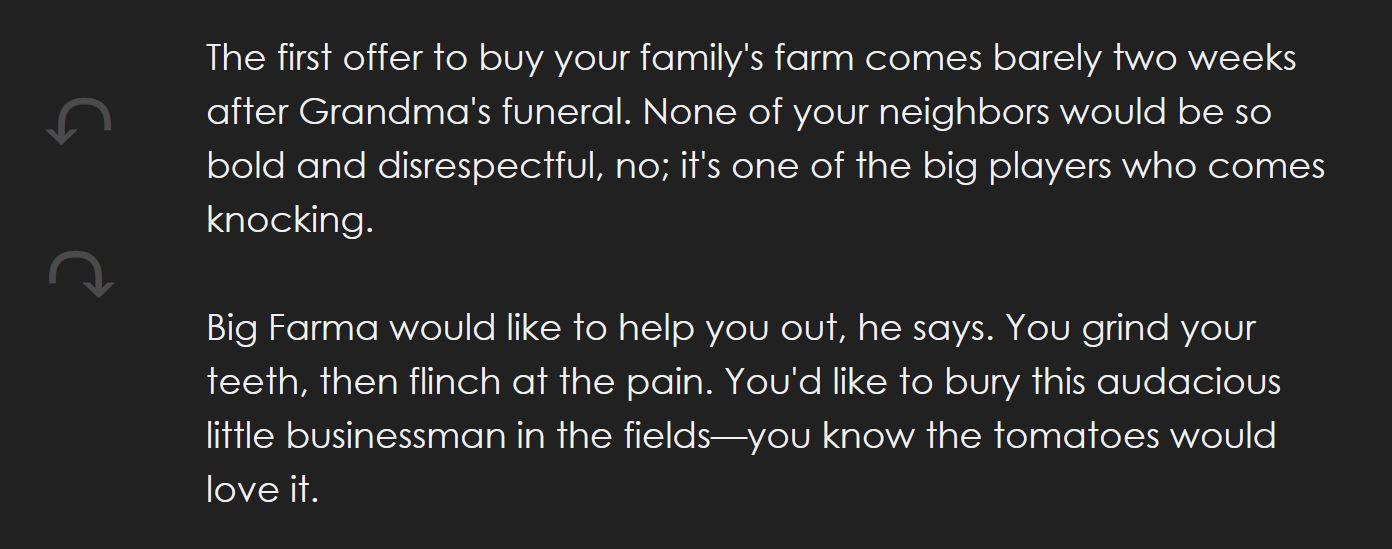
Ground Down is a short botanical horror story presented in the form of a Twine game. The player is occasionally offered choices concerning how to proceed, but there’s only one ending. Depending on your choices and your reading speed, I’d say Ground Down takes about ten to twenty minutes to finish.

You play as a young farmer whose grandmother has just passed away, leaving you the farm you’ve grown up on. You also have your grief, a house full of mementos, and debts to pay. On top of that, you’ve started to grind your teeth, but you have neither the time nor the money to visit a dentist.

I should say that, if you’re unusually squeamish about teeth, you might want to give this game a pass.

Personally speaking, I’m a little squeamish about teeth and dental pain in general, but I very much enjoyed this game. I felt some mild discomfort at the beginning, but the way the theme of “teeth as a symbol of agency” comes back at the end of the story is nothing short of brilliant.

The writing of Ground Down is fantastic in general. Each sentence is perfectly constructed, and each word is chosen with care. There’s a Raymond Carver feel of resonant simplicity to the prose, which is a pleasure to read and to reflect on. The gradual build of the narrative tension is subtle but palpable, and the ending is gorgeously cathartic.

The creator describes Ground Down as a “kinetic novel,” and there’s an interesting rhythm to the text, which sometimes speeds up and slows down. The choices you can and can’t make are interesting as well. Although your choices don’t affect the ending, they’ll color your understanding of what happens.

It’s also worth noting that the Century Gothic font is easy to read, and the contrast between the dark gray background and the light gray text is easy on the eyes, especially if you’re playing the game on your phone. The ambient background music, Kevin MacLeod’s “Decline,” is perfect.

Really, everything about Ground Down is perfect. I played the game twice, and I’m looking forward to playing it again soon. The story’s theme of protecting the roots of your identity from the erosion of late-stage capitalism resonated with me, and the imagery is delicious. And, as a fun bonus, you can name and pet your hen!

Spun Stories Folk Horror Anthology

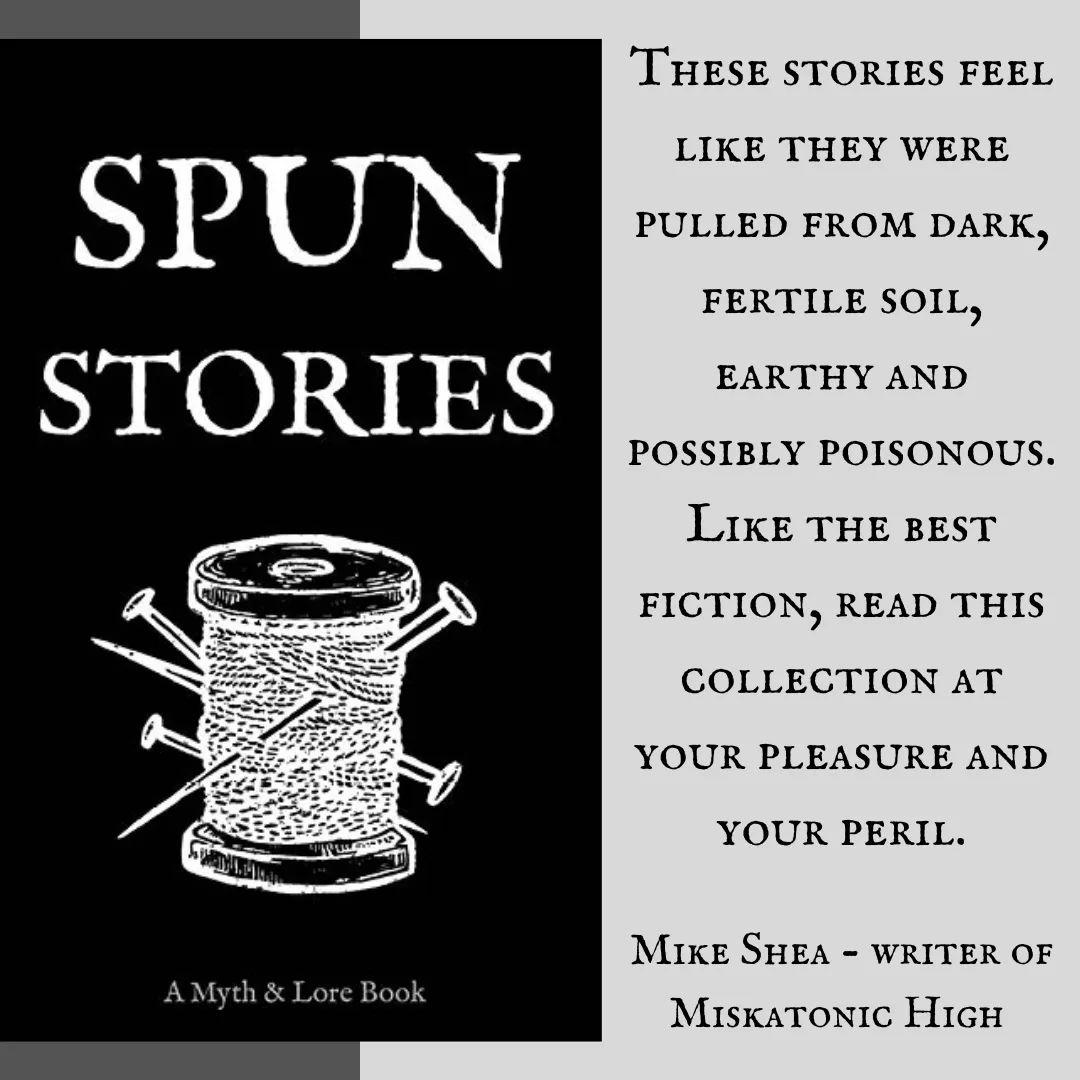
I’m honored to have a piece appearing in Spun Stories, the first anthology of short fiction released by Myth & Lore magazine. My folk horror story, “The Cow-Headed Boy,” is about an idealistic young teacher who accepts a position in a village in rural Pennsylvania at the turn of the twentieth century. Many of the village’s Yuletide traditions are quaint and charming, but some are a bit more sinister. Despite my general lack of interest in anything related to Christmas, I ended up doing a lot of research into Germanic pagan solstice traditions, and I hopefully managed to channel a bit of H.P. Lovecraft in the process.     

If you’re interested, you can preorder a copy of the Spun Stories anthology (here), and you can follow Myth & Lore magazine on Twitter (here) and on Instagram (here). I also want to give a shout-out to the editor, a talented artist who goes above and beyond in promoting authors while networking with the indie horror community. If you’re interested in folk horror, it’s definitely worth following Myth & Lore on social media – and perhaps even submitting your own work!

The Eyes of Hyrule Zine Preview

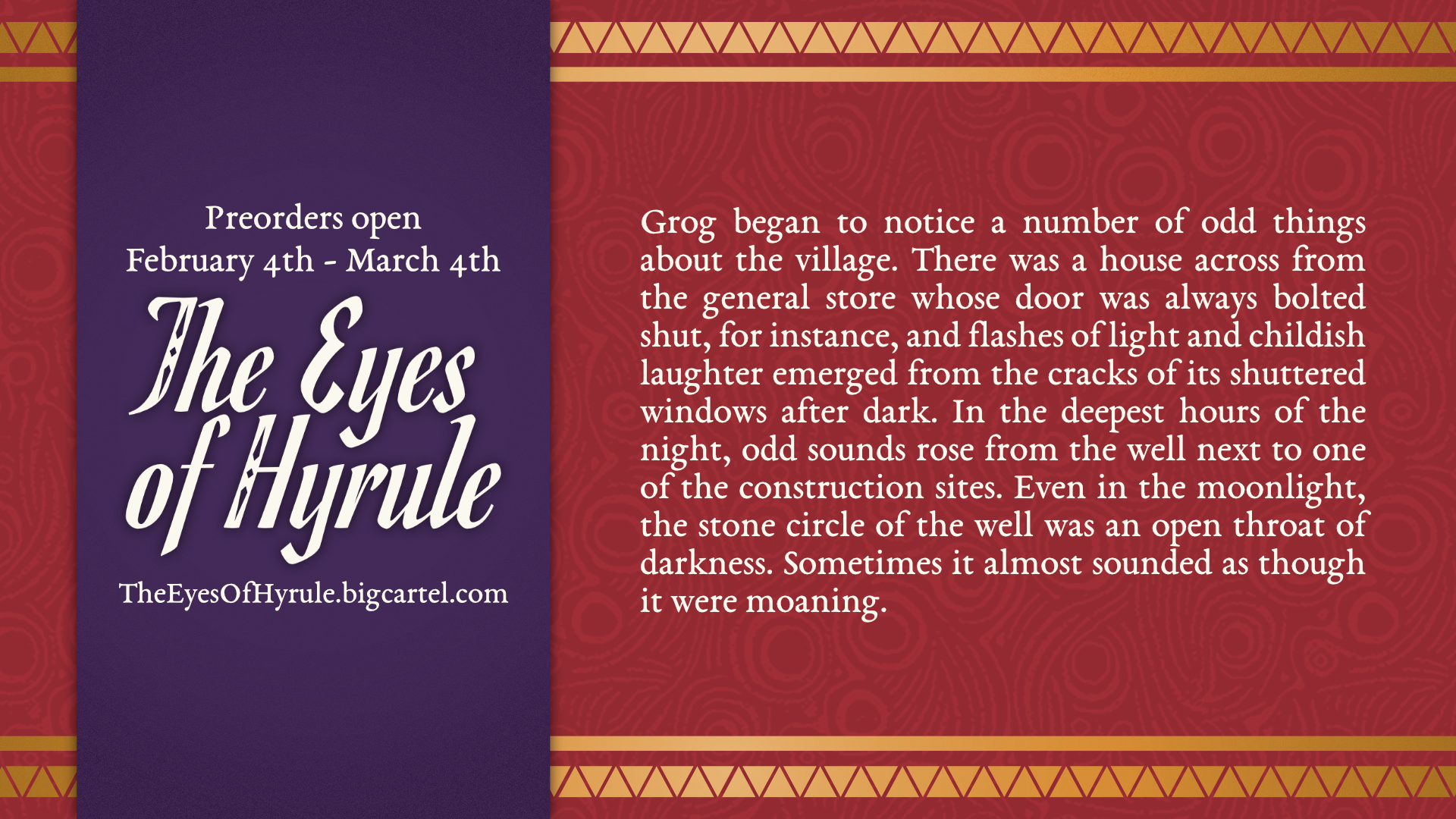
I’m excited to announce that preorders are open for The Eyes of Hyrule, a Legend of Zelda fanzine devoted to the Sheikah. The zine’s Carrd is (here), and you can check out more previews on its Twitter account (here).

There’s a lot of talent involved in this project, and the mods have been totally on the ball at keeping everything organized for the zine, which is expected to ship out this summer. It’s always a pleasure to be part of a project where everything clicks and comes together so well. Also, I might be biased, but I think the stories (and comics!) in this zine are especially interesting and unique.  

My own piece, “The Only Come Out at Night,” is a soft horror story about Kakariko Village in Ocarina of Time. It’s narrated from the perspective of Grog, the punk kid who hangs out near the entrance of the village at night. During the trading sequence necessary to acquire Biggoron’s Sword, the player can pick up hints that Grog’s story is much darker and more complicated than his initial appearance would suggest. I therefore wanted to use this character to explore the darker side of the Sheikah through the medium of a Stephen King style “peculiar little town” story. I had a lot of fun writing this piece, and I can’t wait to share it.

If you’re interested, you can preorder a copy of The Eyes of Hyrule via Bigcartel (here).

At the Edge of the Garden

When I was ten years old, all my friends had trampolines. I wanted a trampoline too, but my mother was opposed to the idea. One of my cousins decided to jump onto a trampoline from the roof of his house, breaking his arm and becoming a neighborhood hero in the process. My mother used my cousin’s behavior as a justification for keeping our yard trampoline-free, but I understood that she didn’t want her garden to be invaded.

My family lived on the outskirts of a pine forest bordering a small town. The property would later be sold, cleared, and incorporated into a subdivision, but our house was fairly isolated when we lived there. Since I had no one to play with and nothing better to do, I spent the summer roaming the forest with my dog while pretending to be a dinosaur. After a boy was shot in a hunting accident only a mile away from our house, my mother came to the reluctant conclusion that keeping me and the dog in the yard on a trampoline would probably be safer than letting us run wild in the woods.

The trampoline dominated my mother’s garden, as she had known it would, but this was more than likely a relief for her. She had neglected to do any weeding that summer, and the plants had gone feral. The trampoline blocked the view of the overgrown tangle of the rose bushes and ornamental shrubs that she used to keep meticulously maintained. My dog would sometimes disappear into the thistles and milkweed that grew as tall as my waist at the edge of the yard and emerge with his coat covered in burs, and my mother would pretend not to notice.

My parents’ marriage had turned sour. They fought after dinner, so I tried to be in the house as little as possible. I would go outside to jump on the trampoline every evening. It was soothing, almost hypnotic. I would position myself in the middle of the black canvas tarp and bounce in place as I watched the sun set over the pine trees standing just beyond the garden. I would hop off the trampoline and head back inside once the sky had gone completely dark, but twilight tends to linger in that part of the world, especially during summer. Sometimes I would be on the trampoline for more than an hour, letting my mind draft into various fantasies of prehistoric life while my dog barked at the rabbits that sniffed around the patch of soil where my mother used to grow carrots.

One evening, just as the sun had begun to sink below the tops of the pines, I saw a figure slink out of the dim forest underbrush. There wasn’t enough light to see clearly, but I was convinced it was a person. My dog was somewhere else, so I was alone with the shadow.

I was struck by a sense of terror, but I couldn’t stop jumping on the trampoline. My body moved mechanically as the blob of darkness made its way across the yard. Eventually it halted, raised the stalks of its arms, and slowly waved at me. I kept jumping, and it kept waving. It seemed as though it were trying to get my attention, but I refused to acknowledge its presence. If I looked at it directly, the stalemate would be broken, and I would be eaten. I was only a dinosaur in my mind, after all, and I knew that I was no match for whatever had come out of the trees.

As the sun disappeared, the shadow sank back into the forest. I hopped off the trampoline and ran inside as quickly as my shaking legs could carry me. 

The next day, when the sun was fully back in the sky, I ventured out to the line of trees beyond the garden, but I didn’t find anything out of the ordinary. The thick mat of pine needles covering the ground lay undisturbed.

Later that afternoon, my dog got hit by a speeding truck on the state highway that ran past the end of our driveway, but I don’t think there was any connection to what I’d seen the previous evening. How could there have been? Nothing made sense to me at the time – not the death of my dog, not the end of my parents’ marriage, and not the creeping realization that my mother and I would have to leave our home at the end of the summer. All things considered, a strange shadow lurking in the woods at the edge of the garden was the least of what was wrong with that house.

. . . . . . . . . . . . . . .

This story was originally published in Issue 7 of 3 Moon Magazine in April 2021. The issue’s theme was “Growing Malcontent,” and this story was my first foray into botanical horror. 3 Moon Magazine ceased publication and closed its website at the end of 2022, and I am reproducing this story with the kind permission of the editors.