Ceres and the Poison Sea

I just finished Chapter 10 of The Demon King, an original fantasy novel about adult wizards making terrible decisions. This chapter is an extended flashback to the time before the apocalypse that created the world of the story. Although I’m still brainstorming the details of this disaster in terms of the universe’s magical system, what essentially happened is that a frustrated researcher with a wealth of funding but no oversight managed to create the equivalent of a miniature sun that exploded into a supernova before collapsing into a black hole. This set off a chain reaction that rapidly accelerated climate change, which in turn significantly raised the sea level and irradiated the ocean.  

The researcher’s tech firm was located in New York. Because of the disaster, the city no longer exists, nor does anything east of Newark Bay and the Arthur Kill Straight. In order to prevent the decimation of the entire Mid-Atlantic region, mages pushed the landmass of Manhattan Island and Staten Island westward to create a mountain range protecting the mainland from the toxic ocean and its storms. This mountain range also serves as a water filtration system that feeds a system of freshwater lakes and rivers to its immediate west, which has become a kingdom known as Whitespire.

Geographically speaking, Whitespire is somewhere in the vicinity of Elizabeth Seaport in New Jersey. Although a great deal of I-95 is underwater, Route 1 still functions as a major trade route, and Whitespire is about halfway between the Northern Kingdoms (Hartford, Springfield, and a bit of Rhode Island) and the Southern Territories (Baltimore and Washington DC). Because of changing climate patterns, everywhere north of Albany and south of Richmond is uninhabitable, as is the land west of the Appalachian Mountains. Meanwhile, most of New Jersey and eastern Pennsylvania is a wasteland where water is scare and nothing grows.

The Northern Kingdoms are governed by draconian regimes that are constantly at war with one another, while the Southern Territories are lawless and threatened by the steadily rising ocean. Whitespire is the only real civilization left on the East Coast of North America, which has been isolated from the rest of the world by the impossibility of travel by sea or air. The citystate thrives because of its mild climate, access to plentiful fresh water, and relative distance from other centers of power.

Whitespire is ruled by a royal family whose primary duty is to ensure that the system filtering the seawater through the mountains continues to function properly. The bloodline of the royal family is not strictly hereditary, as anyone able to command the necessary magic may be adopted into royal line. Generally speaking, however, knowledge of the kingdom’s secrets and rituals are passed from parent to child. The queens and kings of Whitespire are supported by a religious order dedicated to preserving the magic necessary to protect the kingdom.

Under the stewardship of its royal family, Whitespire has been peaceful for several hundred years, but this doesn’t mean the monarchs have absolute authority. Political power is shared between the noble lines that maintain the rivers and lakes that spread from the Whitespire Castle, and there are occasional disputes over succession, taxes, and territory rights.

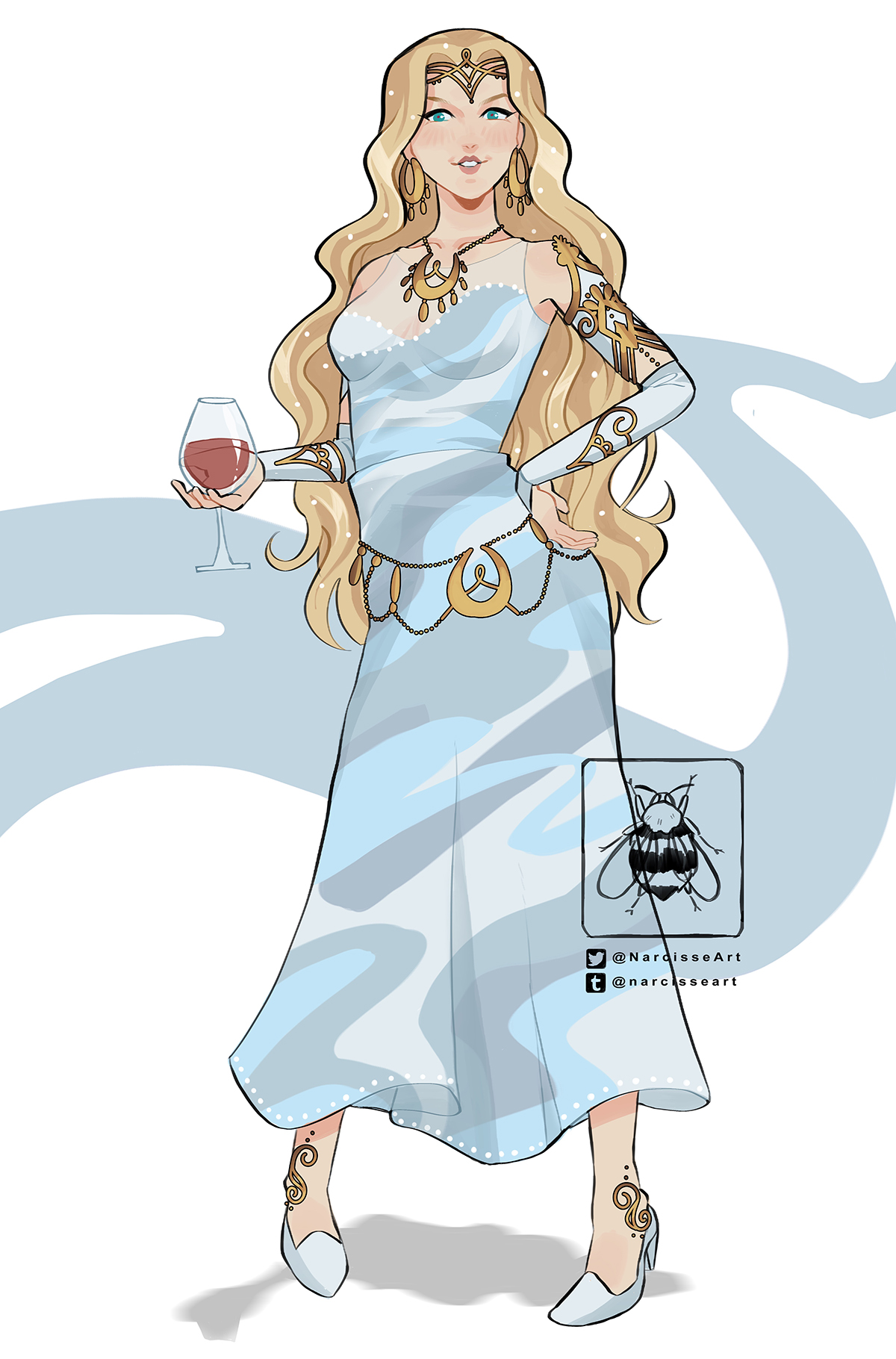
Ceres is the current reigning queen of Whitespire. For reasons known only to herself, Ceres’s mother resolved disputes among Whitespire’s aristocracy through strategic assassinations, which eventually resulted in her murder. As a result, Ceres ascended the throne during a political crisis when she was nineteen. She is a supremely competent ruler, but her reign has been marred by lingering political tensions. She navigates this challenge by presenting a wise and virtuous image of herself in public but being crafty and merciless behind closed doors.

Ceres was born to be a queen, and she plays her role with style and grace. Her only concern is that she is entirely ignorant of the vast majority of Whitespire’s deep magic, as her mother never shared the kingdom’s lore with her. To make matters worse, the former queen killed many of the people who were close to her, along with the entire order of priestesses dedicated to the worship of a deity called The Weaver, who supposedly established Whitespire by wresting the primordial world from the control of demons.

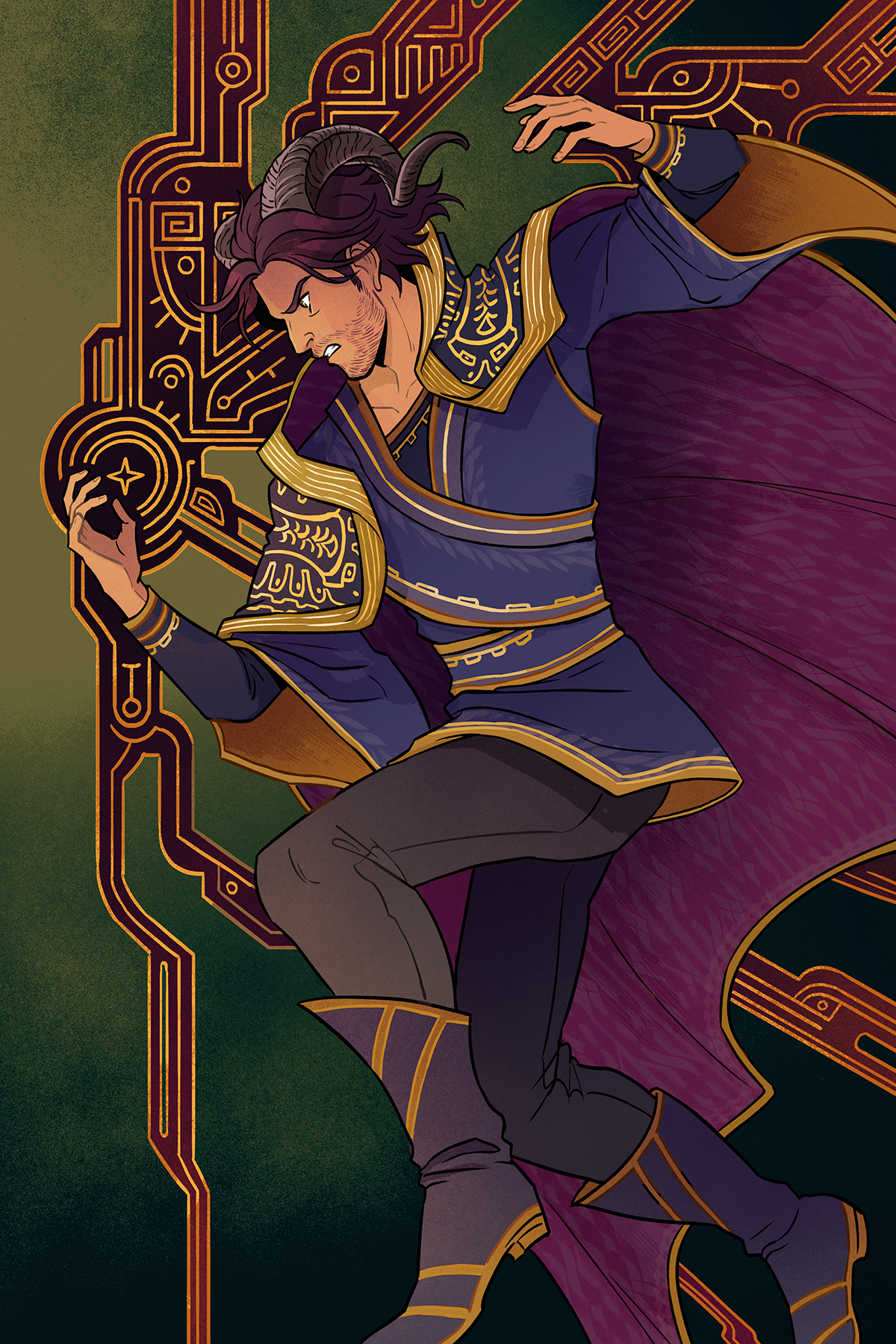
Although the truth is more complicated, “demons” are believed to be powerful monsters whose magic can’t be controlled and can thus only exist in a state of madness and chaos. Demons are real; and the eponymous “demon king” Ananth, who has traveled centuries into the future from a time that he considers be the pre-apocalyptic present, is one of them.

Ceres is primarily a foil to Ananth during the first two narrative arcs, but I plan for her to become the main viewpoint character during the third and final part of the story. She befriends Ananth mainly for political reasons as she attempts to prevent a coup organized by operatives from the Northern Territories, but her real interest in him comes from his openly stated intention to steal the hidden relic that’s the key to the magic of the royal family. Ceres needs this relic just as much as Ananth does, so she aids his plans with the hope that he’ll find it for her. As someone who possess powerful magic of her own, Ceres has full confidence that she can fight and kill Ananth if necessary, so she’s completely unbothered by his antagonism toward her.

Ananth doesn’t treat Ceres like a queen, so she returns the favor by not treating him as a demon capable of destroying her kingdom whenever the mood strikes him. As a result, they gradually form an unlikely friendship that gives Ceres a stage to be her best and most authentic self, namely, a strong and self-assured woman who loves drinking and dick jokes. It goes without saying that she’s a joy to write.

The illustration above was created by Doc Hollibee, who is on Twitter (here) and Tumblr (here). Doc drew me a picture of Princess Zelda with a sword (here), and I loved it so much that I asked her to draw Ceres with the same energy. Doc creates marvelous illustrations that depict the women of the Final Fantasy games as beautiful but still powerful and full of personality, and I’m thrilled and delighted to see the same artistic sensibility applied to my own original character.

The Demon King Reboot

Around this time last year, I finished an original fantasy novella called The Demon King. I serialized it on AO3, posting each chapter as I wrote it with a minimum of editing. This year I’ve been slowly editing the story into a legitimate novel. The process has been a lot of fun, but I’ve had to make some major changes.

I originally planned to serialize The Demon King in five arcs. The outline of the story was structured for each arc to focus on one character while providing the reader with one major revelation. I wanted there to be something resembling a punchline at the end of every scene, so I wrote the story as a comedy centered on character interactions. In other words, I saw The Demon King as something like an ongoing prose webcomic illuminated with occasional illustrations. AO3 isn’t a good platform for a project like this, however, and it was impossible to build an audience. I therefore closed the story at the end of the first arc.

In the original version of the story, I deliberately left room for the plot to spool out across later installments. In order to write a proper novel, however, I need to make the structure more streamlined and compact.

My strategy has been to simplify the plot in order to focus on the most important themes and character development arcs. The easiest way to go about this has been to remove half of the cast from the story. This was relatively painless, as I’m sure these characters will return in another project.

Another efficient way to simplify the story has been to make certain aspects of the plot clear from the beginning. A major component of this was to drop the conceit of the main characters going by multiple names. In the first draft, the eponymous demon king called himself “Balthazar” because he thought it sounded like a wizard name, and the characters closely associated with Balthazar humored him by using wizard names of their own. I decided to cut the plot points relevant to Balthazar using a fake name; so, in the current draft of the story, he goes by his real name, Ananth.

Ananth uses time magic, which needs to be clear from the beginning. The extent of the time travel will only be revealed gradually, but it will make my job infinitely easier if the reader sees Ananth using time magic in the very first chapter. Not only does this explain a number of aspects of his character that would otherwise be needlessly mysterious, but it also creates a compelling sense of mystery by providing opportunities for the reader to understand that Ananth is in fact very bad at using magic. Given that his only real talent is a basic ability to manipulate time, how did he become so powerful? Where (or when) did he come from, and what are his intentions?

While Ananth’s character has changed significantly, his foil Ceres hasn’t changed much at all. Ceres is her real name, and she’s not hiding anything by being catty and manipulative; that’s just her personality. The one significant edit I made is that Ceres is no longer a princess, but a queen. Then again, this isn’t much more than a matter of using the “find and replace” function to switch a few words, as Ceres was always a queen in my heart.

In any case, I’ve succeeded in compacting the story outline from fifty chapters into a solid thirty, and I’ve managed to finish the first ten. I enjoyed serializing fanfic novels on AO3 because of the constant stream of positive feedback and encouragement, so the major challenge of writing an original novel has been working in relative isolation. It was difficult to get started on revising this project, and it’s been slow going. Still, now that I know the shape of the story, I have a better sense of working toward an achievable goal.

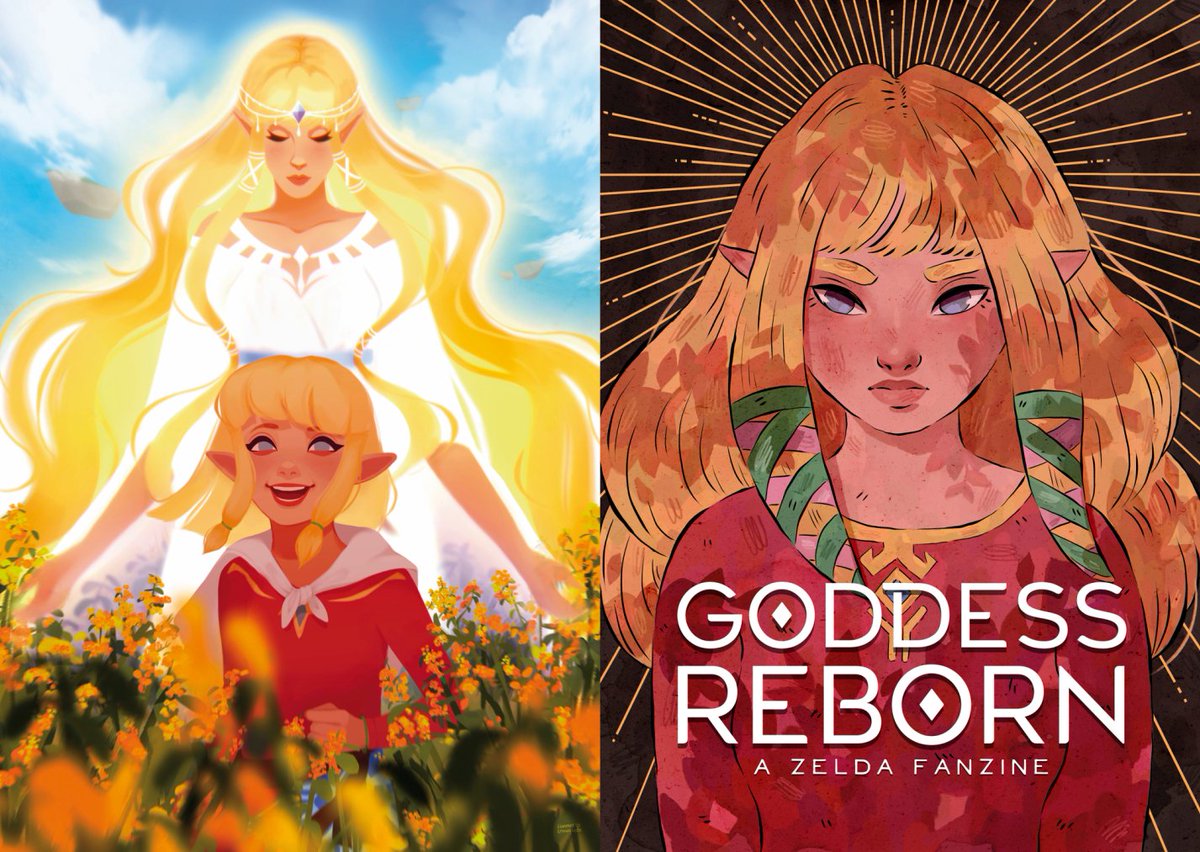
The illustration above is by @Lunie_junk on Twitter, who also shares her work on DeviantArt (here) and on her Patreon page (here). I love Lunie’s Legend of Zelda and Final Fantasy art, and I’m a huge fan of her soft pastel style and colorful fantasy illustrations. She takes character commissions on a regular basis, and I recommend checking her out on her Carrd page (here) if you’re interested. I adore the story illustration Lunie created for me, and I really enjoyed working with her!

Goddess Reborn Zelda Fanzine

I’m excited to share a preview of the story I contributed to Goddess Reborn, a collection of art and fiction that celebrates the female characters of the Legend of Zelda series.

The zine is beautifully inclusive, and the amount of love that has gone into this project has been incredibly uplifting. I can’t wait for everyone to share their full pieces, but you can check out previews on Twitter (here) in the meantime. Preorders are open until May 31, and all proceeds go to international women’s charities.

✨ goddessreborn.etsy.com ✨

Red Trees

Red Trees by Caramel
https://caramel.itch.io/redtrees

Red Trees is a free nonviolent adventure story game made with RPG Maker in a style that emulates the Game Boy Color. It’s about a small village that might be haunted by ghosts in the woods, and it’s adorable.

The game is divided into three sections: the village’s residential area, its business center to the north, and the forest to the south. In order to progress from one area to another, you embark on an extended trading quest. For example, someone asks you to find their cat. To convince the cat to follow you, you need to feed it fish. In order to procure a fish, you need to give a can of worms to the person fishing at the local pond. The trading sequence isn’t strictly linear, but it’s not so complicated that you’d get lost or frustrated.

Red Trees isn’t a horror game by any means, but it gives me strong Omori vibes. (Although, having made that comparison, I should say that Red Trees was originally released in 2016, four years before Omori.) The music is relaxing, the character portraits are super cute, and the writing is wholesome with a touch of light humor reminiscent of Tumblr circa 2015. I especially love the menu screen’s character log, which collects short profiles of everyone you’ve met. The item portraits and descriptions are lovely as well.

Red Trees takes about an hour to complete, but this is mainly because of the game’s spatial layout. Your character can’t run, and the town is so spacious that it takes time to walk from place to place. This never becomes frustrating, but you may want to download the game so you can save your progress, step away, and come back later. Red Trees is extremely charming, and the experience of playing it is much more enjoyable if you take your time instead of rushing to finish it.

If you’re going to download Red Trees, you have the option of paying $2 to get an extra file folder of illustrations and a PDF booklet with annotated concept and development art. I highly recommend this extra material, but I’d also recommend not checking it out until you finish the game, as it spoils the ending. In fact, the bonus content functions almost like a separate postgame story, and it’s just as sweet and adorable as the game itself.

Deep Forest

Deep Forest by Small is Beautiful
https://small.itch.io/deep-forest

Deep Forest is a free GB Studio adventure game that takes about 45 minutes to play. There’s no combat, and the game is driven by puzzle-solving and exploration. You play as a forest witch tasked with helping three trees that have become mysteriously cursed. To purify a tree, you must first find it by exploring the forest. You then enter its nightmare, which functions as a dungeon. Once the tree’s curse is lifted, its thorny roots vanish, thereby allowing you to explore more of the forest.

This is the basic gameplay cycle of the Legend of Zelda series, and the simple puzzles of Deep Forest remind me of certain segments of Oracle of Seasons and Oracle of Ages wherein you:

(1) Use an animal to procure a seed.
(2) Find a patch of soil to plant the seed,
(3) which sprouts into a vine
(4) that allows you to climb a cliff.

If this similarity is intentional, it’s a lovely homage to the debut work of Hidemaro Fujibayashi, who went on to become the director of Breath of the Wild. In addition, I had a nice “Legend of Zelda” moment when I found a secret in Deep Forest. I was delighted when I realized that you can water the single square of roots in front of an otherwise unremarkable cave in order to discover a hidden spring. This moment of discovery lit a spark of excitement that reminded me of exploring Hyrule for the first time.

In terms of its visual style, Deep Forest is reminiscent of the Game Boy games that were released in the West under the “Final Fantasy” logo, which include the first Secret of Mana game and the first three games in the SaGa series. This style feels extremely nostalgic, and it’s cool to see it used to depict a thriving forest.

Deep Forest is fairly linear, and the gameplay mechanics are beautifully intuitive. I would have loved this game as a kid, and I’m extremely fond of it as an adult. It’s exactly the perfect length, and I enjoyed the exploration elements and wholesome story. As a unexpected bonus, the interactive postgame credits sequence is beautiful and genuinely feels like a reward for playing.

Capacity

Capacity by Renee Blair
https://heptad.itch.io/capacity

Capacity is a Game Boy style RPG Maker story game that uses generic pixel graphics and original character illustrations to tell a short fantasy-themed story about a bad relationship. The game describes this as “a toxic relationship,” but I don’t think it’s that complicated; it’s just a teenage girl who is hung up on a boy who clearly isn’t that into her. She doesn’t know how to let him go, so she embarks on a quest that she hopes will fix the relationship.

Capacity is extremely pretty and features a number of clever design elements. The monster art is great, and the final boss is a demon after my own heart. The game is driven by its narrative, and there’s no actual fighting. It takes about ten minutes to play, it’s totally free, and you can play it right in your browser window.

Capacity’s message is a bit heavy-handed and occasionally inappropriate to the situation. The game’s text drops mentions to “a cycle of abuse” and “generational trauma,” but really, it’s just a girl who’s hung up on a boy who isn’t that into her. Presumably because they’re both in their early teens. This isn’t to say that the boy isn’t a jerk and a coward, or that the protagonist isn’t a bit unhinged for pursuing him despite the clear “I don’t want to be involved with you” signals he’s broadcasting at every turn, but this is normal behavior for teenagers who are still figuring out how relationships work. It doesn’t make anyone a “toxic” person, especially not if they’re just a kid. We’ve all been there.

Putting the heavy-handed elements of Capacity’s story and writing aside, the game is really fun to play. In order to “save” your shitty “boyfriend” from his “curse,” you walk through a fantasy castle and interact with monsters, all of whom give you some variation of “he’s just not that into you.” At the top of the castle, the smoking hot Demon Lord tells you that a relationship doesn’t have to be like this, and that you deserve so much better. The fact that you refuse to listen to him proves that you still have some growing to do, and this is reflected in the game’s twist ending.

Capacity’s entire narrative structure emphasizes the point that sometimes your “demons” are right, and that you need to listen to what they’re trying to tell you about the situation that’s triggering your anxiety. It took me years to figure this out, and it’s a powerful message.

A Public Service

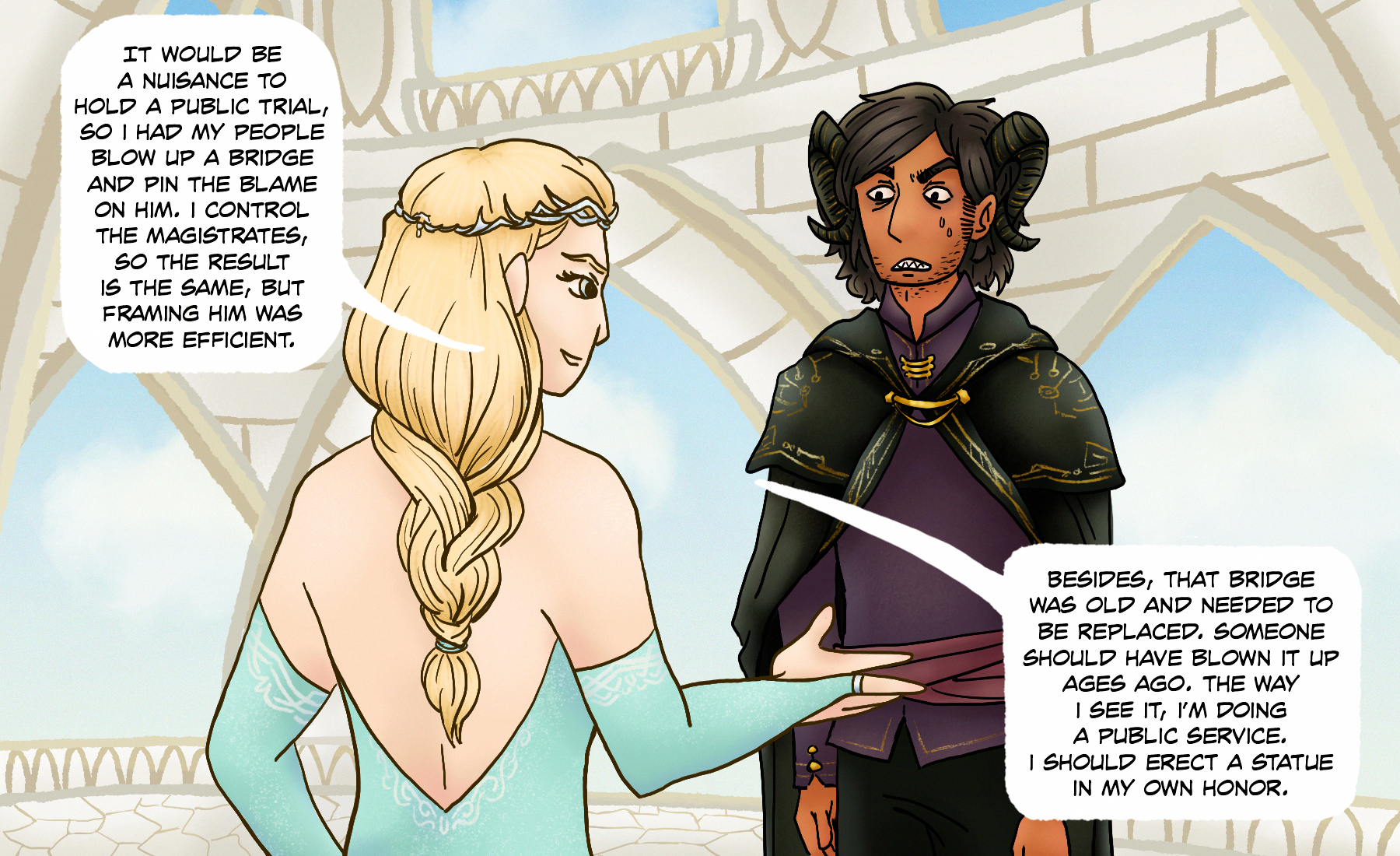
Queens don’t have to do paperwork. 👑

It’s been a while, but I’m back to work on The Demon King, an original fantasy story about tired adults doing their best. I wrote a stand-alone novella last year, and I’m currently expanding it into a proper novel. I drew the thumbnails for a few comic scripts back when I first started playing with ideas, and I recently decided to ink and color a few of them just for fun. This one is loosely based on a study of a panel in Tess Stone’s Not Drunk Enough, a stylish horror comic with a target audience of me specifically.

Spiritfarer

I caught the flu last week. I couldn’t eat or sleep for days. It was intense.

If you ever find yourself in a situation like this, Spiritfarer is the perfect game. The art and music are soothing and gentle, and the gameplay is simultaneously relaxing and addictive. It took me somewhere between 35 and 40 hours to get close to 100% completion, and I didn’t notice the passage of time at all while I was playing.

Spiritfarer describes itself as a “cozy management game about dying,” which is as good of a description as any. As Stella, the newly appointed Spiritfarer, it’s your job to ferry spirits to the great beyond on a giant boat. The twelve spirits you encounter take the forms of anthropomorphic animals, and each has a distinct personality and set of preferences. These spirits will need to spend time on your boat before they’re ready to move on, and you’re tasked with building each of them a small house and then keeping them fed and happy while they travel with you. You pick up cooking ingredients and building resources by visiting various points on the map, which you’ll gradually explore as you complete requests and meet new spirits. While sailing between locations on your boat, you can grow crops, care for livestock, cook food, and craft various materials.

Each spirit gives you an Obol as payment for their passage, and a spirit flower will bloom in their house after they move on. You use these tokens to upgrade your boat and expand your range of abilities, which grow include gliding and double jumping. This system of resource-based expansion allows you to open more of the game at your own pace while simultaneously limiting the number of tasks you need to worry about at any given time.

Spiritfarer has an excellent balance of exploration and crafting, as well as optional bits of Metroidvania-lite platforming. There’s no combat. Most of the challenge comes from effective in-game time management, although there are no time limits or negative consequences for just futzing around. Player movement is limited by a few artificial barriers at the beginning, but the world of Spiritfarer is relatively open, and there’s always a lot going on. The spirits’ requests nudge you in the direction of exploring new areas of the map organically, so you’ll never be at a loss for what to do next. Thankfully, your menu screen contains a list of requests and sidequests for your convenience.

The introduction to Spiritfarer’s story is a bit silly – you are a small child! here’s a giant boat! go out and ferry the dead! – but it becomes much more compelling as you progress. It might seem odd that a cute game about sailing around with talking animals has a “Teen” rating, but some of the spirits are carrying a lot of baggage. Their stories aren’t melodramas with happy endings, but instead involve real and complicated misbehavior, delusions, and regrets. To give an example, one of the souls is suffering from dementia. She’s kind and curious when she’s lucid, but she’s incredibly mean during her foggy periods, and she gradually gets worse instead of better.

There’s no graphic depiction of sex or violence, but some of the stories are surprisingly dark and specific. The first spirit you meet, Gwen, eventually admits that she struggled with suicidal ideation throughout her youth, and the compulsion to end her life returned with a vengeance as she was dying from lung cancer in her early forties. Gwen didn’t commit suicide, but she wasn’t able to survive cancer, and her blithely ironic attitude can’t quite conceal how bitter she is about having her life cut short.

Stella’s own story isn’t revealed until later in the game, but the way the spirits are connected to her is touching and beautiful. Spiritfarer celebrates the joy of being alive, but it’s ultimately about the sweetness and gentleness of death. Thankfully, it has a solid sense of humor, and also you can raise sheep.

Spiritfarer is a perfectly designed to be fun and engaging without being frustrating. I also appreciate that it wraps up in a satisfying thirty to forty hours. It’s exactly the sort of game I might recommend to adults who aren’t into gaming but are interested in how the medium can tell a complex story in an interesting and unique way.

Spiritfarer is also the perfect game to play if you find yourself stuck in bed with a prolonged illness. Even though I would happily recommend the game to anyone, it’s worth saving for when you need it.

The End of the Line for the Shinra Corporation

Over the course of its expansive story, Final Fantasy VII changes direction and shifts focus but holds fast to the goal of saving the world from a crisis created by Shinra. Even if there were no interstellar demons or mad scientists, the Planet would never have survived were it not for a small group of activists who dared to challenge the most powerful corporation in the world…

I contributed a meta essay titled “The End of the Line for the Shinra Corporation” to the Return to the Planet fanzine, which celebrates the 25th anniversary of the original 1997 release of Final Fantasy VII. My piece is about how the game references the corporate critique and real-world grassroots environmental activism in Japan during the 1990s. The zine is filled with gorgeous artwork, stories, and nonfiction, and it’s free to download. You can read my essay on my Japanese fiction blog (here), and I also posted it on AO3 (here). You can check out the zine via these links:

🌿 https://twitter.com/ff7ogzine
🌿 http://whitemateria.net/ff7ogzine/
🌿 https://archiveofourown.org/collections/FF7OGZine

Coffee Talk

Coffee Talk is a visual novel about an all-night coffee shop in Seattle. You play as the barista, and your job is to connect your customers to one another while improving their moods by serving warm drinks. Although the game tackles serious issues softened through the lens of fantasy, its tone is relatively lighthearted and gentle, and the pixel graphics are cute and cozy.  

The game has three screens: your view of the shop from behind the counter as you chat with your customers, an ingredient selection screen for the drinks you make, and your cellphone, which contains an incomplete list of recipes, a music playlist, and an in-game social media app. The story takes place over fourteen nights, and there’s only one ending. There are no dialog choices, but some of your customers will open up to you more (and allow you greater access to their social media profiles) if you serve them drinks to match their moods. In other words, there isn’t much gameplay. Aside from brewing different types of coffee and tea, the player is mainly along for the ride.

Every review I’ve read of Coffee Talk complains about the drink brewing system, and rightly so. It’s counterintuitive and needlessly complicated. Each drink has a base – coffee, tea, green tea, chocolate, or milk – and you can add two additional ingredients, such as mint or cinnamon. The order in which you add the ingredients matters, meaning that tea with lemon and honey is a different recipe than tea with honey and lemon. On top of that, each drink has several different meters measuring qualities such as “sweet” or “cool,” and there’s no way to predict what combination of ingredients will result in the requested combination of qualities. Your customers will sometimes tell you how to brew a drink, but you mostly have to complete the recipe app on your phone yourself.

I can’t imagine that there’s any way to get everyone’s drink orders correct without either using a walkthrough or exploiting the save feature as you employ trial and error to go through a list of possible permutations. Thankfully, it doesn’t really matter, and most players will probably do just fine by paying attention to the dialog.

The main draw of Coffee Talk is its setting, a fantasy AU version of Seattle. The year is 2020, and everything is more or less the same except that fantasy races are real – elves, orcs, vampires, fish people, you name it. As far as I can tell, there’s no magic aside from the general characteristics associated with various fantasy races, meaning that elves have long lifespans, werewolves transform once a month, and so on. Each night at the coffee shop is prefaced by the front page of that day’s newspaper, and the fantasy world’s concerns seem to mirror those of our own: Orcs demand an end to workplace discrimination, the U.S. and Atlantis negotiate immigration reforms, Seattle plans to host this year’s Coachella music festival.  

The eleven characters who visit the coffee shop come from all walks of life. One of my favorites is the werewolf war veteran Gala, who works in medical administration. He seems to have a complicated past, but this is nowhere near as important as the mundane conversations he has with other characters, often contributing a sense of perspective to their problems. It’s refreshing that none of the characters care about the details of what it’s like to be a werewolf but are much more interested in what it means to work in medical admin. Gala is friends with a supermodel vampire named Hyde, who is characterized not as a “supermodel” or “vampire,” but rather someone who means well but is brutally honest – and perhaps romantically interested in Gala.

The setting of Coffee Talk has a lot of narrative potential, but I feel the worldbuilding is somewhat shallow. In addition, the lighthearted tone of the writing doesn’t match the complications of the issues under discussion. To give an example, one of the coffee shop’s patrons is an eighteen-year-old aspiring pop star whose manager seems to be setting her up to be sexually assaulted at a Coachella afterparty. Thankfully, the character is able to avoid this situation by not attending the party. How simple is that! When you’re confronted with sexual menace, you can just… walk away! It’s not like careers in the entertainment industry are based on the connections formed at these parties or anything.

Although this isn’t anywhere near as heavy as some of the other character arcs, I felt personally attacked by Freya, a green-haired human woman who works as a staff writer at a local Seattle newspaper. Freya receives a chance opportunity to submit a novel to a head editor at her newspaper’s parent company, with the caveat that she has to complete a draft in two weeks. Which she is 100% able to do, because she believes in herself. Writing a presentation-ready draft of a novel in two weeks is all about self-confidence, right? And of course her novel is accepted for publication, and it becomes a best seller right away, and all of this happens in less than a year. Because that’s all it takes to publish the first novel you’ve ever written: believing in yourself – and a lot of caffeine!!

Obviously I’m being ironic. Writing and publishing a novel in a few short months is just as much of a fantasy as the story arc of a game developer who solves the issue of crunch culture by… just taking a weekend vacation! Putting aside the work cultures of people in creative industries, I’m frustrated by the suggestion that a pleasant conversation all it takes to solve heavier problems ranging from systemic racism to needlessly high barriers to legal immigration, and that if your own life isn’t working out then you just aren’t drinking enough fancy coffee.

It should go without saying that this is nothing more than my personal response to the game. My frustration with Coffee Talk is my frustration with YA fiction in general, by which I mean that I find it difficult to become emotionally invested in characters who face genuine challenges but aren’t allowed to say “fuck.” Still, I understand that not everything has to be realistic and gritty, and that there’s value in seeing a happy ending for a character whose experience mirrors your own.   

On the whole, Coffee Talk is enjoyable and well-written, and it’s a nice lo-fi game to chill to. It takes about three to four hours to finish, and it has a fun postgame secret ending that adds a bit of replay value. A sequel is planned for release later this year, and I’m looking forward to reading more interactive stories set in this universe.