An Unfound Door, Chapter Three

Early the next morning, Agnes tries to light the campfire with an intonation used by Fhiad the night before. She reflects on how the kingdom of Faloren was once renowned for its sorcery, and how the suppression of magic following a war with Erdbhein a hundred years ago led to the king punishing her for her childhood gift of spellcraft. Fhiad wakes up during her attempt to kindle the bonfire and mocks her lack of success. Agnes acknowledges that his disdain is not undeserved, and her sincerity convinces him to share more of his story.

Fhiad says he was unsuited to be a diplomat and left of his duties to his cousin Lukhara while he studied Faloren legends in the castle library. His interest in a magical relic called Soreiya’s Tear was encouraged by the princess of his era, Agatha, whom he accuses of manipulating him. He was imprisoned shortly after uncovering the location of a door leading to a hidden temple under the castle, and he claims that he is unable to remember anything that happened since then. He tells Agnes that he wants nothing more than to leave Faloren, and she makes the decision to free him from the silver bridle. They agree to part ways as soon as they leave the forest and separate on friendly terms.

. . . . . . . . . . . . . . . . . . . . .

This is the chapter that states the theme of the character development: Agnes needs to break the chains binding her to the past and move forward in a new and different direction.

This theme is suggested by the story catalyst: Agnes breaks the magical silver chain binding Fhiad. She decides to trust what she sees for herself instead of believing what she’s read in books. By doing so, she nurtures the seeds of doubt regarding her kingdom’s history. This act serves as a catalyst because, unfortunately for Agnes, Fhiad is going to come back and cause a lot of trouble in the near future. In addition, Agnes will never be able to return to her former worldview – although she’ll certainly try.

I tried to keep the initial chapters of this novel short and punchy instead of dumping exposition on the reader’s head, but this final chapter in the opening trio contains an abbreviated version of the basic setup of the world of the story. As Agnes makes accusations and Fhiad corrects her, the reader begins to understand Faloren’s history, as well as Fhiad’s place in this history. This chapter also presents a bit of mythology, as well as the first hint of what happened in the past to make the present so terrible.

Fhiad’s testimony suggests that the main villain of the story is the princess of the era he comes from. He is correct. This woman is indeed responsible for the region’s general state of decay. With any luck, Agnes will be able to make a different set of decisions when faced with the same horrible choices.

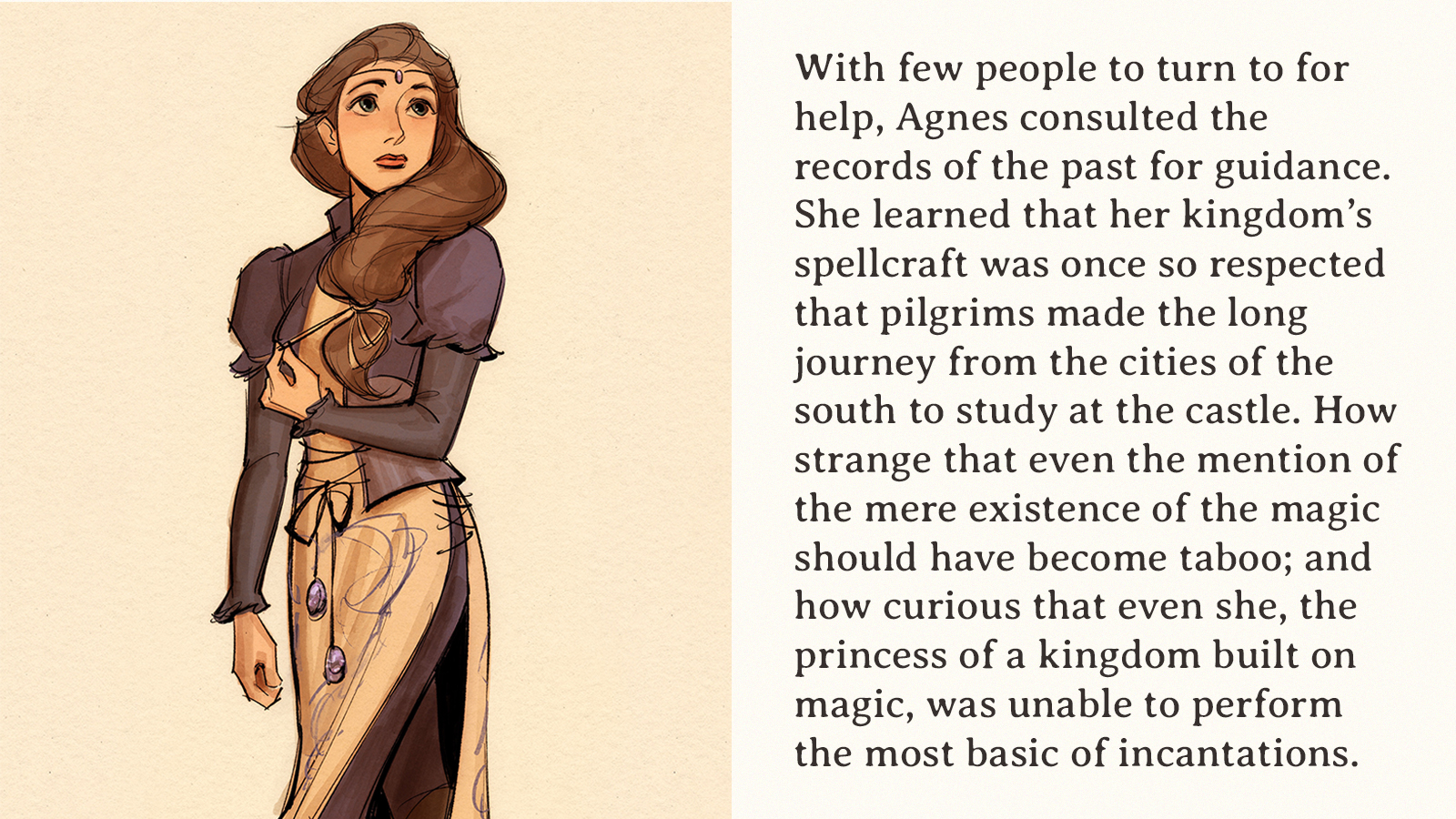
The illustration of Agnes that accompanies the chapter preview graphic was created by Myrthena, whose gentle and lovely Disney-inspired illustrations can be found on Instagram (here), on Twitter (here), and on Patreon (here).

An Unfound Door, Chapter Two

Agnes wakes to find that the boar demon has transformed into a man who identifies himself as Fhiad of Erdbhein, a notorious criminal who was accused of high treason after attacking Faloren a hundred years in the past. He is cultured and well-spoken, but he doesn’t hide his frustration with Agnes, who refuses to free him from the silver chain that bound him as a demon. Fhiad tells Agnes that he never had any intention of attacking Faloren, and he claims to have had no interest in her kingdom at all. Rather, he was only serving as an emissary because he was called back from his studies and ordered to do so. Agnes doesn’t know what to make of this, but she’s exhausted and decides to stop for the night.

. . . . . . . . . . . . . . . . . . . . .

The second chapter of An Unfound Door is about two tired people snapping at each other. Nothing much happens aside from the reveal that the demon Agnes encountered in the first chapter is a person suffering from a curse, but I do my best to establish the geography of the world and a bit of its history without dumping exposition on the reader.

This is what I want the reader to take away from this conversation: Agnes is from a kingdom called Faloren, Fhiad is from a neighboring kingdom called Erdbhein, and there is someplace called Cretia far to the south. Fhiad, who has no concept of how much time has passed since he was cursed, is under the impression that he only recently called back from his studies at a university in Cretia. This establishes him as being in his late twenties while introducing the idea of Cretia being a center of culture in contrast to the forest, which is all we’ve seen of Faloren. According to Agnes, Erdbhein attacked Faloren roughly a hundred years ago, and Fhiad supposedly instigated this attack. Fhiad denies this, but he won’t be forthcoming with more details until the next chapter, as he hasn’t yet had an opportunity to process what Agnes is telling him.

In other words, this chapter establishes the broader conflict of the story through the smaller immediate conflict between Agnes and Fhiad. This conversation sets up a dynamic of Agnes as a character who’s pragmatic and grounded, while Fhiad is well-spoken but emotionally unstable. These two characters have trouble communicating, but each of them gets a “save the cat” moment during this chapter. Despite their petty bickering, their first instinct is to be kind to one another when it counts.

“Petty bickering” may seem like an inappropriate response to the gravity of the situation, and it is. In the next chapter, Fhiad will finally have an opportunity to reflect on his circumstances, and he and Agnes will discuss how they plan to move forward in a more appropriate tone.

As an aside, there are a lot of regrettable aspects of being in your twenties, but it’s nice to be physically fit by default and walk for miles without thinking too much about it. For me in my thirties, I can only walk through the woods for so long before I need to sit down. I wouldn’t turn down an adventure of my own, of course, but it’s so much more pleasant to experience this sort of thing vicariously through fictional characters.

The illustration that accompanies the chapter preview was created by the bold and brilliant Samijen, who paints fantastic character illustrations that practically jump from the screen with life. You can follow their work on Instagram (here), on Twitter (here), and on Bluesky (here).

The Cruel King and the Great Hero

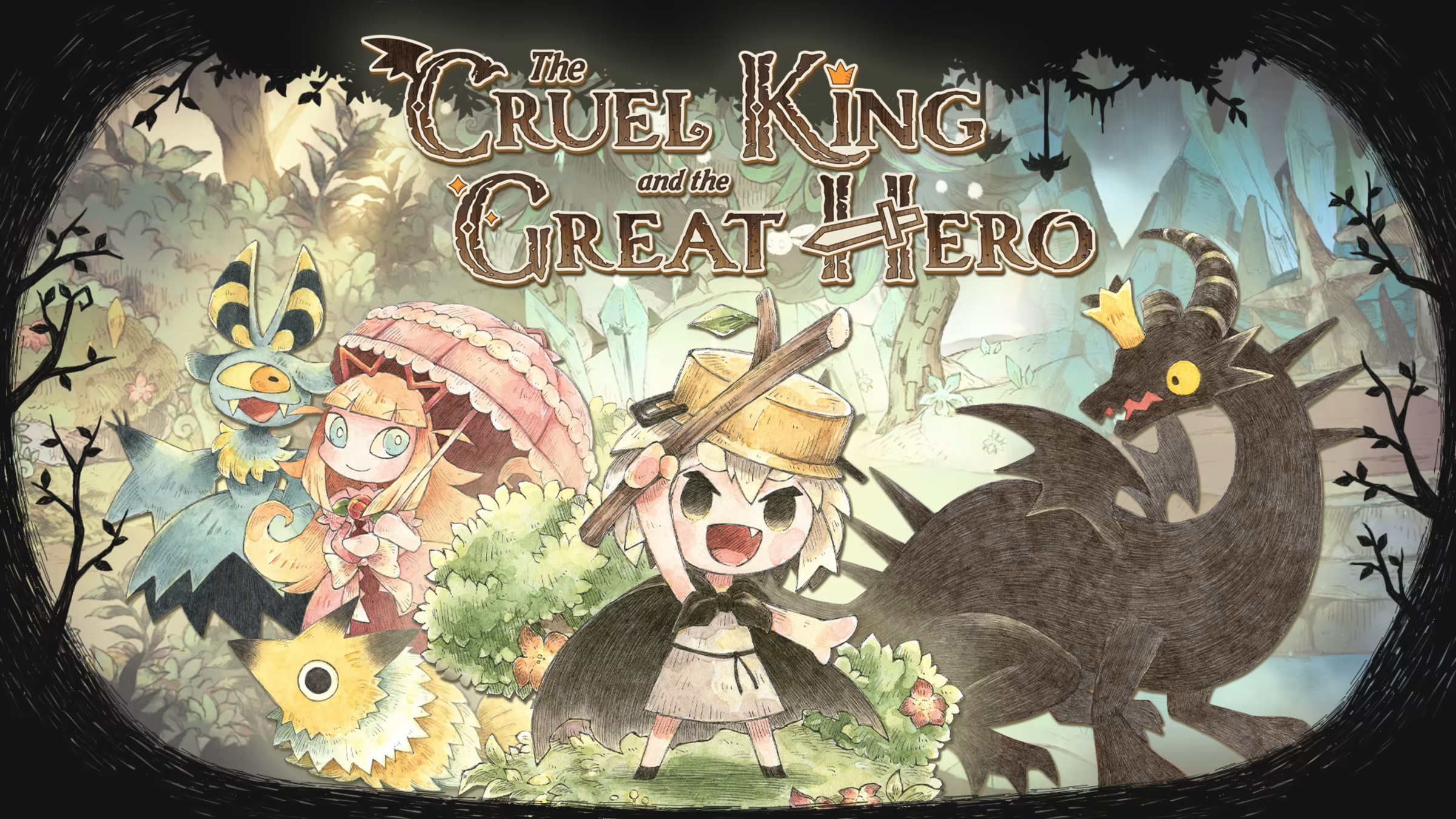
The Cruel King and the Great Hero was developed and published by Nippon Ichi Software, and it’s the spiritual successor to the studio’s 2018 title The Liar Princess and the Blind Prince. Just as The Liar Princess is a simplistic puzzle-platformer set apart by its distinctive manga art style, The Cruel King is a JRPG that’s so traditional it would probably be considered retro were it not so visually gorgeous and beautifully animated.  

When I say that The Cruel King is “traditional,” what I mean is that there are a lot of random encounters. The battles are turn-based and controlled solely through text menus. There’s a bit of strategy involved, but not much. Your character walks slowly, and there’s a not-insignificant amount of backtracking. If you suspect that you’ll find this frustrating, then The Cruel King probably isn’t for you.

If you’re looking for a more relaxed gameplay experience, however, The Cruel King is a delightful way to spend about 20 to 25 hours. Personally speaking, it took a few play sessions for me to readjust my expectations of how quickly the battles should progress, but I became hooked on the gameplay once I got used to the pace.

You play as Yuu, a young human girl who has been adopted by The Cruel Dragon King as his daughter. Every night before bed, the Dragon King tells the girl about her “real” father, a great hero who defeated an evil demon king. The girl wants to become a hero like her father, so the Dragon King decides to make her dream come true by coming up with little quests for her to undertake. These quests are in service to the various monsters who live in the Dragon King’s territory, and the girl becomes involved in a series of adorable sidequests.

Most of these sidequests are optional. Because the game isn’t difficult, the sidequest rewards aren’t strictly necessary. Rather, the real reward is the friendship you find along the way. In less cliché terms, the reward for playing the game is being able to experience more of the game.

The environment is not quite 2D and not quite isometric, and it reminds me a lot of the style of the Paper Mario games. There are no puzzles and no platforming, but your character gradually gains abilities that allow her to bypass environmental obstacles and thereby gain access to more of the map. Like most of the sidequests, exploration isn’t strictly necessary. Still, if you want to poke around a bit, the map screen is annotated in a way that’s easy to understand and keep track of, and there will never be any need to consult an online walkthrough. The player has access to a quest log that visually signposts the objectives for each quest, and you can instantly return to the central village hub whenever you wish.

Your adventuring party only has two characters at a time, Yuu and another character specific to each chapter of the game. This can occasionally cause difficulties when a group of enemies is designed to take advantage of an earlier companion’s special abilities, but most players will never experience anything beyond mild inconvenience. Your characters’ skill points are limited but naturally renew after each turn of battle, and it’s fun to play around with different skills and strategies without having to worry about conserving resources.  

The chill and low-stress gameplay allows the player to appreciate the most notable feature of The Cruel King, which is its gorgeous artwork. Playing the game feels like walking through the pages of a storybook, albeit one that’s beautifully animated. All of the characters and environments are hand-drawn, and each screen is filled with unique details. The illustrated bestiary that you can gradually complete as you find and defeat enemies is a treasure.

I’ve gotten used to ambient background noise in contemporary video games, so it was a treat to realize that each area of The Cruel King has its own theme music. I thought this music was nothing special at first, but over time I found that I enjoyed the fantasy flavor it adds to each section of the game. None of the character lines are voiced, but the actress who narrates the storybook-style cutscenes in Japanese gives a lovely performance (although you can silence her voice and fast-forward through these scenes if you like).

The translation is of uneven quality, but this didn’t bother me. Most of the dialog is cute and quirky but still feels natural, and many of the characters have distinctive ways of speaking that are fun without being annoying. The translation for the third-person narrative cutscenes tends to be a bit shaky, both in terms of style and grammar. I don’t think the errors were intentional (especially since the original Japanese text is relatively polished), but I still appreciate them, as the amateurish writing style made the storybook sections feel more intimate. It reminded me of Super Nintendo JRPGs, whose imperfect translations were a significant part of their charm.

Without spoiling anything, I think it’s fair to say that The Liar Princess and the Blind Prince was a horror game that got especially dark toward the end. The Cruel King and the Great Hero doesn’t have any nasty tricks up its sleeves, but the story ends up being much more interesting and nuanced than you might expect. If nothing else, you get to be friends with all sorts of monsters, and who doesn’t want a kind and supportive Dragon King for a dad?

A Legend of Shadows, Part Three

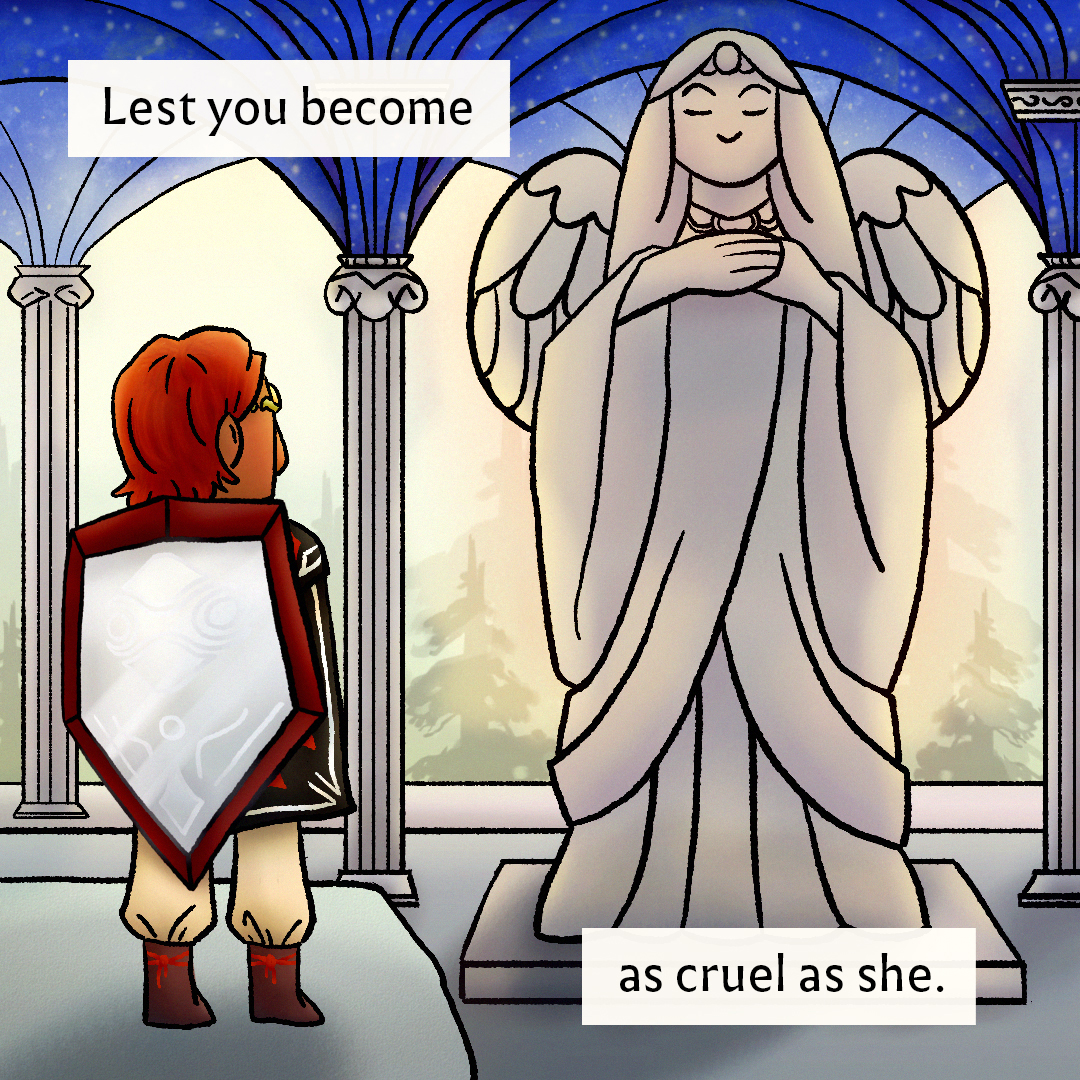
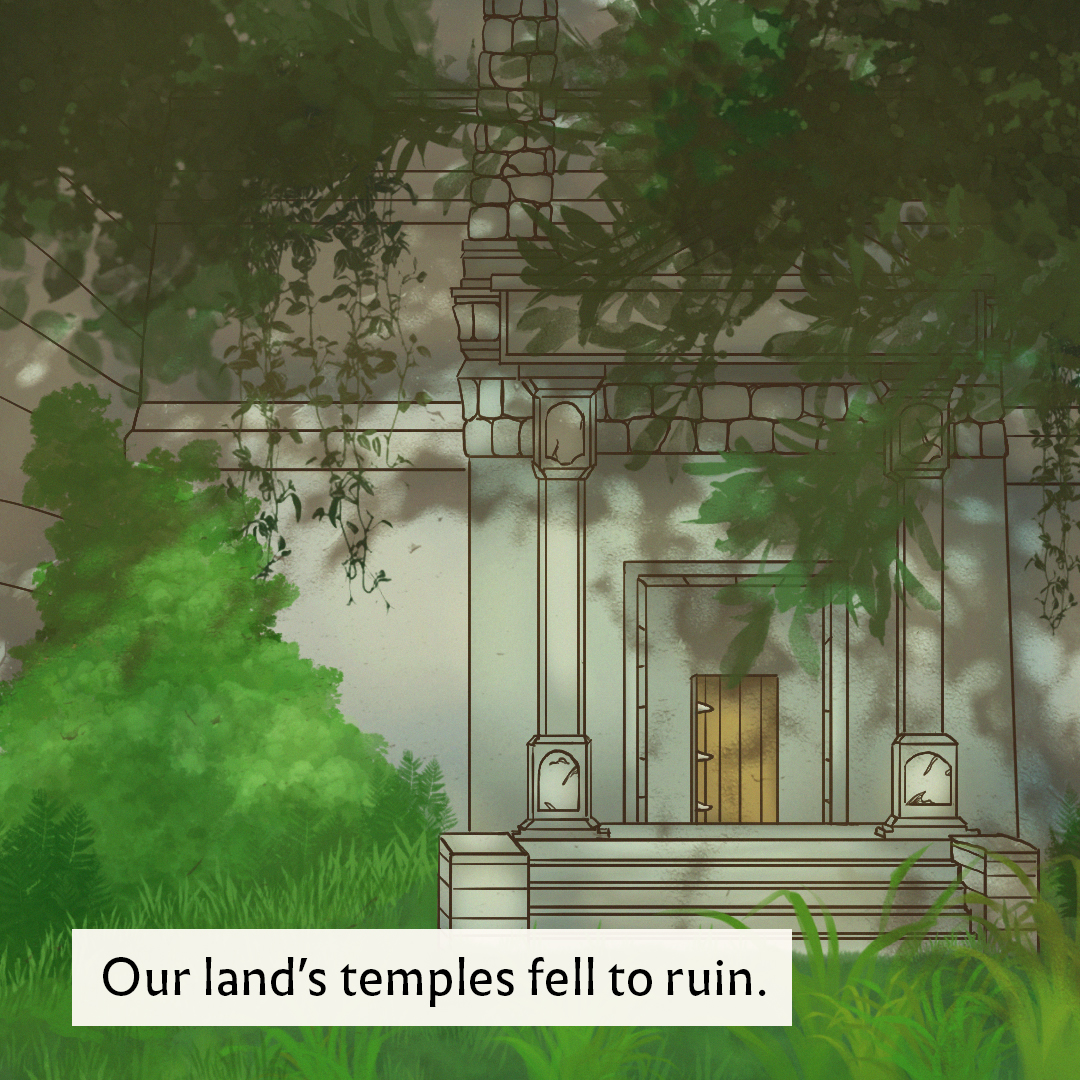
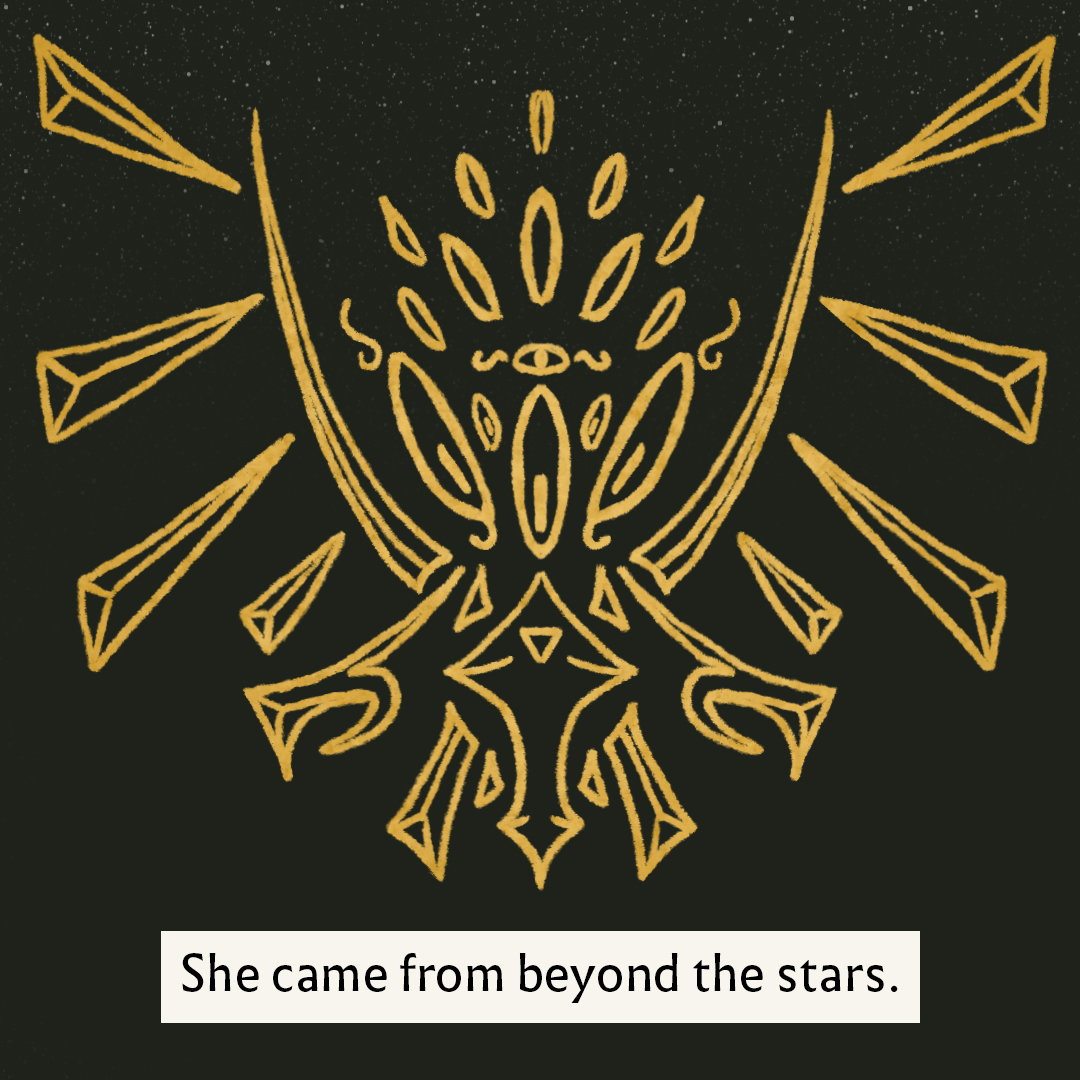
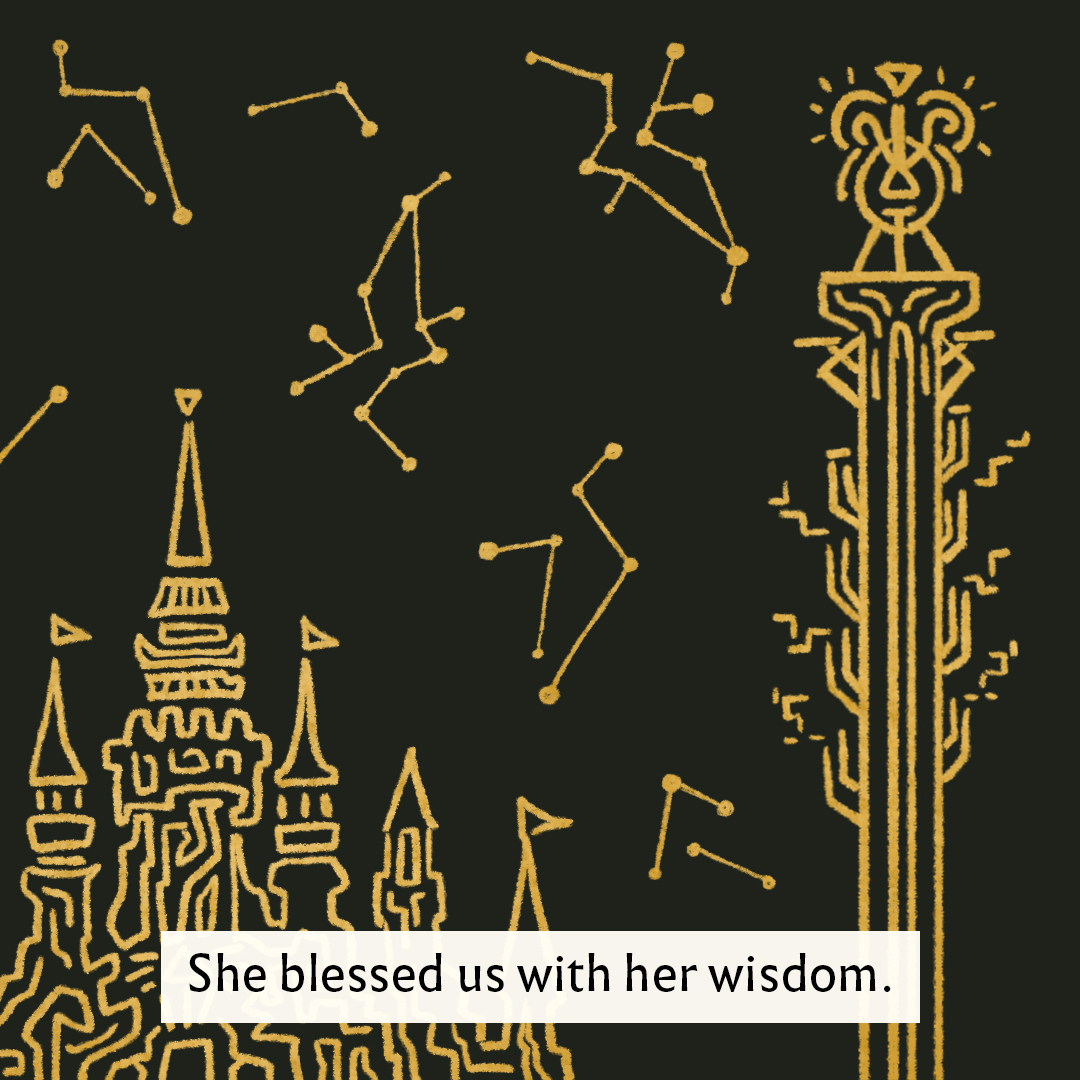
This is the third and final section of a speculative comic about gods and mortals in Legend of Zelda lore and mythology. The first part is (here), and the second part is (here). This is a continuation of the ideas I expressed in a short collaboration comic called Hylia’s Chosen Knight.

The goddess Hylia is more than a little scary, and it’s interesting to think of Ganondorf as being the hero of another story. I’m fascinated by the theme of “the failed or corrupted hero,” and I think it would be interesting if Ganondorf went on a quest that paralleled Link’s journey. Maybe young Ganondorf saw Hylia as the villain, but the power he needed to stand against Hyrule ended up overwhelming him. To me, that’s much more compelling than the idea of power only being “good” when it’s wielded by the “chosen” person.

Watching from the Shadows

I contributed a story about Impa and Princess Zelda titled “Watching from the Shadows” to Goddess Reborn, a zine celebrating the female characters of the Legend of Zelda series. You can check out the zine’s Twitter account (here), and you can read my story on AO3 (here). Here’s a short description of the story…

Impa prepares to train Princess Zelda as a Sheikah warrior during the year following the fall of Hyrule Castle. Zelda is tired of hiding and eager to fight, so Impa shares stories from the past to demonstrate that there is wisdom in waiting for the right moment to strike.

This spot illustration was created by the magical and marvelously skilled Frankiesbugs, whose sharp and deadly work can be found on Tumblr, on Twitter, and on Instagram.

Hylia’s Chosen Knight

I had a horrible thought about the Legend of the Zelda mythology the other day. Demise’s curse supposedly follows the bloodline of the goddess Hylia, so all she needs to do to release Hyrule from an endless cycle of destruction is to stop reincarnating as a mortal. Why she insists on being reincarnated isn’t clear, but Skyward Sword strongly suggests that it’s because she loves Link so much. This is a little creepy…

…but I have nothing but unironic respect for ancient deities who behave like teenage girls!

Once I started thinking about Hylia being creepy, all sorts of interesting possibilities presented themselves. What if Hylia isn’t just a “goddess,” but also completely inhuman? What if she isn’t a sky goddess, but a being from beyond the sky? And what if it’s not necessarily Link she loved, but Hyrule? The idea of an eldritch cosmic entity who wants to become human because she loves the earth is beautiful. It’s also romantic, sort of like The Little Mermaid but endlessly apocalyptic.

Then I started thinking about the Sheikah, the group of people who have historically served Hyrule’s royal family from the shadows. In Breath of the Wild, the ancient Sheikah built incredibly sophisticated technology that is completely at odds with the otherwise medieval world of the game. In addition, their technology also features cosmic and sidereal motifs. What if the Sheikah always knew what Hylia was?

I was partially inspired by (this) comic about how potentially creepy Hylia is in Skyward Sword, and by (this) illustration of Zelda as subtly but undeniably monstrous. I’m fascinated by darker interpretations of the Legend of Zelda universe, and I would love to see more horror-themed Zelda art in the world. While I’m waiting for the sequel to Breath of the Wild to be released, I figured that I might as well create some myself.

Frankiesbugs is one of my all-time favorite horror artists, and I was beyond thrilled when she accepted my commission to draw this comic. She had the brilliant idea to model Hylia on Ebrietas from Bloodborne, who bears the sobriquet “Daughter of the Cosmos” and is theorized to have enabled the dystopian world of the game because of her desire to coexist with humans. Frankiesbugs also drew a connection between the iconic eye motif of the Sheikah and the possibility of Hylia having multiple eyes as someone who watches the earth from the skies – or as someone who always keeps watch over her chosen hero.

Frankiesbugs posts original horror art and video game fan art on Instagram, on Tumblr, and on Twitter, as well as on Teepublic and on Redbubble if you’re interested in wearing some creepy-cute graphic design.

Sumire

Sumire is a short nonviolent story game in which you play as the eponymous Sumire, a young girl who lives in a small town in rural Japan. Sumire’s grandmother recently died, and her father has left home. To make matters worse, Sumire’s childhood friend has progressed from ignoring her to outright bullying her. One morning, a magical talking flower (who is not evil, thank goodness) shows up at Sumire’s house and tells her that he has the power to help her experience one perfect day, at the end of which she might be able to see her grandmother again.

Sumire makes a checklist of what would constitute “a perfect day” and then sets out with her flower companion to achieve all of her goals, which include making peace with her former friend and confessing her feelings to a boy she likes. Along the way, you’re free to explore Sumire’s hometown, which is divided into about half a dozen small and manageable sections. The flower’s magic allows Sumire to speak with animals, plants, and a few inanimate objects, and each section of the town is filled with interesting characters and conversations.

At several points in the story, your character is asked to make a binary choice. One of these choices is always “be a decent human being,” while the other is “I wonder if this game has a genocide route.” Reviews of this game tend to make this seem far more complicated than it actually is, like…

Reviews: The game asks you to make difficult choices.

The game: A cute baby frog asks you to carry him to the river, which requires no effort on your part. Do you happily agree, or do you tell him that he’s disgusting and that you wouldn’t touch him even if he paid you? If you agree, you get a tangible reward and some extra dialog; and if you don’t, he doesn’t talk to you again.

Reviews: The game forces you to think about the consequences of your actions.

The game: Are you friendly to the slightly nerdy kid who’s friends with the boy you like, or do you tell him that he’s a fat fuck who deserves to be bullied? If you’re friendly, this unlocks a fun but entirely optional minigame; and if you’re not, he doesn’t talk to you again.

To me, it was always crystal clear what choices Sumire should make in order to achieve her goals, which are written in the form of a checklist on a piece of paper that you can access from the menu screen. For example, one of your goals is basically “tell Mom I love her.” So, when you trigger a scene in which you have an option to tell your mom you love her… You should probably do that!

The joy of this game is being able to roleplay what it feels like to be friendly and kind and have your kindness acknowledged and rewarded. There are no trick questions, and there are no decisions that don’t turn out the way you expect. For example, if you tell your mother that you love her, she doesn’t respond by accusing you of being emotionally manipulative for demanding attention when she clearly wants to be alone; this just isn’t that sort of game.

When I say “that sort of game,” I’m specifically thinking of Spiritfarer, which is written about adults for an intended audience of other adults. Spiritfarer is about as wholesome as a game can be, but it acknowledges that not everyone is going respond to kindness with gratitude. Meanwhile, I’m pretty sure that Sumire is intended for a younger audience, or at least an older audience that wants to feel nostalgia for a childhood that isn’t complicated by a more mature understanding of human behavior.

That being said, I’m curious about what would happen if you were to consistently choose the antisocial dialog options. Does the game get dark and creepy? Because that would be interesting. I couldn’t find anything about this online, so perhaps it might be worth experimenting with in the future.

Aside from the (probably?) limited satisfaction of trying out different dialog choices, I’m not sure if Sumire has any replay value in the traditional sense, as you can experience everything the game has to offer during a single two-hour playthrough. Regardless, the world of the game is so beautiful and charming that I’m already looking forward to returning to it in the future. Sumire is the video game equivalent of comfort food, and it’s perfect for a rainy afternoon when you need some flowers and sunshine in your life.

Ananth and the World of Demons

Most of my novel The Demon King is set in postapocalyptic New Jersey in an era far in the future, but the world before the apocalypse is my attempt at imagining a contemporary “low fantasy” society where magic is commonplace but not particularly fantastic. Almost anyone can perform magic, just as anyone can play an instrument or do math without a calculator, but most people either don’t care or don’t bother.

The difference is that being good at guitar or having the ability to solve equations in your head can’t directly hurt people or reshape reality. Kids therefore have magic classes in school from age nine to age fourteen; and, starting at around age ten, children attend magic academies for three or four weeks over the summer. Attendance at summer academies is mandatory during middle school and optional during high school. Some of these academies are private, while others are state sponsored. Most of the subsidized summer academies are hosted by local colleges and universities, while others are conducted at specialized institutions.

Magic classes and summer academies are ostensibly intended to train children and teenagers to use magic responsibly while helping them to develop their talents, but most kids take magic class about as seriously as they take art class – which is to say, not very seriously at all. The real purpose of magical education is to alert professional magic users called mages to children with unusual talents.

Most people don’t have much magical aptitude, but a small percentage of children demonstrate powerful magic from an early age. Performing magic is a complicated process that requires an external point of focus, meaning that it’s not something that can be done unconsciously or accidentally. Regardless, any type of magic can be dangerous if the user is powerful and untrained. Children with an unusually high level of magical ability are therefore singled out for extra attention and education.

Many magically talented children grow up to use their magic professionally. Almost all sports involve an element of magic, for example, so most athletes are skilled magic users. People who specialize in “shadow” magic, which involves manipulation of the perception of light, often go into the arts, while people who are skilled at “sun” magic, which involves the manipulation of organic matter at an elemental level, go into medicine. This doesn’t mean that magic is necessary to become an artist or a doctor, but rather that many professional fields accommodate magic.

Highly trained professionals called mages study magic for its own sake. Mages work (and often live) at the magic academies that run summer programs for children, and one of their primary duties is to monitor and police the use of magic. Although mages may be occasionally be affiliated with law enforcement, they mainly operate according to traditional codes of law that are international in scope. As a result, their activities may be extralegal at times. This is because magical threats are extremely dangerous, and it’s necessary to contain such threats as quickly as possible.

Thankfully, magical crises are highly uncommon, as sociopaths and gifted magic users are equally rare. Moreover, the vast majority of potential problems are neutralized at the summer academies, which serve as an opportunity for mages to keep watch for antisocial behavior and dangerous magical talents.

Each of the permanent academies that train mages houses an “elemental keystone,” which is a physical object that functions as a magical battery. A keystone can be anything, but it’s often symbolic and generally small enough to be held in one hand. These keystones contain traces of the power of every mage who has studied at the academy, and they distribute magical energy to the academy’s infrastructure while serving as a repository of tradition and knowledge.

The process used to transfer individual magical power into and away from the keystone can also be weaponized to permanently drain someone’s magical ability. Although this happens only in the most extraordinary of circumstances, the complete absorption of someone’s magic into a keystone can be used as a punishment or a preemptive measure. In most cases, the person is unharmed; while in others, the process renders them physically and psychologically inhuman.

The victims of such tragedies are called “demons,” and their existence is unknown to everyone but the most advanced of mages. The process that creates demons is horrible and inhumane, but the alternative of giving free rein to dangerous magic users is unthinkable.

In order to prevent keystones from being easily accessible, they are hidden within labyrinths that can’t be navigated by anyone who isn’t a mage-level specialist in the particular type of magic contained within the keystone. Human interactions with these keystones are therefore infrequent. Some cultures view them as sacred objects, while the more secular view is that prolonged contact with keystones is demonstrably unhealthy. Starting in the late nineteenth century, there’s been a halting but gradually growing movement to do away with them altogether. Nuclear power is a useful but imperfect analogy, as keystones remain the only way to neutralize dangerous magical abilities.

Like any other magically enchanted object, keystones gradually lose their charge if not maintained. There is nevertheless a covert and illegal trade in keystones, which are perceived as art objects of historical and archaeological significance even if they no longer contain magical power. By the twenty-first century, fully active keystones have become extremely rare, so much so that most people consider accounts of their power to be mere legends.

The apocalypse was triggered by a young researcher at an East Coast R&D branch of a large and wealthy tech company. The researcher and her team had access to multiple keystones in close proximity to each other, a situation that never would have been possible without the company’s extraordinary wealth, prestige, and power. To make matters worse, this researcher was working outside of the academy system with no oversight by more mages who possessed a better understanding of how keystone magic works and what makes it so dangerous.

In the process of triggering the apocalypse, the researcher managed to absorb a portion of the magical energy of the disaster into a new keystone, which happened to be the closest thing she had at hand – her smartphone. After decades of postapocalyptic turmoil, this smartphone-turned-keystone eventually became the magical relic that powers the water purification facility hidden in the mountains separating the kingdom of Whitespire from the ocean, whose water has become toxic to humans. The relic’s existence is a secret guarded by the royal family of Whitespire and the esoteric order of monks who serve them, as its destruction would mean the certain demise of the kingdom.

Ananth, the eponymous “demon king,” comes from the world before the apocalypse. His parents are both specialists in sun magic; but, instead of being able to manipulate matter at a quantum level, he can manipulate time. Suspecting that his magic is highly illegal and would result in his detention at a magic academy if its nature became known, he presented himself as completely unable to use magic for most of his life. When the apocalypse happened, however, the benefits of time travel suddenly outweighed its risks.

As well as going back in time, Ananth is able to jump forward into the future. There are a number of limitations and caveats to what his magic can achieve, however; and, on top of that, he’s a normal person with no magical training. Through extensive trial and error, he’s realized that his best bet for preventing the apocalypse is to steal the keystone from Whitespire and return to the past with it, where he could hopefully use its power to cancel out the initial magical chain reaction.

When The Demon King opens, Ananth has been time traveling for years, but he hasn’t gotten anywhere. He’s seen the apocalypse happen countless times and been unable to stop it, and he’s seen countless people killed in countless wars as he watched civilization re-establish itself. He’s almost been killed countless times himself. He’s gotten older, and he’s tired. Despite himself, he’s managed to become friends with Ceres, the reigning queen of Whitespire, and he finds himself increasingly involved with the people who live in her era.

Ananth is therefore faced with a terrible choice. Is it worth saving his world if he has to destroy another world in the process? More importantly, if Ananth can’t save the world, who’s going to save him?

. . . . . . . . . . . . . . . . . . . .

This illustration of Ananth was created by the legendary Sam Beck, who writes and draws a fascinating and nuanced comic about lost magic and renegade wizards called Verse, which you can check out (here). Sam goes by @sambeckdraws on Twitter and on Instagram, and you can see more of her professional comic and illustration work on her portfolio site (here).