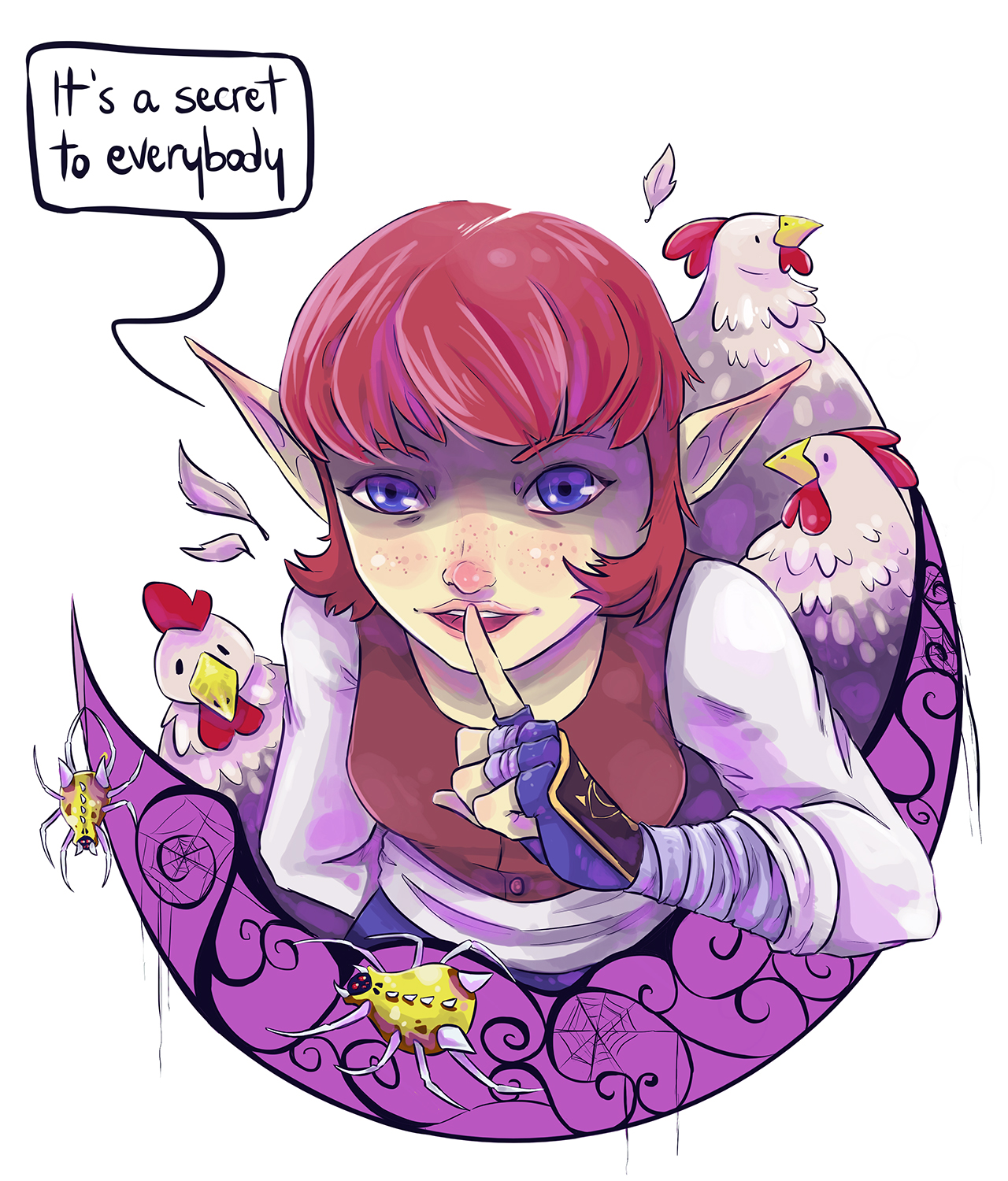
Evil Gardening with Ganondorf

I always seem to find myself in a Wind Waker mood during summer. One of the many things I love about The Wind Waker is how beautiful and green and breezy it is. It’s a joy to spend time in the world of the game, which is filled with all sorts of strange and interesting creatures.

To me, then, it’s always been amusing that the Deku Tree in the Forest Haven blames this state of affairs on Ganondorf. I believe the implication is supposed to be that Ganondorf is so innately evil that his very presence on the Great Sea causes monsters to appear, but that’s extremely silly. Ganondorf may be up to no good, but he’s just a crabby old man.

If Ganondorf is responsible for the appearance of plant monsters, I prefer to think that this is because one of his many old man hobbies is gardening. Evil gardening!!

This comic was drawn by the darkly brilliant Frankiesbugs, whose cute and creepy illustrations and comics can be found on Tumblr (here), on Instagram (here), on Cara (here), and on Redbubble (here). Frankiesbugs is also responsible for the comic art and environment design featured in an upcoming beat-em-up game called V’s Rage. Like Wind Waker, V’s Rage boasts plenty of cute creatures, beautiful sun-soaked landscapes, and ridiculous middle-aged men. You can check out the game and play a substantial free demo on Steam (here).

Tales of the Black Forest

Tales of the Black Forest
https://store.steampowered.com/app/1093910/Tales_of_the_Black_Forest/

Tales of the Black Forest is a 16-bit RPG Maker narrative adventure game whose tone is split evenly between wholesome cuteness and graphic horror. Although Tales of the Black Forest features a dozen simple puzzles, a few short chase sequences, and limited elements of exploration, it might be more accurate to call it a visual novel instead of a classic adventure game. Tales of the Black Forest takes about three and a half hours to play, and more than half of this time is spent reading character dialog as you progress through a linear story.

The game’s story follows a high school student named Kihara Kashin who wakes up on a bench outside an abandoned train station. Kihara has somehow been transported to a depopulated town called Kuromori (whose name means “black forest”), where she used to live as a child before her mother died in a car accident. Inside the derelict station, Kihara meets a mysterious shape-shifting woman named Kiritani Yuki, who tells her that she has been trapped in the ruins of Kuromori by a curse. The only way to escape Kuromori is to use Nensha, a magical power that allows Kihara to travel back in time by touching retro electronic devices. By going back to the 1990s with Kiritani as her guide, Kihara can learn the origin of the curse and hopefully break it. 

The overall story arc of Tales of the Black Forest admittedly doesn’t make much sense. Thankfully, the game is split into three distinct chapters, each of which showcases the stand-alone character story of a cute yōkai girl while allowing the player to explore her environment. Each of the three chapters also explores the intersection between an urban legend and a social issue of the 1990s.

The first chapter is about a deserted village, Shiranaki (a play on the urban legend of Inunaki Village), and rural depopulation. The second chapter is about a magical ghost train and a fictional version of the Aum Shinrikyō “new religious movement” that carried out the Tokyo Subway Sarin Gas Attacks in March 1995. The third chapter is about a haunted movie theater that serves as a case study for how many small businesses that thrived during the postwar Shōwa era were forced to close during the prolonged economic recession of the 1990s.

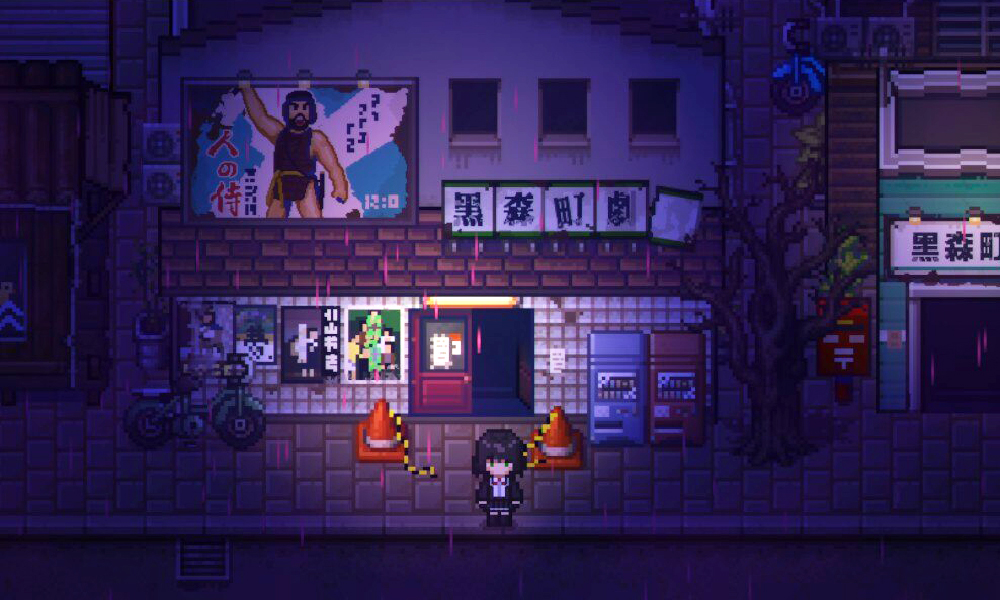
Along with urban legends and social issues, Tales of the Black Forest is strongly inspired by the movies of Studio Ghibli, and its magical world is filled with quirky yōkai and gentle kami. The character illustrations of cute girls that accompany the dialog text are somewhat generic, but the game’s developers clearly put a great deal of love and attention into the 16-bit character sprites and their environments. There’s not a single part of this game that doesn’t make a gorgeous screenshot.

Alongside its whimsy and beauty, however, Tales of the Black Forest contains serious and sometimes graphically violent scenarios with disturbing themes and imagery. The overall tone of the game’s story emphasizes character drama more than horror, but the gruesome and upsetting elements are still there. You’ll be talking to adorable cats in the beautiful green yard of a forest café, and fifteen minutes later you’ll be watching a young woman beaten to death by a deranged cultist.

This mix of wholesome and horror worked for me, but both tonal aspects of the story are equally prominent. Accordingly, I wouldn’t recommend Black Forest to anyone who can’t sit through the creepier moments of The Ring, nor would I recommend it to anyone who can’t tolerate the more sentimental moments of My Neighbor Totoro.

Tales of the Black Forest was made by a Chinese studio in an obvious homage to Japanese popular culture, and its story occasionally feels like an attempt to filter a lecture from an “Introduction to Contemporary Japanese Society” university course through the medium of fiction. I personally found the references to Japanese social problems of the 1990s to be interesting and well-intentioned, but I could understand that some players might find these elements of the story a bit cringe in the way that early 2000s “onigiri means rice ball desu” North American anime fandom was a bit cringe.

Tales of the Black Forest was originally written in Chinese, and the English translation feels as though it was created by someone without much experience in localization. It’s serviceable, but it can be awkward at times. I tend to think the concept of “standard English” is nonsense, and I found the translation to be charming, especially because it reminded me of how pirated anime used to have English subtitles created by people whose first language was Chinese. In keeping with the retro theme of the game, I very much appreciated this unintentional element of nostalgia.

Tales of the Black Forest isn’t perfect, but it’s a solid 7/10 game that’s elevated to an 8/10 by virtue of the love and care that the two-person development team put into every aspect of its creation. This game caters to Japanese pop culture nerds who are fans of both cute anime characters and creepy urban legends, and I’m surprised it hasn’t attracted more attention since it was released on Steam in 2019. Tales of the Black Forest is a small but shining hidden treasure.

Usurper Ghoul

Usurper Ghoul
https://evandahm.itch.io/usurper-ghoul

Usurper Ghoul is a nonviolent Game Boy adventure game that channels the “ruined kingdom” vibe of Dark Souls. I tend to think that Dark Souls is marred by needless difficulty; and, in the same way, the gameplay elements of Usurper Ghoul are needlessly frustrating. The nonlinear exploration-based gameplay of Usurper Ghoul is on brand for a Soulslike Game Boy game, but it’s not for everyone. Like Dark Souls, Usurper Ghoul becomes more interesting the more you engage with it, but the beginning is rough.

You play as a horned, skull-headed demon who wakes in a garden in the hills overlooking a small village, which in turn overlooks a valley of tombs. In true Dark Souls fashion, no one tells you where to go or what you need to do, and it’s possible to spend a lot of time walking around without getting anywhere. There are a few people scattered across the wilderness, but they’re not particularly helpful.

With no particular goal other than to explore the world, your job is to collect three items from three categories. Flowers allow you to interact with people, sticks allow you to interact with the environment, and rocks allow you to access more knowledge about the world. One stick allows you to unlock doors, for example, while another stick allows you to read written text. The catch is that you can only hold one of each type of item at a time.

The necessity of discarding one item in order to use another fits the broader theme of the game, which is that something must be sacrificed in order for something else to be gained. Unfortunately, switching between items involves a great deal of needless backtracking. The world of Usurper Ghoul isn’t that big, and the game isn’t overly complicated, but it’s big and complicated enough for the backtracking to be annoying. There are no puzzles involved; it’s just donkey work.

One might say that Dark Souls involves needless complications and barriers to progress, but one of the primary attractions of Dark Souls is that it’s gorgeous to look at. You might be continually frustrated over the course of your journey through Lordran, but you tolerate the setbacks because the environment is so beautiful and atmospheric. The world design of Usurper Ghoul is unique and interesting, to be sure, but it’s still rendered with primitive Game Boy graphics. There’s no background music, and the sound design is limited to jarring beeps at odd moments. In other words, it’s not necessarily a pleasure to trek back and forth across the map to switch out one tool for another.

The overall story of Usurper Ghoul is intriguing, but the writing is hit or miss. Most NPCs say decontextualized NPC banalities, and the lore encountered in books and on monuments often feels like a parody of Dark Souls. Although this is never explained, your goal is to enter a tower; and, to do so, you have to collect enough lore to figure out the right order to light torches in front of the tombs in the valley. You need different sticks to unlock gates, to read the writing on the tombs, and to light their torches, so this is a tedious process even if you (like me) lose patience with the game’s obtuse writing and resort to a walkthrough to figure out the order.

Having discussed what’s frustrating about Usurper Ghoul, I now want to explain why I enjoyed it anyway. The next paragraph contains mild gameplay spoilers, but it’s also the coolest part of the game.

For your own nefarious purposes, you can offer three varieties of flowers to NPCs. Comely flowers make people like you, malodorous flowers make people dislike you, and horrid flowers will kill anyone who touches them (except you). In one of the game’s endings, you can climb the tower in the valley and simply leave the kingdom behind without hurting anyone. If you want to experience everything Usurper King has to offer, however, your goal becomes to kill as many NPCs as possible while managing the limitations imposed by each death. Each NPC you kill with a horrid flower leaves a book in the tower whose text emphasizes the theme of sacrifice. For me, this was when the story became worth the trouble of navigating the world.

I found the endgame of Usurper Ghoul to be extremely compelling. And really, despite the initial annoyances, the ideas informing Usurper Ghoul are brilliant. I feel that the success of the execution is limited by the Game Boy technology, and I’d like to give the developer a nice chunk of cash to hire collaborators and develop these ideas into a less bare-bones format, perhaps along the lines of Tunic. Usurper Ghoul is a fascinating proof of concept; and, with a bit of polish, I could easily imagine it becoming a cult classic.

For me, the payoff of Usurper Ghoul was worth the frustration of the gameplay and the occasional Dark Fantasy Generator™ writing, but your mileage may vary. There’s a lot to explore and experiment with in the world of the game, and it’s definitely possible to spend several hours there. I lost patience toward the middle and used (this walkthrough on Reddit) to smooth over some of the rougher bits, and I ended up spending a bit more than two hours with the game. If nothing else, I’m really looking forward to checking out the developer’s comic projects in the near future.

An Elegy of Earth and Sky

An Elegy of Earth and Sky
https://archiveofourown.org/works/55003288

Long ago, in a time now lost to the ages, Hyrule was a formless void roiling with primal darkness. Seeing potential in this untapped energy, three goddesses descended from the source of light to shape Hyrule according to their will. They bestowed three sacred virtues upon their daughter before leaving her in the land they created, where the god of the earth waited to grant her a gift of his own.

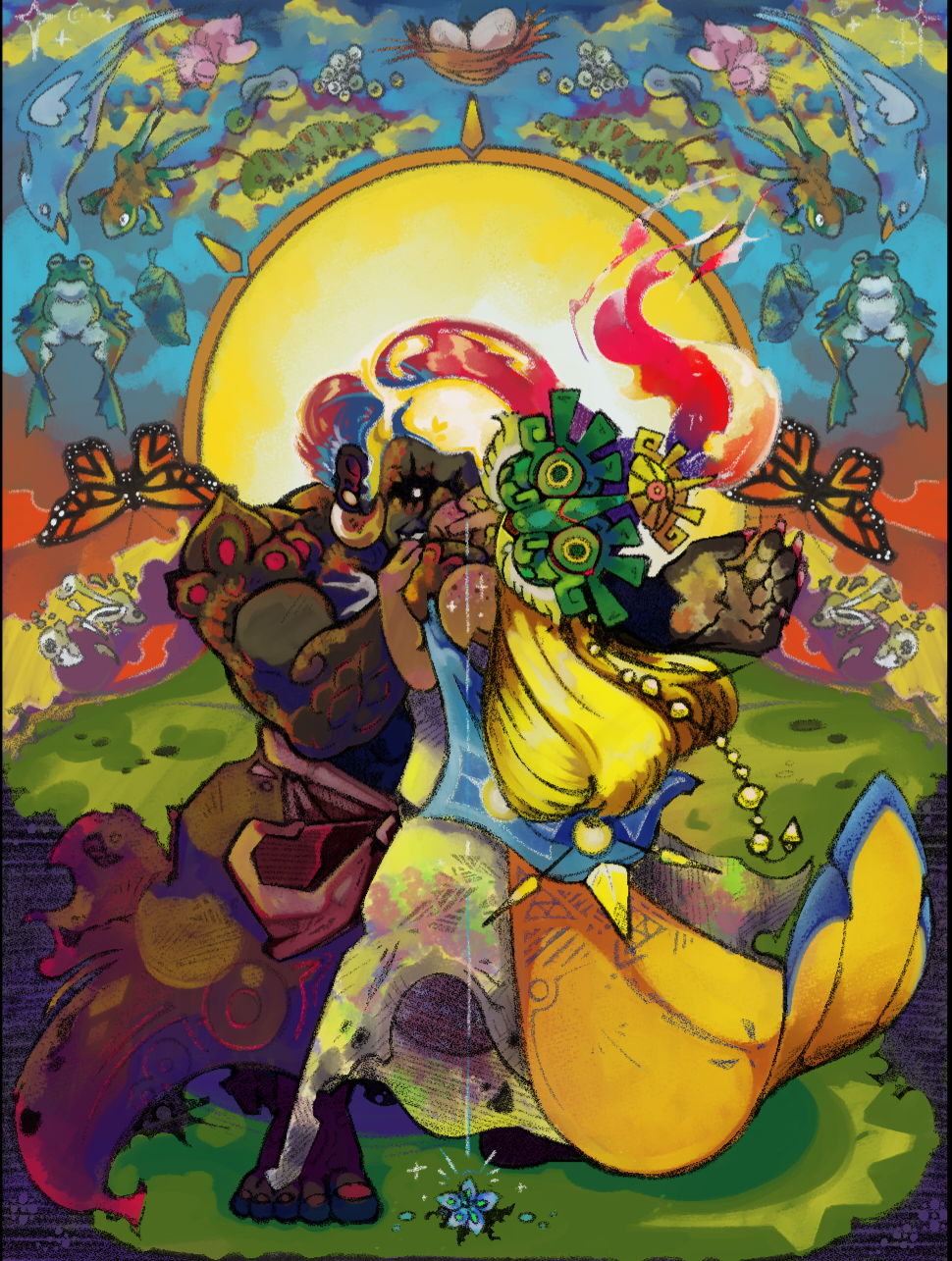
I’ve been intrigued by the mythology of the Legend of Zelda games since I first read the fantastically illustrated story of Hyrule’s creation in the game manual for A Link to the Past, and I’ve enjoyed how games like Ocarina of Time and Skyward Sword have expanded on the divine cosmology of the series. I was frustrated by the lack of any foundational mythology in Tears of the Kingdom, so I decided to write my own version of Hyrule’s origin story. The first half is based on Hesiod’s Theogony, while the second half borrows from one of the stories about Izanami and Izanagi in the Kojiki. Hopefully this short story reflects the poetry of its inspirations!

The illustration that accompanies this story was created by Hylias_Disgrace, a purveyor of the strange and divine whose gorgeous character art and intriguing comics can be found on Instagram (here). It was the artist’s decision to use the famous Gustav Klimt painting The Kiss as a way to bring out the parallels between Hyrule’s deities and the myth of Hades and Persephone, and I love how this dynamic illustration celebrates the cycles of the natural world.

Giraffe and Annika

Giraffe and Annika is an extremely chill 3D adventure story game with anime-style character designs and panel-by-panel manga cutscenes. The game takes about four hours to finish, and I suppose that whether it’s worth $30 depends on how much you value this type of experience. I played Giraffe and Annika in short stretches during the day to get a bit of emotional sunshine, and it was lovely.

You play as Annika, a ten-year-old catgirl who mysteriously finds herself on a beautiful forested island. There’s a bit of an Alice in Wonderland flavor to the scenario, as Annika doesn’t worry too much about where she is or how she got there, and she begins the story as something of a blank slate. After investigating an empty house belonging to someone named Lisa, Annika goes back outside to find a blue-haired catboy named Giraffe waiting for her. Giraffe tells Annika that she has special powers, and he asks her to visit three dungeons on the island in order to restore starlight to a magical pendant.

The dungeons are themed open-air environments inhabited by roaming ghosts that will drain Annika’s health meter if they get too close. Thankfully, the dungeons are also filled with numerous health-restoring crystals. At the end of each dungeon is a boss battle that takes the form of a simple rhythm game. It’s possible to die from ghost attacks and other environmental hazards in the dungeons; and, in fact, I died a lot. Thankfully, save points and respawn points are so frequent that this isn’t an issue. There is zero stress in this game.

By clearing the dungeons, Annika will unlock exploration abilities such as a floaty space jump and the ability to swim underwater. She’ll also perform small fetch-quest tasks for NPCs who will help her bypass other obstacles. There are various objects that Annika can interact with across the island, but the optional collectibles are just for fun. Objectives are clearly marked, and you’ll never be in danger of getting lost or going off-track from the main quest.

The island is very lush and green and beautiful, and there’s a short day-night cycle that adds a touch of visual flair. I also appreciate the cuteness of the designs of the game’s sizeable cast of NPCs. In order to access the second dungeon, for example, you need to feed carrots to a sea turtle; and, to get the carrots, you have to round up a family of rabbits. The rabbits look like a Studio Ghibli adaptation of Beatrix Potter, and they’re adorable. Meanwhile, the sea turtle is completely photorealistic, which is a good illustration of the game’s gentle sense of humor.

It’s always a pleasure to encounter and interact with new characters, and I really enjoyed the manga-style cutscenes, which play out panel by panel. The character art is comically expressive, and the bright pastel colors are lovely.

It’s difficult to critique Giraffe and Annika, as it’s very sweet and competently constructed. Still, the main 3D playspace of the game can feel a bit textureless, and I also felt that the game wears out its welcome when it starts trying to challenge the player at the very end. I actually appreciate the occasionally amateurish design, as it fills me with a sense of nostalgia for the early 3D adventure games of the PlayStation era. Even though Giraffe and Annika sometimes looks as though it was built with out-of-the-box 3D graphic assets, it’s clear that the creators put a lot of effort into creating unique environments with a distinct sense of character.

Giraffe and Annika probably won’t appeal to someone looking for a deep story or challenging gameplay, but I can imagine that it would be a perfect starter game for its target audience of younger players. As for me, it provided a pleasant and much-needed mood boost during a dismal week in February. Giraffe and Annika is a bright and simple fantasy adventure with cute characters and no unnecessary cooking or crafting elements, and sometimes that’s exactly what you need in your life.

The Memory of Stone

I wrote “The Memory of Stone” back in 2020, when the announcement of a sequel to Breath of the Wild encouraged many Legend of Zelda fans to speculate that the game would feature Princess Zelda as a playable character. I returned to this story after finishing my second playthrough of Tears of the Kingdom, which reduces Zelda to a voiceless source of crafting materials. It was a disappointment, to say the least.

One might argue that there are other games with female protagonists, so why insist on playing as Zelda? I would counter this argument with another question: why not play as Zelda? The concept of Zelda as a playable character makes perfect sense within the context of the games’ stories. Link’s journey almost always runs parallel to a journey that Zelda undertakes on her own, after all, and being able to explore Hyrule with a different set of skills (and from a different narrative perspective) would be a lot of fun.

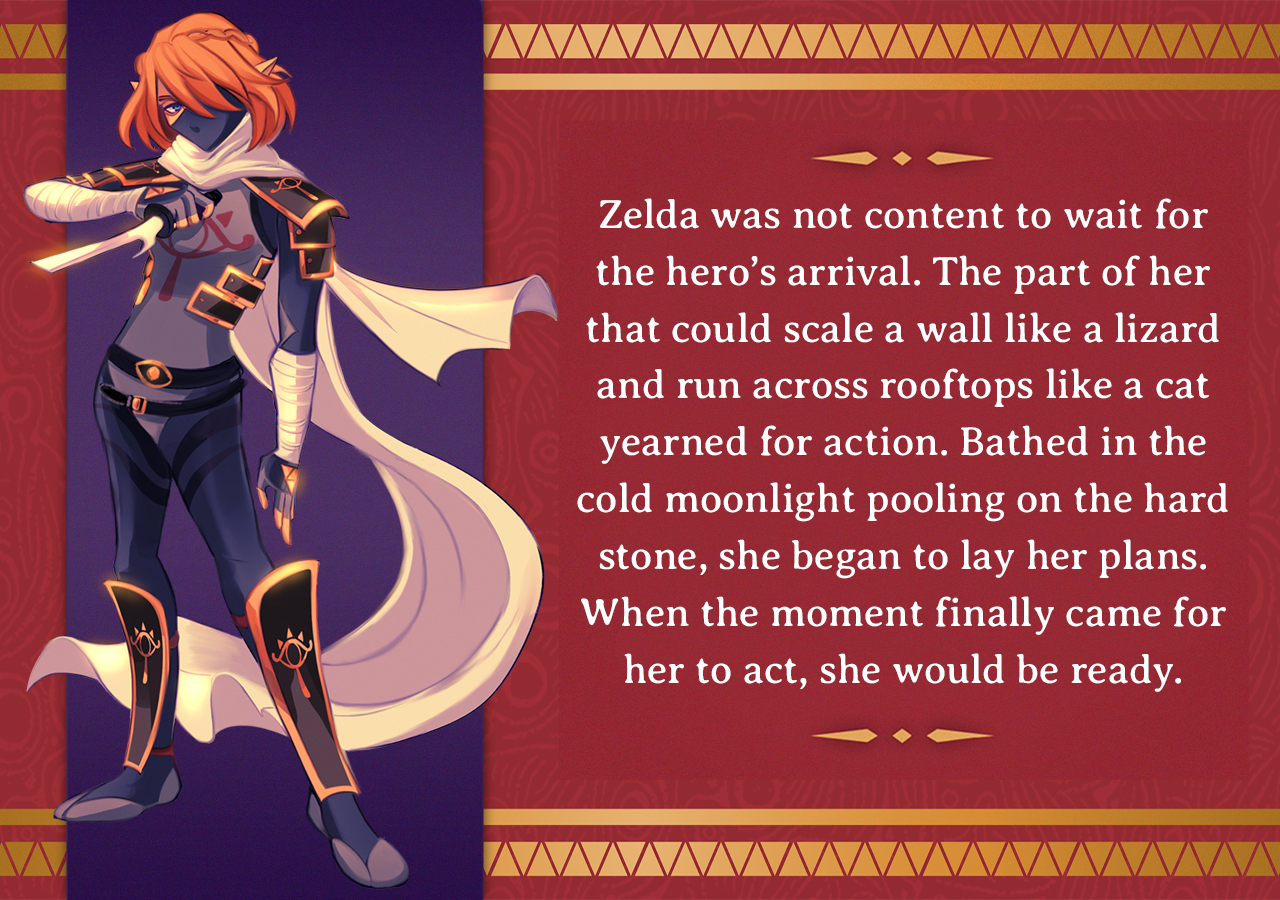
“The Memory of Stone” follows Zelda through each of the temples in Ocarina of Time, and it’s a small attempt to imagine what the eponymous “legend of Zelda” might look like through the eyes of Zelda herself.

You can read the story on AO3 here:
https://archiveofourown.org/works/25230271

The illustration of Sheik included in the story preview graphic was drawn by the revolutionary Nolvini, a fan of shōjo anime who creates magical character illustrations filled with personality and flare. You can check out her work on Twitter (here), on Instagram (here), and on Tumblr (here), and she also has a shop on Etsy (here).

Love in the Time of Gloom Spawn

After years spent investigating the mysterious shrines of East Necula, Dr. Calip has joined the Zonai Survey Team’s efforts to study the Ring Ruins of Kakariko Village. The ancient structures are fascinating, but what has captured Calip’s attention is the chasm in the forest on the hill. While Calip has been gazing into the abyss, however, the leader of the Zonai Survey Team has been gazing at him.

As I grow more impatient with grand narratives of nation-building and heroic destiny, I’ve become more interested in how epic fantasy universes appear to normal people. Hyrule is especially fascinating as a case study, as the privileges enjoyed by Link clearly aren’t applicable to everyone else. This is especially true of the knowledge Link accumulates over his journey, during which the secrets of prior eras are revealed to him alone.

In the present postapocalyptic era of Breath of the Wild, it seems the only person trying to study and understand Hyrule is a scholar named Calip, who lives in an isolated cabin as he attempts to stage an archaeological investigation into the site of one of the ancient Sheikah shrines. As an academic, Calip is a pompous asshole. Regardless of “Dr.” Calip’s self-serving motives, I admire him as a character who investigates the world and tries to understand it instead of simply killing things and accumulating treasure.  

Perhaps because of the popularity of the fandom’s speculation and study of Hyrule, Tears of the Kingdom leans into the ethos of archaeological inquiry with the establishment of a large and diverse set of NPCs forming the Zonai Survey Team. This Sheikah-funded research organization is led by a brick house of a character named Tauro. Tauro has set himself up in Kakariko Village, which has been beset by ruins falling from sky islands and a giant pit opening in the forest on the eastern hill.

Given their interests, it’s only natural that Calip and Tauro would interact. When you read the diaries that Calip has left at his former cabin and at his desk in his office in Kakariko, you learn that Calip is undeniably attracted to Tauro, who apparently went out of his way to invite Calip to work with him. Late in the game, the two men abandon their duties to run off and do research together. I think is a sweet lowkey love story – and even Kotaku agrees, apparently!

The emphasis on archaeological excavation in Tears of the Kingdom is somewhat problematic. In essence, the kingdom of Hyrule had a state-building myth that justified its sovereignty over the surrounding regions, and the result of the archaeological study performed by state-sponsored Zonai Survey Team is the demonstration that these myths were true in the most literal sense. Yes, there are evil outsiders who will kill everyone if they get the chance; and yes, only the royal family and its servants can protect everyone; and yes, the royal family is literally descended from gods/dragons. It’s all kind of gross.

What I therefore appreciate about the implied love story between Calip and Tauro is that they turn their backs on the politics of ancient texts and leave Kakariko so that they can go out into the woods and look at ruins together. For them, curiosity about the world has nothing to do with national mythologies and everything to do with the connection they feel to the people who lived on the land before them – and the connection they have with each other.

Because I am apparently incapable of creating anything that doesn’t have monsters, however, the story I wrote about Calip and Tauro ended up being a horror story as much as it is a love story. It has a happy ending, but it also has a healthy dose of eldritch horrorterrors. Phantom Ganon also makes an appearance, because of course he does.

The story is complete at 4,000 words, and you can read it on AO3 here:
https://archiveofourown.org/works/51328888

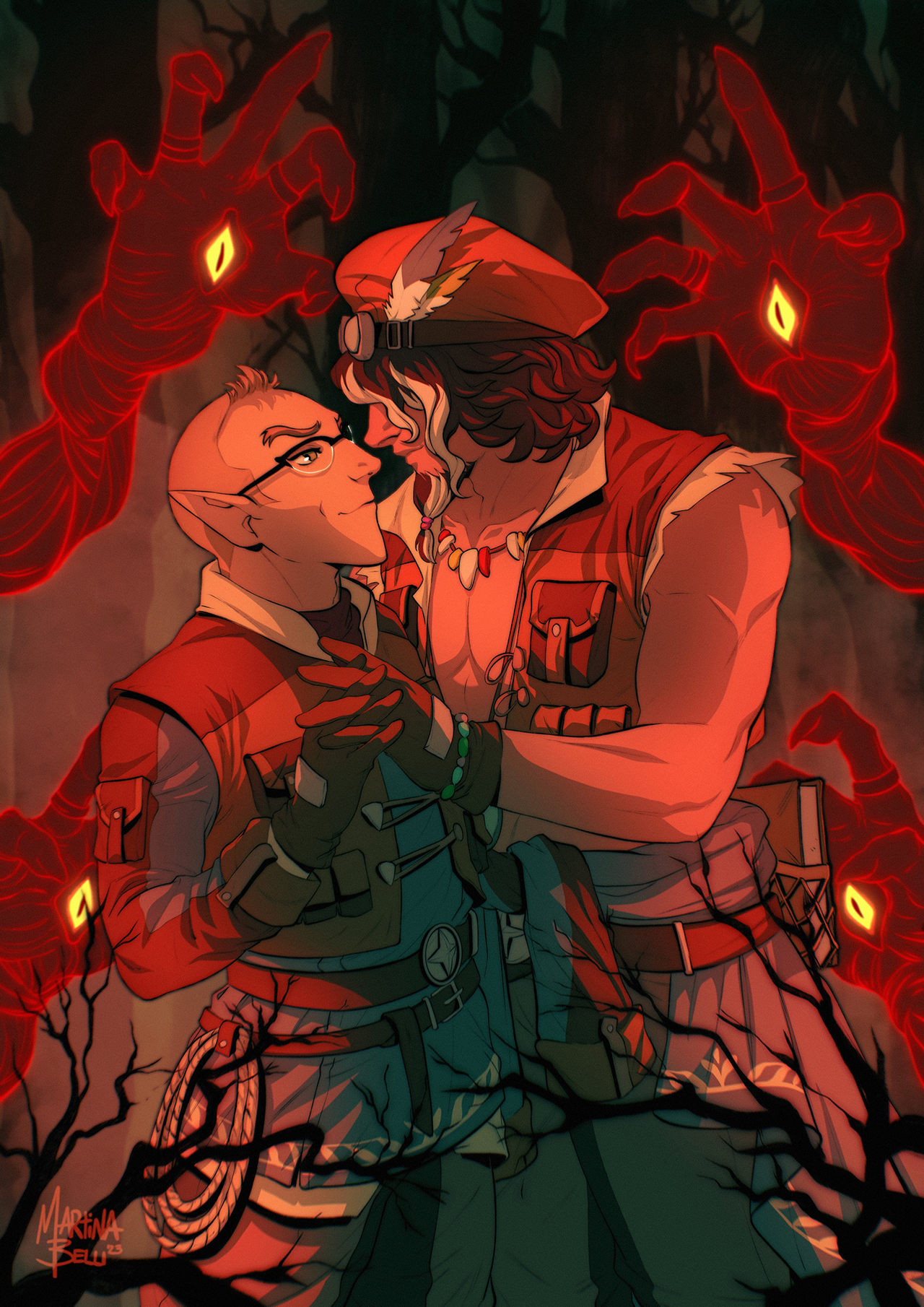
The illustration is by the marvelously talented Martina Belli, whose magical artwork helped me bring these two characters and their story to life. Marty paints dynamic portraits of fantasy characters and dramatic science fiction scenes, and she excels at creating compositions that draw the viewer into the world of her art. It was a lot of fun to work with her, and I highly recommend following her creations on Twitter (here).

They Only Come Out at Night

Grog has noticed a number of peculiarities in Kakariko Village. Eerie lights flicker in the mountain valley after dark. Murky black water fills the old stone well that no one uses. Golden spiders spin their webs under the eaves of abandoned buildings. Little does Grog know that the legendary Sheikah of Kakariko still live, and that they are watching.

I’m one of the many children of the 1990s who read Stephen King way too young. I think I must have been ten years old when I first encountered the IT, and I read the novel like it was Harry Potter. I was too young to understand a lot of what was going on, but what I took away from the story was a lifelong fascination with haunted towns.

This is one of the many reasons why I love Kakariko Village in Ocarina of Time. Like Derry, Kakariko seems pleasant and idyllic in the daytime, but all manner of horrors creep through its sewers. Over the course of his journey through Hyrule, Link learns that Kakariko is a Disneyland-style stage setting that covers an underground labyrinth of corpse-choked dungeons. Impa opened the depopulated village to the refugees from the civil war that left Link an orphan, which means many of the people living in Kakariko have no idea what their homes are standing on top of.

I’m curious about the perspective of normal people who live in fantastic worlds, and I’m particularly interested in Grog, the odd young man who greets Link at the entrance to Kakariko after dark. His dialog is iconic: “People are disgusting. My own father and mother are disgusting. You must be disgusting, too!”

When Link returns to Kakariko after seven years, Grog is nowhere in sight. No longer a surly teenager who resents his parents, Grog has gotten himself caught up in some truly strange business. It was only when I played Ocarina of Time as an adult that I was able to put together all the pieces of Grog’s story, which ends with his death (or perhaps suicide) in the Lost Woods.

I think Grog’s unfortunate fate is representative of what happens to people in Hyrule who see too much or ask too many questions. He’s therefore a fun character to use to look at Kakariko from an outsider’s perspective while speculating on what may have happened to the Sheikah. “They Only Come Out at Night” uses some of my favorite Stephen King tropes to tell a story about a deeply haunted village, and I really enjoyed writing it.

If you’re interested in peering into the shadows, the story is on AO3 here:
https://archiveofourown.org/works/51149224

I wrote this piece for The Eyes of Hyrule, a Legend of Zelda fanzine about the mysterious Sheikah clan. The zine will hold leftover sales on Etsy (here) during November, and you can check out more of the work appearing in the zine on Twitter (here) and on Tumblr (here).

For the story illustration, I was fortunate to be able to join forces with Frankiesbugs, a true master of cute and creepy art. You can follow their work on Instagram (here) and on Tumblr (here). I also recommend checking out their current video game project in development, which is on Steam (here) and on Instagram (here).

The Kumo Diary

A professor’s assistant at Tokyo Imperial University uncovers a curious manuscript whose author weaves an elegant tale of the twilight years of the Heian court. As she reads between the gossamer lines of the narrator’s account of a moonlit assignation, the quiet and unassuming scholar reflects on what happens in the shadows cast by civilization and enlightenment.

This story is a play on The Tale of Genji that I contributed to Carpe Noctem: Vampires Through the Ages, an anthology of historical fantasy fiction, illustrations, and comics about vampires in historically specific settings.

I wouldn’t say I’m a “fan” of The Tale of Genji in the same way that I’m a fan of the Legend of Zelda series, but I’ve read multiple translations of the book and enjoyed them all. When you engage with a story so deeply, it’s difficult not to come up with fun theories. I certainly wouldn’t be the first person in Japanese literary history to make this suggestion, but please consider: Why are the characters in The Tale of Genji always described as being so pale, and why are many of them only active between dusk and dawn?

“The Kumo Diary” is set in the Meiji period (1868-1912), Japan’s industrial era of “civilization and enlightenment.” As Japan attempted to establish itself as a nation that could compete with Western powers, its intelligentsia were motivated to create a unified “Japanese culture.” The Tale of Genji occupied an interesting place in this movement. On one hand, it could easily be regarded as the quintessential work of classical Japanese literature. On the other hand, its plot is largely concerned with the love affairs of a rotating cast of beautiful but neurotic women. Japanese scholars were therefore tasked with making The Tale of Genji a respectable classic to be held in esteem by a modern nation.

Scholars had been compiling and revising the chapters of The Tale of Genji for centuries, so it was necessary to create a “definitive” version of the text. While I was studying the history of The Tale of Genji, I couldn’t help but wonder about all the apocryphal chapters that never made it into the canonical text.

It took me ten years, but finally I wrote one of these apocryphal chapters myself. I embedded the so-called “Kumo Diary” into a frame story about a woman who finds the manuscript and decides not to share it with the stodgy male professor who employs her. It’s interesting to imagine there being a secret history of The Tale of Genji, and I really enjoyed writing the ending of my story. After all, who’s to say there aren’t demonic women pulling the strings from the shadows? If they do their work correctly, we’d never know they were there at all.

I’ve posted the story on AO3, and you can read it here:
https://archiveofourown.org/works/50802628

The illustration is by the darkly brilliant Paristandard, whose creepy and creative illustrations can be found (on Twitter), (on Tumblr), and (on Instagram). It was an amazing experience to work with them, and I can’t recommend them enough for character designs, book covers, short comics, and other illustration projects. For this project in particular, the historical specificity of their costume design was uncanny, and I am in awe.

A Worthy Successor

In an eerie castle submerged under cursed waters, Ganondorf tells Tetra about the world that once was. Ganondorf’s story is at its end, but his words inspire Tetra to dream of the world to come.

I recently started playing The Wind Waker in order to do research for a short essay about Koroks. The Wind Waker is a fresh and lovely game, at least at the beginning, and I always forget the emotional impact of the end. The pathos of Ganondorf’s longing for the Hyrule of the past always gets me right in the heart.

I think it’s interesting that, after The Wind Waker, Tetra goes on to establish New Hyrule, the setting of Spirit Tracks. She thereby achieves Ganondorf’s goal of restoring an ancient kingdom blessed by gentle winds. This begs the question – how would Tetra know about Hyrule? Given how much time Tetra spent with Ganondorf under the Great Sea, I think it’s safe to assume that they must have talked to one another.

This story is my attempt to envision what these conversations might have been. I wrote this story a few years ago, but I’m returning to it now because it still resonates with me. The older I get, the more I sympathize with Ganondorf, and the more willing I become to let decaying empires fall to ruin in favor of embracing the winds of change.

You can read the story here:
https://archiveofourown.org/works/35251798

The comic adaptation is by the magical Lightsintheskye, who is:
(on Twitter) + (on Tumblr) + (on Etsy)