Link Loves Revolution

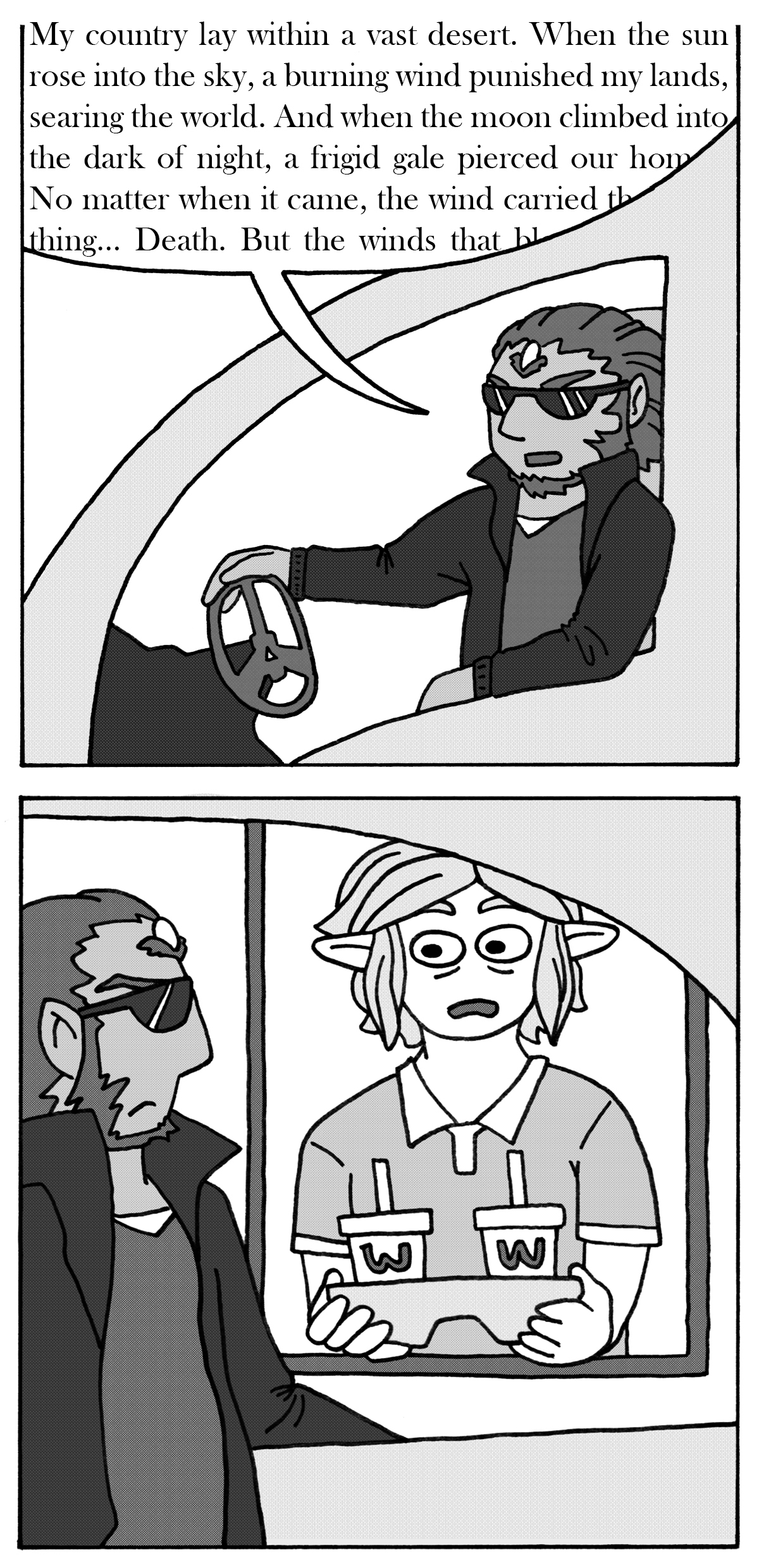
After Nintendo premiered the new Breath of the Wild sequel trailer during E3, all sorts of artists rushed to draw illustrations of the mysterious hero in the sky, but all I can think about when I see these handsome young men is how Link canonically eats bugs. In this house we love our feral son, and I couldn’t resist drawing the Ponyo meme.

Ballad of the Wind Fish

Ballad of the Wind Fish is a bittersweet narrative minicomic that uses the 1993 Game Boy game The Legend of Zelda: Link’s Awakening as a stage to explore the connections between childhood fantasies, nostalgia, and escapism.

The comic is twelve pages long, with one panel per page. I created it for the #Linktober drawing challenge on Instagram during October 2019, but it’s still very near and dear to my heart. Although the comic is ostensibly about Link’s Awakening, it’s really more of a meta exploration of a certain glitch in the original release of the game, as well as a meditation on being a child of the 1990s. I formatted it into a zine and created two pieces of polished art to use for the cover. It’s my hope that this short comic fills the reader with warm memories and sunny summertime vibes.

You can download a free digital copy from Gumroad:
https://gum.co/windfishzine

If you like, you can buy a physical copy on Etsy:
https://www.etsy.com/listing/1035486197/ballad-of-the-wind-fish-zelda-minicomic

The zine is 4.75” square, or roughly the size of a Nintendo DS game case. It’s professionally printed in vibrant full color, and it comes with a 3” circular vinyl sticker depicting the eponymous Wind Fish.

If you’d rather not bother with any of that, you can read the comic as I originally posted it on Tumblr (here).

Vision

In nineteenth-century London, Eleanor lives in her deceased parents’ house with her brother Robert and his wife Cora, who is bedridden with a vague illness. Eleanor was previously engaged, but her fiancé died after enlisting in military service. Having become an unmarried woman of a certain age, Eleanor spends her days caring for her sister-in-law. At night, however, she engages in sexual fantasies in front of her mirror, which she imagines as speaking to her in the voice of an unseen lover.

This situation might continue indefinitely were it not for the romantic attentions of a certain Doctor Bishop, who treats Eleanor’s cataracts and prescribes Laudanum to calm Cora’s nerves. Bishop is affectionate and well-meaning, but Eleanor is a quiet storm of resentment and repressed sexuality whose veneer of quiet virtue and good sense is one the verge of cracking.

Vision is a brilliantly written and gorgeously drawn graphic novella that explores the subtleties of how trapped and lonely people isolate themselves while simultaneously seeking connection, but it’s also a sharp and disturbing story about sex and death. The death is understated and phantasmal, while Eleanor’s sexuality and desire is on open display. Each of the erotic scenes is mirrored by a grotesque reflection, such as when the imagery of Eleanor’s self-pleasure with a candle is reflected in an extended scene depicting her eye surgery. Julia Gfrörer’s linework is delicate yet expressive, granting her characters warmth and personality while occasionally portraying them as eerily inhuman.

Eleanor’s story becomes stranger as various small mysteries and imbalances accumulate into an ever more fragmented portrait of a haunted household. The climax is shocking but perhaps not unexpected, and far more questions are raised than could ever be answered. The absence of clear explanations and justifications is part of the appeal of the narrative conclusion, however, while gradual shifts in the ink style contribute to an encroaching sense of dread – and curiosity.

Vision was published by Fantagraphics Books in September 2020. You can read more about the book on the press’s website (here), and you can order a copy from the Julia Gfrörer’s store on Etsy via its listing (here). Gfrörer’s two previous graphic novel publications with Fantagraphics, as well as her zines, are also listed on Etsy, and each is as creepy and fascinating as the next.

#PitMad for Social Media Introverts

I participated in the #PitMad event on Twitter yesterday. You can read more about it (here), but basically, the goal is to pitch your ready-to-submit novel in a single tweet. If an agent or publisher is interested, they will like the tweet, signalling that you should feel free to get in touch with them. Many agency representatives will also comment directly on the pitch tweet, asking you to send a set of materials to an email address.

In theory, this is an interesting way to get yourself and your work out there, especially if you don’t live on the East Coast and run outside of traditional publishing circles.

In practice, Twitter is still Twitter, and #PitMad is a popularity contest.

Tweets generally gain traction because people “like” them (by which I mean that people click on the heart button), which causes them to appear on other people’s timelines, as well as on the feed for any hashtags you’ve used. Once a tweet accumulates a certain number of likes, that’s when people start retweeting and commenting.

Because the rules of #PitMad say that you can’t like a pitch tweet if you’re not an agent or publisher, however, the tweet needs to receive other types of engagement in order to appear on the tag and on people’s timelines.

For people who aren’t on the Horrible Birdsite, I should probably clarify that Twitter doesn’t show users a chronological feed of content, and that its algorithm doesn’t display the tweets of the people you follow unless it deems them noteworthy. Someone’s tweet can be noteworthy either because you’ve made an effort to go onto their individual page and “like” everything they post, or because the tweet has already gotten enough attention from other sources. Otherwise, the tweet is invisible, and it most certainly doesn’t appear on the tags.

So, in order for #PitMad to work, you have to make plans in advance for people to comment on and retweet your pitch tweet. These markers of engagement will render your tweet visible and will also push it far enough up the tag for agents and publishers to actually see it.

If you have friends in the literary community, or just friends in general, you’re going to need to convince enough of them to shill for you that your tweet passes the minimum threshold of algorithmic engagement to start getting attention organically.

And there is no shame in this! This is what friends and colleagues are for, to help and support each other and work together toward your shared and mutual success.

But what happens if you’re a shy and introverted person like me? Which is to say, what if you are deeply afraid of ever causing trouble for anyone or creating awkwardness by asking for help?

This may seem like an unreasonable thing to be worried about, since “Even if you delete it later, could you please retweet and comment on my #PitMad tweet” isn’t that big of a favor, especially if it results in someone you know getting a publishing deal and thanking you in the acknowledgments of their book.

My own experience, however, was that I lost almost ten followers on Twitter during #PitMad yesterday. In other words, a handful of people who followed me got so upset and offended that I’m trying to pitch an original project that they didn’t just mute me, but they actually went through an additional sequence of button presses to unfollow me. And that’s tough to handle, especially since my pitch tweet didn’t actually go anywhere. I think it’s fair to say that this experience didn’t inspire me with a sense of self-confidence.

I know there might be people out there reading this and thinking, “Well, maybe your pitch just wasn’t that good.” And you know what? Maybe! But this isn’t about whether any given pitch is actually good or not; it’s about how Twitter functions as a platform.

Essentially, if you’re not comfortable enough on Twitter to already have the sort of following that you can reach out to, both broadly and at an individual level, in order to get people to shill for you and engage with your #PitMad tweet, then you’re going to have a disappointing experience.

If you are comfortable with this level of interaction on Twitter, then you’re going to need at least a hundred retweets and two or three dozen comments (including your own replies) in order for your pitch tweet to start gathering steam. Based on what I saw ysterday, publishers and agents started to be interested in tweets that had at least three hundred retweets and fifty or sixty comments. Again, this is just based on what I saw, but the people who were able to pull this off tended to have at least 2,500 followers.

To emphasize this once again, #PitMad is a Twitter popularity contest.

And being on Twitter isn’t that easy. Some people take to the platform naturally, of course, but it can be difficult to gain and retain followers, even if you have a brand and a niche and the time and energy to produce a constant stream of content. It’s been a struggle for me personally, especially as someone who’s become very sensitive to the general ambiance of outrage, hot takes, and assorted unpleasantness that feeds Twitter’s engagement algorithms. It’s important to be able to curate your online experience, but Twitter is infamously bad about showing you things that are specifically designed to upset you. Even if you surround yourself with friends and allies, and even if you’re diligent about blocking and muting, Twitter can be a mental health nightmare.

So I guess I have two recommendations.

First, if you’re going to participate in #PitMad, you need to plan for it in advance, and you need to be aggressive in signing on friends and colleagues to boost your pitch. In all honesty, this is probably good practice for promoting your published work.

That being said, a lot of people – especially other writers – tend not to like it if they feel that you’re cultivating their friendship or goodwill for the sole purpose of promoting yourself, and being around someone who is constantly hustling can be exhausting. If you’re the sort of person who is naturally extroverted and crowd-pleasing, and if you don’t mind certain quieter people drifting away from you, then you probably have a ton of followers on Twitter already.

And this isn’t to say that people like this don’t write and publish amazing and fantastic books! I also don’t want to suggest that “fake it till you make it” isn’t a legitimate strategy. Really, go out there and live your best life, but be aware that participating in #PitMad requires planning and prepwork.

Second, if you’re more introverted and tend to keep the time you spend on social media limited, then #PitMad can be a good way to strengthen the ties you have with your writer friends while hopefully making a few new friends along the way.

Still, because of how Twitter works (and doesn’t work) as a platform, the event has the potential to be a disappointing experience that punches you right in the self-esteem, and you might be better off connecting with potential agents and publishers on a more personal level.

In any case, all of the pitches I saw yesterday were excellent. If nothing else, it was a lot of fun to read through the hashtag, and I would happily sit down and spend time with every single one of those books in the making.

Radiant Princess of Dawn

Gin and cranberry juice is a healthy way to start a magical day.

Ceres is my take on magical video game princesses, and it is my headcanon that all of these ladies are consummate day drinkers. I think you’d probably have to be in order to summon the emotional fortitude to deal with the shenanigans of heroes and villains on top of the everyday business of running a moderately large kingdom.

American Dream, New Jersey

True to my ambition to visit abandoned malls in New Jersey once I got vaccinated, I went to the American Dream mall in East Rutherford.

The mall is located across the river from Manhattan on a gargantuan plot of land that’s been in development since 2003, and you can get a good eyeful of the massive scale of complex while driving on I-95 towards the entrance of the Lincoln Tunnel. From what I understand, the state of New Jersey has been working with various developers to create an attraction that will draw consumer spending money from the city and convince out-of-town tourists to spend the night in a hotel in New Jersey instead of New York, and the amount of money invested is in the billions of dollars. Chris Christie, the former governor of New Jersey, allocated hundreds of millions of dollars of yearly subsidies into the seeing the development completed, which allowed it to project an opening in early 2020… and then the pandemic hit.

Parts of the mall are still under construction, and not all of its retail spaces are occupied, but it’s now open to the public. It is very new and very shiny. The pure white walls and floors gleam under soft white light, and there are fresh-cut flowers and public art everywhere. The empty storefronts and closed-off corridors are hidden by paneling covered in unique and gorgeous graphics, and there are all sorts of interesting pieces of modern furniture in the atrium areas. The soap in the literally sparkling-clean bathrooms is high-quality foam that smells like a garden in springtime.

The shopping seems to be relatively upscale, and the anchor stores are European chains like Primark and H&M. It’s not open yet, but there’s going to be an H-Mart in the basement, which I think is probably a nod to the East Asian retail strategy of having fancy grocery stores in shopping centers. It seems that the mall is also going to have a “luxury wing,” but it hasn’t yet been completed. They’re probably going to charge for parking in the future, but right now it’s free.

What makes this mall unique is that it also has a snowboarding hill, an ice skating rink, two mini golf courses, a Nickelodeon-branded theme park for little kids, and a huge and beautiful DreamWorks-branded water park in a huge and beautiful tropical biodome. There are a few other attractions that are still getting set up, like an aquarium that looks like it’s going to fit the aesthetic of being huge and beautiful and heavily themed in an offbeat artistic way that appeals to younger kids. If I understand the map correctly, the aquarium will have a giant ocean tunnel that will let you walk through a fantasy of a postapocalyptic underwater New York City, which is a bit morbid but still pretty cool.

And this entire place is completely empty. Just, completely empty. Except for a skeleton crew of retail employees at the stores and a few maintenance staff tending to the plants and flowers, there’s no one in the mall. American Dream looks like the international terminal of an airport if humans were to suddenly disappear from the face of the earth – very shiny and modern and clean, but deserted.

Anyway, now I’m wondering how you get the job of being a member of the gardening staff at a high-end abandoned mall that was a ruin before it even opened, because the people I saw tending to the plants and misting the flowers looked very peaceful and happy. It was some next-level Studio Ghibli magic, like Castle in the Sky except real.

If anyone asks, being a gardener in the ruins of capitalism is very much where I would like to see myself in five years.

Ceres’s Story Arc

I’m going to start writing my query letter for The Demon King soon, so I’ve been thinking about how to describe the story, which has two parallel threads that unspool in alternating chapters. The eponymous “demon king” Balthazar (he’s not really a demon king) is the main point-of-view character, as it’s his actions that push the larger narrative forward, but the role of his “nemesis” Princess Ceres (she’s not really his nemesis) as a deuteragonist is equally important and will only become more important as the story progresses.  

Balthazar’s plot arc in the first novella is simple: he says he will go to a temple and find a magical artifact, and he goes to a temple and finds a magical artifact.

Meanwhile, what’s going on with Ceres is more complicated and can’t be succinctly summarized.

Ceres opens the story by sending a hero to fight Balthazar. This “hero” is actually a convict whom she has effectively exiled, and she intends for Balthazar to dispose of him. He does so, but not before the hero kills two people and injures a third.

Back in Whitespire, Ceres grants a private audience to a viscount from an outlying territory who essentially asks to stop paying taxes. Ceres dismisses him, but she allows herself to be seduced by his daughter, who wants the viscount to step down so that she can manage her family’s estate. While engaging in an openly sexual relationship with the viscount’s daughter, Ceres realizes that the viscount is being manipulated by a shadowy anti-monarchist political faction. In an attempt to provoke the members of the faction to reveal themselves, Ceres orders the head of her intelligence staff to direct a covert attack on the viscount’s estate.

Members of a separate anti-monarchist faction, fearing that they will be blamed for this attack, offer a scapegoat in the form of an advanced student of magic – a grad student, basically – who has been distributing seditious tracts. Ceres has actually discussed the matter beforehand with one of the leaders of the grad student’s faction, who is her close friend (and happens to be the author of the ongoing series of romance novels that Balthazar is addicted to). She therefore exiles the student, ostensibly to die at the hands of the demon king but actually to study with his friend Melchior, a wizard from a foreign kingdom who has strong anti-monarchist leanings of his own.

Ceres has grown fond of the viscount’s daughter, and she doesn’t want her or her father to become pawns of court politics in the way that the grad student did. She therefore engineers a minor scandal involving the viscount, which serves as the excuse the daughter needs to transfer power away from her father.

At the end of the first story arc, the viscount and his daughter leave the castle alive and unharmed. Ceres hasn’t been able to figure out who was manipulating the viscount at court, but she’s content to have secured an ally in the viscount’s daughter, who will almost certainly manage her family’s estate better than her father.

All’s well that ends well, but the reader is left with the dangling thread of why Ceres is so amenable to the idea of deposing herself from her own throne. In addition, how does she know Balthazar, and why is she so friendly with him? There’s also the matter of Ceres having sent Balthazar a “hero” that he was given no choice but to murder. Balthazar alludes to the fact that this isn’t the first time Ceres has done this, which is even more disturbing.

At the beginning of the second story arc, probably at the end of the second chapter, Ceres is going to address this matter directly and reflect the main theme of the story back on Balthazar by saying that these “heroes” have a choice. What she means is that no one is forcing them to attack the people they see as their enemies, but this raises the question of whether Ceres is giving Balthazar a choice in how he handles the circumstances she has created. This digs even deeper into the story’s theme by suggesting that some choices aren’t so simple, and that people suffer when they try to deal with making these choices on their own.

Also I intend for Ceres to make a lot of jokes about oral sex in her second story arc.

This summary is much more complicated than the story itself, hopefully. Ceres is not an unreliable viewpoint character, and none of these plot elements are supposed to be confusing or mysterious to the reader.

In the end, the goal of all this political intrigue is to set up Ceres’s kingdom as a battleground while establishing that it is primarily a battleground of relationships and feelings.

If Balthazar is a means to look at high fantasy heroic quest narratives from a different perspective, then Ceres is my take on the traditional “pure-hearted princess” trope. Ceres is in her early thirties, and I don’t think a princess can survive that long in a position of near-absolute power without being extremely clever and at least a little evil.

The above illustration of Ceres was created by the stylish and magical Fernanda V. (@artesiants on Instagram and on Twitter + @artesiant on Tumblr), who draws bold and fashionable designs of witchy characters. The prompt I gave her was “an elven princess who is beautiful and ethereal but delights in destroying her enemies,” and I love how she’s mixed diaphanous skirts and delicate jewelry with a lightly armored Amazonian halter that leaves Ceres’s arms free and ready to handle any conflict that comes her way.

It’s so interesting to see how various artists interpret this character, and every illustration of her makes me even more committed to telling her story despite the occasionally stress-inducing intricacies of its twists and turns.

We Should Improve Society Somewhat

This is my take on the viral Matt Bors comic. Though Bors is depicting a caricature of obnoxious reply guys on Twitter, a surprisingly large collection of random people on Tumblr actually said this to me recently in response to an offhand post that the world wouldn’t end any faster if I didn’t reply to work emails on Saturday evening. Their reasoning seemed to be that it was hypocritical of me to push back against the neoliberal demands of constant work from the “privileged” position of someone who actually has a job.

Since then, their comments have been living in my head rent-free. With this comic I hereby evict that unpleasantness and release it back into the wild.

As I drew this comic, however, I made a decision to limit the negativity I post on social media, which includes this very comic itself. To be honest, most of the experiences that have had a major impact on my life during the pandemic have been negative, but I’m not sure there’s any real use or meaning in representing them directly through autobiographical essays and comics. Instead, I’ve found much more satisfaction in constructing analogies through the medium of fiction.

In addition, I get the feeling that there are many people in the world (including the “yet you participate in society” commenters I encountered on Tumblr) who will aggressively seek out and latch onto negativity specifically in order to make bad-faith arguments about topics that could benefit from more nuance. Now that I’m at a stage of my life where I’ve started to work on more collaborative creative projects, I’d prefer to keep that sort of socially networked negativity out of my space.

Still, even though I do in fact have a job, I’m not wrong. Fuck capitalism.

The Legend of Haiku

The Legend of Haiku celebrates the natural environments and quiet moments of the games in the Legend of Zelda series. This 46-page zine collects the work of 28 poets and artists from around the world who have pooled their talents to create a gentle adventure into a beautiful green world filled with mystery and discovery.

🌿 You can download a free digital copy on Gumroad (here).
🌿 There are a handful of physical copies available on Etsy (here).
🌿 You can download the digital zine directly from Google Drive (here).

This project was a journey. I had initially planned to release the zine in November shortly after the end of the submission period, but I received such an incredible diversity of submissions from such a large number of people that I found myself at a loss regarding the best way to move forward. In addition, the pandemic resulted in severe delays with the United States Postal Service, and I actually had to close my store on Etsy because nothing was getting where it was supposed to go. I therefore had to put the project on hiatus for three months, and I was only able to resume work in March.  

If I learned anything from this process, it’s that most people are lovely and patient and kind. I was expecting to encounter more frustration, but everyone was very chill and nice.

I also learned that it’s good to take a big project like this in baby steps until I reach a sense of critical mass and can work for longer periods as I get a better sense of what needs to be done and how best to do it. I wasn’t prepared for the incredible response I got concerning this project, but I’m very grateful for the support of the contributors as I muddled my way through.

Thankfully, the zine turned out to be gorgeous, so it was all worth it in the end.  

I want to give a special shout-out to the cover artist, who goes by @flyingcucco on Twitter and @acro_bike on Instagram. Trina was an absolute pleasure to work with, and she put an extraordinary level of thought and attention into creating a design that captures the themes of the project. The full, unedited wrap-around cover illustration was awarded the honor of being a Daily Deviation on the portfolio hosting site DeviantArt, and I highly encourage you to check it out (here) if you’d like to read Trina’s concise but insightful artist statement.