An Unfound Door, Chapter Eight

Agnes and Fhiad meet in the library on the morning after the summer court opens. Agnes wakes before dawn out of habit, while Fhiad has been up all night reading. Fhiad left to get tea, and he returns just as Agnes is studying the books he left on a desk.

They sit down together, and Fhiad apologizes for making wild proclamations. When Agnes asks if Fhiad would truly destroy Faloren if he found Soreiya’s Tear, he explains that doing so would be impossible, as the cost for performing magic on such a large scale would have an unimaginably high cost. Fhiad gives a demonstration of magical cost, and Agnes is so amazed that she asks a clueless question about his past, thus chilling the warmth of an intimate moment. 

. . . . . . . . . . . . . . . . . . . . .

This chapter marks the beginning of what Jessica Brody (of Save the Cat fame) calls the “fun and games” section of the story, which should constitute the bulk of Act Two. While the opening and closing of a novel should ideally follow a set formula that helps guide the reader, the middle of the story offers much more freedom to the writer.

I like to use this freedom to indulge in all of the narrative tropes I enjoy, and this chapter includes one of my favorite scenes. Namely, I love when an intimate conversation in a library helps the protagonist and her foil understand that they should be friends. At the beginning of this chapter, Agnes is characteristically blunt and ready to fight, but she and Fhiad manage to establish a common ground by virtue of the fact that they’re both giant nerds.

Fhiad begins to show his true colors in this scene. He’s more socially polished than Agnes, but he’s a shy academic at heart. In fact, most of Fhiad’s trouble has resulted from him being a pushover. Although he gets in a few good jabs at Agnes, Fhiad also submits to her demands multiple times during this conversation.

I was recently reading an academic book chapter about gothic fiction, and the author was saying that the erotic charge of the narrative is primarily generated by the question of whether a wild and mysterious man will sexually assault the heroine who fears him. This sexual fear turns to romance when the heroine realizes that the man’s menacing aura is a result of his violent passion for her.

I unapologetically appreciate that sort of character dynamic, but it doesn’t fit what’s going on with Agnes and Fhiad. Agnes isn’t fearless, but her extreme pragmatism drives her to behave as if she were. Meanwhile, Fhiad is competent and talented in his own way, but he has no business being “wild” or “menacing.” In a reversal of the classic gothic gender dynamic, Fhiad needs Agnes to push him forward, while what Agnes needs from Fhiad is his patience and kindness.     

More than anything, however, this chapter is about doing magic in a cool library. The next chapter is also going to be about magic and libraries. And the chapter after that? More magic, and more libraries. I love libraries and magic, what can I say. This is my story, and I get to write whatever I want.

The lovely gothic portrait of Agnes that accompanies this chapter’s preview was created by the magical Emily.E.Draws, whose vibrantly colorful fantasy characters can be found on Instagram (here) and on Tumblr (here).

Essay on Comic Fanzine Discourse

I’m excited that the essay I presented at the Toronto Comic Arts Festival academic symposium, “The Role of Dōjinshi in Comic Fanzine Discourse,” has been posted on Women Write About Comics (here).

Although this piece began as an overview of the culture of comic fanzines in Japan, it gradually evolved into a discussion of how English-language fanzines have been impacted by the intense pressures of a creative market that provides neither stability nor opportunities for emerging artists. Here’s an excerpt:

This level of competition in formerly free-for-all online spaces has resulted in the widespread frustration succinctly expressed by @rogvaettr’s tweet. From the perspective of someone who simply enjoys fandom culture and indie publishing, we’re living in a golden age of comics and illustration. For many aspiring artists and writers, however, these glossy fanzine anthologies are another shot of anxiety onto a battlefield already pierced with arrows.

The tensions always implicit in any creative industry have been exacerbated by prolonged economic recession and steeply rising costs of living in urban areas, the combination of which has forced freelancers to take on more work while also maintaining an active social media presence. To many people, the intrusion of professional-level competition into ostensibly amateur fandom spaces feels like a betrayal of the sense of community based on affective attachment that formerly provided a relief from professional pressures and anxieties.

This essay was an enormous undertaking that spanned almost half a year, and I want to acknowledge the support of my brilliant editor Kat Overland. Writing about online discourse is difficult, and Kat helped me make good decisions while also directing me to number of useful resources on indie comics. I should mention that Kat is a lot of fun to follow on social media, and you can find them on Twitter (here). I’m also highly indebted to Masha Zhdanova’s essay “A Brief History of Webcomics: 2010 to Now,” which is an interesting and excellent discussion of webcomics in a transcultural context. You can read the essay on WWAC (here) and follow Masha on Twitter (here). Last but not least, I want to thank Anna Peppard (on Twitter here), who organized the TCAF Academic Symposium and encouraged me to share my initial draft with an amazing group of Comics Studies scholars.

An Unfound Door, Chapter Seven

Fhiad leaves the court and walks through the halls of the castle as he reflects on the circumstances that brought him to Faloren. Guerig, the king’s secretary and acting regent, has granted Fhiad permission to live in the castle while supposedly doing research on the building’s architecture. Fhiad curses himself for being drawn back to the kingdom, but he has few resources and fewer choices.

As he wanders, Fhiad reflects on how he was originally sent to Faloren as a replacement for a retired diplomat during what he intended to be a temporary break from his studies. He reflects on how the kingdom has declined during the past hundred years, and he wonders why Agnes seems to be a ghost of the person he met in the northern forest. 

. . . . . . . . . . . . . . . . . . . . .

An Unfound Door is written in limited third-person perspective, and this is the first chapter that focuses on Fhiad. As the representative of the novel’s “B Story,” Fhiad represents the upside-down world of Act Two, which begins when the “A Story” character’s status quo is disrupted. Fhiad is the catalyst for this disruption, but his arc is also a mirror of Agnes’s character development. Fhiad and Agnes ultimately want the same thing – the power to choose the direction of their lives – but their initial motivations and goals are drastically different.

Fhiad may have told Agnes that he intends to destroy her kingdom, but what he truly wants is to understand what happened to him. He’s suffering from severe trauma that he hasn’t been able to process, and he alternates between distraction and intense anger. He attempts to distract himself from his grief by tasking himself with a quest. Meanwhile, his frustration has no outlet save for Agnes, who became his target simply because she’s the only living person he knows. Fhiad is doing his best to survive, but he’s a hot mess.

More than anything, this chapter establishes how and why Fhiad has come to Faloren Castle. It also provides a second perspective on the setting.

What the reader is able to see through Fhiad’s eyes are two things that Agnes takes for granted. First, Agnes is subtly shunned by the members of her court; and second, Faloren Castle is impossibly large and labyrinthine. These two observations help justify the “fun and games” portion of Act Two, which will involve Agnes and Fhiad hunting for a hidden relic. In other words, Fhiad’s observations hint that Agnes is free to search the castle precisely because she doesn’t have many social obligations, and that her search is going to be interesting because it isn’t going to be easy.

Something else Fhiad has noticed is that there’s something suspicious about Agnes’s cousin Galien. This is fair, as Galien is hiding a number of unpleasant secrets. Still, Galien is no more a villain than Fhiad. I like to think of An Unfound Door as a “gothic fantasy mystery,” which means that everyone has secrets. This is why, at this point in the story, the main task of the characters is to learn how to communicate with each other. If they’re going to figure out who the actual villains are, they’ll need to be able to trust each other.

The portrait of Fhiad in the chapter preview was created by the heroic Silverpeel, a fantasy artist with a gothic flair. You can see more of Peel’s illustrations of knights and forests and gods and legends on Instagram (here), on Bluesky (here), and on Tumblr (here).

Fruiting Bodies Review on WWAC

I recently had the honor of writing a review of Ashley Robin Franklin’s graphic novella Fruiting Bodies for the website Women Write About Comics. Here’s an excerpt:

Franklin joins Silvia Moreno-Garcia and Jeff Vandermeer in the pantheon of contemporary writers and artists who have celebrated the uncanny invisible world that stretches deep below our feet and proliferates in the warmth of our bodies. Classical botanical horror has its roots in concerns over cultural hybridization, but Fruiting Bodies resists the genre’s Victorian anxieties in favor of a probing exploration of the primal fears surrounding the collapse of bodily autonomy. In the end, Franklin suggests, human social distinctions of gender and sexuality are meaningless to a natural world that devours everyone equally.

You can read the full review (here), and you can find the book’s page on Silver Sprocket’s website (here). You can follow Ashley Robin Franklin on Instagram (here), and I also recommend checking out her other short comics on her Etsy store (here). As always, I want to acknowledge the good work of my patient and brilliant editor, whom you can follow on Twitter (here).

An Unfound Door, Chapter Six

The summer court opens with a celebration attended by the wealthy families and nobility of Faloren. After the ailing king retires for the evening, Agnes is introduced to Fhiad, who claims to be a university student from Cretia studying architecture. Later, when Agnes escapes to a shadowy corner for a moment of quiet, Fhiad approaches her and quickly becomes cruel and insulting. He tells Agnes that his homeland of Erdbhein has been destroyed, and he declares his intention to take revenge by visiting the same ruin on Faloren by finding Soreiya’s Tear, the legendary relic he was once accused of stealing.

. . . . . . . . . . . . . . . . . . . . .

This chapter is the transition between Act One and Act Two. Fhiad has returned, and he establishes himself as an antagonist. He states his goal to uncover a magical artifact with the intention of destroying Agnes’s kingdom. Fhiad’s anger is not the real problem, however, and it will Agnes’s goal to find a means of addressing the atrocity he survived.

It’s always bothered me when a villain is angry about something legitimately upsetting, but then the writer has this character kick a puppy to show that their anger is bad. What I mean by “kicking a puppy” is that the villain will do something excessively violent or disturbing that is either entirely out of character or framed in such a way as to make their actions seem irrational and done solely for the sake of being evil.

A villain typically represents a challenge to an established order, especially an order built on arbitrary divisions that inform a hierarchy. In the case of fantasy, there is often a class of “monsters” who are sentient yet still positioned as being okay to kill. When a villain wants to establish an alternate power structure in which “monsters” are not killed, it’s only natural to wonder if they might indeed be justified in doing so. The villain must therefore be shown kicking a proverbial puppy so that we do not begin to feel sympathy for them. Based on my observations of various fandom discourse wars, a surprising number of people take this puppy kicking very seriously as an indication that a villain is irredeemably evil.

It’s important to me that Fhiad is portrayed as a legitimate antagonist, at least at first. In this chapter, he proves himself to be two-faced, manipulative, and more than a little creepy. He invades Agnes’s personal space, physically threatens her, and mocks and insults her. He verbally attacks her at a vulnerable moment, and he says horrible things that are all the more hurtful because they’re true. Even worse, he’s cruel to Agnes precisely because he knows she can do nothing to stop him. In addition, it’s implied that he may no longer be entirely human.

Regardless, the root cause of Agnes’s problem – the decline of her kingdom – is not Fhiad, nor is it anything he’s said or done in the past or the present. Rather, this problem is a direct result of a horrible atrocity committed in the past by Agnes’s ancestor. I therefore had to make sure that what Fhiad does at the beginning of Act Two is upsetting but doesn’t fall to the level of puppy kicking. In other words, I attempted to create tension by means of the antagonist’s bad behavior while still being fair to the complexity of his character and his experience of justified anger.

Meanwhile, surrounding both of these characters is the opening of the summer court, a lavish gathering that offers a possibility of what Faloren could be if the kingdom weren’t in decline. Despite the good cheer of the party, Agnes is acutely uncomfortable in her role as a princess. Her keen displeasure in being made an object of display is a window into her essential character, as well as foreshadowing for the development of her story.

The illustration that accompanies the chapter preview was created by Arte072, a fantasy artist inspired by medieval fashion and illuminated manuscripts. You can find their work on Instagram (here) and on Tumblr (here).

The Best Witch of Her Generation

I’m excited to share another short story I wrote for Goddess Reborn, fanzine celebrating the female (and nonbinary!) characters of the Legend of Zelda series. You can download a free digital copy of the zine on Itchio (here), and you can read my full story on AO3 (here).

A Link Between Worlds is one of my favorite games in the Zelda series, mainly because I find the characters so charming. I’m especially fascinated by the figure of “someone who wants to be a hero but isn’t the fated Chosen One,” a character trope the series plays with but never fully explores. Groose from Skyward Sword is a good example, as is Ganondorf from The Wind Waker. There are several such characters in A Link Between Worlds, and Irene is my favorite.

Irene is the granddaughter of the Potion Witch, and she serves as the game’s fast-travel mechanic by flying Link around on her broom. She seems to be modeled half on Hermione Granger – she calls proudly herself “the best witch of her generation,” a play on Hermione’s famous epithet – and half on Kiki from Kiki’s Delivery Service. Like Hermione, Irene sees herself as a hero; but, like Kiki, her character arc involves her journey to understand and acknowledge her own specific set of talents.

What I wanted to capture was a moment of Irene’s life in which she’s happy and confident of herself as the protagonist of her own adventure. Irene understands that what she’s doing is just as important as Link’s quest, and she’s absolutely correct. Although the player may see Hyrule through Link’s eyes, the female characters who surround and support him are absolutely vital to Hyrule’s history.

While writing this short story, I wanted to get as close to the tone of “early-reader fiction” as I could. I’m not used to this style of writing, so it was a fun challenge. I was aided immensely by the story’s illustrator, Leh Latte. Leh helped me with the diction and rhythm, as well as with structure and balance. She also showed me what it means to work with page formatting in mind. Although the story itself is short and simple, it’s the product of a few good conversations during a collaboration between me, Leh, and Aven Wildsmith, the zine editor.

Leh and Aven are both fantastically talented and creative people who work in a variety of media. You can find links to all of Leh’s social media accounts on her Carrd (here). Aven’s website is (here), and you can find links to all their socials on Linktree (here). And again, Goddess Reborn is free to download on Itchio (here). There’s a lot of love on every page, and this zine is really something special.

An Unfound Door, Chapter Five

Agnes rises early the next morning in order to attend to the correspondence that has accumulated in her absence. As she dresses, she reflects on how her mother’s charm and social grace slowed her kingdom’s decline. Unfortunately, her father has done nothing to alleviate the grim atmosphere pervading the castle since the queen’s death.

Agnes proceeds to her study, a dilapidated yet still handsome room where she secludes herself to work. She is interrupted by her cousin Galien, who encourages her to open the summer court. Agnes agrees, believing that a large and lively celebration will be an appropriate symbolic marker of her vow to rejuvenate the kingdom.   

. . . . . . . . . . . . . . . . . . . . .

This chapter is about Agnes’s comfortable existence in the status-quo world. It is indeed a very comfortable and cozy chapter, and I enjoyed writing it.

Aside from establishing the scene of the next chapter, which will be the opening of the summer court, not much happens here. As I wrote in my notes for the previous chapter, it’s important for the reader to understand why Agnes is willing to remain content with the status quo.

It seems as though Agnes is doing useful work and making actionable plans for the future, but none of this actually means anything. An astute reader should be asking the questions that Agnes is aggressively ignoring: How did she find herself out in the woods on the border of her kingdom? Where did the demon come from? Who kidnapped her? Was it someone in the castle? Are they still there?

Agnes needs to start asking herself these questions soon, because Fhiad is going to come back and cause trouble. For the time being, though, it’s nice to have a small interlude of peace.  

I recently read a Tumblr post (here) regarding how the Gothic genre is all about taking four pages to describe a staircase, and there’s a bit of that in this chapter. I want the reader to see how shabby and decrepit Agnes’s castle is, and I want there to be an opportunity to enjoy the comfortable aspects of this state of decay.

All of the chapters in An Unfound Door have titles, by the way. I’m not sure if I’ll end up using them, but I especially like the title for this chapter, “A Slow and Silent Decay.”

The illustration of Agnes that accompanies the chapter preview was created by the fantasy artist and gentle wizard Madeline Hale, whose colorful and whimsical character designs can be found on Instagram (here) and on on Bluesky (here).

Decomposition: Tales of Botanical Horror

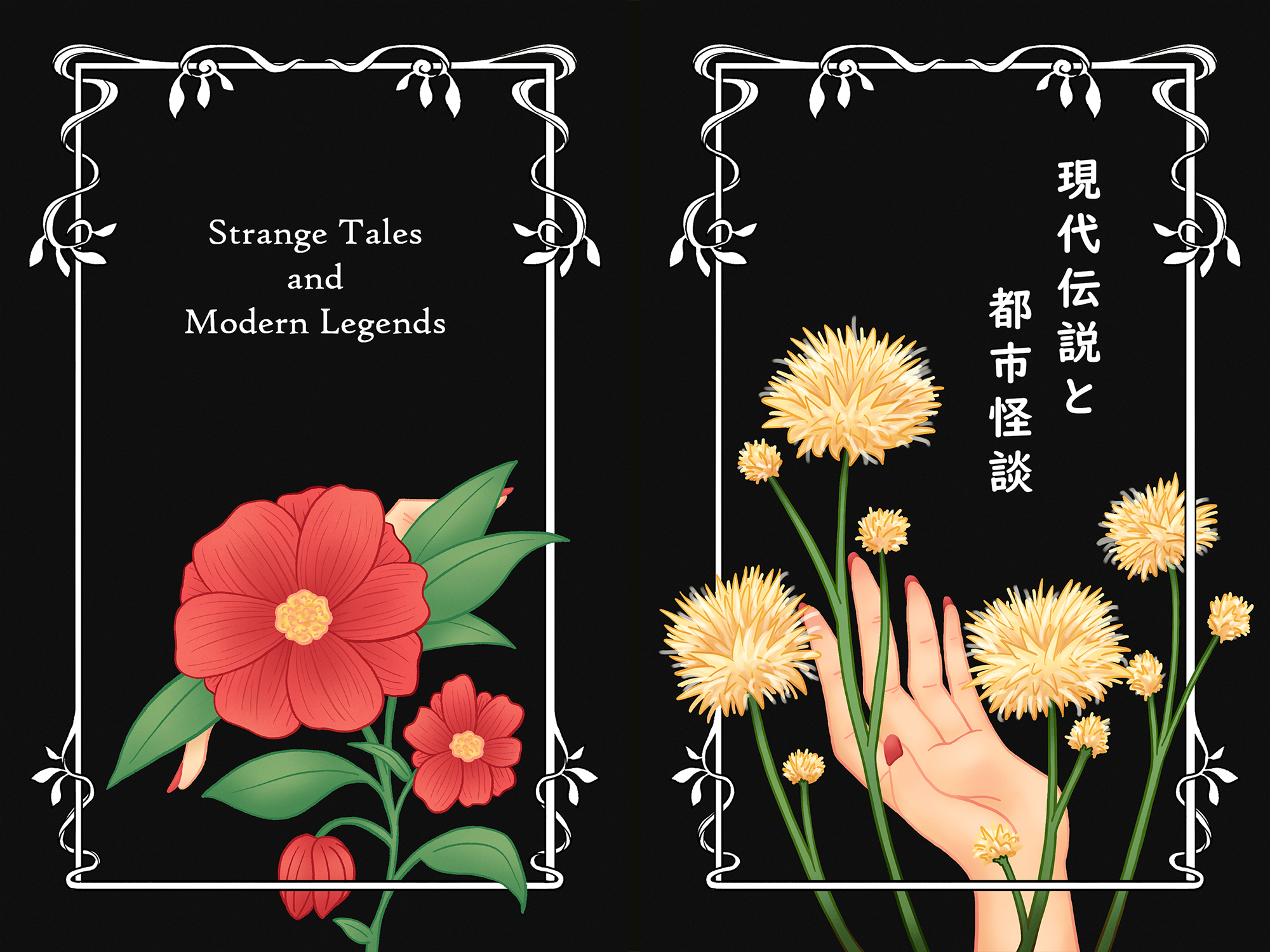
My newest short fiction zine, Decomposition, collects six short stories of botanical horror and dark fantasy. It features a number of guest artists and spot illustrations, as well as a gorgeous cover created by the botanical art wizard Frankiesbugs. I’ve listed the zine on Etsy (here) if you’re interested.

The past few years have been tough for me. It’s become somewhat taboo in American culture to admit that the pandemic wasn’t the best thing to ever happen to you, so the less said about this the better.

I have to admit that I’m a gremlin who doesn’t really care about germs, but for a while I found it very difficult to relate to other people. I didn’t want to see other human beings at all if I could help it. This is why, after I moved to Philadelphia, I started spending a lot of time wandering around abandoned spaces.

Philadelphia is a fun and interesting city with a steadily growing population and multiple vibrant local cultures, and I find it annoying when people take pictures of a normal street or an early-morning empty parking lot and tag their photos as “urban decay” on social media. That’s just rude. Still, I think it’s easier to get funding to build new construction than it is to repair existing structures, so there’s a surprising density of ruins and wild spaces in and around Philadelphia.

What surprised me while walking around the emptier areas of Philadelphia is just how quickly most architecture returns to nature. Maybe stone castles and granite walls and asphalt roads can last for centuries without maintenance, but a normal house or Burger King or whatever is going to last for one or two decades at most. It’s only going to take about five years before the roof goes; and then, once the water damage gets started, that building is finished. The shell of the walls becomes its own little ecosystem, with plants pushing up through the brick and concrete. In Philadelphia, fig trees and sumac shrubs grow wild just about everywhere, providing food and shelter for insects, birds, and larger animals like opossums and raccoons.

On one hand, it’s lovely to see these pockets of green in postindustrial urban areas. On the other hand, it’s a bit creepy how aggressive plants are in taking over space formerly occupied by people. If you think about it, plants have been on this earth for hundreds of millions of years, and they will remain here long after the last human draws its final breath. Their green dreams are beyond our comprehension as their roots silently feed on the soil of our bodies. Plants are forever growing and forever hungry, and they’ll take everything back from us eventually.

An Unfound Door, Chapter Four

Agnes returns to Faloren Castle under the escort of her secretary Myla, who has been searching for her. She immediately goes to see her father, who is bedridden from a lingering illness. Her cousin Galien meets her at the door. After sending his friend, a courier and skilled warrior named Caelif, to track Agnes’s whereabouts, Galien conspired with Myla to hide the princess’s abduction. He informs Agnes that Caelif has already reported back to him, but he doesn’t ask about the demonic boar. As she looks in on the sleeping king, Agnes reflects on the decrepit state of Faloren Castle while mentally preparing herself to resume her normal duties in the morning.   

. . . . . . . . . . . . . . . . . . . . .

This chapter presents the bleakness of the status-quo world to the reader. There are no people on the roads. The castle town has seen better days. The castle itself is falling apart. The king is dying.

Fhiad parted ways with Agnes at some point before the start of the chapter, and she seems to take it for granted that he won’t find anyone in his home kingdom of Erdbhein. This presents a mystery: What happened there? In a later chapter, Agnes will explain what she understands about Erdbhein, but the truth is worse than she fears. Erdbhein has gone full Dark Souls, and it’s filled with ruin and blight and zombies.

In terms of the “Save The Cat” story structure, this chapter establishes the internal debate of the main character. Agnes wants to leave the kingdom of Faloren, but she feels that she can’t. In the next chapter, the reader will see that she takes comfort in routines, especially when these routines make her feel smart, powerful, and in control. She ends her debate with herself in this chapter by saying that she needs to concentrate on “work,” which she’s obviously using as an excuse for not allowing herself to imagine an alternative to her current situation.

This internal debate makes a lot of sense to me personally, as I can definitely relate to Agnes. I was driven by a need to be productive, and I was always busy. My work routines made me happy at the time, but they weren’t sustainable. This is all the more true because the constant activity distracted me from more important issues, namely, that there was something deeply wrong with my work environment.

I had to go through the cycle of blaming myself for poor working conditions a few times – and I got very, very good at it – before I realized what it was. I thought I could somehow fix things by working harder, and damn did I work hard. The realization that the cycle itself was the problem was extremely liberating.

I’m not saying that we should all quit our jobs to live our best lives or whatever. Nobody has the money for that. Rather, I think it can be useful to consider a shift in mindset, and it’s important to take time to allow room for new ideas and new perspectives.

I also think it’s worth considering that some things aren’t salvageable. You can try to keep the lights on, but any effort you expend will only yield diminishing returns. Sometimes it’s better to acknowledge that something is rotten and then simply allow it to decay.

The Potentate of Jarburg

About halfway through Elden Ring, I realized that the player’s character is the villain of the story.

At some point before the story begins, a manifest symbol of divine order called the “Elden Ring” was shattered by nefarious means, and the rulers of the land fought over its shards. Whether because of the battles or because of the nature of the shattering itself, everything is now in ruins.

As an outcast “Tarnished” warrior who has returned to the magical Lands Between, your job is to retrieve the shards of the Elden Ring from the fallen rulers and thereby restore the Golden Order of the once-great civilization. At least, that’s what you’re led to believe.

If you pay attention, you’ll notice that the society enabled by the Golden Order wasn’t so great. The ruling class built its civilization by subjugating other cultures in fantastically horrific ways. This isn’t subtext, exactly, but neither is it surtext – it’s simply the story told by the environment of the game.

You may think that perhaps, if you repair the Elden Ring and become the new Elden Lord, you’ll do better. You’ll burn the ruined vestiges of the old order and create a more just and fair society. The game defies this hope at every turn, however. For every kindness you attempt, you cause only more suffering.     

In more prosaic terms, almost every sidequest in Elden Ring ends badly.

The kind and modest Sorcerer Thops, who has developed a brilliant form of defensive magic, asks you to spare a key to the Academy of Raya Lucaria if you happen to find one. Should you do so, he is unprepared to face the dangers of the battleground the school has become, and he is slaughtered at his desk.

The gentle and noble Irina has fled from the besieged Castle Morne, and she asks you to deliver a letter to her father, beseeching him to join her instead of perishing in a hopeless battle. When you find Irina’s father, you learn that the castle was overtaken by the slaves he abused. Irina is slaughtered in your absence. This drives her father mad, and you are forced to kill him.

Meanwhile, Preceptor Seluvis, a member of the only group of good guys you encounter in Elden Ring, asks you to deliver a healing potion to one of your former companions. What this potion does is to turn her into a mindless “puppet.” This is an act of revenge against the woman’s adoptive father, with whom Seluvis has a feud that he never bothers to explain. It’s strongly implied that Seluvis uses his puppets as sex dolls, but this unsavory magic is necessary is help another female character. In order to save her from endless torture, you must agree to collude with Seluvis.

The only pure and wholesome place in Elden Ring is Jarburg, an isolated village filled with flowers and animate Living Jars. Living Jars are magical war machines that were abandoned because they happen to be extraordinarily bad at fighting. Should you visit Jarburg, you will be greeted by Jar Bairn, a young Living Jar who asks if you will become the Potentate of Jarburg. Jar Bairn will happily chat with you, and he has more lines than almost anyone else in the game. Aside from enjoying a few rounds of idle conversation, there’s nothing to do in Jarburg. There are no battles or treasures or quests, just Living Jars lazing about in the grass and tending to the flowers.

So the player will leave Jarburg – if they ever bother to find the village at all – and probably never return.

Instead, you’ll continue through the game, murdering and pillaging and destroying everything you encounter. Elden Ring doesn’t give you much of a choice. If you don’t kill something, it’s only because it succeeded in killing you first. You have to survive by any means necessary, even if that means leaving a trail of blood in your wake. In order to become the new Elden Lord, you must be utterly ruthless.

Along the way, you’ll bear witness to the atrocities committed by the former rulers of the Lands Between. You’ll gradually understand why this violence was necessary, and you’ll begin to realize that your own choices are limited. There is no happy end to this story, not for you or for anyone else.

So why finish the game, then? The former rulers are no longer in any position to subjugate anyone, and the formerly enslaved peoples are now free. Castles will crumble, and ancient cities will be forgotten, but the dead will finally be allowed to rest. Why not simply lay down your sword and allow the Lands Between to heal?

I am very bad at Elden Ring, which is an extremely difficult and punishing game. To make matters worse, no one in the game offers you real or meaningful guidance. On top of that, all of the guides available online are fragmentary, disconnected, and clearly written in haste. The artist Frankiesbugs is a veteran of the Soulsborne games, and she’s been patiently helping me find my way forward as we slowly navigate the Lands Between. Mostly we’ve been making silly jokes about the game’s shitty wizards and their appalling sense of fashion, but we wanted to try to create something a bit more serious that reflects the deeper themes of Elden Ring.

This collaborative comic is a tribute to a masterpiece of the medium that forces you to ask difficult questions with no easy answers. I have to admit that I may not ever finish Elden Ring, but maybe that’s okay. It wouldn’t be so bad to be the Potentate of Jarburg.

. . . . . . . . . . . . . . . . . . . . .

You can follow Frankiesbugs on Twitter (here), on Tumblr (here), and on Instagram (here). If you like this comic, you can leave Frankiesbugs a tip on Ko-fi (here) and browse her creepy-cute Plague Doctor merch on Redbubble (here). If you’re interested in stylish gothic horror with a heart, please check out Frankiesbugs’s ongoing comic Necrobirth, which you can read on Tapas (here), on Webtoon (here), or on Tumblr (here).