Last Train Home

Last Train Home
https://hby.itch.io/last-train-home

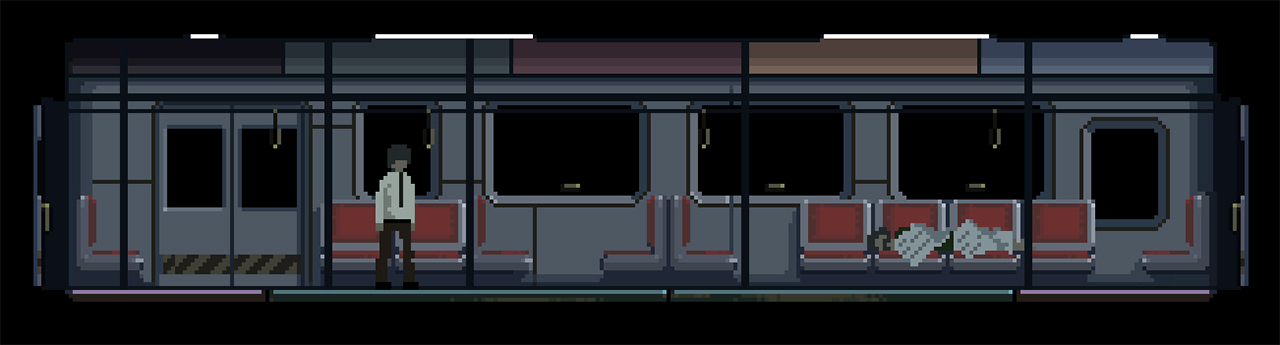
Last Train Home is a short and spooky creepypasta story game. It’s free to play in your browser, and it takes about five minutes to complete. You play as a salaryman who finds himself on a near-deserted commuter train in the dead of night.

The first half of the game is set in three train cars and the two walkways between them, each of which is occupied. With the doors at either end locked, you move between the three cars and talk with their occupants, befriending them by completing small tasks.

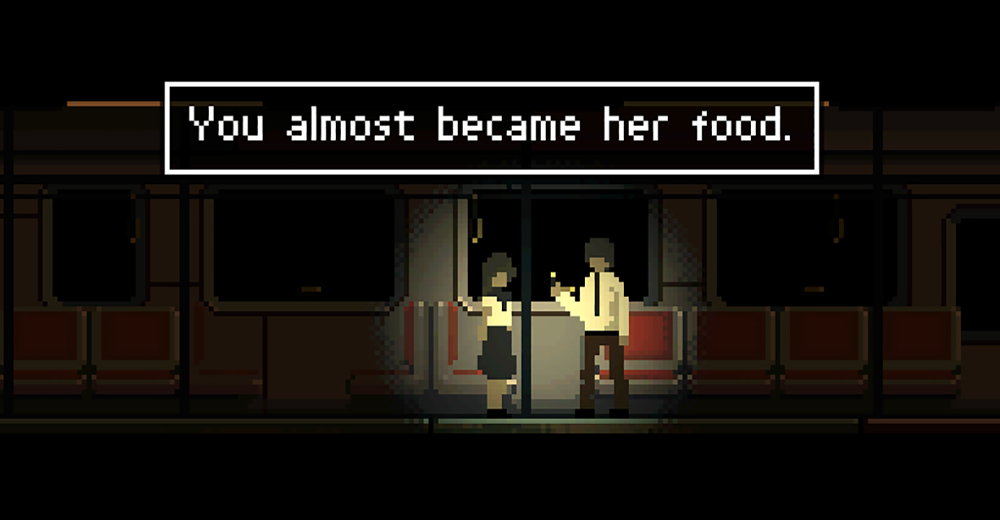
This is all well and good until the lights go off, at which point you’re left to fend for yourself in the darkness with nothing more than a cigarette lighter and the eerie flashes from outside the windows to illuminate your path forward. Where is this train going, and how do you get off?

Just as the United States is home to countless urban legends surrounding cars, from vanishing hitchhikers to cursed highway rest areas, there are all sorts of urban legends about commuter trains in Japan and South Korea. “The last train” is a common motif in cautionary tales warning midnight passengers against accidentally boarding the wrong train or even, heaven forbid, falling asleep and missing your stop as the train continues hurtling into the night.

In contrast to the pristine coziness of trains in East Asia, there’s a New York style grunginess to the cars in Last Train Home that renders the environment unsettling and uncanny. The lighting and sound design are nicely creepy as well. There’s not a lot of text, but each line manages to be subtly unpleasant. There are no jumpscares, just a pervasive atmosphere of creeping dread. The catharsis at the end of the story is lovely, but you’ll definitely have second thoughts about running to catch the last train after playing this game. 

A Zelda Game Starring Princess Zelda

When the first trailer for Tears of the Kingdom was posted in June 2019, fans were excited about Princess Zelda’s new cropped haircut. Perhaps this meant she would be a playable character, people speculated, as it meant that no weapons or armor would have to clip through her hair. In November 2020, Zelda was indeed one of the main playable characters in Age of Calamity. Although it’s great fun to use Zelda’s magical light blasts to part seas of swarming enemies, it was also somewhat disappointing that the gameplay of Age of Calamity positioned Zelda as just another fighter, while Zelda was largely absent from the gameplay of Tears of the Kingdom.

No one can deny that Zelda is an important character in the games that bear her name, but it’s a shame to see her sidelined. My frustration with Tears of the Kingdom made me wonder what the gameplay of a title that focused on Princess Zelda might look like…

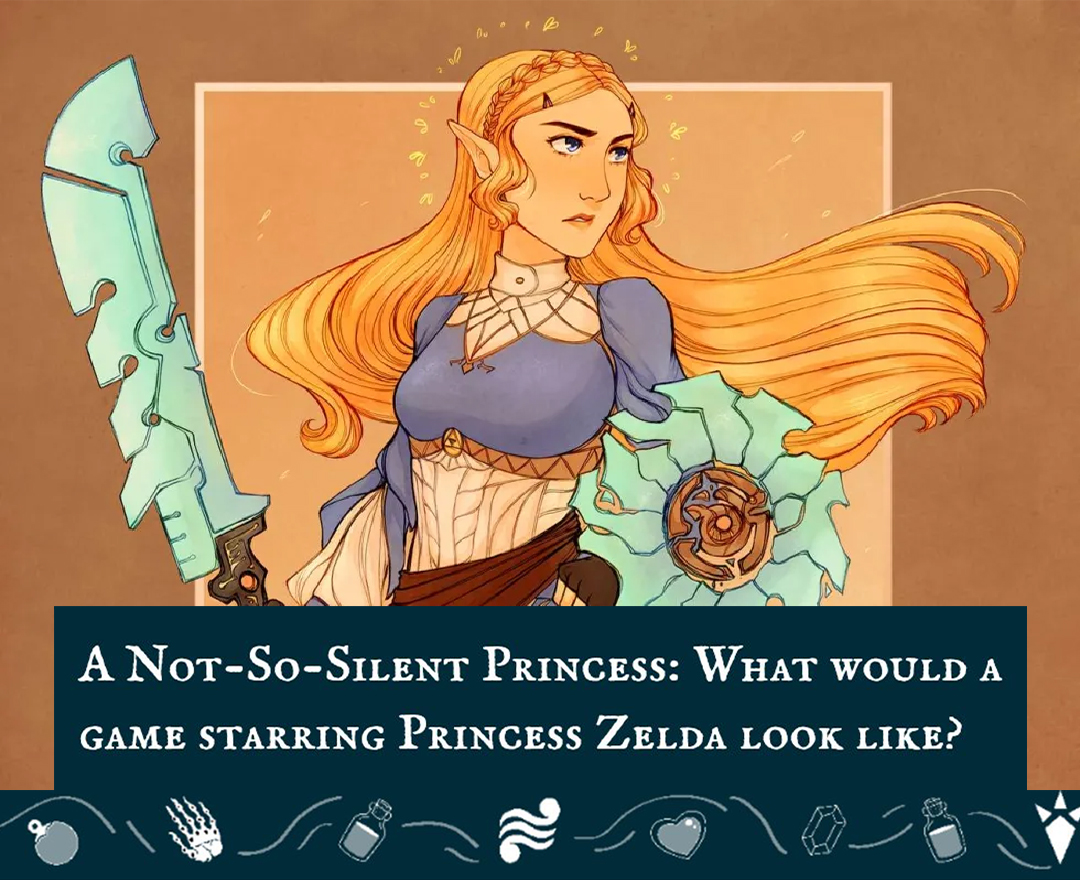
I recently had the opportunity to write a short essay for the Zelda Creators community blog based on this month’s creative prompt, “How would you design a Legend of Zelda game?” I’ve been thinking about what Princess Zelda might look like as a video game protagonist for years, and it was a lot of fun to share my ideas. I included some illustrations that I’ve commissioned over the years that envision Princess Zelda as a playable character, and the art used for the preview graphic is by the wise and powerful Benvey0 on Tumblr.

If you’d like to read the full essay, you can find it here:
https://www.zeldacreators.com/blog/a-not-so-silent-princess

A Man Outside

A Man Outside
https://litrouke.itch.io/a-man-outside

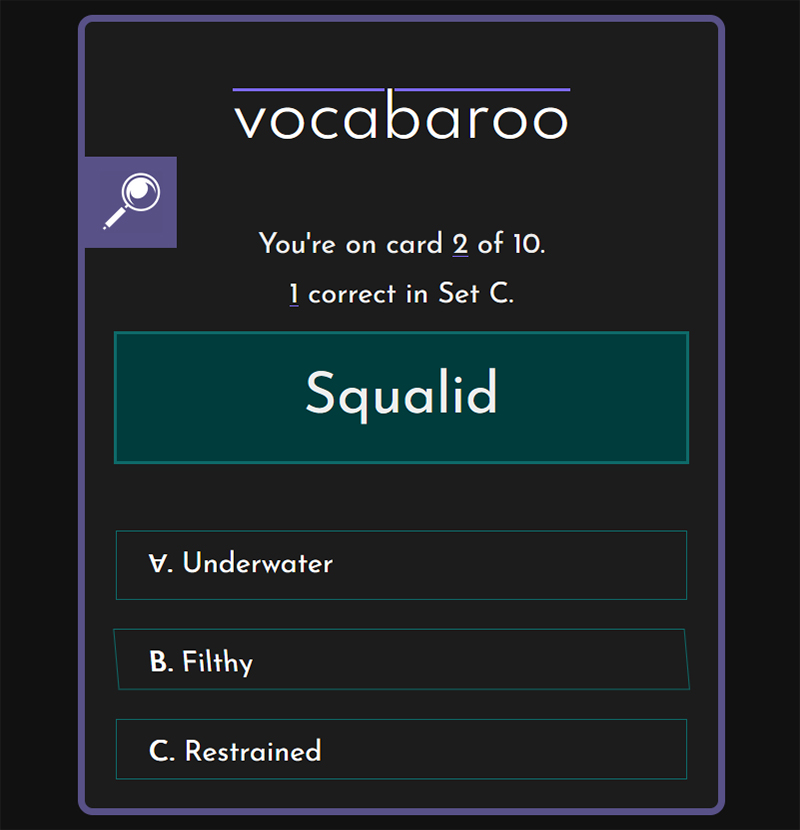
A Man Outside is a short vocabulary quiz game. This twist is that, while you play, a creepy shadow man watches you from outside your bedroom window. You’re tasked with doing three sets of ten vocab cards as spooky ambient sounds play in the background, and you can look out of the window at any time to see if the man has gotten closer. Between quiz sets, you can text a friend to update them on the situation.

I hope it doesn’t spoil this game to say that there are no jumpscares. The vocabulary gets progressively creepier, though, and there are fun distortions in the quiz interface. The vocab game itself is quite good, even without the added attraction of the creepy man. Necrophagy is my new favorite word.

Based on what I’ve seen in YouTube playthroughs, your vocab score doesn’t matter, and the choices you make in the text conversations simply add a bit of extra flavor. In order to get the true ending of the game, you have to play it from start to finish three times. There are three different vocab difficulty levels, so I suppose that adds a bit of replay value. Each run only takes about seven or eight minutes, but I don’t think the second or third ending is anything special. The alternate endings are nice bonuses for vocab flash card enthusiasts who want to try every difficulty level, but the first ending is perfect.

As an aside, as someone with ADHD, I often have to pretend that someone is watching me in order to get past executive dysfunction. I used to “have someone watch me” by going to coffee shops, but that only worked in Tokyo and Washington DC, which are beautiful and walkable and filled with cafés. Philadelphia has many charms, but it’s not that sort of city. Now, if I’m having trouble sending emails or whatever, I have to conjure an amorphous imaginary person who’s sitting in the room with me just out of eyesight like some sort of sleep paralysis demon.

So, for me, playing A Man Outside was kind of comforting. Cozy, even. Honestly, this might actually be a decent way to study vocab.

One Hell of a Maid

One Hell of a Maid
https://bun-tired.itch.io/one-hell-of-a-maid

One Hell of a Maid is a free, ten-minute RPG Maker horror game about a young man who has been dispatched on his first assignment for an at-home maid service. Unfortunately, the apartment he’s been contracted to clean belongs to a group of cultists. Using a handy set of cleaning tools, you follow the handsome maid as he cleanses the apartment of blood on the floor, eldritch horrors in the bathtub, and coffee stains on the couch.

The apartment has three rooms, and each of them has a (very) mild jumpscare. I love the monster design, and I also love the poor maid’s no-nonsense attitude regarding the horrors he encounters. This was the only job he could get, apparently, so he might as well do it. It’s unclear why he has to wear a frilly maid’s outfit, but it’s probably best not to think about that too hard. 

The ending of the game is very sweet. When the cultists finally come home, they are adorable. The gameplay in One Hell of a Maid is minimal, but the art and writing do a lot of heavy lifting. Just like the maid himself, bless his heart.

One Hell of a Maid is not for everyone, but…

Actually who am I kidding. The appeal of this game is universal. What a fun and tasty snack.

An Elegy of Earth and Sky

An Elegy of Earth and Sky
https://archiveofourown.org/works/55003288

Long ago, in a time now lost to the ages, Hyrule was a formless void roiling with primal darkness. Seeing potential in this untapped energy, three goddesses descended from the source of light to shape Hyrule according to their will. They bestowed three sacred virtues upon their daughter before leaving her in the land they created, where the god of the earth waited to grant her a gift of his own.

I’ve been intrigued by the mythology of the Legend of Zelda games since I first read the fantastically illustrated story of Hyrule’s creation in the game manual for A Link to the Past, and I’ve enjoyed how games like Ocarina of Time and Skyward Sword have expanded on the divine cosmology of the series. I was frustrated by the lack of any foundational mythology in Tears of the Kingdom, so I decided to write my own version of Hyrule’s origin story. The first half is based on Hesiod’s Theogony, while the second half borrows from one of the stories about Izanami and Izanagi in the Kojiki. Hopefully this short story reflects the poetry of its inspirations!

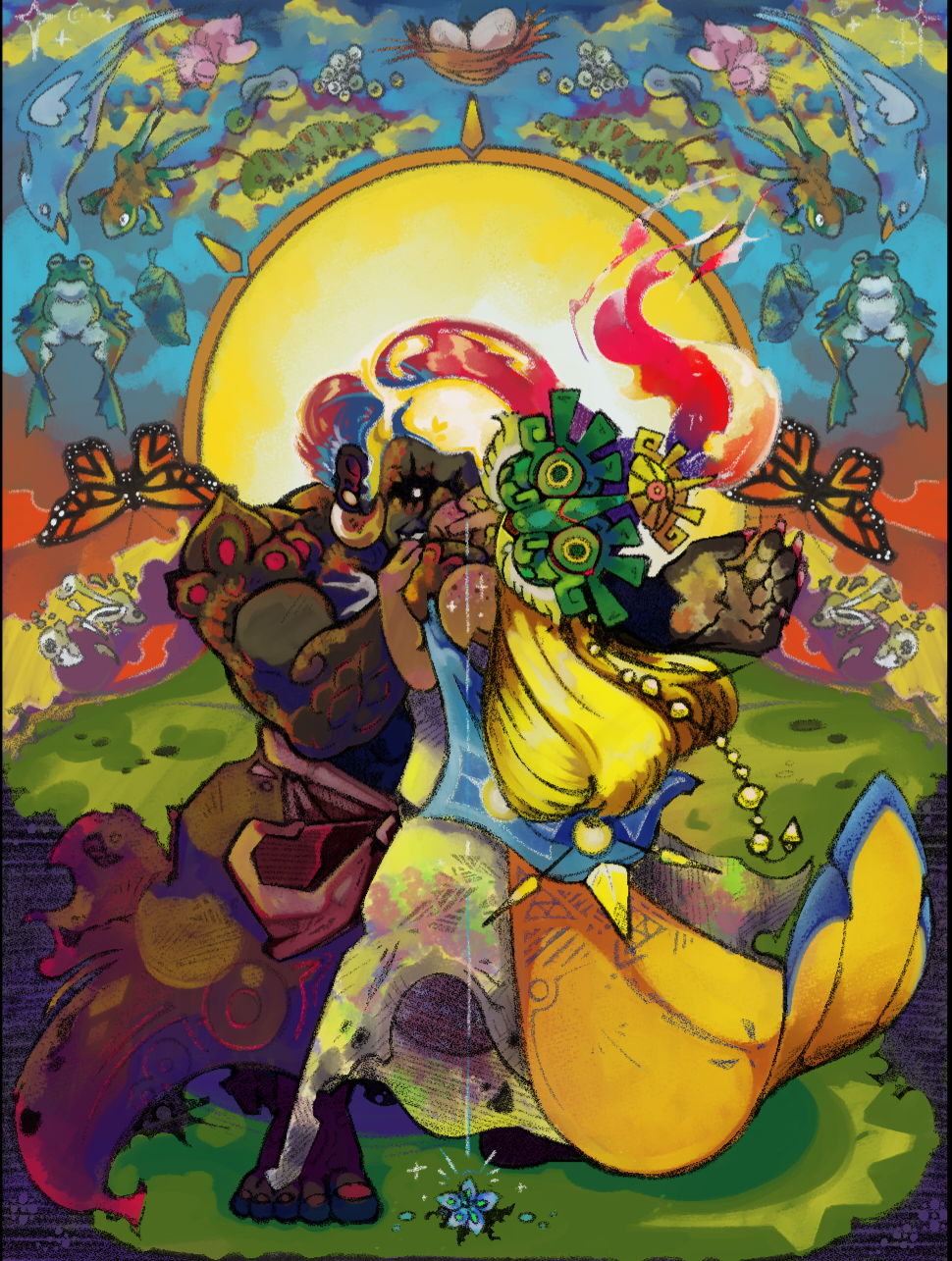
The illustration that accompanies this story was created by Hylias_Disgrace, a purveyor of the strange and divine whose gorgeous character art and intriguing comics can be found on Instagram (here). It was the artist’s decision to use the famous Gustav Klimt painting The Kiss as a way to bring out the parallels between Hyrule’s deities and the myth of Hades and Persephone, and I love how this dynamic illustration celebrates the cycles of the natural world.

Ender Magnolia Early Access Review

This past weekend, I played an early access version of the dark fantasy 2D action-adventure game Ender Magnolia: Bloom in the Mist, which includes about three and a half hours of content. So far, I really like what I see.

Ender Magnolia is a sequel to Ender Lilies, a Soulslike Metroidvania published by the Japanese developer Binary Haze Interactive in January 2021. In Ender Lilies, you play as a young girl named Lily who wakes up alone in a ruined kingdom built on the edge of a much older kingdom. The blight that plagued the kingdom of the Ancients spread to Lily’s kingdom untold decades ago. As the last of a line of priestesses, Lily’s job is to purify those affected by the blight by laying them to rest. Since Lily is defenseless on her own, she’s aided by the spirits of the blighted whom she’s purified. Each boss and miniboss the player defeats contributes to Lily’s moveset, which is completely customizable.  

Although this isn’t 100% confirmed in the early access version, there’s strong evidence to suggest that Ender Magnolia is a prequel that takes place during the last days of the kingdom of the Ancients. This kingdom has clearly fallen on hard times, but it still boasts a sophisticated fusion of magic and technology that led to the creation of artificial lifeforms called homunculi. Homunculi are able to resist the influence of a magical blight rising from underground, but only to a limited extent.

You play as a young girl named Lilac who is an Attuner, a title that designates someone who possesses the magic necessary to repair homunculi and purge the influence of the blight. Where Lily purified decaying zombies in Ender Lilies, Lilac attunes renegade humanoid robots. While Lily’s purification allowed the blighted to rest by allowing them to die, Lilac’s attunement helps homunculi regain their sanity.

Since they’re still alive after attunement, the defeated robots don’t automatically join Lilac as companions. If I had to guess, I’d say that the relatively limited number of Lilac’s companions in Ender Magnolia is probably Binary Haze’s response to a common criticism of Ender Lilies, namely, that there were too many companion spirits and not enough upgrade resources to experiment or use them all effectively. Thankfully, this excess of choice doesn’t seem to be an issue in Ender Magnolia, in which Lilac’s attacks are still fully customizable but much more focused on a core moveset.

None of the minibosses join Lilac, but they’re still fun to fight, as are the challenging area bosses. Whereas there were major spikes in difficulty in Ender Lilies, Ender Magnolia seems to be more balanced and linear in terms of challenge. According to the developer notes on Steam, the full version of the game will allow the player to customize the difficulty, but the standard setting worked just fine for me. I still died a lot (affectionate) and was grateful for every character stat upgrade.

In Ender Lilies, Lily was the only living person in the entire kingdom, so she didn’t have any need for money. This is not the case in Ender Magnolia, which has a central village hosting a small shop where Lilac can buy bracelets that boost her defense and other upgrades. Money isn’t directly received from defeating enemies, but must be found in the environment or offered as a reward.

The game’s economy is supported by numerous NPCs who can be found in the central hub, as well as scattered across the map.  Some of these NPCs are human, and some are homunculi, and some seem to be visitors from the “upper stratum” of the city, like Lilac herself. The player can still find scraps of text with background lore hidden in the environment, but there are also living people directly sharing their experiences. Some of this text is relevant to Lilac, but I appreciate that most of it isn’t. As in Ender Lilies, Ender Magnolia contains a lot of smaller stories that have very little to do with the player. This world is in decline, but the player gets a sense that there’s still something for Lilac to save. She’s a very sweet girl, as is her main companion Nola, a stern but elegant sword lesbian. I’m looking forward to all the tears I’m going to cry as their tragedy unfolds.   

Like Ender Lilies, Ender Magnolia is intensely atmospheric. The primary aesthetic of Ender Lilies was ruin and decay, while Ender Magnolia seems to be more rustpunk (or whatever you’d call what’s going on in the city of Midgar in Final Fantasy VII). There’s a beautiful city above, but you begin the game in the slums, which are filthy and decrepit. When the rusty browns of this aesthetic are interrupted, such as in an abandoned castle overgrown with brilliantly scarlet maple trees, it’s a sight to behold. The sound design and music are also marvelous. To me, the way the game designers use the beauty of the environment to inspire the player to overcome challenges is the hallmark of Soulslike games, and Ender Magnolia nails this perfectly.

I keep comparing Ender Magnolia to Ender Lilies, but it’s not necessary to be familiar with Ender Lilies to enjoy and appreciate what’s going on in Ender Magnolia. In fact, I’d say that Ender Magnolia is much more accessible to newcomers, at least based on what I’ve seen so far.

Meanwhile if you, like me, have done multiple playthroughs of Ender Lilies, Ender Magnolia still feels fresh. It’s significantly different from its predecessor in ways that are fun and interesting and not just new for the sake of change.

I’m really excited about Ender Magnolia. If nothing else, not only can you pet the big fluffy robot zombie dog, but he also serves as your method of fast travel. What a good boy!!

RiME

Rime (stylized as RiME) is an atmospheric 3D exploration adventure game released in May 2017. Its aesthetics are heavily influenced by The Legend of Zelda: The Wind Waker, while its nonviolent gameplay is a tribute to Journey. You’d think this game would be made specifically for me, but I didn’t like it. The music and graphics are beautiful, but the gameplay is abysmal, while the larger story is almost laughably trite. What I’d like to do is try to explain why Rime didn’t work for me.

Like Journey, Rime doesn’t tell the player how things work but instead helps you figure out the mechanics for yourself through environmental design. At the beginning of the game, a young boy washes up on a deserted island, and within the first few minutes he’s given the task of activating four statues. Each of these statues is marked by a bright blue beam that serves as an obvious goalpost indicator. One statue is just off the main path from the beach to the interior of the island, one requires the boy to feed fruit to a boar so that it will move out of his way, and one requires the boy to dive and swim through an underwater passage in order to reach a small offshore structure.

Rime gently guides the player through the actions needed to achieve the first of these three goals. When the boy stands next to the first statue, the triangle button appears onscreen, showing the player how to activate it with the “voice” command. When the boy stands close to the fruit bushes next to the second statue, the square button appears onscreen, showing the player how to pick the fruit with the “interact” command. When the boy swims to the small structure in the bay, the cross button appears onscreen, showing the player how to dive using a variation on the “jump” command. No problems here.

The difficulty with the fourth statue is that it’s far away from the point of specialist action needed to reach it. Moreover, this target point is not flagged in any way. What the player is supposed to do is use the circle button (which otherwise makes the boy perform a somersault) to drop down from a cliff so that the boy hangs from it by his fingertips. He then shimmies along its edge until he can jump to another cliff before following a path to the other side of the island.

There are plenty of cliffs on the island, but most players will have learned that they mark boundaries, as jumping off of them will result in death. Climbable ledges are marked by white erosion patterns, but the player can’t see these patterns from above. Since the cliff the boy needs to navigate is so far away from the actual statue, it would stand to reason that the circle button would appear onscreen when the player approaches this particular cliff – but it doesn’t.

I therefore spent a good 45 minutes running around and trying to jump over or climb up or somersault through piles of rocks close to the fourth statue, all to no avail. I finally had to give up and resort to a video walkthrough. This sort of failure in accessible design wouldn’t be a flaw in a game that’s meant to be difficult, perhaps. Unfortunately, it’s definitely a problem in Rime, which consistently feels twitchy and stressful instead of expansive and atmospheric.

Where Rime succeeds are its striking and brightly colored landscapes, but the game forces the player to spend an inordinate amount of time in unlit interiors fooling around with finicky moving block puzzles hindered by awkward camera angles. On top of that, Rime‘s platforming elements are atrocious. The boy’s jumps won’t successfully land unless he’s positioned in exactly the right place and at exactly the right angle. Again, the camera angle often doesn’t help. The character moves so slowly that returning to the jump point is often a tedious process, especially later in the game when chains of jumps must be completed.

The narrative payoff for the platforming and block puzzles is that the player gradually learns the boy’s story. I suspected that, like other indie games in which a child must complete trials in an otherwise empty world, the boy might already be dead. If that was the case, I wasn’t sure that the emotional payoff of the game would be worth the frustration.

It turns out that the boy is in fact dead, having fallen overboard during a storm while on a boat with his father. It’s not clear whether you play as the kid’s soul making the transition from life to death or whether you play as the father imagining the kid’s fantasy adventures as he navigates his grief, but the last bit of the game involves the father walking around the kid’s room and picking up the kid’s toys, each of which played a symbolic role in the game (a stuffed fox is the fox spirit that leads you through the early stages, and so on). I am predisposed to cry at video games, but this revelation came so totally out of left field that I had no reaction at all.

I think I would have preferred a more straightforward story of a kid being shipwrecked on an island and discovering the remains of an ancient civilization. The game is structured so that the boy is able to visit the island in what seems to be different time periods. In one era, it’s lush and green. In another, it’s filled with ghosts and sand-choked ruins. In yet another, there are robots. Many of the game’s puzzles involve circles, orbits, the sun and moon, light and darkness, and other elements that suggest the cyclical nature of time. It would therefore make sense, both in terms of game design and gameplay, to have the game’s theme be the ultimate ephemerality of human achievement within the endless flow of time.

I can imagine a number of interesting endings in line with this theme. It would be cool if the boy gradually realized that he’s the heir to this ancient civilization but then left everything behind on the island so that he can go home, for instance. Or perhaps the boy might inadvertently (or deliberately) destroy everything on the island, but this wouldn’t be a tragedy to him. Or maybe the boy was sent to the island as some sort of trial or pilgrimage in order to become an adult.

At first glance, Rime seems to have a lot of potential, but I was disappointed that it isn’t more thematically cohesive. As it stands, the game feels like a waste of what could have been a gorgeous work of environmental storytelling. I’m not sure that even the most resonant of themes or the most brilliant storytelling could make up for Rime’s endless series of needlessly frustrating puzzles and godawful platforming, though. In the end, all the art and atmosphere in the world can’t compensate for a poorly-designed game that feels bad to play.

Still, I don’t have it in my heart to say that there’s nothing good or interesting about Rime. It’s not a long game, maybe only about seven or eight hours, and parts of it are genuinely beautiful and clever, especially toward the beginning. Since there’s no payoff at the end, my recommendation would be to get Rime when it’s on sale and enjoy it until it stops being fun.

Everybody’s Gone to the Rapture

Everybody’s Gone to the Rapture is a first-person walking sim set in the fictional village of Yaughton in the west of England. Yaughton is completely deserted, and the player’s job is to figure out what happened. “What happened” turns out to be a combination of things, none of which is ever properly explained, but what really matters is the human drama at the core of the crisis.

The game is entirely first-person, and the player can only do two things: walk and look around. There’s also an action button that can be used to turn on radios, pick up ringing phones, and enter open doors and gates, but we never see the player character’s hands. The player is thus little more than a moving point of view. This is just fine, because Yaughton is gorgeous.

After climbing down from the hill where the game starts, the player is confronted with a jumble of buildings and several intersections. Since you can go into almost every house, not to mention every house’s backyard and garage and garden shed, it was difficult for me to resist the temptation to do so. I kept encountering radios that can be turned on to get a bit of story, as well as shimmers of light that resolved into stylized representations of people sharing brief conversations.

Despite the lovely scenery, the first bit of Everybody’s Gone to the Rapture is fairly stagnant. The front end of the game is loaded with tons of disconnected characters whose relationship to each other isn’t immediately apparent. The light shining on the world is totally flat, and there’s no wind moving the leaves in the trees or blowing garbage across the streets.

After almost two hours of wandering around and trying to figure things out, I stopped caring about finding everything and decided to follow the glowing comet of light that’s intended to lead you through the story. What the guiding comet reveals is a series of conversations centered around a priest, Father Jeremy Wheeler, who was trying to come to terms with his faith in relation to what was happening to the town. Following a climactic scene, the game changes in a significant way.

At this point, Everybody’s Gone to the Rapture becomes much more structured. The player now understands that each area of the game is the stage for a narrative focused on one character. After the first major transition, the world of the game also becomes more active, with floating pollen, falling leaves, swaying flowers, billowing air-dried laundry, and the shadows of wind moving through the trees. As the natural world comes to life, the pieces of the story gradually start coming together.    

Everybody’s Gone to the Rapture isn’t perfect. The start of the game is extremely slow, and it’s easy to get lost at first. The guiding comet has a tendency to disappear, requiring you to restart the game to bring it back, and the slow pace of movement makes backtracking feel more annoying than it should be. Still, the graphics and music are beautiful – rapturous, even – and I was moved by the writing. If you’re patient enough to follow the story to its conclusion, your reward is an almost overwhelming sense of joy.

I should mention that I enjoyed Kirk Hamilton’s write-up of the plot (on Kotaku here), which poses many interesting questions and offers some excellent answers. The apocalyptic story seems more grim and horrific when summarized in writing than it does when you’re playing the game itself, though, so I’d recommend going in without spoilers.

Rental

Rental
https://smarto-club.itch.io/rental

With the spooky season upon us, Smarto Club decided to take a break from being wholesome and turned spooky with Rental, an eerie game about the risks of renting beach houses.

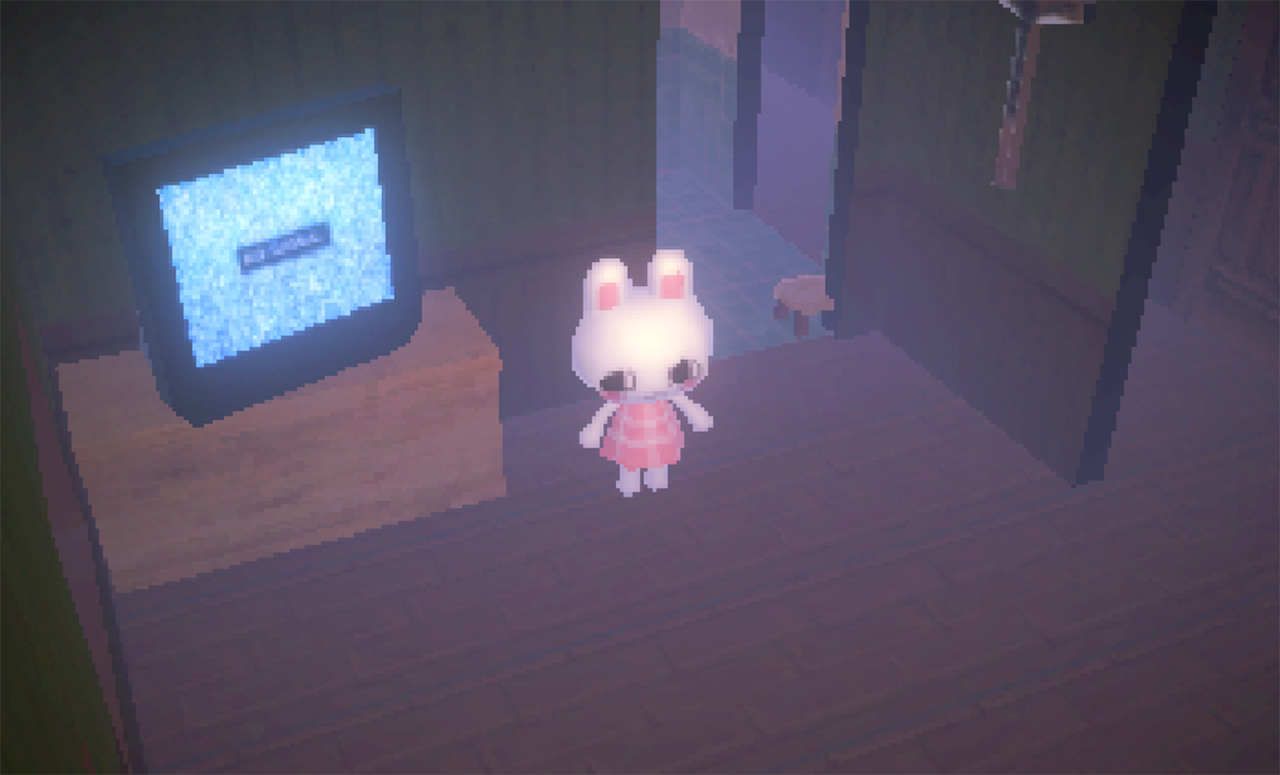
Rental is a 32-bit game about a family of cute bunnies who rent a vacation house in the woods. This isn’t a horror game, necessarily, but it’s strange and lowkey creepy. It takes about fifteen minutes to finish, although it might take slightly longer for people who are out of practice with PlayStation One style 3D spatial navigation.

As the daughter of the bunny family, your job is to walk through the house and collect objects. The twist is that there are House of Leaves shenanigans going on. The first half of the game takes place aboveground, while the second half is more of an adventure. There’s a shadow monster in the house with you, but its appearance seems to be random. I only saw it once, briefly, during my second playthrough, and it wasn’t a big deal. Rental is much more atmospheric than scary, and most of the atmosphere has to do with the ambient music and the oddness of the scenario.

Rental works well as analog horror. The graphics and gameplay and washed-out colors feel super outdated, as do the Hello Kitty character designs. There’s also the combination of the nostalgic childhood experience of going on vacation with the childhood discomfort of trying to settle into an unknown place. The house you’re exploring has a standard layout and floorplan, and the girl often comments on how normal and unremarkable everything is, which adds to the sense of the uncanny.

The Christian religious icons the girl has to gather are also totally normal. For me, this created an extra layer of resonance in the sense of going to a mundane place with a lot of Christian art and imagery and feeling that everything is slightly weird about the oddly suffering men and oddly beatific women and oddly mature babies. I appreciate the girl’s no-nonsense attitude toward everything in the house, which makes the ending all the more amusing.

There are no jumpscares in this game, and it’s not challenging. Rental is a simple but spooky fifteen-minute treat for connoisseurs of perfectly normal houses that are ever so slightly larger on the inside.

Why You Will Always Write Better Than ChatGPT

Let me begin with an admission: I’ve experimented with machine-generated art. No matter the AI model, I find computer-generated images to be aesthetically unappealing, but there’s something charming about their jankiness. Sometimes it’s necessary to post a low-resolution jpeg of the Power Rangers sharing a pizza with Godzilla to the group chat, and it’s best that no actual human artist is harmed in the creation of this image.

Still, I was uninterested in ChatGPT, which seemed less like an amusing toy and more like an annoying tool used by content creators to manufacture endless pages of trash for search engine optimization. My casual dismissal of ChatGPT was challenged when I started to notice a distinctive writing style crop up in undergraduate student papers in early 2023. Later that summer, I began to see the same style appearing on AO3 – and even in professionally published writing. When I finally bit the bullet and signed up for ChatGPT myself, there was the exact same writing style, ready and waiting to produce anything I wanted. I hated it immediately.

At the end of this post, I’ll provide a small selection of essays written by experts about the myriad problems surrounding computer-generated art and writing. Before that, I’d like to offer my own analysis of the “style” of text produced by ChatGPT in order to support an argument for why our human writing will always be better.

(1) Stylistic uniformity

ChatGPT produces sentences of uniform length and structure, which it uses to build paragraphs of similarly uniform length and structure. Sentences always follow a “Clause 1 + Conjunction + Clause 2” pattern and contain a roughly equal number of words. Without exception, paragraphs either have three or five sentences, and the words in the final sentence of the paragraph will mirror the words of the first sentence. This visual uniformity produces a smoothness that makes writing produced by ChatGPT easy to skim. While it’s easy to run your eyes over frictionless paragraphs, however, the lack of texture makes it difficult to find a foothold.

(2) By-the-book formulaic structure

Whether writing fiction or nonfiction, ChatGPT will use the same organizational structure to present information. It relies on a set pattern of transition words and expressions to map this structure, and it always concludes with a moral or take-away point. In all fairness, this is how students are taught to write in English and Rhetoric classes. The clarity of this style must be taught and enforced because its precision doesn’t follow natural human thought patterns, which tend to meander as a writer draws from personal experience and cultural context. A dry organizational precision may be suitable for textbooks and instruction manuals, but this type of writing is infamously boring to read.

(3) Inability to surprise the reader

ChatGPT cannot lie. Granted, it’s prone to hallucinate. It invents citations, misuses specialist terminology, and doesn’t understand basic math. Still, it can’t deliberately create doubt or uncertainty for artistic effect. Moreover, as it can’t acknowledge its past mistakes or correct its assumptions, it can’t create multilayered arguments. The same lack of depth is characteristic of the fictional characters it generates. It’s precisely this lack of a flawed perspective that makes ChatGPT uninteresting and unable to provoke surprise or reflection in the reader.

(4) Lack of a distinct voice

When ChatGPT writes nonfiction, it has no sense of a target audience, so it can’t regulate its tone. Various commenters on social media have pointed out that ChatGPT reads remarkably like mansplaining, a type of address that comes off as condescending because it refuses to acknowledge the pre-existing knowledge of the reader. When it comes to fiction, ChatGPT can’t create distinct character voices, which results in generic characterizations. This inability to understand tone, culture, and context can be downright offensive when ChatGPT is used to mimic a voice grounded in a specific time, place, or identity.

(5) Failure to achieve insight

Even in the most utilitarian nonfiction writing, the process of putting words on the page with your own hands is important. This process generates a distinct mental space, and the physical act of typing enables the time necessary to analyze information properly. As you write, you make connections with your life and past experiences that create insight, and these connections create a sense of depth and meaning. Without a specificity of voice or the serendipity of insightful connections, ChatGPT has nothing to draw on save for a database of clichés.

Many professional writers spend their lives working to achieve a smooth and frictionless style, but every human has stylistic quirks, including favorite words and preferences regarding punctuation. ChatGPT has no texture or individuality at all. It’s this lack of a distinct voice (especially when combined with stylistic uniformity) that alerts me to the use of ChatGPT in student work. One might argue that a tonal flatness is the defining characteristic of ChatGPT’s “voice,” and I would agree. Even if you’re not trained in linguistic or literary analysis, ChatGPT’s generic style of writing is distressingly easy to identify simply because of how boring it is.

Instead of being a pleasure to read, the writing generated by large language models feels like the worst sort of homework. Whether you specialize in fiction or nonfiction, this is why you will always write better than ChatGPT.

If you’re interested in pursuing this topic in a broader cultural context, please allow me to recommend six recent essays written by fellow humans.

Confessions of a Viral AI Writer, by Vauhini Vara
https://www.wired.com/story/confessions-viral-ai-writer-chatgpt

AI Art & the Ethical Concerns of Artists, by Vicki Fox
https://beautifulbizarre.net/2023/03/11/ai-art-ethical-concerns-of-artists/

My A.I. Writing Robot, by Kyle Chayka
https://www.newyorker.com/culture/infinite-scroll/my-ai-writing-robot

AI-generated art raises tricky questions about ethics, copyright, and security, by Melissa Heikkilä
https://www.technologyreview.com/2022/09/20/1059792/the-algorithm-ai-generated-art-raises-tricky-questions-about-ethics-copyright-and-security

How Hollywood writers triumphed over AI, by Dani Anguiano and Lois Beckett
https://www.theguardian.com/culture/2023/oct/01/hollywood-writers-strike-artificial-intelligence

The strange world of high-speed semi-automated genre fiction, by Josh Dzieza
https://www.theverge.com/c/23194235/ai-fiction-writing-amazon-kindle-sudowrite-jasper

. . . . .

This essay was originally published on the blog of the Get Your Words Out writing community on Dreamwidth (here). You can learn more about the community on their website (here), and membership opens every December. The moderators share writing encouragement and advice on the community’s public Tumblr (here) and on Bluesky (here).