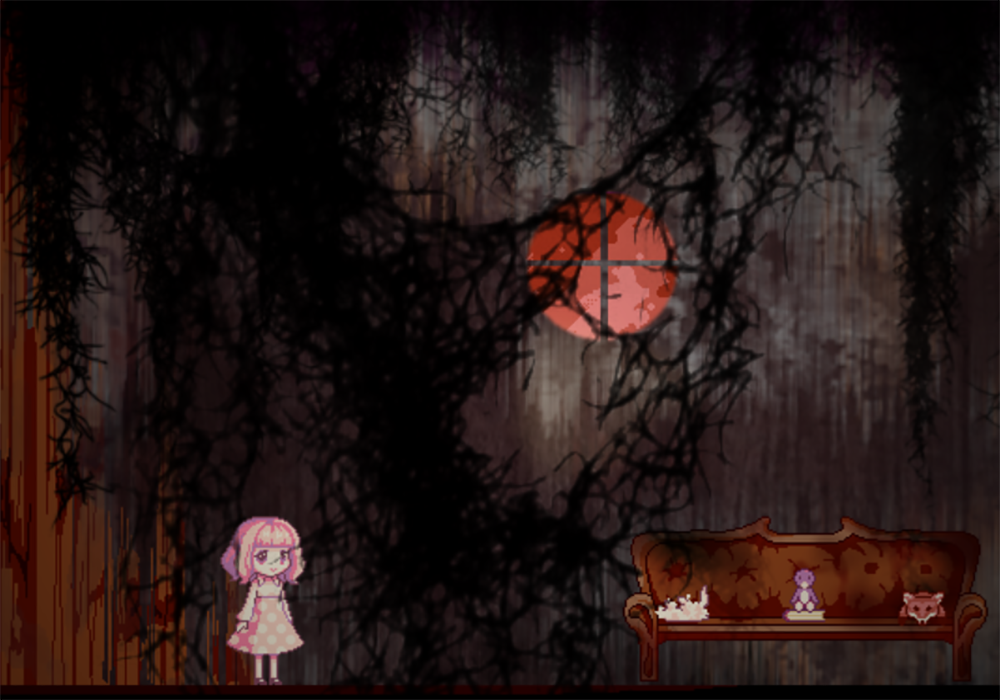
Project Kat

Project Kat is a short narrative horror game that’s free to play on Itch.io (here) and on Steam (here). A playthrough culminating in the game’s “true ending” will take about half an hour, but adventurous players might spend another fifteen minutes experimenting with paths leading to a premature death.

You play as a high school student named Kat who stays late at school one night to undertake an occult ritual of unknown origin and with unknown consequences. Kat has attempted a number of similar rituals, all to no avail. She claims not to believe in the supernatural and seems to be performing these rituals as a hobby. Unfortunately for Kat, this ritual is different.

As Kat, you have the run of three empty classrooms, a meeting room currently being used by the school’s Occult Club, and the Drama Club’s storage closet. Your job is to collect the materials needed for the ritual, such as chalk and candles, and then to perform the various steps of the ritual itself.
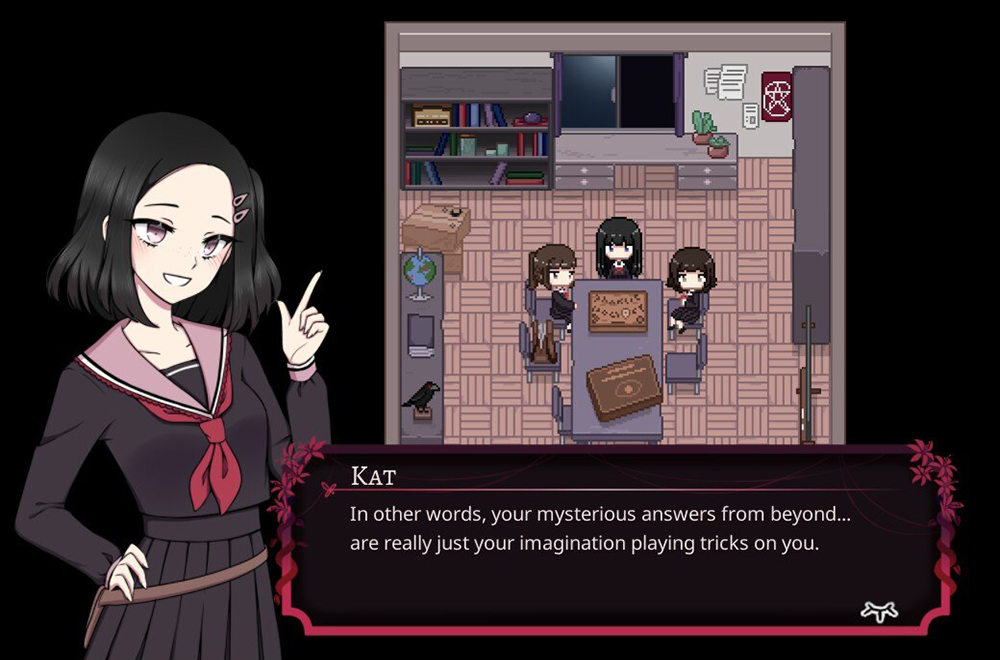
Coincidentally, the three members of the Occult Club are also spending the night at school. Kat taunts them as they experiment with a Ouija Board, saying that they’re deluding themselves. Despite getting the night off on the wrong foot, Kat can continue to talk with the three girls, and she can even recruit them to participate in the ritual with her.

This might be a mistake, however, as the instructions for the ritual state clearly that it must be performed alone.

Should Kat manage to complete the ritual successfully, the game ventures into a surreal space reminiscent of Yume Nikki. This is when the story stops pulling its punches, and the player begins to understand why Kat has started performing occult rituals – and also that her odds of surviving this one are very low. I was impressed by the visual creativity of the final section of the game, and also by the darkness of the ending it leads to.  

I’m a fan of the Japanese tradition of occult “solo games” like One-Person Hide and Seek and Satoru-kun. While many of these rituals are meant to summon a spirit, the purpose of others is to create a gateway to a different dimension. If the dimension-linking ritual is performed correctly, what happens then? No one ever says, and Project Kat offers as good of an explanation as any regarding why this might be.

Since it’s a relatively short game, Project Kat leaves a number of questions unanswered. Still, I really enjoyed the story, which has good pacing and a nice tonal creep from camp into horror. Project Kat is a neat little game to play in one sitting, and the creators have released a longer story set in the same world, Paper Lily, which is free to play on Itch.io (here) and on Steam (here).
Dreaming Mary

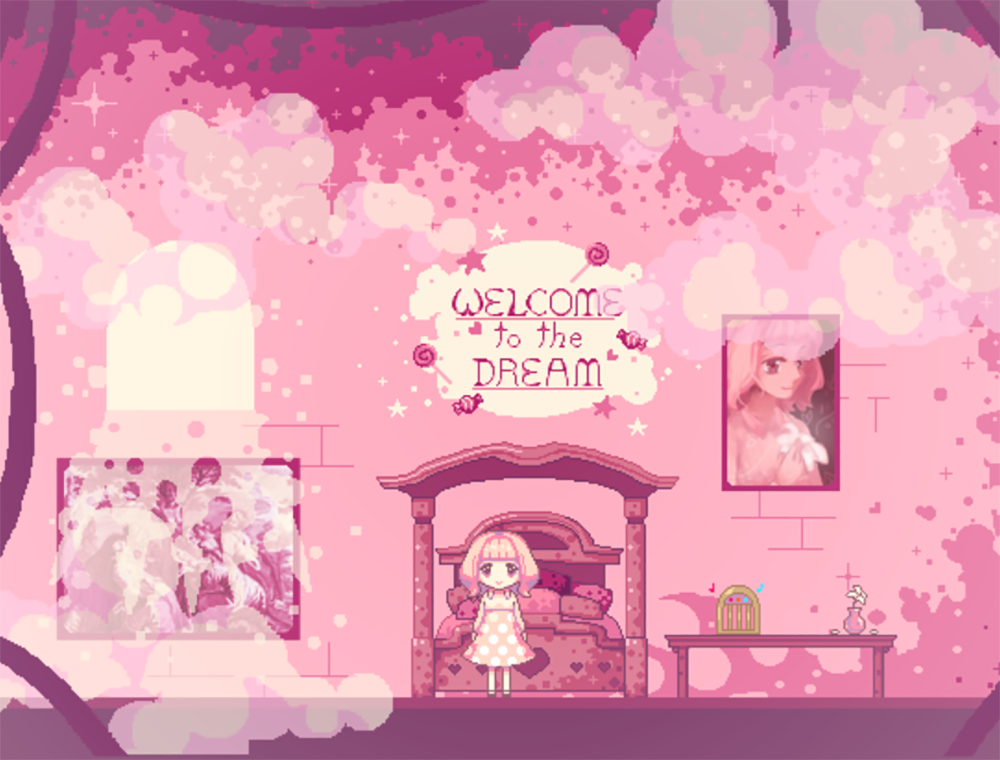
Dreaming Mary (available via the RPG Maker forums here) is a 2D narrative adventure game developed in RPG Maker by Dreaming Games. The opening of the game is super cute, but its pastel pink exterior hides a terrible secret. 

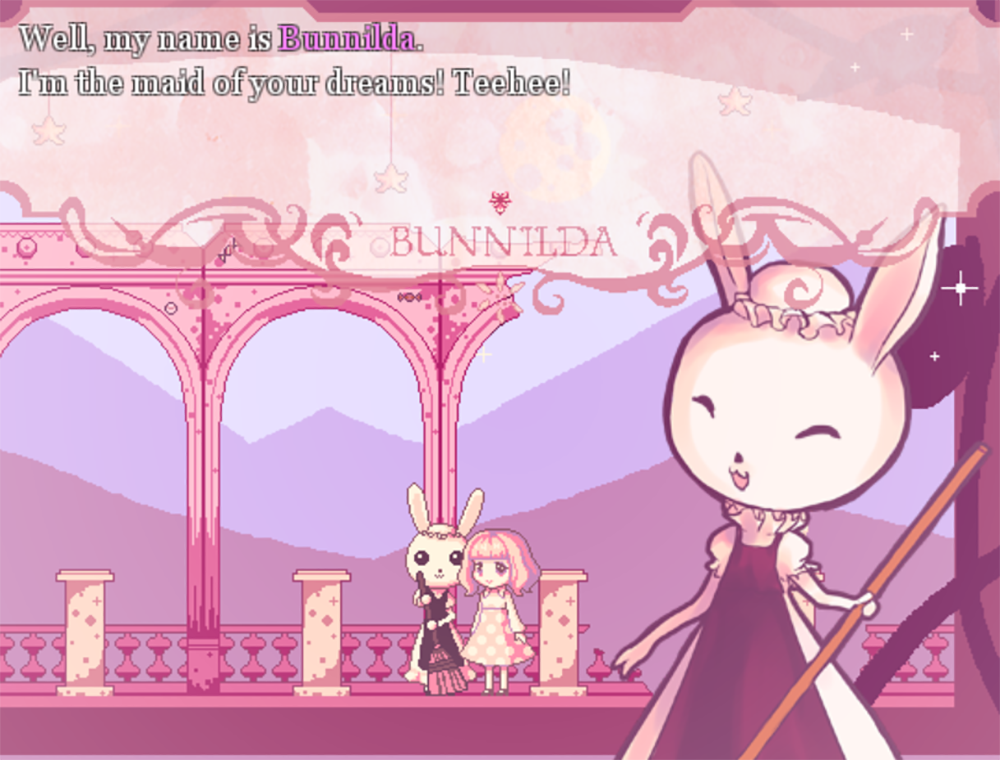
You play as the eponymous Mary, who begins the game in the bedroom of her dream world. She emerges into a lovely hallway with three rooms: a garden modeled on a Greek temple, an aristocratic library with floor-to-ceiling shelves, and a swank but cozy jazz bar. Each room is home to an anthropomorphic animal, each of whom wants to play a simple game. The friendly bunny needs advice on how to arrange her statues, while the flirty fox wants to play a round of hide-and-seek. The gentle owl asks a few questions about the books on his shelves.  

At the end of the corridor is a beautiful tree guarded by a burly boar. If Mary wishes to progress further into the dream, this is her gateway, but she’ll need to collect the blessing of each animal first.

If you play through the game normally, you’ll arrive at a sweet but somewhat ambiguous ending after around 15-20 minutes. If you follow a walkthrough – I recommend this one – to discover the game’s secrets and see the full story, you’ll find your way to a far darker but more satisfying ending in around 30-35 minutes.

According to the developer’s notes, Dreaming Mary was inspired by the 2011 magical girl anime Madoka Magica, which similarly begins as a cute slice-of-life story before evolving into something much more complicated. Mary’s dream is as lushly pink and pastel as Madoka’s fantasies of becoming a magical girl, which makes the hidden nightmare segments all the more shocking.

Should Mary actually figure out how to wake up… That’s when the story becomes truly grim.

To give a fair warning, many of the puzzle solutions don’t make much sense, and I’m not sure how possible it would be to get the game’s true ending without a walkthrough. Still, it’s worth the extra effort, because the contrast between the sunny opening of the game and its sinister conclusion is something special.  

Dreaming Mary was released in 2014. It seems the devs have gone quiet since then, which is a shame. While Dreaming Mary isn’t perfect, it’s promising, and I would have loved to see this prototype expanded into a more polished game. Still, Dreaming Mary stands well enough on its own as a short but intriguing indie horror story in the surreal lineage of Yume Nikki.

Anodyne

After starting and abandoning Anodyne a few times on various platforms, I downloaded it onto my Nintendo Switch. Being able to play this retro-styled adventure game on a handheld console turned out to be just what I needed in order to appreciate the experience, and I got completely sucked into its world. Because of its horror elements, I’m not sure Anodyne is for everyone, but I had a great time working my way through the game while eagerly anticipating what sort of strange and grotesque imagery I would encounter next.

The game has Pokémon Ruby/Sapphire style Game Boy Advance era graphics. The pixel art is by turns allusive and unique, and it’s occasionally genuinely gorgeous or horrifying.

The screen-by-screen dungeon and overworld layouts remind me a lot of the two Legend of Zelda Oracle games, and the gameplay is like what those games could have been if they had focused on their core strengths instead of distracting the player with extraneous marginalia. If you’re willing to explore a bit, you can learn to jump fairly in the game, and it’s a neat ability to incorporate into the Zelda-style gameplay.

Anodyne also gives off strong Yume Nikki vibes. You start off on a fairly generic quest, but it quickly becomes clear that you’re exploring a manifestation of the subconscious mind of the protagonist, who is not doing okay. There are clear references to addition, depression, and suicidal ideation, and each of the dungeons is themed after a specific fear. The first dungeon is about the fear of not being able to see, the second dungeon is about the fear of being born from the bloody entrails of your mother’s body, the third dungeon is about the fear of being generic and unnecessary, and so on.

Anodyne also reminds me of the original The Legend of Zelda in that there’s zero guidance – the game has no interest in telling you where to go or what to do. This is why I abandoned it the first few times I tried to play it, as I arrived at its open field area and became overwhelmed. Once I decided to stick with it and finally figured out the small environmental clues meant to lead the player forward, it was a lot of fun to be able to go anywhere and do anything while unearthing a few secrets along the way.

Anodyne’s structure is balanced between the overworld areas and the dungeons, and each of the dungeons is a perfect puzzle box. Despite the gameplay mechanics being deliberately limited and basic, some of the puzzles are very clever. The controls are a little loose, but it’s not really a combat-heavy game. There’s no real penalty for dying, and I died a good three dozen times out of sheer laziness but didn’t feel frustrated even once.

It took me about six hours to finish Anodyne, and I enjoyed every minute. It seems there’s a lot of postgame content that involves revisiting various locations, talking to important characters again, and using a new ability to access a bonus dungeon. This game is subtly but undeniably disturbing, and I’m looking forward to seeing just how weird it can get after the first “quest” has been completed. Or maybe the player-character finally works through his trauma and gets better? That would be good too. I guess.

To summarize: Anodyne is a 16-bit nightmare adventure for a mature audience, sort of like a re-imagining of Majora’s Mask in which characters are allowed to say fuck. Putting the edginess aside, it’s super fun to play, and the dungeons are ghoulishly creative.