Strange Tales and Modern Legends

My zine Strange Tales and Modern Legends collects three illustrated short stories based on demonic Japanese folklore.

When I was an undergrad, I had the honor of taking a class called “Demonic Women in Japanese Fiction” with a professor I truly admire. This course was a foundational experience, and I ended up writing a lengthy senior thesis with the same title. The project served as an introduction to literary theory and feminist thought; but, more than anything, I really enjoyed stories about women behaving badly.

I taught my own “Demonic Women” class at the University of Pennsylvania for the first time in Spring 2024, and it was a resounding success. Everyone in this class was just as fascinated by the stories as I was, which was a minor miracle. In all fairness – demonic women are a lot of fun.

Though I teach and publish (and blog) about Japanese literature, and though I’ve spent a significant amount of time living in and around Tokyo, I generally don’t write original fiction set in Japan. Still, I love demonic folklore so much that I couldn’t help but be inspired by the literature in my “Demonic Women” class. I therefore put together a short zine that collects two previously published stories and one original piece of flash fiction, and I commissioned a coven of talented artists to create illustrations.

In the zine’s opening story, “The Smile of a Mountain Demon,” a 21st century yamauba entraps a YouTube influencer with Buddhist pretensions by using Airbnb and the language of New Age spirituality. The young man is looking for a scenic “spiritual retreat” to use as a source of content, and the yamauba is looking for a tasty snack. I was inspired by the medieval Adachigahara folktales in which a cunning yamauba entraps a less-than-devout Buddhist priest, as well as Minako Ohba’s beautiful and heartbreaking short story “The Smile of a Mountain Witch.”

The zine’s main story, “The Kumo Diary,” is set in the Meiji period, the era of Japan’s industrial revolution. As Japan established itself as a nation that could compete with Western powers, its intelligentsia were motivated to create a unified sense of “Japanese culture.” Scholars were therefore tasked with making The Tale of Genji a respectable classic to be held in esteem by a modern nation. While I was studying the history of The Tale of Genji, I couldn’t help but wonder about all the apocryphal chapters that never made it into the canonical version, and I created a few fragments of a medieval text to be discovered by a reader who dwells in the shadows cast by the light of modernity.

The final story, “Hanahaki,” is about a neglected cat who vows revenge on the small child that has monopolized his beloved human’s attention. The title comes from a trope in underground manga and fancomics of the late 2000s and early 2010s. In these stories, someone suffering from unrequited love painfully coughs up (haki) delicate flower petals (hana) in lieu of the words they can’t say. The cat in this story is unable to communicate in human language, but he still finds a way to make his displeasure clear. If nothing else, the child must go.

Strange Tales and Modern Legends explores themes that have fascinated me for years, specifically the intersections of folklore, feminism, and the unruly joy of problematic characters. I hope readers find these stories as delightfully unsettling as I did when I wrote them.

If you’re interested, you can order a paper copy of the zine from Etsy or download a free digital version from Itch.io.

👹 https://digitalterrarium.itch.io/strange-tales
👹 https://www.etsy.com/listing/4299187840/strange-tales-horror-fiction-zine

The art at the top of this post, which is one of the illustrations featured in the zine, was created by Le Soldat Mort, a dark fantasy artist who shares their work on Bluesky (here) and on Instagram (here).

Why You Will Always Write Better Than ChatGPT

Let me begin with an admission: I’ve experimented with machine-generated art. No matter the AI model, I find computer-generated images to be aesthetically unappealing, but there’s something charming about their jankiness. Sometimes it’s necessary to post a low-resolution jpeg of the Power Rangers sharing a pizza with Godzilla to the group chat, and it’s best that no actual human artist is harmed in the creation of this image.

Still, I was uninterested in ChatGPT, which seemed less like an amusing toy and more like an annoying tool used by content creators to manufacture endless pages of trash for search engine optimization. My casual dismissal of ChatGPT was challenged when I started to notice a distinctive writing style crop up in undergraduate student papers in early 2023. Later that summer, I began to see the same style appearing on AO3 – and even in professionally published writing. When I finally bit the bullet and signed up for ChatGPT myself, there was the exact same writing style, ready and waiting to produce anything I wanted. I hated it immediately.

At the end of this post, I’ll provide a small selection of essays written by experts about the myriad problems surrounding computer-generated art and writing. Before that, I’d like to offer my own analysis of the “style” of text produced by ChatGPT in order to support an argument for why our human writing will always be better.

(1) Stylistic uniformity

ChatGPT produces sentences of uniform length and structure, which it uses to build paragraphs of similarly uniform length and structure. Sentences always follow a “Clause 1 + Conjunction + Clause 2” pattern and contain a roughly equal number of words. Without exception, paragraphs either have three or five sentences, and the words in the final sentence of the paragraph will mirror the words of the first sentence. This visual uniformity produces a smoothness that makes writing produced by ChatGPT easy to skim. While it’s easy to run your eyes over frictionless paragraphs, however, the lack of texture makes it difficult to find a foothold.

(2) By-the-book formulaic structure

Whether writing fiction or nonfiction, ChatGPT will use the same organizational structure to present information. It relies on a set pattern of transition words and expressions to map this structure, and it always concludes with a moral or take-away point. In all fairness, this is how students are taught to write in English and Rhetoric classes. The clarity of this style must be taught and enforced because its precision doesn’t follow natural human thought patterns, which tend to meander as a writer draws from personal experience and cultural context. A dry organizational precision may be suitable for textbooks and instruction manuals, but this type of writing is infamously boring to read.

(3) Inability to surprise the reader

ChatGPT cannot lie. Granted, it’s prone to hallucinate. It invents citations, misuses specialist terminology, and doesn’t understand basic math. Still, it can’t deliberately create doubt or uncertainty for artistic effect. Moreover, as it can’t acknowledge its past mistakes or correct its assumptions, it can’t create multilayered arguments. The same lack of depth is characteristic of the fictional characters it generates. It’s precisely this lack of a flawed perspective that makes ChatGPT uninteresting and unable to provoke surprise or reflection in the reader.

(4) Lack of a distinct voice

When ChatGPT writes nonfiction, it has no sense of a target audience, so it can’t regulate its tone. Various commenters on social media have pointed out that ChatGPT reads remarkably like mansplaining, a type of address that comes off as condescending because it refuses to acknowledge the pre-existing knowledge of the reader. When it comes to fiction, ChatGPT can’t create distinct character voices, which results in generic characterizations. This inability to understand tone, culture, and context can be downright offensive when ChatGPT is used to mimic a voice grounded in a specific time, place, or identity.

(5) Failure to achieve insight

Even in the most utilitarian nonfiction writing, the process of putting words on the page with your own hands is important. This process generates a distinct mental space, and the physical act of typing enables the time necessary to analyze information properly. As you write, you make connections with your life and past experiences that create insight, and these connections create a sense of depth and meaning. Without a specificity of voice or the serendipity of insightful connections, ChatGPT has nothing to draw on save for a database of clichés.

Many professional writers spend their lives working to achieve a smooth and frictionless style, but every human has stylistic quirks, including favorite words and preferences regarding punctuation. ChatGPT has no texture or individuality at all. It’s this lack of a distinct voice (especially when combined with stylistic uniformity) that alerts me to the use of ChatGPT in student work. One might argue that a tonal flatness is the defining characteristic of ChatGPT’s “voice,” and I would agree. Even if you’re not trained in linguistic or literary analysis, ChatGPT’s generic style of writing is distressingly easy to identify simply because of how boring it is.

Instead of being a pleasure to read, the writing generated by large language models feels like the worst sort of homework. Whether you specialize in fiction or nonfiction, this is why you will always write better than ChatGPT.

If you’re interested in pursuing this topic in a broader cultural context, please allow me to recommend six recent essays written by fellow humans.

Confessions of a Viral AI Writer, by Vauhini Vara
https://www.wired.com/story/confessions-viral-ai-writer-chatgpt

AI Art & the Ethical Concerns of Artists, by Vicki Fox
https://beautifulbizarre.net/2023/03/11/ai-art-ethical-concerns-of-artists/

My A.I. Writing Robot, by Kyle Chayka
https://www.newyorker.com/culture/infinite-scroll/my-ai-writing-robot

AI-generated art raises tricky questions about ethics, copyright, and security, by Melissa Heikkilä
https://www.technologyreview.com/2022/09/20/1059792/the-algorithm-ai-generated-art-raises-tricky-questions-about-ethics-copyright-and-security

How Hollywood writers triumphed over AI, by Dani Anguiano and Lois Beckett
https://www.theguardian.com/culture/2023/oct/01/hollywood-writers-strike-artificial-intelligence

The strange world of high-speed semi-automated genre fiction, by Josh Dzieza
https://www.theverge.com/c/23194235/ai-fiction-writing-amazon-kindle-sudowrite-jasper

. . . . .

This essay was originally published on the blog of the Get Your Words Out writing community on Dreamwidth (here). You can learn more about the community on their website (here), and membership opens every December. The moderators share writing encouragement and advice on the community’s public Tumblr (here) and on Bluesky (here).

Bad Writing Advice

One of the more frustrating aspects of being a writer is receiving outdated or irrelevant feedback. Here at the end of the year, it’s important to reflect on the good things – but also the things that didn’t work so well. I’d like to share some advice I saw on various Discord servers that didn’t match my own understanding of the realities of what it means to be a writer.  

Craft

Advice: Delete adverbs to create a streamlined flow.

Reality: This is an extremely useful piece of advice given to screenwriters, but the conventions that apply to spoken dialog don’t necessarily translate to prose fiction. Prose writers can’t rely on cinematography to direct the reader’s attention, so we have to use words to create a sense of focus through pace, which will sometimes be slower and heavier.

Advice: Open your story with an action-packed intro hook.

Reality: Many readers find this sort of decontextualized opening explosion confusing and exhausting, and it’s not appropriate for every genre. This style of storytelling became common during the YA fiction boom of the 2000s and is still frequently used in screenwriting, but it’s not as ubiquitous as it once was.

Practice

Advice: Write 2,000 words every day, no exceptions.

Reality: Sometimes this is easy, and sometimes you’ll find yourself writing many more than two thousand words in a day. Still, it’s important to write at your own pace and allow yourself to rest. When it comes to professional writing, it’s also important to respect wordcount limits instead of charging ahead with the “more words are better” mentality that many writers pick up in high school or college.

Advice: Only write what you’re passionate about.

Reality: Passion will only carry you so far. Famously prolific writers from William Faulkner to Chuck Tingle have argued that discipline, persistence, and a good-natured willingness to occasionally make concessions to market trends are much more important in the long run.  

Career

Advice: Apply to an MFA program.

Reality: MFA programs are expensive, and you also have to take the cost of living and the opportunity cost into account. Meanwhile, week-long writing workshops and retreats often have financial aid available and may be more accessible to people who aren’t interested in pursuing an academic career.

Advice: Be active on social media.

Reality: Many agents and editors have made it clear that they don’t take a writer’s social media presence into account, and the days of being signed because of a viral tweet ended several years ago. While it can be useful to pay attention to calls for submissions on social media, especially Twitter, it’s not necessary to have a lot of followers (or even a public account) in order to find a venue for your work.

It’s important to note that a lot of this advice isn’t “bad” so much as it is “not generally applicable.” For example, the “write 2k words a day, no exceptions” maxim makes perfect sense for a professionally established novelist under contract to produce three manuscripts every two years. If you’re given the opportunity to be that sort of novelist, “2k words per day” is what you need to do. Nothing controversial about that. Still, the extent to which this advice has transformed from a specific professional practice to A Gospel Truth About Writing can be frustrating.

If you’ve been subjected to any similarly “bad” writing advice, please feel free to leave a comment. The end of the year is a good time to vent and get it all out so that you can start the new year fresh and energized.

. . . . . . . . . . .

A version of this post originally appeared on Get Your Words Out, a community of writers aiming to maintain healthy creative habits and writing productivity. Membership is open for 2023 through January 16, 2023. The community’s content is limited to members who maintain their writing pledges, but the GYWO Twitter account is accessible to everyone and posts encouragement, prompts, and writing resources at a steady but manageable pace.

An Unfound Door, Chapter Seven

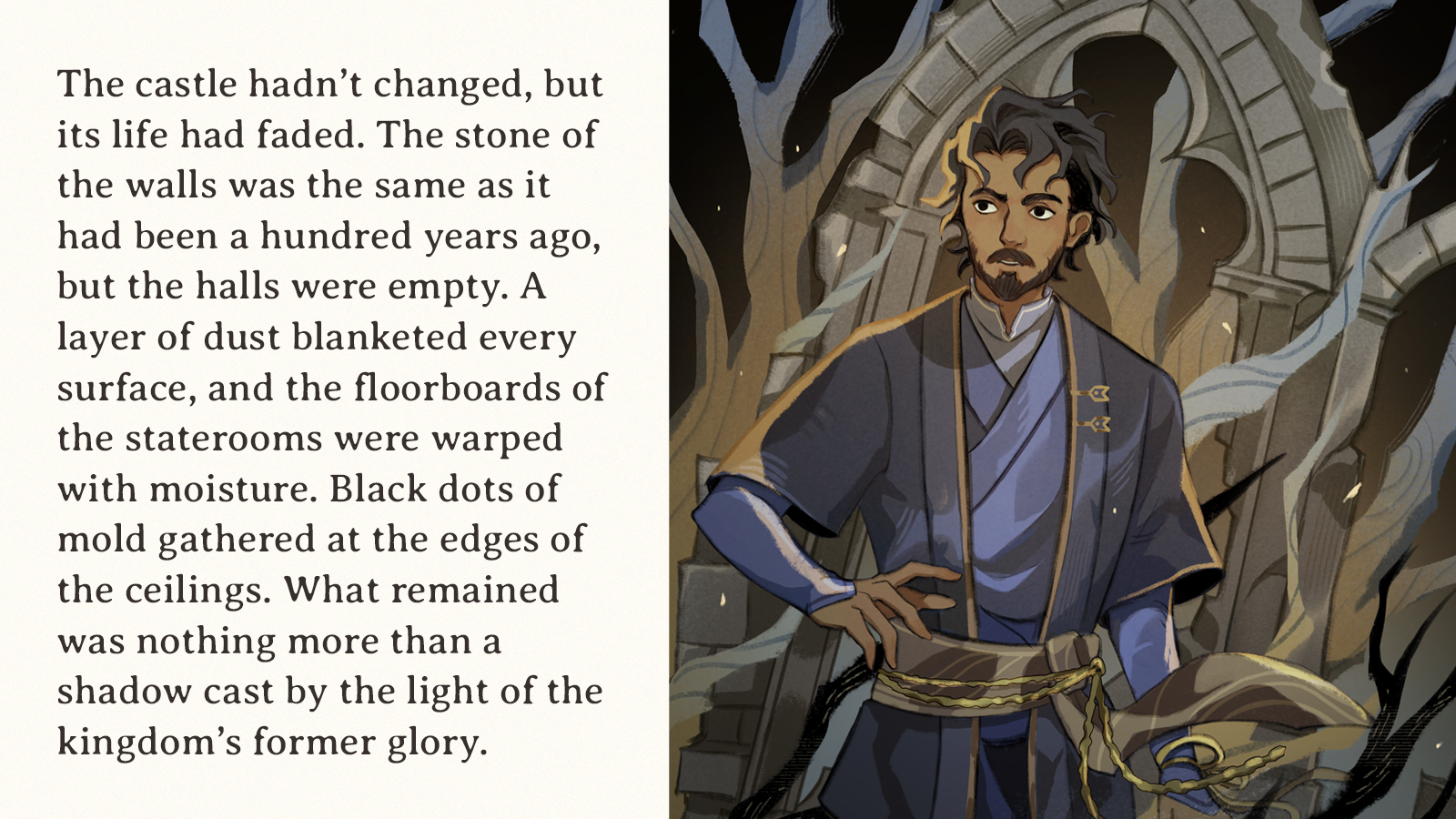
Fhiad leaves the court and walks through the halls of the castle as he reflects on the circumstances that brought him to Faloren. Guerig, the king’s secretary and acting regent, has granted Fhiad permission to live in the castle while supposedly doing research on the building’s architecture. Fhiad curses himself for being drawn back to the kingdom, but he has few resources and fewer choices.

As he wanders, Fhiad reflects on how he was originally sent to Faloren as a replacement for a retired diplomat during what he intended to be a temporary break from his studies. He reflects on how the kingdom has declined during the past hundred years, and he wonders why Agnes seems to be a ghost of the person he met in the northern forest. 

. . . . . . . . . . . . . . . . . . . . .

An Unfound Door is written in limited third-person perspective, and this is the first chapter that focuses on Fhiad. As the representative of the novel’s “B Story,” Fhiad represents the upside-down world of Act Two, which begins when the “A Story” character’s status quo is disrupted. Fhiad is the catalyst for this disruption, but his arc is also a mirror of Agnes’s character development. Fhiad and Agnes ultimately want the same thing – the power to choose the direction of their lives – but their initial motivations and goals are drastically different.

Fhiad may have told Agnes that he intends to destroy her kingdom, but what he truly wants is to understand what happened to him. He’s suffering from severe trauma that he hasn’t been able to process, and he alternates between distraction and intense anger. He attempts to distract himself from his grief by tasking himself with a quest. Meanwhile, his frustration has no outlet save for Agnes, who became his target simply because she’s the only living person he knows. Fhiad is doing his best to survive, but he’s a hot mess.

More than anything, this chapter establishes how and why Fhiad has come to Faloren Castle. It also provides a second perspective on the setting.

What the reader is able to see through Fhiad’s eyes are two things that Agnes takes for granted. First, Agnes is subtly shunned by the members of her court; and second, Faloren Castle is impossibly large and labyrinthine. These two observations help justify the “fun and games” portion of Act Two, which will involve Agnes and Fhiad hunting for a hidden relic. In other words, Fhiad’s observations hint that Agnes is free to search the castle precisely because she doesn’t have many social obligations, and that her search is going to be interesting because it isn’t going to be easy.

Something else Fhiad has noticed is that there’s something suspicious about Agnes’s cousin Galien. This is fair, as Galien is hiding a number of unpleasant secrets. Still, Galien is no more a villain than Fhiad. I like to think of An Unfound Door as a “gothic fantasy mystery,” which means that everyone has secrets. This is why, at this point in the story, the main task of the characters is to learn how to communicate with each other. If they’re going to figure out who the actual villains are, they’ll need to be able to trust each other.

The portrait of Fhiad in the chapter preview was created by the heroic Silverpeel, a fantasy artist with a gothic flair. You can see more of Peel’s illustrations of knights and forests and gods and legends on Instagram (here), on Bluesky (here), and on Tumblr (here).

An Unfound Door, Chapter Six

The summer court opens with a celebration attended by the wealthy families and nobility of Faloren. After the ailing king retires for the evening, Agnes is introduced to Fhiad, who claims to be a university student from Cretia studying architecture. Later, when Agnes escapes to a shadowy corner for a moment of quiet, Fhiad approaches her and quickly becomes cruel and insulting. He tells Agnes that his homeland of Erdbhein has been destroyed, and he declares his intention to take revenge by visiting the same ruin on Faloren by finding Soreiya’s Tear, the legendary relic he was once accused of stealing.

. . . . . . . . . . . . . . . . . . . . .

This chapter is the transition between Act One and Act Two. Fhiad has returned, and he establishes himself as an antagonist. He states his goal to uncover a magical artifact with the intention of destroying Agnes’s kingdom. Fhiad’s anger is not the real problem, however, and it will Agnes’s goal to find a means of addressing the atrocity he survived.

It’s always bothered me when a villain is angry about something legitimately upsetting, but then the writer has this character kick a puppy to show that their anger is bad. What I mean by “kicking a puppy” is that the villain will do something excessively violent or disturbing that is either entirely out of character or framed in such a way as to make their actions seem irrational and done solely for the sake of being evil.

A villain typically represents a challenge to an established order, especially an order built on arbitrary divisions that inform a hierarchy. In the case of fantasy, there is often a class of “monsters” who are sentient yet still positioned as being okay to kill. When a villain wants to establish an alternate power structure in which “monsters” are not killed, it’s only natural to wonder if they might indeed be justified in doing so. The villain must therefore be shown kicking a proverbial puppy so that we do not begin to feel sympathy for them. Based on my observations of various fandom discourse wars, a surprising number of people take this puppy kicking very seriously as an indication that a villain is irredeemably evil.

It’s important to me that Fhiad is portrayed as a legitimate antagonist, at least at first. In this chapter, he proves himself to be two-faced, manipulative, and more than a little creepy. He invades Agnes’s personal space, physically threatens her, and mocks and insults her. He verbally attacks her at a vulnerable moment, and he says horrible things that are all the more hurtful because they’re true. Even worse, he’s cruel to Agnes precisely because he knows she can do nothing to stop him. In addition, it’s implied that he may no longer be entirely human.

Regardless, the root cause of Agnes’s problem – the decline of her kingdom – is not Fhiad, nor is it anything he’s said or done in the past or the present. Rather, this problem is a direct result of a horrible atrocity committed in the past by Agnes’s ancestor. I therefore had to make sure that what Fhiad does at the beginning of Act Two is upsetting but doesn’t fall to the level of puppy kicking. In other words, I attempted to create tension by means of the antagonist’s bad behavior while still being fair to the complexity of his character and his experience of justified anger.

Meanwhile, surrounding both of these characters is the opening of the summer court, a lavish gathering that offers a possibility of what Faloren could be if the kingdom weren’t in decline. Despite the good cheer of the party, Agnes is acutely uncomfortable in her role as a princess. Her keen displeasure in being made an object of display is a window into her essential character, as well as foreshadowing for the development of her story.

The illustration that accompanies the chapter preview was created by Arte072, a fantasy artist inspired by medieval fashion and illuminated manuscripts. You can find their work on Instagram (here) and on Tumblr (here).

An Unfound Door, Chapter Two

Agnes wakes to find that the boar demon has transformed into a man who identifies himself as Fhiad of Erdbhein, a notorious criminal who was accused of high treason after attacking Faloren a hundred years in the past. He is cultured and well-spoken, but he doesn’t hide his frustration with Agnes, who refuses to free him from the silver chain that bound him as a demon. Fhiad tells Agnes that he never had any intention of attacking Faloren, and he claims to have had no interest in her kingdom at all. Rather, he was only serving as an emissary because he was called back from his studies and ordered to do so. Agnes doesn’t know what to make of this, but she’s exhausted and decides to stop for the night.

. . . . . . . . . . . . . . . . . . . . .

The second chapter of An Unfound Door is about two tired people snapping at each other. Nothing much happens aside from the reveal that the demon Agnes encountered in the first chapter is a person suffering from a curse, but I do my best to establish the geography of the world and a bit of its history without dumping exposition on the reader.

This is what I want the reader to take away from this conversation: Agnes is from a kingdom called Faloren, Fhiad is from a neighboring kingdom called Erdbhein, and there is someplace called Cretia far to the south. Fhiad, who has no concept of how much time has passed since he was cursed, is under the impression that he only recently called back from his studies at a university in Cretia. This establishes him as being in his late twenties while introducing the idea of Cretia being a center of culture in contrast to the forest, which is all we’ve seen of Faloren. According to Agnes, Erdbhein attacked Faloren roughly a hundred years ago, and Fhiad supposedly instigated this attack. Fhiad denies this, but he won’t be forthcoming with more details until the next chapter, as he hasn’t yet had an opportunity to process what Agnes is telling him.

In other words, this chapter establishes the broader conflict of the story through the smaller immediate conflict between Agnes and Fhiad. This conversation sets up a dynamic of Agnes as a character who’s pragmatic and grounded, while Fhiad is well-spoken but emotionally unstable. These two characters have trouble communicating, but each of them gets a “save the cat” moment during this chapter. Despite their petty bickering, their first instinct is to be kind to one another when it counts.

“Petty bickering” may seem like an inappropriate response to the gravity of the situation, and it is. In the next chapter, Fhiad will finally have an opportunity to reflect on his circumstances, and he and Agnes will discuss how they plan to move forward in a more appropriate tone.

As an aside, there are a lot of regrettable aspects of being in your twenties, but it’s nice to be physically fit by default and walk for miles without thinking too much about it. For me in my thirties, I can only walk through the woods for so long before I need to sit down. I wouldn’t turn down an adventure of my own, of course, but it’s so much more pleasant to experience this sort of thing vicariously through fictional characters.

The illustration that accompanies the chapter preview was created by the bold and brilliant Samijen, who paints fantastic character illustrations that practically jump from the screen with life. You can follow their work on Instagram (here), on Twitter (here), and on Bluesky (here).

An Unfound Door, Chapter One

Agnes walks along an old road through a mountain forest while leading a demonic boar on a magical silver chain. To keep herself awake, she talks to the creature, confessing that she wants to study its magic in an effort to revitalize the fortunes of her dying kingdom. The demon eventually begins to reply in garbled human speech. It responds strongly when Agnes asks about a golden medallion that she found on the battlefield after she asked the hero who saved her to spare the monster’s life. The demon, who is clearly in pain, asks Agnes to place the medallion against a scar on its forehead. She feels compelled by something larger than herself to do as it asks, only to be overwhelmed by magic.

. . . . . . . . . . . . . . . . . . . . .

An Unfound Door is a gothic mystery set in a decaying castle. Agnes, the princess of Faloren, hopes to save her crumbling kingdom by unlocking the secrets of long-lost relic, but she must conceal it from Fhiad, a mysterious emissary with sinister motives. As their paths cross in twisting corridors and hidden passages, Agnes and Fhiad realize that they must descend into the shadows of the past together if they hope to bring light to the future.

This story summary needs some work, but I’ll keep editing it as I write.

In terms of “Save the Cat” story structure, this initial chapter provides the opening image: A young woman leading a demonic boar through the darkness of a mountain forest.

The closing image, which will mirror the opening image, will be Agnes and the now-human demon sitting in the shade of a lone tree as they watch the sun set. In both cases, Agnes will be leaving the scene of a battle with the demon to return to civilization. What Agnes considers to be “civilization” will have changed, as will her understanding of herself and her relation to the magic she’s trying to harness. And obviously she and the demon will have kissed.

The opening chapter sets the gothic tone of the story by introducing a brave but somewhat naive young woman not-quite lost in a dark and sinister place. It also presents what I hope is an intriguing mystery. What is the demon, and where did it come from? Why is Agnes’s kingdom in decline, and why is she alone in the forest with a demon?

To establish Agnes’s character as the protagonist, she has literally “saved the cat” here, except the “cat” in this case is a giant horrible boar demon. I assume the “hero saves the princess from the evil demon” narrative pattern will be familiar to most readers, who will hopefully be intrigued by the element of Agnes’s character that leads her to capture the demon instead of killing it. She perceives her need of the demon’s magic to be worth the risk, but she’s also curious and looking for trouble, even if she can’t yet admit that to herself.

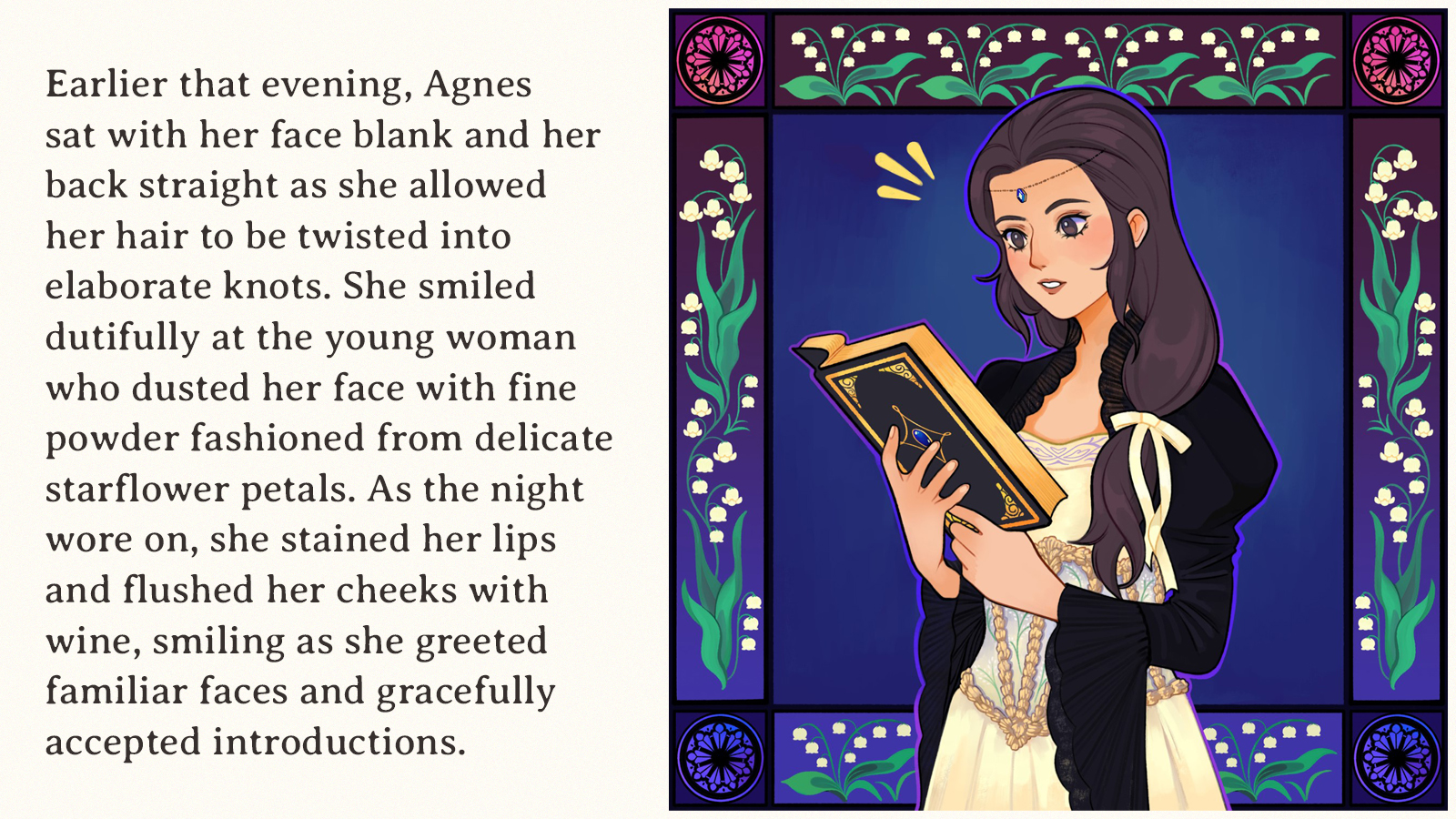
Agnes is going to start wearing a series of masks once the story gets going, so I think it’s useful for the reader to see her true face at the beginning. As corny as this sounds, the way that Agnes needs to change over the course of the story is to learn to follow her heart, by which I mean she needs to recognize her own face underneath her masks. Also, I want to use the story to explore the beauty of decay, and I’d like to use Agnes to make an argument that some kingdoms should be allowed to crumble.

The illustration accompanying the chapter preview graphic was created by the marvelous Ilya Rawan, who posts magical artwork on Twitter (here) and on Instagram (here).

Eight Quick Editing Hacks

It’s always a good idea to take time with editing. Giving your manuscript time to rest and breathe before returning to it with a critical eye can work wonders. Deadlines will not wait, however, and sufficient time may not always be available. That’s when editing hacks come in handy!

This post lists eight of my favorite editing hacks, four for deleting extraneous words and four for catching typos. Each of these editing hacks is painless and intended to help you apply a final layer of polish to your writing before you send it out into the world.

Four Quick Style Hacks with Ctrl+F

Find + delete quantitative adverbs.

This especially applies to Americans, who tend to use quantitative adverbs to add color and rhythm to their speech. Unfortunately, these adverbs don’t often translate well into writing, and they can usually be deleted without affecting the meaning of the sentence. “A lot” and “a bit” are common, as are “only” and “very.”

Crtl+f + ly.

This will help you catch quantitative adverbs like “really” and “completely” and “extremely.” I’m a big fan of adverbs, which add texture and flavor to writing, but many writers tend to have a few specific adverbs they overuse in their initial drafts. Searching for all instances of “ly” in your manuscript is a great way to rein them in.

Find + delete words for facial expressions.

“Smile,” “smirk,” “chuckle,” and “sigh” are some of the common ones. There’s nothing wrong with these words, of course, but many younger writers tend to overuse them. Instead of describing what’s happening on someone’s face, it’s often more effective to convey emotion through action or dialog. You can usually delete words that describe facial expressions or tone of voice without hindering the reader’s understanding of the situation.

Find + delete academic transition words.

I’m referring to words like “therefore,” “moreover,” “conversely,” and so on. Although these words can help you structure your ideas as you write, few people use them outside the context of academic papers. This applies to fiction, obviously, but it’s also relevant to nonfiction that you’re pitching or submitting to an editor at a website, newspaper, or magazine. Many people cultivate a habit of using formal transition words while learning to write in high school and college, and unlearning this habit is a process. In the meantime, ctrl+f can help you weed out any holdovers from academic writing.

Four Editing Hacks for Catching Typos

Apply a different font.

This is common advice, as changing the font of your text can trick your eyes into seeing typos that you would have glossed over otherwise. I have to admit that this has never been effective for me. This is what works instead…

Copy and paste your work into a different word processing program.

If changing the font is too superficial, it may be more effective to change the entire text field. I write in MS Word and Scrivener, but I like to copy and paste my manuscripts into Google Docs for two reasons. First, it’s free; and second, it doesn’t mess with the text formatting. As an added bonus, Google’s grammar check has become remarkably sophisticated during the past two years. Sometimes it’s dead wrong, but sometimes it will surprise you with an excellent suggestion. Free grammar check websites such as Slick Write can also be useful. You may not need help with grammar, but a “copy and paste your writing into the text field” site like Slick Write can point out passive voice, frequently occurring words, and other stylistic issues that it can be easy to miss if you’re on a deadline.

Send the text of your writing to yourself in the body of an email or post it onto a private blog.

Some people swear by the email method, which allows you to read your writing with fresh eyes on a different screen. Unfortunately, there are times when my own email inbox gives me anxiety, and I’m sure this experience is relatable to anyone dealing with deadlines or a high volume of correspondence. Instead of using email, you can set up a private blog (on Dreamwidth, for example) and post your writing as an entry. If it helps to maintain separate spaces for different writing projects, you can set up as many journals as you want and delete them when you’re ready to move on. A few of my nonfiction writer friends tell me that they do this with wiki software, but your mileage may vary.

Use a free text reader tool like NaturalReader or Voice Dream.

Many writers read their text aloud to check for typos, but this is time-consuming and not feasible for people who write in shared spaces. Although text readers are still far from perfect, they’ve gotten much better over the past few years. Commercial text readers offer a range of natural voices, but my own experience is that listening to a slightly mechanical voice read your writing makes typos stand out more than they would in a human voice. NaturalReader is easy to use and works well in a desktop browser window, while the Voice Dream app is good if you prefer to listen from your phone.

All of these hacks are designed for spot checks once you already have an edited manuscript. I’m curious if anyone has any quick and easy strategies that they use to edit manuscripts (fiction or nonfiction) at an earlier stage. Also, if you’ve created a short list of “find and delete” filler words that you’d be willing to share, I’d love to see it!

. . . . . . . . . . .

This post originally appeared on Get Your Words Out, a community of writers aiming to maintain healthy creative habits and writing productivity. Membership to the community opens at the beginning of the calendar year. Its content is limited to members who maintain their writing pledges, but the GYWO Twitter account is accessible to everyone and posts encouragement, prompts, and writing resources at a steady but manageable pace.
Writing While ADHD

I won’t lie. Writing while ADHD is a challenge! There are many benefits to ADHD, such as the ability to think quickly and generate galaxies of original ideas, as well as an enhanced capacity for hyperfocus and flow. It’s always good to remember that ADHD isn’t an “illness,” but rather a less common type of brain wiring. Still, ADHD can make the act of sitting down and putting words on the page trickier than it is for people with other types of brains. What I’ve learned from more than a decade of writing while ADHD is that we simply have to work with it, not against it.  

This post is divided into three segments that address specific ADHD concerns: the necessity of minimizing distractions, the efficacy of establishing a routine, and tricks for overcoming executive function disorder. All of this advice applies to people without ADHD, but it’s critical to those of us whose heads are buzzing with ideas yet who find it difficult to write.

Minimizing Distractions

Virginia Woolf famously established the necessity of a room of one’s own. Writing is a solitary activity, and it’s important to minimize distractions so you can hear yourself think. Unfortunately, avoiding distractions is difficult for many people with ADHD, and it can sometimes be necessary to take extra steps to create a comfortable work environment.

The easiest way to make a quiet space is to stay away from the internet. This is just as obvious as it is problematic, as it negates many of the tools used by other writers, such as Discord-based writing sprints, music channels on YouTube, and online countdown timers. This also means that you can’t do research as you’re writing, meaning that you’ll have to set up a system of annotations to return to later. Nevertheless, the internet is kryptonite for people with ADHD, and it’s best to limit access while you’re writing and editing.

In addition, it goes without saying that your phone should be nowhere near your hand. If you have pressing business or emails that need to be taken care of, promise yourself that you’ll handle it after you finish writing. Many people with ADHD are excellent multitaskers, but writing demands focus.

ADHD gives us intense powers of concentration once we’re able to focus on one task, so it’s important that this concentration isn’t misdirected. Because of our brain chemistry, people with ADHD tend to gravitate toward the most high-stimulation activities available, so we need to be extra careful to create a quiet physical and mental space free of distractions.

To summarize: Be kind to your ADHD brain by putting away your phone and staying off the internet while you’re writing.

Establishing a Routine

Many writing guides stress the importance of establishing a routine. Putting your butt in the chair can be difficult for everyone, but it’s especially difficult for people with ADHD, many of whom find it almost impossible to concentrate if we’re not feeling motivated. This is why it’s crucial for those of us with ADHD to put extra effort into training ourselves to get into an appropriate headspace to write.

Having a quiet environment free of distractions helps immensely, as does having a set time of day for writing. If you use medication, it’s helpful to sync your writing time to your medication schedule. It also helps to schedule your writing in accordance to the natural flow of your mood and energy. While some writers are capable of carving out small blocks of writing time during their daily schedules, this isn’t a feasible strategy for most people with ADHD. Instead of fitting writing into a pre-existing schedule, many of us have to rearrange our commitments to work and education in order to solidify a routine for writing.  

The process of establishing a routine tends to take longer for people with ADHD. Some days might be painful, especially at first. Because we can’t choose how our brains are going to function on any given day, it’s important to be patient and kind to ourselves in order to keep the routine going. If you can only write for twenty minutes during your designated time before getting distracted, consider it twenty minutes well spent. If you can only write for five minutes, that’s okay too. People with ADHD tend to be susceptible to burnout, so it’s important to give yourself time to adjust to a new routine and not to push yourself if you’re not feeling it.

The important thing is to stick to your routine, no matter what. It will take time – three or four months at minimum – but you’ll train your brain to appreciate the routine instead of resisting it. With practice, this routine will help you trigger your ADHD superpowers of concentration when you need them. Knowing with certainty that you’ll be able to access a state of flow is the key the what is perhaps the tallest hurdle for writers with ADHD: overcoming executive function disorder.

To summarize: While paying attention to the natural fluctuations of your focus and energy, set aside a specific time to write every day, and be kind to yourself if some sessions aren’t as productive as others.

Overcoming Executive Function Disorder

Let’s say you have a fantastic idea, and you can’t wait to start writing. You’ve written any number of stories or essays before, not to mention school assignments and social media posts. Even though you acknowledge that writing is work, it’s work you love doing…

…and yet somehow you just can’t bring yourself to do it. It’s like there’s an invisible force field around the project, and no amount of good intentions (or pressing deadlines) will help you get past it. You’ve settled into a writing routine, and you’ve minimized the distractions around your writing space, but you still can’t get started.

This is when it helps to be sneaky. You have to trick yourself into opening the document and putting your fingers on the keyboard. The easiest way to do this is to shift the goalposts of what you count as a successful writing session. Maybe you can’t write a page. So what? You can write a sentence instead. So what if you can’t write a sentence? You can write a short list of sentence fragments. It’s all good. If you can’t focus today, there’s always tomorrow.

Once you get started, you’ll usually end up tricking yourself into meeting your original goal, which is fantastic! Sometimes it’s just not working, and there’s no helping it. And that’s okay! You don’t have to play by the same rules as other writers. If you end up with just a sentence, you’re doing great. (True story: Some of my most successful publications were written at a pace of one sentence every day.)

Delayed gratification isn’t something that most people with ADHD are equipped to handle, so another useful trick to getting around executive function disorder is to treat yourself before you start writing, not as a promised reward. Go ahead and eat a piece of chocolate or drink a cup of fancy tea as soon as you sit down. Physical motion often helps ADHD people focus, and a pantheon of respected writers have said that they do their best work after taking a walk. The brains of people with ADHD aren’t wired to get serotonin from the expectation of a reward, so it helps to treat the opportunity to sit down and write as part of an integrated ritual of self-care.

To summarize: If you find it difficult to start working, shift your expectations of what you need to achieve – and maybe treat yourself before you start writing.

Again, most of this advice applies to almost everyone. Our brains operate along multiple spectrums of how we process the world, and ADHD doesn’t manifest in the same ways or the same degree for everyone. That being said, it’s important to remember that issues that may not be a concern for other writers may be a barrier to an ADHD writer. Creating a distraction-free space and establishing a set routine is extremely helpful to those of us writing while ADHD, as is learning how to treat writing as a reward to be enjoyed instead of a task to be completed.

This post is concerned with the broad strokes of general practice, but it would be interesting to hear the specifics of other writers’ experiences. What are your strategies for keeping your ideas and research organized? How do you stay on track with larger projects? While you’re in a period in when your brain isn’t cooperating and your writing progress is incremental, how do you deal with the anxiety of not being as productive as your peers? I’d love to hear your thoughts!

. . . . . . . . . . .

This post originally appeared on Get Your Words Out, a community of writers aiming to maintain healthy creative habits and writing productivity. Membership to the community opens at the beginning of the calendar year, and its content is limited to members who maintain their writing pledges, but the GYWO Twitter account is accessible to everyone and posts encouragement, prompts, and writing resources at a steady but manageable pace.