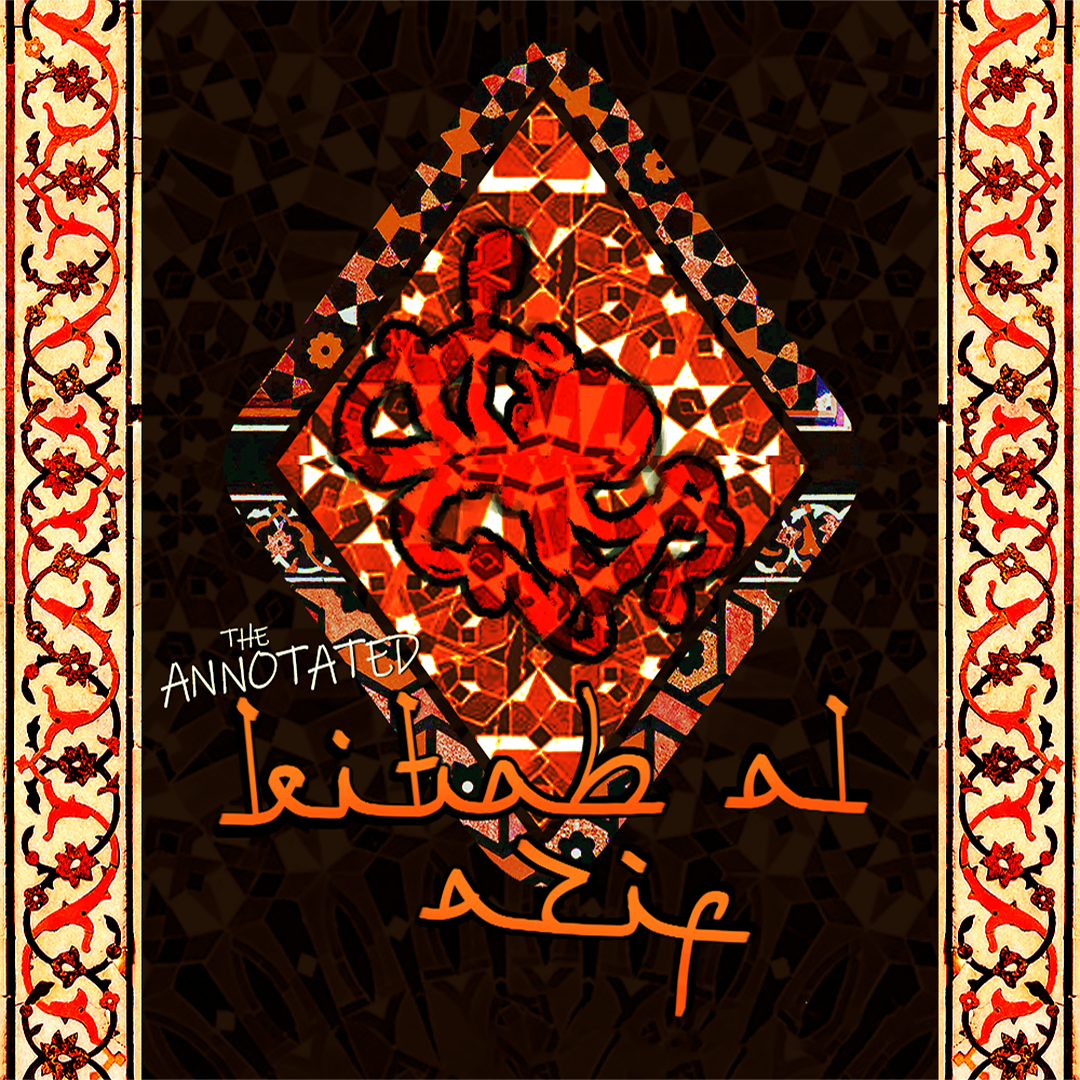
The Annotated Kitab al-Azif on The New Absurdist

I’m excited to announce that my short story “The Annotated Kitab al-Azif” is free to read on The New Absurdist here:

📖 https://newabsurdist.com/editors-picks/the-annotated-kitab-al-azif/

“The Annotated Kitab al-Azif” is a queer Lovecraftian romance about the slow decline of American academia and the supernatural perils of translation. In this story, a burnt-out Millennial podcaster flees the high rent of Boston and accepts a position as a departmental admin assistant in the suburban Miskatonic University, which is suffering from budget cuts and declining enrollments. During the lull of his first summer on the job, the podcaster meets a grad student working on the Gnostic religious traditions of the southern Mediterranean while attempting a translation of the Kitab al-Azif, more popularly known as the Necronomicon.

As you might imagine, this area of study has consequences for the grad student. The podcaster isn’t too concerned, however. He’s already seen all manner of awful things while doing research online, and why let something as trivial as ageless extradimensional horrors get in the way of a budding relationship?

Though I’ve never accidentally summoned an eldritch abomination, the setting of “The Annotated Kitab al-Azif” is partially based on my own experience as a grad student at the University of Pennsylvania. The “horror” part of this experience is the constant scramble for funding, the awkward negotiations with libraries for access to research material, and the unspoken expectation that you’ll work in decaying buildings that haven’t been maintained since the early twentieth century.

Meanwhile, the “romance” part is the opportunity to share space with people from all over the world. When you use the same office (and the same refrigerator and bathroom) with other people, pre-existing differences in culture, language, and nationality quickly become secondary to the warmth of the personal relationships that form between you. Universities aren’t cultural melting pots by any means, but they’re as good of a place as any to realize that cultural differences really don’t matter all that much in the face of genuine friendship.

Though I’ve largely set aside my ambitions to become a translator, one of the reasons I got into academia was to model the positive change I wanted to see in the broader field of literary studies, especially with regards to de-mystifying stories written by authors from “non-Western” countries. Even when it’s done respectfully, the academic tendency to treat these stories as “subaltern” and “marginalized” is frustrating. To begin with, nobody thinks of their own language and culture as “other”; but, more importantly, people are just people.   

The Necronomicon is an interesting base for an exploration of this theme. In my understanding of the lore of the Cthulhu mythos, the Necronomicon is essentially an expression of popular turn-of-the-century Spiritualism, which was in turn inspired by the various strands of medieval Gnostic thought that sprung up along the Silk Road.

Though this sort of spiritually inclusive worldview may have seemed “mystical” to people living in Christian-majority cultures in the late nineteenth century, it’s completely normal to someone coming from a Buddhist or a Hindu tradition. All things considered, the cyclical view of time and the multidimensional view of space suggested by the Necronomicon are completely normal for many people who weren’t raised as Christian, and it’s interesting to consider the real-world foundations of this infamous fictional text without the narrative trappings of Orientalism.

But also…… What if magic were genuinely real? What then?

I’m grateful to The New Absurdist for taking a chance on this odd piece of weird fiction. I also want to express my appreciation to the story’s cover artists, Katie Rejto and Wally Tigerland, for creating such a unique and intriguing illustration.

If your curiosity is piqued by the prospect of true-to-life dark academia haunted by a touch of cosmic horror, please check out my story on The New Absurdist (here).
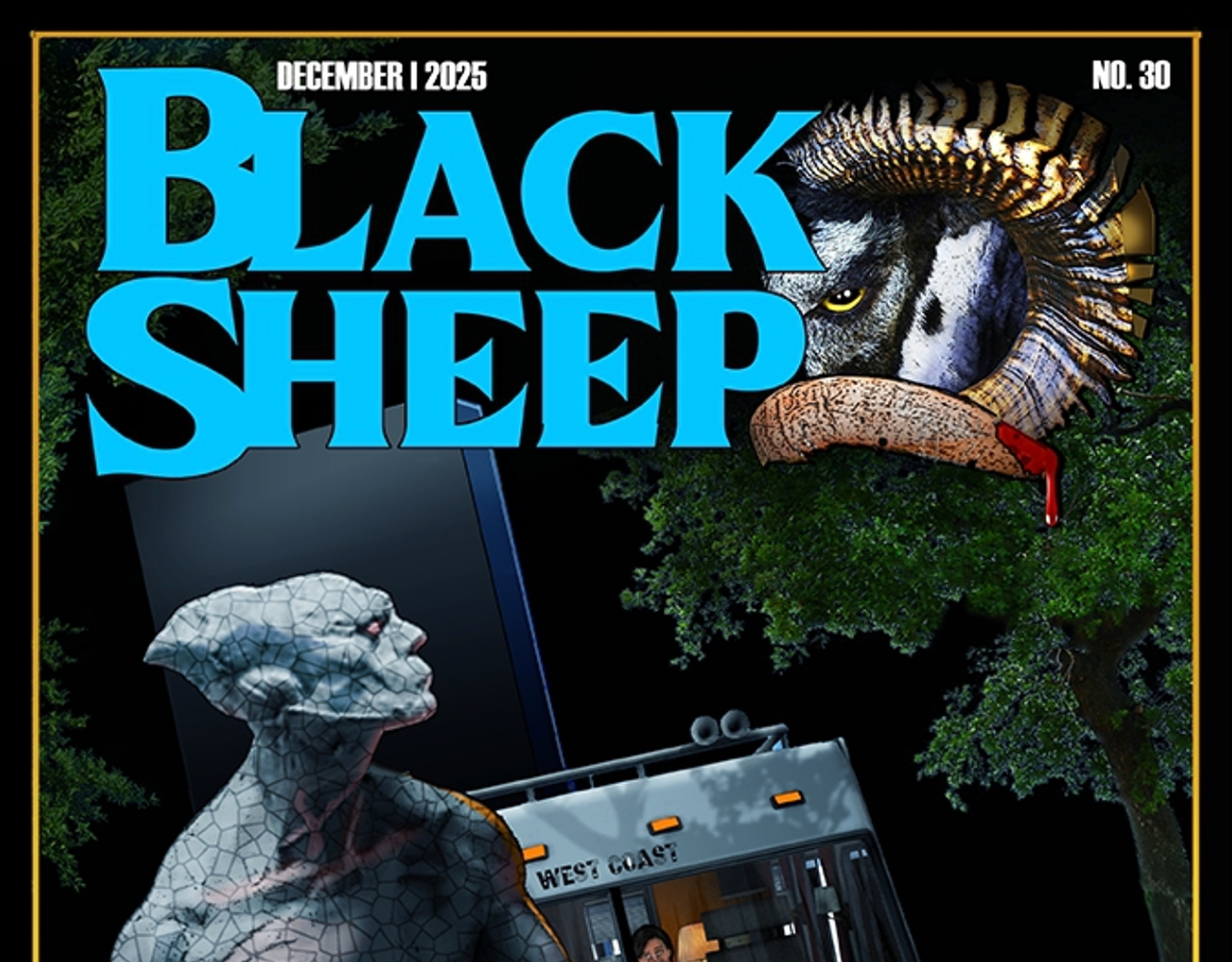
The Annotated Kitab al-Azif

My queer Lovecraftian romance, “The Annotated Kitab al-Azif,” was just published in the latest issue of Black Sheep, a magazine for weird fiction. This story treats the gnostic origins of the Necronomicon with respect while being slightly silly about grad students.

You can order a copy of the issue with my story here:

🐙📖 www.amazon.com/dp/B0G25R82TY

It’s very cool to have the opportunity to publish a Lovecraft pastiche in an honest-to-god pulp magazine, which seems appropriate. At the same time, I definitely feel the friction of using Lovecraft’s own tropes to push back against the ugly Orientalism surrounding the Necronomicon.

The truth is that, while I admire Lovecraft, but I wouldn’t consider myself a fan. Rather, I spent a formative part of my childhood in a small town in the Deep South whose public library was severely limited by budget constraints. The only thing remotely close to fantasy fiction they had on their shelves was Stephen King, the lone second volume of Lord of the Rings, and a handful of ancient paperback collections of H.P. Lovecraft.

I didn’t really have the cultural context to understand Stephen King, and I wouldn’t recommend The Two Towers as the place to start reading Tolkien. Lovecraft grabbed me, though. Even as a kid, I understood the xenophobia expressed in Lovecraft’s stories. Believe me, I understood all too well. Still, I guess I was young enough that this wasn’t a dealbreaker, especially since there was nothing else to read during the summer where I practically lived at this tiny little library.

I had more resources the following year, when I started attending an international school in Atlanta and began to read more widely. But Lovecraft stuck with me, and a small but significant goal of my writing now is to try to capture and explain why that is.

I sincerely believe that people should write whatever they want, but a part of me still questions the value of aligning myself with the work of such a problematic author. The truth remains, though, that these Lovecraft stories only occupy a small closet in the house I’m trying to build with my writing. What I want to do is expand the scope of the small rural library that only had room for Stephen King and H.P. Lovecraft, as well as to create space for original work that dismantles the toxic feedback loop of preset responses to human difference.

Much love to Black Sheep magazine for giving a home to this story. 

Ms. Weaver’s Halloween Candy

I’m proud to see my story “Ms. Weaver’s Halloween Candy” in the newest issue of Suburban Witchcraft.

“Ms. Weaver’s Halloween Candy” is a magical realist suburban gothic fantasy about love, creativity, and the (human) sacrifices necessary to survive as an outsider in academia. The piece begins as a Stephen King style story about a kid on a bike investigating a local legend in a small college town, but it gradually unravels into a veiled reworking of the Ariadne myth as the protagonist learns that the ambitions of her mother extend far beyond the confines of her family.

Suburban Witchcraft Magazine is a gorgeous digital repository of weird writing with a literary bent, and each issue is free to read online. You can check out the issue with my story here:

📚 https://suburbanwitchcraft.com/issue6

Strange Things Happen in Philadelphia

Strange Things Happen in Philadelphia collects six short pieces of weird fiction about the past, present, and near future of a city where anything can happen. Philadelphia is simultaneously filled with decaying ruins and vibrant cultures, and I see the stories in this zine as a celebration of those of us surviving and thriving during the slow collapse of the American empire. Nothing in these stories is real, of course, but I’ve drawn them from a deep well of local folklore and hearsay.

To tell the truth, I don’t actually know that many people in Philadelphia. I lived here for most of grad school but then moved away to chase various academic jobs. I returned during the pandemic, which wasn’t a great time to meet new people or reconnect with old friends. I’ve tried to apply to local writing groups and workshops but haven’t gotten anywhere (yet).

Don’t get me wrong – I’m fortunate to enjoy the support of various writing communities online. Still, my personal experience of Philadelphia has been mediated by long solitary walks through parts of the city that have a lot of abandoned buildings, many of which have fallen to ruin.

One of these areas is my own neighborhood of Point Breeze, which is a lovely place to live but also filled with decrepit warehouses and other abandoned properties. I myself live next door to a derelict funeral home, and I’m constantly reading threads on various Philadelphia reddit boards about the struggles of homeowners whose townhouses adjoin similarly abandoned buildings.

It’s worth emphasizing that Philadelphia is densely populated. In fact, one of the reasons I love living here is that there are always people on the street at all times of the day and night. In a lot of ways, Philadelphia reminds me of Tokyo. It’s an affordable city with a lot of history, culture, and potential…

…but that’s not really what these stories are about. As I edited this zine, I realized that it’s pervaded by a sense of loneliness. Not an unpleasant loneliness, but rather the unique perspective afforded to a stranger. When you’re alone, you end up seeing things that perhaps other people might miss, and that sense of strangeness is what I wanted to capture in this collection.

I was fortunate to be able to work with Kaylee Rowena, an architectural wizard of the highest order, to create the art for the zine cover. The zine also features a spooky illustration of Mothman by an artist of the odd and surreal who goes by Gravemud on Tumblr, as well as a gorgeously aesthetic illustration of two elegant monsters by the brilliant and stylish Critter Crafter Ally. I’ve also included a half dozen of my own illustrations.

Unlike my previous short fiction zines, Strange Things Happen in Philadelphia is printed in full color, and I’d like to think it’s an attractive little book. If you’re interested, you can download a free digital copy from Itch.io or order a physical copy from Etsy.  

🌇 https://digitalterrarium.itch.io/strange-philly-zine
🌇 https://www.etsy.com/listing/1761448527/strange-philadelphia-fiction-zine

When the Moon Didn’t Fall

All the clocks in Clock Town have stopped working, and letters have stopped arriving from the Gerudo in the Great Bay. Both the clock master’s daughter and the swamp witches’ son sense that something is amiss. Slowly they come to understand one another while their world gradually winds itself apart.

When the Moon Didn’t Fall is a short novella that imagines what Zelda and Ganon would look like in the world of Majora’s Mask. According to the Legend of Zelda Encyclopedia, Termina only exists as a dream inside Link’s mind, and it’s interesting to analyze how the events and characters of Majora’s Mask reflect the trauma that Link experienced in Ocarina of Time. I therefore wanted to use Termina as a stage to explore the trauma of Zelda and Ganon, specifically within the context of a dream that’s rapidly fading.

I think it’s fair to admit that I was strongly inspired by Stephen King’s 1990 novella “The Langoliers,” which is a disturbing bit of speculation concerning what happens to the world of the past after the present has already moved on. I tried to capture a similar sense of time (literally) running out, a theme that felt appropriate to the anxiety-inducing atmosphere of Majora’s Mask. Like “The Langoliers,” When the Moon Didn’t Fall has elements of uncanniness and horror, but it’s also about forgiveness, healing, and hope for the future.

I originally wrote this story back in 2018, but it still holds a special place in my heart. I completed a substantial set of edits so that I could include one of the early chapters in my portfolio of writing samples for The Whispers of Hyrule, an upcoming Legend of Zelda fanzine celebrating Hyrule’s forests. I love the swamp forest bordering the open plains of Majora’s Mask, and I enjoyed revisiting the strange green spaces of Termina through this fic.  

You can read the full story on AO3 here:
https://archiveofourown.org/works/14093202/

The story illustration was created by the dangerously talented Thali, whose cool and creepy video game art can be found on Twitter (here), on Instagram (here), and on Tumblr (here).