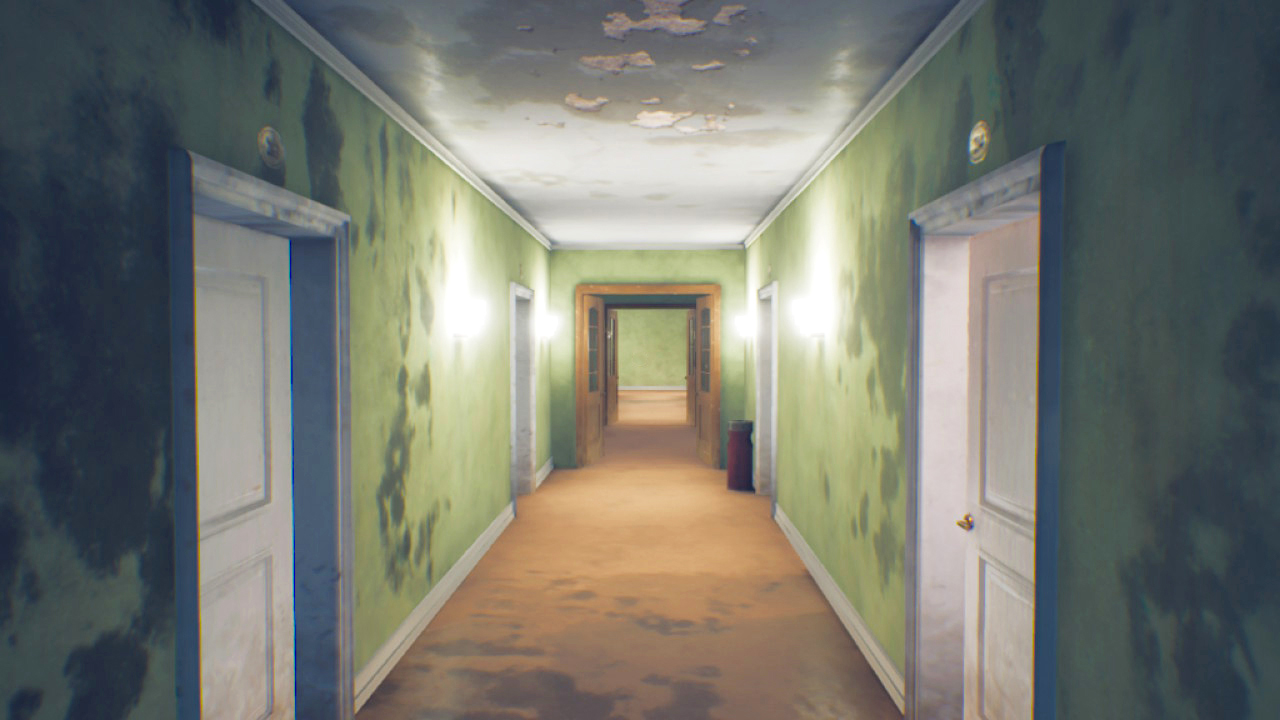
Vartio

Vartio
https://store.steampowered.com/app/3639120/Vartio/

Vartio, a short and atmospheric horror game about walking through the woods at night, was developed by Pepperbox Studios and released on Steam in August 2025.

You play as a medieval soldier sent to an isolated fortress in the middle of a dense forest. As soon as you arrive, the guard captain explains your duty: you must patrol the woods by moonlight. Your job, as the player, is to follow a first-person circular path through the trees. You’ll complete three loops that result in a playtime of around 20 minutes. 

Though Vartio has a bit of a twist ending, there’s nothing explicitly scary in the game. Aside from an owl flying in your direction toward the beginning of the second loop, there’s nothing resembling a jump scare. The graphics are well-designed but primitive and repetitive, and nothing much happens, truth be told. There’s no pathfinding or puzzle-solving; you just follow the road. You can leave the trail to explore a bit if you like, but there’s not much you can see in the darkness.

Precisely because the walk through the woods is so boring, it’s likely that your imagination will begin to work overtime as you navigate the sounds of the forest. The first loop is fairly normal. During the second loop, however, you become more sensitive to any break from the regular noises. And the third loop… Well, it’s a surprise.

Vartio is creepy, but it’s also oddly relaxing, like ambient lo-fi beats for forest goths. If you’re a fan of atmospheric horror that gives you space to make up a story as you go along, Vartio is an intriguing combination of retro graphics and precision sound design that allows you to immerse yourself in the spookiness of a starlit sea of trees.

Everybody’s Gone to the Rapture

Everybody’s Gone to the Rapture is a first-person walking sim set in the fictional village of Yaughton in the west of England. Yaughton is completely deserted, and the player’s job is to figure out what happened. “What happened” turns out to be a combination of things, none of which is ever properly explained, but what really matters is the human drama at the core of the crisis.

The game is entirely first-person, and the player can only do two things: walk and look around. There’s also an action button that can be used to turn on radios, pick up ringing phones, and enter open doors and gates, but we never see the player character’s hands. The player is thus little more than a moving point of view. This is just fine, because Yaughton is gorgeous.

After climbing down from the hill where the game starts, the player is confronted with a jumble of buildings and several intersections. Since you can go into almost every house, not to mention every house’s backyard and garage and garden shed, it was difficult for me to resist the temptation to do so. I kept encountering radios that can be turned on to get a bit of story, as well as shimmers of light that resolved into stylized representations of people sharing brief conversations.

Despite the lovely scenery, the first bit of Everybody’s Gone to the Rapture is fairly stagnant. The front end of the game is loaded with tons of disconnected characters whose relationship to each other isn’t immediately apparent. The light shining on the world is totally flat, and there’s no wind moving the leaves in the trees or blowing garbage across the streets.

After almost two hours of wandering around and trying to figure things out, I stopped caring about finding everything and decided to follow the glowing comet of light that’s intended to lead you through the story. What the guiding comet reveals is a series of conversations centered around a priest, Father Jeremy Wheeler, who was trying to come to terms with his faith in relation to what was happening to the town. Following a climactic scene, the game changes in a significant way.

At this point, Everybody’s Gone to the Rapture becomes much more structured. The player now understands that each area of the game is the stage for a narrative focused on one character. After the first major transition, the world of the game also becomes more active, with floating pollen, falling leaves, swaying flowers, billowing air-dried laundry, and the shadows of wind moving through the trees. As the natural world comes to life, the pieces of the story gradually start coming together.    

Everybody’s Gone to the Rapture isn’t perfect. The start of the game is extremely slow, and it’s easy to get lost at first. The guiding comet has a tendency to disappear, requiring you to restart the game to bring it back, and the slow pace of movement makes backtracking feel more annoying than it should be. Still, the graphics and music are beautiful – rapturous, even – and I was moved by the writing. If you’re patient enough to follow the story to its conclusion, your reward is an almost overwhelming sense of joy.

I should mention that I enjoyed Kirk Hamilton’s write-up of the plot (on Kotaku here), which poses many interesting questions and offers some excellent answers. The apocalyptic story seems more grim and horrific when summarized in writing than it does when you’re playing the game itself, though, so I’d recommend going in without spoilers.

The Suicide of Rachel Foster

The Suicide of Rachel Foster is a suspense thriller in the form of a walking sim that takes about three hours to play. The game has moderate elements of horror, and the relationship between the player-character’s father and the teenage girl he groomed is a key part of the story.

This is a difficult game to recommend, as I’m not sure its merits outweigh its flaws. These flaws aren’t necessarily related to the story, which is engaging despite its sensitive themes. Rather, The Suicide of Rachel Foster has major gameplay issues that will probably be a turn-off for anyone who isn’t already a veteran fan of walking sims. In other words, The Suicide of Rachel Foster is a very walking-simy walking sim, and I think it’s safe to say that people who aren’t interested in the premise probably won’t get a lot out of the game.

That being said, the premise is a banger: Your dad was the manager of what is essentially the Overlook Hotel from The Shining, and you get trapped in the hotel by a snowstorm while inspecting the property after your dad’s death. As you poke around mementos of the past, a terrible family secret comes to light, and it’s entirely possible that you’re not as alone in the building as you were led to believe.

The Suicide of Rachel Foster begins when the player character, Nicole, gets a letter from her late mother, who hired a lawyer to deliver the document to her on the event of her father’s death. Ten years ago, when Nicole was 16, her mother took her to Portland when she left her father and the hotel in Montana they managed together. Nicole’s father had been pursuing an affair with one of Nicole’s classmates, the eponymous Rachel Foster. Rachel became pregnant and committed suicide by jumping off a cliff in the mountains.

The Timberline Hotel struggled on for another six years but closed in 1989, and Nicole’s father continued to live there for another four years before committing suicide himself. It’s now 1993, but everything in the hotel is more or less how it was when Nicole left in 1983 – including, creepily enough, her childhood bedroom. Regardless, the elements have taken their toll on the building, and Nicole is legally required to perform an in-person inspection before she has her father’s lawyer sell the property to a hotel chain.

Thankfully, the hotel still has hot water and electricity. Nicole is connected via a very chunky cellphone to a man named Irving, who identifies himself as a FEMA agent who’s been assigned to monitor her situation. Irving cautions Nicole not to leave during the snowstorm, and he helps guide her through the hotel so that she can keep the lights on and the water running during the emergency.

Oddly enough, Irving seems a little too helpful, and maybe just a little too available. He explains that he’s been a member of the small-town community since he was a child, but perhaps he knows a bit too much about the history of her family. Nicole is suspicious of Irving at first; but, the longer she’s stuck in the hotel, the more she comes to trust him. Despite Irving’s misgivings, Nicole starts to investigate the death of Rachel Foster, and she begins to suspect that perhaps the girl didn’t commit suicide after all.

While Nicole is stuck in the hotel for nine days, the player is tasked with finding the answers to three questions. What happened to Rachel ten years ago? What does Irving know that he isn’t telling you? And something is clearly strange about the hotel – what’s going on there?

While The Suicide of Rachel Foster presents an intriguing set of intertwined mysteries, the performance of Nicole’s voice actress rubbed me the wrong way. Nicole comes off like a whisky-slinging, battle-hardened intergalactic bounty hunter, which is an odd approach to the character. Nicole is only 26 years old, and she’s something of a blank slate. She doesn’t seem to have a job, or friends, or interests, or hobbies, or even practical knowledge concerning how to maintain the hotel. To me, it didn’t feel like Nicole’s badass attitude is earned, and it grated on my nerves.

In addition, one of the main thematic questions of the game doesn’t mean anything to me. Can you still love your dead father if he abused your mother, seduced and impregnated your teenage friend, and then didn’t contact you for ten years? Like… no?? At the very least, this is a complicated issue that would have required much more heavy lifting than the game’s script was willing to do.

Thankfully, what’s going on with Irving is far more interesting, and his voice actor gives an incredible performance that made me feel way more sympathy toward his character than perhaps I should have.

In any case, the game is primarily concerned with creating an atmosphere of slowly mounting dread.

Unfortunately, Nicole walks at a glacial pace, which makes it a pain to explore the hotel. The map you’re given isn’t terribly useful when you have it, and Nicole loses it halfway through the game. The location of your objectives isn’t clear, and there’s a lot of extraneous space with no plot relevance. It’s easy to get lost, and there are no nudges to help get you back on the critical path.

Because you move so incredibly slowly, I ultimately gave up on free exploration and used a walkthrough, this one (here). There’s nothing wrong with using a walkthrough, of course, but I wish it weren’t necessary.

I should note that you can run, but this is also a pain. To run in the Nintendo Switch version of the game, you have to exert force to press down the left joystick as you move it. This is extremely awkward and uncomfortable. To put it bluntly, it’s an obvious accessibility issue that doesn’t need to exist.

Also, you’re occasionally given dialog choices that don’t make much sense. You’ll choose one thing, and then Nicole will say something else. These choices are timed for some inexplicable reason, and what you say doesn’t have any impact on the plot.

This makes it all the more confusing when you’re given a choice that does matter at the end of the game, which is whether or not to allow Nicole to commit suicide. This is a weird choice to have, to be honest, especially since there’s nothing about Nicole that indicates she’s depressed or suicidal. Again, the player doesn’t know anything about her, and nothing that happened in the past is her fault. Even if you don’t allow her to commit suicide, I don’t understand the “good” ending, which doesn’t make any logical or emotional sense.

I know this seems like a lot of criticism, but it’s worth repeating that the game isn’t that long, and its main focus is on creating a creepy narrative atmosphere to accompany its lovingly rendered spatial environment. You can probably finish the story in two and a half hours if you use a walkthrough from the beginning and don’t get stupidly lost like I did, and the gameplay issues might not bother someone more inured to the idiosyncrasies of walking sims.

I have to admit that I never really warmed up to Nicole or felt any sympathy for her sexpest father, but Irving grew on me. The intertwined stories of what happened to Rachel Foster and what’s currently going on in the hotel are extremely intriguing, as is the physical environment of the hotel itself.

I’m a huge fan of The Shining, both the Stephen King novel and the Stanley Kubrick film, and it was cool to see what the “staff only” spaces of a place like the Overlook might actually look like, from the caretaker apartments to the boiler room to the industrial kitchen freezer to the utility crawlspaces. Mercifully, there are no elevators in the Timberline Hotel, but the carpeted hallways are plenty spooky enough. There’s also a secret underground passage with a secret room. I consider myself to be a connoisseur of secret basement rooms, and this one gave me serious chills.

If you’re not sold on The Suicide of Rachel Foster but curious about where it goes with its premise, I’d recommend checking out the Wikipedia article (here), which contains a detailed plot synopsis. I think The Suicide of Rachel Foster probably would have made a better novel, but there’s also something to be said for the experience of being able to walk through the hotel while hearing every creak of the floorboards and every rattle of the pipes in the walls. If nothing else, the sound design is amazing, and the dev team clearly put a lot of love and care into creating an immersive setting.

So, in conclusion, while The Suicide of Rachel Foster is a difficult game to recommend to everyone, I personally very much enjoyed being drawn into the strange and horrible story of the Timberline Hotel.

What Remains of Edith Finch

What Remains of Edith Finch is a walking sim that takes about two hours to complete. It was released in April 2017 for Steam and PlayStation 4, but it’s now available on a number of other platforms, including the Nintendo Switch.

What Remains of Edith Finch is visually gorgeous, and it falls into my favorite category of games: It was created for an adult audience by a small team of developers who take full advantage of the interactive gaming medium but don’t frustrate the player with unnecessary puzzle or platforming elements. There’s a lot to explore in this game, but the atmosphere is never broken by the player having to get up and check a walkthrough.

You play as a teenage woman named Edith Finch, who is returning to her family’s house on a small island off the coast of the Pacific Northwest. The house has been abandoned ever since Edith’s mother moved away in order to escape “the family curse,” which holds that everyone who is born into (or marries into) the Finch family dies in a tragic accident. In order to find closure, Edith tries to reconstruct the details of her family’s deaths, which the player experiences though a series of vignettes that play out in the form of short interactive stories.

Progression through the game is definitely on rails, but it doesn’t feel particularly linear. This is partially due to the unique architecture of the Finch house, whose rooms seem impossible yet manages to fit together neatly like the pieces of a puzzle. The game’s sense of progression is also enhanced by the player’s interactions with the environment, which are essential to the storytelling. I’m going to use the case of Edith’s older brother Lewis as an example of what I mean.

Lewis is a young man who loves fantasy novels, video games, and weed. After he graduates from high school, he drifts aimlessly for a few years before getting a job at a salmon cannery. This job is just as dreary as you might expect, but Lewis survives the tedium of menial labor by immersing himself in daydreams. As the player, you use one joystick to control the repetitive motion of decapitating fish and throwing them onto a conveyor belt while simultaneously using the other joystick to guide Lewis’s avatar through his RPG-themed fantasies.

Lewis’s daydream gradually becomes more interesting and complex. This is reflected by the game inside his mind being upgraded, almost as though it were being remastered across various eras of gaming consoles. The controls for the salmon cannery aspect of Lewis’s life never change, and they remain a constant annoyance as the fantasy slowly expands to fill the screen. When the player is jolted out of this daydream back into the bloody and poorly lit factory, it’s much more jarring than it would be if we were simply reading or watching Lewis’s story.

The psychiatrist who narrates this vignette says that Lewis’s death was caused by a hallucination triggered by withdrawal from hard drugs, but the player understands that it was a suicide brought about by his overwhelming desire to no longer be anchored by an unpleasant and unsatisfying reality. This episode is only twenty minutes long, but I cried. Kind of a lot actually.

What Remains of Edith Finch isn’t sad or sentimental; rather, it’s nuanced and incredibly beautiful. It doesn’t offer the player the same sort of transcendent experience as a more ambitious game like Everybody’s Gone to the Rapture, but its smaller and more personal stories are replete with mystery and wonder. Although the two games were made by different developers, What Remains of Edith Finch feels like a spiritual sequel to Gone Home, and it’s such a pleasure to see the gaming medium used to apply magical realism to gothic dramas of family ghosts and personal journeys of discovery.

I was inspired to return to What Remains of Edith Finch by a recent episode of the podcast Watch Out for Fireballs, which you can listen to (here). Reflecting on the game almost six years after it was first released, I would agree with the podcast hosts: Although What Remains of Edith Finch was almost universally praised when it came out, I’m afraid that its Wes Anderson style of twee humor might not land the same way on social media now. What Remains of Edith Finch treats the twinned subjects of death and mental illness with humor and sympathy in a way that celebrates the joys of being alive, and I’m not sure its multilayered tone would necessarily survive the black-or-white mentality of Twitter.

Still, I love this game, and I appreciate it even more now that I’ve had more personal experience with grief. I wouldn’t go as far as to say that What Remains of Edith Finch is uplifting, but the two hours I spent with the game improved my mood, bolstered my courage, and reignited my creative motivation. As with any work of art, the specificity of the game’s tone and viewpoint may not land with everyone, but it’s precisely this specificity of storytelling that makes What Remains of Edith Finch so strange and fun and interesting.