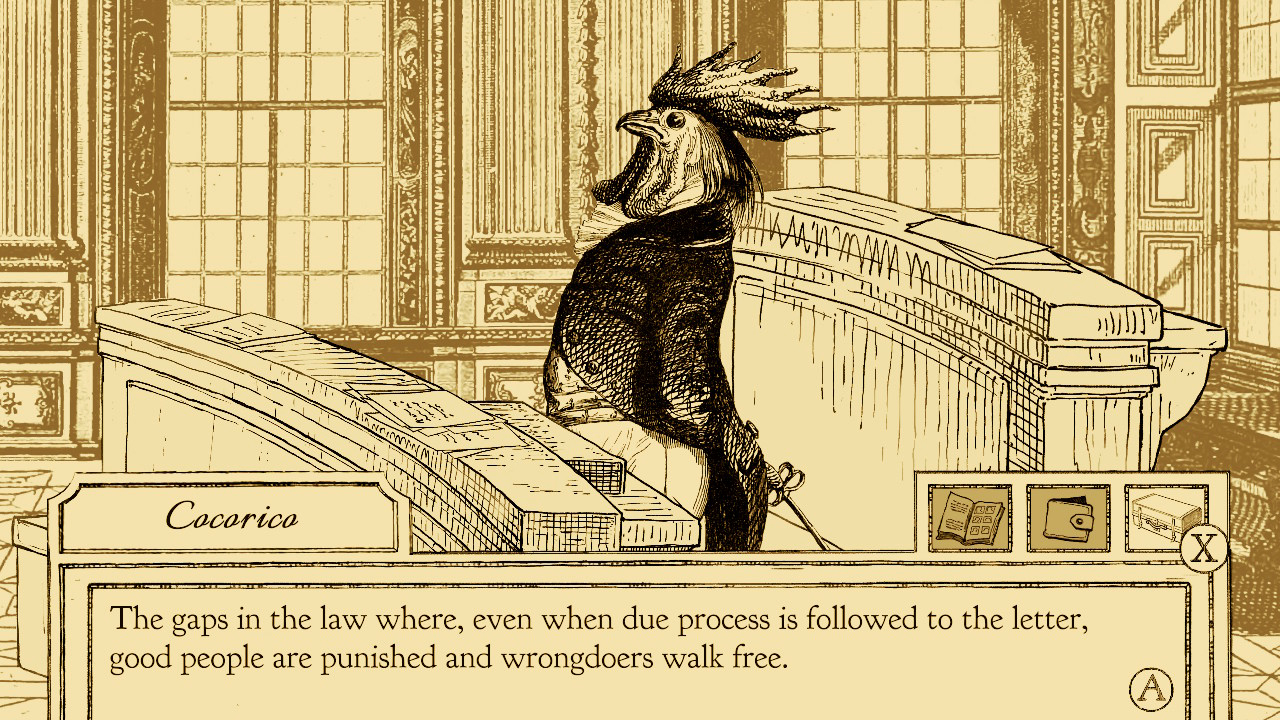
Aviary Attorney is a four-hour visual novel modeled on the Phoenix Wright series and set in Paris in 1848, right on the cusp of the revolution that ushered in the Second Republic.
You take on the role of Jayjay Falcon, a private defense attorney. Jayjay is shadowed by his apprentice Sparrowson, who provides comic relief, and he often butts heads with his rival, the brilliant but arrogant prosecutor Cocorico. The game’s story plays out across four trials. In the days leading to the trial, Jayjay has the opportunity to collect evidence and testimonies by investigating various locations in Paris. During the trial, Jayjay is given the opportunity to present relevant evidence and cross-examine a key witness.
The characters are styled as animal-headed caricatures lifted directly from the line illustrations of J. J. Grandville, an illustrator active in the first half of the nineteenth century known for his detailed line art and his razor-sharp political commentary. As explained in the game’s credits, all of the artwork in Aviary Attorney was taken from Wikipedia and the Internet Archive, and Allison Meier’s article on Hyperallergic (here) presents Granville’s illustrations in their original context. Given how seamlessly all of the game’s assets are integrated, however, a player might be forgiven for assuming that they were custom made. This is a very good-looking game.
Although the story doesn’t strive for realism, the writing is excellent. Each trial has a dramatic twist at the end, and I thought these developments were great fun. If you enjoy ladies doing murder, I think you’ll have a good time too. Even more than the crime, however, what I love is the opportunity to explore Paris while speaking to people from all walks of life and gradually coming to understand why the February Revolution happened.
I also appreciate that, unlike the Phoenix Wright games, the focus of the trials in Aviary Attorney isn’t on catching the culprit or assigning guilt, but rather on ensuring that the accused receives due process under law. Revolution is all well and good, but I admire the characters’ commitment to upholding the practice of civil society. If you manage to achieve the game’s best ending (which I did by using this guide), you’ll learn that Jayjay Falcon is the grandson of Robespierre, the great eighteenth-century French legal theorist. This isn’t a political game, but it’s always a pleasure to see writing that devotes careful attention to historical details while putting itself in conversation with the philosophies of the time.
Aviary Attorney is an interesting exercise in how public domain works can be transformatively reconfigured into contemporary media, but it’s also a great game. Obviously I’d recommend Aviary Attorney to fans of Phoenix Wright and to connoisseurs of visual novels in general, but I really want to encourage anyone who enjoyed the themes and message of Pentiment to give this game a chance. It’s got excellent writing, a unique visual appeal, and a satisfying sense of historical specificity.
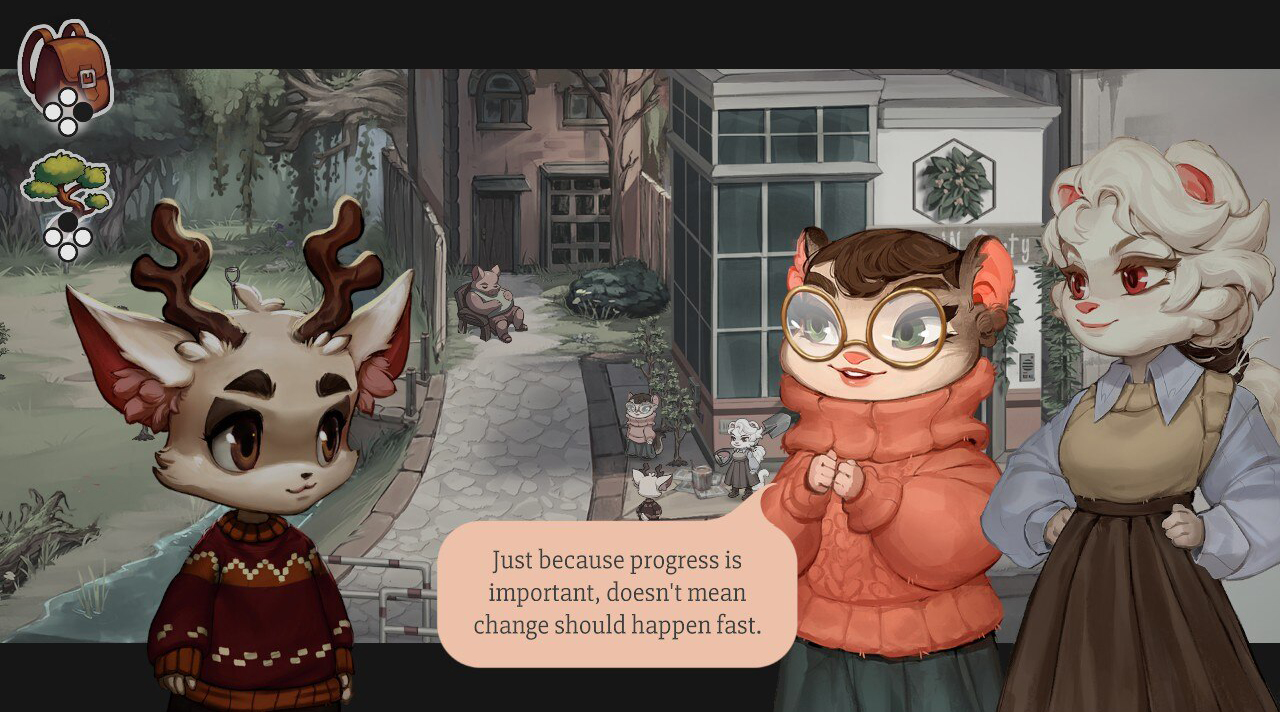
Beacon Pines is an isometric narrative adventure game that takes about four hours to finish. You play as a 12yo boy named Luka who decides to explore a mysterious abandoned factory over summer break and accidentally uncovers the dark secret of his quiet mountain town in the process.
In terms of its playspace, Beacon Pines is relatively small. Not counting a few plot-specific locations that you only visit once, there are about fifteen outdoor screens in the game, along with perhaps half as many indoor screens. Each of these screens is beautifully painted, with each point of interaction clearly indicated.
What gives Beacon Pines a sense of scale is its structure. The game envisions its story as a tree and gives the player the option to make a key choice at each divided branch. While progressing through the separate branches of the story, the player will naturally pick up “charms,” or words that can be used to slightly adjust the narrative at critical points.
You can always return to an earlier choice with zero backtracking when you get a new charm, and the story’s pacing is excellent. The time spent on each branch is relatively short, which makes it easy to remember what’s going on when you switch to another branch. The way everything fits together as you progress is a masterpiece of narrative craftsmanship.
The tone and level of the writing is consistent with Luka’s age, and the first three Harry Potter novels are the easiest analogy. Each character in the expansive cast has a limited yet well-defined personality, and the story scenarios are improbable yet intriguing. There’s not much psychological depth, and the plot is pure fantasy, but I still had a great time with Beacon Pines. It was a pleasant shock the first time I saw the first dead-end branch of the story, which was delightfully morbid.
There’s one true ending of Beacon Pines, but players should expect to see about a dozen premature endings before they get there. In other words, it’s a linear story, but it’s told in a creatively nonlinear manner that takes every “what if” scenario into account. Again, the narrative craftsmanship is superb.
It’s easy to make a comparison with Night in the Woods, as you directly control a character who makes progress by walking around a beautiful small town and talking to every NPC. The themes of the story are similar as well, as the town of Beacon Pines suffers from corporate ownership of its fertilizer factory in the same way that Possum Springs suffers from corporate ownership of its mines. As in Night in the Woods, there are supernatural elements at play, although Beacon Pines is more concerned with mad science than cosmic horror. The major difference is that I wouldn’t give Night in the Woods to a child, while Beacon Pines is suitable for middlegrade (10-14yo) players.
I am not the target audience for “all-ages” fiction, but I enjoyed Beacon Pines regardless. Most of the adult characters in the game are problematic and relatable, and the story’s environmental themes are worth considering beyond a superficial level. The villains are a lot of fun, as are the more horror-themed elements of the plot.
It’s also important to note that the character art is gorgeous. The animal characters were clearly drawn by a furry artist in a way that the characters in Night in the Woods were not, but I have nothing but love for this art style. Despite the relatively large cast of characters, the character designs are all unique and visually interesting. I’m not a furry myself, but I was still able to appreciate the high polish of the art. There is no cringe here, just beauty and creativity.
The environmental art is gorgeous as well. The pleasant façade of Beacon Pines is indeed pleasant, with lovely trees and handsome buildings adorning each screen. Although we don’t see much of the town’s dark secret, the visual design of the spaces it affects fit the theme perfectly.
In terms of gameplay, I always felt directly engaged with the story. There’s nothing missable or collectable, and the game doesn’t get cute with achievements. There are two optional minigames, and they’re both unobtrusive and enjoyable.
Beacon Pines is short, inexpensive, and accessible. If you’re a fan of Night in the Woods, or if you’d like to play a visual novel with more interactivity, I’d definitely recommend giving Beacon Pines a shot. Since it comes off a bit like a generic cozy game on its Steam page, I had no idea Beacon Pines would be as interesting as it is, but it’s an amazing treasure of a game.
Vacant is a free-to-play 2D narrative adventure game that takes about 35 minutes to finish. You play as a camerawoman named Elena who accompanies her friend Priya to a hotel that was abandoned shortly after it was built. Priya runs a ghost hunting video channel, and she wants to make it big by solving the mystery of the unexplained disappearances of Masthill Lodge.
Following a short hike through the woods, Elena and Priya enter the abandoned hotel, which has two floors and a basement. There’s a kitchen and a few staff rooms on the first floor, and the guestrooms are on the second floor. The space is large enough to be fun to explore but small enough to be manageable. All points of interaction are clearly marked, and there are no puzzles. The occasional dialogue choices are fun but don’t seem to affect the story, which is fairly linear.
After you poke around a bit, Elena and Priya have a heart-to-heart talk about why Priya makes these videos despite her firm belief that ghosts don’t exist. Her work is about the craft and the connection with her audience, she says, giving a perfectly reasonable explanation for why so many people enjoy ghost hunting videos.
Regardless, there’s something not quite right about Masthill Lodge. How did 54 people disappear here, exactly? And why has no information about any of them turned up in the ten years since?
The tension comes to a head when a man suddenly appears outside the lodge. “Don’t make a sound,” Priya says, and this is when the strength of the medium comes into play. As the player, you have to move forward, and your choices are limited for the worst possible reasons. I don’t generally get creeped out by horror games, but let me be honest – this one got me.
The writing in Vacant is excellent, and the characters are human and believable. The pixel graphics and sound design contribute to the subtly creepy atmosphere. The pacing is perfect, with a good balance of character drama, humor, mystery, and horror. The ending is fantastic.
There’s no way to save your progress, so you’ll need to sit down and play the whole story in one go. I didn’t mind, as the game is so well crafted that it’s easy to become immersed in the fiction. If you’re a fan of the character writing of Night in the Woods or the magical realism of The Magnus Archives, I’d definitely recommend checking out Vacant.
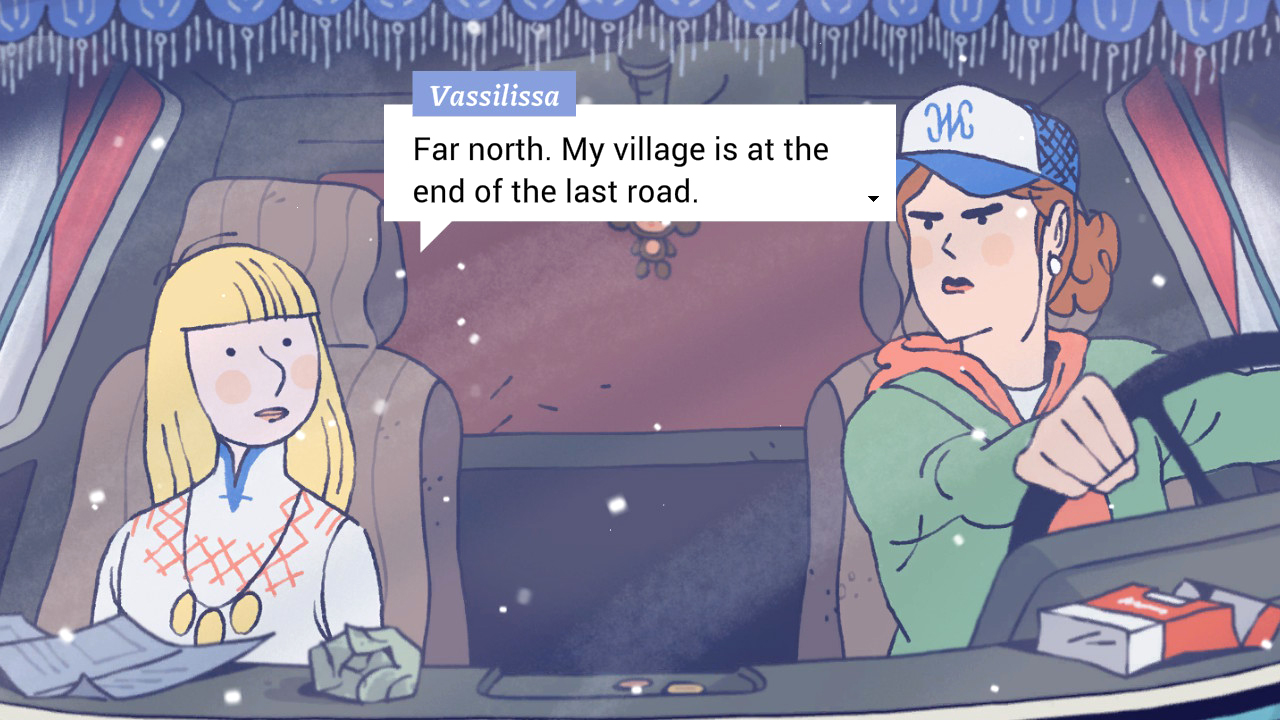
Firebird is a choice-based visual novel that takes about an hour and a half to play. The story is set in the northern borderlands of contemporary Russia, where a Hungarian migrant named Mariska makes her living as a freight trucker.
Since she’s in the country illegally, Mariska had to take out the loan for her truck, the Firebird, from a local mob boss. When she’s caught after trying to flee the boss’s territory without paying the interest on her loan, Mariska crosses paths with a strange girl in traditional clothing named Vassilissa, who promises great riches if Mariska will deliver food to her village in the far north.
Your job as the player is to navigate between points on the map as Mariska and Vassilissa head steadily northward. There’s no backtracking, so you’ll have to choose between multiple routes while ensuring that the Firebird doesn’t run out of gas. The game is entirely text-based, and the elements of resource management are fairly chill.
More than anything, the gameplay is about roleplaying as you explore the dialogue options. It’s possible to die, but doing so will simply restart the game at a crucial choice. As the player, you’re mostly just along for the ride. And what an incredible ride it is.
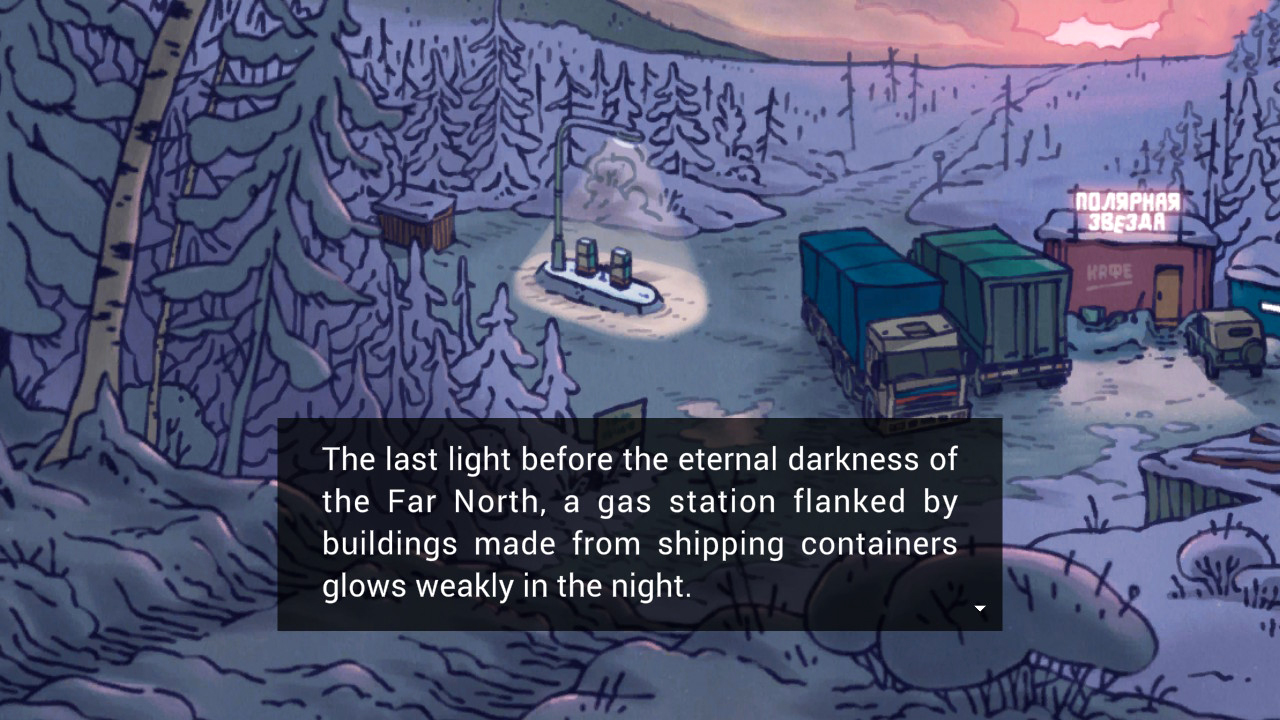
At each point on the map along her route, Mariska is able to leave her truck and search for gasoline or money (which can occasionally be used to buy gas). The road is littered with the ruins of old villages and Soviet outposts, but a few of the waystations are still populated. The humans Mariska and Vassilissa meet are friendly, but the wolves and bears are another story entirely. To make matters worse, the mob boss has sent his henchman Ivan to pursue Mariska in his truck, the Gray Wolf.
As you might have guessed from the character names, which are drawn from Slavic folklore, there are supernatural forces at play. Over the course of her journey, Mariska encounters various legendary characters, from the crafty witch Baba Yaga to the warrior princess Maria Morevna. The gradual shift from gritty realism into the realm of a fairy tale is a lot of fun, especially when the seemingly absurd advice offered by characters along the way begins to make perfect sense. Thankfully, Mariska is nothing if not pragmatic, and her no-nonsense attitude is exactly what she needs to get the job done.
Firebird’s developers, Ludogram, are based in France, but they’ve devoted love and care to bringing the Russian setting to life. The luminous ligne claire artwork of Quentin Vijoux invites the player onto the northern tundra while conveying a strong sense of lingering twilight and freezing cold. Despite Firebird’s celebration of Slavic folklore, the game’s narrative makes no attempt to hide its criticism of the Russian state, especially the collusion between government and organized crime. There’s also a haunting scene with Soviet ghosts that I found genuinely chilling.
Although it’s possible to see an entirely different variation of the game’s story during a second playthrough by having Mariska drive through a different set of points on the map, the destination is always the same. No matter what path you choose, Firebird connects to universal themes as it acknowledges the cycles of nature – between winter and summer, and hardship and plenty, and faith and hard work. The bad times won’t last forever, Firebird suggests, and Mariska will keep on trucking.
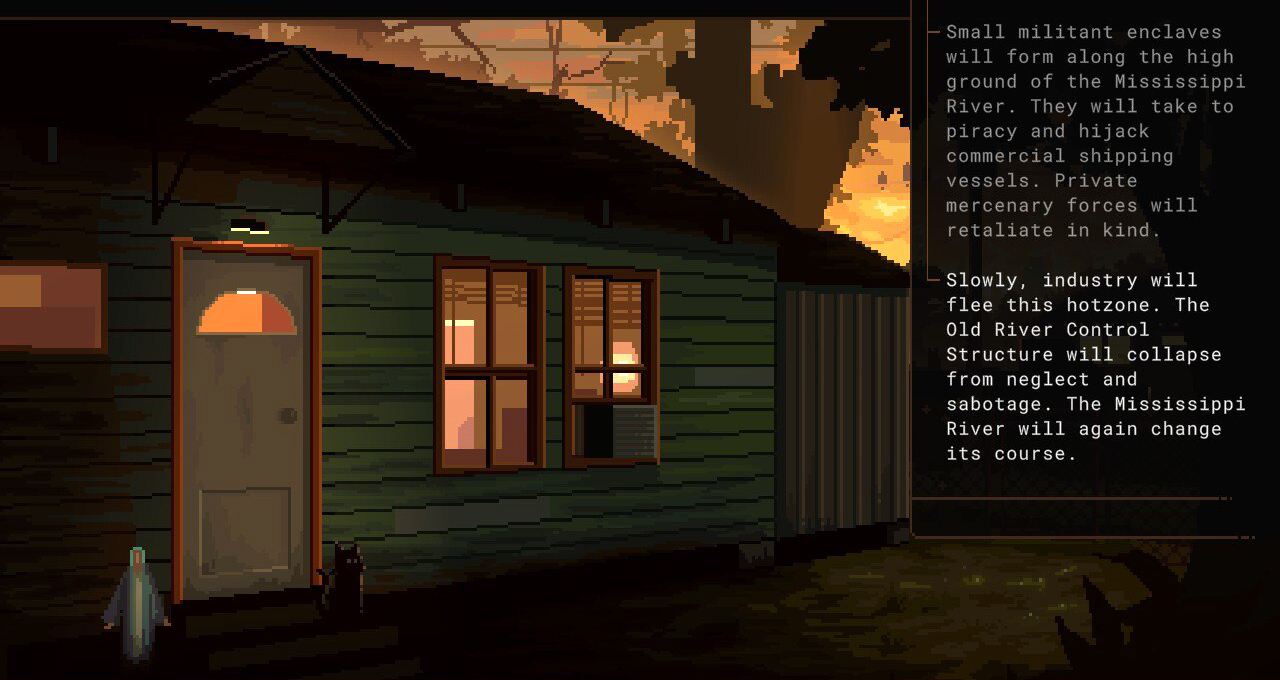
Norco is a cross between a visual novel and a point-and-click adventure game that takes seven hours to play. The game is set in a near-future version of New Orleans and its surrounding bayou. Despite its lowkey cyberpunk elements, the future envisioned by the game isn’t all that different from the present. Norco is gorgeously well-written and intriguingly grounded in the specificity of its setting, and the various small stories it encompasses are filled with fascinating characters and meaningful human drama.
I want to focus on what’s interesting about this game. That being said, Norco can be frustrating, so let me get this out of the way: most of the adventure game elements of Norco are bad. The puzzles (such as they are) are poorly executed and annoying. There’s at least one instance of turn-based combat per act, and it’s not great. Also, the game takes a weird turn toward cosmic horror in the third and final act; and, in order to unlock a slightly more satisfying ending, you have to do a minor random thing in the second act that’s extremely easy to miss.
None of this is a deal breaker. Rather, I think it’s good to set expectations. Specifically, you should expect to use a walkthrough at some point. I actually ended up using three walkthroughs, as I found some of the adventure game sequences to be difficult to piece together. They’re not complicated; they’re just opaque. Thankfully, the more frustrating puzzles are few and far between, and you can play the vast majority of the game just fine on your own.
You begin Norco as a woman named Kay who returns home after her mother dies of cancer and her brother Blake stops replying to texts. Although Blake is nowhere to be found in or around the house, Kay is greeted by the family robot Million, a fugitive from the skirmishes between armed militias that have broken out across the southwest. Million suggests that she and Kay talk to people in the neighborhood to figure out where Blake has run off to.
The search for Blake is interrupted by extended flashback sequences in which you play as Kay’s mother Catherine. While her cancer is in remission, Catherine takes odd jobs on a Fivver-like platform called Superduck in order to pay off loans so her kids can keep the house after she dies. These jobs take Catherine across New Orleans and eventually lead her to an abandoned mall colonized by the teenage disciples of an internet demagogue by the name of Kenner John.
We’re introduced to Catherine as she allows a blandly anonymous tech corporation to make a neural map of her brain. In theory, the experimental procedure is compensated by the generation of an AI personality intended to help Catherine’s family process her death. In reality, Catherine needs the money. Immediately after her brain imaging session, she’s out in the city after dark running errands via the Superduck app.
Oddly enough, Superduck ends up being a real “person,” a branch of an AI personality based on Catherine’s friend Duck. Based on a story Catherine once told Duck, Superduck has figured out that an alien entity resides in the estuary of Lake Pontchartrain, and that it was captured by Kenner John.
Although the cyberpunk elements of Norco’s plot are fun, they’re not the real story. As Catherine, you play as a tired and washed-up adult using a rideshare service to get around town while trying to gather information from other tired adults who are just trying to make a living. It’s through these conversations that the player gets a sense of what New Orleans is like as a city, as well as a sense of how not even wealthy people who seem to be major players have any control over the environment. There are going to be hurricanes, and there are going to be floods, and neither oil companies nor tech companies can do anything about it.
What I appreciate about Norco is how realistic and grounded it is. As someone dealing with cancer, Catherine gets winded climbing stairs during one of the adventure game segments, and she’s okay with telling people that no, actually, she’s not fine and she needs a minute. Kenner John’s cultists are dumb kids (affectionate) who just want to hang out in an abandoned mall and smoke weed while playing video games. Even the MAGA-style militia members who make a brief appearance in the last act are heroic in their own deranged way, and the poor harassed public official who stays late in City Hall dealing with paperwork delivers a monologue about how you can’t save everyone that’s worthy of Shakespeare.
Despite the gritty setting of a city on its last legs and Norco’s complete lack of sentimentality, all of the characters are intensely human and sympathetic. They’re also quite funny, even when they’re at their lowest and most morally dubious. There’s one story about a guy who eats a hotdog from a food cart in a downtown tourist area that made me laugh so hard I cried. Norco tackles challenging themes, but it also manages to be pitch-perfect comedy storytelling. I really can’t overemphasize how brilliant the writing is.
Also, this is worth saying: As someone who grew up in the Deep South, I’m truly and deeply grateful that the script of this game uses an accurate representation of Southern AAVE. My promise to myself about Norco was that I would put the game down and walk away the second anyone said “y’all” or pulled some sort of X-Men Gambit bullshit, but I didn’t need to worry. Everyone talks like a normal person.
The basic gameplay of Norco consists of conversation-based fetch quests. Someone will tell you to talk to someone else, and you have to go find them. You do this by driving (or ordering an off-brand Uber) to take you to a point on a map of New Orleans, and from there you’ll navigate between four or five screens by clicking on various points of interest. Your objective is always clear, but there’s a lot of non-essential content to interact with. And it’s good to talk with everyone! What you’ll get as a reward for being curious is some of the best stand-up comedy you’ll ever read.
The adventure game puzzles are so deeply embedded in the action of the story that they’re difficult to describe without extensive plot summary. What makes the worst of them annoying is that they expect you to leave the game and write something down in real life. One of the more obnoxious of these puzzles involves numerology. I understand that this is a play on the weird Christian-themed numerology cults that have sprung up on YouTube and Facebook – one of my aunts got really into this during the pandemic, true story, and it’s batshit insane – but it’s still a pain to put down the game and go get a piece of paper.
One of the interactive elements of the game that actually works well occupies a large portion of the third act. The Surprise Big Bad antagonist has gotten an offshoot of the Kenner John cult to build a spaceship on the bayou, and Kay needs to go out and find the site by navigating through the swamp in a small boat on a 4-bit pixelated sonar screen. There are all sorts of fun things to find out on the water, and this segment is enhanced by an atmospheric lead-up that includes an interesting lesson in natural history concerning why the topography of the bayou is so treacherous even though it looks like open water.
At the conclusion of the end credits, Norco provides a list of books and documentaries that the developers used as references. I was so drawn into the real-world history presented by Norco that I immediately screencapped this list. I got started on following up with these references by watching a documentary called Mossville: When the Great Trees Fall, and it’s almost painfully apparent that the creators of Norco were pulling inspiration from serious ongoing issues. It’s amazing that they were able to take such heavy material and transform it into something so gorgeously strange and entertaining.
Although Norco isn’t as mechanically robust as Disco Elysium, it’s easily in the same category of excellent writing and unique visual stylization. I somehow got the impression that this game would be all doom and gloom about poverty and injustice, but it’s actually a genuinely funny dark comedy about a cast of characters whom I grew to love despite (and often because of) their flaws and bad behavior.
Fishy is a horror-themed “wholesome” visual novel that takes about twenty minutes to finish. You play as a sweet middle school girl who’s spending the night at an aquarium for a friend’s birthday party. The problem is that she’s deathly afraid of the ocean, and it doesn’t help that there’s mild friendship drama afoot. She gets separated from the group and wanders into a restricted area, where she encounters fish that aquarium guests are never meant to see.
The art of Fishy is fantastic and alternates between genuinely gorgeous and genuinely creepy. Putting the spooky fish aside, the environmental illustrations perfectly capture the magical atmosphere of what it might be like to spend the night in an aquarium. The character designs are lovely as well.
The writing is competent, but the game seems to be aimed at the same audience as its preteen characters. In its determination to be wholesome and teach the player a positive life lesson, the story hesitates to create a sense of tension, dread, or even character development.
Fishy’s message is that having a prosthetic limb is cool, actually. And that’s great! Prosthetic limbs are in fact cool as hell. Still, the twenty minutes that most players will spend with the game isn’t quite enough time to tie all the various thematic threads together. There’s the player-character’s anxiety + her relationship with her friends + her fear of the ocean + the potentially haunted aquarium; and then, on top of that, there’s the positive message about disability positivity. It’s a lot!
The lack of any real darkness or specificity makes the experience of the player-character somewhat confusing, at least to my adult sensibilities. Like, what exactly is the source of the friendship drama? Why is the player-character afraid of the ocean? Is there something going on in her life that makes her prone to attacks of social anxiety? Why does she react to this situation in such an extreme way? Is she having a legitimate psychotic break?
I always appreciate stories that reach for big goals, of course, and the writing is quite compelling. If nothing else, the characters all seem like real people, and I was interested in learning more about them.
Also, I have a bit of a crush on the girl in the friend group who knows all sorts of disturbing facts about the ocean and doesn’t mind bringing them up at (in)appropriate moments. I want a whole game about Weird Fish Girl and whatever her damage is. She’s wonderful, and I love her.
All in all, Fishy is a fun story with a few spooky scenes, and it feels like a good visual novel to share with younger children. The hand-drawn art is appealing, and the story goes to some interesting places in a relatively short amount of time. In any case, it’s free to play, so no complaints there. Even if you’re not into preteen friendship drama, it’s always good to spend quality time with the terrors of the deep.
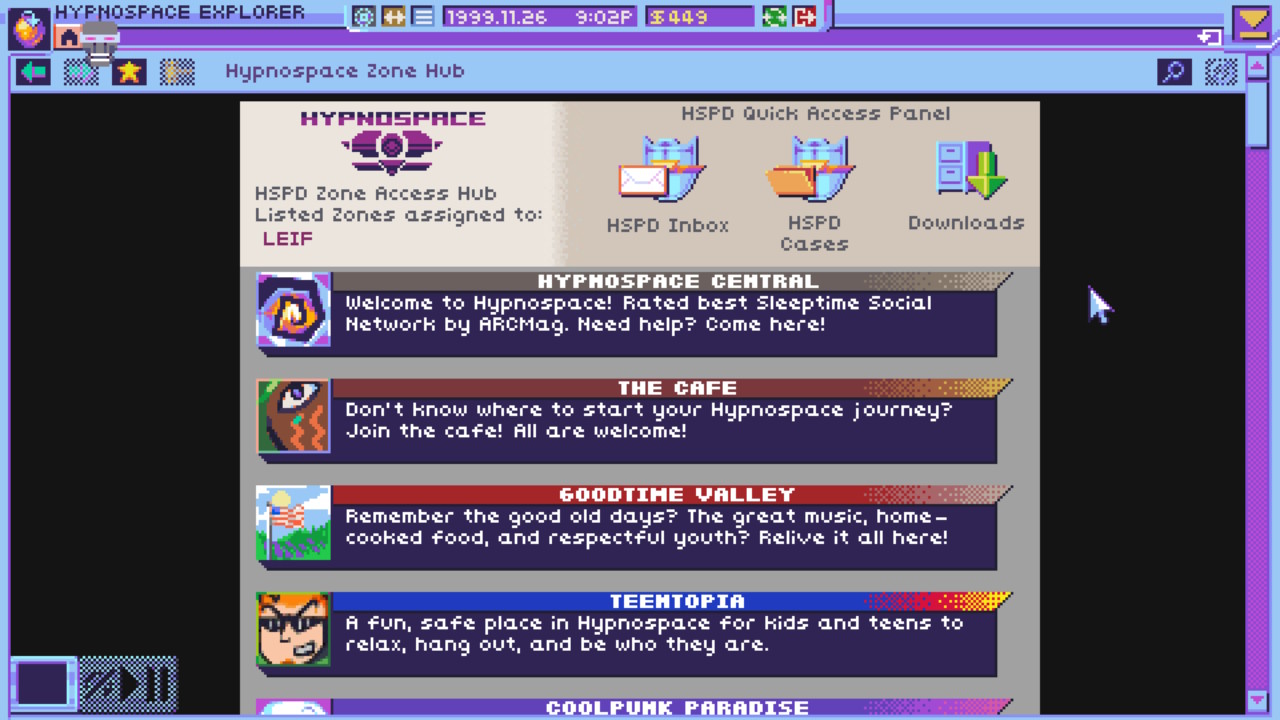
Hypnospace Outlaw is an internet detective game set in a parallel universe in 1999. You play as a volunteer moderator who’s tasked with flagging content violations, and the gamespace consists of your desktop, your email inbox, and a web browser that connects you to Hypnospace, a Geocities-style database of websites.
The Hypnospace admins send you a series of cases, and the first one is easy enough to solve. A representative of the estate of an artist who created a popular cartoon character has reported a page displaying unauthorized reproductions. You can find the page easily enough by searching for the character’s name in your web browser, where you see that a first grade teacher has shared scans of her students’ artwork of the character. You can click on each image and use a special tool in your browser to report it, thus removing the artwork from the woman’s page. Once you’ve removed all images recognizable as the character, you’ll get an email telling you that the case is resolved.
Obviously this is a shitty thing to have done, but the game doesn’t give you any ability to do otherwise. If you want to keep playing, you have to “solve” these cases in the only manner provided. Unfortunately, it’s not possible to make choices.
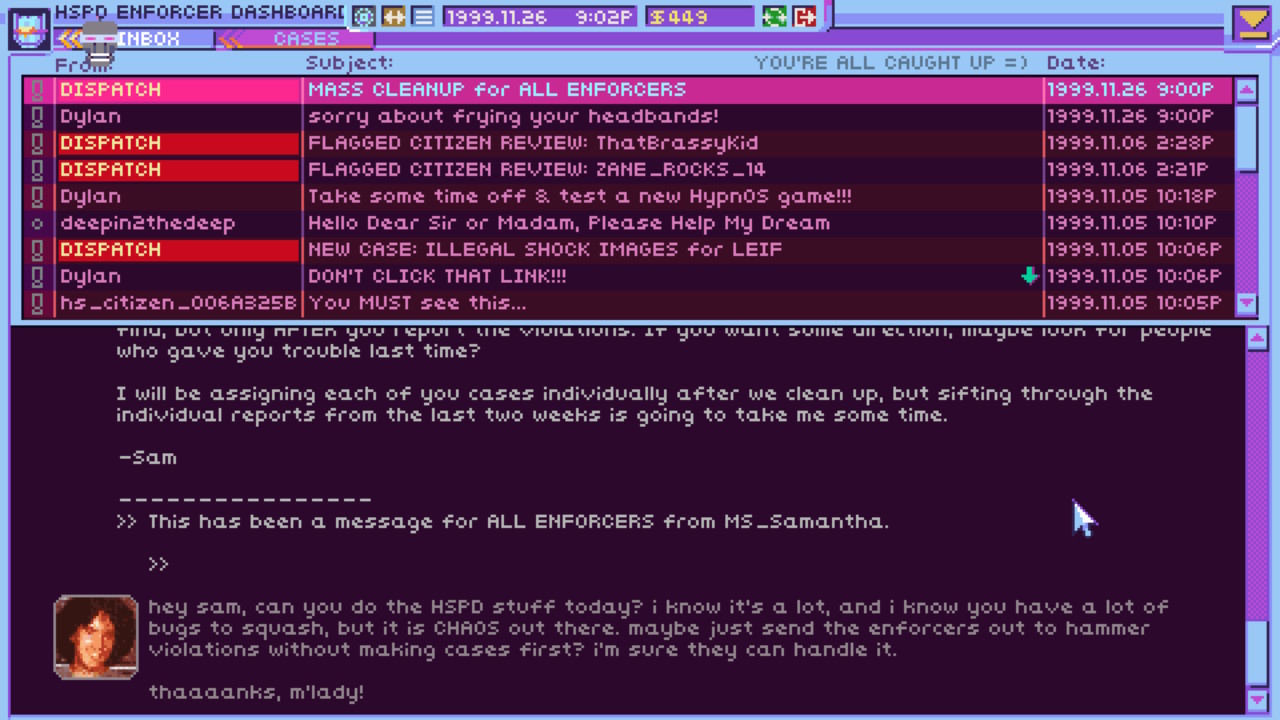
This lack of agency can be upsetting, especially when the game forces you to slap violation penalties on a teenage girl experiencing sexual harassment through DMs. She sent a support request to Hypnospace asking them to address the harassment, and she’s posted screenshots of the chats on her page. When you report these images as harassment, the girl is the one who’s penalized, as the images are hosted on her page.
A female member of the admin staff carbon-copies you on an email that she sends to her boss, asking him if this misattribution can be corrected. Unfortunately, he’s a piece of shit and brushes her off, saying that it’s not his problem. M’lady.
The point of being able to see the internal workings of content moderation is to give the player a sense of how wild and woolly the early public internet used to be. The administrators and moderators managing online communities were young and didn’t really know what they were doing, and there was a complete disconnect between corporate software developers and the end users, many of whom were just kids. In addition to teen drama, Hypnospace also hosts retirees with time on their hands, people who are deeply emotionally invested in the music they enjoy, small businesses doing their best, and a healthy cohort of amateur artists and poets.
Hypnospace Outlaw has a strong Windows 95/98 aesthetic, and the Geocities/Angelfire style of page design is well-observed, with ample crunchy backgrounds and neon colors and spinning GIFs. What’s less well-observed is the quality of the writing people put on their pages. Even in college in the mid-2000s, I remember finding this exact style of personal webpage and being impressed by how knowledgeable and competently written they were. In Hypnospace Outlaw, however, the writing is uniformly bad. It’s bad on purpose, which has its charm, but I still got the feeling that the in-game webpages are more to look at than to read.
If you can tolerate the bad-on-purpose writing, however, all sorts of intriguing worldbuilding details begin to emerge. You never learn much, however, only bits and pieces of trivia that are incorporated into people’s discussions of their special interests. The main “alternate” aspect of this universe, which is that people access the internet by wearing a headband while they sleep, is never explained. It’s also not particularly important… until it is. Still, I wouldn’t say that Hypnospace Outlaw has anything as structured as a plot. You’re mainly just here for the vibes.
After the first case, the game becomes infinitely more difficult and complicated, and I had to make constant use of a walkthrough (this one here). I have no idea how I would have figured out many of the cases otherwise. The problem is that there are dozens of public pages, not to mention hidden pages and directories and search terms and tagging systems, and the “clues” you receive are all extremely cryptic. There’s a lot of noise and not much clarity.
In the end, I’d estimate that it’s completely unnecessary to engage with about 70% of the game. There’s no real incentive to sort through the chaff unless you’re simply curious and don’t mind spending time clicking on links and reading through the webpages collected in the various themed directories. I ended up ignoring a lot of the game’s content, but I really enjoyed the pages that focus on urban legends and conspiracy theories. There’s also a page devoted to a kind of lo-fi, found-noise techno called Fungus Scene that I would very much like to exist in our own universe. Personally speaking, I would have preferred more of this sort of “weird but brilliant” creativity and less “kids being immature” cringe humor.
If you beeline through the cases with a walkthrough, Hypnospace Outlaw takes about three to four hours to finish, and how much time you’re willing to spend exploring outside the main objectives will depend on your tolerance for this subjective version of what the internet looked like in the late 1990s. For me, Hypnospace Outlaw is interesting in theory but somewhat frustrating to engage with, and the ultimate message that incompetent techbros can get away with everything from harassment to manslaughter didn’t really resonate as a meaningful story.
Still, despite routinely subjecting myself to some of the strangest titles Itch.io has to offer, I’ve never seen anything like Hypnospace Outlaw, and I’m happy it exists. If you’re at all curious, I’d recommend checking out the free demo. It’s available for the Nintendo Switch, so you can play the game while smoking weed in the bath, which is probably the best way to experience it to be honest.
Originally released on Valentine’s Day in 2018, Speed Dating for Ghosts is a short and simple roleplaying visual novel (or rather, visual short story collection) in which you can date your choice of nine ghosts. The version currently available on Steam, on Switch, and on Itchio includes the “Go to Hell” expansion, which includes three more postgame ghosts to date and an epilogue in the form of a beach party in Hell.
You play as yourself. Presumably you are dead, and also a ghost. You have registered for a speed dating event that is, predictably, run by a ghost. At this event, you choose between three rooms, each of which contains three ghosts. You have two short conversations with each of the three ghosts. If a ghost likes you, you can go on a date with them. Thankfully, it’s not difficult to convince the ghosts to warm up to you, and you can go on a date with all of them without having to replay the initial conversations.
These “dates,” such as they are, involve helping each ghost take care of their unfinished business. Instead of romancing the ghosts, what you’re really trying to do is learn their stories. After you complete a date, you’re rewarded with more information about the ghost via a character sheet on the “Graveyard” page of the game’s main menu. Once you date the first nine ghosts, you’re given the option to visit Hell for postgame content.
The gameplay consists of choosing between dialog options and being friendly. The art is simple and stylized but manages to achieve a good balance of creepy and cute. The writing is wonderful.
For me, playing through one speed dating room + going on three dates took about 25 minutes. Technically, you can convince a ghost not to date you, but I don’t know why you’d do this. All of the dialog choices make sense, and I can’t imagine needing to use a walkthrough. The postgame content is a bit trickier, and two of the ghosts in Hell might require some extra effort to date. The third ghost in Hell is a dog, and you can pet him. I love him forever.
Aside from the ghost dog, I’m also a fan of Spooky Peter, the plague doctor ghost who’s been around for centuries and has found a vocation in frightening the living. If you agree to apprentice under him, he inducts you into one of the more arcane mysteries of the afterlife, and I appreciated the worldbuilding of his story. There are also two older ghosts (Vera and Gary) who were involved in murder mysteries, and both of their plot arcs are fantastic. One of these stories was so emotionally satisfying that it made me tear up a little, while the other thoroughly creeped me out.
Speed Dating for Ghosts is a fun collection of short stories tied together by an interesting framing device, and I enjoyed the two hours I spent with it. Based on the dry tone of its humor, I’d say that the game is aimed at a mature audience, but there’s nothing particularly grim or edgy or upsetting about it. The writing and art contain elements of horror, but they’re very mild. I didn’t know what to expect from Speed Dating for Ghosts, and I was surprised by how creative and clever it is. It’s always a pleasure to find a weird little game like this that uses the medium to craft a unique and engaging piece of storytelling.
We Know the Devil is a horror-themed visual novel about three teenagers at summer camp. Although the world of the game is close to our own, there are a few differences, one of which is that “the devil” is real. One of the kids’ duties as campers is to reinforce the magical wards protecting a forest, and your job as the player is to help them make it through the night. We Know the Devil has four endings; and, depending on how quickly you read, it takes about thirty to forty minutes to finish a run.
Since you can’t get the true ending on your first playthrough, I might recommend going into the game without consulting a guide, but only if you’re the sort of person who absolutely can’t tolerate any spoilers whatsoever. We Know the Devil functions primarily at an allegorical level, and you’ll get infinitely more out of its story if you understand what’s going on. In this post, I’m not going to spoil what happens, but I think it makes sense to accurately describe the game’s premise.
We Know the Devil is divided into ten short chapters. For the most part, the game is entirely linear. The only element of gameplay is that the player is required to make seven choices, and these choices only affect the ending. Essentially, the player is put into the shoes of one of the three main characters and given a choice between the other two characters. The ending you get is determined by which of the three kids is left out of the pairings the most frequently. Essentially, you’re choosing who dies at the end (although they don’t actually die).
To get the true ending, you have to balance the pairings evenly. Unfortunately, you can’t do this on your first playthrough, as the game doesn’t give you the key choice that makes a perfect balance possible. The first ending you get will therefore be strange and upsetting, but it’s the unpleasantness of this ending that serves as the cipher for decoding the allegory.
A major weakness of We Know the Devil is that the setting of the game is poorly defined to an extreme degree. Unless you understand the allegory, it’s difficult to piece together what’s going on. This confusion is exacerbated by the inanity of the character dialog, a great deal of which is trite chatter. In fact, some of the writing feels like a parody of an indie comic about depressed edgy teens, and my first playthrough of the game left me cold.
Although the horror elements were intriguing, I didn’t understand the larger narrative. Why were these kids at camp if they didn’t want to be there? If they had cellphones, didn’t they have cars? Why couldn’t they just leave? Why were they refusing to communicate with each other? If “the devil” is real, why were teenagers being forced to patrol the woods at night? Were they conducting some sort of ritual? And for what purpose?
None of these questions is answered, and the first ending I got didn’t make much sense in terms of plot, character development, or narrative themes. I couldn’t figure out why people have lavished so much praise on this game since its initial release in 2015, so I googled “We Know the Devil ending explained.” That’s when the story became much more interesting.
Essentially, each of the three main viewpoint characters represents a different type of queer identity. The ways in which these characters fail to communicate with one another are representations of how young people attempt to keep themselves in the closet, and the way in which “the devil” gets one of them at the end is a representation of how a secret queer identity might manifest in an unhealthy way. The summer camp is supposed to be analogous to a Christian camp for “problem teens,” and the ritual night in the woods is an analogy for how such organizations put campers in difficult situations in order to break them emotionally, after which they can be “fixed.” If you’re interested in learning more, I highly recommend (this fantastic essay), which unpacks what’s going on in We Know the Devil from the perspective of someone close to the culture and experience being portrayed.
To me, the queer identities of the characters were obvious from the start. Still, a character being gay or trans is completely normal to me here in 2023, and I know very little about Christianity in the United States. All of the allegory therefore went completely over my head. Once I picked up on what everything was supposed to represent, all of the seemingly random symbology started to make sense and fit together nicely.
Admittedly, the allegory is clever. Still, I wish the story stood better on its own, especially for players who don’t come from that particular cultural background. All that aside, I enjoyed the game’s gentle and sketchy visual portrayals of its characters, and the descriptive writing that frames their conversations is quite good and occasionally even beautiful. In addition, the ambient music that underscores the game is gorgeous and used to fantastic effect. On the whole, I’m grateful that I had the opportunity to experience the story told by We Know the Devil, but I wish I’d done myself a favor and read more about its cultural context first.
Paranormasight: The Seven Mysteries of Honjo is a supernatural thriller set in the Honjo neighborhood of Sumida Ward in central Tokyo during the 1980s. This visual novel’s story is told via the intersecting perspectives of three main protagonists through a series of short episodes laid out along a story grid. Although you have some choice regarding the order in which you play the episodes, the story is linear, with minor branching paths leading to premature endings. Paranormasight has strong elements of horror, as well as a few jumpscares, but it’s sensitive about its use of mature themes and graphic visual imagery. Depending on how quickly you read, it should take about ten to twelve hours to unlock all of the endings.
Let me cut to the chase: I really enjoyed Paranormasight and would happily recommend it even to people who aren’t horror fans. The game only has a moderate level of interactivity, so I’m not sure it would appeal to people who dislike visual novels. That being said, Paranormasight is at the height of its genre, and it’s as well-written, well-illustrated, and intriguingly presented as a visual novel can get.
A quick description of the story is going to sound like anime nonsense, but please take my word for it that this is a story written for an adult audience and bear with me for a moment.
During the early modern Edo period, an onmyōji wizard found the secret to a ritual that would bring someone back from the dead. In order to recreate the soul of the deceased, one would need to store sufficient “soul dregs” of murder victims inside a ritual object. The wizard managed to perform the ritual, a process that resulted in nine deaths. The history of these deaths has survived to the present in the form of urban legends about the “seven mysteries of Honjo.”
Late one night, ritual objects in the form of wooden netsuke charms mysteriously appear in the hands of nine people in the Honjo neighborhood. In addition to the physical charms, these “curse bearers” have inherited the resentful memories of the victims of the original ritual, as well as the power to kill others with a curse, which they’re able to trigger when certain conditions are met. If one of the curse bearers manages to kill enough people, they’ll be able to perform the ritual of resurrection – but only if another curse bearer doesn’t kill them first.
Paranormasight opens with a stand-alone prologue in which one of the curse bearers meets a gruesome end. When the prologue is concluded, the story is taken up by three more curse bearers: a grieving mother whose young son died in a kidnapping incident, a high school girl whose best friend committed suicide, and a senior police detective assigned to investigate the mysterious death of a youth truancy officer. All three of these protagonists are sympathetic, as is the companion character accompanying each of them. As the story unfolds, they gradually begin to work together in an attempt to figure out what’s happening so that they can survive the curse while preventing more murders.
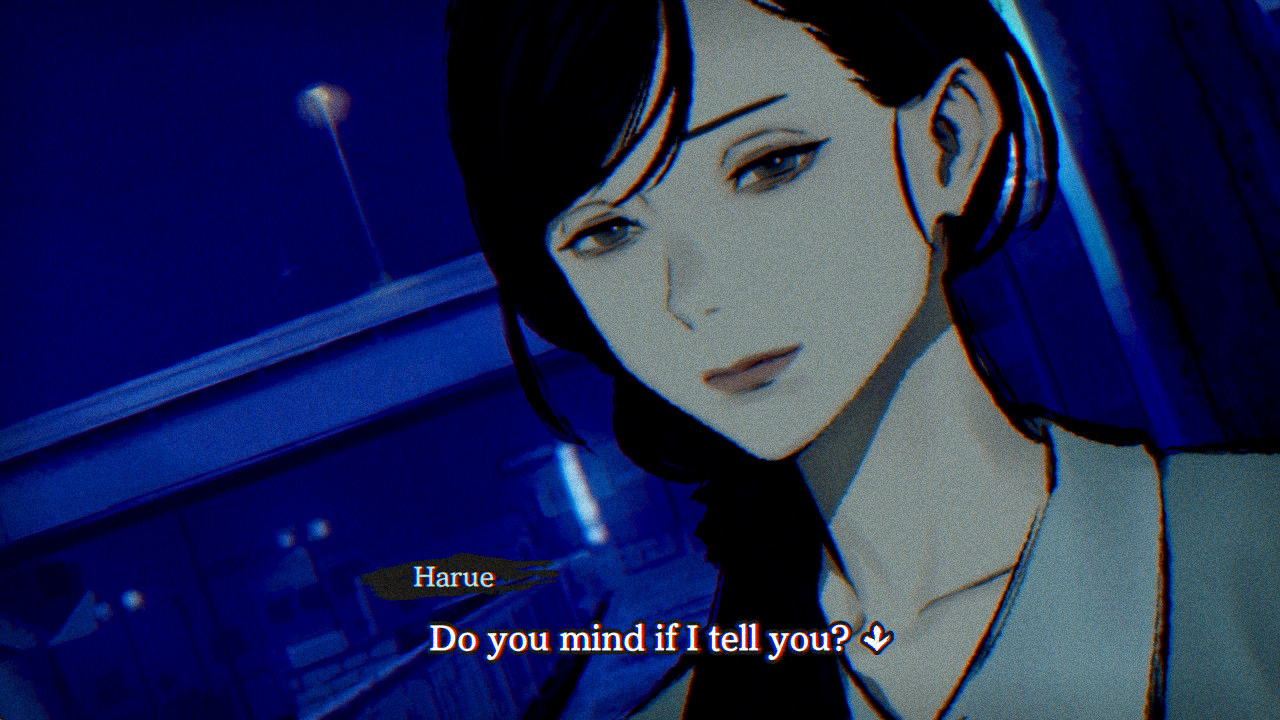
I feel like I’ve spent years quietly waiting for Square Enix to start publishing visual novels, and I’m happy it’s finally happening. Visual novels are somewhat infamous for being relatively inexpensive to make, and it’s so cool to see one of these games with big-budget production values. Although the art and music are wonderful, the high quality of Paranormasight mainly comes through in the strength of its writing, its manga-style mise-en-scène, and its excellent translation.
When I talk about the mise-en-scène, I’m referring to the cinematic framing of each scene. While many visual novels will show you a visually flat illustration of a character superimposed on top of a static background, Paranormasight puts a great deal of effort into making conversations feel more dynamic, with the camera following standard “line of sight” rules to show the player the conversation from different angles and perspectives. As a result, Paranormasight feels like reading a manga instead of reading an illustrated novel. This framing isn’t overly dramatic and doesn’t draw attention to itself, but it must have required an incredible amount of planning and effort to pull off with such skill and variety.
The same goes for the writing. The writing doesn’t go out of its way to appear “brilliant,” but the way the various threads of the characters gradually become woven into the larger story is incredible. Although you’ll often have to finish one character’s current storyline before continuing another’s, I was impressed by how the game maintains its forward momentum while still giving the player a fair amount of freedom to move between characters and conversation topics. I also appreciate how none of the characters ever devolves into a stereotype, and how both major and minor characters have a balanced mixture of admirable and problematic personality traits.
On a lark, I downloaded Paranormasight onto my older Nintendo Switch and played the prologue in Japanese. I can therefore say with confidence that the English translation is excellent. The translation team preserves the flavor of the original writing through canny localization choices, especially regarding the game’s more arcane vocabulary. I’ve been annoyed with the translation of Tears of the Kingdom, which is filled with nonsense like “Ultrahand” and “secret stones,” so I admire how the English version of Paranormasight manages to make its more unusual terms seem perfectly natural.
Despite its goofy name and slightly silly supernatural premise, Paranormasight was created for an audience of intelligent adults. The game is very much mass-market entertainment published by a giant corporation, so perhaps it’s not as bold or edgy as it could be, but I actually think this market concession to “broad appeal” is a blessing. Sometimes it’s nice to read a horror thriller that has the confidence not to rely on sexual assault, fantastically grotesque violence, or poorly-disguised bigotry against minorities. As a fun bonus, there are no creepy “male gaze” character designs, just a wide range of character types who are drawn in an appealing anime-influenced style but still look like real people.
Paranormasight was developed in cooperation with the Sumida City Tourism Association, and the game does a fantastic job of giving the player a sense of its setting. This works especially well in tandem with the story’s theme of how many Japanese urban legends are closely connected to a specific place and the history of the people who live there. Although most of the gameplay involves choosing how to advance the conversation, there are also moments when the player is invited to explore an area via a visual panorama while investigating points that catch their attention. It’s fun to explore this weird little neighborhood in Sumida that’s been around since the Edo period, and you never feel as though you’re on the receiving end of a history lecture.
One of the coolest aspects of Paranormasight is its framing device, in which a narrator wearing an Edo-period kimono and a half-face Noh mask directly addresses the player. This narrator invites the player to watch the story through a Shōwa-era color television, one of the bulky cathode-ray screens embedded in its own piece of furniture.
The menu has a great time with this retro aesthetic, distorting the background with tv “noise” and curving the screen at the edges. From the menu, you can access an annotated index with entries for the characters, places, and historical incidents that appear in the story. Each entry is accompanied by an illustration and two or three paragraphs of text. I generally don’t bother with the annotated indices in visual novels, but the one in Paranormasight is especially well-written and edited to provide a satisfying amount of intriguing information without overwhelming the player with walls of text. I also love that the entries for the urban legends are illustrated with period-accurate woodblock prints.
For someone with my particular set of interests, Paranormasight is a 10/10 game. Even if you’re not into urban history or urban legends, I still think the strength of the game’s writing and the cleverness of its design are strong selling points. You can download Paranormasight as a phone app, but it’s perfect for Nintendo Switch’s handheld mode and well worth the $20.
By the way, if you’re intrigued by the concept of “virtual tourism through a visual novel,” I’d also like to recommend the supernatural mystery thriller Root Letter. Its story is set in the small city of Matsue in rural Shimane prefecture, which is also famous for its Edo-period urban legends. Root Letter is very good, but it’s nowhere near as polished as Paranormasight. Square Enix really hit it out of the park with this one.












 Digital Fantasy Diary