Strange Tales and Modern Legends

My zine Strange Tales and Modern Legends collects three illustrated short stories based on demonic Japanese folklore.

When I was an undergrad, I had the honor of taking a class called “Demonic Women in Japanese Fiction” with a professor I truly admire. This course was a foundational experience, and I ended up writing a lengthy senior thesis with the same title. The project served as an introduction to literary theory and feminist thought; but, more than anything, I really enjoyed stories about women behaving badly.

I taught my own “Demonic Women” class at the University of Pennsylvania for the first time in Spring 2024, and it was a resounding success. Everyone in this class was just as fascinated by the stories as I was, which was a minor miracle. In all fairness – demonic women are a lot of fun.

Though I teach and publish (and blog) about Japanese literature, and though I’ve spent a significant amount of time living in and around Tokyo, I generally don’t write original fiction set in Japan. Still, I love demonic folklore so much that I couldn’t help but be inspired by the literature in my “Demonic Women” class. I therefore put together a short zine that collects two previously published stories and one original piece of flash fiction, and I commissioned a coven of talented artists to create illustrations.

In the zine’s opening story, “The Smile of a Mountain Demon,” a 21st century yamauba entraps a YouTube influencer with Buddhist pretensions by using Airbnb and the language of New Age spirituality. The young man is looking for a scenic “spiritual retreat” to use as a source of content, and the yamauba is looking for a tasty snack. I was inspired by the medieval Adachigahara folktales in which a cunning yamauba entraps a less-than-devout Buddhist priest, as well as Minako Ohba’s beautiful and heartbreaking short story “The Smile of a Mountain Witch.”

The zine’s main story, “The Kumo Diary,” is set in the Meiji period, the era of Japan’s industrial revolution. As Japan established itself as a nation that could compete with Western powers, its intelligentsia were motivated to create a unified sense of “Japanese culture.” Scholars were therefore tasked with making The Tale of Genji a respectable classic to be held in esteem by a modern nation. While I was studying the history of The Tale of Genji, I couldn’t help but wonder about all the apocryphal chapters that never made it into the canonical version, and I created a few fragments of a medieval text to be discovered by a reader who dwells in the shadows cast by the light of modernity.

The final story, “Hanahaki,” is about a neglected cat who vows revenge on the small child that has monopolized his beloved human’s attention. The title comes from a trope in underground manga and fancomics of the late 2000s and early 2010s. In these stories, someone suffering from unrequited love painfully coughs up (haki) delicate flower petals (hana) in lieu of the words they can’t say. The cat in this story is unable to communicate in human language, but he still finds a way to make his displeasure clear. If nothing else, the child must go.

Strange Tales and Modern Legends explores themes that have fascinated me for years, specifically the intersections of folklore, feminism, and the unruly joy of problematic characters. I hope readers find these stories as delightfully unsettling as I did when I wrote them.

If you’re interested, you can order a paper copy of the zine from Etsy or download a free digital version from Itch.io.

👹 https://digitalterrarium.itch.io/strange-tales
👹 https://www.etsy.com/listing/4299187840/strange-tales-horror-fiction-zine

The art at the top of this post, which is one of the illustrations featured in the zine, was created by Le Soldat Mort, a dark fantasy artist who shares their work on Bluesky (here) and on Instagram (here).
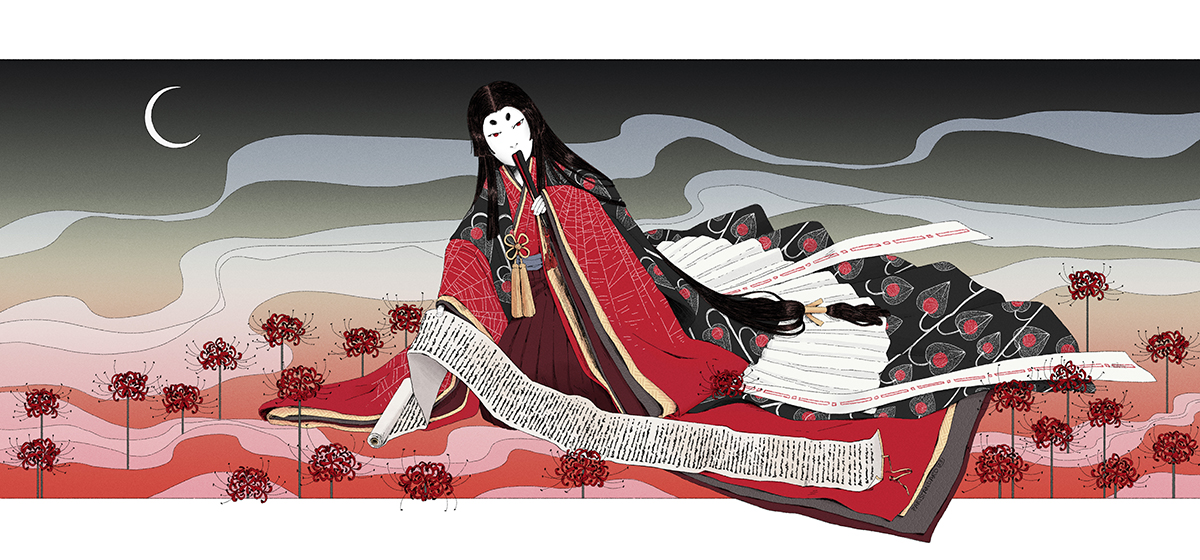
The Kumo Diary

A professor’s assistant at Tokyo Imperial University uncovers a curious manuscript whose author weaves an elegant tale of the twilight years of the Heian court. As she reads between the gossamer lines of the narrator’s account of a moonlit assignation, the quiet and unassuming scholar reflects on what happens in the shadows cast by civilization and enlightenment.

This story is a play on The Tale of Genji that I contributed to Carpe Noctem: Vampires Through the Ages, an anthology of historical fantasy fiction, illustrations, and comics about vampires in historically specific settings.

I wouldn’t say I’m a “fan” of The Tale of Genji in the same way that I’m a fan of the Legend of Zelda series, but I’ve read multiple translations of the book and enjoyed them all. When you engage with a story so deeply, it’s difficult not to come up with fun theories. I certainly wouldn’t be the first person in Japanese literary history to make this suggestion, but please consider: Why are the characters in The Tale of Genji always described as being so pale, and why are many of them only active between dusk and dawn?

“The Kumo Diary” is set in the Meiji period (1868-1912), Japan’s industrial era of “civilization and enlightenment.” As Japan attempted to establish itself as a nation that could compete with Western powers, its intelligentsia were motivated to create a unified “Japanese culture.” The Tale of Genji occupied an interesting place in this movement. On one hand, it could easily be regarded as the quintessential work of classical Japanese literature. On the other hand, its plot is largely concerned with the love affairs of a rotating cast of beautiful but neurotic women. Japanese scholars were therefore tasked with making The Tale of Genji a respectable classic to be held in esteem by a modern nation.

Scholars had been compiling and revising the chapters of The Tale of Genji for centuries, so it was necessary to create a “definitive” version of the text. While I was studying the history of The Tale of Genji, I couldn’t help but wonder about all the apocryphal chapters that never made it into the canonical text.

It took me ten years, but finally I wrote one of these apocryphal chapters myself. I embedded the so-called “Kumo Diary” into a frame story about a woman who finds the manuscript and decides not to share it with the stodgy male professor who employs her. It’s interesting to imagine there being a secret history of The Tale of Genji, and I really enjoyed writing the ending of my story. After all, who’s to say there aren’t demonic women pulling the strings from the shadows? If they do their work correctly, we’d never know they were there at all.

I’ve posted the story on AO3, and you can read it here:
https://archiveofourown.org/works/50802628

The illustration is by the darkly brilliant Paristandard, whose creepy and creative illustrations can be found (on Twitter), (on Tumblr), and (on Instagram). It was an amazing experience to work with them, and I can’t recommend them enough for character designs, book covers, short comics, and other illustration projects. For this project in particular, the historical specificity of their costume design was uncanny, and I am in awe.

Cross the Moon

Cross the Moon is a visual horror novel about a near-future dystopia in which a fraction of the moon has shattered, an event concomitant to the appearance of vampires. No one knows why people suddenly began displaying symptoms of vampirism, but those affected have become a disadvantaged underclass of society.

The game’s story follows two mixed-race vampire siblings and a Japanese detective through the streets of L’Amour, a French city that hosts the headquarters of a corporation called bloodFLOW, a leading producer of artificial blood and scientific research relating to vampires. Although Cross the Moon begins as a murder mystery, it gradually expands into the territory of cosmic horror.  

The beginning is standard vampire fare. The player is introduced to a high school student named Lux who is hanging out at a bar and fishing for someone who will consent to share their blood. Lux is essentially a good kid and thinks this is a bad idea, but he’s acting on behalf of his crush Apollon, who seems to be in thrall to his girlfriend, a manic pixie femme fatale named Corentine. Unfortunately for the trio, the man they seduce is found dead the next morning, and Apollon is charged with murder. In an attempt to clear his friend’s name, Lux ends up becoming involved with the vampire underworld, where he learns that Corentine is not an ordinary high school student – nor is Apollon.

This YA narrative is complicated by the interwoven story of Lux’s adult sister Aurore, who has managed to land an interview for a prestigious job at bloodFLOW. Her intake interview is weird, the job she’s asked to do is bizarre, and her coworkers are more than a little strange. She isn’t a big fan of the company itself, which she knows is exploiting the vampire population. Still, Aurore has grown up watching her working-class parents struggle, and she’s willing to do whatever it takes to give herself and her family a better life. Unfortunately, this leads her to sign a non-disclosure agreement regarding corporate secrets that turn out to be far beyond anything she imagined.

Meanwhile, Yoko has just transferred into L’Amour’s police force as part of an exchange program meant to facilitate cross-cultural communication regarding vampire-related policies and best practices. Due to the timing of her arrival, she’s immediately dropped into the investigation of the gruesome murder supposedly committed by Apollon. She strongly suspects Apollon is innocent, which convinces her to dig deeper into why a random teenage boy is being framed. This in turn leads her to the main mystery of Cross the Moon – what’s going on with bloodFLOW? What does the company have hidden under its corporate offices, and why does Yoko feel so compelled to pry into its secrets?

Cross the Moon is more of a graphic novel than a game. The only interactive element is the option to save your progress, and the story is completely linear. Although Cross the Moon is formatted as a visual novel, with long horizontal text boxes overlaid onto the bottom of a single full-screen image, it’s not a “game” in any meaningful sense. There are no branching paths, and there’s only one ending. There’s no animation or voice acting, and the character art assets are fairly limited. Cross the Moon is also quite long, promising at least seven or eight hours of reading.

The story starts off slow. I’m afraid this may put off many players used to flashy video game opening sequences, but it’s a pitch-perfect opening to a horror novel. This is how almost every Stephen King novel works, after all – the world needs to be built before it’s destroyed, and the reader needs to learn to care about the characters before they start to find themselves in serious trouble. Through the mundane details of the everyday lives of the characters, the player gradually builds an understanding of how the society of L’Amour operates, which makes the final horrific reveals all the more dramatic.

The author is sensitive to inequalities concerning race, class, and gender, but it’s worth mentioning that the game’s take on vampirism is its own thing and not analogous to any real-world identity. The minority status of vampires is informed by real-world politics, but Cross the Moon takes the concept in a creative and unexpected direction. I have to admit that I’m not a particular fan of vampires, but I found myself growing progressively more curious about how vampirism operates in the world of the game, as well as how it originated.

(By the way, if you’ve been reading between the lines of this review and have come to the conclusion that the ethically dubious corporation created vampires, that’s not what’s happening. This story has layers of progressively deepening strangeness, and it absolutely doesn’t go where you expect it to.)

The worldbuilding of Cross the Moon is enhanced by its visual style. The soft grayscale character art pops against the super-saturated backgrounds, which are composed of photographs overlaid with high-contrast color filters. I know this sounds like Baby’s First Photoshop, but it’s remarkably well done and extremely stylish. As I mentioned earlier, the character art assets are limited, so the player is occasionally asked to suspend disbelief while, for example, a character lies in a hospital bed in a full suit. For the most part, the graphics contribute a great deal of atmosphere to the story, as does the ambient music. The game contains some uncomfortably gory and deliciously creepy moments, and there’s a jump scare toward the end that really got me.

If reading a lengthy mature-audience horror story in the form of a visual novel sounds like a chore, then Cross the Moon probably isn’t for you. Speaking personally, I always find myself getting annoyed by extraneous gameplay elements in visual novels, so what Cross the Moon is doing is perfect for me. I read it on my Nintendo Switch between sessions with more action-oriented games, and I very much enjoyed myself. I’m intrigued by the potential of this hybrid medium of storytelling, and I’d love to see more “visual novels” that are in fact genuine novels intended for adult readers.