Mr. Saitou

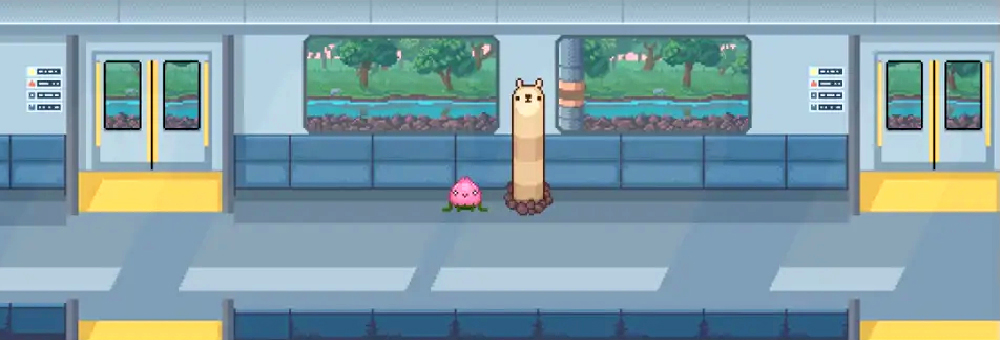
Mr. Saitou is an Undertale-style narrative adventure game (with music by Toby Fox) that takes about two hours to finish. You play as Saitou, a white-collar worker who finds himself in the hospital after a failed suicide attempt triggered by stress and overwork. While sleeping, Saitou dreams of himself as a llamaworm (a comically extended groundhog) who goes on an adventure with a cute pink flowerbud named Brandon, the dream persona of a young child Saitou meets in the hospital.

Mr. Saitou has something of slow start, during which the player’s sole job is mashing a button to advance text. Thankfully, the game becomes much more engaging after the first ten minutes, at which point Saitou enters the dream world.

After the introduction, Saitou spends about half an hour in an office of llamaworms that serves as a stage for a gentle comedy about workplace culture. After a ten-minute segment of mandatory afterwork socialization in an izakaya, Saitou returns home to his neighborhood of underground tunnels.

Saitou decides to skip work the next day. This gives him an opportunity to meet Bradon, who wants to visit the Flooded Gem Caverns deeper in the tunnels. The remainder of Mr. Saitou unfolds in a beautiful fantasy-themed underground space enhanced by lowkey elements of exploration and simple puzzles.

What I appreciate most about Mr. Saitou is its creativity, which is driven by cute but thoroughly original character designs and clever writing. Even though most of the gameplay consists of simple conversation-based fetch quests, I never got tired of seeing what was around the next corner, and I always enjoyed talking with each new character.

The game’s humor sits comfortably at the intersection between wholesome and quirky, and the writing subtly references internet culture without relying too heavily on these allusions. The simple spatial puzzles are easy and engaging without feeling as if they were phoned in, and the thematic background music is lovely from start to finish.

I love almost everything about Mr. Saitou, but I should probably mention that there’s an unskippable musical cutscene featuring about three minutes of unremittingly flashing strobe lights toward the end. If you (like me) are photosensitive, this may be worth taking into consideration.

In addition, the sentimentality of the ending may ring hollow for players searching for a more nuanced or complicated story, especially regarding the extent of an individual’s personal responsibility for ensuring their quality of life under late-stage capitalism. This is a valid criticism, of course, but Mr. Saitou is a game about a llamaworm and a talking flower having magical underground adventures. All things considered, I think it’s probably best to enjoy the game for what it is.

Mr. Saitou is a sweet but still surprising game that’s entertaining to read and engaging to play, and I feel that its story earns the right to state its final message clearly: The world is filled with interesting people and beautiful places, and there’s more to life than slowly killing yourself for your job. Good health is a blessing, so you might as well make the most of your time on this earth while you’re still young.
Deepwell

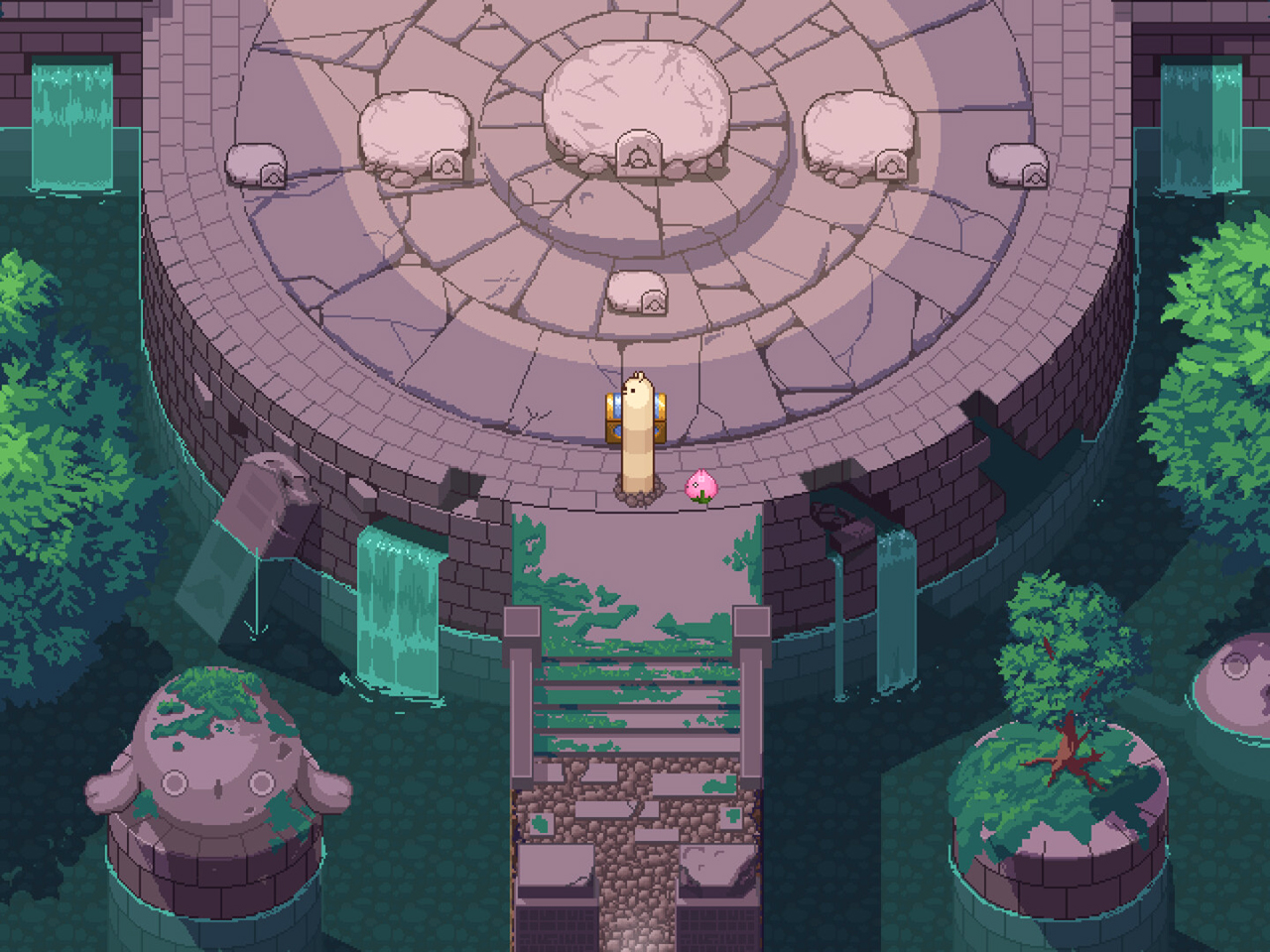
Deepwell is an Undertale-style narrative adventure game that takes about two hours to finish. You play as a blank slate character called “the Cartographer” who has recently arrived in the small forest town of Deepwell, which clings to the southern rim of a massive hole in the ground. Oddly enough, anyone who descends into the hole beyond a certain point gets “blipped,” meaning that they appear at the top of the hole as if nothing had happened. Generations of mystery hunters have sought the solution to this puzzle, but perhaps you might be the one to finally figure it out.

Deepwell is only about two dozen screens large, and there are five main characters to talk to. Most of the game involves engaging in long and meandering conversations with these characters in order to learn their stories. Sokolov manages the town library, and Evan runs the general store. Pierre has created something resembling an art gallery on one side of town, while Lily lives in a field of flowers on the other. At the intersection next to the highway, a robot named Bing helpfully provides information to visitors.  

It stands to reason that everyone living in such an isolated town would be a little weird. Aside from Bing, who is essentially a tutorial robot, each character is a self-contained short story that gradually unfolds as you talk with them. Thankfully, there are no wrong conversation choices, nor is there any missable content. The player is free to walk where they like and talk with the characters as they wish while unlocking a few extra conversation topics by interacting with each character’s environment.

On the eastern edge of town is a waterfall that hides a secret cave. Glyphs drawn onto the wall of this cave indicate whether a character’s dialogue has been exhausted. Once the Cartographer has sufficiently spoken with each of the town’s residents, a new path will open deeper into the forest to reveal a sixth character, who tempts the player with the possibility of an alternate (and much darker) ending.  

You can actually end the game any time you want by simply heading back to the highway and leaving town. You can also choose to wrap up the story at any point by taking a boat across the lake to see what’s on the north side of the giant hole. Although you’re given a choice in the final section of the game that affects the ending, I think Deepwell ties up its thematic threads quite nicely. This is a story about personal purpose and fulfillment, and about why we need art and mystery. How you approach these themes within the context of the game is up to you.

The graphics are primitive yet charming. I was put off by the crunchiness at first, but the lo-fi aesthetic grew on me. Deepwell contains a surprising number of insert illustrations and cutscenes, some of which are extremely well done. This is especially the case with Pierre, whose gallery of art installations closes with a remarkable set piece. I get the feeling that some players may find Pierre pretentious, but I appreciate his sincerity. And he’s not wrong about how visual glossiness is often a disguise for mediocrity. 

Deepwell is akin to a short story anthology that’s easy to pick up for twenty minutes at a time, but I ended up being so fascinated by the overarching narrative that I played the whole game in one sitting. The writing is exceptionally good. It gives me immense joy to know that something like Deepwell exists in the world, and I honestly feel that I’m a better person for having spent time with it.

Deepwell is free to play on Steam here:
https://store.steampowered.com/app/2803660/Deepwell/

A Dark Winter Wander

A Dark Winter Wander by Red Skald
https://redskald.itch.io/a-dark-winter-wander

A Dark Winter Wander is a free horror-themed narrative adventure game created with GB Studio, a game creator that replicates the look and feel of retro handheld games. The game’s story is about a girl chasing her sister through a (mostly linear) maze of underground tunnels filled with monsters. Although it’s deliberately unclear what’s going on, I think the protagonist’s sister might have an eating disorder, while she herself is depressed. This isn’t important to the gameplay, but those elements are there from the beginning of the game if you’re sensitive and need to watch out for them.

In any case, you see your sister run off into the woods and decide to go after her. While chasing her, you fall into a hole filled with monsters. You talk to the monsters instead of fighting them, and the game is entirely driven by exploration and dialog. This invites a comparison to Undertale, but all of the monsters in A Dark Winter Wander absolutely wish you harm. The creature designs are great, and the lo-fi sound and graphics contribute to the unsettling atmosphere.

If you don’t follow your sister into the woods, you can actually finish the game in about ten minutes and watch a depressing indie game ending. I did this inadvertently, and it was a downer. I then reset the game, did what it wanted me to do, and played for about an hour. Exploring the monster tunnels is a lot of fun, and you can easily spend more than an hour poking around if you’re interested in seeing everything this game has to offer. The creator has offered free downloads, and I’d recommend downloading a Game Boy emulator so that you can play the game offline and create save states.

The unskippable cut scenes at the beginning of the game feel unnecessarily long, and the writing is a bit clunky at times. I also find the lack of specificity regarding what’s going on with the narrator’s family frustrating. You probably already know if a text-heavy Game Boy horror game that’s a metaphor for depression is for you, so I won’t try to sell it. Still, A Dark Winter Wander is one of the most interesting and engaging GB Studio projects that I’ve found on Itchio, and it’s inspired me to check out more work in this weird little subgenre.

On the Internet, No One Knows You’re (Not) Kris

I recently participated in the annual Yuletide fic exchange for small fandoms. More than a thousand people contribute their work to this exchange, in which each participant is anonymously matched with someone who requests a story for one of the fandoms they’ve offered to write for. The person with whom I was matched asked for fic about Deltarune, and they requested “existential horror about free will and the ethics of a player guiding characters with self-awareness.” I’m always up for existential horror, and the recipient’s description of how they view the player-character Kris really vibed with me: “A Weird Kid who’s kinda lonely but not quite knowing how to make friends/not liking many of their options in town before the game starts.”

This prompt inspired me to write a story called “On the Internet No One Knows You’re (Not) Kris,” which is an exploration of Kris’s character within a narrative meta-analysis of the game. You can find it on AO3 (here).

The person who requested the story confessed that they’ve spent countless hours diving down the rabbit hole of Deltarune theories, so I took a plunge into the internet theory maze as well. The game subtly implies that Kris isn’t in full control of their body or personality, and that what’s manipulating them is their SOUL, the red heart that represents them during battle sequences. Many Deltarune theories try to answer the question of who (or what) is controlling Kris’s SOUL. There’s also the issue of what connection Deltarune might have to Undertale, as the two games share the same metaphysics and many of the same characters.

This ended up being my favorite Deltarune theory:
https://theamazingsallyhogan.tumblr.com/post/663249972697907200/great-big-massive-spoilers-under-the-cut-part-1

What this theory posits is that Kris has made a devil’s bargain with their SOUL, exchanging their free will for the power to rescue a childhood friend who mysteriously vanished a few years before the game begins. Although this theory doesn’t explain everything that’s going on in Deltarune – which, after all, has only released its first two chapters – the essay shines light on the characters’ backstory, which is only very briefly alluded to in the game itself.

This theory led me to create an illustration (here) based on the scene from Howl’s Moving Castle in which Howl makes a pact with the fallen star Calcifer, and I drew the comic above about how the ostensible villain of the second chapter of Deltarune might have a radically different view of the concept of free will. I also created an animated illustration (here) of the secondary villain Spamton, but I ultimately decided not to include it with the story. Spamton is bizarrely beloved in a certain corner of Deltarune fandom, but I think it’s probably safe to say that he’s an acquired taste. Still, I had a lot of fun writing Spamton’s dialog in my story. Despite spending far too long on the Deltarune wiki, I regret nothing.