
The Suicide of Rachel Foster is a suspense thriller in the form of a walking sim that takes about three hours to play. The game has moderate elements of horror, and the relationship between the player-character’s father and the teenage girl he groomed is a key part of the story.
This is a difficult game to recommend, as I’m not sure its merits outweigh its flaws. These flaws aren’t necessarily related to the story, which is engaging despite its sensitive themes. Rather, The Suicide of Rachel Foster has major gameplay issues that will probably be a turn-off for anyone who isn’t already a veteran fan of walking sims. In other words, The Suicide of Rachel Foster is a very walking-simy walking sim, and I think it’s safe to say that people who aren’t interested in the premise probably won’t get a lot out of the game.
That being said, the premise is a banger: Your dad was the manager of what is essentially the Overlook Hotel from The Shining, and you get trapped in the hotel by a snowstorm while inspecting the property after your dad’s death. As you poke around mementos of the past, a terrible family secret comes to light, and it’s entirely possible that you’re not as alone in the building as you were led to believe.
The Suicide of Rachel Foster begins when the player character, Nicole, gets a letter from her late mother, who hired a lawyer to deliver the document to her on the event of her father’s death. Ten years ago, when Nicole was 16, her mother took her to Portland when she left her father and the hotel in Montana they managed together. Nicole’s father had been pursuing an affair with one of Nicole’s classmates, the eponymous Rachel Foster. Rachel became pregnant and committed suicide by jumping off a cliff in the mountains.
The Timberline Hotel struggled on for another six years but closed in 1989, and Nicole’s father continued to live there for another four years before committing suicide himself. It’s now 1993, but everything in the hotel is more or less how it was when Nicole left in 1983 – including, creepily enough, her childhood bedroom. Regardless, the elements have taken their toll on the building, and Nicole is legally required to perform an in-person inspection before she has her father’s lawyer sell the property to a hotel chain.
Thankfully, the hotel still has hot water and electricity. Nicole is connected via a very chunky cellphone to a man named Irving, who identifies himself as a FEMA agent who’s been assigned to monitor her situation. Irving cautions Nicole not to leave during the snowstorm, and he helps guide her through the hotel so that she can keep the lights on and the water running during the emergency.
Oddly enough, Irving seems a little too helpful, and maybe just a little too available. He explains that he’s been a member of the small-town community since he was a child, but perhaps he knows a bit too much about the history of her family. Nicole is suspicious of Irving at first; but, the longer she’s stuck in the hotel, the more she comes to trust him. Despite Irving’s misgivings, Nicole starts to investigate the death of Rachel Foster, and she begins to suspect that perhaps the girl didn’t commit suicide after all.
While Nicole is stuck in the hotel for nine days, the player is tasked with finding the answers to three questions. What happened to Rachel ten years ago? What does Irving know that he isn’t telling you? And something is clearly strange about the hotel – what’s going on there?
While The Suicide of Rachel Foster presents an intriguing set of intertwined mysteries, the performance of Nicole’s voice actress rubbed me the wrong way. Nicole comes off like a whisky-slinging, battle-hardened intergalactic bounty hunter, which is an odd approach to the character. Nicole is only 26 years old, and she’s something of a blank slate. She doesn’t seem to have a job, or friends, or interests, or hobbies, or even practical knowledge concerning how to maintain the hotel. To me, it didn’t feel like Nicole’s badass attitude is earned, and it grated on my nerves.
In addition, one of the main thematic questions of the game doesn’t mean anything to me. Can you still love your dead father if he abused your mother, seduced and impregnated your teenage friend, and then didn’t contact you for ten years? Like… no?? At the very least, this is a complicated issue that would have required much more heavy lifting than the game’s script was willing to do.
Thankfully, what’s going on with Irving is far more interesting, and his voice actor gives an incredible performance that made me feel way more sympathy toward his character than perhaps I should have.
In any case, the game is primarily concerned with creating an atmosphere of slowly mounting dread.
Unfortunately, Nicole walks at a glacial pace, which makes it a pain to explore the hotel. The map you’re given isn’t terribly useful when you have it, and Nicole loses it halfway through the game. The location of your objectives isn’t clear, and there’s a lot of extraneous space with no plot relevance. It’s easy to get lost, and there are no nudges to help get you back on the critical path.
Because you move so incredibly slowly, I ultimately gave up on free exploration and used a walkthrough, this one (here). There’s nothing wrong with using a walkthrough, of course, but I wish it weren’t necessary.
I should note that you can run, but this is also a pain. To run in the Nintendo Switch version of the game, you have to exert force to press down the left joystick as you move it. This is extremely awkward and uncomfortable. To put it bluntly, it’s an obvious accessibility issue that doesn’t need to exist.
Also, you’re occasionally given dialog choices that don’t make much sense. You’ll choose one thing, and then Nicole will say something else. These choices are timed for some inexplicable reason, and what you say doesn’t have any impact on the plot.
This makes it all the more confusing when you’re given a choice that does matter at the end of the game, which is whether or not to allow Nicole to commit suicide. This is a weird choice to have, to be honest, especially since there’s nothing about Nicole that indicates she’s depressed or suicidal. Again, the player doesn’t know anything about her, and nothing that happened in the past is her fault. Even if you don’t allow her to commit suicide, I don’t understand the “good” ending, which doesn’t make any logical or emotional sense.

I know this seems like a lot of criticism, but it’s worth repeating that the game isn’t that long, and its main focus is on creating a creepy narrative atmosphere to accompany its lovingly rendered spatial environment. You can probably finish the story in two and a half hours if you use a walkthrough from the beginning and don’t get stupidly lost like I did, and the gameplay issues might not bother someone more inured to the idiosyncrasies of walking sims.
I have to admit that I never really warmed up to Nicole or felt any sympathy for her sexpest father, but Irving grew on me. The intertwined stories of what happened to Rachel Foster and what’s currently going on in the hotel are extremely intriguing, as is the physical environment of the hotel itself.
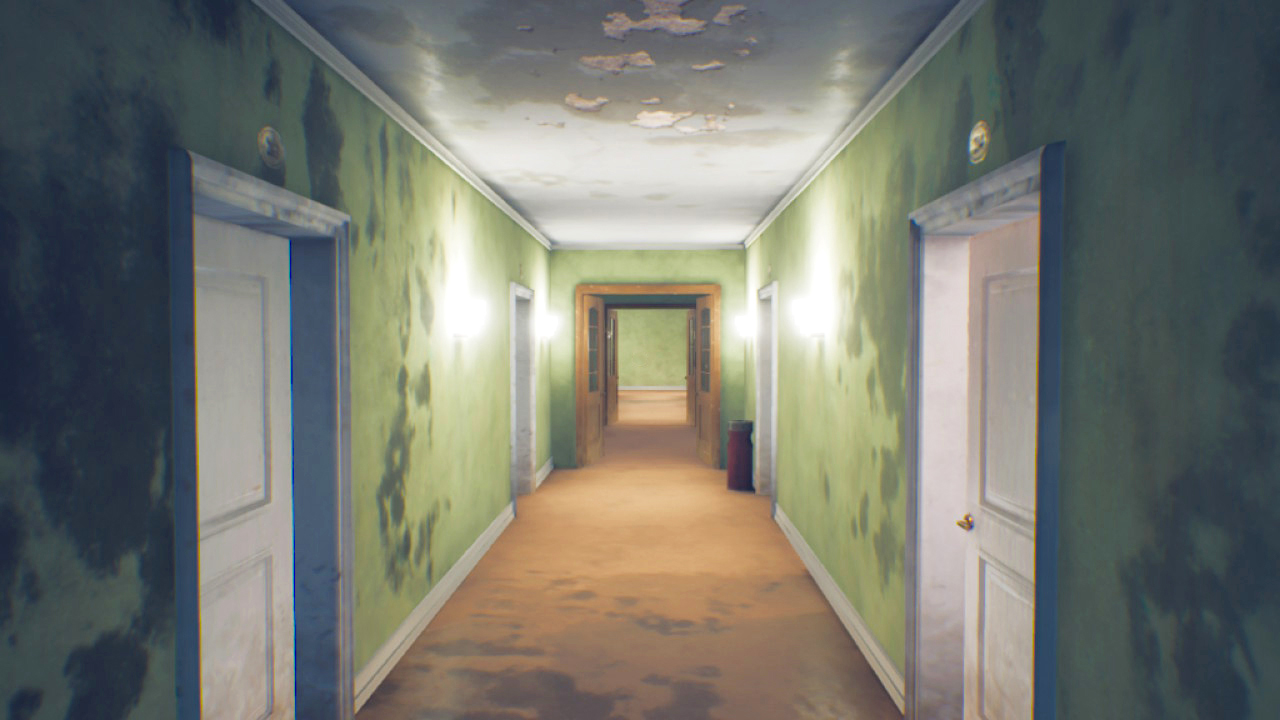
I’m a huge fan of The Shining, both the Stephen King novel and the Stanley Kubrick film, and it was cool to see what the “staff only” spaces of a place like the Overlook might actually look like, from the caretaker apartments to the boiler room to the industrial kitchen freezer to the utility crawlspaces. Mercifully, there are no elevators in the Timberline Hotel, but the carpeted hallways are plenty spooky enough. There’s also a secret underground passage with a secret room. I consider myself to be a connoisseur of secret basement rooms, and this one gave me serious chills.
If you’re not sold on The Suicide of Rachel Foster but curious about where it goes with its premise, I’d recommend checking out the Wikipedia article (here), which contains a detailed plot synopsis. I think The Suicide of Rachel Foster probably would have made a better novel, but there’s also something to be said for the experience of being able to walk through the hotel while hearing every creak of the floorboards and every rattle of the pipes in the walls. If nothing else, the sound design is amazing, and the dev team clearly put a lot of love and care into creating an immersive setting.
So, in conclusion, while The Suicide of Rachel Foster is a difficult game to recommend to everyone, I personally very much enjoyed being drawn into the strange and horrible story of the Timberline Hotel.
 Digital Fantasy Diary