Under the Temple

The Forest Temple in Ocarina of Time is one of the most intriguing dungeons in the Zelda series. It’s so beautiful and full of mystery! One of my favorite areas of the temple is the peaceful underground waterway connecting the two courtyards on either side of the main hall. This is not in the least because the upper walkway provides healing hearts that are extremely welcome after Link’s first battle against a Stalfos. If Link grabs all three hearts the first time through the sewer, there will only be one heart on his return through the passage.

Where did that additional heart come from? Where do any of these hearts come from? Perhaps it’s best not to think about it too hard.

I have very little experience drawing architecture, but hopefully this works to my benefit in conveying the brutalism of the building lines in early 3D games. The primitive perspective scaling isn’t an issue in open spaces with organic shapes like the Kokiri Forest, but it feels somewhat uncanny in confined interior spaces. I get the sense that the game developers understood this, as the slightly off-kilter straight lines of the sewer tunnel are a nice foil against the luxurious twisting corridors of the temple’s upper levels, which are equally confounding to the eye. Poor Link… that kid has seen some shit.

The Wisdom of the Waiting Princess

The Wisdom of the Waiting Princess is an empowering feminist reading of how the trope of the “captive princess” applies to the Zelda of the original 1986 game. While this Zelda is an action hero in her own right, her wisdom manifests in her remarkable ability to lay plans for the future.

You can read the essay on AO3 here:
https://archiveofourown.org/works/67410167

I had the honor of contributing this essay to Silent Princess: A Zelda Zine. The zine’s website is on Carrd (here), and you can check out the art and writing featured in the zine on its Tumblr site (here). Leftover sales of the zine merch are currently open (here), and you can still pick up a digital copy of the zine (here). All profits from zine sales will go to support Doctors Without Borders.

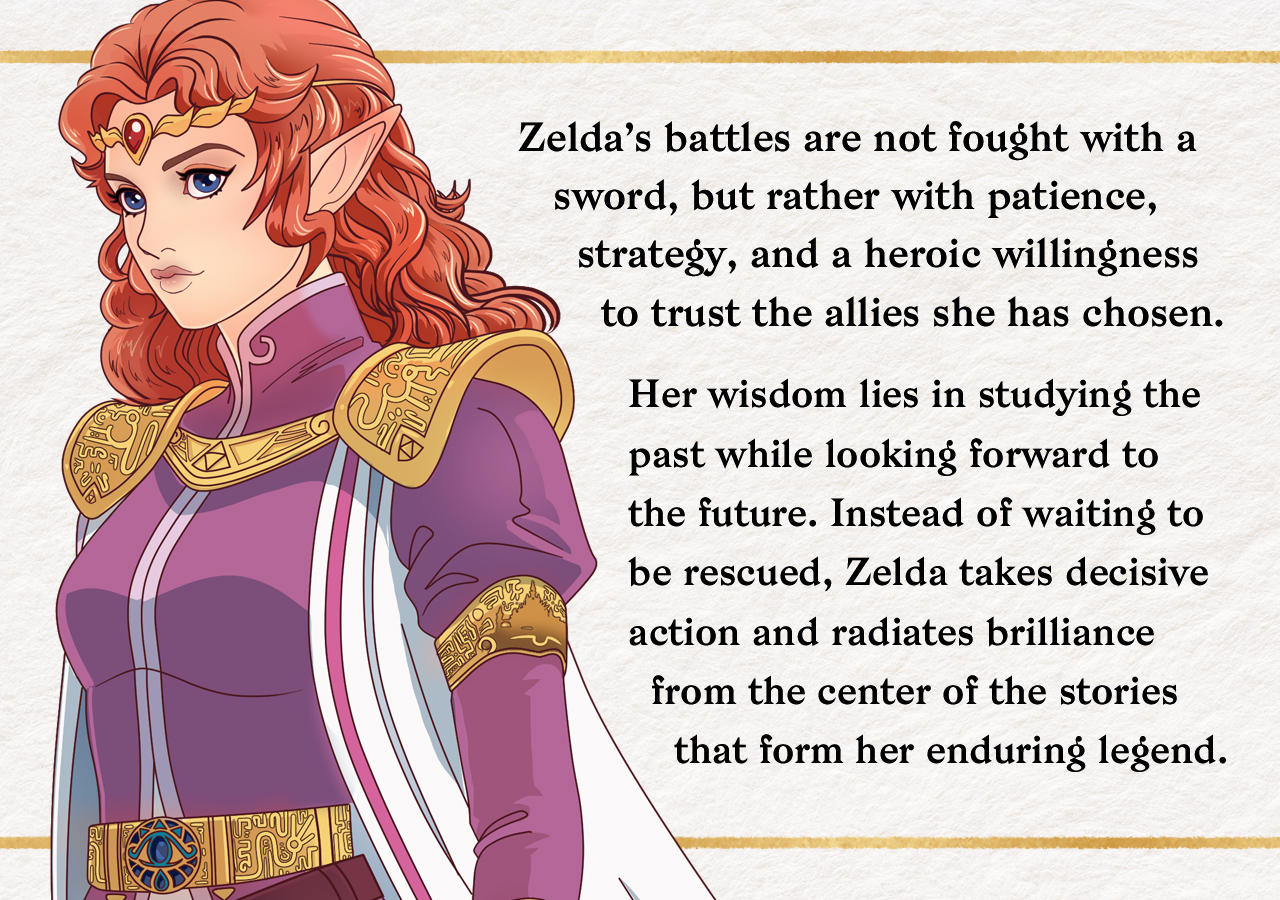
This original design for Princess Zelda was created by Hollarity, who put an incredible amount of love and care into portraying the character as a courageous young woman who is fully capable of going on her own adventures. You can find more of Holly’s gorgeous artwork on her website (here).

The Sleeping Princess

There is a legend in Hyrule that a sleeping princess lies behind the door of a locked room deep under the ruins of the North Castle. When the princess rises, so too will the ancient powers sealed within her dreams. Impa knows the legend is true, and she fears the fate that will befall the kingdom should the first Zelda wake. Yet when a shadow rises on the borders of Hyrule after the birth of a new princess, Impa must make a terrible choice.

I had the honor of contributing a story called “The Sleeping Princess” to Blood Moon Rising: A Zelda Horror Zine. I was interested in exploring the background of Princess Zelda in the original 1986 game, and I thought it might be fun to see her story through the eyes of Impa, who knew about the undead princess who was the first of Zelda’s line. In other words, I’m connecting some of the more disturbing threads between The Legend of Zelda and Zelda II: The Adventure of Link.

“The Sleeping Princess” is a story about maternal love, political sacrifice, and the dark secrets hidden within the labyrinthine dungeons of Hyrule. I was strongly inspired by H.P. Lovecraft’s novel At the Mountains of Madness, which dwells in the geometric terror of monumental architecture built by strange hands, and I did my best to create a sense of ruined grandeur similar to that of Dark Souls and Ico: Castle in the Mist.

For the story’s illustrations, I had the incredible pleasure of working with the devilishly talented Pumpkinsouppe, whose dark arts brought this ruined world to life.

You can find “The Sleeping Princess” on AO3 here:
https://archiveofourown.org/works/62492182

Leftover sales of the zine are open until February 24 on BigCartel (here).

Silent Princess Zine Preorders Open

I’m proud to have contributed a nonfiction meta essay to Silent Princess, a fanzine celebrating Princess Zelda.

My essay, “The Wisdom of the Waiting Princess,” offers an empowering feminist reading of how the trope of the “captive princess” applies to the Zelda of the original 1986 game. My goal is to demonstrate that, while this Zelda is an action hero in her own right, her wisdom lies in patience, strategy, and the careful coordination of allies.

Silent Princess contains a sparkling treasure trove of essays, stories, comics, and illustrations, and I can’t wait for everyone to see the amazing work the team has created.

Preorders for the fanzine are open until January 6 on Bigcartel here:
🌟 https://silentprincesszine.bigcartel.com/

Zelda Horror Zine Preorders Open

I’m excited to share a preview of my story for Blood Moon Rising, a Legend of Zelda horror fanzine.

I wrote about the undead princess of Zelda II, as well as the decision that Impa is forced to make in dooming the princess of the original Legend of Zelda to the same fate. The two NES Zelda games are deeply dystopian, and I enjoyed going full Dark Souls while exploring the decay of their horrifically postapocalyptic settings.

Preorders of the zine are open until March 15, and all proceeds will go to Medical Aid for Palestinians. There’s some truly frightful work in this zine, so please check out their social media if you’re interested!

🩸 https://bloodmoonzine.carrd.co
🩸 https://bloodmoonzine.tumblr.com
🩸 https://twitter.com/BloodMoonZine
🩸 https://bloodmoonrising.bigcartel.com

The Flower Thief

“The Flower Thief” is a story about how Ganondorf visits Hyrule as a child and falls in love with the green and beautiful land, even as he is warned away by the queen who will become Zelda’s mother.

What fascinates me about Ganondorf (at least prior to Tears of the Kingdom) is that he’s a villain whose actions seem far more evil than his character. Given that he’s not necessarily an evil person, what would drive him to such extremes?

In my own experience, evil is boring and mundane. “Evil” is someone who sends hateful messages on social media because they know they can get away with it, or someone who pretends not to see when a colleague is being harassed at work. People who are born into privilege can often be evil without even thinking about it, as the rules that govern the actions of other people don’t apply to them. People in positions of authority are often evil simply because it’s the path of least resistance. So, in most cases, evil is passive; it’s a matter of not challenging the baser impulses of human nature, or not bothering to fix a system that’s become twisted and broken.  

It’s therefore intriguing to me that, when Ganondorf wants “power,” what he’s seeking is the ability to upset the established order. Even if it’s for his own selfish reasons, he aims to transform the world, whether by undoing the mistakes of the past or creating an ideal future. He fails – and he fails miserably – but at least he tries.

I grew up with shōnen adventure manga, and I’m interested in seeing a similar coming-of-age story about someone like Ganondorf, who is talented and works hard but still ends up as the villain. “The Flower Thief” was my attempt to write a story like this for myself, and I think I managed to do a decent job of creating a nice parallel to Link’s first journey to Hyrule Castle in Ocarina of Time.

You can read “The Flower Thief” on AO3 here:
https://archiveofourown.org/works/32033518

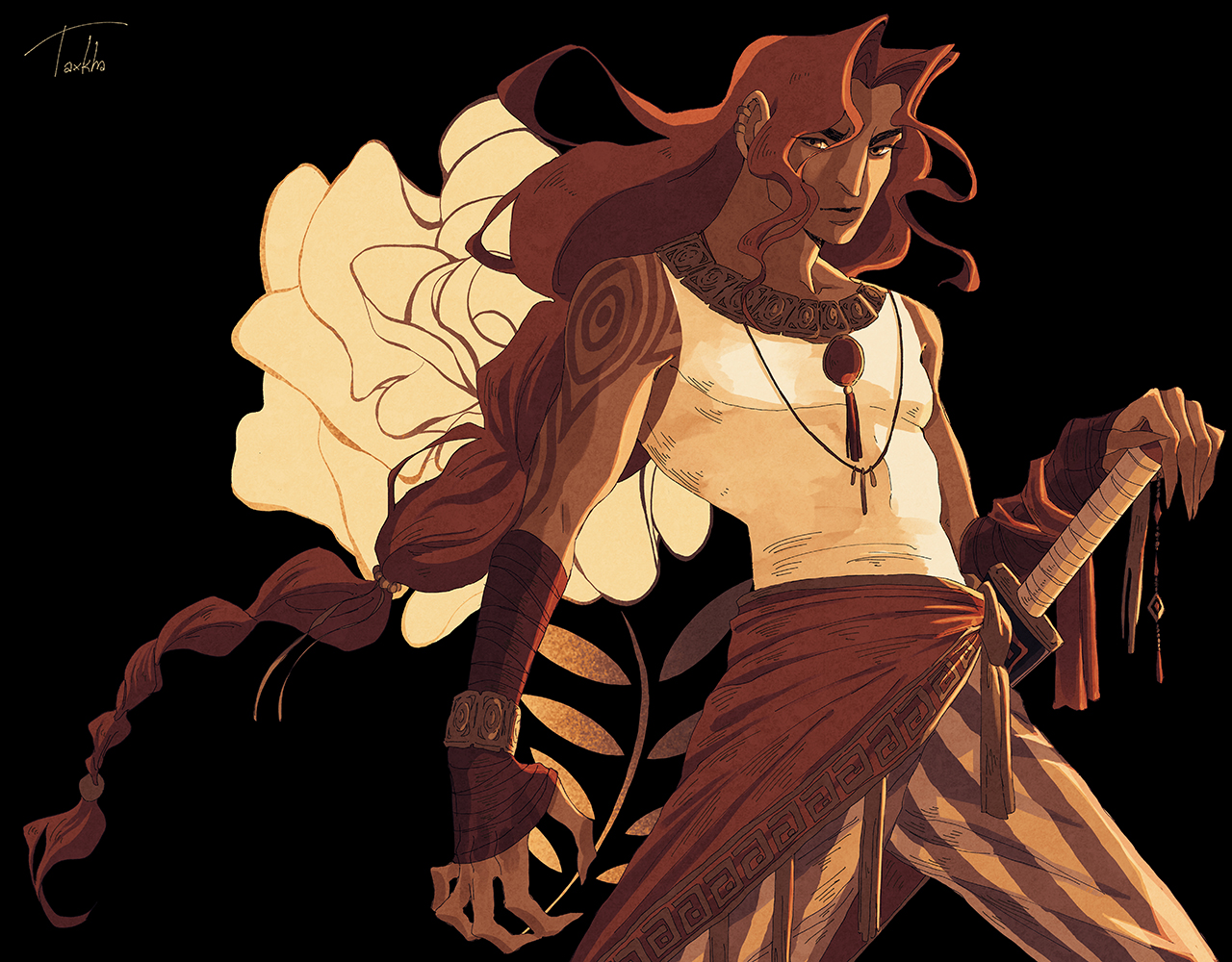
This story was written for Ties of Time, an Ocarina of Time and Majora’s Mask fanzine. Ties of Time was published back in 2021, but you can still see the zine’s artwork on Twitter (here), and the zine’s stories have been collected on AO3 (here). The character illustration of teenage Ganondorf is by the bold and daring Taxkha, who shares their art on Tumblr (here) and on Twitter (here).

Tears of the Kingdom Leaks and Spoiler Culture

This past Sunday, someone on Reddit posted a link to a page-by-page series of photos of the (original Japanese) artbook that comes included with the special edition of Tears of the Kingdom. Since then, a lot of big-name fandom artists have been sharing public pledges that they won’t post any art that contains spoilers. I appreciate their stance, but I’d like to offer my own take – not on the spoilers themselves, but on the culture of corporate secrecy surrounding “spoilers.”

Before anything, I should admit that I looked at the leaked pages. They’re neat! There are a few new interesting character designs, but no story spoilers. The text is little more than design notes. “This clasp connects the two sides of her hairband,” that sort of thing.

I actually wasn’t all that impressed by the Tears of the Kingdom trailers, which make the game seem like a hot mess of heterogeneous elements that don’t fit together. That being said, some of the new character designs are really exciting! I’m not a fan of video game trailers to begin with, as they tend to target action-oriented fourteen-year-old boys. Meanwhile, the Tears of the Kingdom concept artwork is much more specific and interesting, and I think it invites a much broader and more diverse range of people who play games.

To put it bluntly: I didn’t like the trailers, but the leaked concept art sold me on this game.

I think it’s important to keep in mind that the refusal of media companies to put out nothing more than one or two teaser trailers in advance of a big release is a relatively recent practice. Before Disney bought Marvel in 2009, it was common to share all sorts of concept art, cast interviews, behind-the-scenes set photos, and so on. One of the most enjoyable aspects of being a video game fan in the 1990s and 2000s was checking out all the cool pre-release content in magazines and on official websites. In my experience, these little teaser “spoilers” aren’t going to diminish anyone’s enjoyment. Quite the opposite, in fact!

In addition, I think it’s important to put this leak into the context of Nintendo posting a major Direct video saying that they would open preorders for a special edition, only for the extremely limited stock to be almost instantaneously bought out by scalper bots, as Nintendo’s marketing people must have known it would be. Putting the $130 special edition aside, just a regular download of Tears of the Kingdom costs $70, which is quite hefty. I’m not inclined to take Nintendo’s side in any of this, nor am I amused by their weird Disneyesque attempts to create a kind of sacred space around a video game release to inspire “fear of missing out” anxieties.

Of course, I can understand the mindset of someone who wants to go into a game completely “unspoiled,” but you have to wonder. How good can a game (or movie) be if the entire experience of enjoying it would be ruined by knowing more about it?

My final reaction to the conversation surrounding this leak is rooted in my frustration with the prevailing culture of image-based social media. It makes sense for big-name professional artists with large followings to say that they’re not going to post “spoilers.” I understand that having an active online audience of tens of thousands of people necessitates certain precautions against discourse and harassment! Still, that experience is limited to a relatively tiny percentage of creatives.

The tail of social media interest in any given media release is a week at most. If you’re an artist with a low-to-mid-range following, and you can post your work within the first three to five days of a release, this translates to a difference between your post getting 3,000 notes and it getting maybe 300 if you’re lucky. If you’re an absolute amateur like me, this is a difference between getting 3,000 notes and maybe getting 30.

I can’t even begin to explain how intense the pressure to drop everything and produce work quickly is. Intense, and unpleasant. It’s disheartening to see work that was posted maybe two days earlier get an exponentially higher amount of positive feedback simply because of the timing of the post. Essentially: if you’re unable to produce quality work within a magic window, it can feel as though your work doesn’t matter.

( By the way, if your response is “you should create art for yourself,” please go sit in the corner and think about why an aspiring or early-career artist might need or appreciate support. )

Meanwhile, if an artist has more concept art and other development material to work with, they can take their time and create good work on their own schedule so that it’s ready to go when the magic window opens. Personally speaking, I think being able to enjoy the process of making art instead of operating on an unhinged crunch schedule is much healthier, much more sustainable, and a lot more fun.

So, all things considered, maybe being able to access a wider range of information about a game before it releases is kind of nice, actually.

The Museum of Hyrule

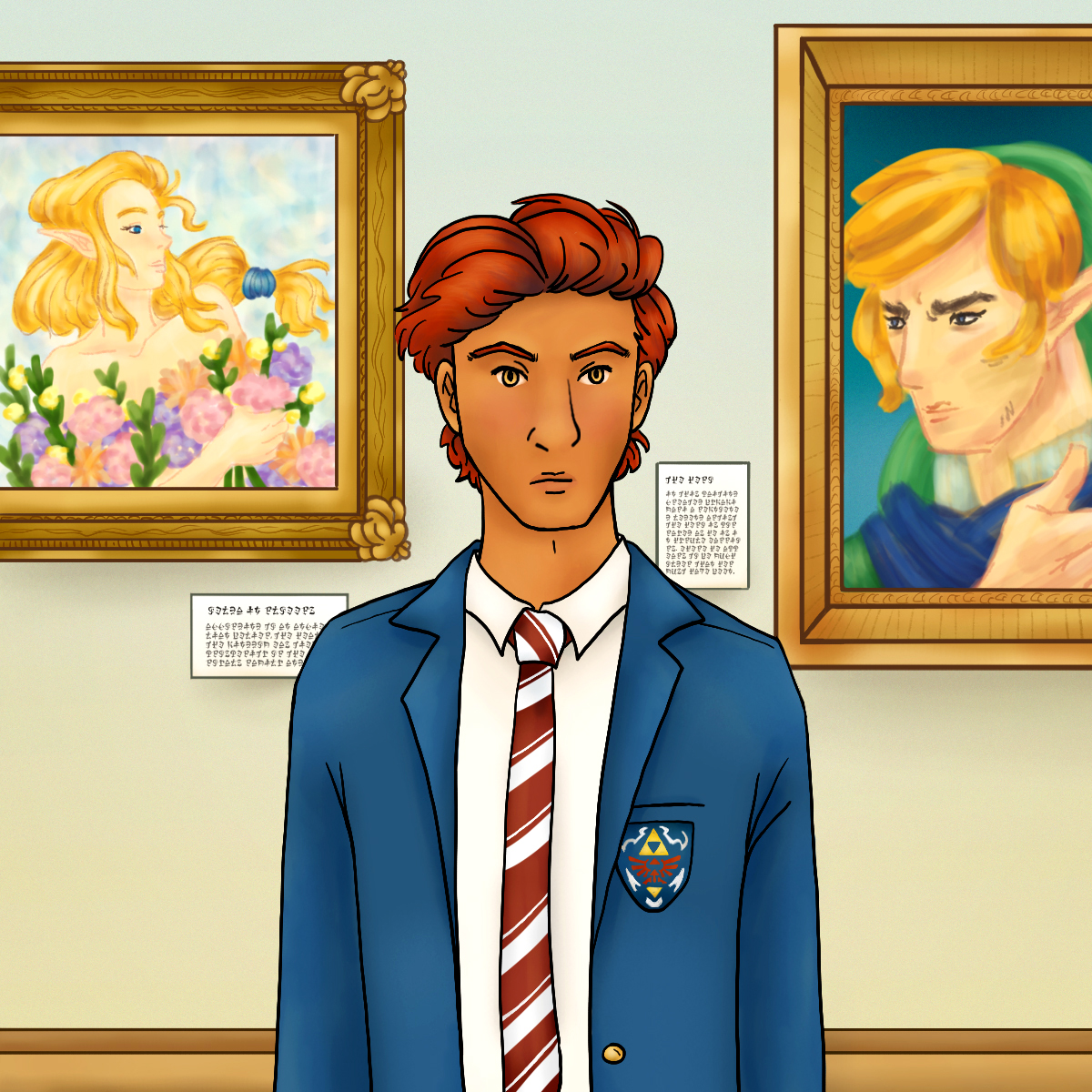
I was recently thinking about what a modern version of Hyrule would look like, and I was imagining how fun it would be for Link to encounter the Master Sword during a class trip to a museum. When I started sketching, however, what I ended up drawing is a reincarnation of Ganon seeing his crown from Ocarina of Time. The moment I wanted to capture is the calm immediately before a terrible storm.

Also, as someone who loves art and history, I tend to dislike museums, but that’s another story entirely.

The Best Witch of Her Generation

I’m excited to share another short story I wrote for Goddess Reborn, fanzine celebrating the female (and nonbinary!) characters of the Legend of Zelda series. You can download a free digital copy of the zine on Itchio (here), and you can read my full story on AO3 (here).

A Link Between Worlds is one of my favorite games in the Zelda series, mainly because I find the characters so charming. I’m especially fascinated by the figure of “someone who wants to be a hero but isn’t the fated Chosen One,” a character trope the series plays with but never fully explores. Groose from Skyward Sword is a good example, as is Ganondorf from The Wind Waker. There are several such characters in A Link Between Worlds, and Irene is my favorite.

Irene is the granddaughter of the Potion Witch, and she serves as the game’s fast-travel mechanic by flying Link around on her broom. She seems to be modeled half on Hermione Granger – she calls proudly herself “the best witch of her generation,” a play on Hermione’s famous epithet – and half on Kiki from Kiki’s Delivery Service. Like Hermione, Irene sees herself as a hero; but, like Kiki, her character arc involves her journey to understand and acknowledge her own specific set of talents.

What I wanted to capture was a moment of Irene’s life in which she’s happy and confident of herself as the protagonist of her own adventure. Irene understands that what she’s doing is just as important as Link’s quest, and she’s absolutely correct. Although the player may see Hyrule through Link’s eyes, the female characters who surround and support him are absolutely vital to Hyrule’s history.

While writing this short story, I wanted to get as close to the tone of “early-reader fiction” as I could. I’m not used to this style of writing, so it was a fun challenge. I was aided immensely by the story’s illustrator, Leh Latte. Leh helped me with the diction and rhythm, as well as with structure and balance. She also showed me what it means to work with page formatting in mind. Although the story itself is short and simple, it’s the product of a few good conversations during a collaboration between me, Leh, and Aven Wildsmith, the zine editor.

Leh and Aven are both fantastically talented and creative people who work in a variety of media. You can find links to all of Leh’s social media accounts on her Carrd (here). Aven’s website is (here), and you can find links to all their socials on Linktree (here). And again, Goddess Reborn is free to download on Itchio (here). There’s a lot of love on every page, and this zine is really something special.