Necromancer Zelda

Echoes of Wisdom is growing on me, and I especially love how Zelda fights by rapid-summoning monsters to overwhelm her enemies. I suppose Zelda is technically creating “echoes” instead of resurrecting her defeated foes, but she still reminds me of the Tears of the Kingdom trailer in which Ganondorf triggers the Blood Moon, summons a bunch of monsters, and tells them to “sweep over Hyrule.” Necromancy seems like a very fun gig if you can get it.

This comic was drawn by the horrifically talented Frankiesbugs, whose cute and creepy illustrations and comics can be found on Tumblr (here), on Instagram (here), on Cara (here), and on Redbubble (here).

Everyday Heroines

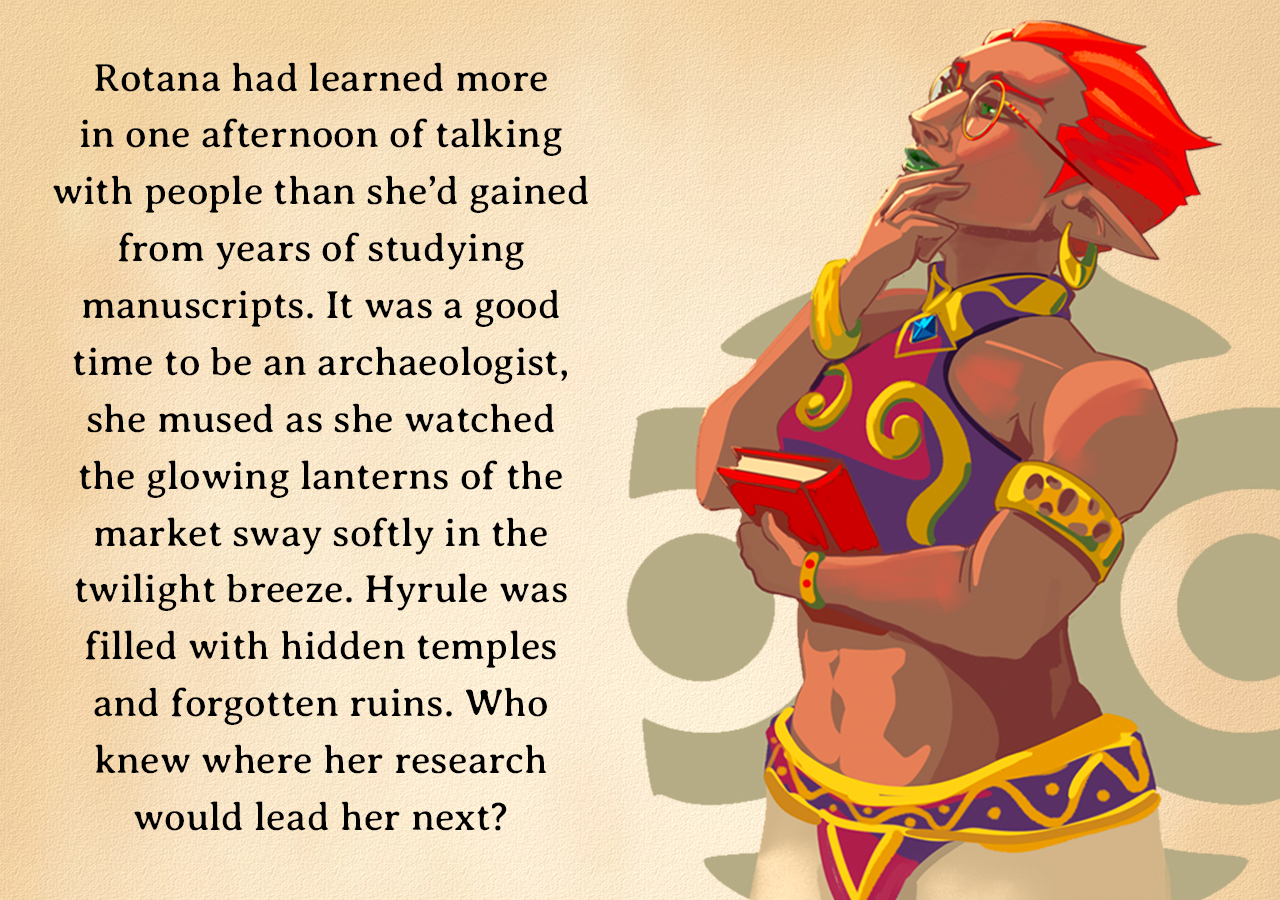
By happy coincidence, the Gibdo attack on Gerudo Town grants the Gerudo archaeologist Rotana a breakthrough in her research on the Seven Heroines. Link’s assistance was invaluable in locating the first mystical orb of the Heroines, but Rotana has resolved to find the others on her own. As she speaks with the residents of Gerudo Town, Rotana becomes acquainted with the virtues espoused by the Heroines and learns that knowledge can be found in surprising places.

I love Rotana as a character, and it’s one of the highlights of Tears of the Kingdom to listen to her lectures. Also, as an academic, it’s a guilty pleasure for me to write about research and fieldwork and the hurdles on the way to publication. Still, what I really wanted to do with this piece was tell a story about everyday life in Hyrule. Because Link is the hero of a video game, everything seems to revolve around him, so it’s interesting to get an outside perspective.

In particular, I wanted to see the characters in Gerudo Town living their best lives and solving their own problems without Link’s help. I hope this story draws the reader into a beautiful setting where the everyday quests of regular people are just as meaningful as Link’s journey to rescue Zelda.

The story is on AO3 here:
https://archiveofourown.org/works/57922744

I’m honored to have contributed this piece to Residents of the Wild, a gorgeous digital fanzine celebrating the NPCs of Breath of the Wild and Tears of the Kingdom. The zine was published on August 3, and you can still order a digital copy during the Zeldathon charity event beginning on August 13.

I consider myself extremely lucky to have my story illustrated by the legendary Linktober veteran Taboonle, who created a radiant portrait of one of Hyrule’s premier scholars. Taboonle draws amazing character art as well as cute comics with a gentle sense of humor, and you can check out his work on Instagram (here) and on Tumblr (here).

Residents of the Wild Fanzine

I’m honored to have a story about the adventures of the Gerudo archaeologist Rotana appearing in Residents of the Wild, a digital Legend of Zelda fanzine celebrating the NPCs of Breath of the Wild and Tears of the Kingdom. All proceeds from the zine will be donated to this year’s Zeldathon charity event. The zine is scheduled to be delivered on August 1, and preorders are open until July 28.

📚 rotwzine.carrd.co
📚 residents-of-the-wild-zine.square.site

A Zelda Game Starring Princess Zelda

When the first trailer for Tears of the Kingdom was posted in June 2019, fans were excited about Princess Zelda’s new cropped haircut. Perhaps this meant she would be a playable character, people speculated, as it meant that no weapons or armor would have to clip through her hair. In November 2020, Zelda was indeed one of the main playable characters in Age of Calamity. Although it’s great fun to use Zelda’s magical light blasts to part seas of swarming enemies, it was also somewhat disappointing that the gameplay of Age of Calamity positioned Zelda as just another fighter, while Zelda was largely absent from the gameplay of Tears of the Kingdom.

No one can deny that Zelda is an important character in the games that bear her name, but it’s a shame to see her sidelined. My frustration with Tears of the Kingdom made me wonder what the gameplay of a title that focused on Princess Zelda might look like…

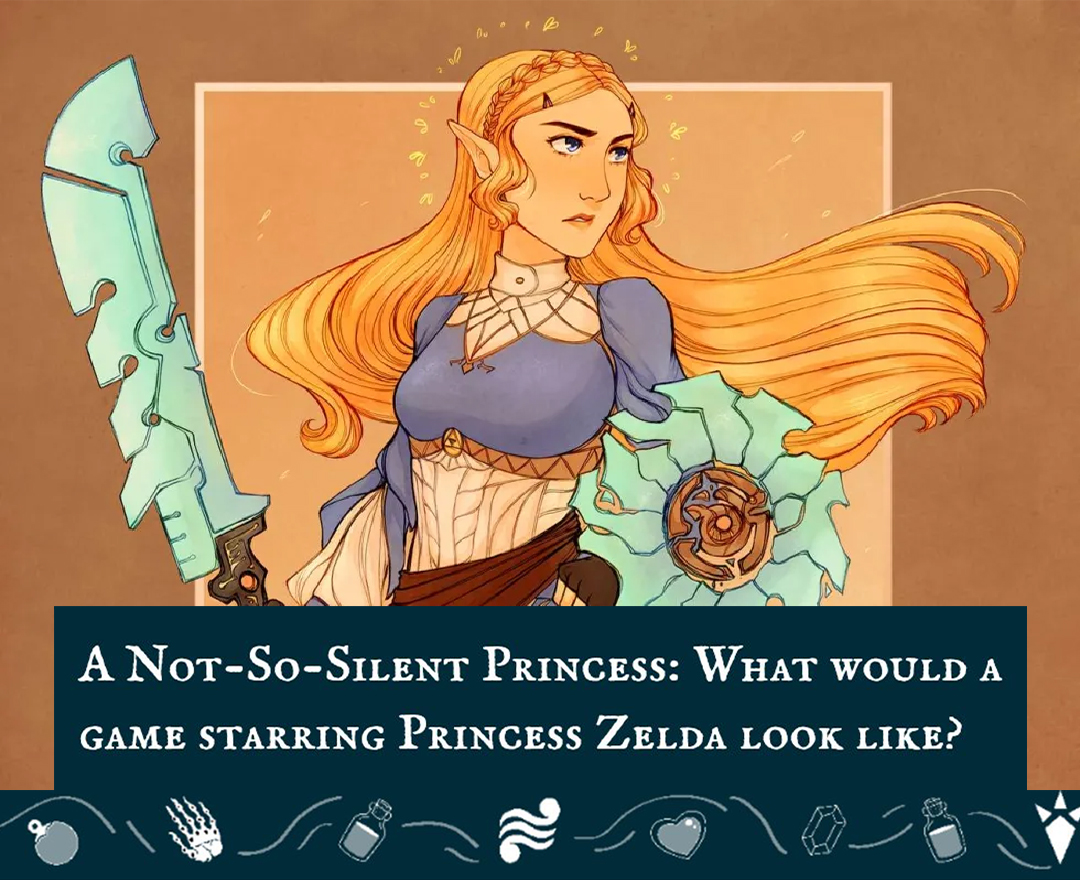
I recently had the opportunity to write a short essay for the Zelda Creators community blog based on this month’s creative prompt, “How would you design a Legend of Zelda game?” I’ve been thinking about what Princess Zelda might look like as a video game protagonist for years, and it was a lot of fun to share my ideas. I included some illustrations that I’ve commissioned over the years that envision Princess Zelda as a playable character, and the art used for the preview graphic is by the wise and powerful Benvey0 on Tumblr.

If you’d like to read the full essay, you can find it here:
https://www.zeldacreators.com/blog/a-not-so-silent-princess

A Record of the Calamity

This collection of meta essays explores the worldbuilding and cultural background of Hyrule and its inhabitants during the timeline of Breath of the Wild and Tears of the Kingdom.

Ninja Lore in Breath of the Wild
On the historical precedents of the Sheikah, the origins of the names “Yiga” and “Kohga,” and how the culture of historical ninja is referenced in the story and setting of Breath of the Wild.

Governance in Hyrule
On the nature and questionable necessity of the Hyrulean monarchy in comparison with other systems of governance in Hyrule.

Zelda and the Calamity
On how Zelda’s repressed emotions may have surfaced in a tragic explosion of chaotic power.

Ganondorf as an Agent of Change
On Ganondorf’s role as the villain of a heroic fantasy, the existential challenge he poses to Hyrule, and the necessity of disruption to an otherwise closed system.

Ganondorf’s Design in Tears of the Kingdom
On the Japanese cultural references incorporated into Ganondorf’s visual design.

The Two Kings in Tears of the Kingdom
On the fantasies of Japanese cultural identity represented by Rauru and Ganondorf, and why the power structures associated with the two kings are disavowed by Zelda.

The Memory of Stone

I wrote “The Memory of Stone” back in 2020, when the announcement of a sequel to Breath of the Wild encouraged many Legend of Zelda fans to speculate that the game would feature Princess Zelda as a playable character. I returned to this story after finishing my second playthrough of Tears of the Kingdom, which reduces Zelda to a voiceless source of crafting materials. It was a disappointment, to say the least.

One might argue that there are other games with female protagonists, so why insist on playing as Zelda? I would counter this argument with another question: why not play as Zelda? The concept of Zelda as a playable character makes perfect sense within the context of the games’ stories. Link’s journey almost always runs parallel to a journey that Zelda undertakes on her own, after all, and being able to explore Hyrule with a different set of skills (and from a different narrative perspective) would be a lot of fun.

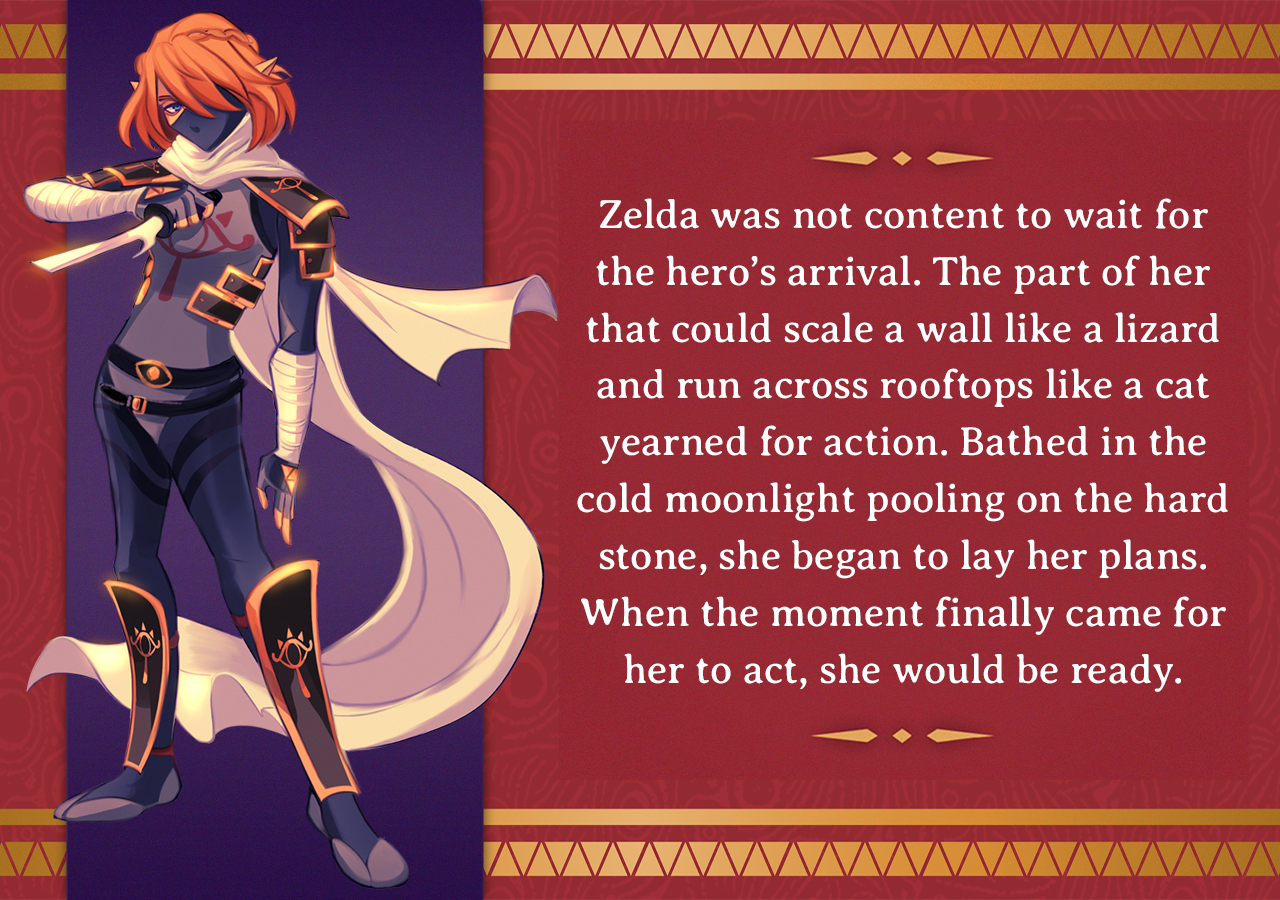
“The Memory of Stone” follows Zelda through each of the temples in Ocarina of Time, and it’s a small attempt to imagine what the eponymous “legend of Zelda” might look like through the eyes of Zelda herself.

You can read the story on AO3 here:
https://archiveofourown.org/works/25230271

The illustration of Sheik included in the story preview graphic was drawn by the revolutionary Nolvini, a fan of shōjo anime who creates magical character illustrations filled with personality and flare. You can check out her work on Twitter (here), on Instagram (here), and on Tumblr (here), and she also has a shop on Etsy (here).

Love in the Time of Gloom Spawn

After years spent investigating the mysterious shrines of East Necula, Dr. Calip has joined the Zonai Survey Team’s efforts to study the Ring Ruins of Kakariko Village. The ancient structures are fascinating, but what has captured Calip’s attention is the chasm in the forest on the hill. While Calip has been gazing into the abyss, however, the leader of the Zonai Survey Team has been gazing at him.

As I grow more impatient with grand narratives of nation-building and heroic destiny, I’ve become more interested in how epic fantasy universes appear to normal people. Hyrule is especially fascinating as a case study, as the privileges enjoyed by Link clearly aren’t applicable to everyone else. This is especially true of the knowledge Link accumulates over his journey, during which the secrets of prior eras are revealed to him alone.

In the present postapocalyptic era of Breath of the Wild, it seems the only person trying to study and understand Hyrule is a scholar named Calip, who lives in an isolated cabin as he attempts to stage an archaeological investigation into the site of one of the ancient Sheikah shrines. As an academic, Calip is a pompous asshole. Regardless of “Dr.” Calip’s self-serving motives, I admire him as a character who investigates the world and tries to understand it instead of simply killing things and accumulating treasure.  

Perhaps because of the popularity of the fandom’s speculation and study of Hyrule, Tears of the Kingdom leans into the ethos of archaeological inquiry with the establishment of a large and diverse set of NPCs forming the Zonai Survey Team. This Sheikah-funded research organization is led by a brick house of a character named Tauro. Tauro has set himself up in Kakariko Village, which has been beset by ruins falling from sky islands and a giant pit opening in the forest on the eastern hill.

Given their interests, it’s only natural that Calip and Tauro would interact. When you read the diaries that Calip has left at his former cabin and at his desk in his office in Kakariko, you learn that Calip is undeniably attracted to Tauro, who apparently went out of his way to invite Calip to work with him. Late in the game, the two men abandon their duties to run off and do research together. I think is a sweet lowkey love story – and even Kotaku agrees, apparently!

The emphasis on archaeological excavation in Tears of the Kingdom is somewhat problematic. In essence, the kingdom of Hyrule had a state-building myth that justified its sovereignty over the surrounding regions, and the result of the archaeological study performed by state-sponsored Zonai Survey Team is the demonstration that these myths were true in the most literal sense. Yes, there are evil outsiders who will kill everyone if they get the chance; and yes, only the royal family and its servants can protect everyone; and yes, the royal family is literally descended from gods/dragons. It’s all kind of gross.

What I therefore appreciate about the implied love story between Calip and Tauro is that they turn their backs on the politics of ancient texts and leave Kakariko so that they can go out into the woods and look at ruins together. For them, curiosity about the world has nothing to do with national mythologies and everything to do with the connection they feel to the people who lived on the land before them – and the connection they have with each other.

Because I am apparently incapable of creating anything that doesn’t have monsters, however, the story I wrote about Calip and Tauro ended up being a horror story as much as it is a love story. It has a happy ending, but it also has a healthy dose of eldritch horrorterrors. Phantom Ganon also makes an appearance, because of course he does.

The story is complete at 4,000 words, and you can read it on AO3 here:
https://archiveofourown.org/works/51328888

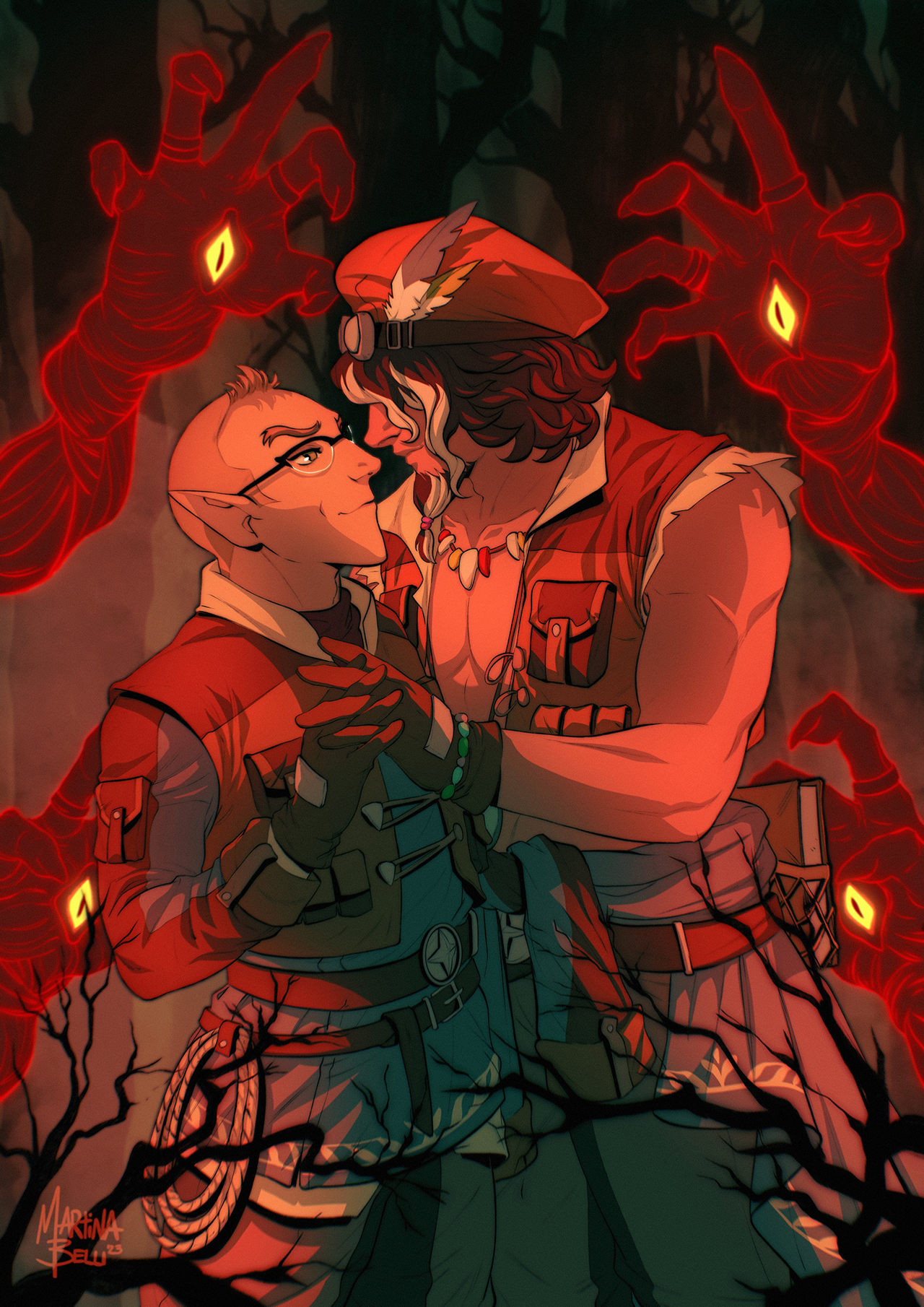
The illustration is by the marvelously talented Martina Belli, whose magical artwork helped me bring these two characters and their story to life. Marty paints dynamic portraits of fantasy characters and dramatic science fiction scenes, and she excels at creating compositions that draw the viewer into the world of her art. It was a lot of fun to work with her, and I highly recommend following her creations on Twitter (here).

Divine Beast

Zelda returns to her original form after the defeat of the Demon King. But, after so many years, is the being that comes back to Link entirely human? Zelda has appetites better suited to claws and fangs, but Link resolves to care for her, no matter the cost. This is a story about Zelda attacking and eating frogs, and cuccos, and horses… and possibly something with even sweeter flesh.

I’ve been enjoying Tears of the Kingdom, but I’m frustrated by its story. I love all the characters, and I think the game’s broad narrative arc is an interesting reimagining of Ocarina of Time. Still, there are many elements of Tears of the Kingdom that I find unsatisfying, especially its ending. I understand the plot mechanics of what happens, which are nicely explained in (this post) on Tumblr, but Zelda’s complete reversion to her human form doesn’t sit easy in my mind. Is it really possible for a transformation of such magnitude to have no lasting effects? Did the sacrifice Zelda made really have such little weight?

Tears of the Kingdom fails to attach meaning to its worldbuilding in a way that very few Legend of Zelda games have in the past. It’s understandable to dismiss these games as childish heroic fantasies. Still, at some point, the true darkness of each game’s story expresses itself. The player may have seen the plot through the limited viewpoint of Link, the teenage “chosen one,” but the crumbling kingdom of Hyrule looks substantially different through the eyes of other characters. Link will emerge triumphant and ride off into the sunset, but everyone else has to live in the ruins, and it’s only very late in his quest that Link realizes this. With this realization, the player can begin to put together the missing pieces of a much larger story.

Despite having an incredible potential to expand on the many mysteries of Hyrule, Tears of the Kingdom does its best to simplify its story to a single one-dimensional layer: Ganon is bad. By defeating Ganon, Link gets rid of everything that’s wrong with the world, meaning that everything in Hyrule is now good again. This is all that matters. What happened in Breath of the Wild doesn’t matter. What happened in the ancient era doesn’t matter. What happened to the Zonai doesn’t matter. None of Hyrule’s past matters, nor does its future. In the endless present of the game, Zelda only exists as a vessel for “good,” and the only important thing is that Link saves her.

As much as I love Zelda, I resent that she only exists as a plot device and a reward for the player. While superficially turning Zelda into a superhero, Tears of the Kingdom robs her of agency. I generally like happy endings, but I hate the conclusion of Tears of the Kingdom. Simply put: it’s happy, but it’s boring. What I therefore wanted to do with “Divine Beast” was to make Zelda’s decision more interesting by ensuring that it has consequences. I also wanted to give the worldbuilding of Tears of the Kingdom a bit of the weight and depth it deserves.

And, more than anything, I want Link and Zelda to be free.

“Divine Beast” is complete at 2,000 words, and you can read it on AO3 here:
https://archiveofourown.org/works/49296496

I drew the illustration myself. You can follow my art on Tumblr (here) or on Instagram (here).

The Best Wells in Tears of the Kingdom

“The Best Wells in Tears of the Kingdom” is a series of short travelogue essays celebrating the hidden secrets, environmental storytelling, and understated exploration elements of Tears of the Kingdom.

One of my main criticisms of Breath of the Wild was that its world felt curiously flat. Why wasn’t Link allowed to go underground? What was lurking underneath Hyrule?

When I first discovered that Tears of the Kingdom was filled with wells and caves, I made it my mission to track them all down. Ganondorf would just have to wait. I’m currently taking my time and leisurely enjoying myself as I go cave diving, but I managed to locate all 58 wells before completing the first dungeon. Each of these wells is unique, but what I’ve been most impressed by are the small stories told by the characters who’ve found themselves at the bottom of a well by accident – or by choice.

For the record, these are my favorites:

1. Kakariko Village Well
2. Haran Lakefront Well
3. Rikoka Hills Well
4. Popla Foothills South Well
5. Kara Kara Bazaar Well
6. Zelda’s Secret Well

You can find the annotated list on AO3 here:
https://archiveofourown.org/works/48633913/chapters/122678209

The cover illustration for this piece, which depicts the veteran well explorer Fera, was created by the magical MiroiMirage. You can find their lively and colorful artwork on Twitter (here) and on Instagram (here). It was a joy and an honor to work with Miroi while getting a glimpse into their creative process. All of the groundwork they laid for the final painted illustration was amazing, so much so that I’d like to share one of their preliminary sketches, which you can see (here).

Hyrule’s Finest Teas

Link is a second-year college student who works as a barista at a small café on a cobblestone street next to his university. Every day he waters the plants, samples new teas, and listens patiently to the concerns of the people who visit. He especially enjoys the company of one of the regulars, a posh upperclassman named Zelda who comes to the café every day to write. It would be the perfect job if not for his boss, whose excellent taste does little to blunt the edge of his exacting standards.

It took me years of being in fandom to reach this point, but I finally embraced the cliché of writing a Coffeeshop AU. I had an intense Fall 2022 semester, and I wrote “Hyrule’s Finest Teas and Imports” to let off steam during the winter break. This started as a wholesome story about delicious café food, but it gradually transformed into something a bit darker. While I was thinking about why someone like Ganondorf would manage a café, I did a lot of research into the shady real estate practices common around college campuses in the United States. I ultimately decided that it would be fun for Ganondorf to commit tax fraud. As a treat.

The story is complete at four chapters and 9,200 words. It’s on AO3 here:
https://archiveofourown.org/works/43918116/chapters/110424639

I was extremely fortunate to work with the magical Mirarasol on an illustration for this story. Mirarasol creates lovely artwork of cute characters inhabiting stylish interiors, and they’ve done fan art for a number of games in addition to their original illustrations. If you’re interested, you can check out their work on Twitter (here) and on Instagram (here).