The summer court opens with a celebration attended by the wealthy families and nobility of Faloren. After the ailing king retires for the evening, Agnes is introduced to Fhiad, who claims to be a university student from Cretia studying architecture. Later, when Agnes escapes to a shadowy corner for a moment of quiet, Fhiad approaches her and quickly becomes cruel and insulting. He tells Agnes that his homeland of Erdbhein has been destroyed, and he declares his intention to take revenge by visiting the same ruin on Faloren by finding Soreiya’s Tear, the legendary relic he was once accused of stealing.
. . . . . . . . . . . . . . . . . . . . .
This chapter is the transition between Act One and Act Two. Fhiad has returned, and he establishes himself as an antagonist. He states his goal to uncover a magical artifact with the intention of destroying Agnes’s kingdom. Fhiad’s anger is not the real problem, however, and it will Agnes’s goal to find a means of addressing the atrocity he survived.
It’s always bothered me when a villain is angry about something legitimately upsetting, but then the writer has this character kick a puppy to show that their anger is bad. What I mean by “kicking a puppy” is that the villain will do something excessively violent or disturbing that is either entirely out of character or framed in such a way as to make their actions seem irrational and done solely for the sake of being evil.
A villain typically represents a challenge to an established order, especially an order built on arbitrary divisions that inform a hierarchy. In the case of fantasy, there is often a class of “monsters” who are sentient yet still positioned as being okay to kill. When a villain wants to establish an alternate power structure in which “monsters” are not killed, it’s only natural to wonder if they might indeed be justified in doing so. The villain must therefore be shown kicking a proverbial puppy so that we do not begin to feel sympathy for them. Based on my observations of various fandom discourse wars, a surprising number of people take this puppy kicking very seriously as an indication that a villain is irredeemably evil.
It’s important to me that Fhiad is portrayed as a legitimate antagonist, at least at first. In this chapter, he proves himself to be two-faced, manipulative, and more than a little creepy. He invades Agnes’s personal space, physically threatens her, and mocks and insults her. He verbally attacks her at a vulnerable moment, and he says horrible things that are all the more hurtful because they’re true. Even worse, he’s cruel to Agnes precisely because he knows she can do nothing to stop him. In addition, it’s implied that he may no longer be entirely human.
Regardless, the root cause of Agnes’s problem – the decline of her kingdom – is not Fhiad, nor is it anything he’s said or done in the past or the present. Rather, this problem is a direct result of a horrible atrocity committed in the past by Agnes’s ancestor. I therefore had to make sure that what Fhiad does at the beginning of Act Two is upsetting but doesn’t fall to the level of puppy kicking. In other words, I attempted to create tension by means of the antagonist’s bad behavior while still being fair to the complexity of his character and his experience of justified anger.
Meanwhile, surrounding both of these characters is the opening of the summer court, a lavish gathering that offers a possibility of what Faloren could be if the kingdom weren’t in decline. Despite the good cheer of the party, Agnes is acutely uncomfortable in her role as a princess. Her keen displeasure in being made an object of display is a window into her essential character, as well as foreshadowing for the development of her story.
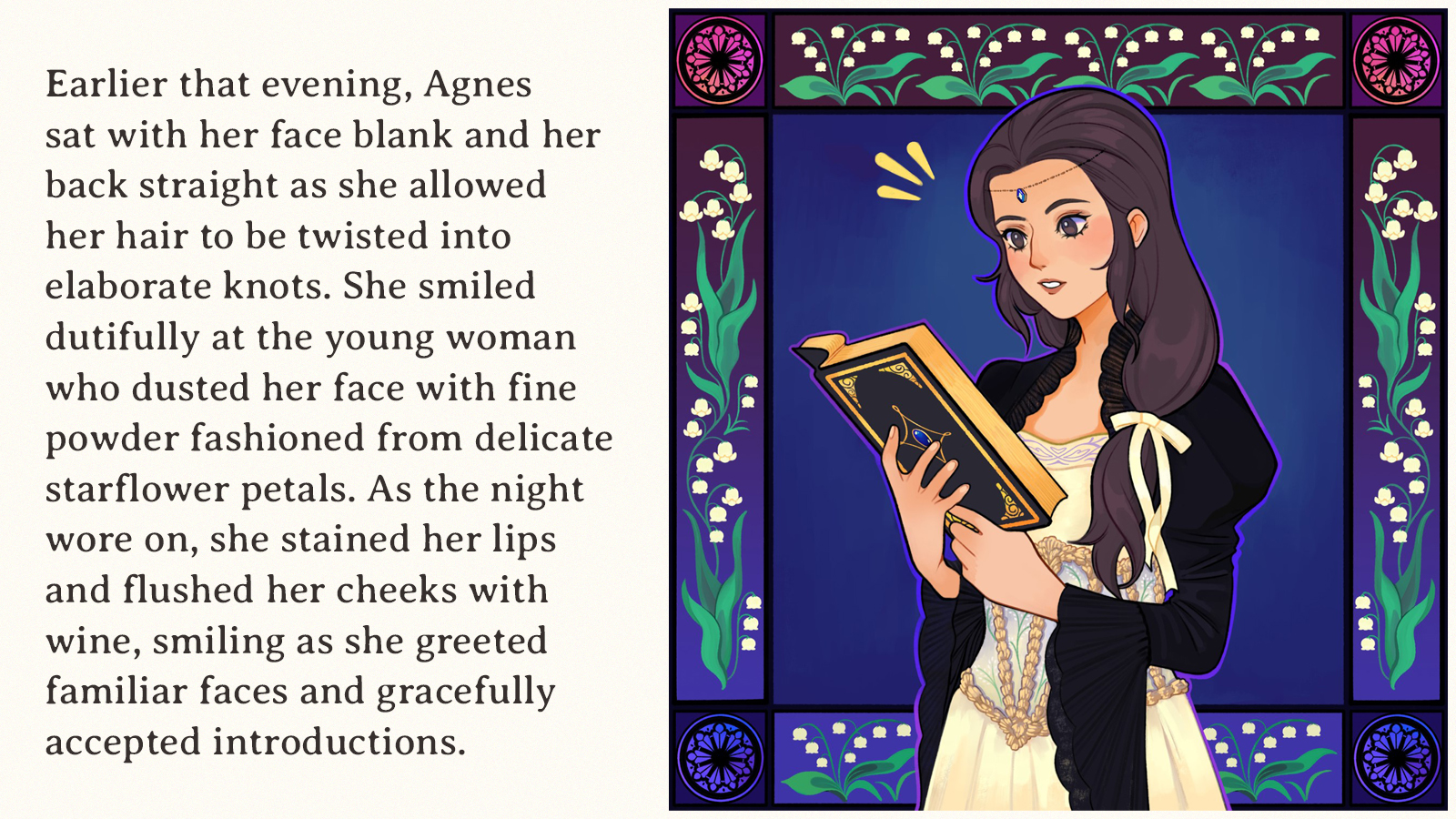
The illustration that accompanies the chapter preview was created by Arte072, a fantasy artist inspired by medieval fashion and illuminated manuscripts. You can find their work on Instagram (here) and on Tumblr (here).
 Digital Fantasy Diary