Review of Loving, Ohio on WWAC

I recently had the opportunity to write a review of Loving, Ohio, a graphic novel about a small town shadowed by the secrets of a cult. Here’s an excerpt…

Loving, Ohio is a powerful work of contemporary horror guided by a tense mystery that unravels against the backdrop of eerily evocative scenery. What makes this story truly disturbing is its resonance with the current cultural climate, in which exploitative religious organizations have become more mainstream while conspiracy theories are taken seriously by people looking for connection on social media. Loving, Ohio tells a compelling story that’s all the more haunting because of how critically relevant it is to the hidden monsters of contemporary American society.

You can read the full review on Women Write About Comics (here). You can read more about Matthew Erman on his website (here) and check out more of Sam Beck’s art (here). As always, I’d like to express my appreciation for my amazing and brilliant editor at WWAC, Kat Overland, who is admirably fearless and as sharp as ten knives.

Norco

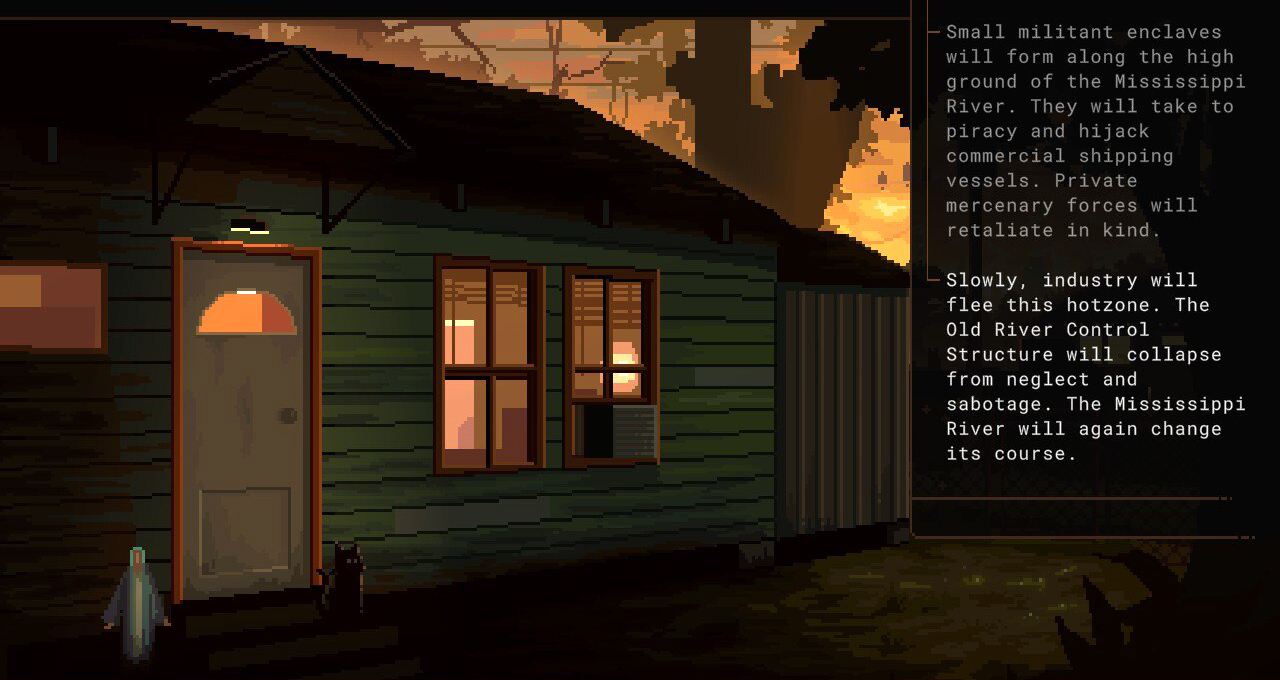
Norco is a cross between a visual novel and a point-and-click adventure game that takes seven hours to play. The game is set in a near-future version of New Orleans and its surrounding bayou. Despite its lowkey cyberpunk elements, the future envisioned by the game isn’t all that different from the present. Norco is gorgeously well-written and intriguingly grounded in the specificity of its setting, and the various small stories it encompasses are filled with fascinating characters and meaningful human drama.

I want to focus on what’s interesting about this game. That being said, Norco can be frustrating, so let me get this out of the way: most of the adventure game elements of Norco are bad. The puzzles (such as they are) are poorly executed and annoying. There’s at least one instance of turn-based combat per act, and it’s not great. Also, the game takes a weird turn toward cosmic horror in the third and final act; and, in order to unlock a slightly more satisfying ending, you have to do a minor random thing in the second act that’s extremely easy to miss.

None of this is a deal breaker. Rather, I think it’s good to set expectations. Specifically, you should expect to use a walkthrough at some point. I actually ended up using three walkthroughs, as I found some of the adventure game sequences to be difficult to piece together. They’re not complicated; they’re just opaque. Thankfully, the more frustrating puzzles are few and far between, and you can play the vast majority of the game just fine on your own.

You begin Norco as a woman named Kay who returns home after her mother dies of cancer and her brother Blake stops replying to texts. Although Blake is nowhere to be found in or around the house, Kay is greeted by the family robot Million, a fugitive from the skirmishes between armed militias that have broken out across the southwest. Million suggests that she and Kay talk to people in the neighborhood to figure out where Blake has run off to.

The search for Blake is interrupted by extended flashback sequences in which you play as Kay’s mother Catherine. While her cancer is in remission, Catherine takes odd jobs on a Fivver-like platform called Superduck in order to pay off loans so her kids can keep the house after she dies. These jobs take Catherine across New Orleans and eventually lead her to an abandoned mall colonized by the teenage disciples of an internet demagogue by the name of Kenner John.            

We’re introduced to Catherine as she allows a blandly anonymous tech corporation to make a neural map of her brain. In theory, the experimental procedure is compensated by the generation of an AI personality intended to help Catherine’s family process her death. In reality, Catherine needs the money. Immediately after her brain imaging session, she’s out in the city after dark running errands via the Superduck app.

Oddly enough, Superduck ends up being a real “person,” a branch of an AI personality based on Catherine’s friend Duck. Based on a story Catherine once told Duck, Superduck has figured out that an alien entity resides in the estuary of Lake Pontchartrain, and that it was captured by Kenner John.

Although the cyberpunk elements of Norco’s plot are fun, they’re not the real story. As Catherine, you play as a tired and washed-up adult using a rideshare service to get around town while trying to gather information from other tired adults who are just trying to make a living. It’s through these conversations that the player gets a sense of what New Orleans is like as a city, as well as a sense of how not even wealthy people who seem to be major players have any control over the environment. There are going to be hurricanes, and there are going to be floods, and neither oil companies nor tech companies can do anything about it.

What I appreciate about Norco is how realistic and grounded it is. As someone dealing with cancer, Catherine gets winded climbing stairs during one of the adventure game segments, and she’s okay with telling people that no, actually, she’s not fine and she needs a minute. Kenner John’s cultists are dumb kids (affectionate) who just want to hang out in an abandoned mall and smoke weed while playing video games. Even the MAGA-style militia members who make a brief appearance in the last act are heroic in their own deranged way, and the poor harassed public official who stays late in City Hall dealing with paperwork delivers a monologue about how you can’t save everyone that’s worthy of Shakespeare.  

Despite the gritty setting of a city on its last legs and Norco’s complete lack of sentimentality, all of the characters are intensely human and sympathetic. They’re also quite funny, even when they’re at their lowest and most morally dubious. There’s one story about a guy who eats a hotdog from a food cart in a downtown tourist area that made me laugh so hard I cried. Norco tackles challenging themes, but it also manages to be pitch-perfect comedy storytelling. I really can’t overemphasize how brilliant the writing is. 

Also, this is worth saying: As someone who grew up in the Deep South, I’m truly and deeply grateful that the script of this game uses an accurate representation of Southern AAVE. My promise to myself about Norco was that I would put the game down and walk away the second anyone said “y’all” or pulled some sort of X-Men Gambit bullshit, but I didn’t need to worry. Everyone talks like a normal person.

The basic gameplay of Norco consists of conversation-based fetch quests. Someone will tell you to talk to someone else, and you have to go find them. You do this by driving (or ordering an off-brand Uber) to take you to a point on a map of New Orleans, and from there you’ll navigate between four or five screens by clicking on various points of interest. Your objective is always clear, but there’s a lot of non-essential content to interact with. And it’s good to talk with everyone! What you’ll get as a reward for being curious is some of the best stand-up comedy you’ll ever read. 

The adventure game puzzles are so deeply embedded in the action of the story that they’re difficult to describe without extensive plot summary. What makes the worst of them annoying is that they expect you to leave the game and write something down in real life. One of the more obnoxious of these puzzles involves numerology. I understand that this is a play on the weird Christian-themed numerology cults that have sprung up on YouTube and Facebook – one of my aunts got really into this during the pandemic, true story, and it’s batshit insane – but it’s still a pain to put down the game and go get a piece of paper.

One of the interactive elements of the game that actually works well occupies a large portion of the third act. The Surprise Big Bad antagonist has gotten an offshoot of the Kenner John cult to build a spaceship on the bayou, and Kay needs to go out and find the site by navigating through the swamp in a small boat on a 4-bit pixelated sonar screen. There are all sorts of fun things to find out on the water, and this segment is enhanced by an atmospheric lead-up that includes an interesting lesson in natural history concerning why the topography of the bayou is so treacherous even though it looks like open water.

At the conclusion of the end credits, Norco provides a list of books and documentaries that the developers used as references. I was so drawn into the real-world history presented by Norco that I immediately screencapped this list. I got started on following up with these references by watching a documentary called Mossville: When the Great Trees Fall, and it’s almost painfully apparent that the creators of Norco were pulling inspiration from serious ongoing issues. It’s amazing that they were able to take such heavy material and transform it into something so gorgeously strange and entertaining.

Although Norco isn’t as mechanically robust as Disco Elysium, it’s easily in the same category of excellent writing and unique visual stylization. I somehow got the impression that this game would be all doom and gloom about poverty and injustice, but it’s actually a genuinely funny dark comedy about a cast of characters whom I grew to love despite (and often because of) their flaws and bad behavior.

Cosmic Horror and the Ruins of Capitalism in Night in the Woods

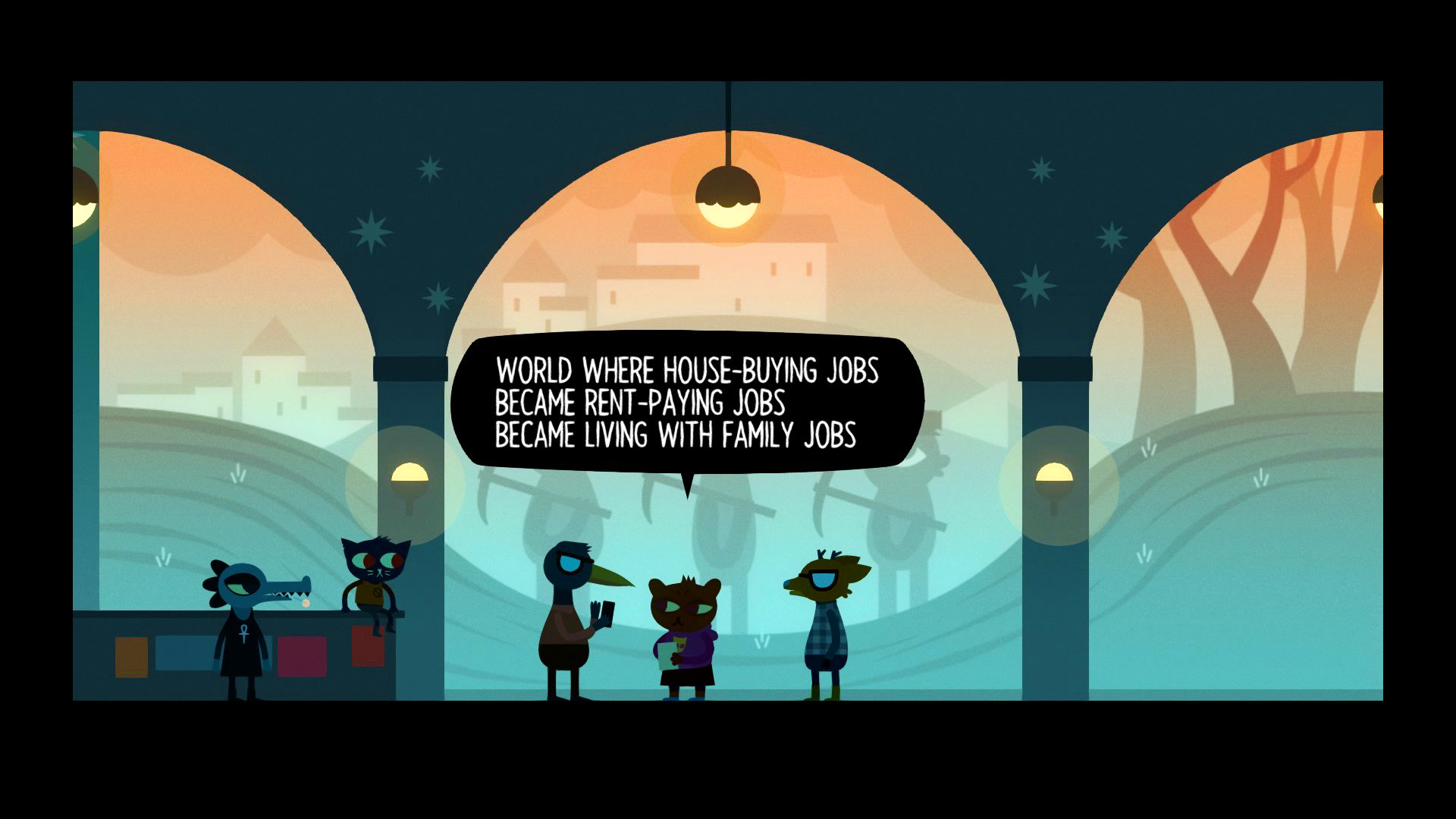
I maintained my sanity during the pandemic by spending time outdoors in abandoned places. Some of these places exist in the real world, but most were virtual. One of my favorite haunts has been Possum Springs, a depopulated town in western Pennsylvania that serves the setting of the 2017 story exploration game Night in the Woods.

In Night in the Woods, you play as Mae, an anthropomorphic cat who has dropped out of college and moved back to Possum Springs to live with her parents. With no job and nothing better to do, Mae decides to investigate the disappearance of several local children. It turns out that there is a monster living in the abandoned mine tunnels under Possum Springs, and a cult of town residents has been feeding young people to this creature in return for a promise that it will prevent the town’s economic decline. When Mae and her friends catch the cult in the act of sacrificing one of its own members, its leader tells the group of teenagers that these rituals aren’t easy for them, especially now that they’re getting older. It’s time for a new generation to take over and ensure the prosperity of Possum Springs, however modest this prosperity might be.

Mae and her friends don’t join the death cult, of course. They escape from the monster, and the mine tunnels collapse and trap the remaining cult members underground. At the end of the game, Mae reflects that what she’s taken away from this experience is the conviction that, if there is no benevolent higher power in a hostile universe, then she and her friends will have to help each other while doing the best they can for themselves and their community.

The elements of cosmic horror in Night in the Woods are genuinely creepy, especially during Mae’s interactive nightmare sequences, but the purpose of the cult is to serve as a thematic juxtaposition to the true terror of Possum Springs, a large and impersonal set of interlocking systems that collectively exploit hardworking but vulnerable people – namely, capitalism.

Mae’s parents are afraid of losing their house to the bank because of an usurious mortgage they took out to finance Mae’s college tuition, and entire neighborhoods in Possum Springs are filled with repossessed, unsold, and subsequently abandoned buildings. The pastor of the local church wants to open a shelter for the newly homeless and the railroad drifters who camp out in the forest next to town, but she fails to obtain a permit from the city council due to concerns that lowering the property values in the neighborhood will fatally disrupt an already struggling real estate market.

The horror of an absurd and uncaring universe in Night in the Woods has very little to do with the unfathomable monster lurking in the mine tunnels, although the cult of older people who sacrifice members of younger generations for the vague promise of being able to sustain an imagined standard of living comes uncomfortably close to allegory in the wake of the 2016 American presidential election. Forces beyond our control and comprehension are indeed destroying individual lives and modestly thriving communities, but these forces are nothing as quaint as a stygian tentacle beast that eats children.

According to Scott Benson, the lead writer and artist of Night in the Woods, Possum Springs is located in western Pennsylvania just outside of Pittsburgh. This situates the town in the Rust Belt, an economically depressed region stretching around the Great Lakes from Buffalo to Detroit. The cities in the Rust Belt were centers of American manufacturing until the 1980s, when international free trade agreements incentivized companies in sectors like natural resource extraction and the automotive industry to outsource materials and labor. Formerly bustling mines and factories closed, resulting in a dramatic decline in population that in turn resulted in the bankruptcy of many smaller businesses.

It’s currently possible to accrue a sizeable following on social media by posting urban exploration photos of shuttered factories and other ghostly relics of infrastructure, such as empty schools, hospitals, movie theaters, and shopping malls. There’s a certain poetic charm in high-contrast photos of healthy green weeds stretching up through the cracks of ash-gray concrete and leafy vines twining around rusted iron support pillars. Images of the remains of modern civilization devoid of human presence provide fertile ground for the imagination to run wild.

Night in the Woods denies its players the solitary pleasures of urban exploration, however. As a dialog-driven game, its story can’t be advanced unless the player participates in conversations with various people around Possum Springs. As the you learn more about the town, you begin to understand the problems experienced by its inhabitants, which range from poverty to alcoholism to severe depression. At the same time, you come to appreciate the people who care about each other and want to do right by their community even despite the financial and emotional burdens they carry.

Night in the Woods suggests that the fractures in the community cannot be repaired by any given individual action, like “going to college” or “owning a home.” Rather, the problem lies in the larger economic forces that steamroller over working-class people in small towns. None of the characters Mae interacts with are stupid or unaware of what’s happening, but most of them don’t have the agency to make any real choices about their lives.

Night in the Woods features a number of optional sidequests that tell an ongoing story about the historical tension between the former mine owners and the labor unions in Possum Springs, and it’s clear that the working conditions for miners were deplorable. The mines closed at least a decade before the story begins, but the labor of the workers in Possum Springs is still exploited. Mae’s father, who was laid off from his job at a small factory, now works at a large supermarket by the highway that forced the local grocery store in Possum Springs to be shut down. At the end of the game, Mae’s father considers starting a labor union at his workplace, which pulls money out of the local economy without benefiting the town or its people.

The game’s presentation of unions isn’t entirely positive, however. As Mae’s friend Bea explains, the unions are male-dominated, and homosocial labor solidarity lends itself to an atmosphere in which overt sexual harassment is swept under the rug. Mae’s friend Selmers, who started writing poetry for the rehab program she entered after becoming addicted to pain pills while working at the local pharmacy, performs a reading of an incredible piece about how even unionized jobs are becoming unsustainable in the face of global capitalism.

Night in the Woods is ultimately about accepting uncomfortable realities while moving forward and finding friendship and community in difficult times and circumstances. The game isn’t just a protest against the violence of the global neoliberal capitalism that destroys local economies; it’s a model of resistance on a small and personal scale, as well as an argument for the quiet beauty of allowing outdated structures to fall gently to ruin.

Small town life isn’t for everyone, but neither is building a community from scratch in a big city. If nothing else, it’s good to have choices. The gameplay of Night in the Woods is centered around making choices, and the choice Mae and her friends make is to bury the monster in the mine, sacrificing short-term gains for long-term stability.

Although Night in the Woods is set in the days leading to and following Halloween, its advocacy for regrowth and positive change is a welcome message as society gradually begins to recover from the effects of the pandemic. If nothing else, Possum Springs is a great place to find surreal and spooky chills, and Mae’s homecoming is a crash course on how to make conversation with other people in real-world places that will be hopefully be not so abandoned in the future.

. . . . . . . . . . . . . . .

This essay was originally published on May 18, 2021 in Entropy, a digital magazine about the fringes of art and culture. Entropy closed its website in late 2022, and I am reproducing this publication with the kind permission of the editors.