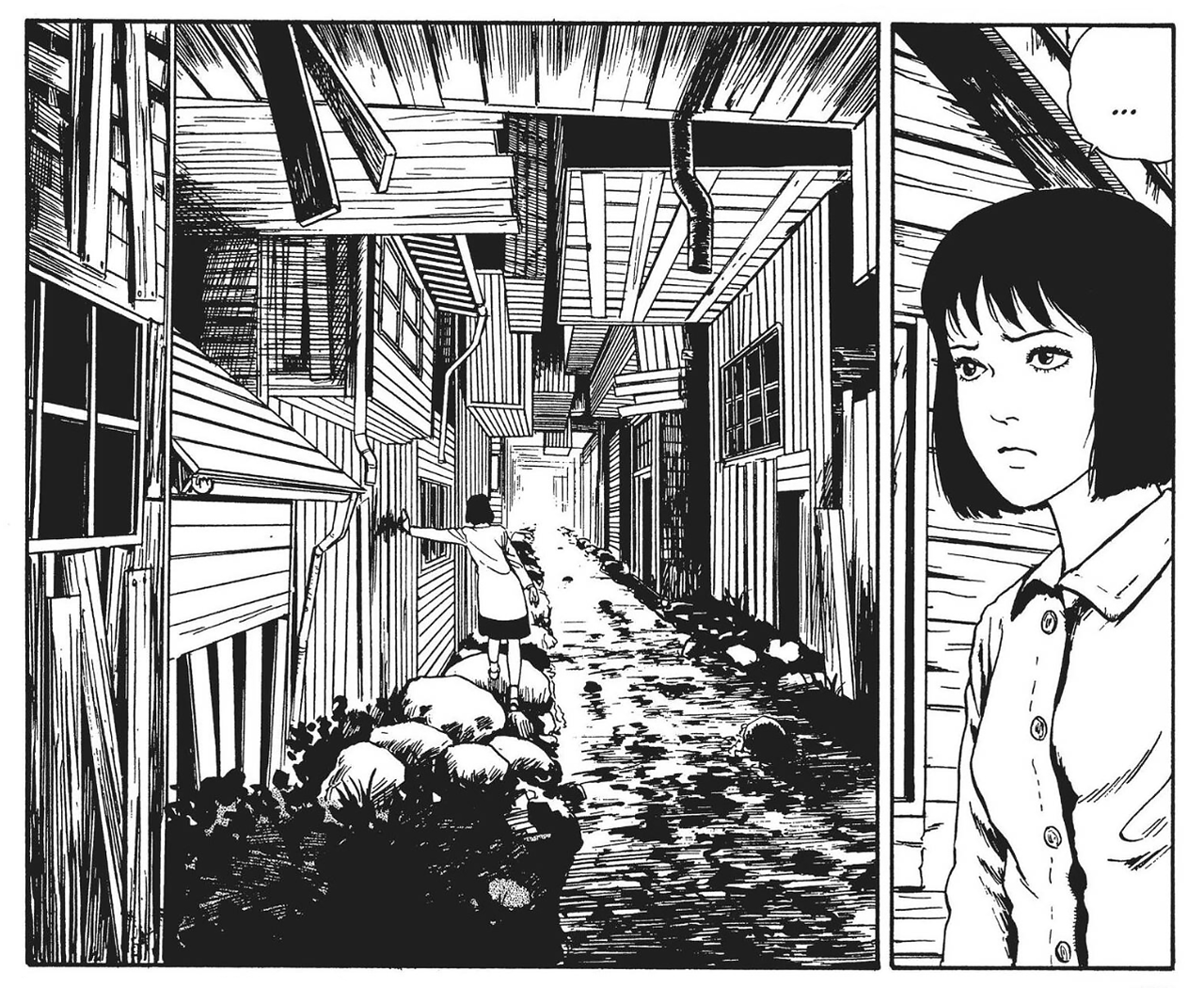
I recently had an opportunity to write a short essay for the comics website Shelfdust about Junji Ito’s short story “Town of No Roads” (道のない街), a stand-alone manga from 1992 included in the 2002 collection Alley (路地裏), which was published in English translation by Viz Media in 2024.
“Town of No Roads” is an oddly structured story that begins with a teenage girl’s experience of having her privacy violated. After she decides to leave home, the manga follows her journey into a weird labyrinthine suburb that’s been rebuilt into one giant wooden house. I’ve always been intrigued by the imagery of “Town of No Roads,” and I thought it might be fun to explore its take on the theme of postwar nostalgia as expressed through its uncanny architecture.
Part of my conclusion is a paragraph that goes…
The pleasure of a labyrinth is that you can enjoy the sensation of getting lost while always knowing that you can simply leave. Perhaps the same can be said of nostalgia as well, and so much the better. The reactionary mode of thought that insists society used to be better when protections for individual rights and dignity were more limited has unpleasant implications, after all. Perhaps it’s best not to linger in this space for too long.
This conclusion makes sense in relation to the story, but what I also mean is that a mode of thought that holds that “things were better before Second Wave Feminism” (which definitely existed in Japan) steps into the territory of horror. I don’t say that part out loud in my essay, but a careful reader will probably understand what’s going on. In all fairness, I’m not entirely sure that Junji Ito intended for a political message to be read into this manga; but, if nothing else, it feels validating to know that he finds certain aspects of the postwar period as creepy as I do.
You can read the full essay on Shelfdust here:
https://shelfdust.com/2026/10/28/how-to-escape-junji-itos-town-of-no-roads/


