Crow Country Essay on Sidequest

I’m excited to share “Crow Country Is a Game about Climate Change,” an ecocritical analysis of one of my favorite indie games of 2024. This essay also serves as a kind of “Ending Explained” story breakdown that was inspired by a few Reddit discussion threads that missed the point of what (to me at least) is a clear, powerful, and compelling artistic statement. How do we process the reality of climate change, and how can we face the challenges of the future?

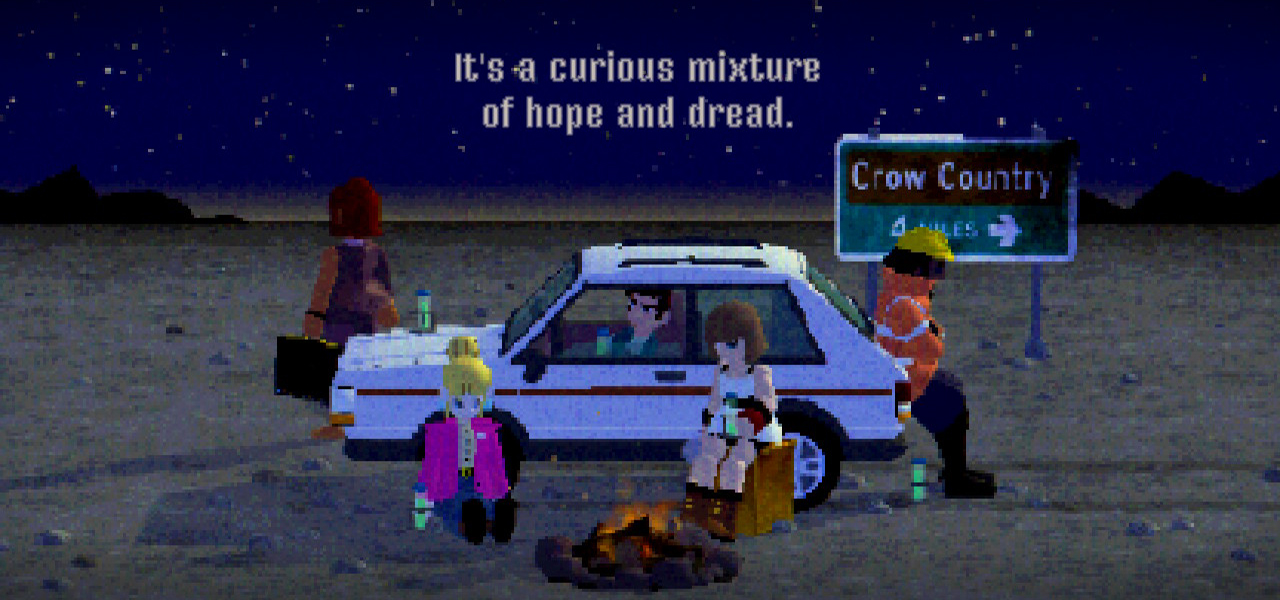
Crow Country borrows heavily from the visual design of Resident Evil and Final Fantasy VII, and I argue that it provides an interesting meta-commentary on their themes as well. Specifically, I think Crow Country uses its retro aesthetics to remind players of the political climate of the late 1980s and early 1990s, when environmentalism was considered an important bipartisan issue in the United States.

In my essay, I put Crow Country in conversation with two books, Colette Shade’s Y2K: How the 2000s Became Everything (2025) and David Wallace-Wells’s The Uninhabitable Earth: Life After Warming (2017). I believe that Shade’s discussion of the “lost environmentalism” of 1990s media like Captain Planet and FernGully can be expanded to video games, and I explain how Crow Country plays on that cultural nostalgia. Meanwhile, Wallace-Wells discusses a “crisis in storytelling” about climate change that positions its victims as cute animals instead of actual human beings, but Crow Country subverts this narrative impulse by demonstrating that its “zombie” climate refugees are none other than ourselves.

You can read the essay on Sidequest here:
https://sidequest.zone/2025/04/22/crow-country-climate-change/

Crow Country (on Steam here) is an incredible game, by the way. I enjoyed writing about it, and I enjoyed playing it as well. It takes about four hours to finish, and there’s an optional “no combat” mode that allows players to focus on exploring the space while engaging with the story and puzzles. If you’re interested, I posted a no-spoiler review of the game ( here ).

ETA: This essay was featured on Critical Distance (here). What an honor! I hope a wider audience gets a chance to read this piece, if only so that more people can appreciate the nuanced but powerful message of this incredible game.

Crow Country

Crow Country is a retro-styled 32-bit survival horror game that takes about four hours to play. What I love about Crow Country is its Story Mode, which removes all enemies and allows you to enjoy the game as an atmospheric adventure in an abandoned amusement park.

The year is 1990, and you (ostensibly) play as a police detective named Mara Forest. Mara is investigating the disappearance of Edward Crow, the owner of a small amusement park called Crow Country. Crow Country shut down and closed to the public two years ago after a girl named Elaine Marshall was severely injured in an accident.

Although Elaine’s family sued Edward Crow for the hospital fees, he never responded to court summons, and now the park sits boarded up and abandoned. Mara has reason to believe that Crow has holed up on the property, so she breaks in and begins searching for clues pertaining to his whereabouts.

Unfortunately for Mara, there are zombies about. Thankfully, she has a gun and a car trunk full of ammo. There’s also ample ammo scattered throughout the park, as well as various types of guns (and grenades) for Mara to pick up and experiment with. I’ve heard that the zombies aren’t particularly aggressive, and that shooting them isn’t particularly difficult, but I wouldn’t know. I didn’t bother with combat, and I have no regrets.

Even in Story Mode, Crow Country is a dense game with a lot to do. The map isn’t actually that big, but every “room” has multiple points of interaction. Most of this interaction provides atmosphere and flavor text, but Mara also needs to solve environmental puzzles in order to find the tools she needs to progress deeper into the park.

Mara can collect bits and pieces of brochures that she assembles into a map that proves to be extremely useful, as locked doors and unsolved puzzles are clearly marked. Although I did have to look up one or two solutions for optional challenge puzzles, I was never lost or confused about what I needed to do next. Unlike many puzzle-based adventure games, Crow Country is entirely possible to play without a guide.

In terms of its PlayStation-era retro graphics, Crow Country looks exactly like Final Fantasy VII. All of the character models are composed of charmingly blocky polygons, and the environments are pre-rendered and gradient shaded. Points of interaction are easy to distinguish, and you can rotate the camera a full 360 degrees. It’s a joy to move through this environment, especially once you begin to open Dark Souls style shortcuts.

Crow Country isn’t a cozy horror game; there’s no learning or friendship or beautiful autumn leaves. That being said, the horror elements are very mild, especially in Story Mode. Despite the atmospheric creepiness of its setting, Crow Country is less of a horror story about zombies and more of a speculative fiction story about how humans process the reality of climate change – or rather, how we will do anything to avoid processing this reality. The game’s conclusion is fantastic, as is the foreshadowing leading to its final reveals.

I wasn’t expecting Crow Country to be so fun to play, or for its environment to be so creatively designed, or for its story to hit so hard. I have zero patience for “intentionally inaccessible” retro game nonsense at this point in my life, but Crow Country wants to be experienced. Since it’s so short and accessible, I’d recommend the game to anyone who’s interested in the premise, even if you’re not typically a fan of survival horror.