Project Kat is a short narrative horror game that’s free to play on Itch.io (here) and on Steam (here). A playthrough culminating in the game’s “true ending” will take about half an hour, but adventurous players might spend another fifteen minutes experimenting with paths leading to a premature death.
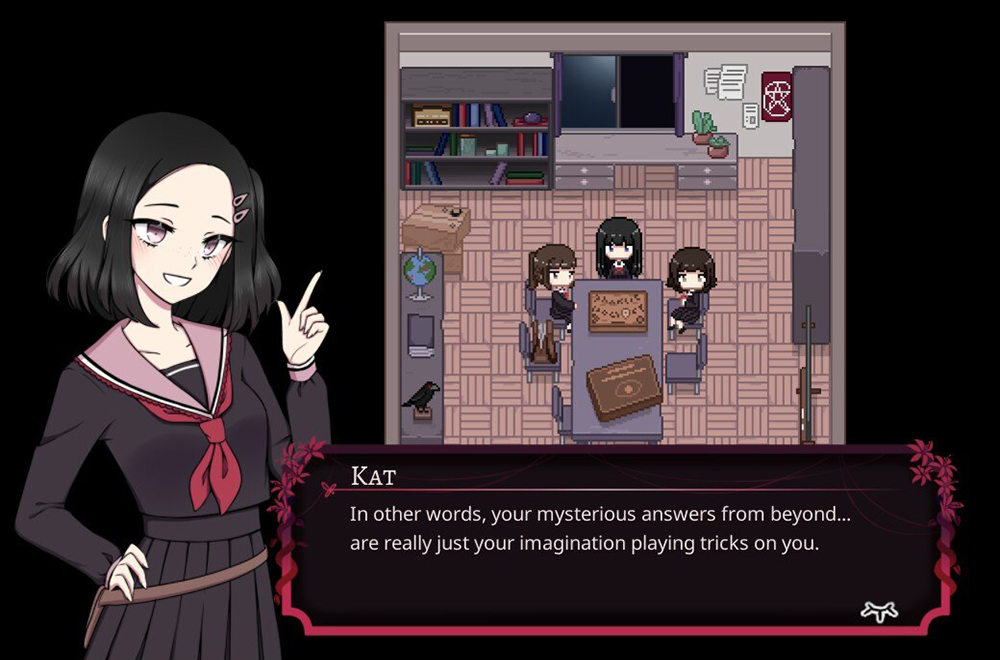
You play as a high school student named Kat who stays late at school one night to undertake an occult ritual of unknown origin and with unknown consequences. Kat has attempted a number of similar rituals, all to no avail. She claims not to believe in the supernatural and seems to be performing these rituals as a hobby. Unfortunately for Kat, this ritual is different.
As Kat, you have the run of three empty classrooms, a meeting room currently being used by the school’s Occult Club, and the Drama Club’s storage closet. Your job is to collect the materials needed for the ritual, such as chalk and candles, and then to perform the various steps of the ritual itself.
Coincidentally, the three members of the Occult Club are also spending the night at school. Kat taunts them as they experiment with a Ouija Board, saying that they’re deluding themselves. Despite getting the night off on the wrong foot, Kat can continue to talk with the three girls, and she can even recruit them to participate in the ritual with her.
This might be a mistake, however, as the instructions for the ritual state clearly that it must be performed alone.
Should Kat manage to complete the ritual successfully, the game ventures into a surreal space reminiscent of Yume Nikki. This is when the story stops pulling its punches, and the player begins to understand why Kat has started performing occult rituals – and also that her odds of surviving this one are very low. I was impressed by the visual creativity of the final section of the game, and also by the darkness of the ending it leads to.
I’m a fan of the Japanese tradition of occult “solo games” like One-Person Hide and Seek and Satoru-kun. While many of these rituals are meant to summon a spirit, the purpose of others is to create a gateway to a different dimension. If the dimension-linking ritual is performed correctly, what happens then? No one ever says, and Project Kat offers as good of an explanation as any regarding why this might be.
Since it’s a relatively short game, Project Kat leaves a number of questions unanswered. Still, I really enjoyed the story, which has good pacing and a nice tonal creep from camp into horror. Project Kat is a neat little game to play in one sitting, and the creators have released a longer story set in the same world, Paper Lily, which is free to play on Itch.io (here) and on Steam (here).
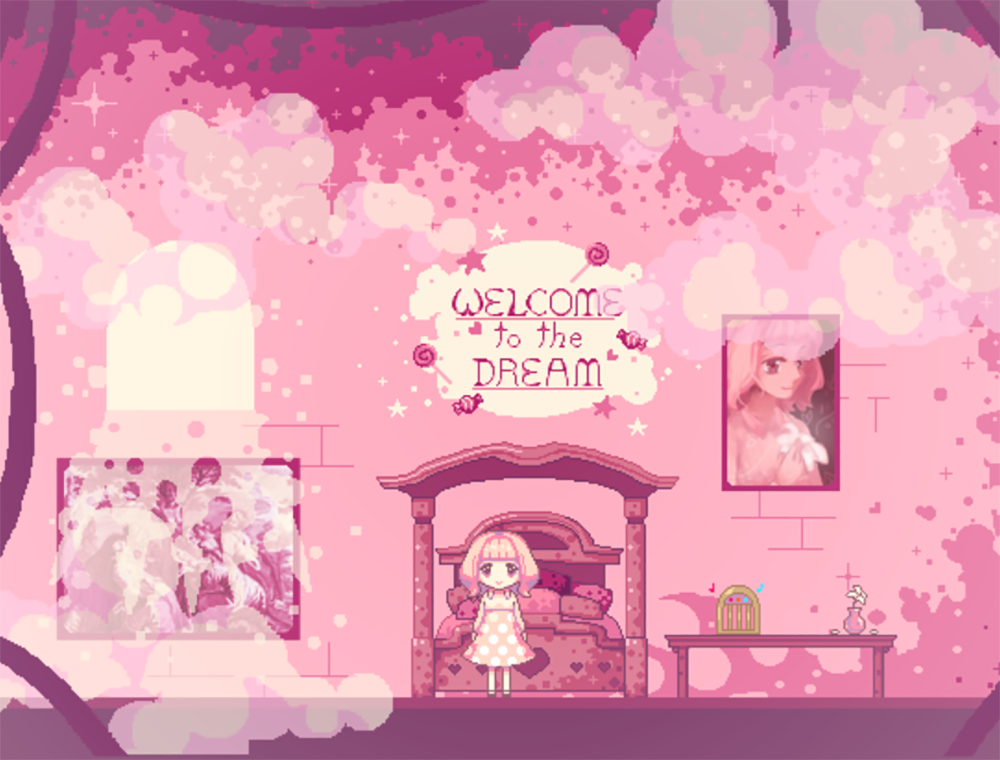
Dreaming Mary (available via the RPG Maker forums here) is a 2D narrative adventure game developed in RPG Maker by Dreaming Games. The opening of the game is super cute, but its pastel pink exterior hides a terrible secret.
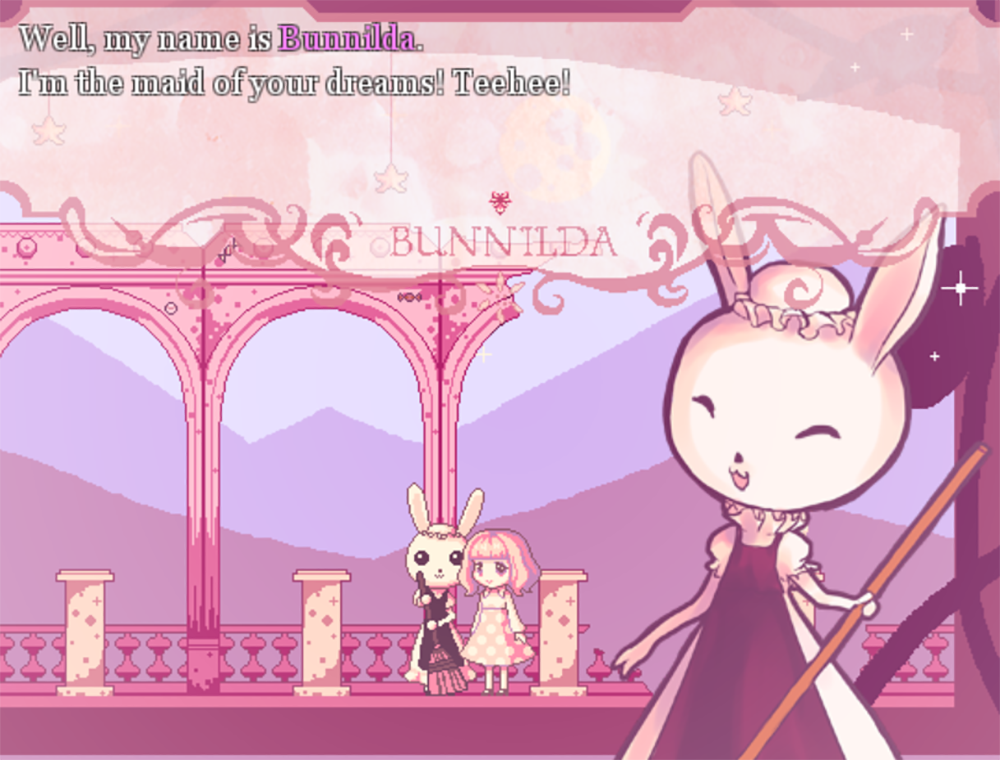
You play as the eponymous Mary, who begins the game in the bedroom of her dream world. She emerges into a lovely hallway with three rooms: a garden modeled on a Greek temple, an aristocratic library with floor-to-ceiling shelves, and a swank but cozy jazz bar. Each room is home to an anthropomorphic animal, each of whom wants to play a simple game. The friendly bunny needs advice on how to arrange her statues, while the flirty fox wants to play a round of hide-and-seek. The gentle owl asks a few questions about the books on his shelves.
At the end of the corridor is a beautiful tree guarded by a burly boar. If Mary wishes to progress further into the dream, this is her gateway, but she’ll need to collect the blessing of each animal first.
If you play through the game normally, you’ll arrive at a sweet but somewhat ambiguous ending after around 15-20 minutes. If you follow a walkthrough – I recommend this one – to discover the game’s secrets and see the full story, you’ll find your way to a far darker but more satisfying ending in around 30-35 minutes.
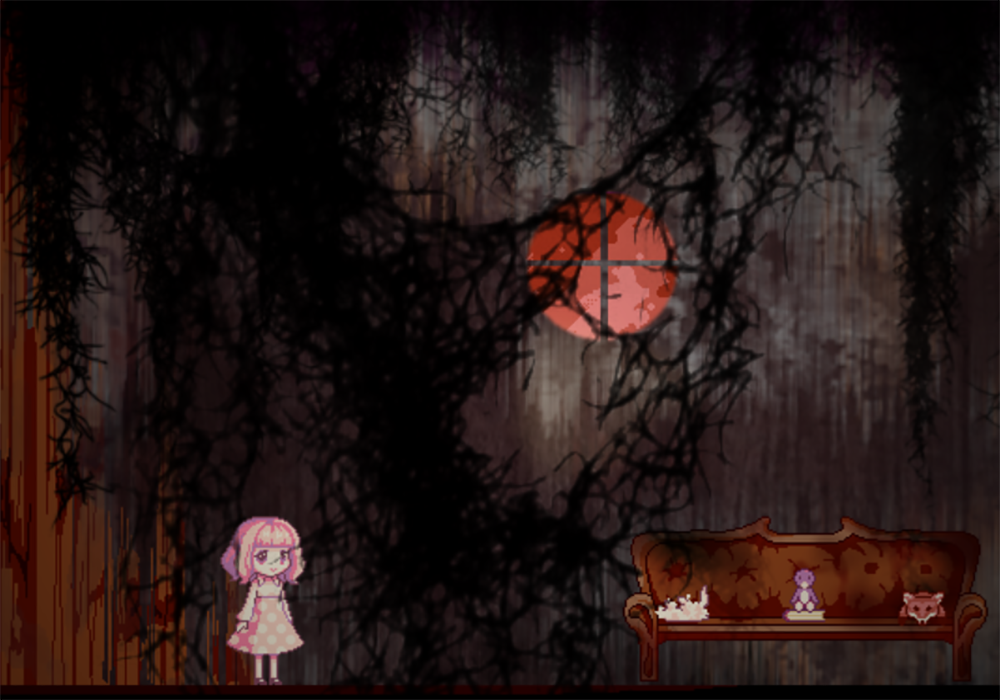
According to the developer’s notes, Dreaming Mary was inspired by the 2011 magical girl anime Madoka Magica, which similarly begins as a cute slice-of-life story before evolving into something much more complicated. Mary’s dream is as lushly pink and pastel as Madoka’s fantasies of becoming a magical girl, which makes the hidden nightmare segments all the more shocking.
Should Mary actually figure out how to wake up… That’s when the story becomes truly grim.
To give a fair warning, many of the puzzle solutions don’t make much sense, and I’m not sure how possible it would be to get the game’s true ending without a walkthrough. Still, it’s worth the extra effort, because the contrast between the sunny opening of the game and its sinister conclusion is something special.
Dreaming Mary was released in 2014. It seems the devs have gone quiet since then, which is a shame. While Dreaming Mary isn’t perfect, it’s promising, and I would have loved to see this prototype expanded into a more polished game. Still, Dreaming Mary stands well enough on its own as a short but intriguing indie horror story in the surreal lineage of Yume Nikki.
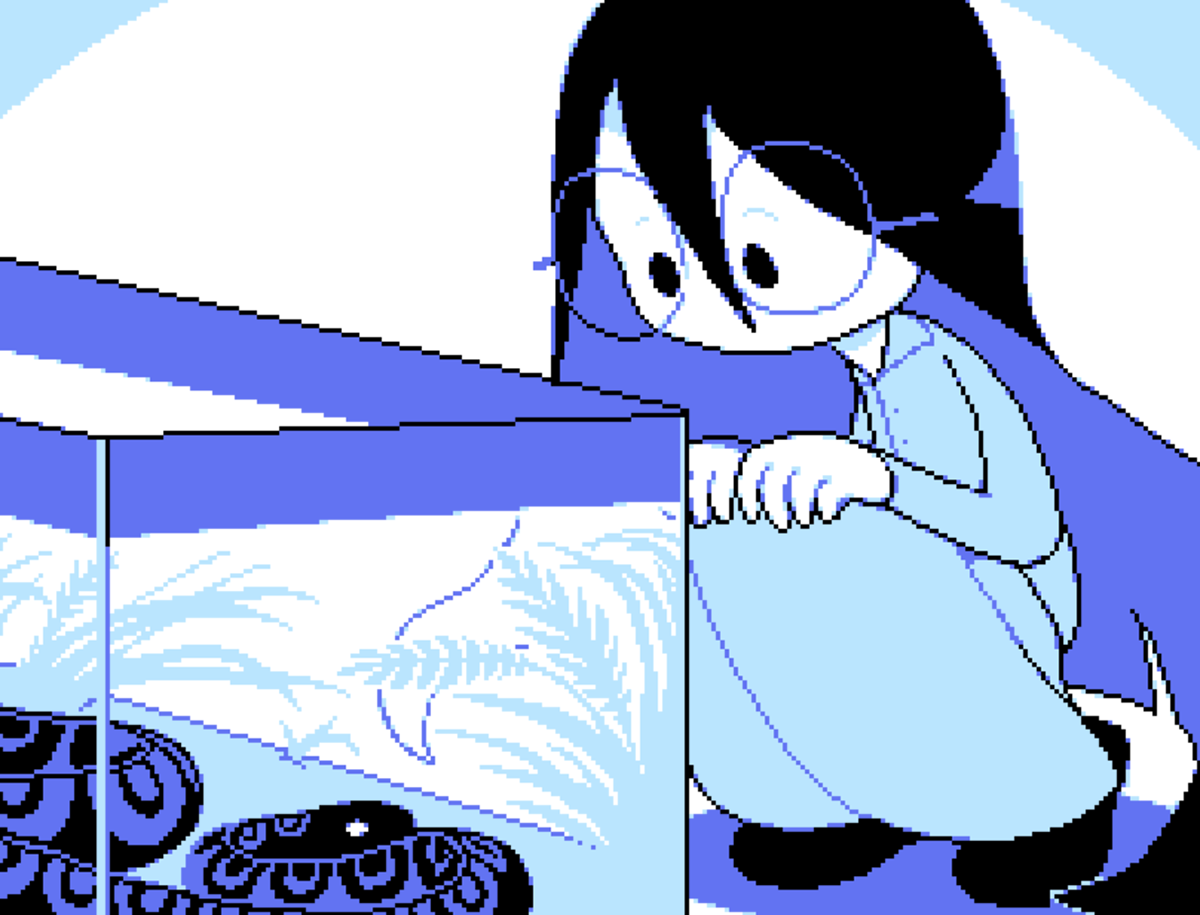
Escaped Chasm is a 25-minute dark fantasy adventure game created in RPG Maker with a mix of retro Game Boy graphics and anime-style cutscenes. Originally released in 2019, it’s the first stand-alone project of Temmie Chang, a longtime collaborator of Toby Fox who contributed character designs and graphics to Undertale and Deltarune.
You play as a young teenage “Lonely Girl” who doesn’t leave the house and lives vicariously through her dreams and art. Her parents appear to have gone missing, and she doesn’t know what to do. To make matters worse, she’s tired all the time, and a strange man has started appearing in her house.
Something is seriously wrong, and the Lonely Girl has four days to figure it out and escape. If leaving the house isn’t an option, where can she go? And how can she find the courage to leave?
Escaped Chasm is free to download, and the zip file contains an illustrated guide to the game’s four endings. I get the feeling that most players will probably see the good ending simply by playing the game naturally, but it’s nice to have grimdark alternatives. After unlocking the good ending, the player is able to enter and explore a bonus “developer’s room” that I love with all my heart. It’s fascinating to read Chang’s thoughts about making the game while checking out extra material that fills out a few gaps in the story.
Both Toby Fox and Temmie Chang were fans of and contributors to Homestuck, and it’s possible to see its influence on Escaped Chasm. It’s difficult to summarize Homestuck, but the webcomic begins as a story about four young teenagers who can’t leave their houses because they’re the last remaining survivors of a universe that’s unraveling around them. I get the sense that the Lonely Girl in Escaped Chasm is based on one of the four teenagers in Homestuck, Jade Harley, and it’s probably not a coincidence that she’s found herself in a remarkably similar situation.
Escaped Chasm is like a bridge between Homestuck and Deltarune in its theme of “using art and imagination to escape into another world,” but it’s also very much its own thing. I love Chang’s illustration style and narrative voice, and I admire how she pushes the boundaries of the medium to create a palpable sense of liminality and dread – and of catharsis and joy. Escaped Chasm is atmospheric horror with a (potentially) happy ending, and it’s idiosyncratic and self-indulgent in interesting ways that elevate it above the level of mere pastiche.
Escaped Chasm is a short test project made in preparation for Dweller’s Empty Path (on Itch.io here), a more extensive Game Boy style narrative adventure game. I really enjoyed Escaped Chasm, and I’m looking forward to jumping into Dweller’s Empty Path.
Symbiosis is a free-to-play RPG Maker horror game about a murderous mad scientist living in a house in the woods with an adorable child. The story has two endings, and it takes about 25 minutes to play through the game once.
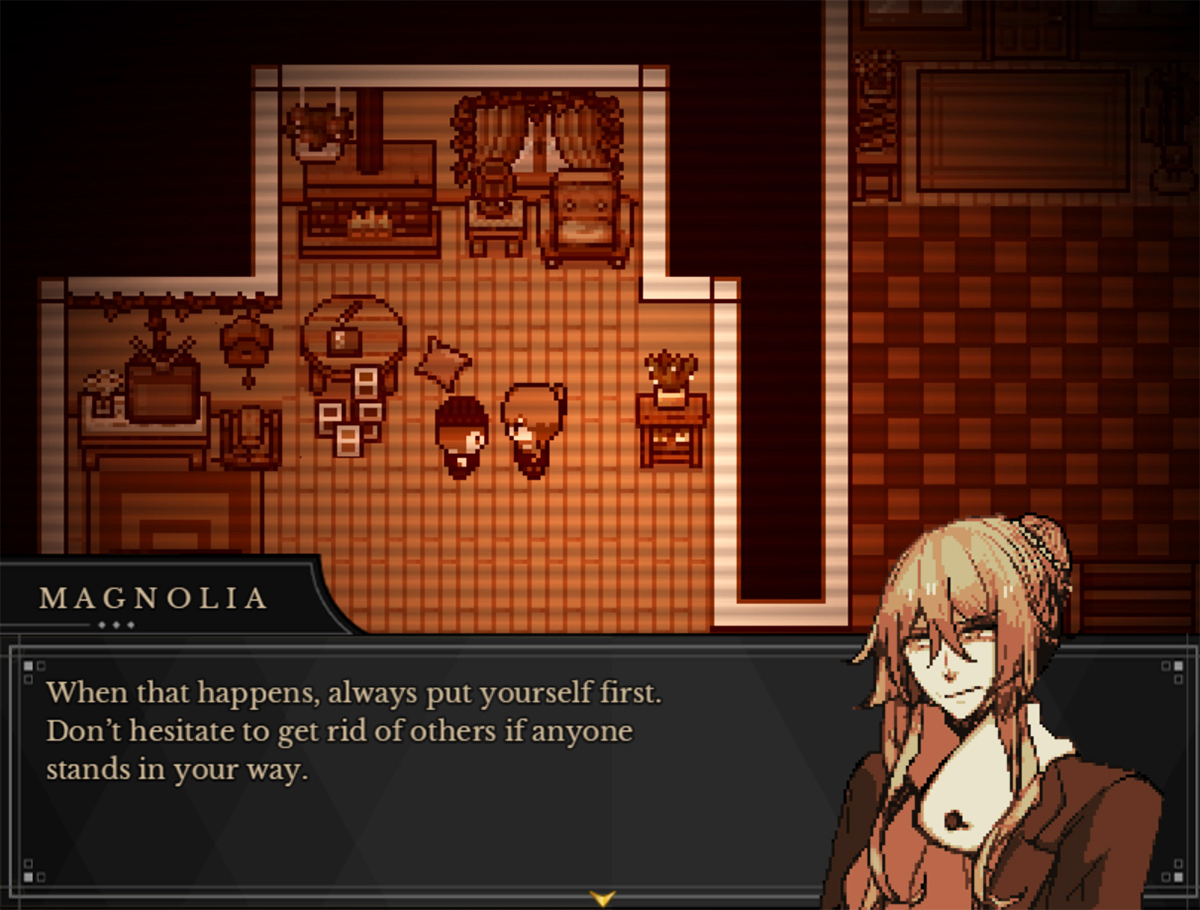
You play as Magnolia, a geneticist who left her university post after a mysterious fire broke out in her lab when her research came under public scrutiny. She now lives in isolation with Mint, a curious and precociously intelligent young boy whom she’s raising as her son. According to local rumors, Magnolia is a witch. It doesn’t help that hikers have a tendency to disappear in the forest surrounding her property.
The game begins as Magnolia carves up the corpse of someone she caught sneaking into her house. She’s interrupted by Mint, who can’t sleep and wants a bedtime story. Unfortunately, there are three more intruders in the house, and Mint won’t stay in his room. Your job as the player is to turn the remaining intruders into corpses – for science! – while ensuring that Mint remains out of harm’s way.
Magnolia’s house isn’t too terribly large, but it’s big enough to have all sorts of nooks and crannies to poke around, as well as various journals and research notes to find. The player can use these clues to figure out who Magnolia is and where Mint came from, although you’ll have to make your own decision regarding Magnolia’s feelings toward Mint and what the fate of the pair will be. The game’s creator has posted a guide for the two endings (here), and this short devlog also contains their thoughts on the story and characters.
What sets Symbiosis apart from the crowd of RPG Maker horror games is the creator’s gleeful willingness to allow Magnolia to be messy and problematic. She initially seems to be a complete sociopath, and her bad behavior is a joy to watch. As you witness her interactions with Mint unfold, however, her character becomes more complicated. Why Magnolia feels affection for Mint is open to interpretation, but I think it’s fair to say that her attachment is genuine.
The way I interpret this relationship is that it’s an analogy for the process of artistic creation (or scientific discovery, as the case may be). In order to create something meaningful, an artist has to be unpleasant, selfish, and more than a little antisocial. Gradually the art comes to take on a life of its own, and it’s up to the artist to decide whether to let it go or to keep it firmly in the orbit of their own dysfunctional personality.
Lest you think I’m spoiling the story, fear not – there’s all sorts of nasty business in Magnolia’s past for the player to discover. This woman is a legitimately horrible person, and her crimes are fantastic fun.
Symbiosis tells a short but grisly story through simple narrative adventure gameplay intercut with stylishly illustrated cutscenes, and I enjoyed it enough to go back and see both endings. I definitely recommend this game to fans of gothic horror, demonic women, and questionable scientific ethics.
Flesh, Blood, & Concrete is a free-to-play RPG Maker adventure game that bills itself as “an apartment building exploration simulator.” During its 45-minute playtime, the game delves into themes of isolation, mental illness, and existential dread within the confines of a decaying apartment complex.
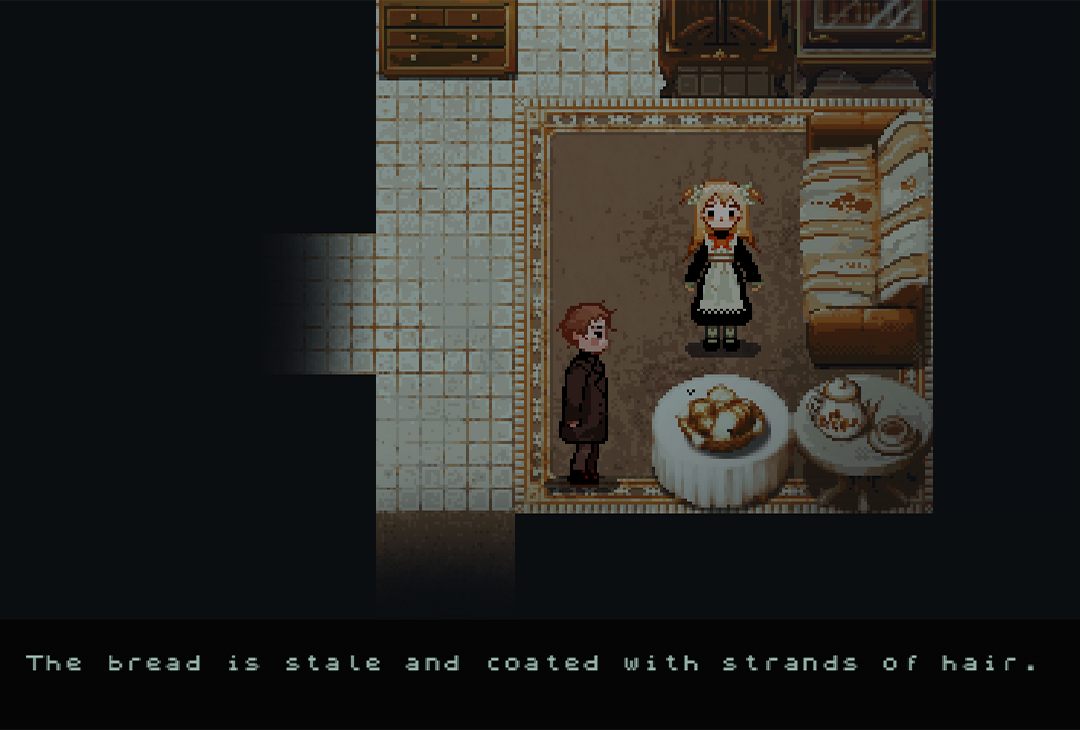
Players take on the role of Lera, a 28yo architect whose car breaks down in the snow. While seeking refuge from the cold, Lera meets a girl named Nika who, inexplicably, is dressed like an anime maid. Nika invites Lera to warm up inside her “house,” a giant abandoned apartment block at the edge of an unnamed town. As Lera, the player is given free rein to explore the building. The deeper inside you get, the stranger the architecture becomes, and it turns out that the “flesh and blood” of the title are not merely symbolic.
Flesh, Blood, & Concrete has no combat or puzzles. Instead, players explore the building and interact with the environment. In essence, your job is to collect items, which you can examine in the game’s small menu screen at your leisure. As you move from floor to floor and poke around all the vacant units, you gradually piece together Lera’s backstory through environmental storytelling and occasional conversations with Nika.
While the game’s pacing might feel a bit slow, the deliberate sense of space between incidents gives the player time to reflect on what exactly is going on with Lera. In my interpretation, Lera’s interactions with Nika hint at her desire to flee from the adult world, and I don’t think it’s a stretch to suggest that the dilapidated building is a manifestation of the intensity of Lera’s depression. At the end of the game, the player is confronted with a symbolic choice (the mechanics of which are explained in the creator’s spoiler-free guide), and what constitutes the “good” ending is open to interpretation.
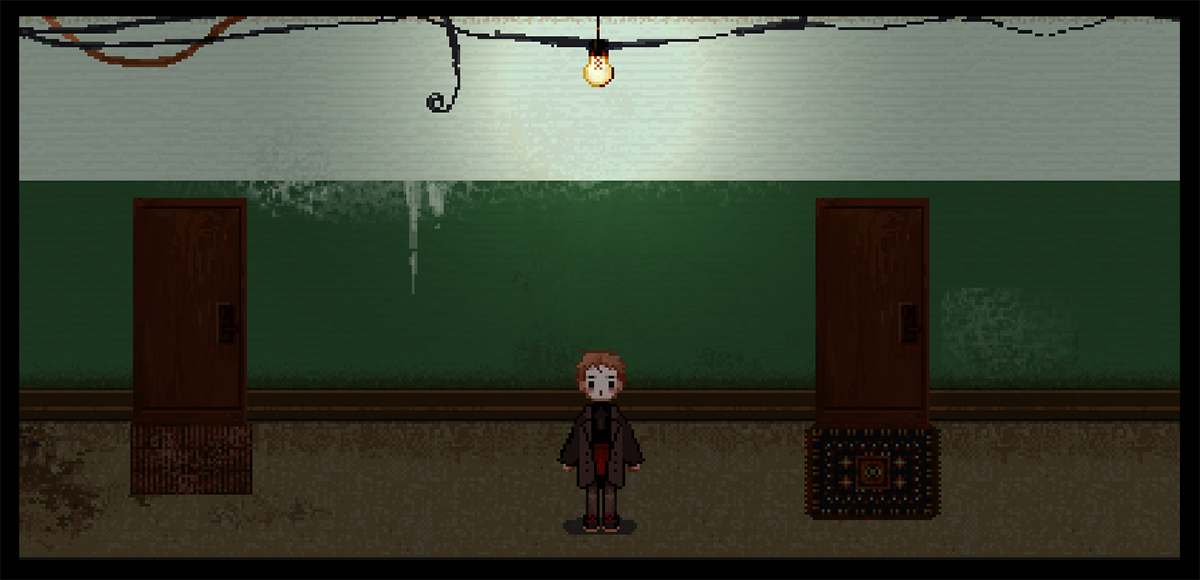
In keeping with the bleakness of the game’s themes, its pixel art is rendered in muted tones. The corridors are desolate stretches of flickering lights and peeling wallpaper, and the individual apartment interiors start off as charming and cozy but gradually descend deeper into the uncanny. The game’s soundtrack complements its visuals, with a blend of ambient sounds and minimalist synth piano pieces working to create a melancholic mood. Any sense of nostalgic coziness won’t last, however – some of the game’s visuals are sublimely gory.
As an aside, I recently played the indie narrative adventure game Indika, and I was thinking that I’d love to see more games set in Eastern Europe. Flesh, Blood, & Concrete is a universal story, but the specificity of the game’s Russian setting adds a unique and interesting flavor to its narrative and visuals. I also appreciate that this “apartment exploration simulator” takes the darker aspects of mental illness seriously but still delights in the playfulness of its morbid style of creative expression. It’s one of the more intriguing RPG Maker horror games I’ve encountered, and I’d recommend giving it a shot if you can handle the (literal) viscerality of its imagery.
Corpse Party is a 16-bit RPG Maker horror adventure game from 1996 that was released on multiple platforms before finally finding its way, in a substantially updated form, to the Nintendo Switch. It shows its age, but it’s definitely worth playing if you’re into retro-styled horror adventure games.
Corpse Party is divided into five chapters, each of which stands as a discrete unit accompanied by its own set of save files that can be selected from the main menu. Every chapter has a number of optional bad endings, but you need to achieve the good ending in order to unlock access to the next chapter. If you’re using a walkthrough, each chapter takes roughly an hour to complete.
You play as various members of a group of high school students who stayed late after school one evening to tell ghost stories. They unfortunately trigger a curse that transports them to an abandoned elementary school building that was shut down in the 1970s after a grisly series of abductions and murders. Different students occupy different pocket dimensions of the school, which is almost entirely cut off from reality. To make matters worse, your group of students isn’t the first batch of kids to be spirited away to the school, which is littered with corpses and haunted by vengeful ghosts. Your goal is to help the kids escape the school… if that’s even possible.
Corpse Party is extremely gory, and not all the kids are going to make it. The game contains intense depictions of mutilation and self-harm accompanied by vivid textual descriptions and occasional environmental illustrations of an uncomfortably graphic nature. The violence occupies an intersection between disturbing, gross, and campy, and I thought it was a lot of fun.
The main challenges of Corpse Party are of the standard “find a key to unlock the door” adventure game variety. The layout of the school changes from scene to scene, but it’s not large enough to get lost in. Aside from avoiding the occasional wandering ghost, there are no reflex challenges, and your characters are very rarely in any immediate danger. If there were jump scares, they didn’t register with me. The 16-bit character sprites are very cute, even when they’re depicting corpses.
As far as horror games go, Corpse Party is relatively chill, but with one caveat:
Corpse Party is completely linear and frustratingly opaque about what you need to do to trigger the next event in any given sequence. Unless you want to walk through endless dark hallways searching every square of the map, you’re going to need a walkthrough to get through the game. The walkthrough people use is (this one), but the walkthrough can sometimes be just as opaque as the game itself.
Personally speaking, I’m not the sharpest tool in the shed, but I managed to get through the first two chapters of Corpse Party without using a walkthrough. These initial two chapters stand on their own as a story, and I felt that they were actually the best part of the game. I think it’s probably safe to say that the opening of Corpse Party is more than enough to satisfy someone with a casual interest and playstyle.
The characters are usually divided into interesting pairs, and most of what you’ll do in the game consists of walking around inside the ruins of the school building while having conversations. The kids are very good about following horror movie rules – they don’t split up or do anything stupid – but they’re at the complete mercy of the ghosts of the original murder victims, who will change the layout of the school or create traps just to mess with them. For the most part, the kids are good and gentle and kind to one another, which makes it all the more upsetting when something bad happens.
The characterization and conversations aren’t that deep, however, so you never get so attached to any character that you don’t want to see them die. My favorite death is when one of the kids gets slammed against a wall so hard that his body explodes into red pulp, which all the rest of the kids have to walk through for the remainder of the game while navigating that particular hallway intersection.
Through disjointed and disconnected teamwork, your characters learn what actually happened to the ghosts haunting the school. For curious lore hunters, there are various bits of text scattered around, from newspaper clippings to messages left by other victims of the curse. These textual passages start off as grim and gradually grow more disturbing, and it’s always a pleasure to find something new to read. There’s also an optional collection quest that encourages you to find and interact with all the corpses in each chapter; and, if you like, you can return to the main menu and read about all the horrible ways these kids died.
It’s probably more accurate to call Corpse Party a “visual novel” as opposed to an “adventure game,” but it’s fun to explore the school while interacting with various objects in the environment. It’s also fun to gain access to new areas, both to learn more about the story and to see more of the game’s pixel art. One of my favorite areas is the outdoor pool in Chapter 4, which is filled with waterlogged corpses and preceded by a hellishly filthy locker room. Good times.
Despite its frustrations, I really enjoyed Corpse Party, and the English translation created by XSeed is fantastic. While reading the game’s Wikipedia page (here), I learned that there’s a manga adaptation (here), and I had so much fun exploring this horrible haunted school that I started reading it. It’s just as ridiculous and over the top as you’d expect from a manga adaptation of a horror game, but each chapter has one or two really great horror scenes enhanced by lovingly detailed and disturbingly gruesome artwork.
It’s Not Me, It’s My Basement is an RPG Maker gothic horror game from 2021 along the lines of The Witch’s House and Mad Father. It takes about 35 minutes to finish, and it’s free to download from Itchio.
You play as a kid named Embry whose parents have been eaten by monsters. Embry has managed to padlock the basement door, but the monsters are constantly hungry. The player is therefore tasked with feeding the monsters so they don’t escape and eat Embry. The game consists of navigating between Embry’s kitchen and the town market while stopping at the basement door a few times along the way.
The story is divided into three days, during which food becomes progressively scarce and the monsters become increasingly hungry. Each night, after feeding the monsters, Embry has a dream. All three dreams end with an extremely mild jumpscare, but the game is more concerned with creating an oppressive atmosphere than it is with trying to shock you.
What I appreciate is that it’s unclear what the monsters are or where they came from, just as it’s occasionally unclear what Embry is feeding them. Although you have the choice to enter the basement in one of Embry’s dreams, you never learn exactly what’s going on down there, and sometimes not knowing is worse.
If you’re worried that I just spoiled the game, please don’t be. There’s a lot going on here.
The creator has a few shorter games available on Itchio, some of which are loosely connected through a shared universe. The reason I chose to play It’s Not Me, It’s My Basement is because this game has a surprisingly large online fandom. Seriously, it even has its own page on TV Tropes (here).
It’s Not Me, It’s My Basement feels a bit like Homestuck run through a few filters. Everything about this game is catnip for edgy tweens. Even if that doesn’t sound appealing to you, It’s Not Me, It’s My Basement presents an interesting and open-ended story, and the game is a fun experience that doesn’t bother the player with any puzzle elements that impede the flow – or the steadily mounting creepiness – of the delivery.
Red Trees is a free nonviolent adventure story game made with RPG Maker in a style that emulates the Game Boy Color. It’s about a small village that might be haunted by ghosts in the woods, and it’s adorable.
The game is divided into three sections: the village’s residential area, its business center to the north, and the forest to the south. In order to progress from one area to another, you embark on an extended trading quest. For example, someone asks you to find their cat. To convince the cat to follow you, you need to feed it fish. In order to procure a fish, you need to give a can of worms to the person fishing at the local pond. The trading sequence isn’t strictly linear, but it’s not so complicated that you’d get lost or frustrated.
Red Trees isn’t a horror game by any means, but it gives me strong Omori vibes. (Although, having made that comparison, I should say that Red Trees was originally released in 2016, four years before Omori.) The music is relaxing, the character portraits are super cute, and the writing is wholesome with a touch of light humor reminiscent of Tumblr circa 2015. I especially love the menu screen’s character log, which collects short profiles of everyone you’ve met. The item portraits and descriptions are lovely as well.
Red Trees takes about an hour to complete, but this is mainly because of the game’s spatial layout. Your character can’t run, and the town is so spacious that it takes time to walk from place to place. This never becomes frustrating, but you may want to download the game so you can save your progress, step away, and come back later. Red Trees is extremely charming, and the experience of playing it is much more enjoyable if you take your time instead of rushing to finish it.
If you’re going to download Red Trees, you have the option of paying $2 to get an extra file folder of illustrations and a PDF booklet with annotated concept and development art. I highly recommend this extra material, but I’d also recommend not checking it out until you finish the game, as it spoils the ending. In fact, the bonus content functions almost like a separate postgame story, and it’s just as sweet and adorable as the game itself.
Capacity is a Game Boy style RPG Maker story game that uses generic pixel graphics and original character illustrations to tell a short fantasy-themed story about a bad relationship. The game describes this as “a toxic relationship,” but I don’t think it’s that complicated; it’s just a teenage girl who is hung up on a boy who clearly isn’t that into her. She doesn’t know how to let him go, so she embarks on a quest that she hopes will fix the relationship.
Capacity is extremely pretty and features a number of clever design elements. The monster art is great, and the final boss is a demon after my own heart. The game is driven by its narrative, and there’s no actual fighting. It takes about ten minutes to play, it’s totally free, and you can play it right in your browser window.
Capacity’s message is a bit heavy-handed and occasionally inappropriate to the situation. The game’s text drops mentions to “a cycle of abuse” and “generational trauma,” but really, it’s just a girl who’s hung up on a boy who isn’t that into her. Presumably because they’re both in their early teens. This isn’t to say that the boy isn’t a jerk and a coward, or that the protagonist isn’t a bit unhinged for pursuing him despite the clear “I don’t want to be involved with you” signals he’s broadcasting at every turn, but this is normal behavior for teenagers who are still figuring out how relationships work. It doesn’t make anyone a “toxic” person, especially not if they’re just a kid. We’ve all been there.
Putting the heavy-handed elements of Capacity’s story and writing aside, the game is really fun to play. In order to “save” your shitty “boyfriend” from his “curse,” you walk through a fantasy castle and interact with monsters, all of whom give you some variation of “he’s just not that into you.” At the top of the castle, the smoking hot Demon Lord tells you that a relationship doesn’t have to be like this, and that you deserve so much better. The fact that you refuse to listen to him proves that you still have some growing to do, and this is reflected in the game’s twist ending.
Capacity’s entire narrative structure emphasizes the point that sometimes your “demons” are right, and that you need to listen to what they’re trying to tell you about the situation that’s triggering your anxiety. It took me years to figure this out, and it’s a powerful message.








 Digital Fantasy Diary
