Project Kat

Project Kat is a short narrative horror game that’s free to play on Itch.io (here) and on Steam (here). A playthrough culminating in the game’s “true ending” will take about half an hour, but adventurous players might spend another fifteen minutes experimenting with paths leading to a premature death.

You play as a high school student named Kat who stays late at school one night to undertake an occult ritual of unknown origin and with unknown consequences. Kat has attempted a number of similar rituals, all to no avail. She claims not to believe in the supernatural and seems to be performing these rituals as a hobby. Unfortunately for Kat, this ritual is different.

As Kat, you have the run of three empty classrooms, a meeting room currently being used by the school’s Occult Club, and the Drama Club’s storage closet. Your job is to collect the materials needed for the ritual, such as chalk and candles, and then to perform the various steps of the ritual itself.
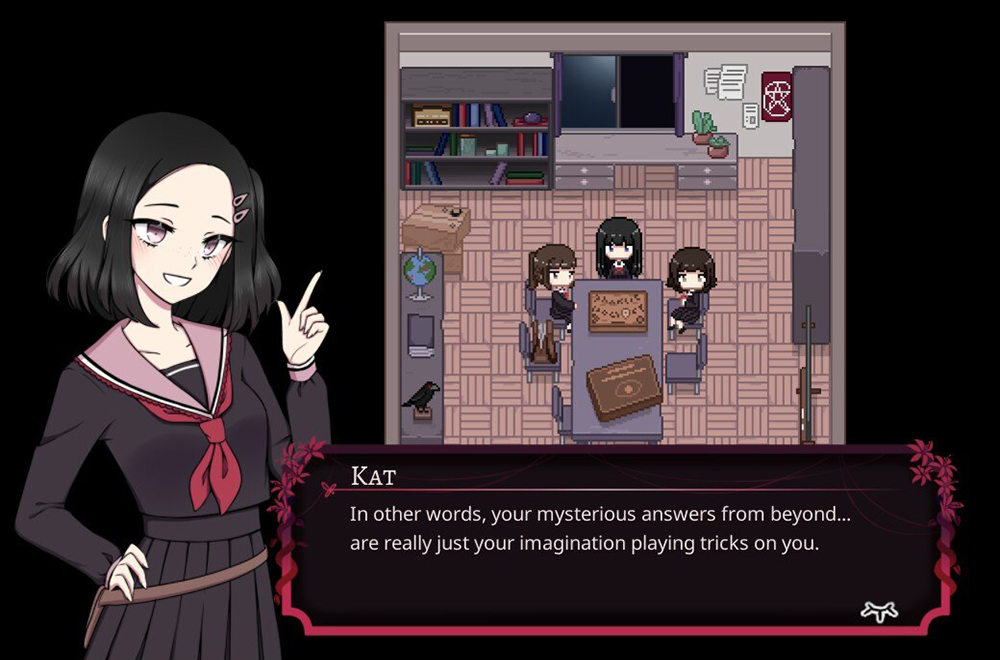
Coincidentally, the three members of the Occult Club are also spending the night at school. Kat taunts them as they experiment with a Ouija Board, saying that they’re deluding themselves. Despite getting the night off on the wrong foot, Kat can continue to talk with the three girls, and she can even recruit them to participate in the ritual with her.

This might be a mistake, however, as the instructions for the ritual state clearly that it must be performed alone.

Should Kat manage to complete the ritual successfully, the game ventures into a surreal space reminiscent of Yume Nikki. This is when the story stops pulling its punches, and the player begins to understand why Kat has started performing occult rituals – and also that her odds of surviving this one are very low. I was impressed by the visual creativity of the final section of the game, and also by the darkness of the ending it leads to.  

I’m a fan of the Japanese tradition of occult “solo games” like One-Person Hide and Seek and Satoru-kun. While many of these rituals are meant to summon a spirit, the purpose of others is to create a gateway to a different dimension. If the dimension-linking ritual is performed correctly, what happens then? No one ever says, and Project Kat offers as good of an explanation as any regarding why this might be.

Since it’s a relatively short game, Project Kat leaves a number of questions unanswered. Still, I really enjoyed the story, which has good pacing and a nice tonal creep from camp into horror. Project Kat is a neat little game to play in one sitting, and the creators have released a longer story set in the same world, Paper Lily, which is free to play on Itch.io (here) and on Steam (here).
Misao

Misao is a short 16-bit indie survival horror game originally released in 2011 and then published on Steam (here) as a remastered edition in 2024. The game is set in a high school that’s been transported to a demonic realm by the vengeful spirit of the eponymous Misao, a beautiful but quiet girl who mysteriously disappeared three months prior to the opening of the story. 

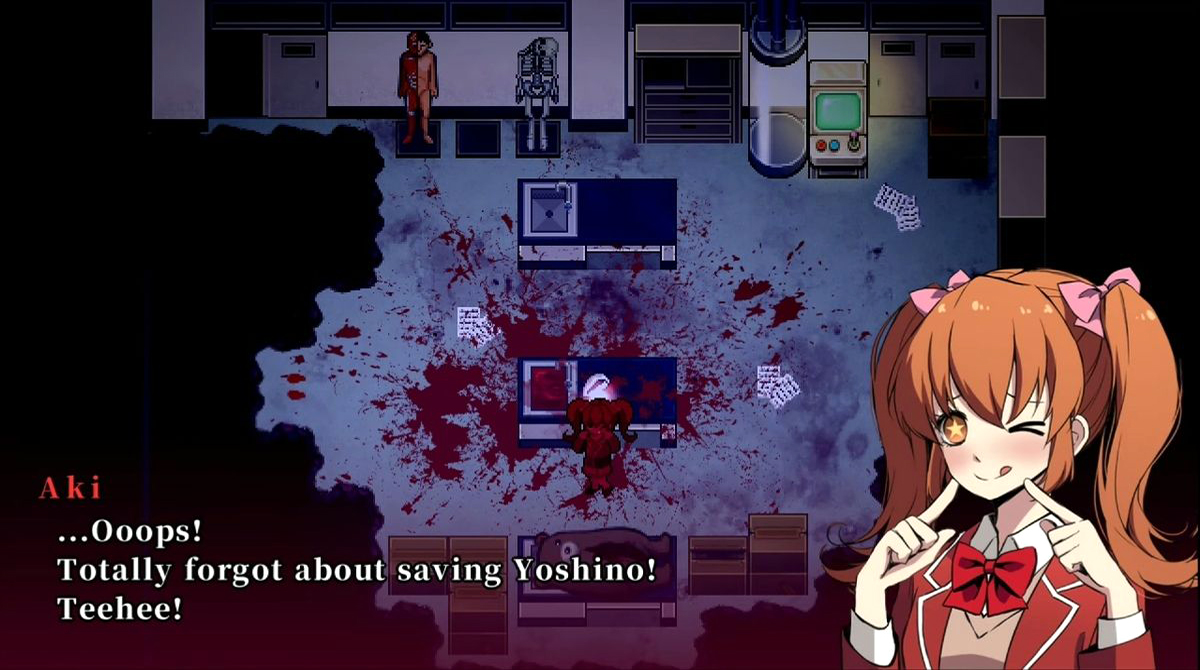
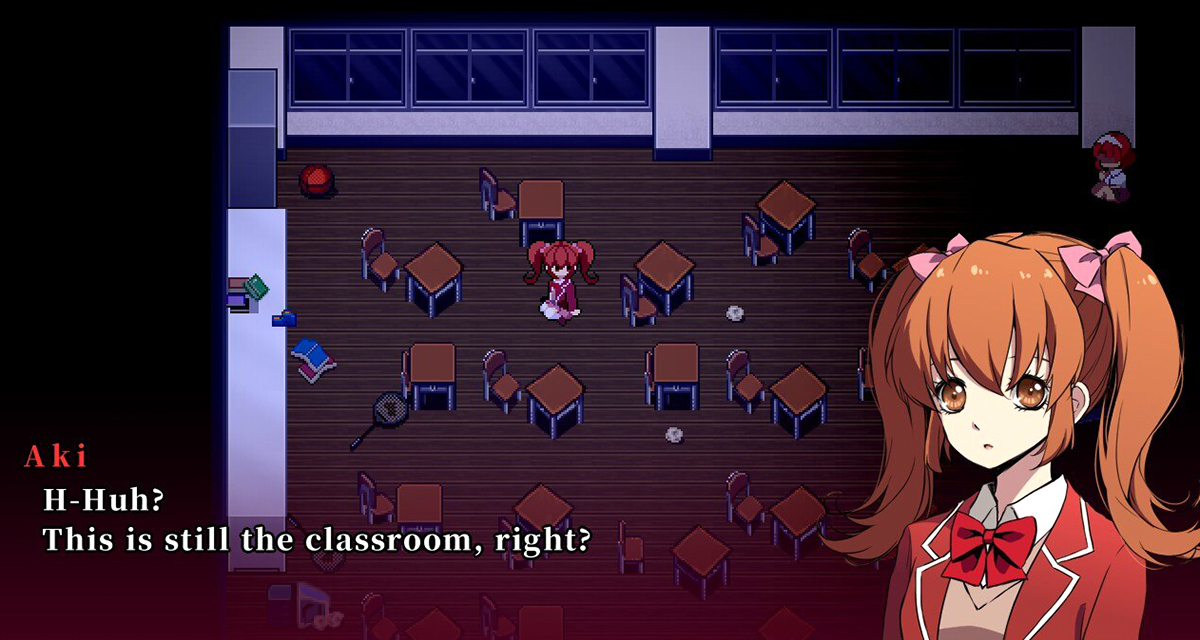
You play as a girl (or optionally as a boy, in the HD version) named Aki who suddenly hears Misao’s voice in the middle of class, asking someone to “find me.” The classroom is cloaked in darkness, an earthquake hits, and the school begins to fall apart in the aftershocks. As Aki explores the mostly abandoned building, she learns that four of her classmates were bullying Misao with the compliance of their homeroom teacher. Despite the intensity of the bullying, Misao didn’t kill herself – but someone else did.

The gameplay consists of navigating the school while collecting six objects necessary to piece together Misao’s story. There’s no set order to acquiring these items, meaning that the game starts off as somewhat confounding but gradually comes to make more sense. Once you get your bearings, what you need to do becomes fairly self-evident, but a walkthrough is recommended for players (such as myself) who might find themselves overwhelmed at first. There are several excellent guides posted to Steam, but I recommend (this one) on account of its helpful division into sections.

Like Mad Father (reviewed here), which was also published by Miscreant’s Room, Misao is essentially a haunted house simulator in which your player-character can die in dozens of delightfully gruesome ways. Thanks to a handy quicksave function, there’s no penalty for dying, and the player is encouraged to get into all sorts of trouble for the sole purpose of seeing what will happen. Aside from two short chase sequences, very little skill is needed to survive, just a bit of trial and error.

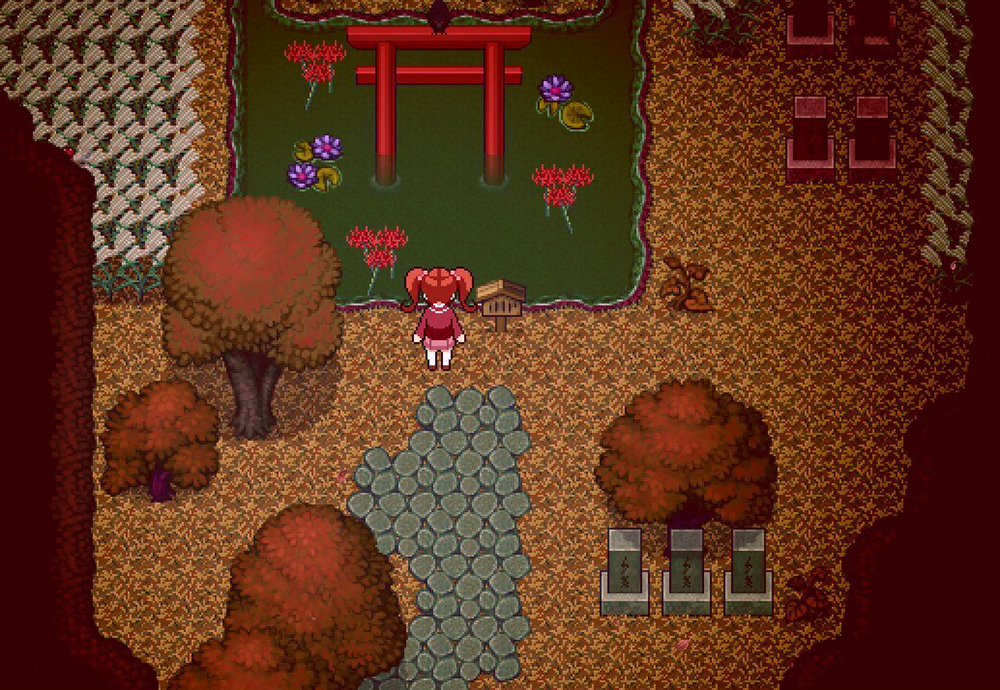
What I love about Misao is how much fun this game has with the tropes and imagery of a haunted high school. The laboratory is staffed by a mad scientist who has a chainsaw and will take advantage of any excuse to use it. The hamburgers in the cafeteria are made of unspeakable meat, and the seating area in front of the open kitchen is filthy with blood and entrails. The toilets haven’t been cleaned for a very long time, nor has the secret zombie cave under the school. The Shinto shrine in the courtyard is beautiful, but the rituals performed there are anything but.

Misao’s story mixes high school bullying and friendship drama with a mystery surrounding a twisted serial killer, and everyone gets exactly what they deserve. Still, for players who think high school kids shouldn’t be condemned to eternal damnation, Aki can rescue her classmates from their personal hells in a short epilogue. A few of the characters Aki encounters are native to the demon realm, and they’re all having the time of their lives. My favorite is the student librarian, who’s fully aware of the bloodshed surrounding her but just wants to make friends. She is a treasure.

If you’re not a completionist, Misao takes about two hours to finish, allowing the story to make an impact without testing the player’s patience through needless puzzles or gameplay challenges. The haunted high school setting is creatively rendered and a lot of fun to explore, even if the open-world structure is a bit overwhelming at the beginning.

The deaths are all creative and disturbing, but the retro graphics allow the game to feel campy instead of creepy, so much so that Misao sometimes feels more like a comedy than a horror story. I grew to feel a begrudging sort of affection for the characters, but I can’t deny that I had a huge smile on my face as I watched them get picked off – and really, good for Misao. I support her.

Dreaming Mary

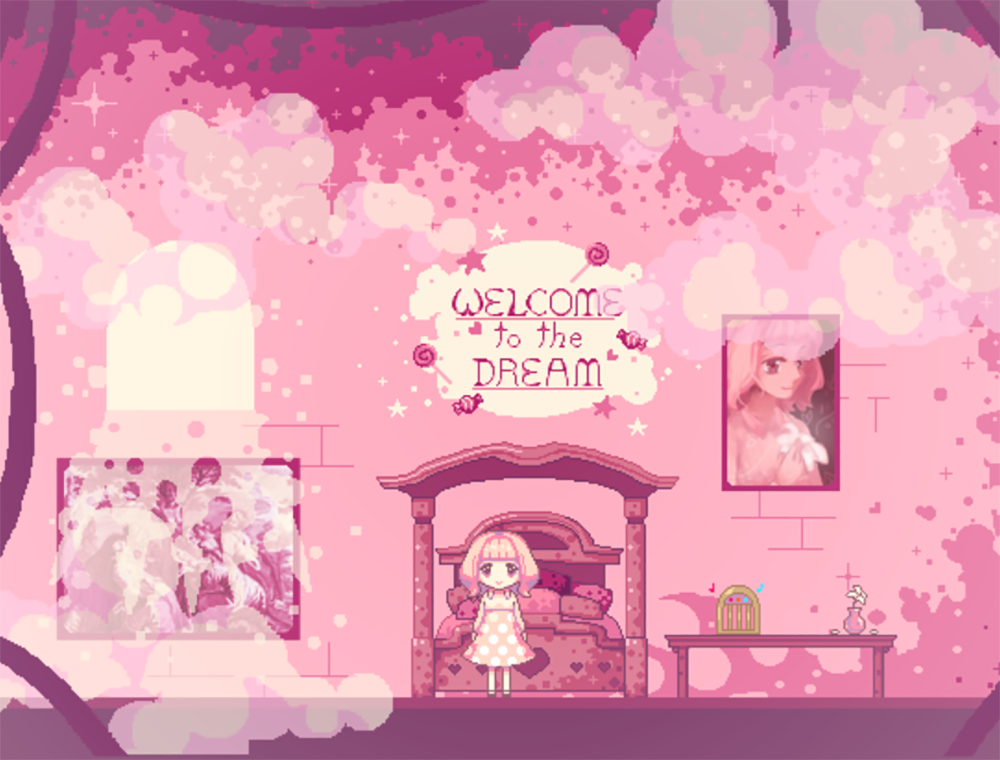
Dreaming Mary (available via the RPG Maker forums here) is a 2D narrative adventure game developed in RPG Maker by Dreaming Games. The opening of the game is super cute, but its pastel pink exterior hides a terrible secret. 

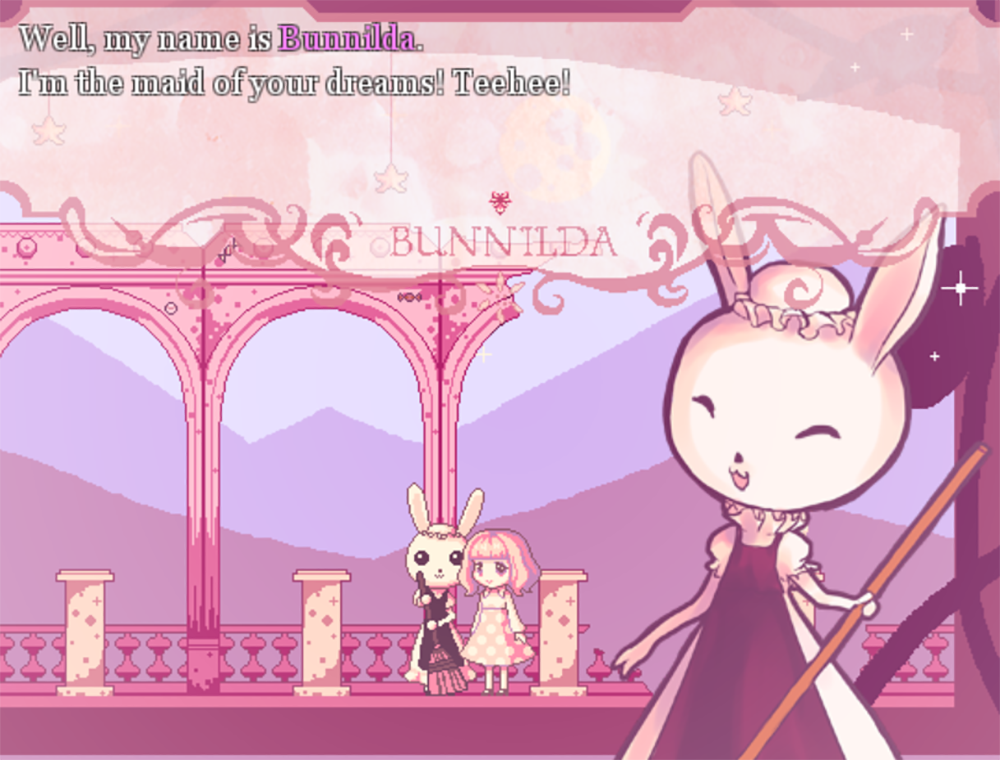
You play as the eponymous Mary, who begins the game in the bedroom of her dream world. She emerges into a lovely hallway with three rooms: a garden modeled on a Greek temple, an aristocratic library with floor-to-ceiling shelves, and a swank but cozy jazz bar. Each room is home to an anthropomorphic animal, each of whom wants to play a simple game. The friendly bunny needs advice on how to arrange her statues, while the flirty fox wants to play a round of hide-and-seek. The gentle owl asks a few questions about the books on his shelves.  

At the end of the corridor is a beautiful tree guarded by a burly boar. If Mary wishes to progress further into the dream, this is her gateway, but she’ll need to collect the blessing of each animal first.

If you play through the game normally, you’ll arrive at a sweet but somewhat ambiguous ending after around 15-20 minutes. If you follow a walkthrough – I recommend this one – to discover the game’s secrets and see the full story, you’ll find your way to a far darker but more satisfying ending in around 30-35 minutes.

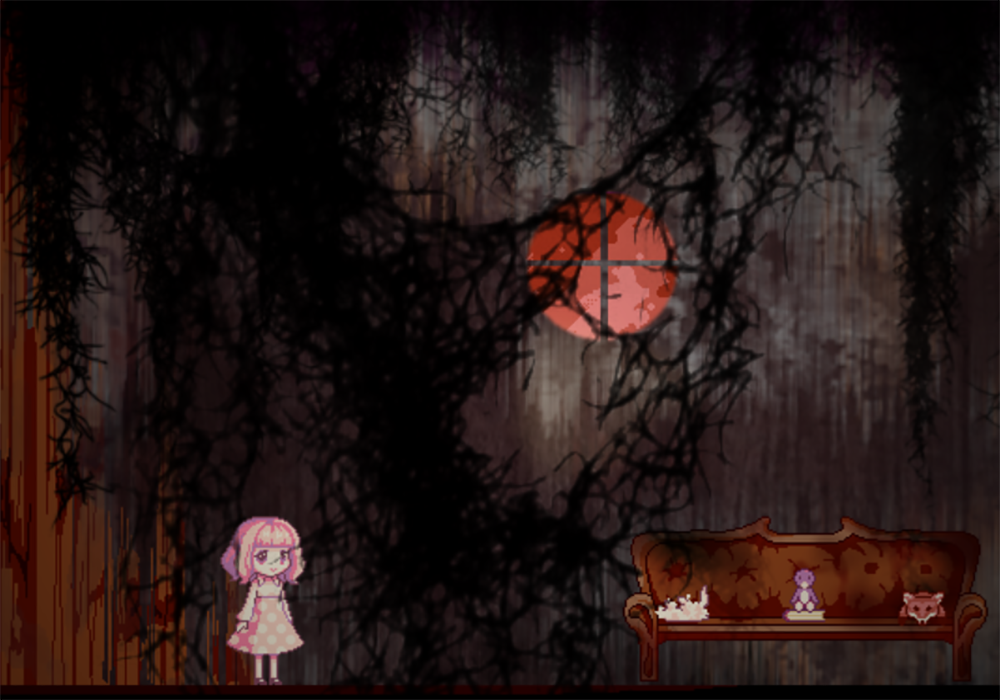
According to the developer’s notes, Dreaming Mary was inspired by the 2011 magical girl anime Madoka Magica, which similarly begins as a cute slice-of-life story before evolving into something much more complicated. Mary’s dream is as lushly pink and pastel as Madoka’s fantasies of becoming a magical girl, which makes the hidden nightmare segments all the more shocking.

Should Mary actually figure out how to wake up… That’s when the story becomes truly grim.

To give a fair warning, many of the puzzle solutions don’t make much sense, and I’m not sure how possible it would be to get the game’s true ending without a walkthrough. Still, it’s worth the extra effort, because the contrast between the sunny opening of the game and its sinister conclusion is something special.  

Dreaming Mary was released in 2014. It seems the devs have gone quiet since then, which is a shame. While Dreaming Mary isn’t perfect, it’s promising, and I would have loved to see this prototype expanded into a more polished game. Still, Dreaming Mary stands well enough on its own as a short but intriguing indie horror story in the surreal lineage of Yume Nikki.

Vartio

Vartio
https://store.steampowered.com/app/3639120/Vartio/

Vartio, a short and atmospheric horror game about walking through the woods at night, was developed by Pepperbox Studios and released on Steam in August 2025.

You play as a medieval soldier sent to an isolated fortress in the middle of a dense forest. As soon as you arrive, the guard captain explains your duty: you must patrol the woods by moonlight. Your job, as the player, is to follow a first-person circular path through the trees. You’ll complete three loops that result in a playtime of around 20 minutes. 

Though Vartio has a bit of a twist ending, there’s nothing explicitly scary in the game. Aside from an owl flying in your direction toward the beginning of the second loop, there’s nothing resembling a jump scare. The graphics are well-designed but primitive and repetitive, and nothing much happens, truth be told. There’s no pathfinding or puzzle-solving; you just follow the road. You can leave the trail to explore a bit if you like, but there’s not much you can see in the darkness.

Precisely because the walk through the woods is so boring, it’s likely that your imagination will begin to work overtime as you navigate the sounds of the forest. The first loop is fairly normal. During the second loop, however, you become more sensitive to any break from the regular noises. And the third loop… Well, it’s a surprise.

Vartio is creepy, but it’s also oddly relaxing, like ambient lo-fi beats for forest goths. If you’re a fan of atmospheric horror that gives you space to make up a story as you go along, Vartio is an intriguing combination of retro graphics and precision sound design that allows you to immerse yourself in the spookiness of a starlit sea of trees.

Retro Horror Games on Sidequest

My annual roundup of free-to-play retro horror games on Itch.io is now on Sidequest. There’s a gritty mix of fresh blood and decayed favorites in this year’s creepypixel harvest, from the recent haunted forest simulator Bloodbark to the Tumblr-favorite Flesh, Blood, & Concrete to the first game created by Deltarune artist Temmie Chang, Escaped Chasm.

You can check out the post here:
https://sidequest.zone/2025/10/15/retro-horror-games-on-itchio/

And there’s also my lists from October 2024 and October 2023, which are somehow even more liminal and retro.

I’m overjoyed to have commissioned a banner illustration from the shining Teller-of-Tragedies, who shares gorgeous and immersive dreamcore pixel art on Tumblr (here) and on Instagram (here).

Don’t Let Her In

Don’t Let Her In
https://flowerstudio.itch.io/dont-let-her-in

Don’t Let Her In is a free ten-minute horror game that you can play on a Game Boy Color emulator (such as mGBA) or directly in your browser on Itch.io.

You play as a teenager who hasn’t set foot outside the house in several weeks. Their father left a note on the kitchen table with a simple warning: Don’t let her in. As the player, you move through the house while interacting with various objects. You have one job, but you won’t be able to keep yourself safe forever.

Alternatively, you can ignore your father’s warning and invite the creepy woman inside the house as soon as she knocks on the kitchen window. This also leads to a satisfying story, although I’d recommend playing the game straight the first time around. The slow lead to the twist ending is wonderful, and having already experienced this twist makes the second ending much more satisfying.

The game’s graphics are simple but effective, and you might be surprised by how much body horror a few pixels can generate. The subtle worldbuilding is quite intriguing as well. There’s no good ending to this story, and its tone is bleak – there’s no irony or campiness, just horror. Don’t Let Her In may be short, but it’s remarkably effective at creating an atmosphere of loneliness and dread.

Crow Country

Crow Country is a retro-styled 32-bit survival horror game that takes about four hours to play. What I love about Crow Country is its Story Mode, which removes all enemies and allows you to enjoy the game as an atmospheric adventure in an abandoned amusement park.

The year is 1990, and you (ostensibly) play as a police detective named Mara Forest. Mara is investigating the disappearance of Edward Crow, the owner of a small amusement park called Crow Country. Crow Country shut down and closed to the public two years ago after a girl named Elaine Marshall was severely injured in an accident.

Although Elaine’s family sued Edward Crow for the hospital fees, he never responded to court summons, and now the park sits boarded up and abandoned. Mara has reason to believe that Crow has holed up on the property, so she breaks in and begins searching for clues pertaining to his whereabouts.

Unfortunately for Mara, there are zombies about. Thankfully, she has a gun and a car trunk full of ammo. There’s also ample ammo scattered throughout the park, as well as various types of guns (and grenades) for Mara to pick up and experiment with. I’ve heard that the zombies aren’t particularly aggressive, and that shooting them isn’t particularly difficult, but I wouldn’t know. I didn’t bother with combat, and I have no regrets.

Even in Story Mode, Crow Country is a dense game with a lot to do. The map isn’t actually that big, but every “room” has multiple points of interaction. Most of this interaction provides atmosphere and flavor text, but Mara also needs to solve environmental puzzles in order to find the tools she needs to progress deeper into the park.

Mara can collect bits and pieces of brochures that she assembles into a map that proves to be extremely useful, as locked doors and unsolved puzzles are clearly marked. Although I did have to look up one or two solutions for optional challenge puzzles, I was never lost or confused about what I needed to do next. Unlike many puzzle-based adventure games, Crow Country is entirely possible to play without a guide.

In terms of its PlayStation-era retro graphics, Crow Country looks exactly like Final Fantasy VII. All of the character models are composed of charmingly blocky polygons, and the environments are pre-rendered and gradient shaded. Points of interaction are easy to distinguish, and you can rotate the camera a full 360 degrees. It’s a joy to move through this environment, especially once you begin to open Dark Souls style shortcuts.

Crow Country isn’t a cozy horror game; there’s no learning or friendship or beautiful autumn leaves. That being said, the horror elements are very mild, especially in Story Mode. Despite the atmospheric creepiness of its setting, Crow Country is less of a horror story about zombies and more of a speculative fiction story about how humans process the reality of climate change – or rather, how we will do anything to avoid processing this reality. The game’s conclusion is fantastic, as is the foreshadowing leading to its final reveals.

I wasn’t expecting Crow Country to be so fun to play, or for its environment to be so creatively designed, or for its story to hit so hard. I have zero patience for “intentionally inaccessible” retro game nonsense at this point in my life, but Crow Country wants to be experienced. Since it’s so short and accessible, I’d recommend the game to anyone who’s interested in the premise, even if you’re not typically a fan of survival horror.

Melissa

Melissa
https://cattrigger.itch.io/melissa-heart

Melissa is a free-to-play retro horror visual novel about a rudimentary dating game on an old library computer. If you’re okay with dying quickly, it takes about seven minutes to play, but you can add a few more minutes by trying to stay alive for longer. The game has an easily accessible save system, so you can restart at every dialogue choice to see what happens when you beg for mercy. Good luck!

Melissa reminds me of the best parts of Doki Doki Literature Club without the need to scroll through an hour of cutesy school shenanigans. The initial dating game is exactly the sort of thing you’d find on a floppy disc next to Oregon Trail, and both the graphics and the sound design feel nicely textured and deliciously crunchy. The writing gets in and gets the job done, and the twist is a lot of fun.

The developer made a sequel called Morris
https://cattrigger.itch.io/morris-heart

…that is significantly longer (about 25-30 minutes) and also very good. The retro nostalgia appeal is amplified by the occasional internet dial-up sounds, and at certain points the game asks you to print things out on the library’s public printer, which makes adorable dinosaur noises. Aside from the eponymous Morris, the story featured two additional characters, both of whom are delightfully unhinged. In the comments on the game’s page on Itch.io, a few people said that they’d happily date the evil older woman, and honestly? Same.

It amuses me that Melissa and Morris are both named after famous computer viruses. If you’re interested, I recommend checking out these two bizarre FBI pages, if only for their top-notch banner graphics:

The Melissa Virus
https://www.fbi.gov/news/stories/melissa-virus-20th-anniversary-032519

The Morris Worm
https://www.fbi.gov/news/stories/morris-worm-30-years-since-first-major-attack-on-internet-110218

Anyway, it seems like the developer is making a full Date Time trilogy for release on Steam, and I’m intrigued by the work they’ve posted so far. It’s interesting to think that this universe of cursed retro dating games is informed by its own system of deep lore, and I’m always here for monster computer viruses who are down to smooch.

Fishing Vacation Review on Sidequest

I’m excited to have published my first video game review for Sidequest! I had the opportunity to write about Fishing Vacation, a Game Boy horror adventure game from 2020 that was released for Nintendo Switch at the beginning of June. Here’s an excerpt from my review…

What intrigued me about Fishing Vacation wasn’t necessarily its atmosphere of creeping horror, but rather how its story provides a critical perspective on the fantasy of “getting away from everything to live in nature.” During the prologue, your friend jokes about having quit his job, but there’s a sense of unease to his cheerfulness that’s later reflected in his nightmares. I imagine that many people harassed by the pressures of a prolonged economic recession have experienced similar anxieties, and perhaps many of us have entertained a similar fantasy of dropping everything to disappear into the woods. Fishing Vacation forces the player to confront the unpleasant consequences of cutting oneself off from society.

You can read the full review on the Sidequest website here:
https://sidequest.zone/2023/06/19/review-fishing-vacation-dredges-up-unwholesome-summer-fun/

Mad Father

Mad Father is a retro survival horror game about a cute girl named Aya who lives in an isolated mansion with her father. As you might be able to guess from the title, her dad is not 100% sane.

The game was originally designed with RPG Maker and released on Steam in 2012, but it’s been remastered for Nintendo Switch with updated graphics and sound design, as well as a few postgame bonus segments. It takes about three hours to play, and I felt that it was a good value when I bought it on sale on Nintendo’s digital storefront for $5. The horror is ghoulishly cheesy, and the jump scares are a lot of fun.

The opening of the game is nonlinear, as Aya has the run of the entire aboveground portion of the mansion. It’s somewhat difficult to understand what to do at first, and I admit that I had to consult a walkthrough to figure out how to get started. Once you gain access to the family’s sprawling underground murder dungeon, however, the path forward becomes easier to discern. Also, once you figure out how the environmental puzzles are supposed to work, they become much more entertaining.

As you grow accustomed to Mad Father during the first hour of playing, the jump scares become less effective, and the game compensates by leaning hard into camp. I don’t mean to suggest that anime can’t be scary, but Mad Father’s combination of over-the-top character portraits and cute pixel art amps up the carnivalesque elements of the story. By the time the dad starts chasing you with a chainsaw, my main reaction to the various horrors on display was delighted amusement.

There is one genuinely creepy moment toward the beginning of the game involving the father’s (nonsexual) reaction to the distress of a naked preteen girl, and it’s creepy because the game knows this reaction is upsetting but still treats it as perfectly natural. The killer dolls and unquiet ghosts haunting the tunnels of the murder dungeon aren’t actually all that scary, but the “kind” behavior of the father during the sepia-tinted nostalgia flashbacks is super disturbing. Mad Father is officially rated Teen, but it’s definitely not for kids (or adults sensitive to depictions of child abuse).

The basement of this family’s house is truly epic, by the way. The other day I was reading that a lot of families who live in McMansions don’t actually have any furniture in most of the rooms, and that makes sense to me. If you’re not imprisoning people to use as subjects for occult medical experiments, then what are you supposed to do with all that space, exactly? If nothing else, I suppose Aya’s dad is to be commended for his commitment to his interior decorating theme. It’s a shame that this theme is “horrible grotesque murder,” but if he’s paying the property tax on all those rooms then he might as well put them to good use.