Castaway

Castaway is a tribute to Link’s Awakening whose story campaign takes about 35 minutes to play. This campaign functions as a tutorial to the game’s Death Tower, in which you have one life to climb fifty simple and static floors with very few health drops and no permanent upgrades. The Death Tower is not for me, but the story campaign was a pocket of pure and unadulterated joy.

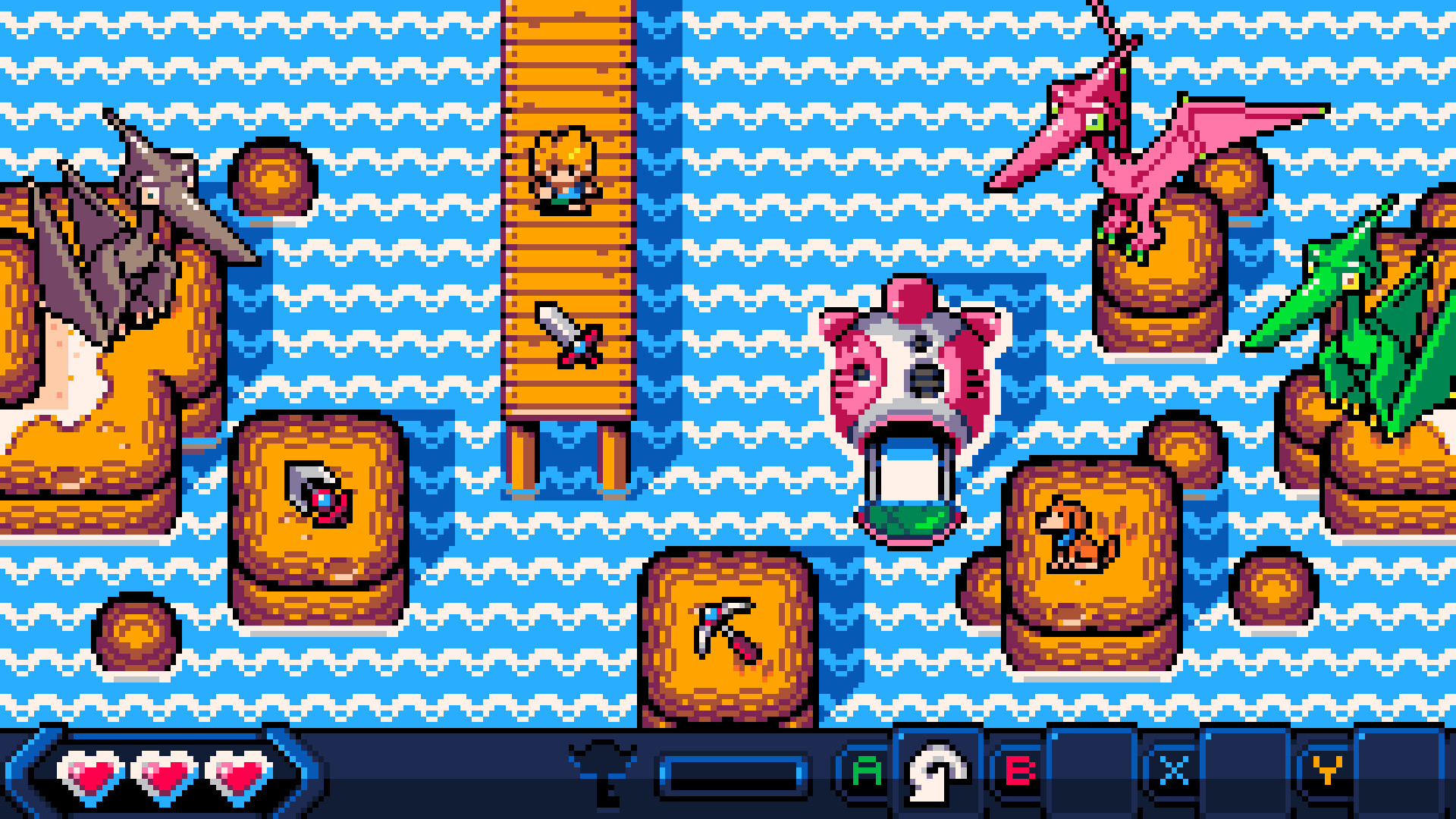
You play as a young boy whose escape pod lands on a deserted island after his spaceship blows up. After the crash, pterodactyls steal the boy’s survival tools and his dog, so it’s up to him to unsheathe his trusty sword and explore the island to get everything back.

The island is very small, as are each of the three dungeons. There’s no one to talk to, and there are only four types of enemies. The only aspects of the environment you can interact with are two types of rocks, so all of the puzzles involve sokoban-style block pushing. The two tools you find in the first two dungeons are a pickaxe that allows you to break rocks and a hookshot that allows you to latch onto rocks to cross gaps. If you use your tools to backtrack, you can collect three additional hearts to bolster your health.

The overworld map and dungeons are all tight and precise. More than a true imitation of a Zelda game, Castaway’s story campaign seems to be a stage for speedrunning, and there’s a special Speedrun Mode that allows you to see the clock onscreen. I tend not to care about such things, but the Speedrun Mode was a nice excuse to give the game a second playthrough with a bit more challenge.

The music and sound effects of Castaway are forgettable, but the graphics manage to achieve the trick of using modern technology to reproduce what you thought Game Boy Color games looked like when you were younger. The pixel art of the opening and closing animations is gorgeous, and the interstitial illustrations are lovely as well.

Whether this tiny game is worth $8 is debatable, especially if you’re not interested in speedruns or gauntlet survival challenges. I love Link’s Awakening beyond all reason, so I was happy to put down the money to support indie developers while spending an hour in nostalgia heaven. Still, it would have been nice if Castaway had more substance.

If you’re interested in the concept of Castaway but don’t want to spend money on something that feels like it should be a free demo of a larger game, please consider the alternative of Ocean’s Heart, a beautiful and robust Zeldalike game that’s honestly better than most actual Zelda games. If you’re interested, you can check out my review of Ocean’s Heart (here).

Neko Can Dream Review on Sidequest

I’m excited to have published a review of the indie narrative adventure game Neko Can Dream on Sidequest. Neko Can Dream was created by the Japanese yuri manga artist Nekobungi Sumire, who captures a complex and beautiful world inside the simple Game Boy graphics.

Here’s an excerpt from my review:

Neko Can Dream will take most players about two and a half hours to finish. Even though the narrative tone is gentle, the pace is quite brisk, and the excellent game design ensures that the player never becomes lost or confused. Certain elements of the individual character stories will resonate strongly with players interested in themes relating to queer identity; however, at its core, Neko Can Dream is about how the dream worlds of video games can help people at all stages of life recover from trauma and reach out for connection.

If you’re interested, you can read the full review on Sidequest here:
https://sidequest.zone/2024/05/27/neko-can-dream-bittersweet-nostalgic-treat/

Essay about Evergrace on Sidequest

My summer replay of Elden Ring triggered memories of an obscure PlayStation 2 game from 2000 called Evergrace. When I went online to see if anyone else had made the connection between Elden Ring and Evergrace, I was surprised to find that I seem to be one of the few people who remember this game. I did some deep digging and ended up writing an essay for Sidequest about why Evergrace is a forgotten FromSoft classic worthy of critical attention. Here’s an except:

Even in this brief description of the setting of Evergrace, FromSoft fans will notice various seeds of worldbuilding that have since sprouted into more developed forms in later titles, from the Darksign marking the Chosen Undead player-character in Dark Souls to the queen imprisoned in the towering Erdtree in Elden Ring. As I read about Evergrace, I was fascinated by the earlier forms of signature FromSoft leitmotifs that appear in the game, just as I was intrigued by its challenging elements of gameplay that would later evolve into the characteristic trademark of the Soulslike genre of video games.

You can read the full essay on Sidequest here:
https://sidequest.zone/2023/09/25/evergrace-a-forgotten-fromsoft-classic/

I’d love to write a substantial academic article about Evergrace, but I’m hindered by the fact that I can’t actually play the game without investing in a desktop computer that can run a PlayStation 2 emulator. Hopefully this essay presents a strong argument for textual documentation of classic titles, as well as freely accessible video game archives.  

Fishing Vacation Review on Sidequest

I’m excited to have published my first video game review for Sidequest! I had the opportunity to write about Fishing Vacation, a Game Boy horror adventure game from 2020 that was released for Nintendo Switch at the beginning of June. Here’s an excerpt from my review…

What intrigued me about Fishing Vacation wasn’t necessarily its atmosphere of creeping horror, but rather how its story provides a critical perspective on the fantasy of “getting away from everything to live in nature.” During the prologue, your friend jokes about having quit his job, but there’s a sense of unease to his cheerfulness that’s later reflected in his nightmares. I imagine that many people harassed by the pressures of a prolonged economic recession have experienced similar anxieties, and perhaps many of us have entertained a similar fantasy of dropping everything to disappear into the woods. Fishing Vacation forces the player to confront the unpleasant consequences of cutting oneself off from society.

You can read the full review on the Sidequest website here:
https://sidequest.zone/2023/06/19/review-fishing-vacation-dredges-up-unwholesome-summer-fun/

The Minish Cap

Nintendo recently released The Minish Cap on the Game Boy Advance virtual console included with its Nintendo Switch Online + Expansion Pack subscription service. This service costs $50 a year, and you have to pay the annual fee all at once. As a reminder: It is always morally correct to pirate Nintendo games.

The Minish Cap came out around the same time as The Wind Waker, and it translates a lot of The Wind Waker’s characters and enemy designs into a 16-bit pixel aesthetic modeled on A Link to the Past. As a Zelda game, the structure of The Minish Cap is very conventional: There are five themed dungeons in five themed zones. You must beat these dungeons in order, as the item you find in each dungeon allows you to access more of the world. All of the dungeons are well-designed, and it’s fun to navigate each of the five zones.

To me, there are three things that make The Minish Cap special. The first is a core game mechanic that’s brilliant and magical; the second is a minor game mechanic I hate; and the third is the game’s lighthearted tone.

The main conceit of The Minish Cap is that Link is able to shrink down to the size of the Minish, tiny little mouse-elves who live in adorable mushroom houses, hollowed-out books, and so on. The Minish spaces in the game are a Studio Ghibli fantasy on par with The Secret World of Arrietty, and there are a number of fun navigation puzzles that require Link to alternate between human size and Minish size. This is especially enjoyable during an item quest that requires you to return three books to the library, which necessitates navigating the central hub of Hyrule Castle Town at Minish size.

Unfortunately, the Minish are obsessed with fusing kinstones. A kinstone is a broken medallion, and several dozen NPCs are willing to connect their half of a kinstone with a matching half in your possession. A successful fusion will result in a small change somewhere in the world – a merchant will come to Castle Town, a treasure chest will appear in a cave, or a special golden monster will appear in the field. These fusions are mostly random, as are the kinstones you find. All of the game’s sidequests (if you can even call them that) are connected to kinstone fusions, and the randomness of the fusions can make these sidequests infuriating. Thankfully, none of the sidequests is necessary, as The Minish Cap is easy enough to play with just the bare minimum of resources.

I imagine that most players will probably think of successful kinstone fusions as fun bonuses, but a Zelda game without sidequests can feel a little empty. In addition, because many of these fusions are made with random NPCs at seemingly random points in the game, none of the sidequests is connected to a narrative.

This lack of substance and specificity is tied to the lighthearted tone of The Minish Cap, which doesn’t have much of a story. The King of Hyrule has been possessed by an evil Minish wizard named Vaati, who turns Princess Zelda to stone during the first ten minutes of the game. Because only children are pure-hearted enough to see the Minish, only Link can save Zelda. Meanwhile, none of the adults care about any of this.

Aside from Zelda and your trusty talking hat Ezlo (who has also been transformed by Vaati), nothing bad happens to anyone in the game. In fact, everyone is quite happy.

In The Wind Waker, the disconnect between the carefree world of the Great Sea and the importance of Link’s quest is a major thematic element of the story. The only person living on the Great Sea who cares about Hyrule is Ganondorf, and the only reason he cares is because he’s been woefully displaced in time. The fact that no one except the King of Red Lions understands Link’s quest emphasizes The Wind Waker’s tone of loneliness, and this is why it’s so emotionally impactful when Link finds someone who appreciates the stakes of what he’s trying to accomplish and volunteers to help.

Meanwhile, in The Minish Cap, Hyrule is densely populated by Hylians and Minish who seem to be doing just fine, even without a government. Aside from poor Zelda, everyone is living their best life, and no one needs your help. I can’t overemphasize that there is not a single element of darkness in this game, which has no narrative tension and very little forward momentum.

A fandom friend who recently played The Minish Cap for the first time said that this is the game they’d recommend to first-time Legend of Zelda players, and I can understand where they’re coming from. The Minish Cap is about as conventional as you can get. Overall, it’s really fun, and neither its combat nor its puzzles are difficult.

Unfortunately, the kinstone fusion sidequests can be hideously annoying, and the game’s “safe for children” cutesy tone makes the world and its story seem unimportant and forgettable. The Minish Cap feels like it was created for casual players, and your mileage may vary on how much you appreciate this.

In the end, The Minish Cap is still a great 8/10 game that’s very much worth playing, but it’s on an entirely different level than A Link Between Worlds, which perfected the top-down 2D Zelda formula while also featuring excellent writing and interesting design work. Given its limitations, I think The Minish Cap will probably appeal most strongly to 16-bit retro game fans, as well as its actual target demographic of ten-year-old kids.

Infernax

Infernax is an 8-bit 2D Metroidvania style game with platforming elements and dark themes that feed into a morality system. The retro graphics, music, and gameplay remind me of Shovel Knight, save that Infernax is the opposite of Shovel Knight‘s brand of quirky and wholesome family fun. Infernax boasts buckets of blood and plenty of creatively disturbing imagery, but the uniquely upsetting aspect of this game is its sidequests, which force the player to make distinctly unpleasant choices.

You play as Alcedor, a duke who served as a knight in the Holy War and returns to his homeland only to find it overrun with the undead. Your job is to infiltrate the five demon strongholds and thereby break the magical seal on your own castle, which is occupied by the big boss demon. You navigate the 2D overworld with the various skills that you acquire in the five 2D dungeons, and along the way you accumulate experience points and money that you can use to upgrade your abilities and equipment.

Infernax bills itself as having a “tough-as-nails” level of difficulty. I found that it isn’t actually that hard until the final two levels, in which the platforming is a bit too precision-oriented for the game mechanics. If you prefer, you can get around this difficulty by using Game Genie style cheat codes (these ones right here) on a menu that’s available at every save point. Using this system to allow yourself infinite lives and access a double-jump ability can really help you out toward the end of the game, where failure at the platforming segments is unduly punished.

I think it’s important to be realistic and accurate about the difficulty level of a game like this, as not everyone is looking for a super hyper mega challenge. Maybe some people just want to stroll around a horror-themed digital theme park while fighting skeletons and zombies, and that’s cool. Infernax lets you turn the cheat codes on and off at any point you like and doesn’t penalize you for using them, and it offers a decent but not impossible challenge to anyone who wants to play the game straight.

The parts where you might need to use a walkthrough are when Infernax asks you to make a binary choice. This choice is usually between showing mercy to monsters or outright killing them. The key to these choices is presented to the player at the very beginning of the game, when you’re asked to make a decision regarding whether to spare someone who has been possessed by a demon. If you’re a decent person and choose to spare him, he kills several people and forces you to kill him anyway.

In order to get the “ultimate good” ending, the player has to continue to choose to kill monsters. This isn’t always easy. Later in the game, for example, a town under siege has trapped another possessed person in a cage. The townspeople claim that the possessed man has killed people, and that he needs to be put to death. Succumbing to the will of an angry mob with torches in order to enact violence on a seemingly defenseless person in a small cage isn’t great. If you let him go, however, he kills everyone. Should you allow the townspeople to set the possessed man on fire, it takes a long time for him to burn, and he screams and thrashes in pain the entire time.

This violence is somewhat mitigated by the 8-bit pixel graphics, which add a layer of campiness to the grimdark world. What Infernax celebrates isn’t just the visuals and gameplay of 8-bit games, but also their unironic and unapologetic violence. Infernax leans into this goriness by having its overworld enemies constantly attack and kill soldiers right in front of you. You can save some of these people, but most become zombie food. Sometimes you’re forced to kill other humans, which can be bloody business as well. If you like, you can aim for the “ultimate evil” ending and kill other humans by choice. This makes the game more difficult in terms of gameplay but also more interesting from a narrative perspective.

Infernax delights in violence for the sake of violence. It’s not actually that deep, but it’s quite fun. Even as they’ve created a dungeon whose theme is literally “piles of dead babies,” the developers are sensitive to the needs of a diversity of players and allow you to customize the level of difficulty to suit your preferences. In addition, there are multiple guides online that will help you unlock all the various silly bonuses the game has to offer, which include letting you run around with a machine gun and giving you free rein to zip through the overworld on a motorcycle.

If you’re bad at games like I am, Infernax might take about ten to fifteen hours to finish without cheat codes. If you’re good at games – or if you use cheat codes – it can be finished in under five hours, which makes the prospect of exploring multiple morality paths more intriguing. Overall, I spent about twenty hours in ultraviolent medieval zombie demon hell, and I regret nothing.