Animal Well

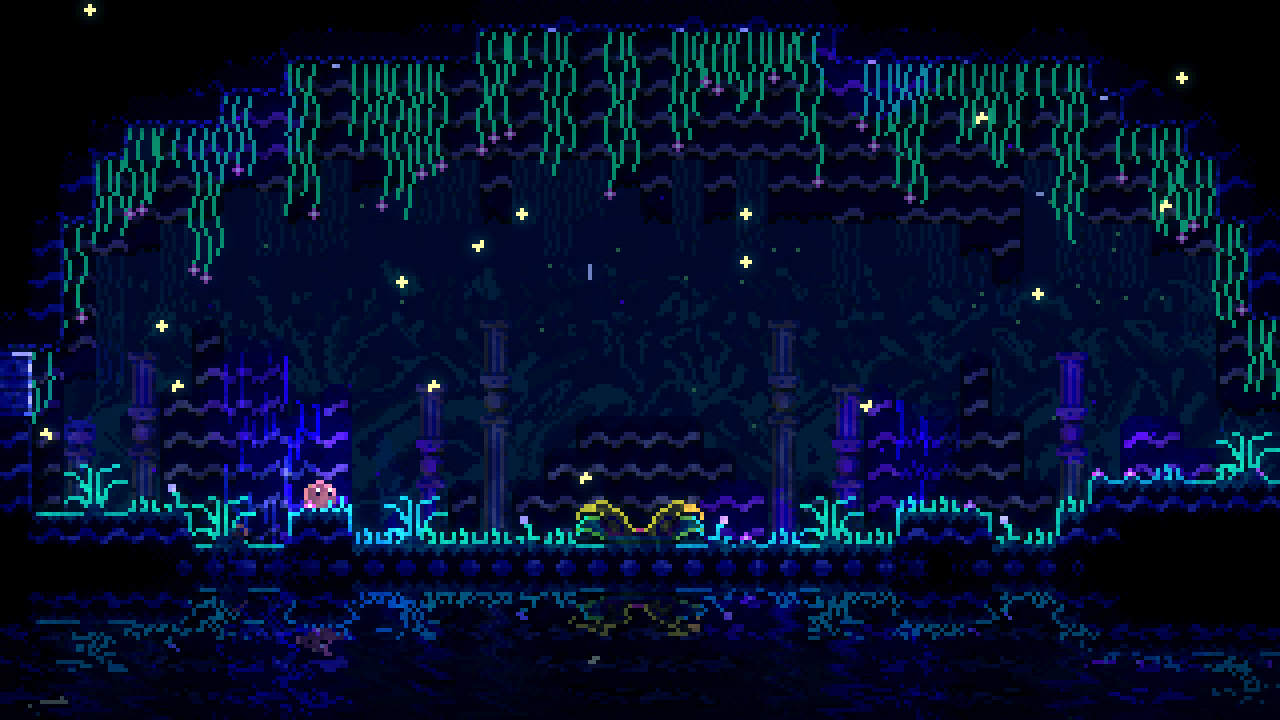
Animal Well is a no-combat puzzle platformer with an open-world Metroidvania structure. You play as a small seed navigating a mossy system of underground tunnels. The game has no dialogue or diegetic text, nor does it need any. Your job is simply to explore.

Because this is a video game, however, the player needs objectives. Early on in the game, the little seed arrives in what appears to be a central hub with statues of four animals. Each animal’s flame is sealed in a themed quadrant of the map. Although your map is mostly blank at the beginning, the location of each flame is marked, giving you four goals to work toward. Navigation is anything but simple, however, and figuring out where you’re supposed to go is just as much of a puzzle as any of the one-room set pieces.

Since Animal Well gives you so many paths to choose from, the beginning can be confusing. In many ways, this game reminds me of Hollow Knight and Hyper Light Drifter, which are similarly cagey about where the critical path might lie. Thankfully, there’s no wrong way to play Animal Well, so you’ll be fine if you simply choose a direction and start walking. Once you make your way into a level proper, the path forward becomes much easier to follow.  

As you might guess from the title, the vast underground well that serves as the setting of the game is filled with animals that theme the puzzles. In the dog level, for example, you’ll need to find a frisbee that you can throw to distract the dogs that chase after you. In the seahorse level, fish blow bubbles into the air that you can use to reach higher platforms. In the chameleon level, you’ll need to adjust the path of wall-climbing hedgehogs so that they hit otherwise inaccessible switches.
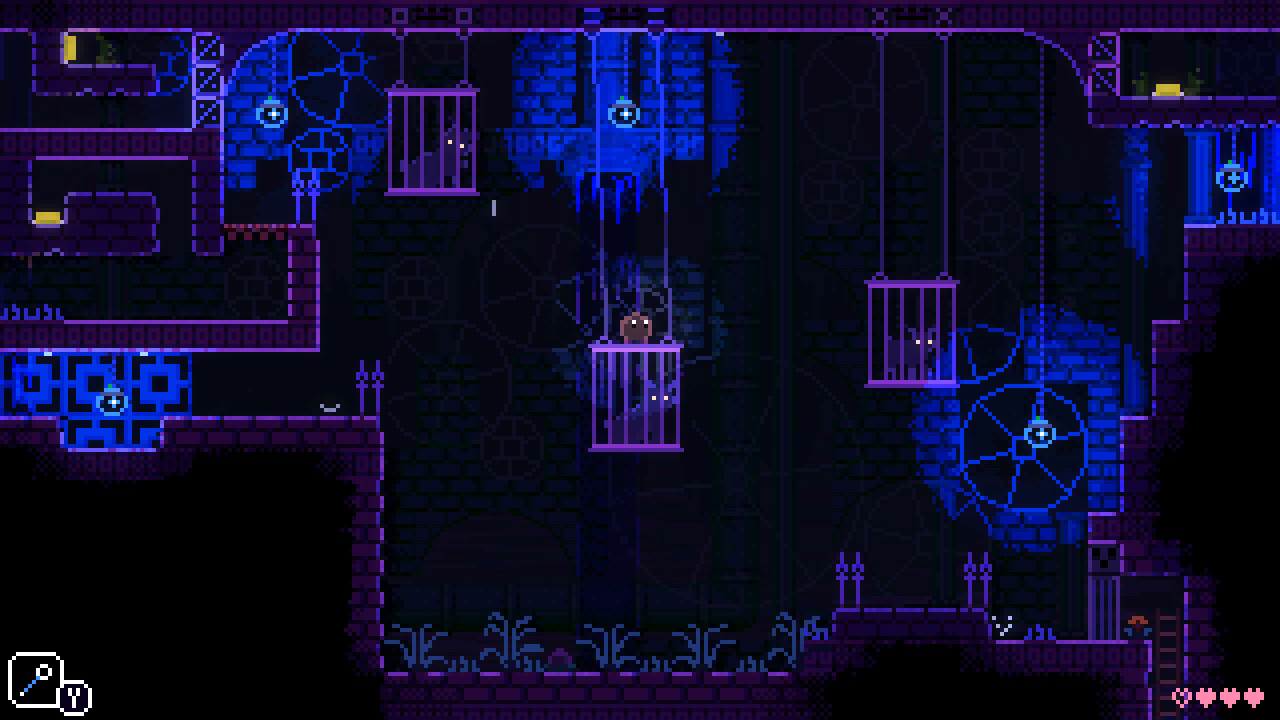
Animal Well offers the player a beautiful and evocative environment to get lost in, and it’s nice to see such a well-designed game that focuses on exploration instead of combat. Most of the platforming puzzles are relatively easy but still very clever, which I appreciate. The pixel art is gorgeous and atmospheric, and each area manages to express its theme while still maintaining a unified aesthetic that ties the various ecosystems together. There’s not much music, but the sound design is fantastic.   

If I have one complaint about Animal Well, it’s that the map is riddled with secret passageways that are completely unmarked. In addition, you can only make it so far into each level without the aid of a tool from another level. In theory, this means that there are eight levels instead of four. In practice, it can be frustrating not to know whether you can’t proceed because you need a tool from a different level or whether you simply missed a hidden path. Unless you happen to be either very good (or very patient) with this sort of thing, I’d strongly recommend playing Animal Well with a walkthrough.

It’s impossible to say how long Animal Well takes to play. According to reviews, it has the potential to be a five-hour game, but I get the feeling that the majority of players aren’t going to have such a smooth experience. If I had to guess, I’d say that most first-time players should expect to spend at least six or seven hours getting to the end. After that, there’s potentially another ten hours of exploration enabled by the tools you find at the end of the final area.

Is the cleverness and charm of Animal Well worth the aggravation of getting lost and not knowing what you’re supposed to do? That depends on the player, of course, and it’s worth saying that this isn’t a casual game. Still, although I wish Animal Well were less opaque, I appreciate that it’s not actually difficult. Exploration is always rewarded, and I never stopped being surprised and amazed by each new bit of the game I managed to find. Every single screen in Animal Well is a work of art.

After finishing Animal Well, I read the TV Tropes page to see if there’s an actual story to the game. Perhaps you can unlock a different ending if you can manage to find all the collectables? From what I can tell, there’s no real story no matter what you do, but there are collectables underneath collectables underneath collectables. There’s also an ARG. None of that is any of my business, but it’s cool I guess. I always appreciate when the people who created a game were living their best lives, and I’m happy to have an excuse to spend more time poking around the beautiful mossy tunnels of Animal Well

Inside

Inside is a 2.5D puzzle platformer originally released for the Xbox One in 2016. The near-future dystopian sci-fi setting contains strong elements of horror, and players should expect to experience numerous violent deaths. The game takes about four hours to finish, although a longer completionist run that involves accessing hidden areas will be rewarded with a secret ending.

You play as a ten-year-old boy, and you begin the game alone in the woods. The boy has presumably escaped from a shadowy research facility, and he’s being chased by dogs and men with guns. The boy will be killed if he’s spotted, so the player’s initial goal is to move to the right side of the screen while evading capture.

After the boy escapes from the woods, he emerges onto a farm littered with the carcasses of parasite-infested pigs. It’s here that the game introduces its central puzzle mechanic, which involves using a headset to control the mindless bodies of adult humans. When the boy makes his way out the farm and into a decaying city, it becomes clear that these mindless bodies were once marketed to the general population before the apparent collapse of human civilization.

Inside eventually finds its stride, but the puzzles at the beginning of the game have the potential to be frustrating for a first-time player. In order to progress through one of the barns on the farm, for example, the player has to backtrack to the left in order to open the barn’s back door. Opening this door allows a gaggle of chirping chicks to enter the barn.

The game has never previously asked the player to move from right to left, and there’s no indication that the chicks exist other than a faint chirping on the other side of the barn’s back door. It’s therefore not immediately apparent that these chicks are a necessary element to solving a puzzle that already has half a dozen moving parts. The game becomes much better about broadcasting puzzle solutions as it progresses, but it might be necessary to consult a walkthrough at the beginning.

The first quarter of the game also features another type of frustrating puzzle that involves crossing long distances to escape from attack dogs. If the boy dies at any point during one of these sequences, the player has to start over at the beginning, thereby losing up to six or seven minutes of progress. Repeatedly playing through one of these sequences only to fail at the end isn’t fun.

Thankfully, Inside becomes much better at managing respawn points after the boy leaves the farm. Many of the game’s later puzzles involve a combination of careful timing and brutal death, but they allow the player adequate space to stand still and assess the situation.

Tiny birds and bloodthirsty canines aside, Inside is visually striking from start to finish. The sound design is brilliant, and the audio works alongside the graphic design to create a palpable sense of danger and menace. Unlike Playdead’s earlier game Limbo (2010), which was more abstract and fantasy-themed, Inside is grittier and more focused on portraying a disturbingly realistic apocalypse.

As I played Inside, I could envision its story evolving in two ways. My first theory was that the boy is a host for the same parasite that killed the pigs on the farm; and, if he escapes into civilization, the infection will spread and the world will be doomed. My second theory was that the boy is being controlled just as he controls the mindless bodies; and, after he accomplishes his mission, he will be unplugged.

The actual endgame story developments are nothing even remotely resembling what I expected. Instead, Inside gradually transforms into a meditation on bioethics and subjectivity that’s all the more striking because of the player’s interaction with the story. I’m still not sure how to interpret the ending, but the path to get there involves one of the biggest ludo-narrative surprises I’ve ever had the pleasure to encounter. I usually don’t have any patience for concerns over spoilers, but I’d recommend going into this game spoiler-free. The ending of Inside genuinely has to be experienced to be believed.

Hoa

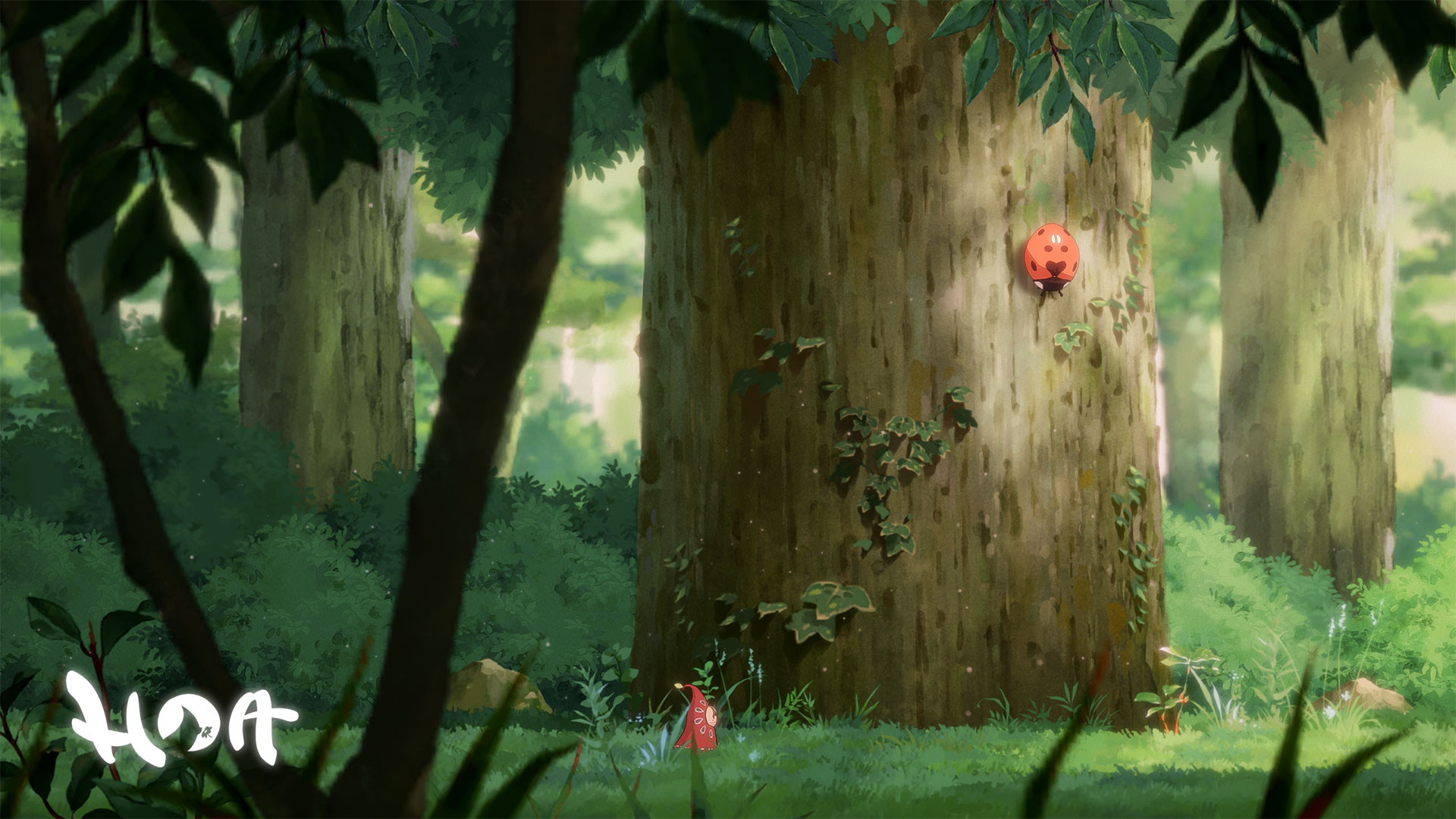
Hoa is a short and nonviolent 2D puzzle platformer set in a gorgeous green world of hand-painted art. If you’ve ever watched a Studio Ghibli movie and wanted to spend more time exploring the backgrounds, Hoa was made for you. The game’s gentle piano music is reminiscent of a Joe Hisaishi score, and Hoa gave me strong My Neighbor Totoro vibes in all the best ways.

You play as a tiny fairy who has returned to the forest after a mysterious trip across a body of water. Your motivation is unclear, but your character seems to want to make her way back to her home. Along the way, you navigate eight levels organized according to simple themed platforming puzzles. Your goal in each level is to wake the level “boss” by restoring light to their sigils, and the boss will give you a new navigation ability once you collect all the golden butterflies scattered throughout the level.

There is no combat or hostility in Hoa, and successful navigation of each level requires the cooperation of its denizens, which include snails, ladybugs, jellyfish, and tiny little robots. As your character walks, flowers bloom and leaves unfurl to help her on her way, and she double jumps in a swirl of sparkling pixie dust. All of this magic is understated and feels like a natural part of the world, and every new level is filled with pleasant surprises.

Unfortunately, there are parts of Hoa that are somewhat unintuitive, especially toward the beginning.

In the first area, your character is taught that she can break horizontal branches if she jumps on them with sufficient force. In the next area, she’s presented with a vertical branch blocking her way. On a higher level, a bug repeatedly rams into another vertical branch, eventually breaking it. It seems the message is clear: If you ram into the vertical branch on your own level enough times, it will eventually break.

This is not what the game is trying to teach you, however. What the game wants you to do is leave the room and walk all the way around the area so you can enter the room from the opposite side, where the branch that the bug knocked down now forms a bridge to another room. Hoa is trying to teach you that all of the rooms in an area are interconnected, and that sometimes you’ll need to approach a puzzle from a different direction. This makes sense, of course, but it’s counterintuitive. When I tried to search for a walkthrough, I found dozens of people asking the same question: How do you break the vertical branch?

In other words, it’s easy to understand what the level design seems to be suggesting, but it’s harder to understand whether that’s the solution the designers intended. I won’t lie – this can be frustrating.    

Once you get deeper into Hoa, you’ll begin to understand how the designers constructed these puzzles, but the game’s combined lack of precision and flexibility still creates unnecessary moments of tension. Although Hoa seems to be aimed at young children, I feel like it demands an unusually high level of patience and forgiveness, as well as an ability to read the abstract intentions of the designers instead of the concrete environment of the game. I would say that Hoa may indeed be a good game to play with a kid, but you probably want to play it all the way through by yourself first.

I should also mention that there’s a gameplay twist in the final level. It’s very good, but it’s also legitimately challenging in a way that the game hasn’t prepared you for. The basic gameplay loop is significantly disrupted, and there’s a certain tricky sequence about halfway through the level that I imagine might cause many players to quit the game without finishing it. Still, even if Hoa doesn’t perfectly execute what it’s trying to do here, it offers the player an interesting concept presented with a surprising degree of style and creativity.

I don’t want to suggest that these moments of frustration break the game. Once I was able to get past the idea that Hoa is supposed to be easy and intuitive, I was able to have a lot of fun with it. After you get a better sense of what the game wants you to do, you can make your way through the later areas with minimal hassles as you enjoy the art and music, both of which are well worth the experience.

My first playthrough of Hoa took about two and a half hours, which includes the time I spent searching for puzzle solutions online. My second playthrough was a smooth one hour, and it was a chill and peaceful experience. I’d say that Hoa is a solid “7/10 game” in the best sense of what that generally means, with the more unpolished elements serving to endow the game with a unique sense of character. All things considered, I’m happy that Hoa is a piece of hand-crafted art that exists in this world.