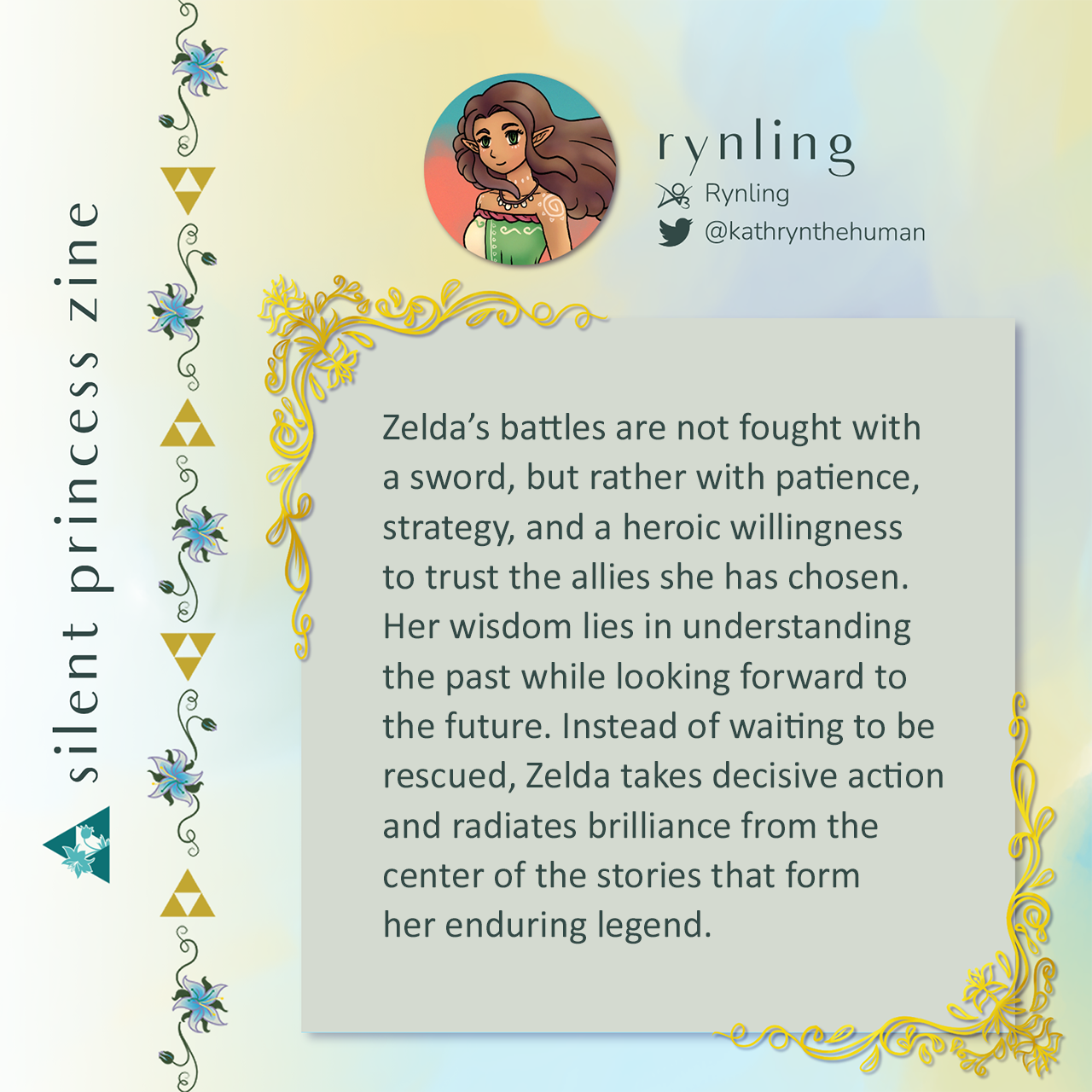
The Wisdom of the Waiting Princess

The Wisdom of the Waiting Princess is an empowering feminist reading of how the trope of the “captive princess” applies to the Zelda of the original 1986 game. While this Zelda is an action hero in her own right, her wisdom manifests in her remarkable ability to lay plans for the future.

You can read the essay on AO3 here:
https://archiveofourown.org/works/67410167

I had the honor of contributing this essay to Silent Princess: A Zelda Zine. The zine’s website is on Carrd (here), and you can check out the art and writing featured in the zine on its Tumblr site (here). Leftover sales of the zine merch are currently open (here), and you can still pick up a digital copy of the zine (here). All profits from zine sales will go to support Doctors Without Borders.

This original design for Princess Zelda was created by Hollarity, who put an incredible amount of love and care into portraying the character as a courageous young woman who is fully capable of going on her own adventures. You can find more of Holly’s gorgeous artwork on her website (here).

The Sleeping Princess

There is a legend in Hyrule that a sleeping princess lies behind the door of a locked room deep under the ruins of the North Castle. When the princess rises, so too will the ancient powers sealed within her dreams. Impa knows the legend is true, and she fears the fate that will befall the kingdom should the first Zelda wake. Yet when a shadow rises on the borders of Hyrule after the birth of a new princess, Impa must make a terrible choice.

I had the honor of contributing a story called “The Sleeping Princess” to Blood Moon Rising: A Zelda Horror Zine. I was interested in exploring the background of Princess Zelda in the original 1986 game, and I thought it might be fun to see her story through the eyes of Impa, who knew about the undead princess who was the first of Zelda’s line. In other words, I’m connecting some of the more disturbing threads between The Legend of Zelda and Zelda II: The Adventure of Link.

“The Sleeping Princess” is a story about maternal love, political sacrifice, and the dark secrets hidden within the labyrinthine dungeons of Hyrule. I was strongly inspired by H.P. Lovecraft’s novel At the Mountains of Madness, which dwells in the geometric terror of monumental architecture built by strange hands, and I did my best to create a sense of ruined grandeur similar to that of Dark Souls and Ico: Castle in the Mist.

For the story’s illustrations, I had the incredible pleasure of working with the devilishly talented Pumpkinsouppe, whose dark arts brought this ruined world to life.

You can find “The Sleeping Princess” on AO3 here:
https://archiveofourown.org/works/62492182

Leftover sales of the zine are open until February 24 on BigCartel (here).

Silent Princess Zine Preorders Open

I’m proud to have contributed a nonfiction meta essay to Silent Princess, a fanzine celebrating Princess Zelda.

My essay, “The Wisdom of the Waiting Princess,” offers an empowering feminist reading of how the trope of the “captive princess” applies to the Zelda of the original 1986 game. My goal is to demonstrate that, while this Zelda is an action hero in her own right, her wisdom lies in patience, strategy, and the careful coordination of allies.

Silent Princess contains a sparkling treasure trove of essays, stories, comics, and illustrations, and I can’t wait for everyone to see the amazing work the team has created.

Preorders for the fanzine are open until January 6 on Bigcartel here:
🌟 https://silentprincesszine.bigcartel.com/

Necromancer Zelda

Echoes of Wisdom is growing on me, and I especially love how Zelda fights by rapid-summoning monsters to overwhelm her enemies. I suppose Zelda is technically creating “echoes” instead of resurrecting her defeated foes, but she still reminds me of the Tears of the Kingdom trailer in which Ganondorf triggers the Blood Moon, summons a bunch of monsters, and tells them to “sweep over Hyrule.” Necromancy seems like a very fun gig if you can get it.

This comic was drawn by the horrifically talented Frankiesbugs, whose cute and creepy illustrations and comics can be found on Tumblr (here), on Instagram (here), on Cara (here), and on Redbubble (here).

When the Moon Didn’t Fall

All the clocks in Clock Town have stopped working, and letters have stopped arriving from the Gerudo in the Great Bay. Both the clock master’s daughter and the swamp witches’ son sense that something is amiss. Slowly they come to understand one another while their world gradually winds itself apart.

When the Moon Didn’t Fall is a short novella that imagines what Zelda and Ganon would look like in the world of Majora’s Mask. According to the Legend of Zelda Encyclopedia, Termina only exists as a dream inside Link’s mind, and it’s interesting to analyze how the events and characters of Majora’s Mask reflect the trauma that Link experienced in Ocarina of Time. I therefore wanted to use Termina as a stage to explore the trauma of Zelda and Ganon, specifically within the context of a dream that’s rapidly fading.

I think it’s fair to admit that I was strongly inspired by Stephen King’s 1990 novella “The Langoliers,” which is a disturbing bit of speculation concerning what happens to the world of the past after the present has already moved on. I tried to capture a similar sense of time (literally) running out, a theme that felt appropriate to the anxiety-inducing atmosphere of Majora’s Mask. Like “The Langoliers,” When the Moon Didn’t Fall has elements of uncanniness and horror, but it’s also about forgiveness, healing, and hope for the future.

I originally wrote this story back in 2018, but it still holds a special place in my heart. I completed a substantial set of edits so that I could include one of the early chapters in my portfolio of writing samples for The Whispers of Hyrule, an upcoming Legend of Zelda fanzine celebrating Hyrule’s forests. I love the swamp forest bordering the open plains of Majora’s Mask, and I enjoyed revisiting the strange green spaces of Termina through this fic.  

You can read the full story on AO3 here:
https://archiveofourown.org/works/14093202/

The story illustration was created by the dangerously talented Thali, whose cool and creepy video game art can be found on Twitter (here), on Instagram (here), and on Tumblr (here).

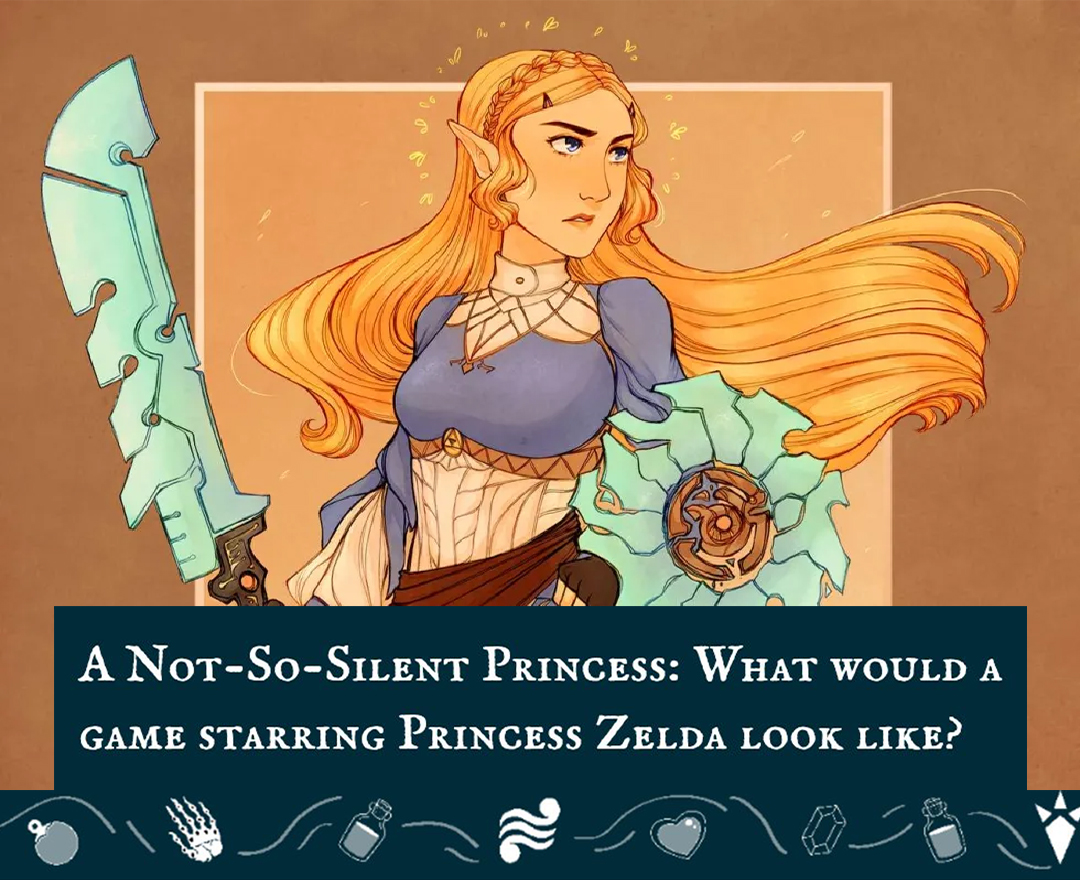
A Zelda Game Starring Princess Zelda

When the first trailer for Tears of the Kingdom was posted in June 2019, fans were excited about Princess Zelda’s new cropped haircut. Perhaps this meant she would be a playable character, people speculated, as it meant that no weapons or armor would have to clip through her hair. In November 2020, Zelda was indeed one of the main playable characters in Age of Calamity. Although it’s great fun to use Zelda’s magical light blasts to part seas of swarming enemies, it was also somewhat disappointing that the gameplay of Age of Calamity positioned Zelda as just another fighter, while Zelda was largely absent from the gameplay of Tears of the Kingdom.

No one can deny that Zelda is an important character in the games that bear her name, but it’s a shame to see her sidelined. My frustration with Tears of the Kingdom made me wonder what the gameplay of a title that focused on Princess Zelda might look like…

I recently had the opportunity to write a short essay for the Zelda Creators community blog based on this month’s creative prompt, “How would you design a Legend of Zelda game?” I’ve been thinking about what Princess Zelda might look like as a video game protagonist for years, and it was a lot of fun to share my ideas. I included some illustrations that I’ve commissioned over the years that envision Princess Zelda as a playable character, and the art used for the preview graphic is by the wise and powerful Benvey0 on Tumblr.

If you’d like to read the full essay, you can find it here:
https://www.zeldacreators.com/blog/a-not-so-silent-princess

A Record of the Calamity

This collection of meta essays explores the worldbuilding and cultural background of Hyrule and its inhabitants during the timeline of Breath of the Wild and Tears of the Kingdom.

Ninja Lore in Breath of the Wild
On the historical precedents of the Sheikah, the origins of the names “Yiga” and “Kohga,” and how the culture of historical ninja is referenced in the story and setting of Breath of the Wild.

Governance in Hyrule
On the nature and questionable necessity of the Hyrulean monarchy in comparison with other systems of governance in Hyrule.

Zelda and the Calamity
On how Zelda’s repressed emotions may have surfaced in a tragic explosion of chaotic power.

Ganondorf as an Agent of Change
On Ganondorf’s role as the villain of a heroic fantasy, the existential challenge he poses to Hyrule, and the necessity of disruption to an otherwise closed system.

Ganondorf’s Design in Tears of the Kingdom
On the Japanese cultural references incorporated into Ganondorf’s visual design.

The Two Kings in Tears of the Kingdom
On the fantasies of Japanese cultural identity represented by Rauru and Ganondorf, and why the power structures associated with the two kings are disavowed by Zelda.

The Memory of Stone

I wrote “The Memory of Stone” back in 2020, when the announcement of a sequel to Breath of the Wild encouraged many Legend of Zelda fans to speculate that the game would feature Princess Zelda as a playable character. I returned to this story after finishing my second playthrough of Tears of the Kingdom, which reduces Zelda to a voiceless source of crafting materials. It was a disappointment, to say the least.

One might argue that there are other games with female protagonists, so why insist on playing as Zelda? I would counter this argument with another question: why not play as Zelda? The concept of Zelda as a playable character makes perfect sense within the context of the games’ stories. Link’s journey almost always runs parallel to a journey that Zelda undertakes on her own, after all, and being able to explore Hyrule with a different set of skills (and from a different narrative perspective) would be a lot of fun.

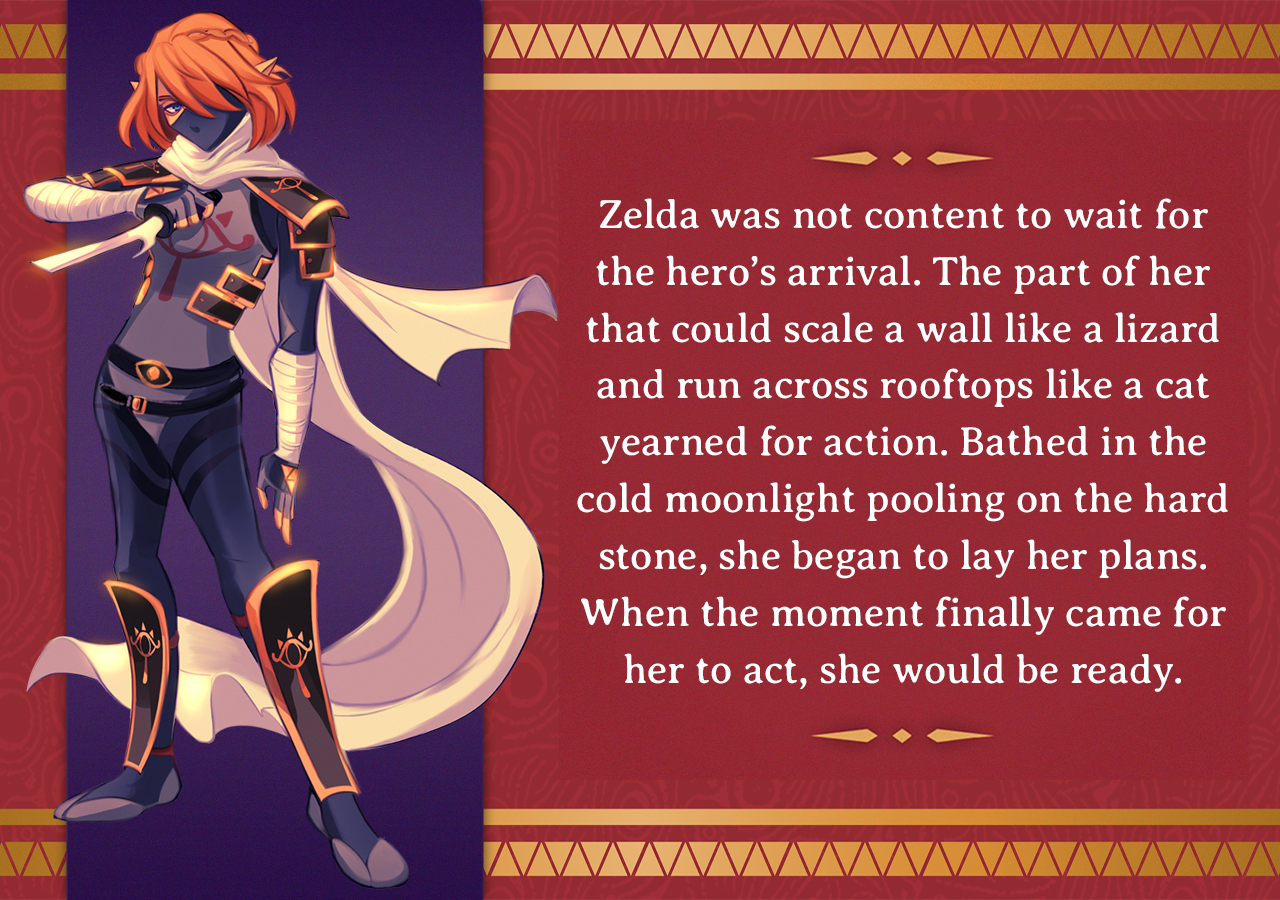
“The Memory of Stone” follows Zelda through each of the temples in Ocarina of Time, and it’s a small attempt to imagine what the eponymous “legend of Zelda” might look like through the eyes of Zelda herself.

You can read the story on AO3 here:
https://archiveofourown.org/works/25230271

The illustration of Sheik included in the story preview graphic was drawn by the revolutionary Nolvini, a fan of shōjo anime who creates magical character illustrations filled with personality and flare. You can check out her work on Twitter (here), on Instagram (here), and on Tumblr (here), and she also has a shop on Etsy (here).

Divine Beast

Zelda returns to her original form after the defeat of the Demon King. But, after so many years, is the being that comes back to Link entirely human? Zelda has appetites better suited to claws and fangs, but Link resolves to care for her, no matter the cost. This is a story about Zelda attacking and eating frogs, and cuccos, and horses… and possibly something with even sweeter flesh.

I’ve been enjoying Tears of the Kingdom, but I’m frustrated by its story. I love all the characters, and I think the game’s broad narrative arc is an interesting reimagining of Ocarina of Time. Still, there are many elements of Tears of the Kingdom that I find unsatisfying, especially its ending. I understand the plot mechanics of what happens, which are nicely explained in (this post) on Tumblr, but Zelda’s complete reversion to her human form doesn’t sit easy in my mind. Is it really possible for a transformation of such magnitude to have no lasting effects? Did the sacrifice Zelda made really have such little weight?

Tears of the Kingdom fails to attach meaning to its worldbuilding in a way that very few Legend of Zelda games have in the past. It’s understandable to dismiss these games as childish heroic fantasies. Still, at some point, the true darkness of each game’s story expresses itself. The player may have seen the plot through the limited viewpoint of Link, the teenage “chosen one,” but the crumbling kingdom of Hyrule looks substantially different through the eyes of other characters. Link will emerge triumphant and ride off into the sunset, but everyone else has to live in the ruins, and it’s only very late in his quest that Link realizes this. With this realization, the player can begin to put together the missing pieces of a much larger story.

Despite having an incredible potential to expand on the many mysteries of Hyrule, Tears of the Kingdom does its best to simplify its story to a single one-dimensional layer: Ganon is bad. By defeating Ganon, Link gets rid of everything that’s wrong with the world, meaning that everything in Hyrule is now good again. This is all that matters. What happened in Breath of the Wild doesn’t matter. What happened in the ancient era doesn’t matter. What happened to the Zonai doesn’t matter. None of Hyrule’s past matters, nor does its future. In the endless present of the game, Zelda only exists as a vessel for “good,” and the only important thing is that Link saves her.

As much as I love Zelda, I resent that she only exists as a plot device and a reward for the player. While superficially turning Zelda into a superhero, Tears of the Kingdom robs her of agency. I generally like happy endings, but I hate the conclusion of Tears of the Kingdom. Simply put: it’s happy, but it’s boring. What I therefore wanted to do with “Divine Beast” was to make Zelda’s decision more interesting by ensuring that it has consequences. I also wanted to give the worldbuilding of Tears of the Kingdom a bit of the weight and depth it deserves.

And, more than anything, I want Link and Zelda to be free.

“Divine Beast” is complete at 2,000 words, and you can read it on AO3 here:
https://archiveofourown.org/works/49296496

I drew the illustration myself. You can follow my art on Tumblr (here) or on Instagram (here).
The Ritual of Lomei Labyrinth

A vast labyrinth stretches under the ancient kingdom of Lomei. It is said that this labyrinth serves as the prison for a terrible monster known only as the Calamity. Every seventeen years, a sacrifice is performed in order to appease the monster. As the day of the ritual draws near, a young soldier named Link volunteers himself as the sacrifice, secretly hoping that he will be the one to put an end to the Calamity. It is tradition for the princess of Lomei to lead the sacrifice underground, a ritual for which Zelda has trained her entire life. Inspired by Link’s courage, she dares to reveal a hidden secret of the labyrinth that may save them both – as well as the monster trapped within a maze of deceit.

Since I started writing original horror stories in 2018, I’ve become increasingly fascinated with the Greek myth of Ariadne and the Minotaur. I consider this to be one of the earliest prototypes of gothic fiction, which explores the topos of a young woman navigating a large house that holds a terrible secret.

Earlier this year, I returned to one of my favorite gothic labyrinth stories, Ursula Le Guin’s The Tombs of Atuan. I love the idea of a bratty teenage girl being the priestess of horrific elder gods trapped in an underground maze, and reading The Tombs of Atuan while waiting for the release of Tears of the Kingdom made me think about the Lomei Labyrinths in Breath of the Wild, as well as the mysterious Zonai civilization that created them. Before I could stop myself, I ended up writing a three-chapter short story that casts Zelda in the role of Ariadne. I think Calamity Ganon makes a suitably creepy Minotaur, but hopefully Link is a much more sympathetic character than Theseus!

The story is complete at 5,400 words, and you can find it on AO3 here:
https://archiveofourown.org/works/44979319/chapters/113177725

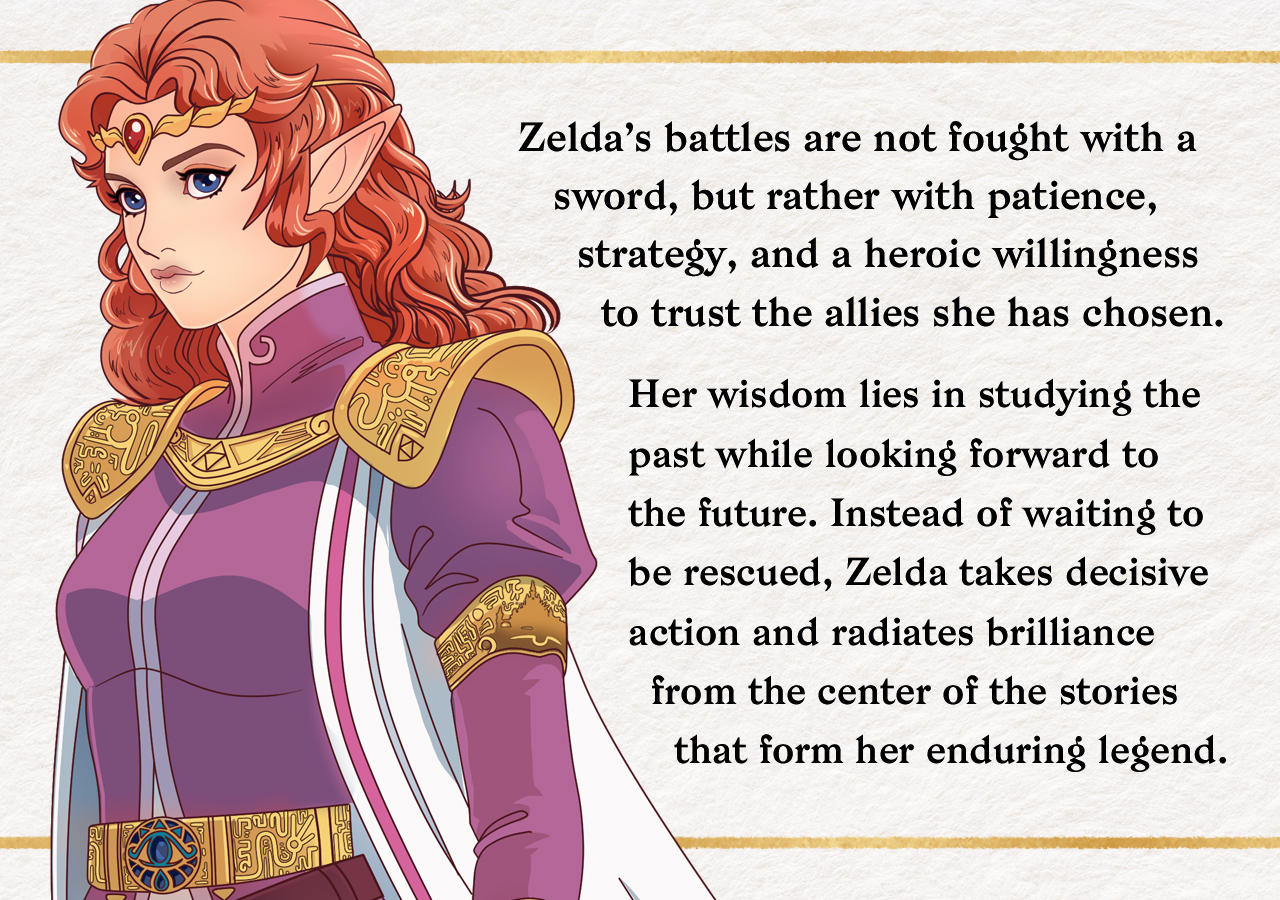
I had a great time working with one of my favorite character artists, Benveydraws, to create a portrait of Princess Zelda. Benvey replaced Zelda’s characteristic feather motifs with the earthier imagery of golden leaves, and he worked closely with references of Greek statues to give the character a suitable Classical Mythology vibe. Benvey specializes in designing bold and beautiful female characters, and you can find more of his work on Tumblr (here) and on Twitter (here).