My annual roundup of free-to-play retro horror games on Itch.io is now on Sidequest. There’s a gritty mix of fresh blood and decayed favorites in this year’s creepypixel harvest, from the recent haunted forest simulator Bloodbark to the Tumblr-favorite Flesh, Blood, & Concrete to the first game created by Deltarune artist Temmie Chang, Escaped Chasm.
And there’s also my lists from October 2024 and October 2023, which are somehow even more liminal and retro.
I’m overjoyed to have commissioned a banner illustration from the shining Teller-of-Tragedies, who shares gorgeous and immersive dreamcore pixel art on Tumblr (here) and on Instagram (here).
Symbiosis is a free-to-play RPG Maker horror game about a murderous mad scientist living in a house in the woods with an adorable child. The story has two endings, and it takes about 25 minutes to play through the game once.
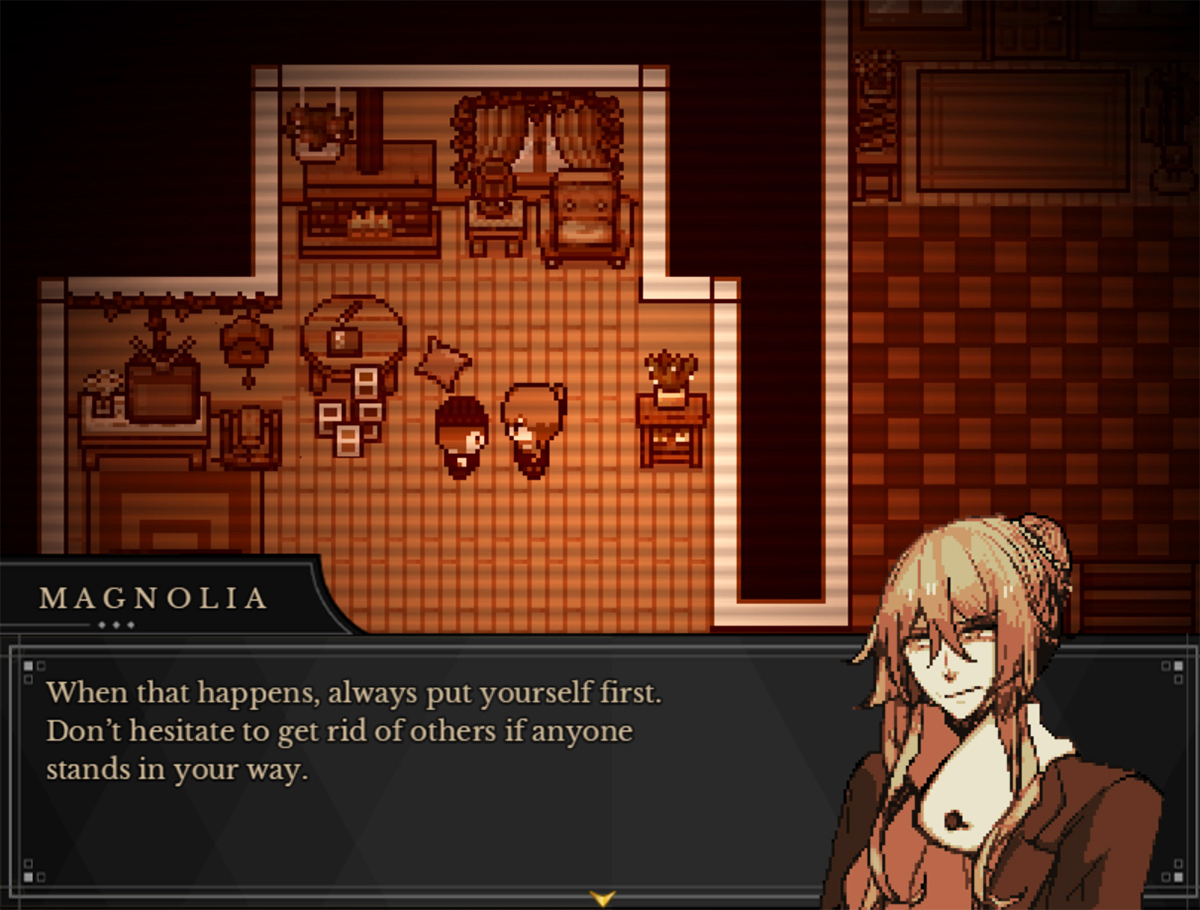
You play as Magnolia, a geneticist who left her university post after a mysterious fire broke out in her lab when her research came under public scrutiny. She now lives in isolation with Mint, a curious and precociously intelligent young boy whom she’s raising as her son. According to local rumors, Magnolia is a witch. It doesn’t help that hikers have a tendency to disappear in the forest surrounding her property.
The game begins as Magnolia carves up the corpse of someone she caught sneaking into her house. She’s interrupted by Mint, who can’t sleep and wants a bedtime story. Unfortunately, there are three more intruders in the house, and Mint won’t stay in his room. Your job as the player is to turn the remaining intruders into corpses – for science! – while ensuring that Mint remains out of harm’s way.
Magnolia’s house isn’t too terribly large, but it’s big enough to have all sorts of nooks and crannies to poke around, as well as various journals and research notes to find. The player can use these clues to figure out who Magnolia is and where Mint came from, although you’ll have to make your own decision regarding Magnolia’s feelings toward Mint and what the fate of the pair will be. The game’s creator has posted a guide for the two endings (here), and this short devlog also contains their thoughts on the story and characters.
What sets Symbiosis apart from the crowd of RPG Maker horror games is the creator’s gleeful willingness to allow Magnolia to be messy and problematic. She initially seems to be a complete sociopath, and her bad behavior is a joy to watch. As you witness her interactions with Mint unfold, however, her character becomes more complicated. Why Magnolia feels affection for Mint is open to interpretation, but I think it’s fair to say that her attachment is genuine.
The way I interpret this relationship is that it’s an analogy for the process of artistic creation (or scientific discovery, as the case may be). In order to create something meaningful, an artist has to be unpleasant, selfish, and more than a little antisocial. Gradually the art comes to take on a life of its own, and it’s up to the artist to decide whether to let it go or to keep it firmly in the orbit of their own dysfunctional personality.
Lest you think I’m spoiling the story, fear not – there’s all sorts of nasty business in Magnolia’s past for the player to discover. This woman is a legitimately horrible person, and her crimes are fantastic fun.
Symbiosis tells a short but grisly story through simple narrative adventure gameplay intercut with stylishly illustrated cutscenes, and I enjoyed it enough to go back and see both endings. I definitely recommend this game to fans of gothic horror, demonic women, and questionable scientific ethics.
Blackout is a Halloween-themed point-and-click adventure game that you can play in your browser or download for free.
You play as a teenage witch who falls from the roof of a house while trying to snatch a feather from a crow. She loses her memory during her tumble to a second-floor balcony, and she’s surprised to find that the house is filled with corpses. The electricity seems to have been cut, and it’s too dark to see anything clearly. Your job as the player is to guide the witch through the haunted house and get the lights on so she can figure out what happened.
Once the lights are back on, you’re free to explore the house a second time to see what’s actually going on. This is a super fun twist, and it’s what really sells the game for me. The tone completely shifts, and the ending is fantastic. I hope it doesn’t spoil the story to say that it’s just as much comedy as it is horror.
Even though your character is in the dark, the game’s 16-bit pixel art is bright and colorful. Each room of the house is a pleasure to explore. There are enough points of interest to provide flavor, but the graphics are designed to help the important puzzle pieces stand out. The puzzles are mostly self-explanatory – use the footstool to reach the key on the shelf, etc. – but some are silly and surprising. The writing in this game is just as charming as the art, and I really enjoyed the time I spent in this weird little house.
Blackout probably takes twenty minutes to play if you know what you’re doing. Since there’s not much guidance, I got stuck a few times, and it took me about 45 minutes to finish the game. I’m grateful to ( this ) short video walkthrough on YouTube for helping me figure out the endgame puzzle, which is very clever but only makes sense in retrospect once the lights are back on.
There’s a chill in the air as the twilight lingers and the moon glows bright in the autumn sky. What better time to crouch in front of your computer and scare yourself silly? For intrepid digital ghost hunters, Sidequest presents eight eerie games that are free to play on itch.io and short enough to occupy an intermission between deep dives into creepypasta wikis…
I was thrilled to have an opportunity to write another piece for Sidequest showcasing a curated collection of indie horror games. If you’re interested, you can check out the list here:
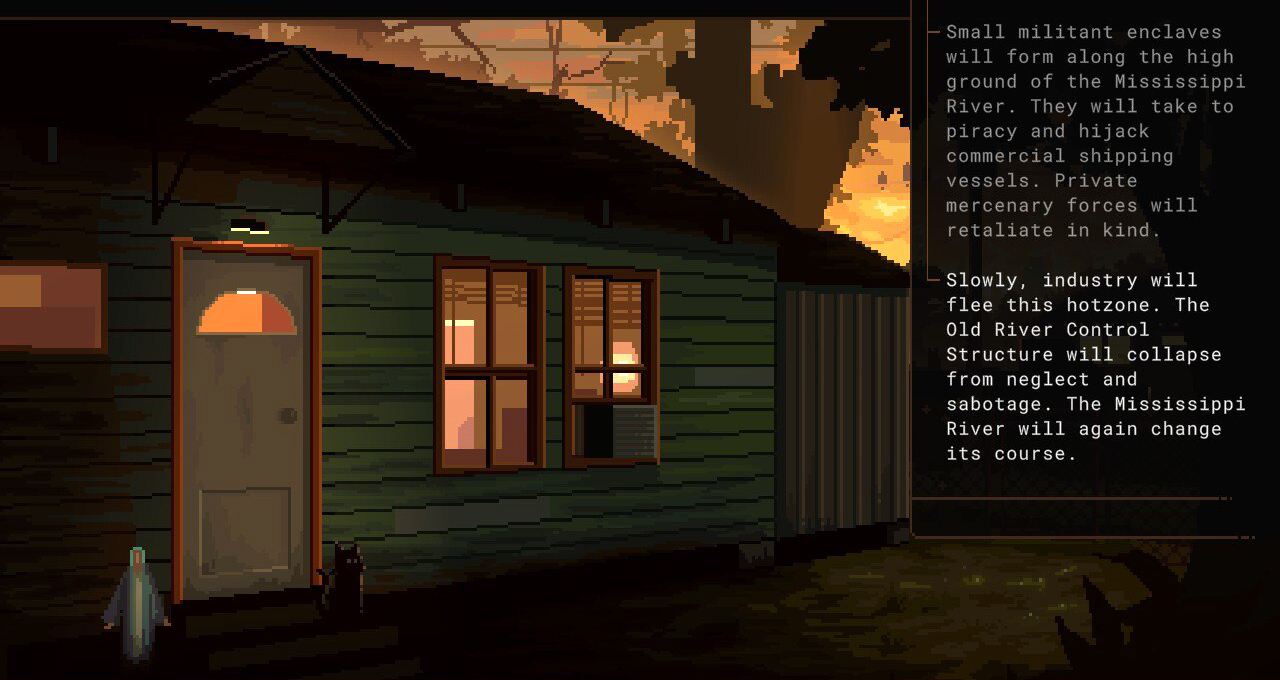
Norco is a cross between a visual novel and a point-and-click adventure game that takes seven hours to play. The game is set in a near-future version of New Orleans and its surrounding bayou. Despite its lowkey cyberpunk elements, the future envisioned by the game isn’t all that different from the present. Norco is gorgeously well-written and intriguingly grounded in the specificity of its setting, and the various small stories it encompasses are filled with fascinating characters and meaningful human drama.
I want to focus on what’s interesting about this game. That being said, Norco can be frustrating, so let me get this out of the way: most of the adventure game elements of Norco are bad. The puzzles (such as they are) are poorly executed and annoying. There’s at least one instance of turn-based combat per act, and it’s not great. Also, the game takes a weird turn toward cosmic horror in the third and final act; and, in order to unlock a slightly more satisfying ending, you have to do a minor random thing in the second act that’s extremely easy to miss.
None of this is a deal breaker. Rather, I think it’s good to set expectations. Specifically, you should expect to use a walkthrough at some point. I actually ended up using three walkthroughs, as I found some of the adventure game sequences to be difficult to piece together. They’re not complicated; they’re just opaque. Thankfully, the more frustrating puzzles are few and far between, and you can play the vast majority of the game just fine on your own.
You begin Norco as a woman named Kay who returns home after her mother dies of cancer and her brother Blake stops replying to texts. Although Blake is nowhere to be found in or around the house, Kay is greeted by the family robot Million, a fugitive from the skirmishes between armed militias that have broken out across the southwest. Million suggests that she and Kay talk to people in the neighborhood to figure out where Blake has run off to.
The search for Blake is interrupted by extended flashback sequences in which you play as Kay’s mother Catherine. While her cancer is in remission, Catherine takes odd jobs on a Fivver-like platform called Superduck in order to pay off loans so her kids can keep the house after she dies. These jobs take Catherine across New Orleans and eventually lead her to an abandoned mall colonized by the teenage disciples of an internet demagogue by the name of Kenner John.
We’re introduced to Catherine as she allows a blandly anonymous tech corporation to make a neural map of her brain. In theory, the experimental procedure is compensated by the generation of an AI personality intended to help Catherine’s family process her death. In reality, Catherine needs the money. Immediately after her brain imaging session, she’s out in the city after dark running errands via the Superduck app.
Oddly enough, Superduck ends up being a real “person,” a branch of an AI personality based on Catherine’s friend Duck. Based on a story Catherine once told Duck, Superduck has figured out that an alien entity resides in the estuary of Lake Pontchartrain, and that it was captured by Kenner John.
Although the cyberpunk elements of Norco’s plot are fun, they’re not the real story. As Catherine, you play as a tired and washed-up adult using a rideshare service to get around town while trying to gather information from other tired adults who are just trying to make a living. It’s through these conversations that the player gets a sense of what New Orleans is like as a city, as well as a sense of how not even wealthy people who seem to be major players have any control over the environment. There are going to be hurricanes, and there are going to be floods, and neither oil companies nor tech companies can do anything about it.
What I appreciate about Norco is how realistic and grounded it is. As someone dealing with cancer, Catherine gets winded climbing stairs during one of the adventure game segments, and she’s okay with telling people that no, actually, she’s not fine and she needs a minute. Kenner John’s cultists are dumb kids (affectionate) who just want to hang out in an abandoned mall and smoke weed while playing video games. Even the MAGA-style militia members who make a brief appearance in the last act are heroic in their own deranged way, and the poor harassed public official who stays late in City Hall dealing with paperwork delivers a monologue about how you can’t save everyone that’s worthy of Shakespeare.
Despite the gritty setting of a city on its last legs and Norco’s complete lack of sentimentality, all of the characters are intensely human and sympathetic. They’re also quite funny, even when they’re at their lowest and most morally dubious. There’s one story about a guy who eats a hotdog from a food cart in a downtown tourist area that made me laugh so hard I cried. Norco tackles challenging themes, but it also manages to be pitch-perfect comedy storytelling. I really can’t overemphasize how brilliant the writing is.
Also, this is worth saying: As someone who grew up in the Deep South, I’m truly and deeply grateful that the script of this game uses an accurate representation of Southern AAVE. My promise to myself about Norco was that I would put the game down and walk away the second anyone said “y’all” or pulled some sort of X-Men Gambit bullshit, but I didn’t need to worry. Everyone talks like a normal person.
The basic gameplay of Norco consists of conversation-based fetch quests. Someone will tell you to talk to someone else, and you have to go find them. You do this by driving (or ordering an off-brand Uber) to take you to a point on a map of New Orleans, and from there you’ll navigate between four or five screens by clicking on various points of interest. Your objective is always clear, but there’s a lot of non-essential content to interact with. And it’s good to talk with everyone! What you’ll get as a reward for being curious is some of the best stand-up comedy you’ll ever read.
The adventure game puzzles are so deeply embedded in the action of the story that they’re difficult to describe without extensive plot summary. What makes the worst of them annoying is that they expect you to leave the game and write something down in real life. One of the more obnoxious of these puzzles involves numerology. I understand that this is a play on the weird Christian-themed numerology cults that have sprung up on YouTube and Facebook – one of my aunts got really into this during the pandemic, true story, and it’s batshit insane – but it’s still a pain to put down the game and go get a piece of paper.
One of the interactive elements of the game that actually works well occupies a large portion of the third act. The Surprise Big Bad antagonist has gotten an offshoot of the Kenner John cult to build a spaceship on the bayou, and Kay needs to go out and find the site by navigating through the swamp in a small boat on a 4-bit pixelated sonar screen. There are all sorts of fun things to find out on the water, and this segment is enhanced by an atmospheric lead-up that includes an interesting lesson in natural history concerning why the topography of the bayou is so treacherous even though it looks like open water.
At the conclusion of the end credits, Norco provides a list of books and documentaries that the developers used as references. I was so drawn into the real-world history presented by Norco that I immediately screencapped this list. I got started on following up with these references by watching a documentary called Mossville: When the Great Trees Fall, and it’s almost painfully apparent that the creators of Norco were pulling inspiration from serious ongoing issues. It’s amazing that they were able to take such heavy material and transform it into something so gorgeously strange and entertaining.
Although Norco isn’t as mechanically robust as Disco Elysium, it’s easily in the same category of excellent writing and unique visual stylization. I somehow got the impression that this game would be all doom and gloom about poverty and injustice, but it’s actually a genuinely funny dark comedy about a cast of characters whom I grew to love despite (and often because of) their flaws and bad behavior.
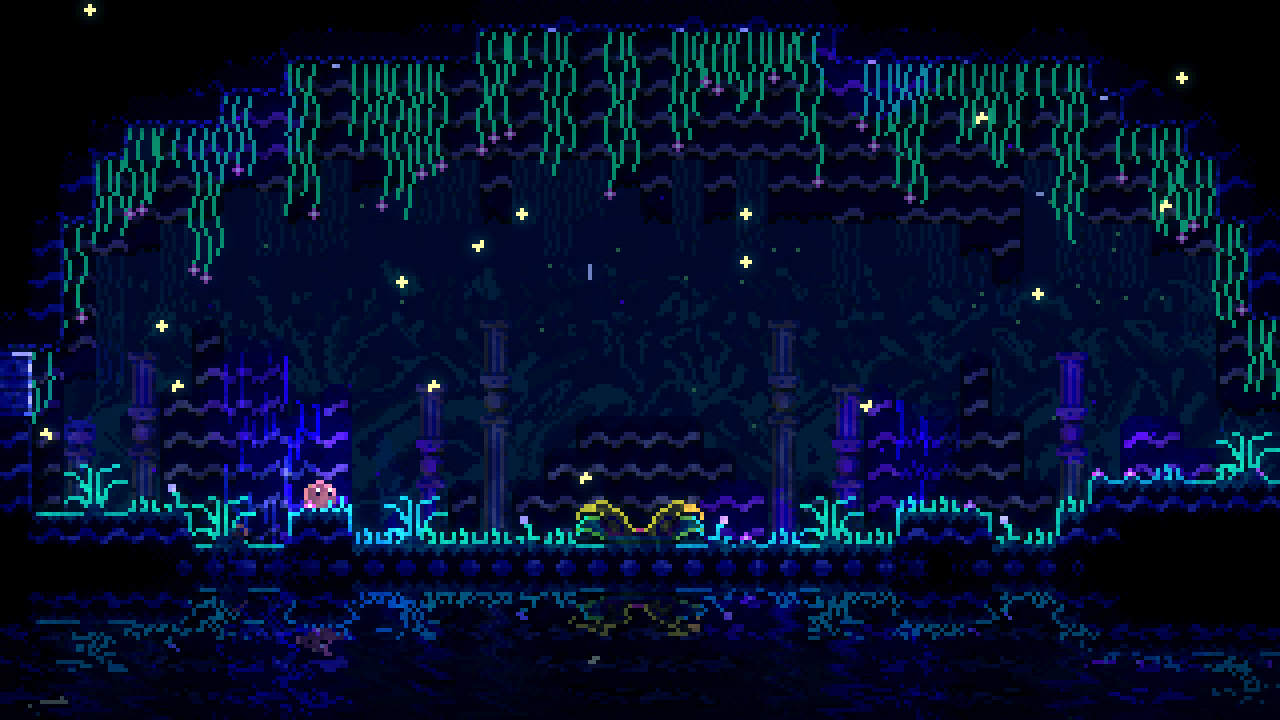
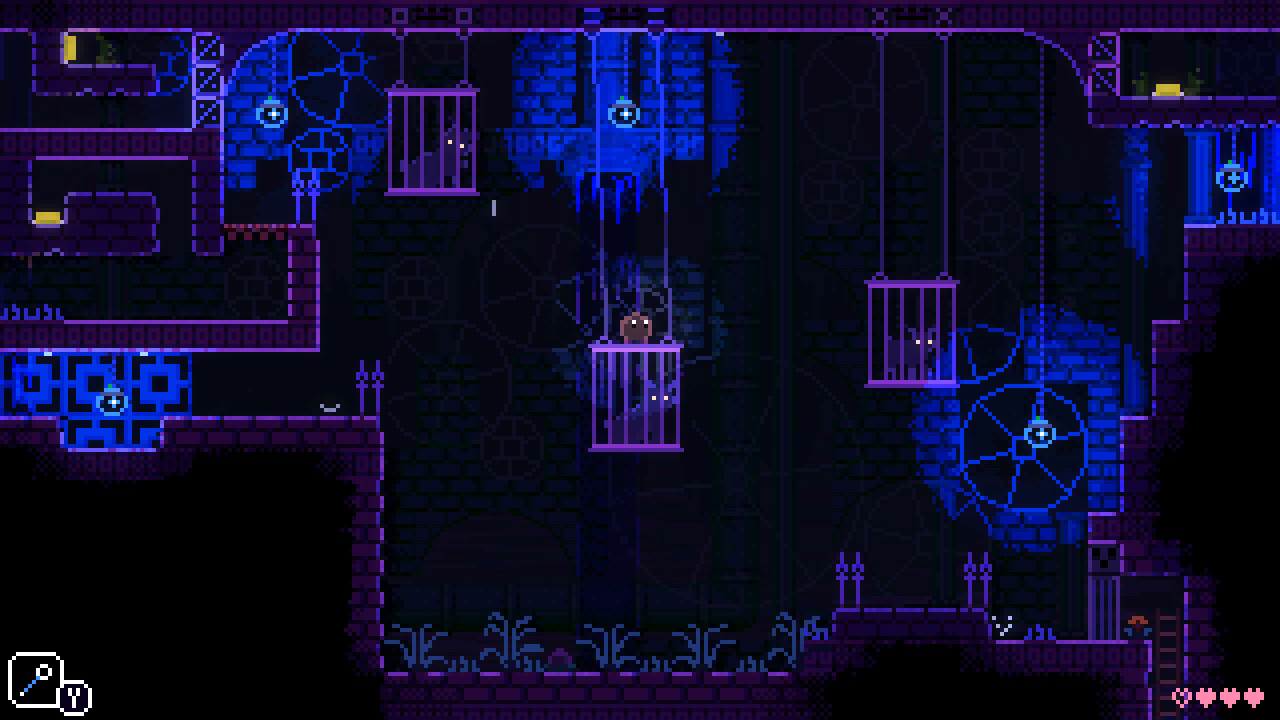
Animal Well is a no-combat puzzle platformer with an open-world Metroidvania structure. You play as a small seed navigating a mossy system of underground tunnels. The game has no dialogue or diegetic text, nor does it need any. Your job is simply to explore.
Because this is a video game, however, the player needs objectives. Early on in the game, the little seed arrives in what appears to be a central hub with statues of four animals. Each animal’s flame is sealed in a themed quadrant of the map. Although your map is mostly blank at the beginning, the location of each flame is marked, giving you four goals to work toward. Navigation is anything but simple, however, and figuring out where you’re supposed to go is just as much of a puzzle as any of the one-room set pieces.
Since Animal Well gives you so many paths to choose from, the beginning can be confusing. In many ways, this game reminds me of Hollow Knight and Hyper Light Drifter, which are similarly cagey about where the critical path might lie. Thankfully, there’s no wrong way to play Animal Well, so you’ll be fine if you simply choose a direction and start walking. Once you make your way into a level proper, the path forward becomes much easier to follow.
As you might guess from the title, the vast underground well that serves as the setting of the game is filled with animals that theme the puzzles. In the dog level, for example, you’ll need to find a frisbee that you can throw to distract the dogs that chase after you. In the seahorse level, fish blow bubbles into the air that you can use to reach higher platforms. In the chameleon level, you’ll need to adjust the path of wall-climbing hedgehogs so that they hit otherwise inaccessible switches.
Animal Well offers the player a beautiful and evocative environment to get lost in, and it’s nice to see such a well-designed game that focuses on exploration instead of combat. Most of the platforming puzzles are relatively easy but still very clever, which I appreciate. The pixel art is gorgeous and atmospheric, and each area manages to express its theme while still maintaining a unified aesthetic that ties the various ecosystems together. There’s not much music, but the sound design is fantastic.
If I have one complaint about Animal Well, it’s that the map is riddled with secret passageways that are completely unmarked. In addition, you can only make it so far into each level without the aid of a tool from another level. In theory, this means that there are eight levels instead of four. In practice, it can be frustrating not to know whether you can’t proceed because you need a tool from a different level or whether you simply missed a hidden path. Unless you happen to be either very good (or very patient) with this sort of thing, I’d strongly recommend playing Animal Well with a walkthrough.
It’s impossible to say how long Animal Well takes to play. According to reviews, it has the potential to be a five-hour game, but I get the feeling that the majority of players aren’t going to have such a smooth experience. If I had to guess, I’d say that most first-time players should expect to spend at least six or seven hours getting to the end. After that, there’s potentially another ten hours of exploration enabled by the tools you find at the end of the final area.
Is the cleverness and charm of Animal Well worth the aggravation of getting lost and not knowing what you’re supposed to do? That depends on the player, of course, and it’s worth saying that this isn’t a casual game. Still, although I wish Animal Well were less opaque, I appreciate that it’s not actually difficult. Exploration is always rewarded, and I never stopped being surprised and amazed by each new bit of the game I managed to find. Every single screen in Animal Well is a work of art.
After finishing Animal Well, I read the TV Tropes page to see if there’s an actual story to the game. Perhaps you can unlock a different ending if you can manage to find all the collectables? From what I can tell, there’s no real story no matter what you do, but there are collectables underneath collectables underneath collectables. There’s also an ARG. None of that is any of my business, but it’s cool I guess. I always appreciate when the people who created a game were living their best lives, and I’m happy to have an excuse to spend more time poking around the beautiful mossy tunnels of Animal Well.
Ocean’s Heart is a top-down 16-bit adventure game in the style of A Link to the Past or The Minish Cap. You play as Tilia, the daughter of a former soldier who manages a tavern on a small island. After the island is attacked by pirates, Tilia’s father sails away to chase them down. He doesn’t return, so Tilia leaves the village to look for him.
Ocean’s Heart is set on an archipelago of interconnected islands. Most of the map can be navigated on foot, while sailing serves as a form of fast travel. The archipelago is densely populated, with multiple large cities and smaller towns, but it’s also filled with beautiful green spaces. The primary biome of the islands is “forest,” but there’s an incredible amount of diversity within this biome, from alpine pine forests to leafy old-growth oak forests to swampy mangrove forests.
The green spaces of Ocean’s Heart are gorgeous, and the pixel art is a true feast for the eyes.
When I was a kid, I remember being disappointed by the 3D graphics of the N64 and the PlayStation. Now I find the visual style of games like Ocarina of Time and Final Fantasy VII to be charming, but for a long time (until there were better alternatives) I thought the blocky polygons and difficult-to-read environments of “next gen” games looked like garbage. I kept thinking that what I really wanted was for developers to use next-gen technology to make pixel art more polished, intricate, and interactive.
Ocean’s Heart is exactly the sort of game I wanted. Flowers and grass rustle in the wind, falling leaves drift across the screen, and birds take flight as you approach. The overworld map is dense with interaction points, all of which are visually signaled without being obtrusive. The landscape is also dense with scenery that does nothing but add magic and wonder to the environment. Towns and cities are filled with uniquely designed stores and characters, and each center of population has its own distinct visual character.
Even aside from the graphics, Ocean’s Heart is a lovely game. Although it doesn’t disrupt the basic Legend of Zelda gameplay formula, the way Ocean’s Heart structures and populates its world is extremely well executed. Unlike many Zelda-style games, Ocean’s Heart features an excellent balance between gameplay and written text. The dialog offered by the NPCs is substantial, and the player can interact with all manner of books, bookshelves, maps, paintings, documents lying on desks, and so on. Very little of this text is necessary to understanding the game’s story, but it makes the world feel like a living place that exists independently of Tilia and her quest.
The menu screen of Ocean’s Heart offers modern ease-of-use concessions, from the option to save the game at any time to a labeled map to a list of sidequests. Many titles seeking to capture a retro feel – Tunic springs immediately to mind – seem to expect the player to engage with the game through the medium of an online walkthrough, but Ocean’s Heart is entirely self-contained. The player has a great deal of freedom to move across the archipelago, but it’s difficult to become lost. The confidence derived from such a well-curated experience makes exploration all the more enjoyable.
As in any Zelda-style game, Ocean’s Heart contains about half a dozen mandatory dungeons. These dungeons have no maps, but they’re laid out in a way that feels easy to navigate and speaks to thoughtful game design. Careful exploration of the world will reveal another dozen optional dungeons with more specialized themes. My favorite of these optional “dungeons” was an entire Mediterranean-themed island with its own fully populated town of cafés and street musicians and people sitting on terraces while drinking and enjoying the sea breeze.
Ocean’s Heart comes equipped with an optional hard mode that you can trigger early on and reverse any time you want, but the default level of difficulty is well balanced. You don’t have much health at first, and healing items are extremely limited. More than anything else, this early-game difficulty seems intended to keep players on the critical path. As you power up Tilia and her sword through various collectables scattered throughout the world, exploration becomes more comfortable. Many players may have to resign themselves to dying several times at the beginning of Ocean’s Heart, but the difficulty curve balances out about an hour or two into the game’s playtime, which is roughly eight to ten hours.
I haven’t encountered any discussion of Ocean’s Heart in the Legend of Zelda fan community, so I was surprised to learn that it was originally released in January 2021. I’m amazed that I hadn’t heard of it before I saw it on sale on the Nintendo Switch store, because this game is really good. The gameplay is solid, the writing is fun, and the beautiful pixel art is everything I ever wanted. Ocean’s Heart is also inexpensive and accessible to players of all skill levels, and I’d recommend it to anyone who’s up for a chill and rewarding island adventure.
Opossum Country is a free ten-minute lo-fi horror game about a rural pizza delivery driver who finds himself stranded in an isolated trailer park where something isn’t quite right. If you’re worried that the game is poking fun at the sort of low-income and mentally unbalanced of people who might live in a trailer park, there’s definitely an element of that, but the story goes in a direction that I wasn’t expecting. In the end, the moral of Opossum Country is that you shouldn’t jump to conclusions about a community you don’t understand. I mean, if the game can be said to have a moral. Which it arguably doesn’t. Regardless, the ending is fantastic.
Ben Jelter also made another free ten-minute Game Boy game called The Last Employee, which definitely has a moral: fuck capitalism. This being the case, I’m guessing that Opossum Country was created from a place of deep sympathy for people on the margins of society. This narrative viewpoint is refreshing in its unapologetic portrayal of difference, but Jelter’s sympathy for these characters doesn’t stop the game from being creepy as fuck. The overworld pixel graphics are creative and unsettling, as are the more detailed character portraits.
Opossum Country was made with a program called GB Studio. Not only is it free, but there are also a ton of pay-what-you-want graphics asset packs floating around Itchio, as well as collections of free-to-use chiptunes music that’s compatible with the Game Boy engine. I also found a few pixel art resources for Clip Studio Paint in the form of brushes, templates, and filters. I’m not sure that “just anyone” can make a game as unique and interesting as Opossum Country, but it’s nice to know that there’s nothing stopping you from trying.
Half Part Fate is a visual romance novel by an American developer that follows three couples on their journey to their first date. There’s a long list of possible achievements to unlock, but the story itself is entirely linear. Although the characters are adults, the tone is 100% PG, and everything is very sweet and wholesome.
The game is divided into twelve chapters, each of which takes about ten to fifteen minutes to complete depending on how quickly you read and how much you want to explore. You play each chapter as one of the romantic leads in a top-down environment, each of which functions as a small and self-contained stage reminiscent of the “town” sections of a 16-bit JRPG. Your job is to walk around and talk to people, and the gameplay elements are limited: Person A will give you Object B, but only if you trade it for Object C that you get from Person D. There are (mercifully) no puzzles or reflex-based minigames, making Half Past Fate a chill and relaxing experience.
The environments are a lot of fun. The game is set in a romanticized hybrid of Los Angeles and Austin, and there is no crime, poverty, or infrastructural decay. Everything is clean and neat and aesthetically pleasing, and no one is rude or creepy. You can therefore walk around urban environments like coffee shops, public parks, outdoor shopping arcades, and waterfront bars without worrying that someone is going to report you to the police for striking up conversations with strangers. Half Past Fate reminds me a lot of Earthbound in that it offers the player an opportunity to stroll around a contemporary city and read quirky flavor text while catching small glimpses of people’s lives.
The three love stories are just as cute and charming as the pixel art. One couple has been friends since college but never found the right time to confess their feelings, and now they find themselves realizing how much they mean to each other as their artistic careers have started to take off. One couple meets randomly at a tea-themed street fair and has a lovely afternoon together, but then the boy loses the girl’s phone number and has to track her down. The third couple is entangled in a high-stakes game of money and power and deception, and it admittedly takes a willing suspension of disbelief to fit them into the same world as the other characters, but I still liked their story a lot.
The three main couples are straight, but they’re surrounded by representatives of a rainbow of genders and sexualities. Many of the queer side characters are involved in romantic dramas that you can piece together if you take your time exploring, and queerness is so open and omnipresent that the straightness of the main characters doesn’t feel forced.
In addition, the diversity of the cast is taken entirely for granted, which I appreciate. The racial and ethnic identities of the characters are specific and affect more than their family names and physical appearance, but they’re never the sum total of any character’s personality or backstory. Speaking personally, it’s rare to see multiethnic friend groups represented in popular media in a way that doesn’t involve tokenism, but the characters’ networks of relationships felt very real and natural to me.
I picked up Half Past Fate on Nintendo’s online storefront, and I enjoyed playing it as a handheld portable game on the Switch Lite. I’m not sure if the full $10 list price will be worth the three hours of gameplay for everyone, but it definitely was for me (especially considering that paperback novels cost almost $20 these days). Although I would have preferred a bit more bite and tension in the storytelling, the art and graphics are wonderful, and I’m a big fan of this retro JRPG style of structuring a visual novel. I’ve already downloaded the second game in the series, Half Past Fate: RomanticDistancing, and I’m looking forward to sitting down with it the next time I want to spend a relaxing afternoon in a softer and brighter version of reality.






 Digital Fantasy Diary