Review of Hero Cave on Comics Beat

My review of Hero Cave, a dark fantasy comedy, was recently published on Comics Beat (here). This graphic novella is only about fifty pages long, but it’s surprisingly powerful and cathartic. Here’s an excerpt from my review…

It’s easy to look down on NPCs, the “non-player characters” who seem shallow and uninteresting when compared to the protagonists. It’s not so easy to realize that, in certain aspects of your life, you’re not much better than an NPC yourself. In Player vs. Monster: The Making and Breaking of Video Game Monstrosity, Jaroslav Ŝvelch explains how the construction of monsters in Dungeons & Dragons reflects the concerns of the white-collar managerial class. To the dungeon master, even a creature as miraculous as a walking skeleton is little more than a series of numbers to be entered into a spreadsheet. Given how frequently we’re all reduced to data points — by social media algorithms, by insurance companies, and certainly by employers — perhaps it’s worthwhile to extend a bit of sympathy to a low-level skeleton.

You can read the full review on Comics Beat here:
https://www.comicsbeat.com/graphic-novel-review-hero-cave/

As an aside, Hero Cave features a type of nonbinary representation that I love to see. Waifishly thin models with stylishly androgynous faces are all well and good, but it’s frustrating that only attractive and nonthreatening “childlike” body types are commonly understood as being nonbinary. I believe we should have a bit more range in our representation, while also not limiting ourselves to conventional notions of “humanity.”

Why, for example, does a cartoon skeleton need to fit into a binary notion of gender? Also, if a character is an undead eldritch monstrosity, it’s silly to think that their nonbinary gender identity is the most interesting thing about them. Hero Cave demonstrates a refreshing lack of concern for the gender of its skeleton protagonist, but that doesn’t preclude the possibility of queer sexuality serving as an escape from the restrictive confines of hellworld capitalism. I didn’t want to get into this aspect of the book in my review, but it’s brilliant, and it means a lot of me personally.

A Monstrous Little Mermaid Story

I’m honored to have an essay in one of my favorite online magazines, Cosmic Double. “A Monstrous Little Mermaid Story” is about how I discovered the joy of queer transformations in HP Lovecraft’s “The Shadow over Innsmouth.”

“A Monstrous Little Mermaid Story” is free to read on the Cosmic Double website here:
https://cosmicdouble.com/2023/01/08/a-monstrous-little-mermaid-story/

I originally created this essay as something of a writer’s statement for a short story called “Don’t Eat the Fish.” The story is about the uncanny space at the intersection of queerness, disability, and economic precarity, but I also think it stands on its own as an unsettling work of body horror. I workshopped this story for years as I slowly developed my skills, and I worked hard to polish the narrative voice and sharpen the genre effectiveness while also being as honest as I could about the nuances of my own personal experience.

I generally try to keep overt identity politics out of my writing, which isn’t a value statement as much as it is a personal preference. It’s not as though my stories aren’t informed by my identity or social environment. Rather, both my identity and my environment constantly shift and change, and my stories generally aren’t about myself to begin with. Still, because this particular story was so strongly informed by my positionality, I spent more than a year submitting it a series of literary magazines dedicated to raising the voices of queer, disabled, and economically precarious writers.

Unfortunately, every single magazine I submitted the story to was like, “Oh damn, that’s truly upsetting, and this story is not Positive Queer Representation™ enough.” Usually, when I have a story rejected, I’m lucky enough to get a personal note from an editor along the lines of, “This isn’t a good fit for us right now, but we all enjoyed this piece and would love to see more work from you in the future.” With this story, the response was inevitably: NO.

I therefore wrote this essay as a way of processing what my story and its literary influences meant to me. I’ve long since accepted that the story itself will never be published, but I’m truly grateful to Cosmic Double for being willing to publish an essay that may not be Positive Queer Representation™ but still attempts to represent what I believe is a very real aspect of nonbinary (and trans!) queer identity. That takes courage, and the essays I’ve been reading on the site led me to believe that the editors are open to an earnest investigation of what it means to feel “monstrous.” If you’re interested in well-crafted essays from unexpected points of view, please check them out!

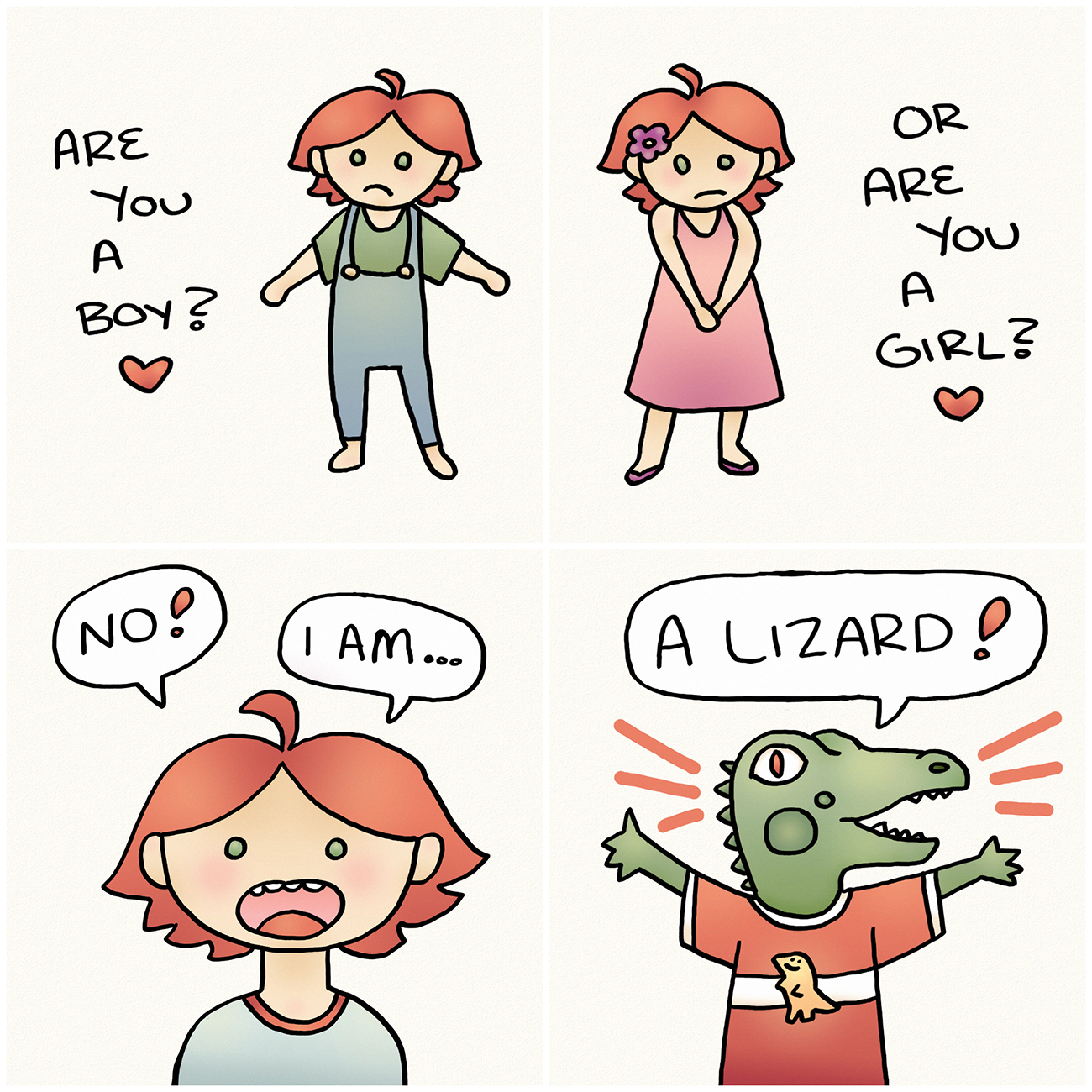
Today’s gender is…

…lizard! 🦎

I used to have a pet iguana, and I never learned whether it was a girl or a boy. It was fascinating to me that this beautiful and handsome creature could exist in the world without a gender and be perfectly fine, and I still think that’s neat. I was a weird kid, but I knew what I was about.

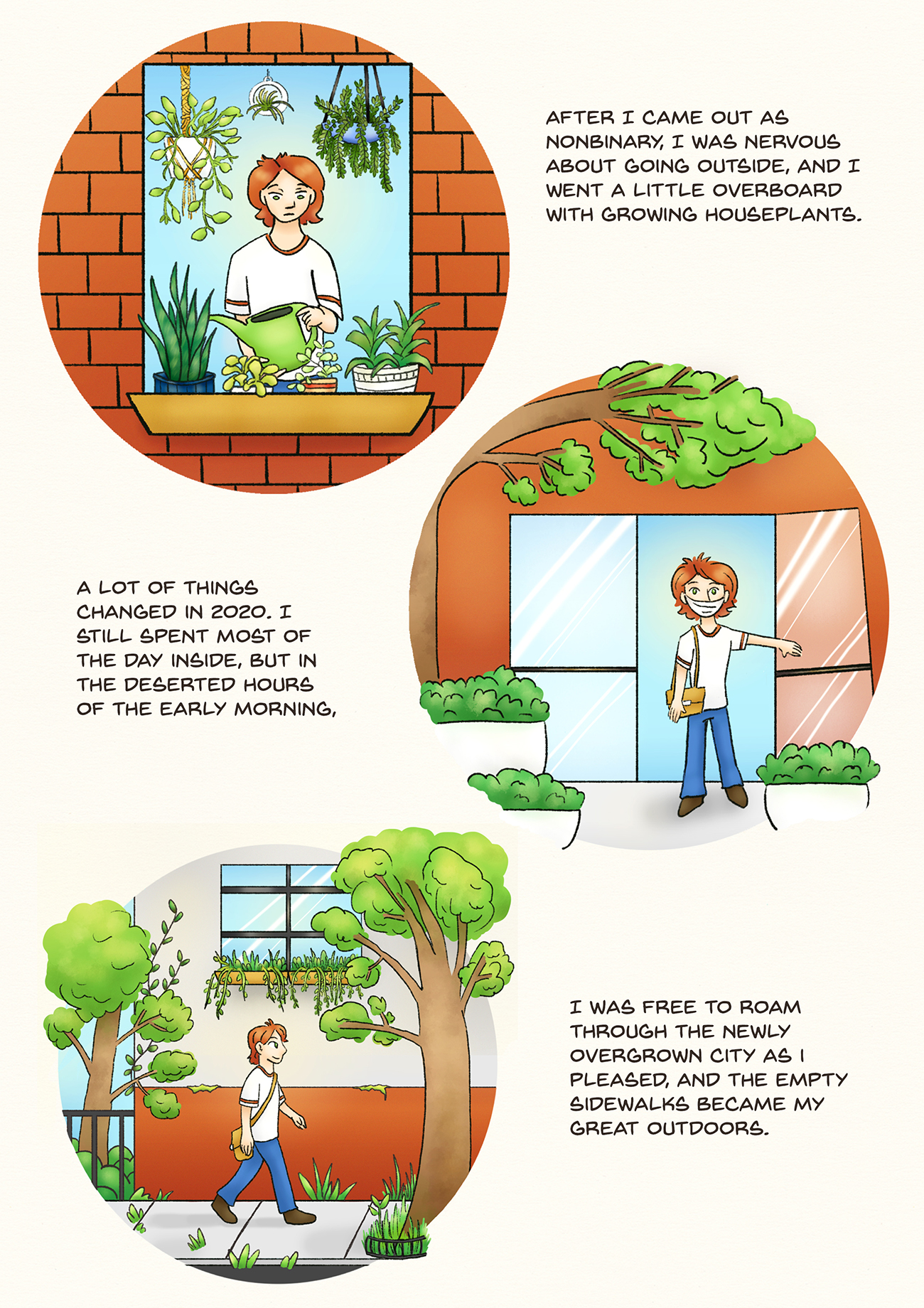
My Great Outdoors

When I moved to West Philadelphia at the beginning of the pandemic, the neighborhood was a mess. The city sanitation workers were on strike (good for them!!), and trash was everywhere. No one had trimmed the vegetation growing along the sidewalks, and there were all sorts of weeds and flowers pushing their way up from underneath the piles of loose rubbish. Most of the university students and faculty had evacuated the city, and no one was walking around outside to begin with, so the crows and opossums had gotten bold. It was quite nice, actually.

I don’t intend to suggest that there was anything “good” about the pandemic, which was and continues to be a nightmare, but I have to admit that it was still a welcome relief to be able to walk around outside while feeling like I was just another part of nature.

. . . . . . . . . . . . . . .

This is a comic I created for the third issue of Nature Held Me Close, a zine about “gender dysphoria and the great outdoors.” Free digital copies of all three issues of the zine are available on its website (here).